check oil AUDI A4 2016 User Guide
[x] Cancel search | Manufacturer: AUDI, Model Year: 2016, Model line: A4, Model: AUDI A4 2016Pages: 278, PDF Size: 70.26 MB
Page 210 of 278
Check ing and F illing
@ For the sake of the environment
- Under no circumstances can the oil come in
contact with the sewage network or the soil.
- Observe and fo llow legal regulations when
disposing of empty oil containers .
Changing the engine oil
We recommend that hove your oil changed by on
authorized Audi dealer or a qualified service sta
tion .
Before you che ck anything in the eng ine compart
ment,
always read and heed all WARNINGS ¢ A
in Working in the engine comportment on
page 203.
The engine oil must be changed according to the i n tervals specified in your Warranty
& Mainte
nance booklet . This is very important because the
lubricat ing propert ies of oil diminish gradually
during normal vehicle use.
Under some circ umstances the eng ine oi l sho uld
be changed more frequently. Change oil more of
ten if yo u drive most ly short distances, operate
the vehicle in dusty areas or under predominantly
stop-and-go traffic cond it ions , or have your vehi
cle where temperatures remain below freezing
for extended periods .
Detergent additives in the oil will make fresh oil
look dark after t he engine has been run ning for a
short t ime . T his is normal and is not a reason to
cha nge the oil mo re often than recommended .
Because of the prob lem of proper disposal, along
with the special tools and necessary expertise re
qu ired, we strongly recommend that you have
your oil c hanged by an aut ho rized
Audi dealer o r
a qualif ied se rvice station .
If you choose to change your o il yourself , please
note the following important informat ion:
A WARNING
To re duce the risk of pe rsonal injury if you
must c hange t he engine oil in your ve hicle
yo urs elf:
- W ear eye protection .
208
-
-To reduce the r is k of burns from hot engine
oil, let the engine cool down to the touch .
- W hen removing the oil drain plug with your
fingers, stay as far away as possible. Always
keep your forearm pa rallel to the ground to
he lp prevent hot oil from run ning down your
arm .
- Drain t he oil into a container designed for
this purpose, one large enough to hold at
leas t the tota l amou nt of oil in you r engine.
- Engi ne oil is poisonous . Keep it well out of
the reach of childre n.
- Continuous contact wit h used engine o il is
ha rmf ul to your skin. Always protect your
skin by washi ng oil
off thoroughly with soap
and wate r.
(D Note
Neve r mix oil additives with yo ur engine oil.
These additives can damage your e ngine and
adverse ly affect your A udi L imi ted New Vehi
cle Warranty .
@ For the sake of the environment
-Be fore chang ing you r oi l, first make sure
you know where you can properly dispose o f
t h e used oil.
- Always dispose of used e ngine o il pro perly .
Do not d ump it on garden so il, wooded
areas, into op en streams o r down sewage
drains.
- Recycle used e ngine o il by tak ing it to a used
eng ine oil collect io n fa cil ity in you r area, o r
c o nta ct a servi ce st ation .
Cooling system
Coolant '
The engine coolant performs two functions: it
keeps the engine from overheating and it pro
tects the engine from free zing in the winter.
The coolin g system is sealed and generally re
quires little attention .
The coo lin g sys tem h as been filled a t the fac to ry
wi th a pe rmanent coolan t which does not need to
be changed. The coo lant consists of a mixture of .,.
Page 211 of 278
..... N
0 ::..:: co .....
er's g lycol-bas edcoo lant additive Gl3 antifreeze
with anticorrosion additives (50% for USA mod
e ls; 60% for Canadian models). This m ixture
both assures the necessary frost protection and
protects metal components in the engine's cool
ing system from corrosion and scaling.
It also
raises the boiling point of the coolant .
Do not reduce the concentration of the coolant in
the summer by adding p lain water .
The propor
tion of coolant addit ive must be at l eas t 50° /4
but not more th an 60 %
to maintain antifreeze
p rotection and cooling effic iency. If the coolant
frost protec tion is too low, the coolant co uld
freeze and damage the vehicle heating and en
gine cooling system.
F or yea r-round driving, antifreeze is added at the
factory for temperatures down to :
- -31 °F (- 35 °C) USA
- -40 °F ( - 40 °C) Canada.
If you must add coolant, use a mixture of water
and coolant addit ive. Mixing the coolant additive
with d istilled water is recommended.
A WARNING
Before you check anything in the engine com
partment, always read and heed all WARN
INGS
Q &. in Working in the engine compart
ment on page 203.
(D Note
- Before winter sets in, have the coolant
checked to see if the coolant additive in your
vehicle is sufficient to meet the climate con
dit ions. This is especially important if you
li ve in a reg ion where the w inte r is ext reme
l y co ld. If ne cessary, in cre ase the proport io n
of coo lant add itive to 60%.
- When addi ng coolant addit ive to you r cool
i ng system, remember:
- We recommend using only coolant addi
tive Gl2 ++ or Gl3 for your ve hicle. T his
coolant additive is available at authorized
Audi dea lers. Othe r types of antifreeze can
significant ly reduce cor ros ion p rotection .
Ch eck ing and Filling
The resulting co rrosion can cause a loss of
coolant and serious engine damage.
- Do not add any type of radiator lea k sealant
to your vehicle's engine coolant. Adding ra
diator repair fluid may adversely affect the
function and performance of your cooling
system and cou ld resu lt in damage not cov
ered by your New Veh icle Limited Warranty.
Checking the engine coolant level
The engine coolant level can be checked with a
quick glance.
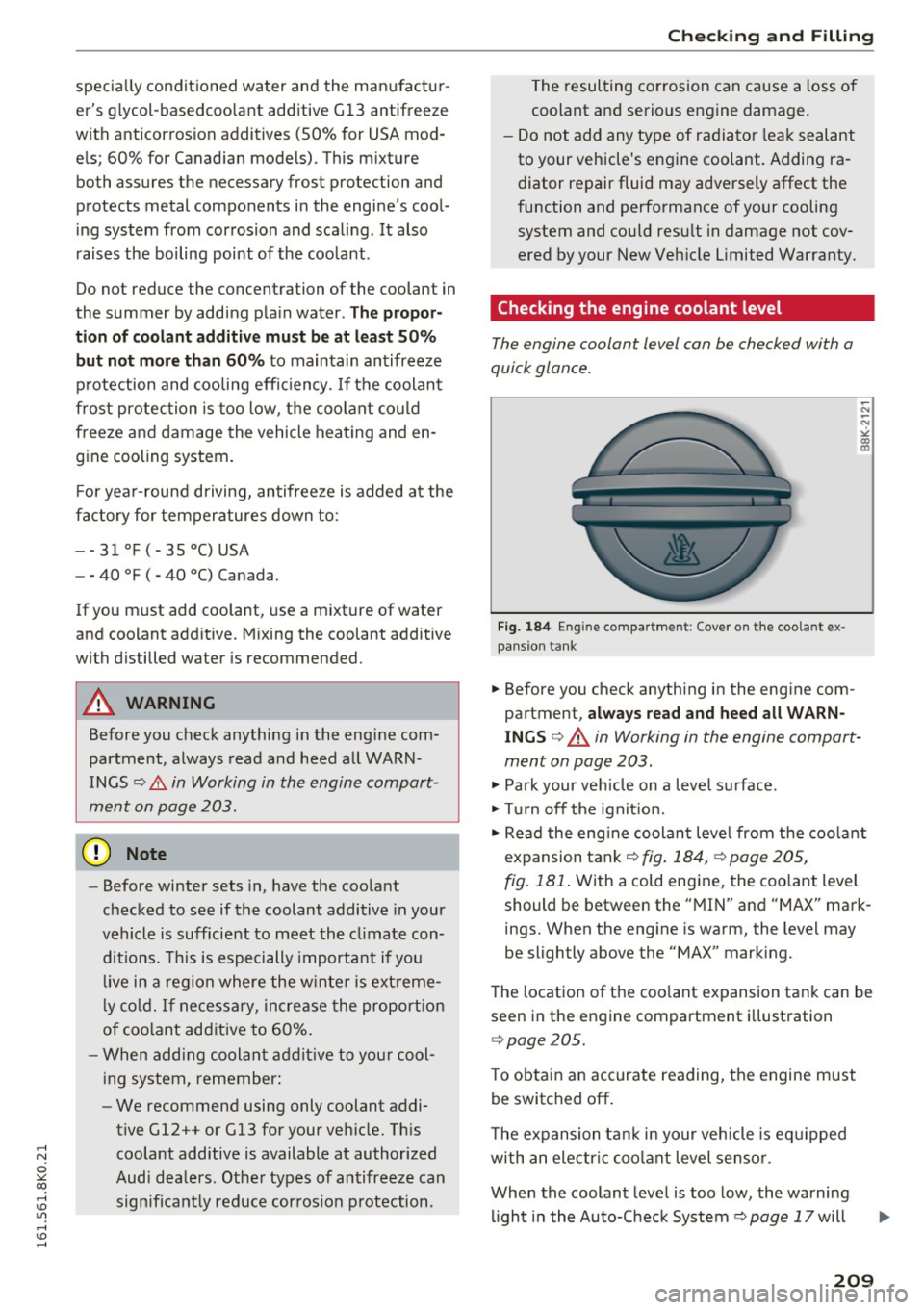
F ig. 184 En gin e co mpa rt men t: Cover o n the coo la nt ex
pans ion t ank
.. Before you check anything in the eng ine com
partment,
al ways read and heed all WARN
INGS
q ..&. in Working in the engine compart
ment on page 203 .
.. Park your ve hicle on a leve l sur face .
.. Tu rn off the ignit io n .
.. Read the eng ine coolan t level from the coo lant
expansion tank
q fig . 184, Q page 205,
fig. 181 .
With a cold engine, the coolant level
should be between the " MIN" and "MAX" mark
ings. When the engine is warm, the level may
be slightly above the "MAX" marking.
The location of the coo lant expansion tank can be
seen in the engine compartment illustration
q page 205.
To obtain an accurate reading, the engine must
be switched off.
T he expansion ta nk in your veh icle is eq uipped
with an electric coo lant level senso r.
When the coolant leve l is too low , the warning
light i n the Auto-Check System
Q page 17 will
209
Page 212 of 278
Check ing and F illing
blink until you add coolant and the level has been
restored to normal. Even though there is an e lec
tr ic coolant level sensor, we still recommend you
check the coo lant level from time to time.
Coolant los s
Coolant loss may indicate a l e ak in the cooling
system. In the event of coolant loss, the cooling
syst em should be insp ected immediately by your
authorized Audi dealer. It is not enough merely
to add coolant.
I n a
s e aled system, losses can occur only if the
boiling point of the coo lant is exceeded as a re
sult of overheating.
A WARNING
The cooling system is under pressure and can get very hot. Reduce the risk of scalding from
hot coolant by following these steps.
- Turn off the eng ine and allow it to cool
down .
- Protect your face, hands and arms from es
caping fluid and steam by covering the cap
with a large, thick rag.
- Turn the cap slowly and very carefully in a
counter-clockwise direction wh ile apply ing
l ight, downward pressure on the top of the
cap .
- To avo id being burned, do not sp ill anti
freeze or coolant on the exhaust system or
hot eng ine parts . Under certain conditions,
the ethy lene g lycol i n engine coolant can
catch fire.
{Q) Note
Do not add any type of radiator leak seala nt
to your veh icle's engine coolant . Adding radia
to r repa ir fluid may adversely affec t the func
tion and performance of yo ur cooling system
and could result in damage not covered by
your New Vehicle Limited Warranty.
Adding coolant
Be very careful when adding engine coolant.
Before you check anyth ing in the eng ine compart
ment,
a lwa ys re ad an d heed all WARNINGS
210
¢ A in Working in the engine compartment on
page 203.
Requireme nt: The re must be a res idual amount
of coo lant in the expans ion tank
~CD-
.,,. Turn off the engine .
.,,. Let the engine cool down.
.,,. Place a thick rag over the coolan t expa nsion
tank ¢ page 209, fig. 184 and
carefull y turn
the cap counter-clockwise ¢.&_ .
.,,. Add coo lant mixed in the correct ratio
~ page 208, Coolant up to the MAX marking.
.,,. Make sure that the fluid level remains stab le.
Add more coolant if necessary .
.,,. Twist the cap on aga in tightly.
Replacement engine coolant must conform to ex
act specifications ¢ page 208, Coolan t.
We recommend using only coo lant additive
G l2 +
+ , Gl3
or in an emergency Gl2+. Do not use a
different additive . In an emergency use plain wa
ter unt il you can get the correct addit ive and can
restore the correct rat io. Th is should be done as
soon as possible.
If you have lost a considerable amount of cool
ant, then you should add cold antifreeze and cold
water only when the engine is cold.
Always use new engine coo lant when refilling .
Do not fi ll coolant above the "MAX " mark. Excess
coolant will be forced out th rough the pressure
relief valve in the cap when the engine becomes
hot.
A WARNING
- The cooling system is under pressure and can get very hot. Reduce the risk of scalding
from hot coolant by following these steps.
- Turn off the engine and a llow it to cool
down.
- Protect your face, hands and arms from
escaping fluid and steam by covering the
cap with a large, thick rag.
- Turn the cap s low ly and very ca refully in a
counter-clo ckwise direction wh ile app ly ing
li ght, downward pressure on the top o f
the cap.
~
Page 214 of 278
Check ing and F illing
The brake fluid rese rvoir is located at the rear
partition of the engine compartment on the l eft
side ¢
page 205 .
The fl uid level may drop slightly after some time
due to the automatic adjustment of the brake
pads . This is not cause for alarm.
If th e b rake fl uid level fa lls considerably be low
the "M IN" mark, the b rake warning/ind icator
lig ht ( U.S. mode ls :
1111 , Canadian models:. )
will come on ¢
page 15. Do not contin ue to oper
ate the vehicle . T he comp lete brake system
should be thoroughly checked by an authori zed
Aud i dealer or qualified workshop and the cause
corrected . If the brake flu id level is too low, the
b rake warning/indicator light will i llum inate.
Contact a n author ized Audi dealer
immediately .
{D) Tips
The brake fluid reservoir is located under
neath the cover .
Changing brake fluid
Have the brake fluid changed by an experienced
technician .
Brake fluid absorbs mo isture from the air. If the
water content in the b rake fluid is too high, cor
rosion in the brake system may resu lt afte r ape
riod of t ime. The boiling poi nt of the brake flu id
will also decrease cons iderably and decrease
b raking perfo rman ce.
Therefore, the brake fluid must be changed
every
two year s.
Always use new brake fluid wh ic h con
forms to Fede ral Motor Veh icle Standard "FMVSS
1 16 DO T 4".
The brake fluid reservoir can be diff icult to reach,
therefore, we recommend that yo u have the
brake fl uid changed by yo ur autho rized
Audi
dealer .
Your dealer has t he corre ct tools, t he
right brake fluid and the know-how to do this for
you.
A WARNING
- Brake fluid is poisonous. It must be stored
only in the closed orig inal container out of
the reach of chi ldren!
212
- Bra ke fa ilure ca n result from old or inapp ro
priate brake fluid . Observe these precau
tions:
- Use only brake fluid t hat meets SA E speci
fi ca ti on
J 170 3 and con forms to Federa l
Motor Ve hicle Standard 116 . Always check
wi th yo ur autho rized Audi dea le r to make
s ur e yo u are using the correct brake fluid .
The correct type of brake flu id is also ind i
cated on the b rake fluid reservo ir .
- The brake fluid m ust be new . Heavy use of
the brakes can cause a vapo r lock if the
brake fluid is left in the system too long .
This can se riously affect the efficiency of
the b rakes as well as your safety . This
could resu lt in an accident .
(D Note
Brake fluid will damage the paint of your veh i
cle.
@ For the sake of the environment
Because of the problem o f proper d isposa l o f
brake fluid as well as the spec ial too ls re
q ui red a nd the necessary expertise, we rec
omme nd that you have the bra ke f luid
changed by yo ur autho rized Aud i dea le r.
Battery
, General information
U nder normal operating condit ions, the battery
i n your Audi does not need any maintenance.
With
high outside temperatures or long daily
drives we recommend that you have the elect ro
lyte level c hecked by an au thorized Aud i dealer o r
qualified workshop. The electro lyte level shou ld
a lso be che cked each time the battery is c ha rged
~ page 214.
Have the batte ry chec ked when you take yo ur ve
hicle in for service. You are we ll adv ised to re
pla ce a battery tha t is older than 5 yea rs.
With certain types of airbag deployment, t he
batte ry is d iscon nected from the ve hicle electri
ca l system for safety reasons ¢.&.
in Repair, care
and disposal of the airbags on page 151. .,.
Page 219 of 278
Wheels
Wheels and Tires
General information
.,.Check your tires regularly for
damage (punctures, cuts, cracks
and bulges). Remove foreign ob
jects from the tire tread.
.,. If driving over curbs or similar
obstacles, drive slowly and ap
proach the curb at an angle.
.,.Have faulty tires or rims re
placed immediately.
"'Protect your tires from oil,
grease and fuel.
.,.M ark tires before removing
them so that the same running
direction can be maintained if
they are reinstalled.
"'Lay tires flat when storing and
store them in a cool, dry location
with as little exposure to light as
possible.
(D Note
-Please note that summer and
winter tires are designed for
the conditions that are typical in those seasons. Audi recom
mends using winter tires dur
ing the winter months. Low
temperatures significantly de crease the elasticity of summ
er tires, which affects traction
Wheels
and braking ability. If summer
tires are used in very cold
temperatures, cracks can form
on the tread bars, resulting in
permanent tire damage that
can cause loud driving noise
and unbalanced tires.
-Burnished, polished or
chromed rims must not be
used in winter driving condi
tions. The surface of the rims
does not have sufficient corro
sion protection for this and
could be permanently dam aged by road salt or similar
substances.
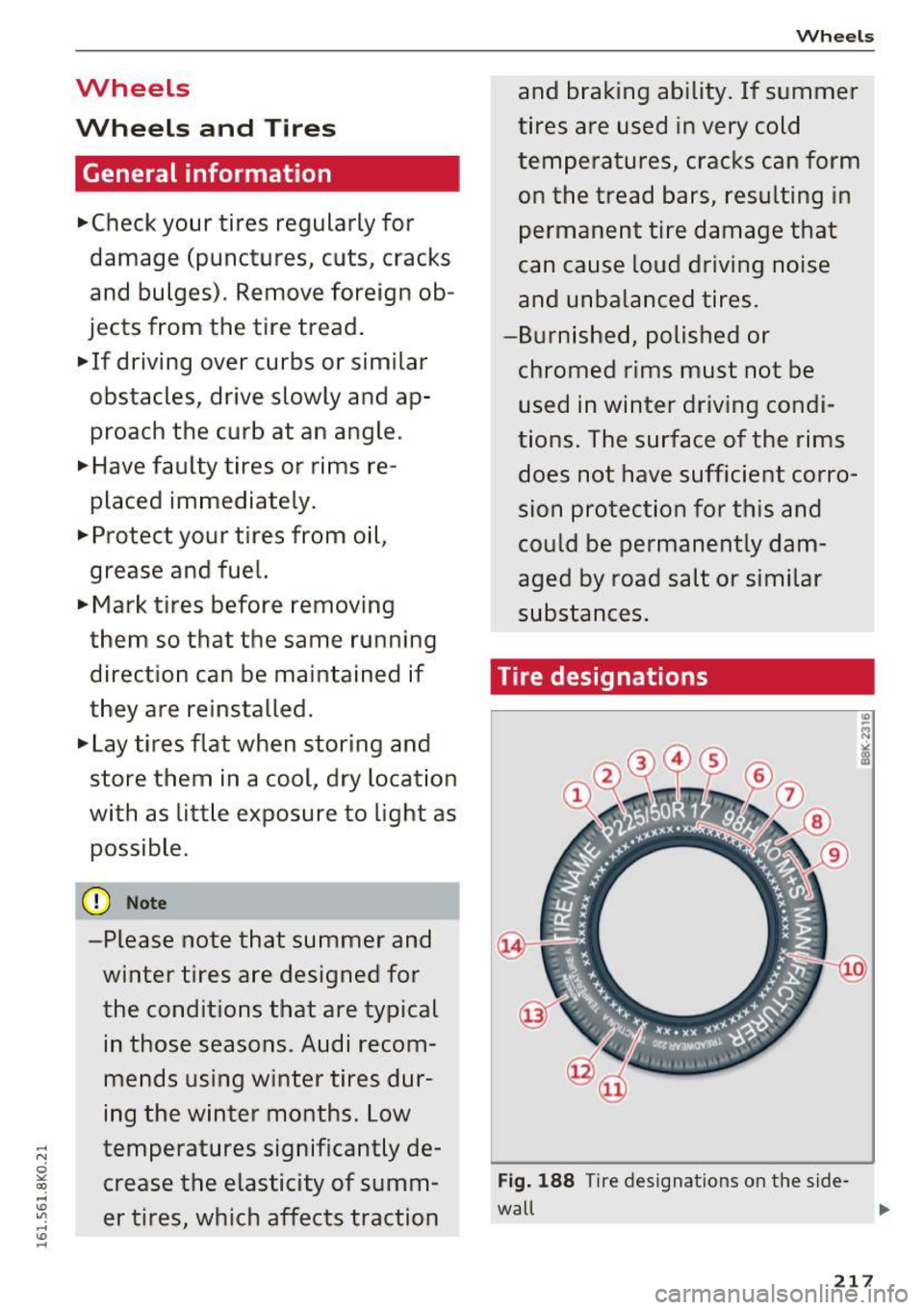
Tire designations
Fig. 188 T ir e designations on the side -
wall Ill>
217
Page 256 of 278
Emergency situations
Raising the vehicle
Lifting with workshop hoist and with floor
jack
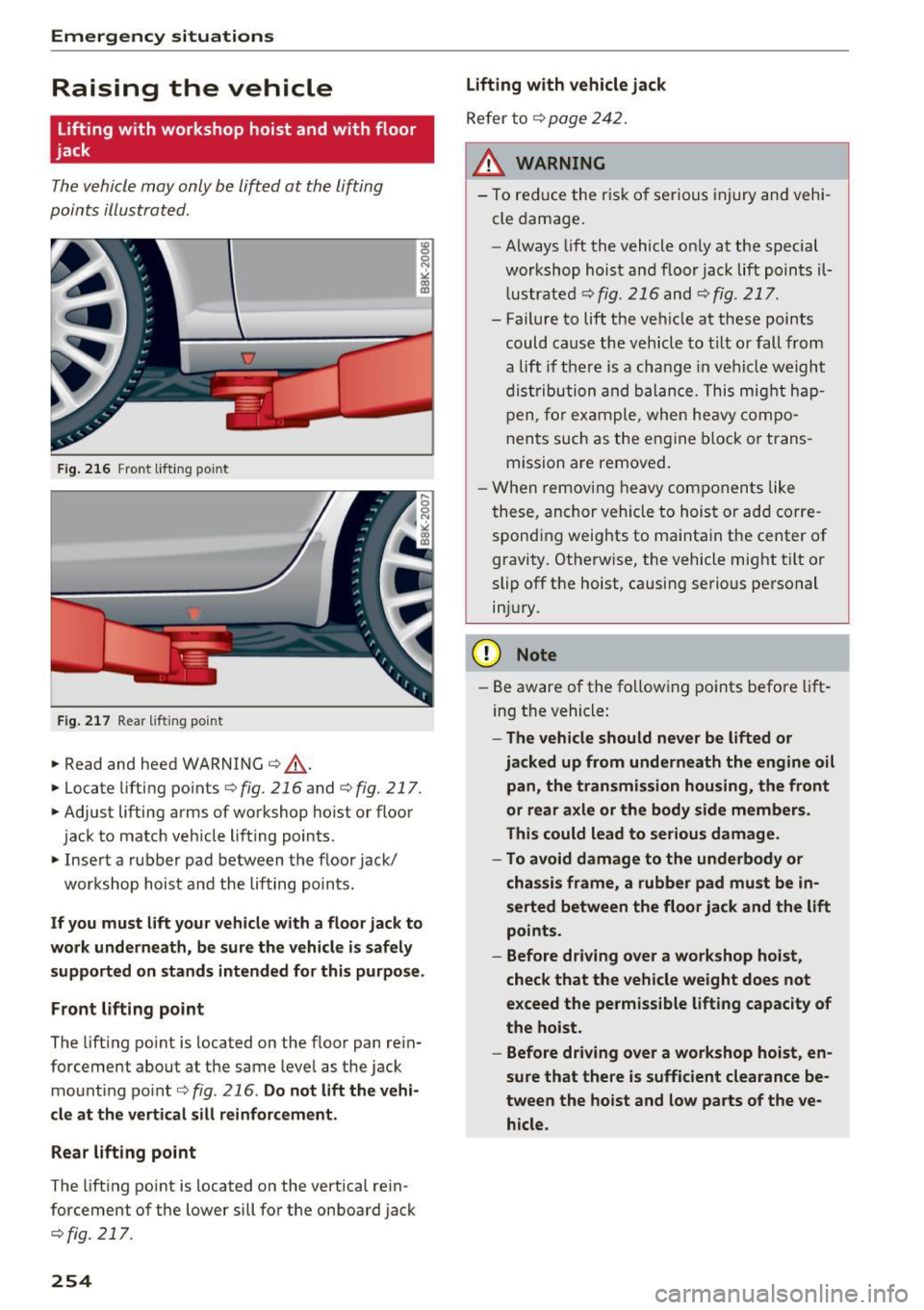
Th e vehicle may only b e lift ed at the lifting
poin ts illust rated.
F ig .. 216 F ro nt lift ing po int
F ig. 217 Rea r lifti ng po int
.,. Read and heed WARNING ¢ A-
.,. Locate lifti ng po ints ¢ fig. 216 and ¢ fig. 217 .
.,. Adjust lifting arms of wo rkshop hoist or floor
jack to match veh icle lifting points .
.,. In se rt a rubb er pad between t he floor jack/
wor kshop hoist a nd the lif ting poin ts .
If you must lift your vehicle with a floor jack to
work underneath, be sure the vehicle is safely
supported on stands intended for this purpose .
Front lifting point
The lift ing po int is located on the floo r pan re in
forcement about at the same leve l as the jack
mo unt ing point ¢
fig. 216 . Do not lift the vehi
cle at the vertical sill rei nforcement.
Rear lifting point
The lift ing po int is located on the vertica l re in
for cement of the lower sill fo r the on board jack
¢fig. 217.
254
Lifting with vehicle jack
Refer to ~ page 242.
A WARNING
-To re duce the r is k of serious injury and vehi
cle dama ge .
- Always lift the vehicle o nly at the special
workshop hois t an d floor jack lift points il
l ustrat ed
~ fig. 216 and ~ fig . 217.
- Failur e to lift the v ehicle at these points
could ca use the veh icle to tilt or fall from
a lift if the re is a cha ng e i n ve hicle weigh t
dis tribu tion and ba lan ce . T his mig ht hap
p en, for exa mple, whe n he avy co mpo
n en ts such as the engine block o r tr an s
mission are removed.
- W hen re m ov in g h eavy co mponen ts like
these, an cho r veh icle to hoist or ad d co rre
spond ing weights to ma inta in the ce nter of
gravity . Othe rw ise, the vehicle mi ght t ilt o r
slip off t he hoist, causing serious pe rsonal
in jur y.
(D Note
- Be aware of the fo llowing po ints befo re lift
ing the vehicle:
- The vehicle should never be lifted or
jacked up from underneath the engine oil pan, the transmission housing, the front
or rear axle or the body side members .
This could lead to serious damage .
- To avoid damage to the underbody or
chassis frame, a rubber pad must be in
serted between the floor jack and the lift
points.
- Before driving over a workshop hoist,
check that the vehicle weight does not
exceed the permissible lifting capacity of
the hoist.
- Before driving over a workshop hoist , en
sure that there is sufficient clearance be
tween the hoist and low parts of the ve
h icle.
Page 257 of 278
.... N
0
""' CX)
.... I.Cl U"I
.... I.Cl ....
Technical data
Vehicle identification
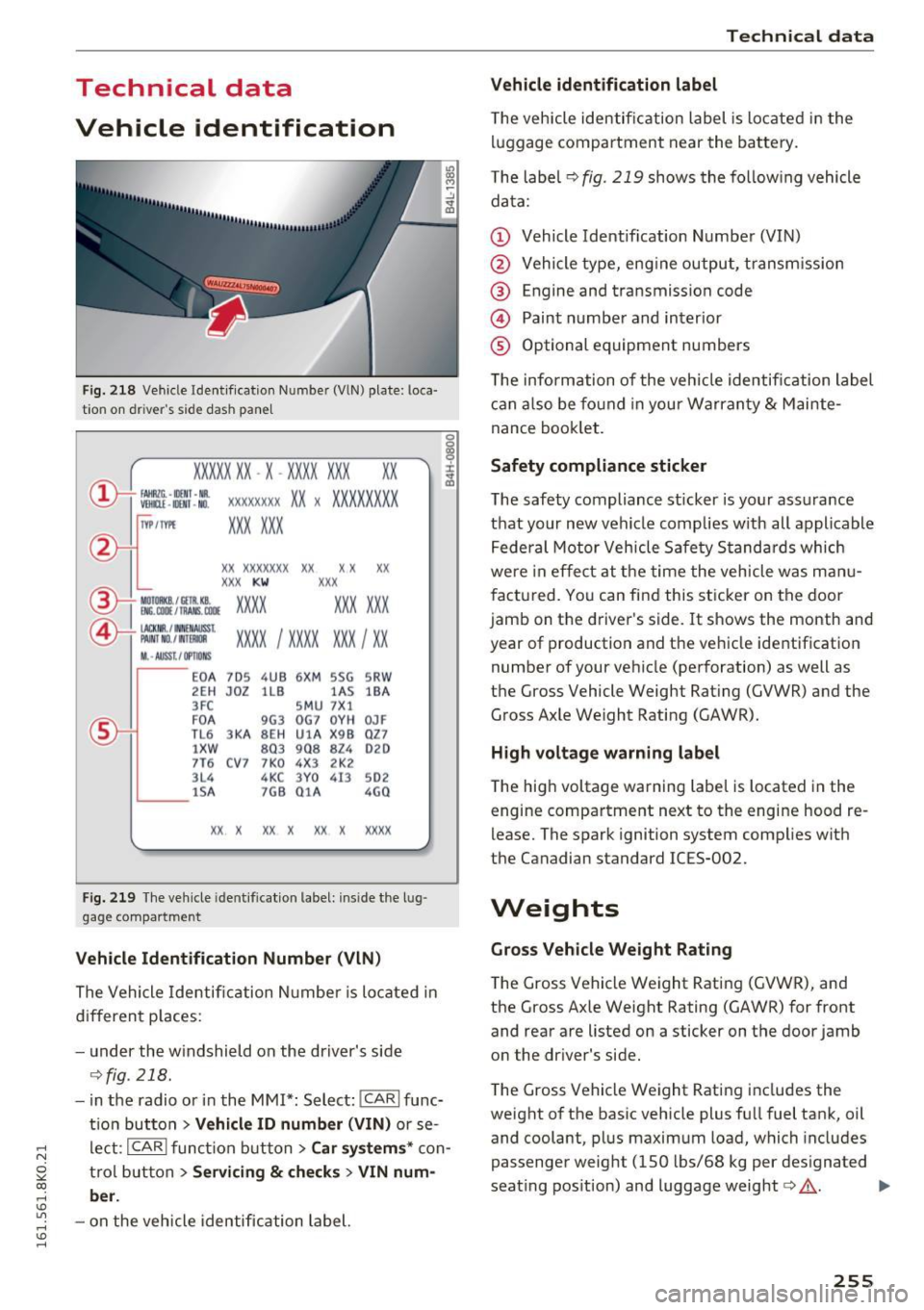
F ig . 2 18 Vehi cle Ident if icatio n Number (VlN) plate : loca·
t ion on dr iver 's side dash pane l
XXXXX XX -X -XX XX X XX XX
CD+ ~t :1:: xxxxxxxx xx x xx xxx xxx
TVP/fffl XXX XXX
XX XXXXXXX XX X X xx
XXX KW XXX
®i ~:J ·f lfils~~ XXXX XXX XXX
®-+ ~ N:a=i~l xxxx ; xxxx xx x ; xx
II. · AUSS, I OPTIONS
,__ __
EO A 7D 5
2E H J0Z
3FC
F O A
TL 6 3KA
lXW
7T6 C V7
3L4 lS A
4UB 6XM 5SG
llB lA S
S M U 7Xl
9G3 OG7 0YH
SE H UlA X 98
803 908 824
7 K0 4 X3 2K2
4KC 3Y0 413
7G8 01 A
5RW
18A
0JF
QZ7
020
502
4G0
XX . X XX X XX X XXXX
Fig. 219 Th e ve hicle ident ifica tion label: ins ide the l ug·
gage co mpartment
Veh icle Identification Number (VlN )
The Vehicle Identific ation N umbe r is lo cate d in
d if f eren t places:
- u nder the w indshield on the dr iver's side
~ fig. 218.
-in the radio or i n the MMI*: Select: !CAR! func
t io n but ton
> Vehicle ID number (VIN) or se
l e ct:
I CAR ! funct ion button > Car system s* con
t rol but ton
> Servicing & checks > VIN num
ber .
-on the vehicle identific ation label.
Technical data
Vehicle identification label
T he vehicle identi fica tion label is lo cate d in t he
l uggage compa rtment near the ba tte ry.
T he labe l
~ fig. 219 shows the fo llow ing vehicle
da ta:
(D Vehicle Identification Number (VIN)
@ Vehicle type, eng ine output, transm ission
@ Engine and transmission code
@ Paint numbe r and interior
® Optional equipment numbers
T he information of the veh icle identification label
c an also be fo und in your Warran ty
& Mainte
nance booklet.
Safety compliance sticker
The safety compliance sticker is yo ur ass urance
t h at your n ew vehi cle complies w ith all appli cable
Fede ral Motor Vehicle Safety Stand ard s which
we re in effe ct at the time the veh icle w as m anu
fac tured. Yo u ca n fi nd this sticker on the door
jamb on the driver 's side. It shows the month and
year of production and t he ve hicle identification
number of your ve hicle (perforation) as well as
t h e Gross Vehicle Weight Rat ing (GVWR) and the
G ross Axle We ight Rati ng (GAWR).
H igh vo ltage warning label
T he hig h voltage warning label is located in the
engine compa rtment ne xt to the engine hood re
lease. The spark ignition system complies with
the Canadian standard ICES-002.
Weights
Gross Vehicle W eight Rating
The Gross Vehicle Weight Rating (GVWR), and
the Gross Axle Weight Rating (GAWR) for front
and rear a re listed on a sticker on the door jamb
o n the dr iver 's side .
T he Gross Vehicle Weight Rating includes the
weight o f the basic vehicle plus fu ll fuel tank, oil
and coolant, p lus maxim um load, which includes
passenger weight (150 lbs/68 kg per des ignated
seat ing pos ition) and luggage weight
c:> .&, . .,.
255
Page 265 of 278
..... N
0 ::..:: co .....
Kick -down . . . . . . . . . . . . . . . . . . . . . . . . . . . 95
Manual shift program . . . . . . . . . . . . . . . . . 94
Removal lock (igni tion key) . . . . . . . . . . . . . 80
Selector lever . . . . . . . . . . . . . . . . . . . . . . . . 91
Automatic wipers . . . . . . . . . . . . . . . . . . . . . . 54
Auto Safety Hotline . . . . . . . . . . . . . . . . . . . 128
Average speed . . . . . . . . . . . . . . . . . . . . . . . . 24
Avoid damaging the vehicle . . . . . . . . . . . . . 185
B
Bag hooks . . . . . . . . . . . . . . . . . . . . . . . . . . . . 72
Battery . . . . . . . . . . . . . . . . . . . . . . . . . . . . . . 16
Ba ttery location inside the luggage compart-
ment .. ... ................... .... .. 213
Charge level . . . . . . . . . . . . . . . . . . . . . . . . 182
Charging . . . . . . . . . . . . . . . . . . . . . . . . . . . 214
Energy management . . . . . . . . . . . . . . . . . 182
I mportant warn ings when work ing on the
battery . . . . . . . . . . . . . . . . . . . . . . . . . . . . 213
Jump starting . . . . . . . . . . . . . . . . . . . . . . . 250
Replacing the battery . . . . . . . . . . . . . . . . 215
Working on the battery . . . . . . . . . . . . . . . 213
Before driving . . . . . . . . . . . . . . . . . . . . . . . . 121
Belt tensioners . . . . . . . . . . . . . . . . . . . . . . . 136
Bio-ethanol (Fuel) . . . . . . . . . . . . . . . . . . . . . 199
Blended gasoline . . . . . . . . . . . . . . . . . . . . . 198
Blower (automatic climate control) . . . . . . . . 78
Booster seats . . . . . . . . . . . . . . . . . . . . . . . . 166
Brake fluid
Changing the brake fluid . . . . . . . . . . . . . . 212
Checking the brake flu id level . . . . . . . . . . 211
Brake system Anti -lock brak ing system . . . . . . . . . . . . . . . 19
Brake fluid specifications for refill and re
p lacement . . . . . . . . . . . . . . . . . . . . . . . . . 212
Brake light defective . . . . . . . . . . . . . . . . . . 21
Brake power assist unit . . . . . . . . . . . . . . . 180
Brakes . . . . . . . . . . . . . . . . . . . . . . . . . . . . . 180
Ceramic brakes . . . . . . . . . . . . . . . . . . . . . . 180
Electromechanical parking brake . . . . . . . . 85
Warning/indicator lights . . . . . . . . . . . . . . . 15
Worn brake pads symbol . . . . . . . . . . . . . . . 20
Braking Brake assist . . . . . . . . . . . . . . . . . . . . . . . . 177
Emergency braking function . . . . . . . . . . . . 87
Index
braking guard . . . . . . . . . . . . . . . . . . . . . . . . . 98
Messages . . . . . . . . . . . . . . . . . . . . . . . . . . 105
Settings . . . . . . . . . . . . . . . . . . . . . . . . . . . 105
Break-in period
Brake pads . . . . . . . . . . . . . . . . . . . . . . . . . 180
T ires . . . . . . . . . . . . . . . . . . . . . . . . . . . . . . 185
Breaking in . . . . . . . . . . . . . . . . . . . . . . . . . . 185
New t ires . . . . . . . . . . . . . . . . . . . . . . . . . . 224
Bulbs . . . . . . . . . . . . . . . . . . . . . . . . . . . . . . . 249
C
California Proposition 65 Warning . . . . . . . 204
Battery specific . . . . . . . . . . . . . . . . . . . . . 214
Capacities . . . . . . . . . . . . . . . . . . . . . . . . . . . 256
Engine oil . . . . . . . . . . . . . . . . . . . . . . . . . . 205
Care . . . . . . . . . . . . . . . . . . . . . . . . . . . . . . . . 193
Cargo area
refer to Luggage compartment . . . . . . 69, 126
Catalytic converter . . . . . . . . . . . . . . . . . . . . 186
Center armrest . . . . . . . . . . . . . . . . . . . . . . . . 61
C entral locking . . . . . . . . . . . . . . . . . . . . . . . . 31
Central locking switch . . . . . . . . . . . . . . . . . 35
Convenien ce key . . . . . . . . . . . . . . . . . . . . . . 34
Remote control key . . . . . . . . . . . . . . . . . . . 34
Ceramic brake rotors
New brake pads . . . . . . . . . . . . . . . . . . . . . 180
Certification . . . . . . . . . . . . . . . . . . . . . . . . . 261
Changing engine oil . . . . . . . . . . . . . . . . . . . 208
Checking Engine coolant level . . . . . . . . . . . . . . . . . . 209
Child restraints
Danger of using child restraints in the front
seat . . . . . . . . . . . . . . . . . . . . . . . . . . . . . . . 139
Where can I get additional information
about child restraints and their use? . . . . 175
Child restraint system anchors . . . . . . . . . . 171
Child safety . . . . . . . . . . . . . . . . . . . . . . . . . . 158
Impor tan t safety ins tructions for using child
safety seats . . . . . . . . . . . . . . . . . . . . . . . . 161
Installing a child restraint using the LATCH
system . . . . . . . . . . . . . . . . . . . . . . . . . . . . 172
Lower anchorages . . . . . . . . . . . . . . . . . . . 172
Mounting and releas ing the anchorage
hook .............................. 172
Tether anchors . . . . . . . . . . . . . . . . . . . . . . 173
Tether straps . . . . . . . . . . . . . . . . . . . . . . . 173
263
Page 268 of 278
Index
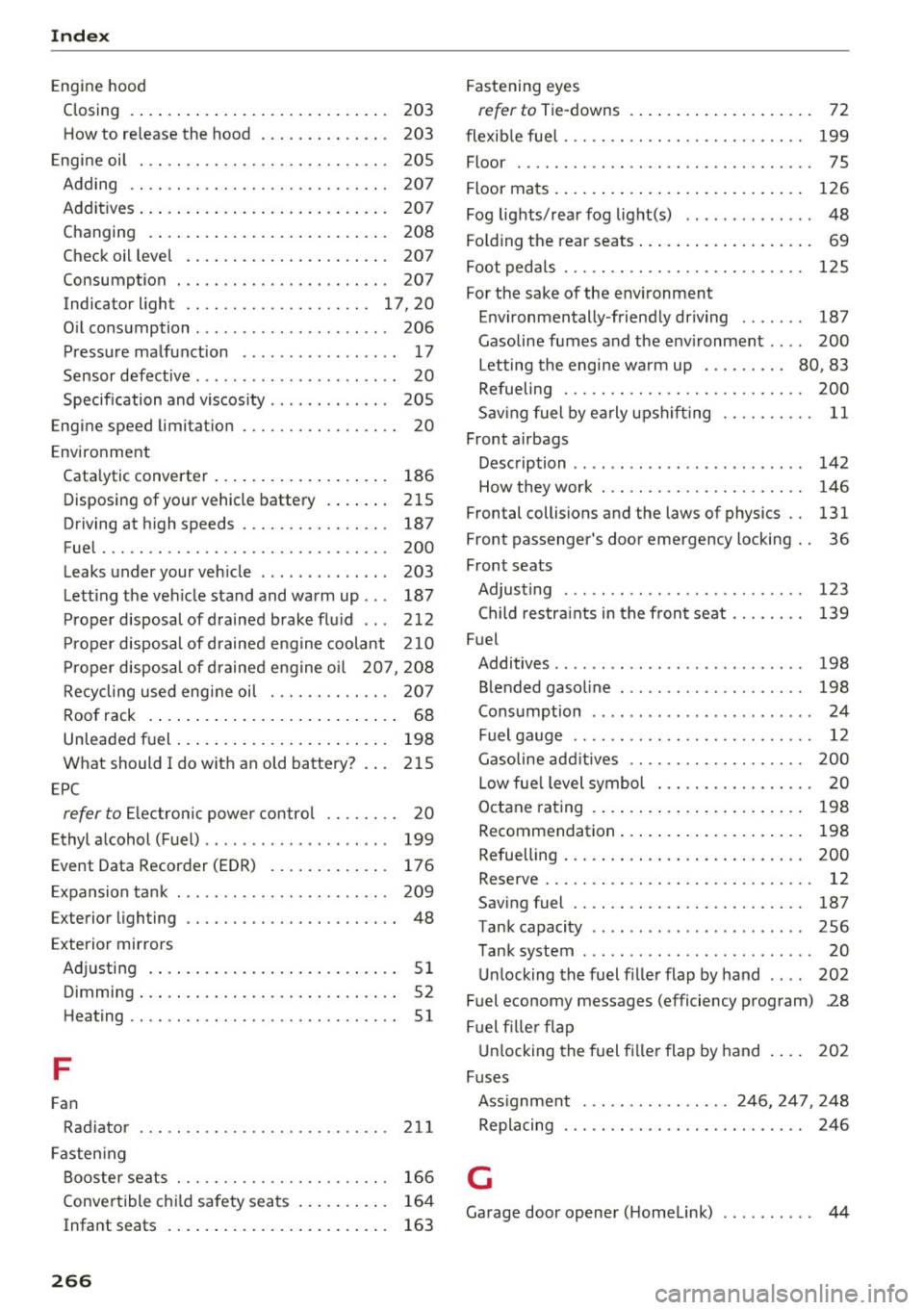
Engine hood Closing . . . . . . . . . . . . . . . . . . . . . . . . . . . .
203
How to release the hood . . . . . . . . . . . . . . 203
Engine oil . . . . . . . . . . . . . . . . . . . . . . . . . . . 205
Adding .. .. .. ............... .... ... 207
Additives . . . . . . . . . . . . . . . . . . . . . . . . . . . 207
Changing . . . . . . . . . . . . . . . . . . . . . . . . . . 208
Check oil level . . . . . . . . . . . . . . . . . . . . . . 207
Consumption . . . . . . . . . . . . . . . . . . . . . . . 207
Indicator light .. .................. 17, 20
Oil consumption . . . . . . . . . . . . . . . . . . . . . 206
Pressure malfunction . . . . . . . . . . . . . . . . . 17
Sensor defective . . . . . . . . . . . . . . . . . . . . . . 20
Specification and viscosity . . . . . . . . . . . . . 205
Engine speed limitation . . . . . . . . . . . . . . . . . 20
Environment
Catalytic converter . . . . . . . . . . . . . . . . . . .
186
Disposing of your vehicle battery . . . . . . . 215
Driving at high speeds . . . . . . . . . . . . . . . . 187
Fuel. .... .. .. .. ............. .... .. . 200
Leaks under your vehicle . . . . . . . . . . . . . . 203
Letting the vehicle stand and warm up . . . 187
Proper disposal of drained brake fluid . . . 212
Proper disposal of drained engine coolant 210
Proper disposal of drained engine o il 207, 208
Recycling used engine oil . . . . . . . . . . . . . 207
Roof rack . . . . . . . . . . . . . . . . . . . . . . . . . . . 68
Unleaded fuel . . . . . . . . . . . . . . . . . . . . . . . 198
What should I do with an old battery? 215
E PC
refer to Electronic power control . . . . . . . . 20
Ethyl alcohol (Fuel) . . . . . . . . . . . . . . . . . . . . 199
Event Data Recorder (EDR) . . . . . . . . . . . . . 176
Expansion tank
Exterior lighting
Exterior mirrors 209
48
Adjusting . . . . . . . . . . . . . . . . . . . . . . . . . . . 51
D ' . 1mming ... .. .. ................ ..... 52
Heating . . . . . . . . . . . . . . . . . . . . . . . . . . . . . 51
F
Fan
Radiator
211
Fastening
Booster seats . . . . . . . . . . . . . . . . . . . . . . .
166
Convertible chi ld safety seats . . . . . . . . . . 164
Infant seats . . . . . . . . . . . . . . . . . . . . . . . . 163
266
Fastening eyes
refer to Tie-downs . . . . . . . . . . . . . . . . . . . . 72
flexib le fue l . . . . . . . . . . . . . . . . . . . . . . . . . . 199
Floor . . . . . . . . . . . . . . . . . . . . . . . . . . . . . . . . 75
Floor mats . . . . . . . . . . . . . . . . . . . . . . . . . . . 126
Fog lights/rear fog light(s) . . . . . . . . . . . . . . 48
Fold ing the rear seats . . . . . . . . . . . . . . . . . . . 69
Foot pedals . . . . . . . . . . . . . . . . . . . . . . . . . . 125
For the sake of the environment
Environmentally -friendly driving . . . . . . .
187
Gasoline fumes and the environment . . . . 200
Letting the engine warm up . . . . . . . . . 80, 83
Refueling . . . . . . . . . . . . . . . . . . . . . . . . . . 200
Sav ing fuel by early upshifting . . . . . . . . . . 11
Front airbags
Description . . . . . . . . . . . . . . . . . . . . . . . . .
142
How they work . . . . . . . . . . . . . . . . . . . . . . 146
Frontal collisions and the laws of physics . . 131
Front passenger 's door emergency locking . . 36
Front seats
Adjusting . . . . . . . . . . . . . . . . . . . . . . . . . .
123
Child restraints in the front seat . . . . . . . . 139
Fuel
Additives .. ... ... ... ...... ....... ...
198
Blended gasoline 198
Consumption . . . . . . . . . . . . . . . . . . . . . . . . 24
Fuel gauge . . . . . . . . . . . . . . . . . . . . . . . . . . 12
Gasoline add it ives . . . . . . . . . . . . . . . . . . . 200
Low fue l level symbol . . . . . . . . . . . . . . . . . 20
Octane rating . . . . . . . . . . . . . . . . . . . . . . . 198
Recommendation ... ................. 198
Refuelling . . . . . . . . . . . . . . . . . . . . . . . . . . 200
Reserve . . . . . . . . . . . . . . . . . . . . . . . . . . . . . 12
Saving fuel . . . . . . . . . . . . . . . . . . . . . . . . . 187
Tank capacity . . . . . . . . . . . . . . . . . . . . . . . 256
Tank system . . . . . . . . . . . . . . . . . . . . . . . . . 20
Unlocking the fuel filler flap by hand . . . . 202
Fuel economy messages (efficiency program) 28
Fuel filler flap
Unlocking the fuel filler flap by hand . . . .
202
Fuses
A . ss 1gnment . .. .. .. .. .. ..... 246, 247, 248
Replacing . . . . . . . . . . . . . . . . . . . . . . . . . . 246
G
Garage door opener (HomeLink) . . . . . . . . . . 44