flat tire AUDI A4 2016 User Guide
[x] Cancel search | Manufacturer: AUDI, Model Year: 2016, Model line: A4, Model: AUDI A4 2016Pages: 278, PDF Size: 70.26 MB
Page 227 of 278
different tire speeds. For this reason, in case of emergency, only
use a spare tire* that is the same
circumference as the regular
tires.
&_ WARNING -
-Only use tire/rim combina tions and suitable wheel bolts
that have been approved by
Audi. Otherwise, damage to
the vehicle and an accident could result.
-For technical reasons, it is not possible to use tires from oth
er vehicles - in some cases,
you cannot even use tires from
the same vehicle model.
-Make sure that the tires you
select have enough clearance
to the vehicle . Replacement
tires should not be chosen
simply based on the nominal
size, because tires with a dif
ferent construction can differ
greatly even if they are the
same size. If there is not
enough clearance, the tires or
the vehicle can be damaged and this can reduce driving
safety and increase the risk of
an accident.
Wheels
-Only use tires that are more
than 6 years old when abso lutely necessary and drive
carefully when doing so.
-If you install wheel covers on
the vehicle, make sure they al
low enough air circulation to
cool the brake system. If they
do not, this could increase the
risk of an accident.
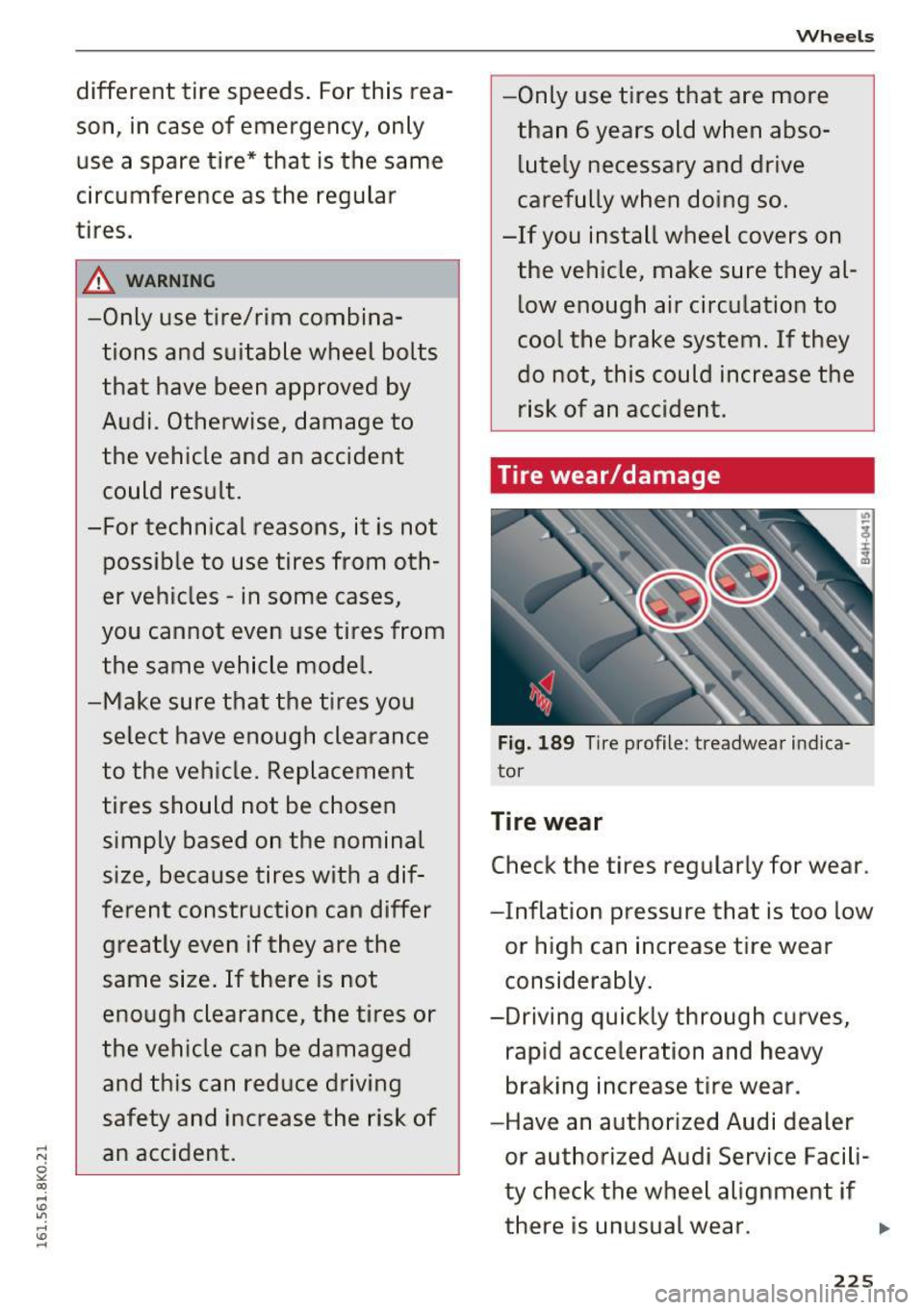
Tire wear/damage
Fig. 189 Tire profile : treadwear indica
tor
Tire wear
Check the tires regularly for wear .
-Inflation pressure that is too low
or high can increase tire wear
considerably.
-Driving quickly through curves, rapid acceleration and heavy
braking increase tire wear .
-Have an authorized Audi dealer
or authorized Audi Service Facili
ty check the wheel alignment if
there is unusual wear. ..
225
Page 232 of 278
Wheels
loss of vehicle control, but can al
so damage important parts of the
vehicle and can lead to sudden tire failure, including a blowout
and sudden deflation that can
cause the vehicle to crash.
Your safety and that of your pas
sengers also depends on making
sure that load limits are not ex
ceeded. Vehicle load includes ev
erybody and everything in and on
the vehicle. These load limits are
technically referred to as the vehi
cle's
Gross Vehicle Weight Rat
ing
("GVWR ") .
The "GVWR" includes the weight
of the basic vehicle, all factory in
stalled accessories, a full tank of
fuel, oil, coolant and other fluids plus maximum load. The maxi
mum load includes the number of
passengers that the vehicle is in
tended to carry ("seating capaci
ty") with an assumed weight of 150 lbs. (68 kg) for each passen
ger at a designated seating posi
tion and the total weight of any
luggage in the vehicle. If you tow
a trailer, the weight of the trailer
hitch and the tongue weight of
the loaded trailer must be includ
ed as part of the vehicle load.
230
The Gross Axle Weight Rating
("GAWR") is the maximum load
that can be applied at each of the
vehicle's two axles.
The fact that there is an upper
limit to your vehicle's Gross Vehi
cle Weight Rating means that the
total weight of whatever is being
carried in the vehicle (including
the weight of a trailer hitch and
the tongue weight of the loaded
trailer) is limited. The more pas
sengers in the vehicle or passen
gers who are heavier than the
standard weights assumed mean
that less weight can be carried as
luggage.
The Gross Vehicle Weight Rating and the Gross Axle Weight Rating
are listed on the safety compli
ance sticker label located on the
driver's side B-pillar
¢ page 22 7,
fig. 190.
! WARNING
Overloading a vehicle can cause
loss of vehicle control, a crash
or other accident, serious per
sonal injury, and even death.
-Carrying more weight than your vehicle was designed to carry will prevent the vehicle
from handling properly and
Page 233 of 278
increase the risk of the loss of
vehicle control.
- The brakes on a vehicle that
has been overloaded may not
be able to stop the vehicle
within a safe distance.
-Tires on a vehicle that has
been overloaded can fail sud
denly, including a blowout and
sudden deflation, causing loss
of control and a crash.
-Always make sure that the to
tal load being transported -
including the weight of a trail
er hitch and the tongue
weight of a loaded trailer -
does not make the vehicle
heavier than the vehicle's
Gross Vehicle Weight Rating.
Determining correct load
limit
Use the example below to calcu
late the total weight of the pas
sengers and luggage or other
things that you plan to transport so that you can make sure that
your vehicle will not be overload
ed.
Wheels
Steps for Determining Correct Load Limit
1. Locate the statement "THE
COMBINED WEIGHT OF OCCU
PANTS AND CARGO SHOULD
NEVER EXCEED XXX KG OR XXX
LBS"on your vehicle's placard
(tire inflation pressure label)
~ page 227, fig. 190.
2.
Determine the combined
weight of the driver and pas
sengers that will be riding in
your vehicle.
3. Subtract the combined weight of the driver and passengers
from
" XXX " kilograms or "XXX "
pounds shown on the sticker
¢page 227, fig. 190.
4. The resulting figure equals the
available amount of cargo and
luggage load capacity. For ex
ample, if the
" XXX " amount
equals
1400 lbs. and there will
be five
150 lbs. passengers in
your vehicle, the amount of
available cargo and luggage load capacity is
650 lbs.
(1400-750 (5 X 150) = 650
lbs.)
5. Determine the combined weight of luggage and cargo being loaded on the vehicle.
231
Page 235 of 278
..... N
0 ::..:: co .....
You can also use all season tires instead of
winter t ires . Please note that in some coun
tries where w inter t ires are required, only
w inter t ires with the
& symbol may be per
m itted.
Snow chains
Snow chains improve trac tion in the snow.
"' Only install snow chains on the front wheels.
This applies also to ve hicles w ith all wheel
drive* .
"' Check and correct the seating of the snow
chains if necessary after driving a few feet . Fol
low the instructions from the manufacturer.
"' Note the max imum permitted speed when d riv
ing with snow chains . Do not ex ceed 30 mp h
(50 km/h).
Snow chains not only imp rove the
driving in win
ter road cond itions, but also the
braking .
Use of snow chains is only perm itted with certain
r im/t ire combinations due to tec hnical reasons .
Check w ith an authorized Aud i dealer o r autho r
iz ed A udi Service Fac ility to see if yo u may use
snow cha ins.
Use
fine-mesh snow chains . They must not add
mo re than 0.53 inch (13 .5 mm) in height , includ
in g the chain lock.
You must remove the chains when driving on roads that are
free of snow. When roads are free
of snow, snow chains can impair handling and
damage the t ires, and t he cha ins w ill quickly be
destroyed.
_& WARNING
Us ing in co rrect snow chains o r inst alling snow
chains incorrectly can result in loss o f vehicle
cont rol, which inc reases t he risk of an acci
dent.
([) Note
Snow chains can damage the rims/whee l cov
ers * if the chains come into direct con ta ct
Wh eel s
with them. Remove the whee l covers* fi rst .
Use coated snow chains .
(D Tips
When driv ing wi th snow chains, it may he lp to
switch on sport/offroad mode<=>
page 178.
Low aspect ratio tires
Your Audi is factory -equ ipped with low aspect ra
tio t ires . These tires have been thorough ly tested
and been selected spec ifically for your model for
their superb performance, road fee l and handling
under a var iety of dr iv ing condit ions . Ask your au
thorized Aud i dea le r fo r more detai ls .
The low aspect rat io of these tires is indica ted by
a numeral of
55 or less in the t ire 's size des igna
tion . The numeral represents the ratio of the
t ir e's s idewa ll height in relation to its t read width
exp ressed in perce ntage. Conve ntiona l tires have
a height/wid th ra tio of 60 or more.
The performance of low-asp ect-ratio tir es is par
ticularly sen sitive to improper inflation pres
sure. It is therefore important that low aspect ratio tire s are inflated to the specified pressure
and that the inflation pressure i s regularly
checked and maintained. Tire pressures should
be checked at lea st once a month and alway s
before a long trip
¢ page 22 7 .
What you can do to avoid tire and rim
damage
Low aspect ratio tires can be damaged more easi
l y by impact with potho les, curbs, gullies or
ridges on the road, particularly if the tire is un
der i nflated.
In order to minimize the occurrence of impact
damag e to the tires of yo ur v ehicle, we recom
mend that you observe the following preca u
tions:
- Always maintain recommended inflation pres
sures . Check yo ur tire pressure every 2,000
m iles (3,000 km) and add air if necessary.
- Dr iv e carefully on roads w ith potholes, deep
gullies or ridges. The impact from dr iving
through or over such obstacles can damage
233
Page 236 of 278
Wheels
you r tires. Impact with a cu rb may also cause
damag e to your tires .
- After any impact, immediately inspect your
tires or have them inspected by the nearest au
thorized Audi dea ler. Replace a damaged tire as
soon as possib le.
- Inspect yo ur tires every 2,000 miles (3,000 km)
f or damage and wear. Damage is not always
easy to see. Damage can lead to loss of air and
underinflation, which could eventually cause
tire failure . If you believe that a tire may have
been damaged, replace the t ire as soon as pos
s ible .
- These tires may wear more quickly than others .
- Please a lso remember that, w hile these t ires
deliver responsive handling, they may r ide less
comfortably and make more no ise than other
cho ices .
Reduced perform ance in winter /cold season
conditions
All tires are designed fo r certa in purposes. The
low aspect ratio, ultra hig h pe rformance t ires
or iginally insta lled on you r vehicle a re intended
for max imum dry and we t road performa nce and
handling. They are not s uita ble fo r cold, snowy or
icy weathe r cond itions. If you drive under those
circumstances, you shou ld equip your vehicle
with all-s eason or winter tires, which offer b etter
traction under those condit ions. We suggest you
use the recommended snow or all-season tires
specif ied for your vehicle, or their equivalent .
Ref er to ¢
page 232 for more detai led informa
tion regarding winter tires.
Uniform tire quality grading
- Tread wear
- Traction AA A B C
- Temperature ABC
Q ua lity grades c an be found where app licab le on
the tire side wall between tread shoulde r and
maximum section width
¢ page 217, fig . 188.
For example : Tread wea r 200, Trac tion AA , Tem
pe ra ture
A .
All passenger car tires must conform to Federal
Safety Requi rements in add ition to these grades.
234
Tre ad wear
The tread wear g rade is a compara tive rating
based on the wear rate of the tire when tested
u nder controlled conditions on a specified gov
e rnment test course .
Fo r example, a tire g raded 150 wou ld wear one
and one half (1 1/2) times as we ll on the govern
ment course as a t ire graded 100.
The re lative pe rformance of tires depends upon
the actual cond itions o f the ir use, however, and
may depa rt sign ificantly from the no rm due to
variations in driv ing habits, service practices and
differences in road character istics and climate.
Traction
The traction grades , from highest to lowest, a re
AA, A, B and
C. Those g rades rep resent the tire 's
ability to stop on wet pavement as measured un
der controlled conditions on specified govern
ment test s urfaces of asphalt and concrete. A tire
marked C may have poor traction performance
¢ ,& .
Temperature
The temperature grades are A (the highest), B,
and C, representing t he tire's resistance to the
generat ion of heat and its ability to dissipate
heat when tested under controlled conditions on
a specified indoor laboratory test wheel.
Sustained high temperature can cause the mate rial of the tire to degenerate and reduce tire life,
and excessive temperature can lead to sudden
tire failure¢ ,&.
The grade C corresponds to a level of perform
ance which all passenger car tires must meet un
der the Federal Motor Vehicle Safety Standard No. 109 . Grades Band A represent higher levels
of performance on the laboratory test wheel than
the minimum requ ired by law .
A WARNING
-
The t ract ion g rade assigned to this t ire is
based on straight-ahead br aking traction
tes ts, and does not include acceler ation, cor
nering, hydroplaning or pea k traction charac
teristics .
Page 237 of 278
..... N
0 ::..:: co .....
The temperature grade for this tire is established for a tire that is properly inflated and
not overloaded. Excess ive speed, underinfla
tion, or excessive loading, either separately or
in combination, can cause heat buildup and
possible tire failure.
& WARNING
-
-
Temperature grades apply to tires that are properly inflated and not over or underinflat
ed.
Tire pressure monitoring system
U) General notes
App lies to vehicles: with tire pressure mo nitoring system
Each tire, including the spare (if provided),
should be checked monthly when cold and inflat
ed to the inflation pressure recommended by the
ve hicle manufact urer on the vehicle placa rd o r
tire inflat ion press ure label.
(If your vehicle has
tires of a different size than the size indicated on
the vehicle placard or tire inflation pressure la
be l, you should determine the proper tire infla
tion pressure for those tires).
As an added safety feature, your vehicle has been
eq uipped with a tire pressu re monitoring system
(TPMS) that illuminates a low tire pressure te ll
tale when one or more of your t ires is significant
ly under- inflated. Accordingly, when the low tire
pressure tellta le illuminates, you should stop and
check your tires as soon as possible, and inflate
them to the proper press ure. Driving on a s ignifi
cantly under-inflated tire causes the tire to ove r
h eat and can lead to t ire failure. Unde r-inflation
a lso reduces fuel e fficiency and tire tread life,
and may a ffec t the vehicle's handling and stop
p ing ability .
P lease note that the TPMS is not a substit ute for
p roper tire main tenance, and i t is the drive r's re
sponsib ility to ma intain correct tire pressure,
even if under-inflation has not reached the level
to trigger illumination of the TPMS low tire pres
sure telltale .
Wh eel s
Your vehicle has also been equipped with a TPMS
malfunction indicator to indicate when the sys
tem is not ope rating properly. The TPMS ma l
funct ion indicator is combined with the low t ire
pressure telltale. When the system detects a
malfunction, the telltale will flash for app roxi
mately one m inute and t hen rema in continuously
illuminated. This seque nce w ill cont inue upon
s u bsequent vehicle star t-ups as long as the mal
funct ion exists.
When the malfunction indicator is illum inated,
the system may not be able to detect o r signal
l ow tire p ressure as intended. TPMS malfunct ions
may occur fo r a v arie ty of reaso ns, including the
insta llation of replacement or al ternate tires or
whee ls on the vehicle that p revent the TPMS
from functioning proper ly . Always check the
TPMS ma lfunction te lltale after replacing one or
more tires or wheels on yo ur vehicle to ensure
that the rep lacement or a lternate tires and
wheels allow the TPMS to continue to function prope rly.
' If the Tire Pressure Monitoring System
indicator appears
Applies to vehicles: wi th t ire pressure monitoring system
The tire pressure indicator in the instrument
cluster informs you if the tire pressure is too low
or if there is a system malfunction.
Fi g. 192 Instrument cluster: indicator light with message
Using the ABS sensors, the tire pressure monito r
ing system compares the tire tread c ircumfer-
ence and v ibration characterist ics of the ind ividu-
al tires. If the press ure changes in one or mo re
t ir es, th is is indicated in the instrument clust er
display with an indicato r light
RI] and a message . .,.
235
Page 238 of 278
Wheels
If on ly one t ire is affected , the location o f that
tire will be indicated .
The tire pressures must be stored in t he Info tain
men t sys tem ag ain each time the pressu res
change (switch ing between pa rtial and f ull load
pressure) or after changing or rep lacing a tire on
your vehicle ¢
pag e 236. The t ire pressu re moni
toring system only monitors the tire pressure you have stored. Refer to the tire pressure labe l for
the recommended tire pressure for your ve hicle
¢ page 227, fig.191 .
Tire tread circumference and vibration character
istics can change and cause a tire pressure war n
i n g if:
- the tire p ressure in one o r more tires is too low .
- the tire has struct ural damage.
- the tire was repl aced o r the tire p ressure was
changed and i t was not stored
¢ page 236 .
-the sp are t ire* or co llapsible spa re t ire* i s in-
st alled.
Indicator lights
[I] Loss of press ure in at leas t one tire 9 .6, .
Check the tires and rep lace o r repa ir if necessary .
Chec k/correc t th e p ressures o f all four tires and
s to re the pressure aga in in the In fota inment sys
tem
¢ page 236 .
@m (Tir e Pr essure Monito ring System) Tire
pressure : Sy stem malfunction !. If @m
appears
a fte r swi tc hi ng t he igni tion on or wh ile dr iving
a nd the
[I] indicator light in the instrument cl us
ter blinks for approximate ly one minute and then
stays on, there is system malfunction. Try to
sto re the correct tire pressures¢
page 236. If
the indicator light does turn off or tu rns on again
afte r a short period of t ime, dr ive to an a uth or
ized Aud i dealer o r authorized Aud i Serv ice Fac ili
ty immedia tely to have the malfunct ion correct
ed.
_& WARNING
- If the tire pre ssu re indic ator appe ars in the
display, reduce your speed immedia te ly and
avoid any har d steer ing or braking maneu
vers. Stop as soon as possib le and check the
t ir es and t heir pressu re.
236
'
- The drive r is responsible fo r maintain ing the
correct tire pressu re . You m ust check the
tire pressure regularly .
- Unde r ce rtain con ditions (such as a spo rty
driving style, w inter condit ions or unpaved
roads), the pressure monitor indicato r may
be de layed.
- Do not use run-flat tires on your vehicle . U s
ing them when no t perm itted can lead to
ve hicle damage o r acciden ts.
(D Tips
- The tire p ressure mon itor ing system can al
so stop wo rking when there is an ESC mal
function .
- Us ing snow chains may result i n a system
ma lfunction.
- The tires w ith the identif ication "AO" or
"RO"¢
page 224 have been matched w it h
you r Audi t ire pressu re monitoring system.
W e recommend tha t you use these tires.
Storing tire pressures
App lies to vehicles: with tire pressure mo nitori ng syste m
If the tire pressure changes or a tire is replaced,
it must be confirmed in the Infotainment sys tem .
.,. Make sure before stor ing t hat the t ire pressures
of all four tires meet the specified values and
are adapted to t he load
¢ page 22 7 .
.,. Switch o n the ign ition .
.,. Sele ct: the
I CARI fu nct io n but ton > Tir e pres
s ure monitoring
con trol but ton. O r
.,. Sele ct: the
I CAR I funct ion but ton > Car Sys
tems*
cont rol b utton > Servicing & check s >
Tire pressure monito ring .
(D Tips
Do not s tore the tire pressures if snow chains
a re installed .
Page 240 of 278
Emerg ency assis ta nce
Removing th e spar e tir e
.. Lift the ca rgo floor by the plast ic ha ndle
¢ fig. 195 .
.. Hook the hand le into the luggage compartment
weather strip.
.. Turn the large screw
c;, fig. 195 counter-clock
wise.
.. Take out the spare tire.
.. Always store the vehicle tool kit, the jack*, and
the replaced t ire in the luggage compartment
¢ page 126.
.. Unhook the ca rgo floor befo re closing the rear
li d.
Using the spare tire (compact spare t ire )
The compact spare tire is only intended for emer
genc ies until you can reach a repair shop . Replace
it as qu ickly as possible with a standard wheel
and tire.
There are some restrictions on the use of the compact spare tire. The compact spare tire has been designed specifically for yo ur type of vehi
cle .
It must no t be swapped w ith a compact
spare tire from another type of vehicle.
Snow chains
For technical reasons, the use of snow chains on
the compact spare t ire is
not p ermi tted.
If you do have to drive with snow chains and a
front tire fails, mount the spare wheel with tire
instead of a rear tire. Install the snow chains on
the rear t ire and use it to replace the defective
front tire.
,&. WARNING
- Never use the spare tire if i t is damaged or if
it is worn down to the tread wear i ndicators .
- If the spare tire is more than 6 years o ld,
use it only i n an emergency a nd with ex
treme caution and carefu l driving.
- T he spare tire is intended o nly for tempora
ry and short-term use. It sho uld be replaced
as soon as possible with the norma l wheel
and t ire.
- A fter mounting the compact spare tire, the
tire pressure must be checked as soon as possible . The tire pressure of the compact
238
spare tire must be 4.2 bar; otherwise, you
risk having an accident .
- Do not drive faster than 50 mph (80 km/h).
You risk having an accident .
- Avoid full-throttle acce leration, heavy brak
ing, and fast cornering. You r isk having an
accident .
- Never drive using more than one spare
wheel and tire. You risk having an accident .
- Normal summer or winter tires must not be
mounted on the compact spare wheel rim .
- For technical reasons, the use of tire chains on the spare t ire is not permitted . If it is
necessary to drive with tire chains, the spare
wheel must be mounted on the front axle in
the event of a flat in a rear tire . The newly
available front wheel must then be installed
in place of the rear wheel w ith the flat tire .
Installing the tire chain befo re mounting
the wheel and tire is recommended.
- Loose items in the passenger compartment
can cause se rious pe rsonal injury during
hard bra kin g or in an accident. Never store
the spare tire or jack and tools i n the pas
senger compartment.
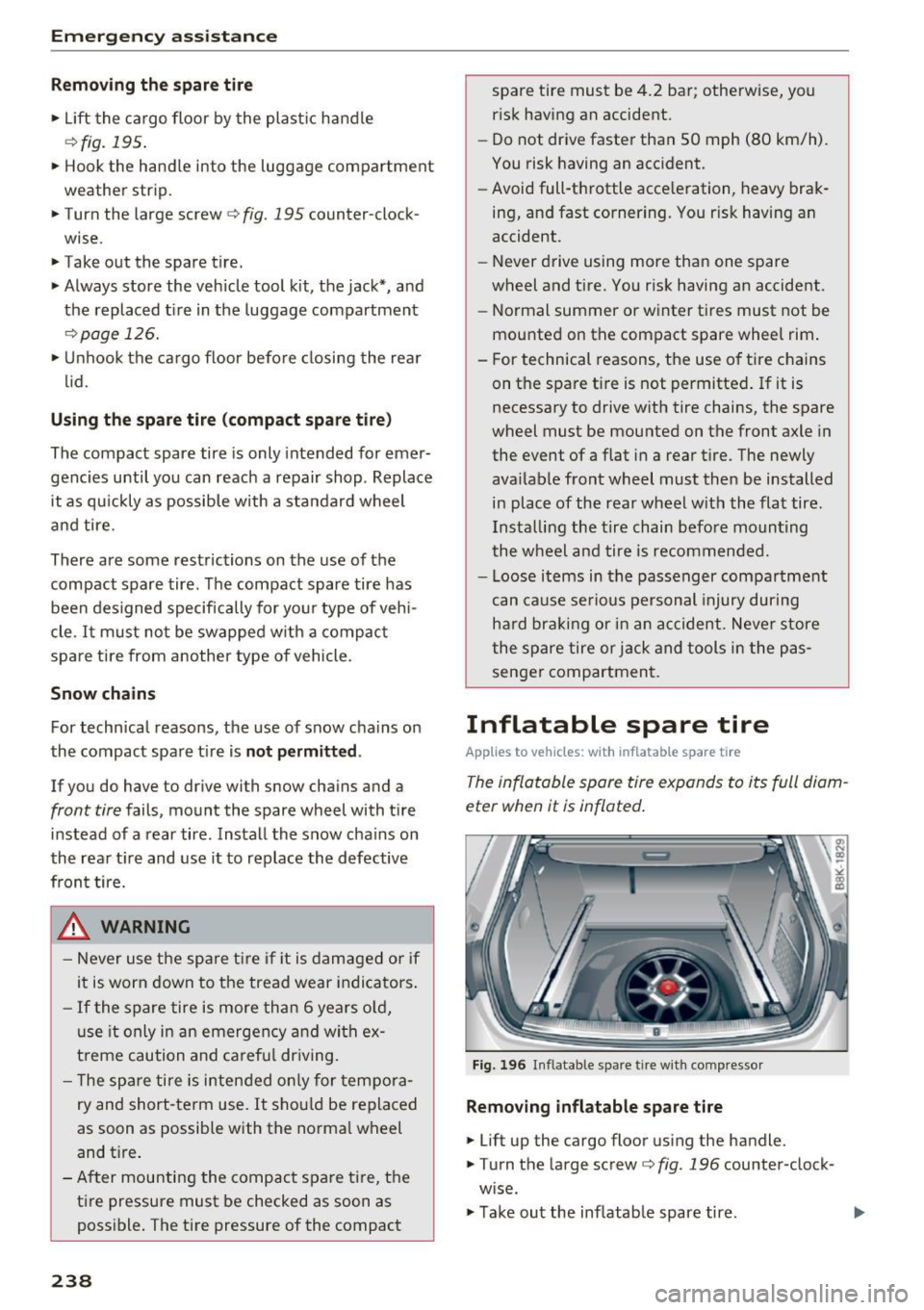
Inflatable spare tire
App lies to vehicles: with inflatable spare tire
The inflatable spare tire expands to its full diam
eter when it is inflated .
Fig. 196 Inflatable spare tire w ith comp resso r
Remo ving inflatab le spare tire
.. Lift up the cargo floor using the handle.
.. Turn the large screw¢
fig. 196 counter -clock
w ise.
.. Take out the inflatab le spare tire .
Page 241 of 278
,....,
N
0
""' CX) ,....,
I.Cl U"I ,....,
I.Cl ,....,
.,. Always store the vehicle tool kit, the jack* and
the replaced tire in the luggage compartment
e::> page 126 .
Stowing the inflatable spare tire
.,. Release the air by unscrewing the valve stem .
.,. Screw the valve stem back in afterwards.
.. Wait a few hours before placing the whee l in
the spare wheel well
e::> .&_.
.. Secure the wheel with the large screw.
.,. Fold the cargo floor back down.
After using the infl atabl e spare w hee l
The inflatable spare tire can be re-used as long as
it is not damaged and is not worn down to the
tread wear indicators~ .&..
When you le t the air out of the infla table spare
tire, it does not assume its folded shape again for
several hours. Until then, it cannot be placed
back in the spare wheel well and stowed securely .
A WARNING
-Never use the spare tire if it is damaged or if
it is worn down to the tread wear indicators.
- If the inflatable spare tire is more than 6
years old, use it on ly in an emergency and
with extreme caut ion and careful driving.
- The inflatab le spare tire is intended only for
temporary and short-term use. It shou ld be
replaced as soon as poss ible with the nor
mal wheel and tire.
- The tire pressure value for the inflatable
spare tire is located on the driver's s ide B
pillar
e::> page 227, fig. 190.
- Maximum perm iss ible speed is 50 mph
(80 km/h).
- Avoid full-throttle accelerat io n, heavy brak
ing, and fast corneri ng.
- When the air is let out of the inflatable
spare wheel, it does not assume its folded
shape for several hours. Until then, it can not be placed back in the spare wheel well
and stowed secu rely .
- Never drive with more than one inflatable
spare tire .
- For technical reasons ., the use of tire chains
on the inf latab le spare tire is not perm itted.
Em ergen cy a ssis tanc e
If it is necessary to drive with tire chains,
the inflatable spare wheel must be mounted
on the rear a xle in the event of a flat in a
front tire. The newly available rear whee l
must then be installed in place of the front
wheel wi th the flat t ire. Installing the t ire
chai n befo re mounting the whee l and tire is
re comme nded.
- L oose items in the passenger compartment
can cause se rious personal injury during
ha rd br aking or i n an accident . Never store
the inflatable spare tire or jack * and too ls in
the passenge r compartment .
(D Note
- The inflatable spa re t ire has been deve loped
specifically fo r thi s ve hicle mode l.
It must
not be exchanged or used for other vehicle
mode ls. S imilar ly, inf latab le tires from oth
er veh icle mode ls must not be used.
- Normal summer or w inte r tires must not be
installed on the inflatable t ire rim.
Inflating inflatable spare
tire
Applies to vehicles: wit h inflatable s pare tir e
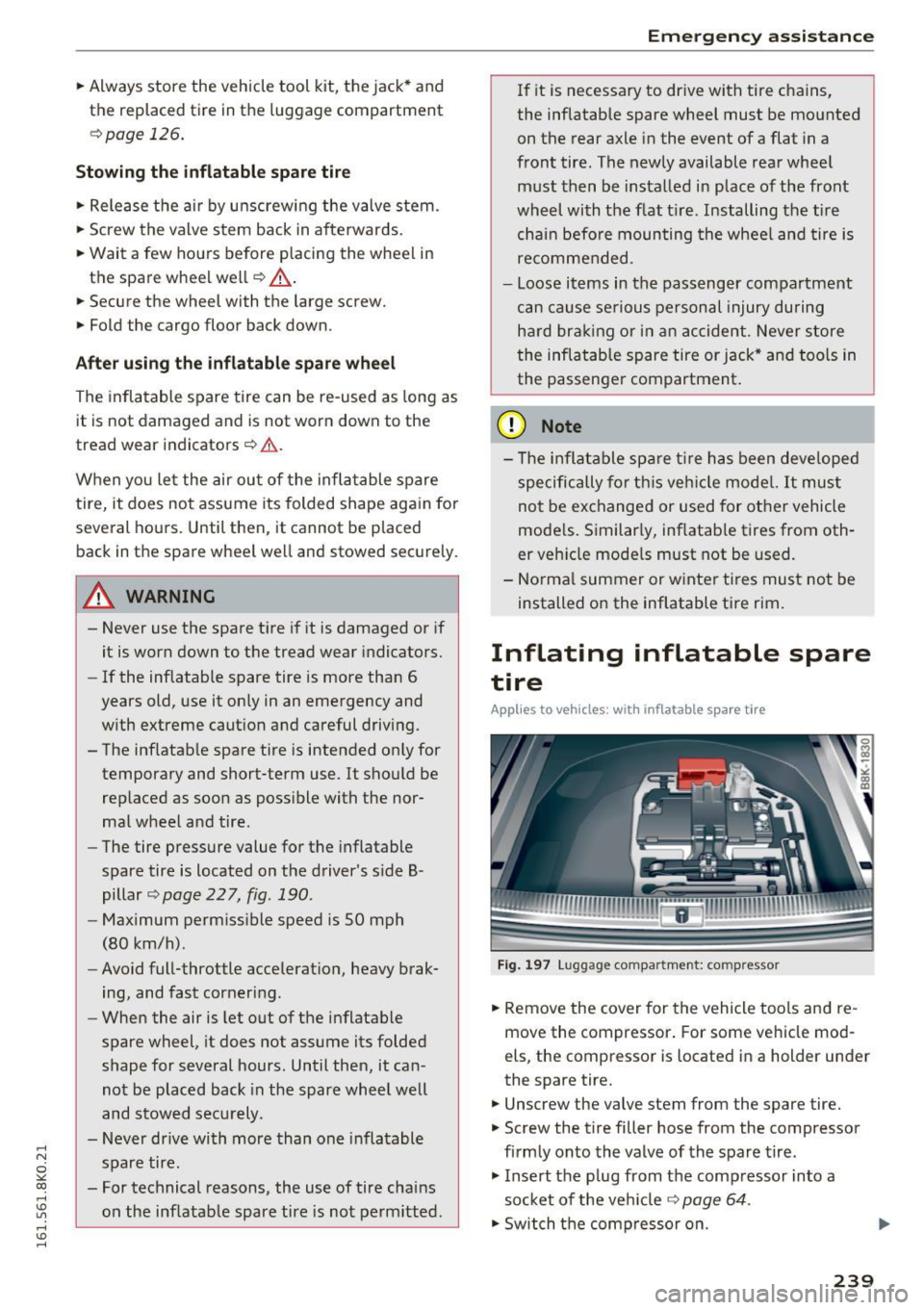
Fig. 19 7 Luggage compartm ent: compressor
.. Remove the cover for the vehicle tools and re
move the compressor . For some vehicle mod
els, the compressor is located in a holder under
the spare tire.
.. Unscrew the valve stem from the spare tire.
.,. Screw the t ire filler hose from the compressor
fi rmly onto the valve of the spare tire .
.,. Insert the p lug from t he comp ressor into a
soc ket of the veh icle
e:> page 64 .
.,. Sw itch t he comp ressor on. .,,.
239
Page 242 of 278
Emergency assistance
"'Let the compressor run until the va lue specified
on the tire pressure label is reach ed
¢ page 227, fig. 191 . Switch the compressor
off after running for 12 minutes at the mos t -
danger of overheating!
A WARNING
The compressor and the tire filler hose can become extremely hot while they are running
- danger of burns!
CD Note
Switch the compressor off after running for
12 minutes at the most -danger of overheat
ing! Allow the compressor to cool down for a
few minutes before you use it again.
Replacing wheels
Before changing a wheel
Observe the following precaut ions for your own
and your passenger's safety when changing a
wheel.
"' After you experience a tire failure, pull the car
well away from moving traffic and try to reach
level ground before you stop ¢.&_ .
"' All passengers shou ld
leave the car and move
to a safe location (for instance, behind the
guardrail) ¢.&_ .
"' Engage the
parking brake to prevent your vehi
cle from rolling unintentionally ¢&_ .
"' Sh ift into
1st gear on vehicles w ith manual
transmission, or move the
selector lever to the
P position
on vehicles with automatic transmis
sion .
"' If you are towing a trailer: unhitch the trailer
from your vehicle.
"' Take the
jack¢ page 237 and the spare tire
¢ page 238 out of the luggage compartment .
A WARNING
You or your passengers could be injured wh ile
chang ing a wheel if you do not follow these
safety precautions :
- If you have a flat tire, move a safe distance
off the road . Turn off the engine, turn the
240
emergency flashers on and use other warn
ing devices to alert other motorists.
- Make sure that passengers wait in a safe
place away from the vehicle and well away
from the road and traffic.
- To help prevent the vehicle from moving
suddenly and possibly slipping off the jack,
always fully set the parking brake and block
the wheel diagonally opposite the wheel be ing changed with the folding chocks or oth
er objects . When one front whee l is lifted
off the ground, placing the Automat ic
T ransmission in "P" (Par k) w ill
not prevent
the vehicle from moving.
- Before you change a wheel, be sure the
ground is level and firm . If necessary, use a
sturdy board under the jack.
- Always store the vehicle tool kit, the jack*
and the replaced tire in the luggage com
partment
¢ page 126.
CD Note
If you a re changing the wheel on a steep in
cline, use a rock or similar object to block the
opposite wheel to prevent the vehicle from
moving.
(D Tips
Obey all laws.
Changing a wheel
When you change a wheel, follow the sequence
described below step-by-step and in exactly that
order .
1. Remove the decorative wheel cover* or the
wheel bolt caps* . For more details see also
¢ page 241, Decorative wheel covers or
¢ page 241, Wheels with wheel bolt cops.
2. Loosen the wheel bolts ¢page 242.
3. Locate the proper mounting point for the
jack and align the jack below that point
¢ page 242.
4. Lift the car with the jack¢ page 242.
5. Remove the wheel with the flat tire and then
install the
spare tire ¢page 243.
6. Tighten all whee l bolts lightly .