air condition AUDI A4 2017 User Guide
[x] Cancel search | Manufacturer: AUDI, Model Year: 2017, Model line: A4, Model: AUDI A4 2017Pages: 386, PDF Size: 96.32 MB
Page 245 of 386
<( a, .... N ,....
N .... 0 0
3 a,
-Never leave your vehicle unattended espe
cially with the rear lid left open. A child
could crawl into the vehicle through the lug
gage compartment and close the rear lid be
coming trapped and unable to get out . Be
ing trapped in a vehicle can lead to serious
personal injury.
- Never let children play in or around the vehi
cle.
- Never let passengers ride in the luggage
compartment. Vehicle occupants must al
ways be properly restrained in one of the ve
hicle's seating positions.
-Air circulation helps to reduce window fog
ging . Stale air escapes to the outside
through vents in the trim panel. Be sure to
keep these slots free and open.
- The tire pressure must correspond to the
load. The tire pressure is shown on the tire
pressure label. The tire pressure label is lo
cated on the driver's side B-pillar. The tire
pressure label lists the recommended cold
tire inflation pressures for the vehicle at its
maximum capacity weight and the tires that
were on your vehicle at the time it was man
ufactured. For recommended tire pressures
for normal load conditions, please see chap
ter
c:> page 328.
Tie-downs
The luggage compartment is equipped with four
tie-downs to secure luggage and other items.
Use the tie-downs to secure your cargo properly
c:> page 242, Loading the luggage compar tment.
In a collision, the laws of physics mean that even
smaller items that are loose in the vehicle will
become heavy missiles that can cause serious in
jury . Items in the vehicle possess energy which
vary with vehicle speed and the weight of the
item. Vehicle speed is the most significant factor .
For example, in a frontal collision at a speed of
30 mph (48 km/h) , the forces acting on a 10-lb
(4 .5 kg) object are about 20 times the normal
weight of the item. This means that the weight
Driving safety
of the item would suddenly be about
200 lbs. (90 kg) . You can imagine the injuries
that a 200 lbs. (90 kg) item flying freely through
the passenger compartment could cause in a col
lision like this.
A WARNING
= -
Weak, damaged or improper straps used to
secure items to tie-downs can fail during hard
braking or in a collision and cause serious per
sonal injury.
- Always use suitable mounting straps and
properly secure items to the tie-downs in
the luggage compartment to help prevent
items from shifting or flying forward as dan
gerous missiles.
- When the rear seat backrest is folded down,
always use suitable mounting straps and
properly secure items to the tie-downs in
the luggage compartment to help prevent items from flying forward as dangerous
missiles into the passenger compartment.
- Never attach a child safety seat tether strap
to a tie-down.
Reporting Safety Defects
Applicable to U.S.A.
If you believe that your vehicle has a defect which could cause a
crash or could cause injury or
death, you should immediately in
form the National Highway Traffic Safety Administration (NHTSA) in
addition to notifying Audi of
America, Inc.
If NHTSA receives similar com
plaints, it may open an investiga
tion, and if it finds that a safety
defects exists in a group of
vehicles, it may order a recall and ""'
243
Page 255 of 386
<( a, .... N ,....
N .... 0 0
3 a,
Airbag system
Important information
Importance of wearing safety belts and
sitting properly
Airbags are only supplemental restraints. For
airbags to do their job, occupants must always
properly wear their safety belts and be in a prop
er seating position.
For your safety and the safety of your passen
gers, before driving off, always :
.,. Adjust the driver's seat and steering wheel
properly
9 page 237,
.,. Adjust the front passenger's seat properly
¢page 238,
.,. Wear safety belts properly¢ page 247,
.,. Always properly use the proper child restraint
to protect children ¢
page 2 77.
In a collision, airbags must inflate within the
blink of an eye and with considerable force. The
supplemental airbags can cause injuries if the
driver or the front seat passenger is not seated
properly. Therefore in order to help the airbag to
do its job, it is important, both as a driver and as
a passenger to sit properly at all times.
By keeping room between your body and the
steering wheel and the front of the passenger
compartment, the airbag can inflate fully and
completely and provide supplemental protection in certain frontal collisions
¢ page 237, Correct
seating position for passengers.
For details on
the operation of the seat adjustment controls
¢page 61.
It 's especially important that children are proper
ly restrained
¢page 277 .
There is a lot that the driver and the passengers
can and must do to help the individual safety fea
tures installed in your Audi work together as a
system.
Proper seating position is important so that the
front airbag on the driver side can do its job. If
you have a physical impairment or condition that prevents you from sitting properly on the driver
seat with the safety belt properly fastened and
Airbag system
reaching the pedals, or if you have concerns with
regard to the function or operation of the Ad
vanced Airbag System, please contact your au
thori zed Audi dealer or qualified workshop, or
call Audi Customer Relations at 1-800-822-2834
for possible modifications to your vehicle.
When the airbag system deploys, a gas generator
will fill the airbags, break open the padded cov ers, and inflate between the steering wheel and
the driver and between the instrument panel and
the front passenger. The airbags will deflate im
mediately after deployment so that the front oc
cupants can see through the windshield again
without interruption.
All of this takes place in the blink of an eye, so
fast that many people don't even realize that the airbags have deployed. The airbags also inflate
with a great deal of force and nothing should be
in their way when they deploy. Front airbags in
combination with properly worn safety belts slow
down and limit the occupant's forward move
ment . Together they help to prevent the driver
and front seat passenger from hitting parts of
the inside of the vehicle while reducing the forces
acting on the occupant during the crash . In this
way they help to reduce the risk of injury to the
head and upper body in the crash. Airbags do not
protect the arms or the lower parts of the body.
Both front airbags will not inflate in all frontal
collisions . The triggering of the airbag system de
pends on the vehicle deceleration rate caused by
the collision and registered by the electronic con
trol unit . If this rate is below the reference value
programmed into the control unit, the airbags
will not be triggered, even though the car may be badly damaged as a result of the collision. Vehi
cle damage, repair costs or even the lack of vehi
cle damage is not necessarily an indication of
whether an airbag should inflate or not.
Since the circumstances will vary considerably
between one collision and another, it is not possi
ble to define a range of vehicle speeds that will
cover every possible kind and angle of impact
that will always trigger the airbags . Important
factors include, for example, the nature (hard or
soft) of the object which the car hits, the angle of
impact, vehicle speed , etc. The front airbags will
II>
253
Page 257 of 386
<( a, .... N ,....
N .... 0 0
3 a,
about children and Advanced Airbags
¢ page 2 77.
E ven though yo ur vehicle is equipped with an Ad
vanced Airbag System, make certain that all chil
dren, especially those 12 years and younger, al
ways ride in the back seat properly restrained for
their age and size. The airbag on the passenger
side makes the front seat a potentially dangerous place for a child to ride. The front seat is not the
safest place for a child in a forward-facing child
safety seat .
It can be a very dangerous place for
a n infant or a child in a rearward-fac ing seat.
T he Advanced Airbag System in your veh icle has
been certified to comply with the requirements
of United States Federal Motor Vehicle Safety
Standa rd (FMVSS) 208, as well as Canada Motor
Veh icle Safety Standa rd (CMVSS) 208 as applica
b le a t the time your veh icle was m an ufact ured.
Accord ing to requirements, the front Advanced
Airbag System on the passenger side has been
certified for "suppression" for infants of about 12 month old and younger and for "low risk de
ployment" for children aged 3 to 6 years old (as
defined in the standard) .
T he
PASSENGER AIR BAG OFF ~ ; light in the
headliner tells you when the front Advanced Air
bag on the passenger side has been turned off by
the electronic control unit.
Each time yo u turn on the ignition, the
PASSEN
GER AIR BAG OFF ~; ON
@ light will come on
for a few seconds and:
- PASSENGER AIR BAG OFF~; will come on if
the front passenger seat is not occupied
- PASSENGER AIR BAG OFF~; will come on if
the e lectrica l capacitance measured by the ca
pacitive passenger detection system for the
front passenger seat equa ls the comb ined ca
pacitance of an infant up to about one year of
age and one of the rearward-facing or forward
facing child restra ints listed i n Federa l Moto r
Vehicle Safety Standard ( FMVSS) 208 with
wh ich the Advanced Airbag System i n your veh i
cl e was certified . Fo r a listing of the child re
straints that were used to ce rtify you r vehicle 's
compliance with the Safety Standard
¢ page 279 .
Airb ag sys tem
-PAS SENGER AIR BAG OFF~; will come on if
there is a small chi ld or child restraint on the
front passenger seat
- PASSENGER AIR BAG ON@ will come on if the
front passenger seat is occupied by an ad ult as
registered by the capacit ive passenger detec
tion system
¢ page 265, Monitoring the Ad
vanced Airbag System .
The PASSENGER AIR BAG OFF~; light comes on
when e lectrical capacitance registered on the
front passenger seat is equal to or less than the
combined capacitance of a typical 1 year-old in
fant and one of the rearward-facing or forward
facing child restrai nts listed in Federal Motor Ve
hicle Safety Standard ( FMVSS) 208 with wh ich
the Advan ced Airbag System in yo ur vehicle was
ce rtified.
If the total electr ical capacitance reg istered on
t h e front passenger seat is mo re than that of a
typ ical 1 year -old ch ild but less than the weight
of a sm all adult, the front air bag on the passen
ger side can deploy (the
PASSENGER AIR BAG
OFF ~;
light does not come on) .
If the
PASSENGER AIR BAG OFF~; light does
not come on, the front airbag on the p assenger
s ide has not been turned off by the electronic
contro l unit and can deploy if the contro l unit
senses an impact that meets the conditions stor
ed in its memory .
For example , the airbag may deploy if :
-a small c hild that is heav ier than a typ ica l 1
year -o ld child is on the front passenger se at
(regardless o f whethe r the child is in one o f the
child sa fe ty seats listed
¢ page 2 79), o r
- a child who has outgrown c hild rest raints is on
t he front passenge r seat .
If the front passenge r airbag is t urned off, the
PASSENGER AIR BAG OFF~; light comes on i n
t h e headliner a nd stays o n.
If the front passenger a irbag deploys, the Feder
al Standard requi res the airbag to meet the "low
r isk " dep loymen t criteria to redu ce the r isk of in
j u ry through interaction w it h t he airbag. "Low
risk" deployment oc curs in those crashes that
take place at lowe r decelerations as defined in
Ill>
255
Page 260 of 386
Airbag system
-Therefore, always wear your safety belts and
make sure that everybody in your vehicle is
properly restrained.
- Always hold the steering wheel with both
hands on the outside of the steering wheel
rim at the 9:00 o 'clock and 3 :00 o'clock po
sitions to help reduce the risk of personal in
jury if the driver's airbag inflates .
- Never hold the steering wheel at the 12
o'clock position or with your hands any
where inside the steering wheel or on the steering wheel hub. Holding the steering
wheel the wrong way increases the risk of
severe injury to the arms, hands, and head if
the driver airbag deploys.
A WARNING
Objects between you and the airbag will in
crease the risk of injury in a crash by interfer
ing with the way the airbag unfolds and/or by
being pushed into you as the airbag inflates.
- Always make sure nothing is in the front air-
-
bag deployment zone that could be struck
by the airbag when it inflates.
- Objects in the zone of a deploying airbag
can become projectiles when the airbag de
ploys and cause serious personal injury.
- Never hold things in your hands or on your lap when the vehicle is in use .
- Never place accessories or other objects
(such as cup holders, telephone brackets,
note pads, navigation systems, or things
that are large, heavy, or bulky) on the doors;
never attach then to the doors or the wind
shield; never place them over or near or at
tach them to the area marked ,.AIRBAG" on
the steering wheel, instrument panel or the
seat backrests; never place them between
these areas and you or any other person in
the vehicle.
- Never attach objects to the windshield
above the passenger front airbag, such as
accessory GPS navigation units or music
players. Such objects could cause serious in
jury in a collision, especially when the air bags inflate .
258
-Never recline the front passenger seat to
transport objects. Items can also move into
the deployment area of the side airbags or
the front airbag during breaking or in a sud
den maneuver . Objects near the airbags can
fly dangerously through the passenger com
partment and cause injury, particularly
when the seat is reclined and the airbags in
flate.
A WARNING
A person on the front passenger seat, espe
cially infants and small children, will receive
serious injuries and can even be killed by be ing too close to the airbag when it inflates .
- Although the Advanced Airbag System in
-
your vehicle is designed to turn off the front
passenger airbag if an infant or a small child
is on the front passenger seat, nobody can
absolutely guarantee that deployment un
der these special conditions is impossible in
all conceivable situations that may happen
during the useful life of your vehicle.
- The Advanced Airbag System can deploy in
accordance with the .,low risk" option for 3-
and 6-year-old children under the U.S . Fed
eral Standard if a child with electrical capac
itance greater than the combined capaci
tance of a typical one-year old infant re
strained in one of the forward facing or rear
ward-facing child seats with which your ve
hicle was certified is on the front passenger
seat and the other conditions for airbag de
ployment are met.
- Accident statistics have shown that children
are generally safer in the rear seat area than
in the front seating position.
- For their own safety, all children, especially
12 years and younger, should always ride in
the back properly restrained for their age and size.
Advanced front airbag system
Your vehicle is equipped with a front Advanced
Airbag System in compliance with United States
Federal Motor Vehicle Safety Standard (FMVSS)
208 , as well as Canada Motor Vehicle Safety ..,.
Page 279 of 386
Child safety
Important information
Introduction
The rear seat is generally the safest place in a
collision .
The physical principles of what happens when
your vehicle is in a crash apply also to children
c:> page 246, What happens to occupants not
wearing safety belts? .
But unlike adults and
teenagers, their muscles and bones are not fully
developed. In many respects children are at
greater r isk of serious injury in crashes than
adults .
Because children's bodies are not fu lly devel
oped, they require restraint systems especially
designed for their size, weight , and body struc
ture. Many countries and all states of the United
States and provinces of Canada have laws requir
ing the use of approved child restraint systems
for infants and small children .
I n a frontal crash at a speed of 20-3 5 mph
(30-56 km/h) the forces acting on a 13-pound
(6 kg) infant will be more than 20 times the
weight of the child . This means the weight of the
child would suddenly be more than 260 pounds (120 kg) . Under these conditions, only an appro
priate child restraint properly used can reduce
the risk of serious injury . Child restra ints, like
adult safety belts, must be used properly to be
effect ive. Used improperly, they can increase the
risk of serious injury in an accident .
All ch ildren, especially those 12 years and young
er must always ride in the back seat proper ly re
strained for their age and size. If you must install
a child restraint on the front passenger seat in
exceptional circumstances, be sure to read and
heed the important information and warnings
c:>page 254. Infants and other children who are
properly restrained in an appropriate child re
straint that is for their si ze and age can benefit
from the protection that supplemental side air-
<( ~ bags provide in some kinds of crashes.
N ,....
:=:: For more information please see information
0
3
provided by the:
- National Highway Traffic Safety Administration
(NHTSA), currently at: http :/ /www.safe
rcar.gov (for the USA)
- Transport Canada Information Centre, current-
ly at: http://www.tc .gc.ca (for Canada)
Consult the child safety seat manufacturer's in
structions in order to be sure the seat is right for
yo ur child's size
c:> page 281 , Important safety
instructions for using child safety seats .
Please
be sure to read and heed all of the important in
formation and WARNINGS about child safety,
Advanced Airbags, and the installation of child
restra ints in this chapter .
There is a lot you need to know about the Ad
vanced Airbags in your vehicle and how they work
when infants and children in child restraints are on the front passenger seat . Because of the large
amount of important informat ion, we cannot re
peat it all he re . We urge you to read the detailed
information in this owner's manual about airbags
and the Advanced Airbag System in your vehicle
and the very important information about trans
porting children on the front passenger seat.
P lease be sure to heed the WARNINGS -they are
extremely important for your safety and the safe
ty of your passengers, especially infants and
small children .
A WARNING
--Accident statistics have shown that children
are generally safer in the rear seat area than
in the front seat ing pos ition. Always restrain
any child age 12 and under in the rear.
- All vehicle occupants and especially children
must be restrained properly whenever riding
in a vehicle. An unrestrained or imp roperly
rest rained child could be injured by striking
the interior or by being ejected from the ve hicle during a sudden maneuver or impact.
An unrestrained or improperly restrained
child is also at greater risk of injury or death
through contact w ith an inflating a irbag.
- A suitable child restraint properly installed
and used at one of the rear seating positions
provides the h ighest degree of protection
for infants and small children in most acci
dent situat ions .
277
Page 314 of 386

Check ing and F illing
right brake fluid and the know -how to do this for
you.
A WARNING
- Brake fluid is poisonous. It must be stored
only in the closed orig inal container out of
the reach of chi ldren!
- B rake failure can resu lt from old or inappro
pr iate brake flu id. Observe these precau
t ions:
- Use on ly brake fluid that mee ts SA E speci
fi cation) 17 0 3 and confo rms to Fede ral
Motor Ve hicle Standard 116. Always check
wit h your authorized Audi dealer to make
sure you are using the correct brake fluid.
The cor rect type o f brake fluid is a lso indi
cated on the brake fluid reservoir.
- The brake fluid must be new. Heavy use of
the brakes can cause a vapor lock if the
brake flu id is left in the system too long.
This ca n ser iously affect t he efficiency of
the bra kes as well as your safety. This
could result in an acc ident.
{U) Note
Brake fluid w ill damage the pa int of yo ur vehi
cle.
@ For the sake of the environment
Because of the prob lem of proper disposal of
brake flu id as we ll as the special tools re
quired and the necessary expertise, we rec
ommend tha t you have the brake fluid
changed by your author ized Audi d ealer.
Battery
General information
Unde r normal operating conditions, the battery
i n your Audi does not need any maintenance.
W ith
high outs ide temperat ures o r long da ily
d rives we recommend that you have the electro
lyte leve l checked by an a uth orized Audi dea le r or
qua lified wor kshop. The e lectroly te leve l should
a lso be checked each time the batte ry is ch a rged
¢ page 314.
312
Have t he battery chec ke d when yo u take yo ur ve
hicle in for service . You are we ll advised to re
place a battery that is o lder than 5 yea rs .
With ce rta in types o f airbag deployment, t he
b atte ry is disconnected from the veh icle elect ri
ca l system for safety reasons ¢.&
in Repair, care
and disposal of the airbags on page 268.
Disconnecting the battery terminals
Some ve hicl e fu nctions (power window regula
tors, for examp le) are lost if the batte ry te rm i
nals a re disconnected . These f unc tions have to be
relearned after the battery term inals are con
nected again . To p revent this, the battery should
o nl y be disconnected from the vehicle electrical
system when absolute ly necessary for repairs.
Vehicles not driven for long periods
If you do not d rive yo ur vehicle ove r a period of
severa l days o r weeks, electr ica l components are
grad ua lly cut back or switched of f. T his reduces
energy consumpt ion and maintains start ing ca
pability over a longer period ¢
page 138.
Some of the convenience functions may not oper
ate, such as the inter ior lights or the power seat
adjustment . The convenience functions will be
available again w hen you turn on the ignit io n and
start the eng ine .
Winter operation
Dur ing the winte r months, battery capacity tends
to decrease as tempe ratures drop. This is be
ca use more power is also consumed while start
i ng, and t he headlights, rear w indow defogger,
etc ., are used more often.
Avo id unnecessary powe r consumption, partic u
l a rly in city traffic or when traveling o nly short
distances . Let your author ized Audi dealer check
the capacity of the vehicle battery before win ter
sets in ¢
page 314 . A well charged battery will
n ot only p reve nt sta rting prob lems when the
we ather is co ld , but will also last longer.
@ Tips
I f yo ur vehicle is left sta nding for several
weeks at extreme ly low te mpera tures, th e ve-
h icl e b att ery should be re mo ved and store d
II>-
Page 334 of 386

Wheels
bolts and a special procedure. You must never
repair or disassemble them ¢
.&..
A WARNING
Wheel bolts that are tightened or repaired in
correctly can become loose and result in loss
of vehicle control, which increases the risk of
an accident. For the correct t ightening specifi
cation, refer to ¢
page 348, Finishing .
-Always keep the wheel bolts and the
threads in the wheel hub clean and free of
grease .
- Only use wheel bolts that fit the rim .
- Always have damaged rims repaired by an
authorized Audi dealer or authorized Audi
Service Facility . Never repair or disassemble
rims yourself, because this increases the risk
of an accident.
Winter tires
W inter tires significantly improve the vehicle's
handling when driving in winter conditions. Be
cause of their construction (width, compound,
tread pattern) , summer tires provide less trac
tion on ice and snow.
.,. Use winter t ires on all four wheels.
.,. Only use winter tires that are approved for your
vehicle.
.,. Please note that the maximum permitted
speed may be lowe r with winter tires
q ,&. . An
authori zed Audi dealer or authori zed Audi Serv
ice Facility can inform you about the maximum
permitted speed for your tires .
.,. Check the tire pressure after installing wheels
¢page 327.
The effectiveness of winter tires is reduced great
ly when the tread is worn down to a depth of
0 .16 in (4 mm) . The characteristics of winter
tires also decrease great ly as the tire ages, re
gardless of the remaining tread .
A WARNING
-Never drive faster than the maximum per
mitted speed for your tires. This could cause
the tires to heat up too much. This increases
332
-
the risk of an accident because it can cause
the tire to burst.
- Always adapt your driving to the road and
traffic conditions . Drive carefully and reduce
your speed on icy or slippery roads . Even
winter tires can lose traction on black ice .
@ For the sake of the environment
Reinstall summer tires at the appropriate
time, because they prov ide better handling
when roads are free of snow and ice. Summer
tires cause less road noise, tire wear and fuel
consumpt ion .
(D Tips
You can also use all season tires instead of
winter tires. Please note that in some coun
tries where winter tires are required, only
winter tires w ith the ~ symbol are permitted .
Snow chains
Snow cha ins not only improve the driving in win
ter road condit ions, but also the braking.
.,. Only install snow chains on the
front wheels .
This applies a lso to vehicles with all wheel
drive* .
.,. Check and correct the seating of the snow
chains after driving a few feet, if necessary. Fol
low the instructions from the manufacturer.
.,. Note the maximum permitted speed when driv
ing with snow chains. Do not exceed 30 mph
(SO km/h) .
Use of snow chains is only permitted with certain
rim/tire combinations due to technical reasons.
Check with an authorized Audi deale r or author
ized Audi Service Facility to see if you may use
snow chains .
Use
fine-mesh snow chains. They must not add
more than 0.53 in (13 .5 mm) in height, including
the chain lock.
You must remove the snow chains on roads with
out snow. Otherwise , you could impair driving
ability and damage the tires .
Page 335 of 386
<( a, .... N ,....
N .... 0 0
3 a,
A WARNING ,~
Using incorrect snow chains or insta lling snow
chains incorrectly can result in loss of vehicle
control, which increases the risk of an acc i
dent.
(D Note
Snow chains can damage the r ims/wheel cov
ers* if the chains come into d irect contact
w ith them. Remove the wheel covers* before
hand . Use coated snow chains.
{1) Tips
When using snow cha ins, it may be useful to
sw itch on sport mode
¢page 135.
Low aspect ratio tires
Your Aud i is facto ry-equipped with low aspect ra
tio ti res. These t ires have been tho rough ly tested
and been se lected specifically for yo ur model for
their superb per formance, road feel and handling
under a variety of driving conditions. Ask your au
thorized Audi dealer for more details .
The low aspect ratio of these t ires is indica ted by
a numera l of
55 or les s in the tire's size designa
tion. The numeral represents the ratio of the
tire's sidewall height in r elation to its tread width
expressed in percentage. Conventional tires have
a height/w idth rat io of 60 or more.
The performan ce of low-aspect- ratio tire s is par
ticularl y sensiti ve to improper inf lat ion pres
sure . It is therefore impo rtant that low aspect
ratio tir e s are infl ated to the specified pressu re
and tha t the inflation pr essure is regularly
checked and maint ained . Tire pre ssure s should
be check ed at lea st once a month and alwa ys
b efore a long trip<=:>
page 32 7.
What you can do to a void tire and rim
damage
L ow aspect rat io tires can be damaged more easi
l y by impact with potho les, cu rbs, gull ies or
r idges on the road, pa rtic ularly if the tire is un
derinflated.
Wh eel s
In order to min imize the occurrence o f impact
damage to the tires of your vehicle, we recom
mend that you observe the following precau
t ions:
- Always maintain recommended inflation pres
sures . Check your tire pressure every 2,000
m iles (3,000 km) and add air if necessary .
- Drive carefully on roads with potholes, deep
gu llies or ridges . The impact from driving
through or over such obstacles can damage
your tires. Impact with a curb may a lso cause
damage to your tires.
- After any impact, immed iate ly inspect your
tires or have them inspected by the nearest au
thorized Audi dealer . Replace a damaged tire as
soon as possible .
- Inspect your tires every 2,000 m iles (3,000 km)
for damage and wear. Damage is not always
easy to see . Damage can lead to loss of a ir and
underinflation, wh ich could eventually cause
tire fa ilu re . If yo u bel ieve that a tire may have
been damaged, replace the tire as soon as pos
sible.
= These tires may wear mo re quickly tha n others.
- Please also remember that , while these tires
de live r responsive ha nd ling, they may ride less
comfort ably and make more noise t han other
choices .
Reduced performance in w inter /cold season
conditions
All tires are des igned for certai n pu rposes. The
low aspect ratio, ultra high performance tires
origina lly installed on your vehicle are intended
for maximum dry and wet road performance and handling. They are not suitable for co ld, snowy or
icy weather conditions. If you drive under those
c ircumstances, you should equip your vehicle
with all -season or winter tires, which offer better
tract ion under those conditions . We suggest you
use the recommended s now or a ll-season tires
spe cified for your vehicle, o r their equiva lent.
Refer
to <=:> page 332 for more detailed informa
t ion regard ing winter tires.
Uniform tire quality grad ing
- Tread wear
333
Page 342 of 386
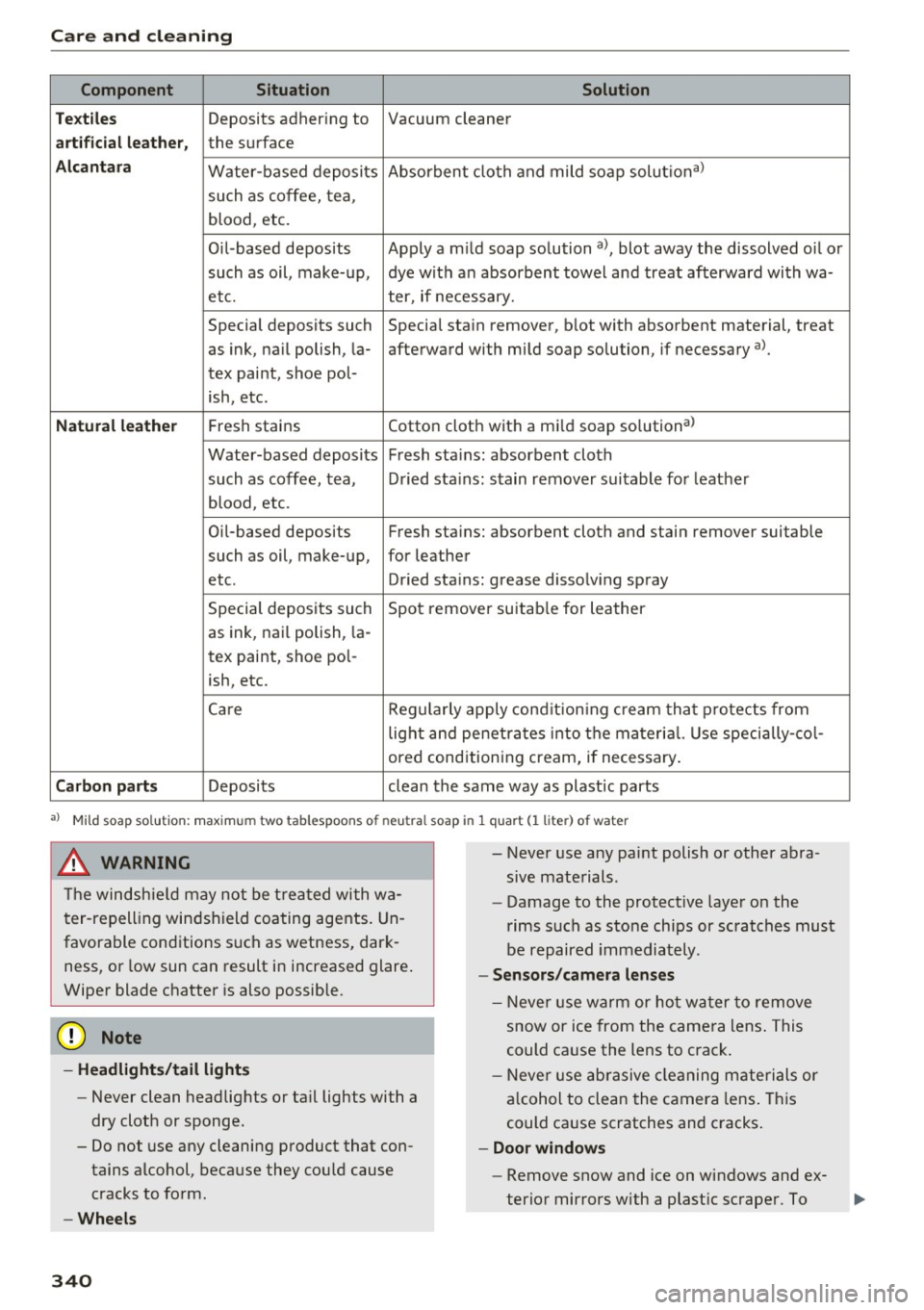
Care and cleaning
Component Situation Solution
Te xtil es
Deposits adhering to Vacuum cleaner
a rt ifici al le ather , the surface
Alcant ara Water-based deposits Absorben
t cloth and mild soap solutiona>
such as coffee, tea,
blood, etc.
O il-based deposits Apply a m ild soap solution a), blot away the dissolved oil or
such as oil, make-up, dye with an absorbent towel and treat afterward with wa-
etc. ter, if necessary.
Special deposits such Special stain remover, b lot with absorbent material, treat
as ink, na il polish, la- afterward with mild soap solution, if necessary a).
tex paint, shoe pol-
ish, etc.
Natural leather Fresh stains Cotton cloth with a mi
ld soap solutiona>
Water-based deposits Fresh sta ins : absorbent cloth
such as coffee, tea, Dried sta ins: stain remover suitable fo r leather
blood, etc.
Oil-based deposits Fresh stains: absorbent cloth and stain remover suitable
such as oil, make-up, for leather
etc. Dried sta ins : grease dissolv ing spray
Special deposits such Spot remover suitab le for leather
as ink, nai l polish, la -
tex paint, shoe pol-
ish, etc.
Ca re Regularly apply cond ition ing cream that protects from
light and penet rates into the materia l. Use specia lly-co l-
ored conditioning cream, if necessary.
Carbon parts Deposits clean the same way as plastic parts
a) Mild soap solution: maximum two tablespoons of neutral soap in 1 quart (l liter) of water
_& WARNING
The windshie ld may not be trea ted with wa
ter-repelling windshield coating agents. Un
favorable conditions s uch as wetness, dark
ness, or low sun can result in increased glare .
Wiper blade chatter is also possible.
(D Note
- Headlights/tail light s
-Never clean headlights or tail lights with a
dry cloth or sponge.
- Do not use any cleaning product that con
tains alcohol, because they could cause
cracks to form.
- Wheels
340
-
- Never use any paint polish or other abra
sive materials.
- Damage to the protect ive layer on the
rims such as stone chips or scratches must
be repaired immediately.
- Sensors /camera lenses
- Neve r use wa rm or ho t wa ter to remove
snow or ice from the camera lens . This
could cause the lens to crack .
- Neve r use ab rasive cleaning materials or
a lcohol to clea n the camera lens . This
could cause scratches and cracks .
-Doo r window s
-Remove snow and ice on windows and ex-
terior mirrors with a plast ic scraper. To
Page 365 of 386
<( a, .... N ,....
N .... 0 0
3 a,
Consumer information
Warranty coverages
Y our Audi is co vered b y the foll owing war ran
tie s:
- New Vehicle Limited Warranty
- Limited Warranty Against Corrosion Perfora-
tion
- Emissions Control System Warranty
- Emissions Performance Warranty
- California Emissions Control Warranty (USA
vehicles only)
- California Emissions Performance Warranty
(USA vehicles only)
Detailed information regard ing your warranties
can be found in yo ur
W arranty & M ainten ance
bookl et.
Operating your vehicle
outside the U.S.A. or
Canada
Government reg ulations in the Un ited States and
Canada require that automobiles meet specific
emission regulations and safety standards.
Therefore, vehicles built for the U .S.A. and Cana
da differ from vehicles sold in other countries.
I f you p lan to take your vehicle outside the conti
nenta l limits of the United States or Canada,
there is the poss ibility that:
- u nleaded fue ls for vehicles with cata lytic con
verter may not be available;
- fuel may have a considerably lower octane rat
i ng. Imprope r fuel may ca use engine damage;
- service may be inadequate due to lack of p roper
service facilities, tools or testing eq uipment;
- r eplacement parts may not be readily ava ilable.
- Navigation systems for veh icles built for the
U .S .A . and Canada will not necessa rily work in
E urope, and may not wo rk in other countries
outside of North Amer ica.
Con sumer inf ormation
(D Note
Audi cannot be respons ible for mechanical
damage that could resu lt from inadequate
fuel, service or parts ava ilability.
Audi Service Repair
Manuals and Literature
Audi Official Factory Service Manuals and L itera
ture are published as soon as poss ible after mod
el introduction. Service Ma nua ls and literature
are avai lab le to order from the Audi Tec hni cal Lit
erature Ordering Center at:
www .audi .t e chlit eratur e.com
Maintenance
General
Your vehicle has been designed to he lp keep
maintenance requirements to a min imum. How
ever, a certain amount of regular maintenance is
still necessary to assure your veh icle's safety,
economy and reliab ility . For detailed vehicle
maintenance consult your Wa rranty
& Mainte
nance book let .
Und er diff icult op erating condition s, for exam
ple at extremely low outside temperatures, in
very dusty regions, when towing a trai le r very fre
quently, etc., some service work shou ld be per
fo rmed between the in terv als specified. This ap
plies particularly to:
- oil changes, and
- cleaning or replacing the a ir filter .
(® For the sake of the environment
By regularly maintain ing your vehicle, you
help make sure that emiss ion standards are
maintai ned, thus min imizing adverse effects
on the environment .
Important considerations for you and your
vehicle
The increasing use of electronics, sophisticated
fuel injection and emission control systems, and
the generally increas ing technica l complexity of ""'
363