engine oil AUDI A4 2017 User Guide
[x] Cancel search | Manufacturer: AUDI, Model Year: 2017, Model line: A4, Model: AUDI A4 2017Pages: 386, PDF Size: 96.32 MB
Page 309 of 386
<( a, .... N ,....
N .... 0 0
3 a,
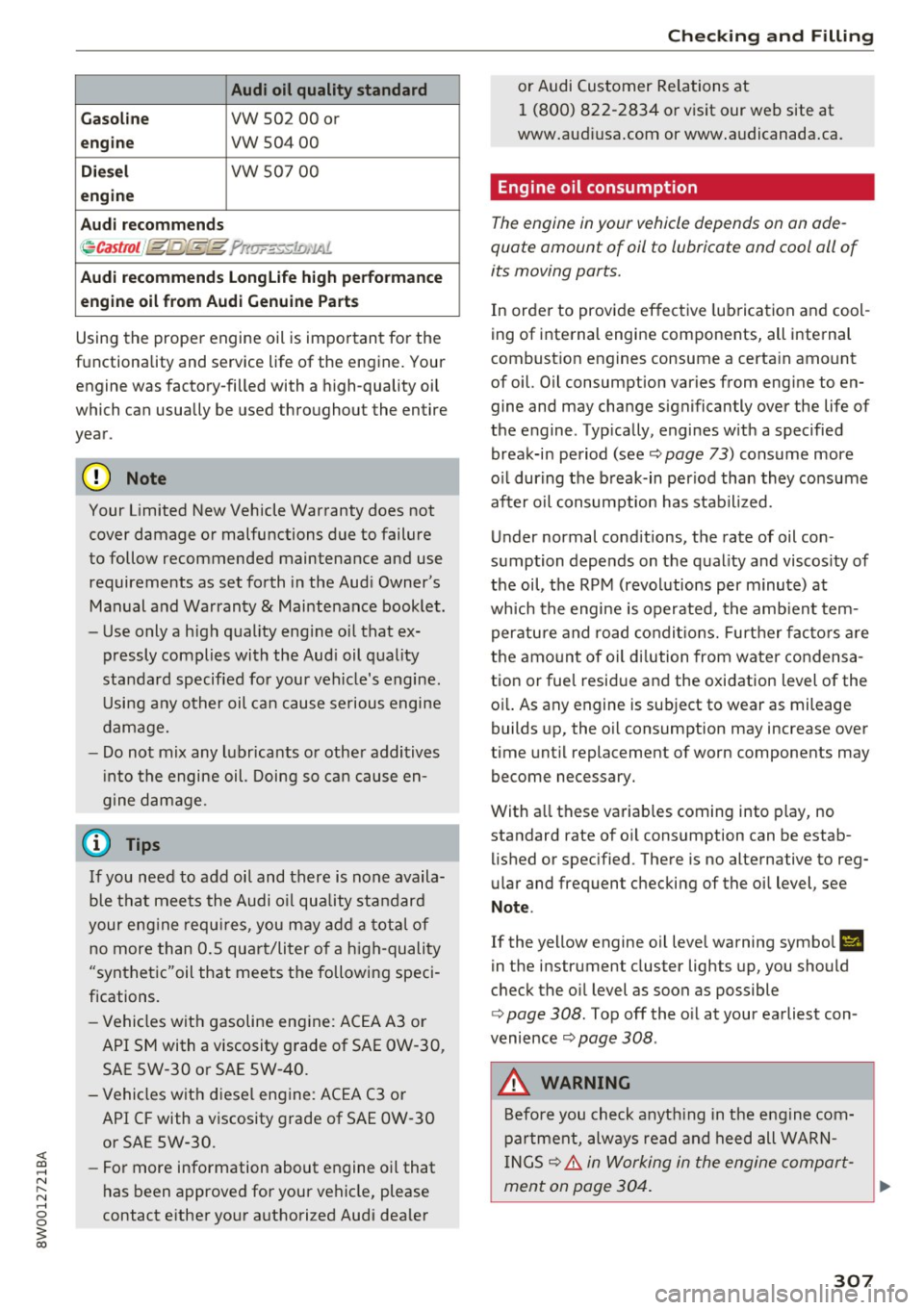
Audi oil quality standard
Gas oline
VW 502 00 or
engi ne vw 504 00
Diesel vw 507 00
eng ine
A udi recomm ends
~ Castrot /jglQ,Y j;-11Jt ?rtwF«J.o,.11-J.
Audi recomm ends Longlife high perf orma nce
engine oil from Aud i Genuine Parts
Using the proper engine oil is important for the
functionality and service life of the eng ine. Your
engine was factory-filled with a high-quality oil
which can usually be used throughout the entire
year.
(D Note
Your Limited New Vehicle Warranty does not
cover damage or malfunctions due to failure
to follow recommended maintenance and use
requirements as set forth in the Aud i Owner's
Manual and Warranty
& Maintenance booklet .
- Use only a high quality eng ine oil that ex-
pressly complies with the Aud i oil quality
standard specified for your vehicle's engine .
U si ng a ny other oil can cause serious engine
damage.
- Do not mix any lubr icants or othe r additives
i nto the engine oil. Doing so can cause en
gine damage.
If you need to add oil and there is none availa
ble that meets the Audi o il quality standard
your eng ine requ ires, you may add a tota l of
no more than 0 .5 qua rt/liter of a h igh-quality
"synthetic"oil that meets the following speci
fications.
- Vehicles with gasoline engine: AC EA A3 or
API SM with a viscosity grade of SAE OW-30,
SAE SW-30 or SAE 5W-40.
- Vehicles with diesel engine: ACEA C3 or API CF with a viscosity grade of SAE OW-30
or SAE 5W-30.
- For more information about engine oil that
has been approved for your vehicle, please
contact either your authorized Audi dea ler
Ch eck ing and Filling
or Audi Customer Relations at
1 (800) 822-2834 or visit our web site at
www.aud iusa .com or www .a udicanada .ca.
Engine oil consumption
The engine in your vehicle depends on on ade
quate amount of oil to lubricate and cool all of
its moving ports.
In order to provide effective lubrication and cool
ing of internal engine components, all internal
combust ion eng ines consume a certa in amount
of oil. Oil consumption varies from eng ine to en
gine and may change s ignificantly over the life of
the engine. Typ ically, engines w ith a specified
break-in period (see
c::> page 73) consume more
o il during the break-in per iod than they consume
after oil consumpt ion has stabil ized.
Under normal cond itions, the rate of oil con
sumption depends on the quality and viscos ity of
the oil, the RPM (revolutions per minute) at
which the engine is operated, the amb ient tem
peratu re and road co ndit ions. Furt her fac to rs a re
the amo unt of oil di lution from wate r condensa
tion or fuel residue and the oxidation level of the oi l. As any engine is subject to wear as mileage
builds up, the oil consumption may increase over
time unt il replacement of worn components may
become necessary.
With a ll these variab les coming into play, no
standard rate of oil consumption can be estab
lished or spec ified . There is no alternative to reg
ular and frequent checking of the oi l level, see
Not e.
If the yellow engine oil level warning symbo l El
in the instrument cluster lights up, you should
check the oil level as soon as possible
c::> page 308 . Top off the o il at your earliest con
venience
c::> page 308 .
A WARNING
Before you check anyt hing in the engine com
partment, always read and heed all WARN
IN GS
c::> .&. in Working in the engine compart-
ment on page 304. ..,_
307
Page 310 of 386

Check ing and F illing
CJ) Note
Driving with an insufficient oil level is likely to
cause severe damage to the engine .
@ Tips
-The oil pre ssure warn ing display. is not
an ind icato r of the oil l evel. Do not rel y on
it. In stead , che ck th e oil le vel in your e n
gi ne a t regul ar int ervals, prefe rably e ach
t ime you re fuel , and al ways befo re go ing
on a long trip .
-If you have the impression your engine con
sumes excessive amounts of oil, we recom
mend that you consult an authorized Aud i
dealer to have the cause of your concern
properly d iagnosed . Keep in mind that the
accurate measurement of oil consumpt ion
r equi res great ca re and may take some
time. An authorized Audi dealer has instruc
tions about how to measure oil consump
tion accurately.
Checking the engine oil level
The engine oil level can be checked in the Info
tainment system
.. Park you r vehicle on a level surface.
.. Shut the engine off when it is warm.
.. Switch only the ignition back on.
.. Wait approximately two minut es .
.. Se lect in the Infotainment system: the
I MENU I
button > Ve hicle > left cont rol button > S er vice
& c h ecks > Oil lev el.
.. Check the oil level in the Infotainment system
display . Add engine oil if the bar in the oil level
indicato r is near "min "¢
page 308 .
The engine oil consumpt ion may be up to
0 .5 quart pe r 600 miles (0.5 l iter/1,000 km), de
pending on driving style and operating condi
tions. Consumption may be highe r d uring the
fi rst 3 ,000 mi les (5,000 km). Because of this, the
engine o il level must be checked regu larly. I t
wou ld be best to check each time you refuel your
vehicle and before long drives .
308
(D Tips
The oil level indicator in the disp lay is only an
i nformat ional disp lay .
If the oil leve l is too
l ow, a min imum oil warning appears in the in
strument cluster. Add oil and close the hood.
The current oil level is displayed in the instru
ment cluster the next t ime the ignition is
switched on.
Adding engine oil
cover
.. Read a nd follo w all WARNIN GS before check
ing anything in the engine compartment ¢
A
in Working in the engine compartment on
page 304 .
.. Turn the engine off .
.. Unscrew the cap
ce--: for the engine oil filling
opening <=>
fig. 248, <=> page 306 .
.. Carefully add 0 .5 quart (0.5 l iter) of the correct
oil ¢
page 306.
.. Check the oil level aga in after two minutes
¢ page 308, Checking the engine oil level .
.. Add more o il if necessary.
.. Close the engine oi l filler opening cap .
A WARNING
-When adding oil, do not let oil drip onto hot
engine components. This increases the risk
of a fire.
- You must secure the cap on the oil f iller
open ing correctly so that oil does not leak
out onto the hot engine and exhaust system
when the engine is runn ing, because this is
a fire hazard .
- Always clean sk in thoroughly if it comes into
contact with eng ine oil.
Page 311 of 386
<( a, .... N ,....
N .... 0 0
3 a,
CD Note
-Check the oil level in the Infotainment sys
tem. If the message
II Please reduce oil
level
appears, contact an authorized Audi
dealer or authorized Audi Service Fac ility to
have excess oil extracted if necessary.
- Do not mix any additional lubricants into
the engine o il. Damage caused by such addi
tives is not covered by the warranty .
@ For the sake of the environment
-Oil should never enter the sewer system or
come into contact with the ground.
- Pay attention to legal requirements when
dispos ing of empty oil containers.
Changing the engine oil
We recommend that have your oil changed by an
authorized Audi dealer or a qualified service sta
tion.
Before you check anything in the engine compart
ment,
always read and heed all WARNINGS c> A
in Working in the engine compartment on
page 304 .
The engine oil must be changed according to the
intervals specified in your Warranty
& Mainte
nance booklet. This is very important because the
lubricating properties of oil diminish gradually
during normal vehicle use.
Under some circumstances the engine oil should
be changed more frequently . Change oil more of
ten if you drive mostly short distances, operate
the vehicle in dusty areas or under predominantly
stop-and-go traffic cond it ions, or have your vehi
cle whe re temperatures remain below freezing
for extended pe riods.
Detergent additives in the oil will make fresh oil
look dark after the engine has been running for a
short time. This is no rmal and is not a reason to
change the oil more often than recommended.
Because of the problem of proper disposal, along
with the special tools and necessary expertise re
qu ired, we strong ly recommend that you have
Checking and Filling
your oi l changed by an authorized Audi dealer or
a qualified service station .
If you choose to change your oil yourself, please
note the following important info rmation:
A WARNING ~
To reduce the risk of persona l injury if you
must change the engine oil in your vehicle
yourself:
- Wear eye protection.
-
-To reduce the risk of burns from hot engine
oil, let the engine cool down to the touch.
- When remov ing the oil drain plug with your
fingers, stay as far away as possible. Always
keep your forearm parallel to the ground to
help prevent hot oil from running down your
arm.
- Drain the oil into a container designed for
this purpose, one large enough to hold at
least the tota l amount of oil in your engine.
- Engine oil is poisonous. Keep it well out of
the reach of children.
- Continuous contact with used engine oil is
harmful to your skin. Always protect your
skin by washing oil off thoroughly with soap
and water.
CD Note
Never mix oil additives with your engine oil.
These additives can damage your engine and
adverse ly affect your Audi Limited New Vehi
cle Warranty.
@ For the sake of the environment
-Before changing your oi l, first make sure
you know where you can properly dispose of
the used oil.
- Always dispose of used engine o il properly.
Do not dump it on garden soil, wooded
areas, into open streams or down sewage
drains.
- Recycle used engine o il by tak ing it to a used
eng ine oil collection fac ility in your area, or
contact a service station .
309
Page 313 of 386
and have the cooling system inspected. If the
cooling system is not leaking, a loss can come
from the coolant boiling through overheating and being pushed out of the cooling system.
A WARNING
- The cooling system is under pressure. Do
not open the coolant expansion tank cap
when the engine is hot. This increases the
risk of burns .
- The coolant add itive and the coolant can be
dangerous to your health. For this reason,
keep the coolant in the original container
and away from children. There is a risk of
poisoning.
- When working in the engine compartment,
remember that the radiator fan can switch
on even if the ignition is switched off, which
increases the risk of injury.
(D Note
Do not add coolant if the expansion tank is
empty. There may be a ir in the cooling sys
tem, which increases the risk of engine dam
age . If this is the case, do not continue driv
ing . See an authorized Audi dealer or author
ized Audi Service Facility for assistance.
Brake fluid
Checking brake fluid level
The brake fluid level can be checked with a quick
glance .
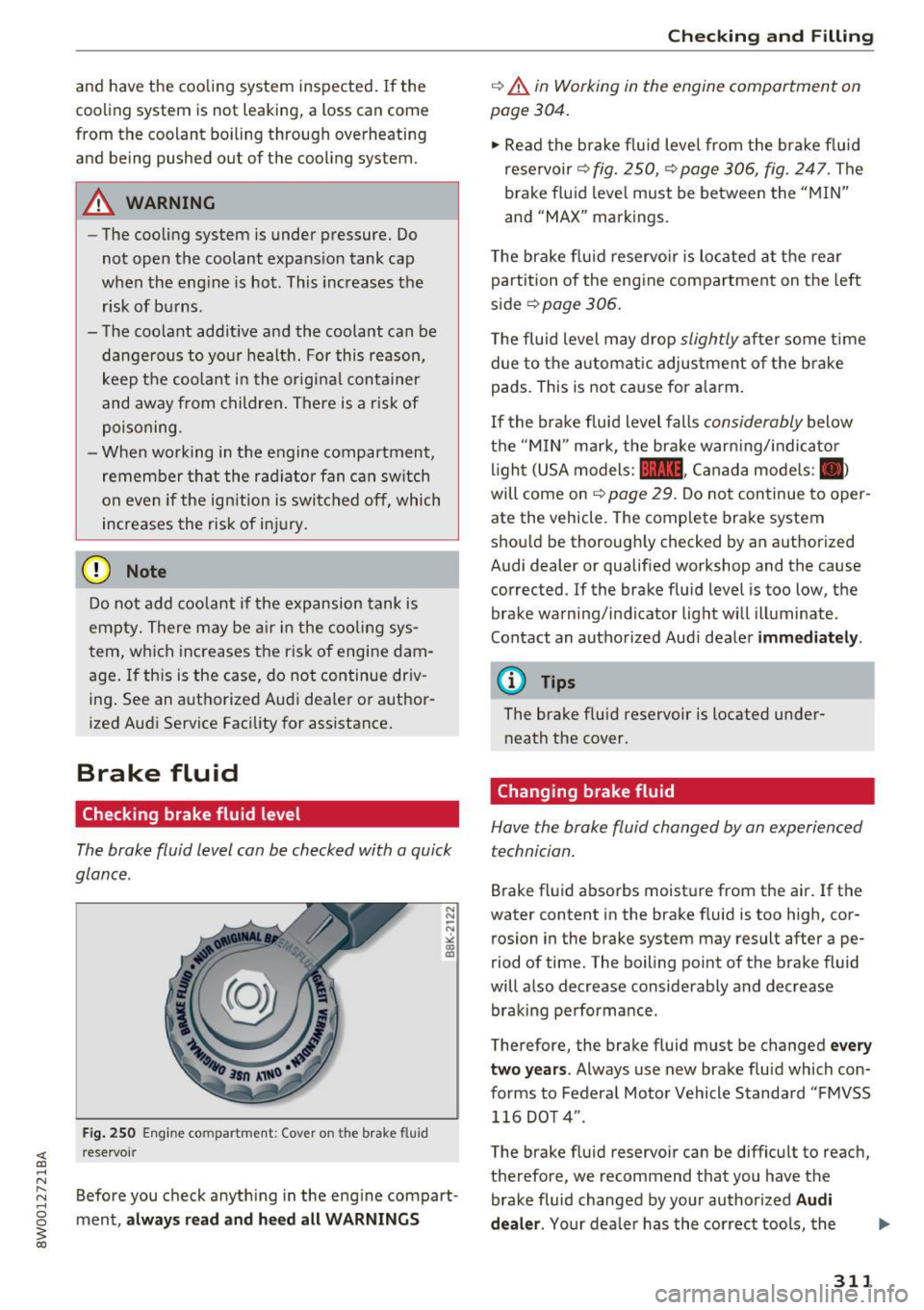
Fig. 250 Engine compa rtment: Cover o n the brake fluid
rese rvoir
Before you check anything in the eng ine compart
ment,
always read and heed all WARNINGS
Checking and Filling
c::> .&. in Working in the engine compartment on
page 304.
" Read the brake fluid level from the brake fluid
reservoir
c::> fig. 250, c::> page 306, fig. 247. The
brake fluid level must be between the "MIN"
and "MAX" markings.
The brake flu id reservoir is located at the rear
partition of the engine compartment on the left
side
~ page 306 .
The fluid level may drop slightly after some time
due to the automatic adjustment of the brake
pads . This is not cause for alarm.
If the brake fluid level falls considerably below
the "MIN" mark, the brake warning/indicato r
light (USA models:
11111 , Canada models : II>
will come on c::> page 29. Do not continue to oper
ate the vehicle. The complete brake system
should be thoroughly checked by an authorized
Audi dealer or qualified workshop and the cause
corrected . If the brake fluid level is too low, the
brake warning/indicator light will illuminate .
Contact an authorized Audi dealer
immediately .
@ Tips
The brake fluid reservoir is located under
neath the cover.
Changing brake fluid
Hove the broke fluid changed by on experienced
technician.
Brake fluid absorbs moisture from the air. If the
water content in the brake fluid is too high, cor
rosion in the brake system may result after ape
riod of time. The boiling point of the brake fluid
will also decrease considerably and decrease braking performance .
Therefore, the brake fluid must be changed
every
two years .
Always use new brake fluid which con
forms to Federal Motor Vehicle Standard "FMVSS
116 DOT 4" .
The brake fluid reservoir can be difficult to reach,
therefore, we recommend that you have the brake fluid changed by your authorized
Audi
dealer.
Your dealer has the correct tools, the
311
Page 318 of 386
Check ing and F illing
Windshield washer
system
.........
w •
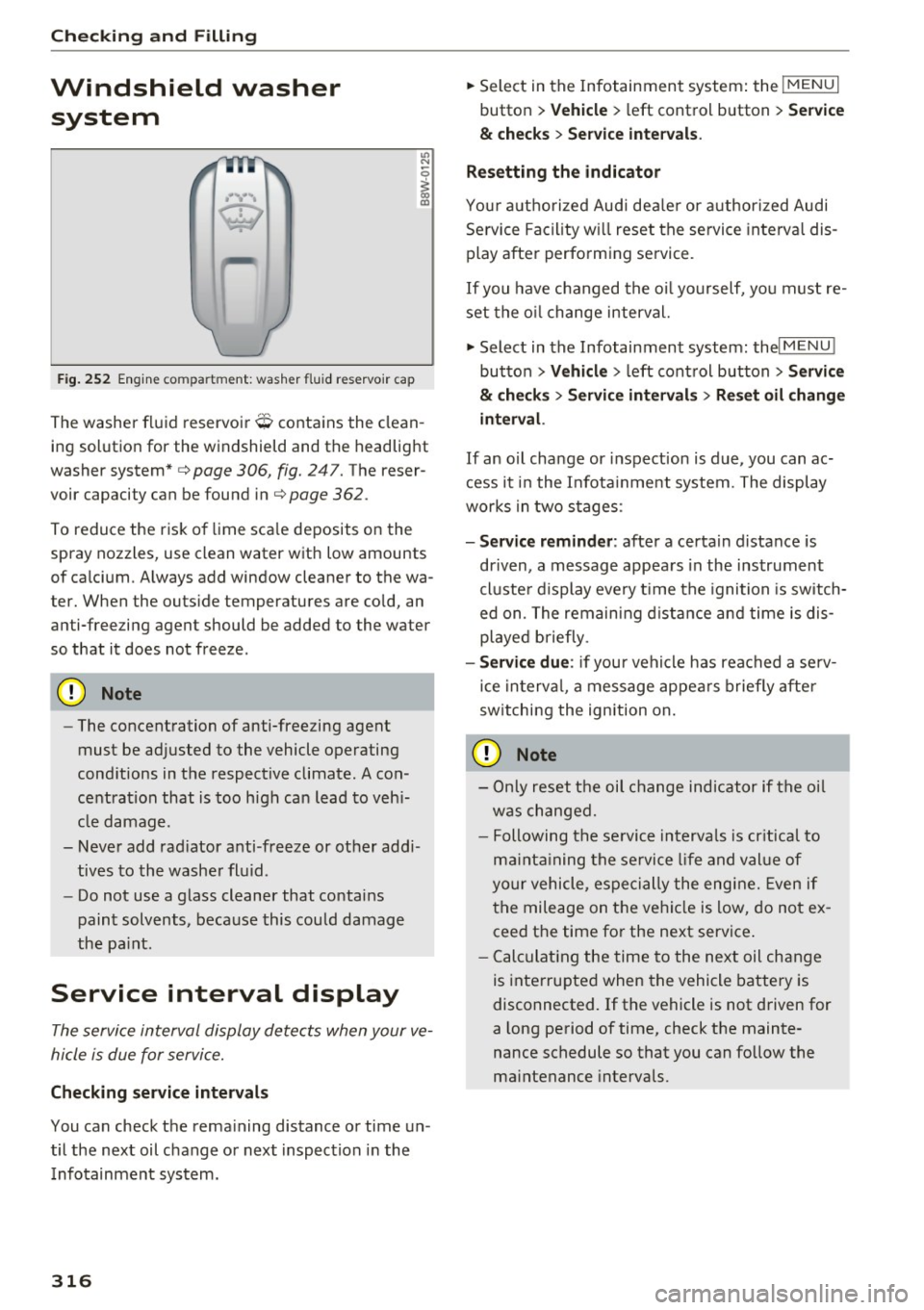
F ig. 252 Engin e comp artm ent : wash er fluid r ese rvoir cap
"' N
0
~ 00 m
The washer fluid reservoir O contains the clean
ing solution for the windshield and the headlight
washer system* c>
page 306, fig. 24 7. The reser
voir capacity can be found inc>
page 362 .
To reduce the risk of lime sca le deposits on the
spray nozzles, use clean water with low amounts
of calci um. Always add window cleaner to the wa
t er. When the outside temper atures are co ld, an
anti-free zing agent should be added to the water
so that it does not freeze .
Cl) Note
-The concentration of anti-free zing agent
must be adjusted to the vehicle operating
conditions in the respective climate. A con
centration that is too high can lead to veh i
cle damage .
- Never add rad iator anti -freeze or other addi
tives to the washer fluid .
- Do not use a glass cleaner that contains
paint solvents, beca use this could damage
the pa int.
Service interval display
The service interval display detects when your ve
hicle is due for service.
Checking se rv ice intervals
You can check the rema ining distance or time un
til the next oil change or next inspection i n the
I nfotainment system .
316
.. Select in the Infotainment system : the !MENUI
button > V ehicle > left control button > Se rvice
& che cks > Ser vice inte rvals .
Resettin g the indicator
You r authorized Audi dea le r or authorized Audi
Se rvice Facility w ill reset the se rvice interval dis
play after performing service.
If you have changed the oi l yourself, yo u must re
set the o il change interval.
.. Select in the Infotainment system: thel
M ENU !
button > Vehicle > left control button > Ser vic e
& check s > Service int erv al s > Re set oil chang e
int erva l.
If an o il cha nge or inspection is due, you can ac
cess it i n the Infota inment system. The display
works in two stages :
-Se rv ice re mind er: after a certain distance is
dr iven, a message appears in the instrument
cluste r display eve ry t ime the ignition is switch
ed on. The remaining d istance and time is dis
played briefly .
-Serv ic e due : if your vehicle has reached a se rv
ice in terva l, a message appears briefly after
sw itching the ignition on.
(D Note
- Only reset the oil change indicator if the oi l
was changed.
- Following the se rvice interva ls is cr itical to
ma inta ining the se rvice l ife and val ue of
yo ur vehicle, especially the engine. Even if
the mileage on the vehi cle is low, do not ex
ceed the time for the next service .
- Calc ulat ing the time to the next oil change
is interrupted when the vehicle battery is
disconnected.
If the vehicle is not driven for
a long period of time, check the mainte
nance schedule so that you can fo llow the
maintenance intervals .
Page 331 of 386
<( a, .... N ,....
N .... 0 0
3 a,
Wheels
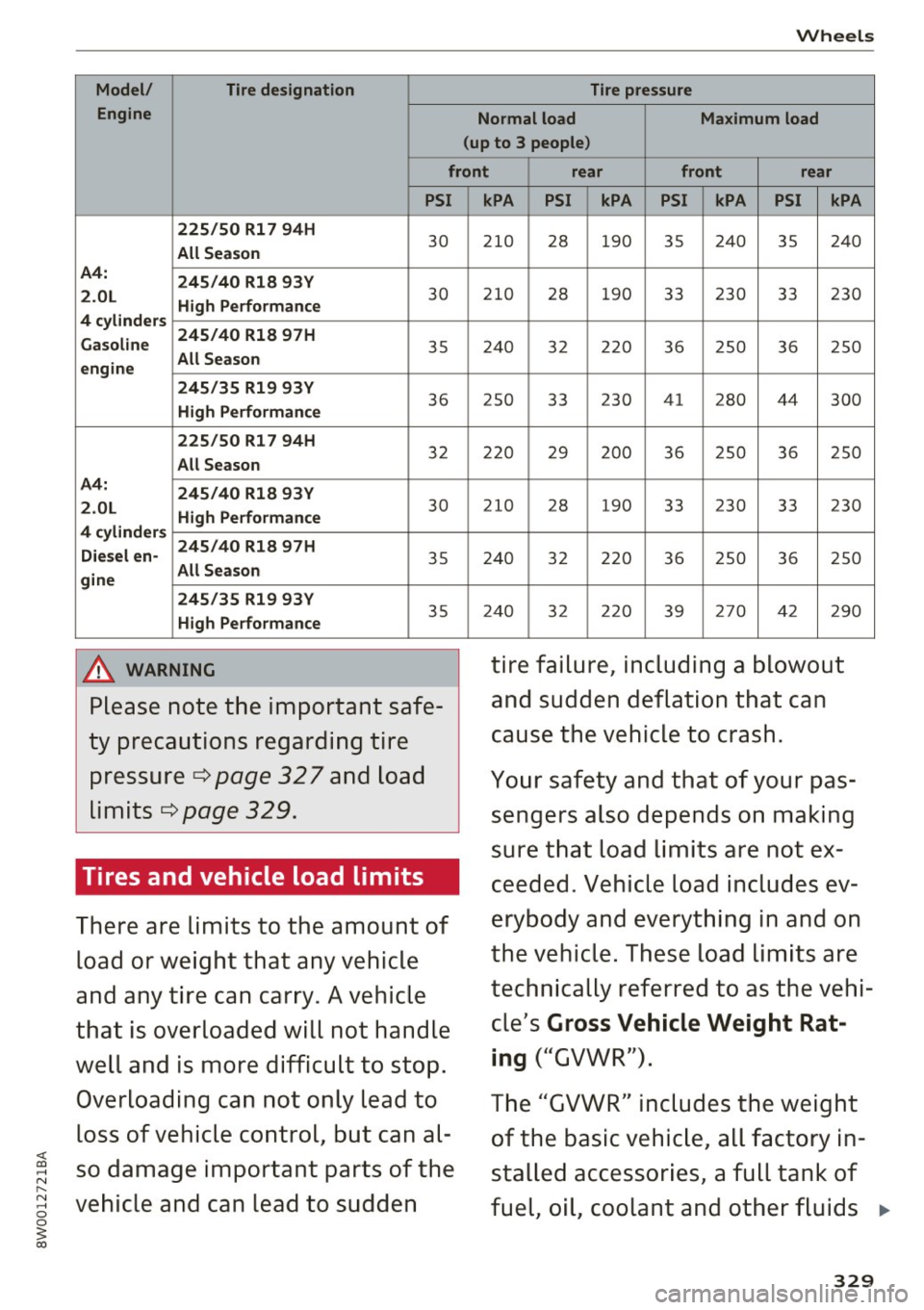
Model/ Tire designation Tire pressure
Engine Normal load Maximum load
(up to 3 people)
front rear front rear
PSI
225/50 Rl 7 94H
30 All Season
A4: 245/40 R18 93Y
2.0L High Performance
30
4 cylinders
245/40 R18 97H
Gasoline
35
engine All Season
245/35 R19 93Y
36 High Performance
225/50 Rl 7 94H
32 All Season
A4: 245/40 R18 93Y
2.0L High Performance
30
4 cylinders
245/40 R18 97H
Diesel en-
35
gine All Season
245/35 R19 93Y
35 High Performance
A WARNING
Please note the important safe
ty precautions regarding tire pressure
¢ page 32 7 and load
limits
¢ page 329.
Tires and vehicle load limits
There are limits to the amount of
load or weight that any vehicle
and any tire can carry. A vehicle
that is overloaded will not handle
well and is more difficult to stop. Overloading can not only lead to
loss of vehicle control, but can al
so damage important parts of the
vehicle and can lead to sudden
kPA PSI kPA PSI kPA PSI kPA
210 28 190 35
240
35 240
210 28 190 33 230 33 230
240 32 220 36 250 36 250
250 33 230 41
280
44 300
220 29 200 36 250 36 250
210 28 190
33 230
33 230
240 32 220 36 250 36 250
240 32 220 39 270 42 290
tire failure, including a blowout
and sudden deflation that can
cause the vehicle to crash.
Your safety and that of your pas
sengers also depends on making
sure that load limits are not ex
ceeded. Vehicle load includes ev
erybody and everything in and on
the vehicle. These load limits are
technically referred to as the vehi cle's
Gross Vehicle Weight Rat
ing
("GVWR").
The "GVWR" includes the weight of the basic vehicle, all factory in
stalled accessories, a full tank of
fuel, oil, coolant and other fluids ..
329
Page 355 of 386
<( a, .... N ,....
N .... 0 0
3 a,
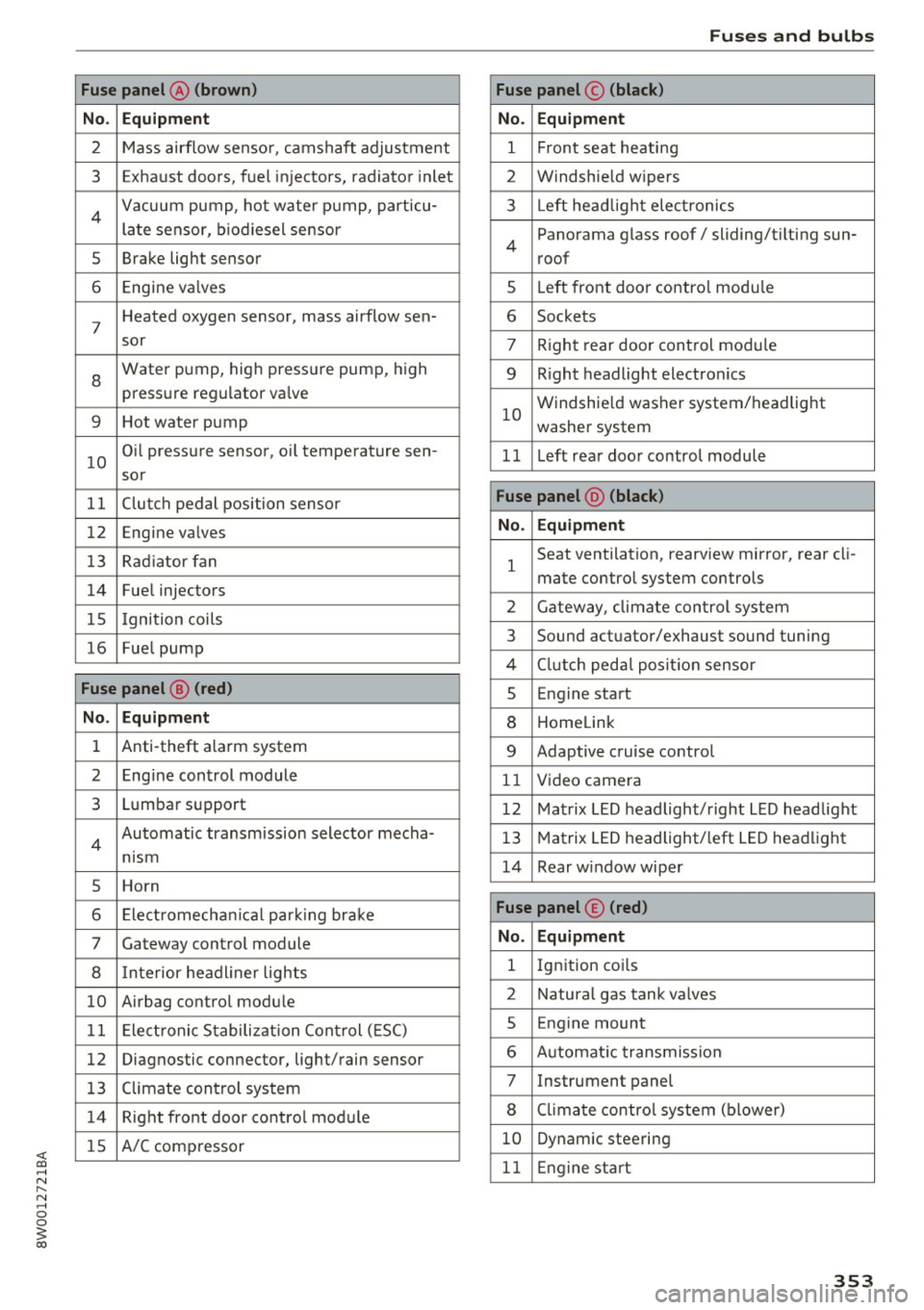
Fuse panel @ (brown)
No . Equipment
2 Mass airflow sensor, camshaft adjustment
3 Exhaust doors, fuel in jectors, radiator inlet
4 Vacuum pump, hot water pump, particu -
late senso r, biodiesel sensor
5 Brake light sensor
6 Engine va lves
7
Heated oxygen sensor, mass airflow sen-
sor
8
Water pump, high pressure pump, high
pressure regulator va lve
9 Hot water pump
10
Oil pressure sensor, oi l temperature sen-
sor
11 Clutch pedal position sensor
12 Engine valves
13 Radiator fan
14 Fuel injectors
15 I gnition coils
16 Fuel pump
Fuse panel @ (red)
No . Equipment
1 Anti-theft alarm system
2 Engine control module
3 Lumbar support
4
Automatic transmission selector mecha-
nism
5 Horn
6 Electromechan ical park ing brake
7 Gateway control module
8 I nterior headl iner lights
10 Airbag control module
11 Electronic Stabilization Control (ESC)
12 Diagnostic connector, light/rain sensor
13 Climate control system
14 Right front door control module
15 A/C compressor
Fuses and bulbs
Fuse panel © (black)
No . Equipment
1 Front seat heating
2 Windshield w ipers
3 L eft head light electronics
4
Panorama glass roof/ sliding/t ilting sun-
roof
5 L eft front door control module
6 Sockets
7 Right rear door control module
9 Right headlight electronics
10
Windshield washer system/headlight
washer system
1 1 Left rear door control module
Fuse panel @ (black)
No . Equipment
1
Seat ventilation, rearv iew mirror, rear cl i-
mate control system controls
2 Gateway , climate control system
3 Sound actuator/exhaust sound tuning
4 Clutch pedal pos ition sensor
s Engine start
8 Homelink
9 Adaptive cruise control
11 Video camera
12 Matrix LED headlight/right LED headlight
13 Matrix LED headlight/left LED headlight
14 Rear window wiper
Fuse panel © (red)
No . Equipment
l Ignition coi ls
2 Natural gas tank valves
5 Engine mount
6 Automat ic transmission
7 Instrument panel
8 Cli mate control system (blower)
10 Dynamic steering
11 Engine start
353
Page 362 of 386
Emergency situations
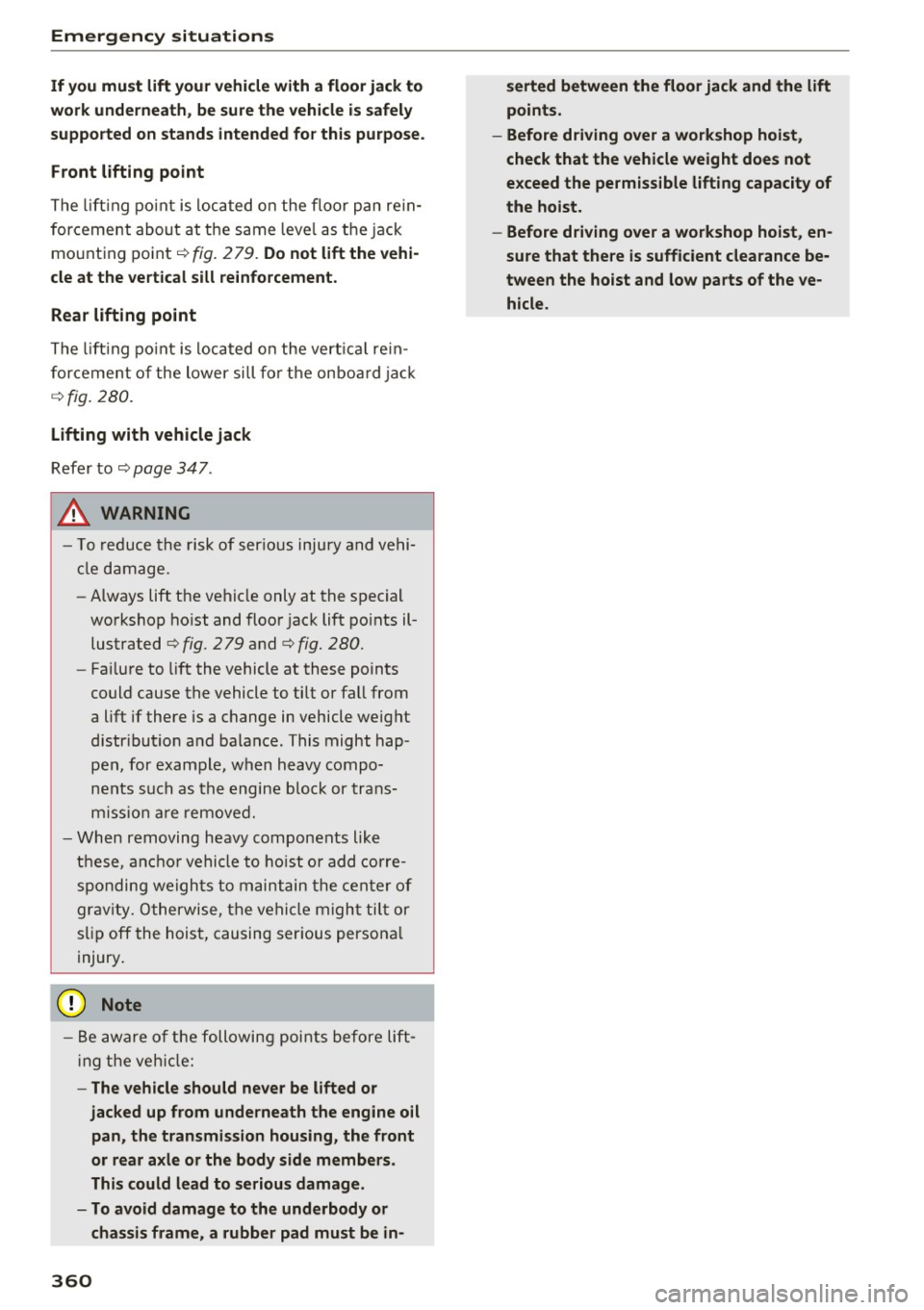
If you must lift your vehicle with a floor jack to
work underneath, be sure the vehicle is safely
supported on stands intended for this purpose .
Front lifting point
T he lift ing po int is loc ated on the floo r pan re in
for cement about at the same leve l as t he jack
mounting po int r=;,
fig. 279. Do not lift the veh i
cle at the vertical sill re inforcement.
Rear lifting point
T he lift ing po int is loca ted on the vert ica l re in
for cement of the lower sill fo r t he on b oard ja ck
r=:> fig. 280 .
Lifting with vehicle jack
Refer to r=;, page 347.
A WARNING
- To reduce the risk of ser io us injury and vehi
cl e d amage.
- Always lift t he ve hicle only at the special
wo rkshop ho ist and floo r jack lift po ints il
lustrated
r=;, fig . 279 a nd r=;, fig. 280.
- Fa ilure to lift the vehicle at these poin ts
could cause the vehicle to tilt or fa ll from
a lift if there is a change in vehicle weight
distr ibut io n and balance. This might hap
pen, for exam ple, when heavy co mpo
n e nts s uch as the engine b lock or tra ns
mi ssio n are removed.
- When removing heavy components like
th ese, a nchor vehicle to hoist o r add cor re
s pon ding weigh ts t o ma in ta in t he ce nte r o f
gr avit y. Ot herwise, t he ve hicl e migh t tilt or
s lip
off the hoist, causing ser ious perso na l
injury .
(D Note
- Be awa re o f th e followi ng poi nts before li ft
in g th e ve hicle:
-The vehicle should never be lifted or
jacked up from underneath the engine oil
pan, the transmiss ion housing, the front
or rear axle or the body side members .
This could lead to serious damage.
- To avoid damage to the underbody or
chassis frame, a rubber pad must be in-
360
serted between the floor jack and the lift
points.
- Before driving over a workshop hoist ,
check that the vehicle weight does not
exceed the permissible lifting capacity of
the hoist.
- Before driving over a workshop hoist , en
sure that there is sufficient clearance be
tween the hoist and low parts of the ve
hicle .
Page 363 of 386

Technical data
Vehicle specifications
F ig. 281 W indshield (front left): Ve hicle Ident ification
Number (VIN)
XXXXX XX -X -XX XX X XX XX
CD+ ~t :1 :: xxxxxxxx xx x xxx xxxxx
TVP/fffl XXX XXX
XX XXXXXXX XX X X XX
XXX
KW XXX
®i ~:J ·f lfils~~ XXXX XXX XXX
®-+ ~N:a=i~l xxxx ; xxxx xx x ; xx
11. • AUSS, I OPTIONS
E0 A
7D 5 4UB 6
XM 5SG 5R W
2E H
J0Z lL B l
A S lB A
3FC SM U 7 Xl
F 0 A 9G3 0G7 0YH 0JF
TL 6 3KA 8EH UlA X 98 Q Z7
lXW 803 908 824 020
7T6 C V7 7 K0 4 X3 2K2
3L4
4KC 3 Y 0 413
502
lSA 7GB 01 A 4G0
XX . X XX X XX X xxxx
Fig. 282 Vehicle identification label
Vehicle Identification Number (VIN) in the
Infotainment system
• Select in the Infotainment system: the I MENU I
button > left control button > Service & checks
> Vehicle information.
Vehicle Identification Number (VIN)
The VIN can be found in the Infotainment sys
tem, on the vehicle data label and under the
windshield on the driver's side*¢
fig. 281 . The
VIN is also in the right side of the luggage com
partment.
Technical data
Vehicle identification label
T he veh icle identification label¢ fig. 282 is locat
ed in the luggage compartment under the cargo
floor cover .
T he information of the veh icle identification label
can also be found in your Warranty
& Mainte
nance booklet.
The sticker contains the fol low ing vehicle data:
(D Vehicle Identification Number (VIN)
@ Vehicle type, eng ine output, transm ission
@ Engine and transmission codes
@ Paint and interior codes
® Optional equipment numbers
Safety compliance sticker
The safety compliance sticker is your assurance
that your new vehicle complies w ith all applicable
Federal Motor Vehicle Safety Standards which
were in effect at the time the vehicle was manu
factured. You can find this sticker on the front end of the driver's door.
It shows the month and
year of production and the vehicle identification number of your vehicle (perforation) as well as
the Gross Vehicle Weight Rating (GVWR) and the Gross Axle Weight Rating (GAWR).
High voltage warning label
The high voltage warning label is located in the
engine compartment next to the engine hood re
lease. The spark ignition system complies with
the Canadian standard ICES-002.
Weights
Gross Vehicle Weight Rating
The Gross Vehicle Weight Rating (GVWR), and
the Gross Axle Weight Rating (GAWR) for front
and rear are listed on a sticker on the front end of
the driver's door .
The Gross Vehicle Weight Rating includes the
weight of the basic vehicle plus full fuel tank, oil and coolant, plus maximum load, which includes
passenger weight (150 lbs/68 kg per designated
seating pos ition) and luggage weight¢,&. . .,.
361
Page 365 of 386
<( a, .... N ,....
N .... 0 0
3 a,
Consumer information
Warranty coverages
Y our Audi is co vered b y the foll owing war ran
tie s:
- New Vehicle Limited Warranty
- Limited Warranty Against Corrosion Perfora-
tion
- Emissions Control System Warranty
- Emissions Performance Warranty
- California Emissions Control Warranty (USA
vehicles only)
- California Emissions Performance Warranty
(USA vehicles only)
Detailed information regard ing your warranties
can be found in yo ur
W arranty & M ainten ance
bookl et.
Operating your vehicle
outside the U.S.A. or
Canada
Government reg ulations in the Un ited States and
Canada require that automobiles meet specific
emission regulations and safety standards.
Therefore, vehicles built for the U .S.A. and Cana
da differ from vehicles sold in other countries.
I f you p lan to take your vehicle outside the conti
nenta l limits of the United States or Canada,
there is the poss ibility that:
- u nleaded fue ls for vehicles with cata lytic con
verter may not be available;
- fuel may have a considerably lower octane rat
i ng. Imprope r fuel may ca use engine damage;
- service may be inadequate due to lack of p roper
service facilities, tools or testing eq uipment;
- r eplacement parts may not be readily ava ilable.
- Navigation systems for veh icles built for the
U .S .A . and Canada will not necessa rily work in
E urope, and may not wo rk in other countries
outside of North Amer ica.
Con sumer inf ormation
(D Note
Audi cannot be respons ible for mechanical
damage that could resu lt from inadequate
fuel, service or parts ava ilability.
Audi Service Repair
Manuals and Literature
Audi Official Factory Service Manuals and L itera
ture are published as soon as poss ible after mod
el introduction. Service Ma nua ls and literature
are avai lab le to order from the Audi Tec hni cal Lit
erature Ordering Center at:
www .audi .t e chlit eratur e.com
Maintenance
General
Your vehicle has been designed to he lp keep
maintenance requirements to a min imum. How
ever, a certain amount of regular maintenance is
still necessary to assure your veh icle's safety,
economy and reliab ility . For detailed vehicle
maintenance consult your Wa rranty
& Mainte
nance book let .
Und er diff icult op erating condition s, for exam
ple at extremely low outside temperatures, in
very dusty regions, when towing a trai le r very fre
quently, etc., some service work shou ld be per
fo rmed between the in terv als specified. This ap
plies particularly to:
- oil changes, and
- cleaning or replacing the a ir filter .
(® For the sake of the environment
By regularly maintain ing your vehicle, you
help make sure that emiss ion standards are
maintai ned, thus min imizing adverse effects
on the environment .
Important considerations for you and your
vehicle
The increasing use of electronics, sophisticated
fuel injection and emission control systems, and
the generally increas ing technica l complexity of ""'
363