brakes AUDI A4 2017 Owner's Manual
[x] Cancel search | Manufacturer: AUDI, Model Year: 2017, Model line: A4, Model: AUDI A4 2017Pages: 386, PDF Size: 96.32 MB
Page 110 of 386
Ass is t
- Note that the reversible belt tensioner on
the front passenger's side deactivates when
the front passenger's a irbag is deactivated.
- Switch the pre sense off when you are not
using public streets or when loading the ve
hicle onto a vehicle carrier, train, ship or
other type of transportation. This can pre
vent an undes ired intervention from the pre
sense system .
Audi pre sense basic
Description
Applies to: vehicles with Aud i pre sense basic
The pre sense basic functions are activated at a
speed of approximately 20 mph (30 km/h) or
h igher.
The fo llowing functions can be triggered unde r
certain conditions within the limits of the sys
tem:
- Tensioning of the safety belts (for example,
during heavy braking): the front sa fety belts
have reversible belt tensioners . If a collision
does not occur, the safety belts loosen slightly
and are ready to trigger again.
- The emergency flashers activate
1) , the win
dows and the sunroof* close (for example when
under- or oversteering) : the clos ing process for
the windows and the sunroof* in itiates.
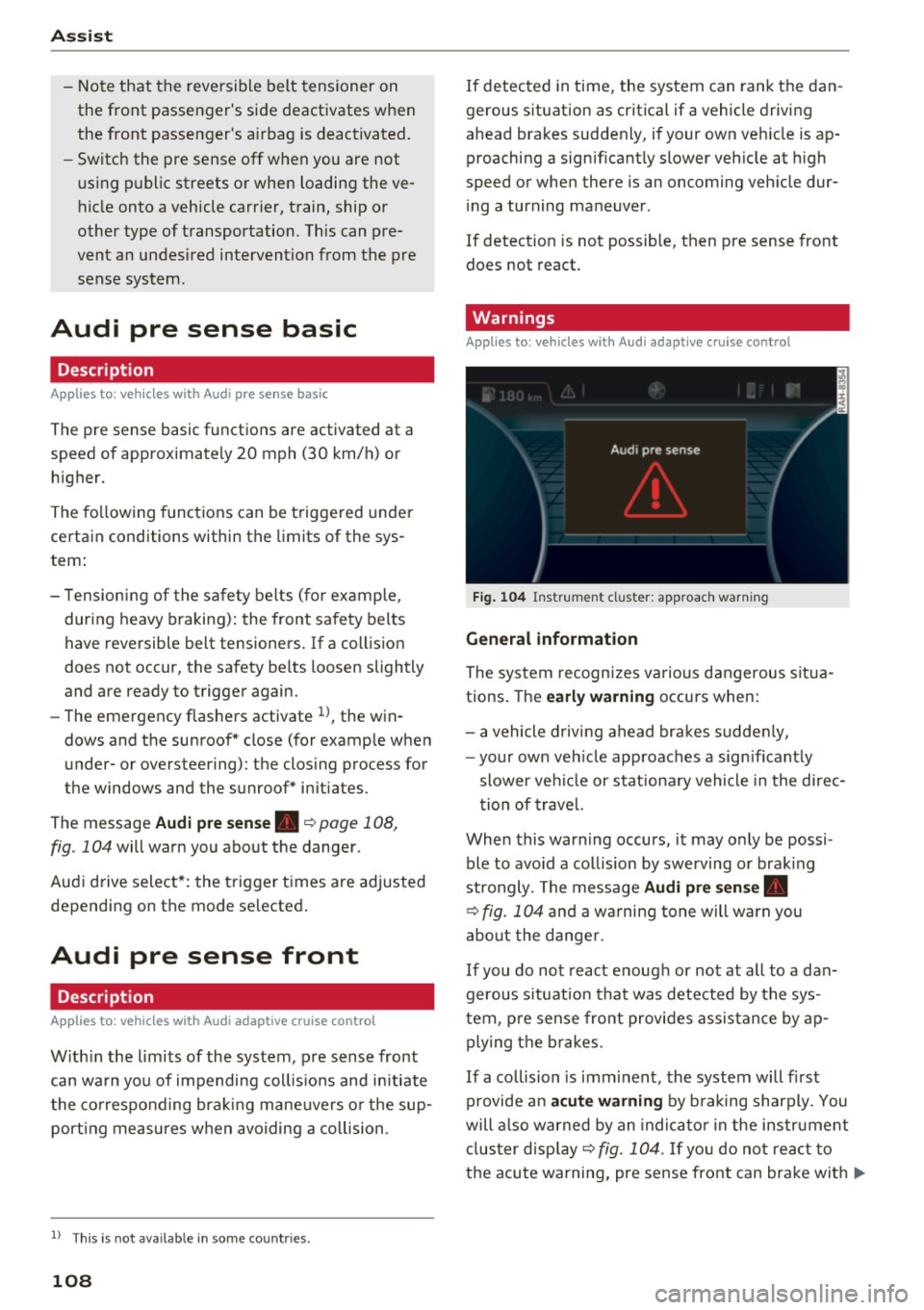
The message
Audi pre sen se. ~ page 108,
fig. 104 will warn you abo ut the danger.
Aud i drive select*: the trigger times are adjusted
depending on the mode selected .
Audi pre sense front
Description
Applies to: vehicles with Audi adapt ive cruise control
W ith in the lim its of the system, pre sense front
can wa rn you of impending coll is ions and initiate
the co rresponding brak ing mane uvers o r the sup
port ing measures when avoiding a collision .
1> This is not ava ilab le in some co untri es.
108
If detected in time, the system can rank the dan
gerous situation as critical if a vehicle driving
ahead brakes suddenly, if your own veh icle is ap
proaching a significant ly slower veh icle at h igh
speed or when there is an oncoming veh icle dur
i ng a turning maneuver .
If detection is not possible, then pre sense front
does not react.
Warnings
Applies to: vehicles with Audi adapt ive cru ise control
F ig . 104 Instrument cl uster : approach warning
G eneral information
The system recognizes various dangerous situa
tions. The
early w arning occurs when:
- a vehicle d riving ahead bra kes sudde nly,
- your own veh icle approaches a sign ificant ly
slower ve hicle or stationa ry vehicle in the direc
tion of trave l.
When this warn ing occurs, it may o nly be possi
ble to avo id a collision by swerving or braking
strongly. The message
Audi pre sen se.
~ fig. 104 and a wa rning tone will warn you
abo ut the dange r.
If you do not react enough or no t at all to a dan
gerous s ituation that was detected by the sys
tem, p re sense front provides assis tance by ap
ply ing the b rakes .
If a collision is imminent, the system will fi rst
provide an
a cute warning by b raking sharply. You
will a lso warned by an indica to r in the instrument
cl us ter disp lay ~
fig. 104. If yo u do not react to
the acute warning, pre sense front can brake with
IJ>-
Page 112 of 386
Assist
Audi pre sense rear
Description
App lies to: ve hicles w ith Audi side assist
If the risk of a collision is detected, the following
functions can trigger:
- Reversible tensioning of the front safety belts
at the corresponding speeds .
- Closing the windows and sunroof*.
- Inflating the side bolsters* in the seat backrest
and seat surface.
- Switching on the emergency flashers with in-
creased frequency
l ).
The message Audi pre sense. ~ page 108,
fig. 104 will warn you about the danger.
Aud i drive select*: the function is not active de
pending on the mode selected.
A WARNING
- To reduce the risk of an accident, please
note that the side assist* radar sensors do
not always detect every object.
- Pre sense rear does not react to people, ani
mals or objects that are crossing the vehi
cle's path or that are difficult to detect.
- Reflective objects such as guard rails, heavy
rain and ice can impair the function of the
radar sensors and the ability to detect a col
lision risk .
(D Note
The radar sensors can be displaced by impacts
or damage to the bumper, wheel housing and
underbody. Pre sense rear can be impaired by
this . Have an authorized Audi dealer or au
thorized Audi Service Facil ity check their func
tion.
(0 Tips
- The pre sense rear functions switch off
when towing a trailer.
- The pre sense rear functions may also
switch off if there is a malfunction in the
side assist* system.
1> This is not ava ilab le in some co untri es.
110
Audi pre sense city
' Description
App lies to : vehicles wit h Audi pre sense city
Within the limits of the system, pre sense city
can warn you of impending collisions with
vehicles and pedestrians and initiate the applica
ble braking maneuver if needed. Pre sense city is
active at a speed of 6 mph (9 km/h) and higher.
A pedestrian warning can occur at speeds up to 50 mph (85 km/h), and vehicle warnings can oc
cur at speeds up to 155 mph (250 km/h). A pre
sense city braking maneuver is possible at speeds
up to 50 mph (85 km/h).
Warnings
App lies to: vehicles wit h Aud i pre sense city
The system recognizes various dangerous situa
tions. The
early warning occurs when:
- a vehicle driving ahead brakes sudden ly,
- your own vehicle approaches a sign ificantly
slower vehicle or stationary vehicle in the direc
tion of travel.
- a pedestrian is standing in the lane or is moving
into the lane.
When this warning occurs, it may only be possi
ble to avo id a collision by swerving or braking
strongly. The message
Audi pre sense.
~ page 108, fig. 104 and a warning tone will
warn you about the danger.
Additionally, a jerk on the brakes may occur as an
acute warning when there is an impend ing colli
sion . If you do not react to the acute warning, pre
sense city can brake to the point of complete de
ce leration within the limits of the system. This
reduces the vehicle speed in the event of a colli
sion. The message
Audi pre sense. also ap
pears.
The following functions are triggered in conjunc
tion with pre sense basic/rear:
- Reversible tensioning of the front safety belts .
- Closing the windows and sunroof*. ..,
Page 121 of 386
_& WARNING
The exit warning system is subject to limita
tions and cannot warn you before every im
pending collision:
- If the vehicle is too wide for the parking
space and covered by the neighboring
vehicles.
- Approaching objects or people such as cy
cl ists o r skateboarders may not be detected
under certain circumstances.
- The system does not react to stationary ob
jects.
- The view of the radar sensors may be im
paired by leaves, snow, heavy spray or d irt.
Clean the area in front of the sensors
r:!vpage 116, fig. 112.
(D Note
Also read this information ¢0 in General in
formation on page 117.
@ Tips
- The ex it warning system is switched on and
off through the side assist¢
page 117.
-The display brightness for the exit warning
system cannot be adjusted.
- The system is not available when towing a
trailer.
Rear cross-traffic assist
A ppl ies to: vehicl es with rear cross-traffic assist
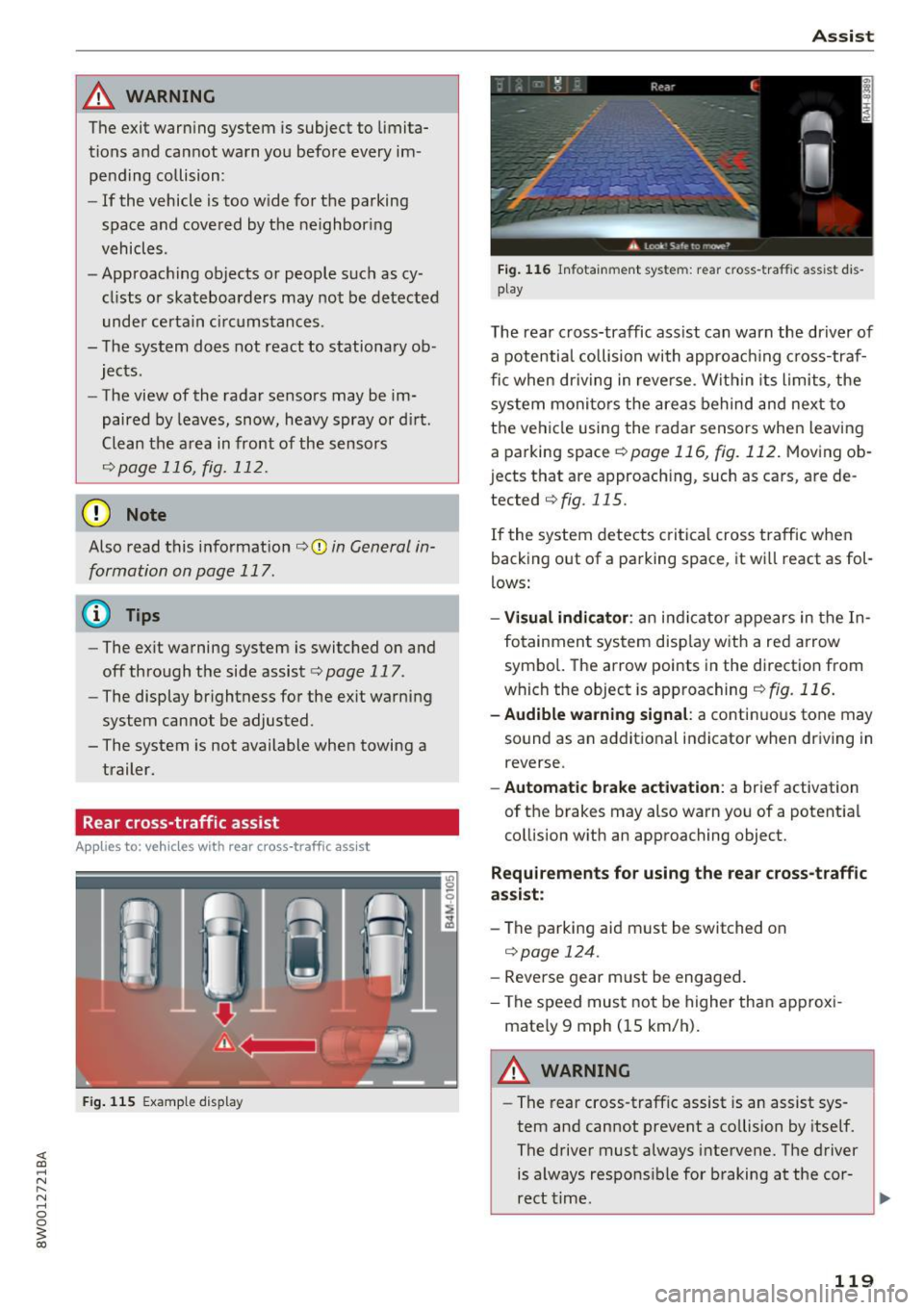
Fig. 115 Example display
Assist
Fig. 116 Infotainment system: rear c ross -tra ffic assist dis
play
The rear cross-traffic ass ist can warn the driver of
a potential collision with approach ing cross-traf
fic when driving in reve rse. Within its limits, the
system monitors the areas behind and next to
the vehicle using the radar sensors when leaving
a parking space
r:!vpage 116, fig. 112. Moving ob
j ects that are approaching, such as cars, are de
tected
¢ fig. 115.
If the system detects critical cross traffic when
backing out of a parking space, it wi ll react as fol
lows:
- Visual indicator : an indicator appears in the In
fotainment system disp lay with a red arrow
symbo l. The arrow points in the direction from
which the object is approaching
¢fig. 116.
-Audible warning signal: a continuous tone may
sound as an additional indicator when driving in
reverse.
- Automatic brake activation : a brief activation
of the brakes may also warn you of a potent ial
collision with an approaching object.
Requirements for using the rear cross-traffic
assist :
-The parking aid m ust be switched on
¢page 124.
-Reverse gear m ust be engaged.
- The speed must not be higher than approxi-
mate ly 9 mph (15 km/h).
A WARNING
- The rear cross-traffic assist is an assist sys
tem and cannot prevent a co llision by itself.
The driver must always intervene. The driver
is always responsible for braking at the cor-
rect time .
~
119
Page 122 of 386
Ass is t
- Please note that the rear cross-traffic assist
may act ivate the brakes unexpectedly. Se
cure any cargo that you are transporting to
reduce the risk of damage or injury .
- An additional brake act ivat ion may be tr ig
gered within 20 seconds after an automat ic
brake activation.
- If there is an acoustic warning signa l from
the rear cross-traff ic assist, then the park
ing system may not warn you of detected
obstacles under certa in circumstances .
- The view of the radar sensors may be im paired by leaves, snow, heavy spray or d irt.
Clean the a rea in front of the sensors
~ page 116, fig . 112.
A WARNING
T he rear cross-t raff ic assist is s ubject to lim i
t at ions and cannot warn you before every im
pending collision:
- If the vehicle is too w ide fo r the pa rki ng
spa ce and covered by the ne ighbor ing
vehicles.
- People , such as cyclis ts, jogge rs, in line skat
ers and pedestrians, may not be detected
under certain circ umstances.
- If you are in a par allel par king sp ace.
(D Note
Also read this info rmation ~ CD in General in
formation on page 117.
(0 Tips
- You can cancel the automatic brake activa
tion with increasing braking force if you ap
ply the bra kes yourself or accele rate cons id
e rab ly.
- In some s ituations, rea r cross-traffic ass ist
may warn you even if t here is no cross traffi c
i n a critic al are a, for examp le w hen ba cking
i nto a parking space or maneuver ing.
- T he rea r cross -traffic ass ist also switches off
whe n you swi tch off the ESC.
- T he rea r cross traffic assist switches on and
off thro ugh the p arking aid<:?
page 12 4.
- T he system is not ava ilable when towing a
trailer.
120
' Messages
Applies to: vehicles with Audi side assist
A message appea rs in the ins trument cluster dis
play if the side ass ist sw itches off automat ica lly.
@j Audi side assist: currently unavailable . Sen
sor vi sion re stricted due to surroundings. See
owner' s manual
@j Audi side ass ist and ex it warning: currently
unav ailable . Sensor vi sion restricted due to sur
rounding s
The radar sensors ' vision is affected . The area in
front of the sensors must not be covered by bike
racks, stickers, leaves, snow or any other objects .
Clean the area in front of the sensors, if necessa
r y
<:? page 116, fig . 112.
@j Audi side ass ist: currently unavailable . See
owner's manual
@j Audi side ass ist and exit warning: currently
unavailable. See owne r's manual
Side assist ca nnot be switched on at this time be
cause ther e is a malfunction (for example, the
battery charge level may be too low).
@j Audi side as sist: malfunction! Plea se contact
Service
@j Audi side assi st and exit warning: malfunc
tion! Plea se contact Service
The system cannot guarantee that it will detect
vehicles correct ly and it has sw itched off. The
senso rs have been moved or are fa ulty . Have the
system checked by an authori zed Aud i dea ler o r
a uthorized Aud i Serv ice Facility soon.
@j Audi side assi st: unavailable in towing mode
@j Audi side ass ist and ex it warning: currently
unavailable. Towing mode
Side assist switches off automatically when the electrical connector in the factory-installed trail
er hitch is connected . There is no guarantee the
system will sw itch off when using a retrofitted
trailer hitch . Do not use side assist and the ex it
warning when tow ing a tra ile r.
Ill Rea r parking aid: obstacl e detection res trict-
ed ..,.
Page 136 of 386

Intelligent Technology
Intelligent Technology
Electronic Stabilization
Control (ESC)
Description
Elect ronic Stabilization Control (ESC) suppo rts
driver safety.
It red uces the risk of slipping and
improves dr iving stability. ESC detects crit ica l sit
uations such as when the vehicle is oversteering
a nd understeering or the wheels are spinning.
The vehicle is stabilized by applying the brakes or reducing eng ine torq ue. When the ESC engages,
the
Ji) i n d icator light blinks in the instrument
cluste r.
The fo llow ing systems are integrated in the ESC :
Anti-lock braking system (ABS)
ABS p revents the whee ls from locking whe n brak
ing. The vehicle can sti ll be steered even during
hard brak ing. Apply steady press ure to the brake
pedal. Do not pump the pedal. A puls ing in t he
b rake pedal indicates that the system is acting to
s tabilize the vehicle .
Brake assist system
The brake assist system can decrease brak ing dis
tance . It increases brak ing power when the d river
presses the brake pedal q uick ly in emergency sit
uations . You must press and hold t he b rake pedal
until the dangerous sit uat io n is over . In veh icles
with adapt ive c ruise control*, the bra ke as sist
sy stem is more sensitive if t he di sta nce detec ted
t o the vehicle dr iv ing ahead is too small.
Anti-slip regulation (ASR)
ASR reduces eng ine power when the drive wheels
beg in sp inning a nd adapts the force to the road
conditions . T his makes it easie r to sta rt, acceler
a te and dr ive up h ills.
Electronic differential lock (EDL)
The EDL brakes w heels that a re spinning and
transfers the drive power to the other drive
wheel or whee ls if t he ve hicle is equipped with a ll
wheel drive*) . T his funct ion is no t av ail able at
h igher spee ds.
134
In extreme cases, EDL automat ically switches off
to keep the b rake on the bra ked whee l from over
heating. The veh icle is still working correct ly. ED L
will switc h on again automatically when condi
tions have returned to normal.
Steering recommendation
The E SC he lps to stabili ze the vehicle by changing
the steer ing torque.
I n veh icles with dyn amic steer ing *, ES C also
helps to sta bilize the s teer ing in cr it ic al situa
tions.
Selective wheel torque control
Se lective wheel to rque cont rol is used when d riv
i ng on curves. The fron t whee l on the ins ide of
t h e curve or both wheels on t he i nsi de of the
curve are braked se lective ly as needed. This al
l ows mo re precise driving in c urves.
Automatic post -collision braking system
The "a utomat ic post-collis io n braking system"
c a n help to reduce t he risk of sliding and of addi
tiona l co llisions after an acc ident. If th e airbag
contro l modu le de te cts a collision, t he ve hicle is
bra ked by the ESC.
The veh icle does not br ake automatically if:
- the dr iver presses the acce lera tor pedal, or
- the ESC, the brake system or the veh icle electri-
cal system are not functioning.
&_ WARNING
- The ESC and i ts integ ra ted systems cannot
overcome the lim its imposed by natura l
phys ical laws. This is es pec ially impo rtan t
o n s lippery or we t road s. If the sy stems be
gin ac ting to s tabilize yo ur vehicle, you
should immediately a lter your speed to
match the road and traffic conditions . Do
not let t he inc reased safety provided tempt
you into taking risks. This could increase
your r isk of a coll is ion.
- Please note the r is k of a coll is ion increases
when dr iv ing fast, especially t hrough c urves
and on sli ppery or wet roads, and when dr iv
ing too close to objects ahead . T he ESC a nd
its integrated systems cannot always
Page 138 of 386

Intelligent Technology
- The re is no vehicle stabilizat ion when ESC/
ASR are switched off.
Braking
New brake pads
New b rake pads do not achieve the ir full braking
effect during the first 250 miles (400 km) . They
must be "broken in" first . However, you can com
pensate for the slightly reduced brak ing force by
pressing firmly on the brake pedal. Avoid heavy
braking dur ing the break-in per iod.
W ear
Brake pad wear depends largely on the way the
vehicle is driven and on operating conditions.
This is especially true if you are driving frequently
in the c ity and on curves or with a sporty driving
style .
Operating noise
Noises may occur when braking depending on the
speed, b raking force and outside conditions such
as tempe rature and humidity.
W et conditions or road salt
In certain s ituations, for example after dr iving
through water, in heavy rain or after washing
your car, the brak ing effect may be reduced due
to mo isture or ice on the brake rotors and brake
pads. The brakes must be "dr ied" first wit h a few
careful brake applications.
At higher speeds and with the windshie ld wipers
turned on, the brake pads press against the brake
rotors for a short amount of time. Th is action,
which is not felt by the driver, happens at regular
i n tervals a nd ensu res a better reaction time for
the bra kes in wet weather .
The braking effect can also be reduced if you are
driving on salted roads and you do not apply the
brakes fo r long periods of time . The laye r of salt
on the brake rotors and pads must be wo rn off
fi rst when the b rakes are app lied.
Corrosion
Leaving the vehicle parked for long periods of
time, low mi leage and avo iding heavy brak ing
136
can con trib ute to corros ion on t he b rake roto rs
and to dirty brake pads .
I f you usu all y avoid he avy br aking or if there is
corrosion present, occasiona l heavy brak ing at
high speeds is recommended to clean the brake
rotors and pads~.&. .
Brake system malfunction
if you not ice that the b rake peda l t ravel has sud
denly gotten larger, t hen a b rake c ircuit in the
dual-c ircuit brake system may have failed. Drive
to an authorized Audi dea ler o r authorized Audi
Se rvice Facility immediate ly to have the prob lem
corrected . On the way there, dr ive with reduced
speed and keep in mind tha t you w ill need a lon
ger distance to stop and you will need to press
the brake pedal harder.
l o w brake fluid level
When the brake fluid level is low, malfunctions in
the brake system may occur. The brake fluid level
i s electronically monitored.
Brake booster
The bra ke boos ter amp lifies the p ressure yo u ap
ply to the brake pedal. It only wor ks when the en
gine is running .
A WARNING
- Only app ly the bra kes for the purpose o f
cleaning the brake system w hen road and
traffic conditions permit. You must not en
danger other road users. This i ncreases the
r is k of an accident.
-
- Never let the ve hicle roll while the engine is
s to pped because t his i ncreases the ris k of an
acciden t.
Q) Note
- Never let the brakes "rub" by pressing the
peda l lightly when braking is not actually
necessary . This causes t he b rakes to over
heat and incr eases brak ing distanc e and
c a u ses we ar.
- Before driving a long d istance o n a steep
d ownward hill, decrease your speed a nd se-
le ct a lo wer driving gear. This m akes use of
1111>
Page 139 of 386

<( a, .... N ..... N .... 0 0
3 a,
the engine braking effect and relieves the brakes.
If you need to brake additionally,
brake in interva ls and not continuously .
(D Tips
-If the brake booste r is no t working, you
must p ress the brake pedal with much more
fo rce than norma l.
- If you retrofit you r vehicle with a front spoil
er, whee l covers or s imilar items, make sure
that the air flow to the front whee ls is not
i nterr upted. Otherw ise the brake system
can become too hot .
Electromechanical power
steering, dynamic
steering
The electrom echanical steering supports th e
driver's steering movements.
P ower steering adapts electronically based on
the vehicle speed.
Indicator lights and messages
• Steering : malfunction! Plea se stop vehicle
If th is ind icator lig ht turns on and stays on and
this message appears, the power steer ing may
h ave fa iled.
Stop the vehicle in a safe locat io n as soon as pos
sib le . Do
not continue dr iving . See an a uthor ized
Aud i deale r or autho rized Aud i Serv ice Faci lity fo r
assistance .
':r-ij Steering: malfunction! You may continue
driving
If the indicator lig ht t urns on and the message
appears, the steering w heel may be mo re diffi
cult to move or more sensitive than usual. The
steer ing whee l may also be at an angle when
d riving s tra ight.
Drive s low ly to an author iz ed Audi dealer or au
thor ized Audi Service Facility to have the ma l
f u nction corrected .
~ Dynamic steering: correcting steering wheel
position
Intellig ent Technology
If the indicator ligh t turns on and this message
appears, the dynamic steering* is re init ializing.
The steeri ng whee l will be easy to move after
start ing the engine. Reinitiali zation might be
necessary if the steering wheel was moved whi le
the engine was sw itched off . The disp lay turns
off if the initializat ion was successf ul.
(D Tips
- If the . or ':r-ij indicato r light only stays on
for a sho rt time, you may cont inue drivi ng.
- The dynamic steering stability systems
c:.> page 134 are not ava ilable in the event of
a system malfunc tion.
- Fo r add itiona l information on dynamic
steeri ng, refer to
c:.> page 121.
ALL wheel drive (quattro)
App lies to : vehicles wit h all w heel drive
In all wheel drive, all four wheels are pow ered.
General information
In all wheel dr ive, the dr iving power is divi ded be
tween all four wheels . T h is happens aut omatical
ly depending on your dr iv ing behav ior as we ll as
the cur rent road condit ions . A lso refer to
c:.> page 134 , Electronic Stabilization Control
(ESC) .
A center d ifferential d istributes the driving powe r
var iably to the front and rea r axle .
It works to
ge ther w it h selec tive whee l to rque contro l, w hich
activates when driving thro ugh curves
c:.> page 134.
The all wheel dr ive concept is des igned for high
engi ne power . Yo ur vehicle is exce ptionally pow
erfu l and has excell ent driv ing cha rac teristics
bot h unde r normal d riving conditions and o n
sn ow and ice. A lways rea d and follow s afety pre
ca utions
c:.> &. .
Winter tires
By using all wheel dr ive, your ve hicle has good
forward mot ion w it h standard ti res in win ter con
di tions. However, i n w in te r, we re co m men d using
winter or all sea so n t ires on
all four whee ls, be-
c au se this will improve the
braking effec t. ..,.
137
Page 314 of 386

Check ing and F illing
right brake fluid and the know -how to do this for
you.
A WARNING
- Brake fluid is poisonous. It must be stored
only in the closed orig inal container out of
the reach of chi ldren!
- B rake failure can resu lt from old or inappro
pr iate brake flu id. Observe these precau
t ions:
- Use on ly brake fluid that mee ts SA E speci
fi cation) 17 0 3 and confo rms to Fede ral
Motor Ve hicle Standard 116. Always check
wit h your authorized Audi dealer to make
sure you are using the correct brake fluid.
The cor rect type o f brake fluid is a lso indi
cated on the brake fluid reservoir.
- The brake fluid must be new. Heavy use of
the brakes can cause a vapor lock if the
brake flu id is left in the system too long.
This ca n ser iously affect t he efficiency of
the bra kes as well as your safety. This
could result in an acc ident.
{U) Note
Brake fluid w ill damage the pa int of yo ur vehi
cle.
@ For the sake of the environment
Because of the prob lem of proper disposal of
brake flu id as we ll as the special tools re
quired and the necessary expertise, we rec
ommend tha t you have the brake fluid
changed by your author ized Audi d ealer.
Battery
General information
Unde r normal operating conditions, the battery
i n your Audi does not need any maintenance.
W ith
high outs ide temperat ures o r long da ily
d rives we recommend that you have the electro
lyte leve l checked by an a uth orized Audi dea le r or
qua lified wor kshop. The e lectroly te leve l should
a lso be checked each time the batte ry is ch a rged
¢ page 314.
312
Have t he battery chec ke d when yo u take yo ur ve
hicle in for service . You are we ll advised to re
place a battery that is o lder than 5 yea rs .
With ce rta in types o f airbag deployment, t he
b atte ry is disconnected from the veh icle elect ri
ca l system for safety reasons ¢.&
in Repair, care
and disposal of the airbags on page 268.
Disconnecting the battery terminals
Some ve hicl e fu nctions (power window regula
tors, for examp le) are lost if the batte ry te rm i
nals a re disconnected . These f unc tions have to be
relearned after the battery term inals are con
nected again . To p revent this, the battery should
o nl y be disconnected from the vehicle electrical
system when absolute ly necessary for repairs.
Vehicles not driven for long periods
If you do not d rive yo ur vehicle ove r a period of
severa l days o r weeks, electr ica l components are
grad ua lly cut back or switched of f. T his reduces
energy consumpt ion and maintains start ing ca
pability over a longer period ¢
page 138.
Some of the convenience functions may not oper
ate, such as the inter ior lights or the power seat
adjustment . The convenience functions will be
available again w hen you turn on the ignit io n and
start the eng ine .
Winter operation
Dur ing the winte r months, battery capacity tends
to decrease as tempe ratures drop. This is be
ca use more power is also consumed while start
i ng, and t he headlights, rear w indow defogger,
etc ., are used more often.
Avo id unnecessary powe r consumption, partic u
l a rly in city traffic or when traveling o nly short
distances . Let your author ized Audi dealer check
the capacity of the vehicle battery before win ter
sets in ¢
page 314 . A well charged battery will
n ot only p reve nt sta rting prob lems when the
we ather is co ld , but will also last longer.
@ Tips
I f yo ur vehicle is left sta nding for several
weeks at extreme ly low te mpera tures, th e ve-
h icl e b att ery should be re mo ved and store d
II>-
Page 321 of 386
® Mud and snow capability
"M/5" or "M+S" indicates the tire
is suitable for driving on mud and
snow. £ indicates a winter tire.
@ Composition of the tire cord
and materials
The number of plies indicates the
number of rubberized fabric lay
ers in the tire . In general: the
more layers, the more weight a
tire can carry. Tire manufacturers must also specify the materials
used in the ti re . These inc lude
stee l, nylon, polyester and other
materials.
@ Maximum permitted load
This number indicates the maxi
mum load in kilograms and
pounds that the tire can carry.
@ Un iform tire quality grade
standards for treadwear,
traction and temperature resistance
Treadwear, traction and tempera
ture ranges
¢page 333.
@ Running direction
T he arrows indicate the running
direction of unidirectional tires.
You must always follow the speci
fied running direction
¢page 348.
Wheels
~ Maximum permitted tire
pressure
T his number indicates the maxi
mum pressure to which a tire can
be inflated under normal operat
ing conditions .
Glossary of tire and loading
terminology
Accessory weight
means the combined weight (in
excess of those standard items
which may be replaced) of auto matic t ransmission, power steer
ing, power brakes, power win
dows , powe r seats, radio, and
heater, to the extent tha t these
items are avai lab le as factory- in
stalled equipment (whether in
s t alled or not).
Aspect ratio
means the ratio of the height to
the w idth of the tire in percent.
Numbers of 55 or lower indicate a
low sidewall for improved steer
ing response and better overall
handling on dry pavement .
Bead
means the part of the tire that is
made of steel wires, wrapped or
reinfo rced by ply cords and that is
shaped to fit the rim. ...
319
Page 323 of 386
Maximum (permissible )
inflat ion pressure
means the maximum cold infla
tion pressure to wh ich a t ire may
be inflated . Also called "maxi
mum inflation pressure ."
Normal occupant weight
means 150 lbs . (68 kilograms)
times the numbe r of occupants
seated in the veh icle up to the to
tal seating capacity of your vehi
c le .
Occupant distribution
means distribution of occupants
in a vehicle .
Outer diameter
means the overall diameter of an
inflated new tire .
Overall width
means the linear dis ta n ce be
tween the exteriors of the side
walls of an inflated tire, inc luding
e levations due to labeling, deco
rations, or protect ive bands or
ribs.
Ply
means a layer of rubber-coated
parallel cords .
Wheels
Production options weight
means the combined weight of
those installed regular production
options weighing over 5 lbs. (2.3 kg) in excess of those standard
items which they replace, not pre
viously considered in curb weight
or accessory weight, including heavy duty brakes, ride levelers,
roof rack , heavy d uty ba tte ry , and
special trim .
Radial ply tire
means a pneumatic tire in which
the ply cords that extend to the
beads are laid at substantia lly 90
degrees to the centerline of the
tread .
Recommended inflation
pressure
see ¢ page 320, Cold tire infla
tion pressure .
Reinforced tire
means a tire designed to operate
at higher loads and at higher in
fl at ion pressures than the corre
sponding standard tire. Rein
forced tires may be identified as
"X L", "x l", "EXTRA LOA D", or "RF"
on the s idewa ll. ..,
321