door lock AUDI A4 2018 Owner's Manual
[x] Cancel search | Manufacturer: AUDI, Model Year: 2018, Model line: A4, Model: AUDI A4 2018Pages: 403, PDF Size: 66.81 MB
Page 71 of 403
of injuries, never leave children unattended in
the vehicle with the vehicle key.
(D Note
-To reduce the risk of damage to the vehicle
electrical system, never attempt to charge
the vehicle battery by connecting accesso
ries that provide power, such as solar panels
or battery chargers, to the 12 Volt sockets
or the cigarette lighter.
-To reduce the risk of damage to the sockets,
only use plugs that fit correctly.
Storage
Cup holders
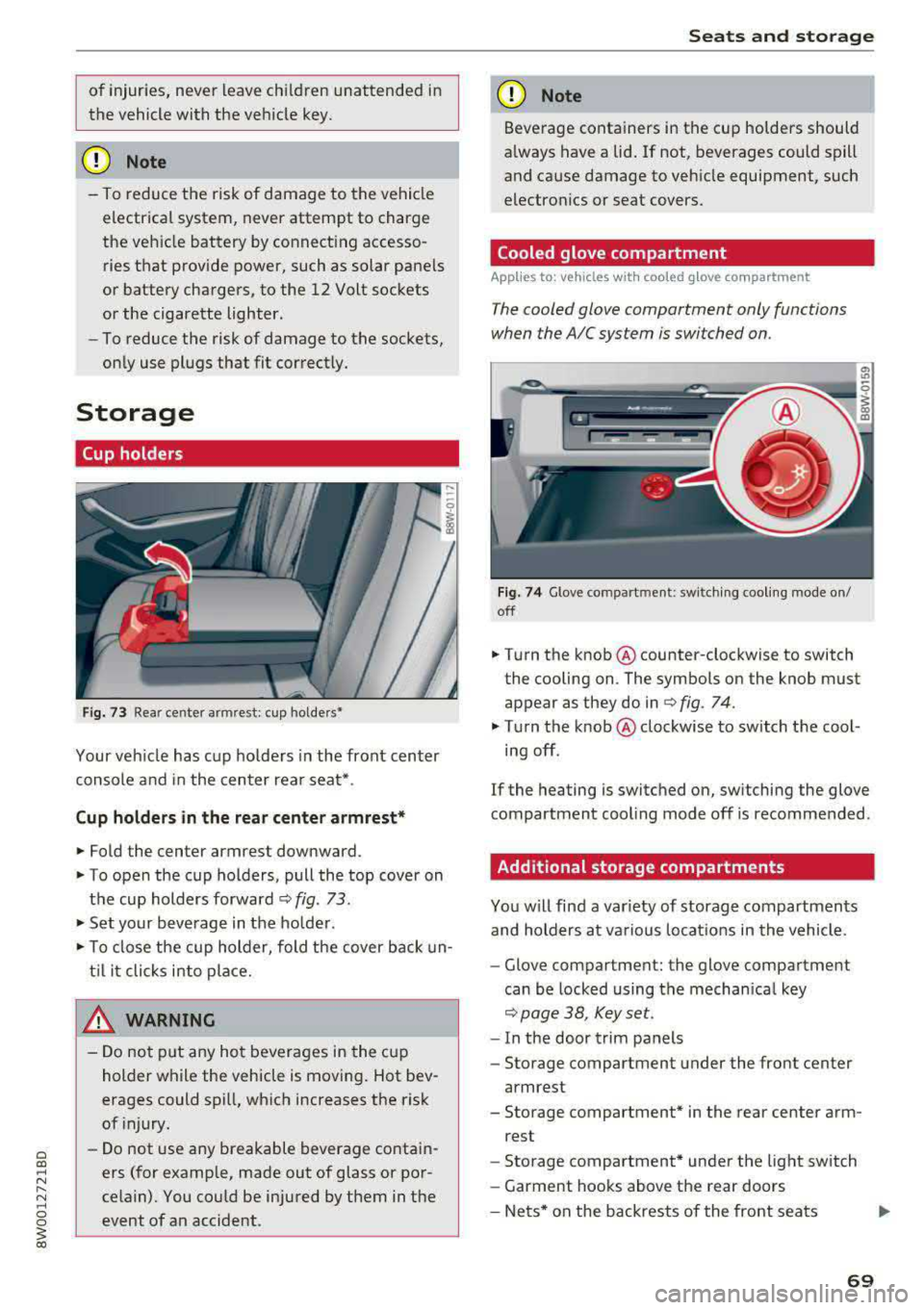
Fig. 73 Rea r cente r arm rest: cup holde rs•
Your vehicle has cup holders in the front center
console and in the center rear seat* .
Cup holders in the rear center armrest*
.,. Fold the center armrest downward.
.,. To open the cup holders, pull the top cover on
the cup holders forward
c::> fig. 73.
.,. Set your beverage in the holder .
.,. To close the cup holder, fold the cover back un
til it clicks into place.
& WARNING
-Do not put any hot beverages in the cup
holder while the vehicle is moving. Hot bev
erages could spill, which increases the risk
of injury.
-Do not use any breakable beverage contain
ers (for example, made out of glass or por
celain). You could be injured by them in the event of an accident.
Seats and storage
(D Note
Beverage containers in the cup holders should
always have a lid. If not, beverages could spill
and cause damage to vehicle equipment, such
electronics or seat covers.
Cooled glove compartment
App lies to: vehicles wit h coo led g love co mpartment
T he cooled glove compartment only functions
when the AIC system is switched on .
Fig. 74 Glove compart ment : swi tching cooling mode on/
off
.,. Turn the knob @counter-clockwise to switch
the cooling on . The symbols on the knob must
appear as they do in
r=> fig. 74.
.,. Turn the knob @clockwise to switch the cool
ing off.
If the heating is switched on, switching the glove
compartment cooling mode off is recommended .
Additional storage compartments
You will find a var iety of storage compartments
and holders at various locations in the vehicle .
-Glove compartment: the glove compartment
can be locked using the mechanical key
c::> page 38, Key set.
-In the door trim panels
- Storage compartment under the front center
armrest
- Storage compartment* in the rear center arm-
rest
- Storage compartment* under the light switch
- Garment hooks above the rear doors
-Nets* on the backrests of the front seats
69
Page 86 of 403

Driving
St ee ring lock1
)
The stee ring locks when you t urn the engine off
using the
! S T A RT ENGINE ST OP I button and
open the driver 's door. The locked steering helps
prevent v ehicle theft .
Emergency off function*
If it is abso lutely necessary, the engine can also
be turned off while dr iv ing at speeds star ting at
4 mph (7 km/h). To switch the eng ine off, press
the
! S TAR T ENGINE ST OP I button tw ice in a row
briefly or press and hold for longer than two sec
onds.
A WARNING
- Never turn off the engine before the veh icle
has come to a comp lete stop . The full func
t ion of the brake booster and the power
stee ring is not guaranteed. Yo u must use
more force to turn or b rake . Because you
cannot s teer an d brake as you usu ally
would, t his co uld lead to accidents and ser i
ous in juries.
- Alw ays t ake the key wi th you w henever you
leave you r vehicle . Othe rw ise, the engi ne
cou ld be started o r electrical equipment
s uch as the power windows cou ld be operat
ed . This can lead to se rious injury.
- For safety reasons, always park the vehicle
with the se lector lever in the P position
(a u
tomat ic transmission) or with 1st gear en
gaged (manual transmission). Otherwise
the vehicle could roll away u nintent ionally .
(D Note
If the eng ine has been under heavy load for
an extended per iod of t ime, heat builds up in
the engine compartment after the engine is
sw itched off and there is a risk of damaging
the engi ne . For this reason, let the engi ne run
for at idle for approximately two minutes
be
fore shutting it off.
l) Th is fun ction is not avai la bl e in al l co un tries.
84
(D Tips
Fo r u p to 10 minutes after stopping the en
g ine, the radiator fan may turn on again auto
matically or it may continue to r un (even if
the ig nition is switched off) for the following
r easons:
- The coolant temperature is increas ing due
to trapped heat.
- If the eng ine is wa rm and the eng ine com
partment a lso heats up from strong sun
light .
- Applies to: vehicles with diesel particulate
filter: The emissions control system is heat
ed through the regeneration process, even if
the engine has not reached its operat ing
tempe rature yet.
Messages
Engin e running . Warning! Turn off ignition be
fore leavin g vehicle
This message appears and a warning tone sounds
i f you open the drive r's door w hen the eng ine is
r un ning .
Applies to: vehicles with manual transmission
Please pres s clutch pedal
This message appears if you do not press the
clutch pedal to start the eng ine. The engine can
o nly be started w hen the clutch pedal is pressed.
Applies to: vehicles with automatic transmissions
Plea se pres s brake pedal
This message appears if you do not press the
bra ke peda l when sta rting t he eng ine .
Ill Remote control key : key not recognized. Is
the key still in the vehicle ?
This indicator light turns on and this message ap
pears if the ignition key was removed from the
vehicle when the engine was running . If the igni
tion key is no longer in the vehicle, you cannot
switch on the ignition or start the engine once
Page 87 of 403

you stop it. You also cannot lock the vehicle from
the outside .
Applies to: vehicles with au tomatic transm issions
Shift to P , otherwise vehicle can roll away.
Doors do not lock if gearshift is not in P
This message appears for safety reasons if the
selector lever is in the N position when you
sw itch the ignition off. Move the selector leve r to
the P position. Otherwise the vehicle is not pro
tected from ro lling and it cannot be locked .
DJ Remote control key: hold back of key
against the designated area . See owner 's man
ual
If the indicator light turns on and th is message
appears, there is a malfunction
q page 85 .
Applies to: vehicles with automatic transmissions
Shift to P before leaving car, otherwise vehicle
can roll away
This message appears if the driver's door is
opened while the ignition is switched on and the
transmission has not been shifted to the P posi
tion . Sh ift the transmiss ion into the P position
and turn off the ignition if you are leaving the ve
hicle . Otherwise the vehicle could roll. Also see
c::> page87 .
Starting the engine when there is a
malfunction
It may not be possible to start the engine under
certain circumstances, for example if the battery
in the vehicle key is drained, if interference is af
fected the key or if there is a system malfunc
tion .
Fig. 94 Cente r console/ remote contro l key: starting t he
eng ine if there is a malfunc tion
Driving
Requirement: the message Remote control key:
hold back of key against the designated area .
See owner's manual
must display and the DJ i n
dicator light must turn on.
.,. Place the remote control key on the location
shown in the illustration
y >l) c::> fig . 94.
Applies to: vehicles with manual transmission
.,. Press the clutch pedal.
Applies to: vehicles with automatic transmissions
• Press the brake pedal.
.. Press the !START ENGINE STOP ! button. The
engine will start.
.,. Drive to an authorized Audi dea ler or author
ized Aud i Service Facility immediately to have
the malfunction corrected.
@ Tips
You can view the message again by pressing
the
I S TART ENGINE STOP I button.
Start/Stop system
Description
Applies to: vehicles with Start/Stop system
The Start/Stop system can help increase fue l
economy and reduce CO2 emissions.
In Sta rt/Stop mode, the engine shuts off auto
matically when the vehicle is stopped, such as at
a traffic light. The ignition remains switched on
during this stop phase . The engine wi ll restart
automatica lly when needed .
Th e Start/Stop system is a utomaticall y activated
as soon as the ignition is switched on.
Basic requirements for Start/Stop mode
-The driver's door must be closed .
-The driver's seat belt much be fastened.
- The hood must be closed.
- The vehicle must have driven faster than
2 mph
(3 km/h) since the last time it stopped .
- A trailer must not be hitched to the vehicle.
If you leave the vehicle during a stop phase, the
engine can be restarted within approximately 30
seconds if the following requi rements are met:
IJ>
85
Page 91 of 403
a co .... N ..... N .... 0 0
3 co
~ Applies to: automatic transmission: Select the
P selector lever position .
~ Turn the eng ine off ¢,&. .
~ Applies to: manual transmission: Engage 1st
gear.
~ Turn the steering wheel when parking on in
clines so that the wheels will roll into the curb
if the veh icle starts moving .
A WARNING
-Never accelerate or release the clutch pedal
carelessly when a gear or a selector lever
posit ion (automatic transmission) is engag
ed whi le the vehicle is stationary and the en
gine is running. Otherwise, the vehicle will
start to move immediately and this cou ld re
sult in an accident.
- Emergency braking should only be used in
an emergency, when the normal brake peda l
has failed or the brake pedal is obstructed.
During emergency braking, your veh icle will
brake sim ilar to heavy brak ing . ESC and the
associated components (ABS, ASR, EDL)
cannot overcome the laws of physics,
Around curves and when road or weather
conditions are bad, a full brake application
can cause the vehicle to skid or the rear end
to swerve, which increases the risk of an ac
c ident.
- If the power supply fails, you cannot set the
park ing brake if it is released . If th is is the
case, stop the veh icle on leve l ground and
secure it by engaging 1st gear (manual
transmiss ion) or select ing the P selector lev
er position (automatic transm iss ion). See an
authorized Aud i dealer or autho rized Aud i
Service Facility for assistance .
- Always take the vehicle key with you when
leaving your vehicle, even if for a short pe ri
od of time. This applies particu larly when
children remain in the vehicle. Otherwise,
children could start the engine, release the
parking brake or operate electrical equip
ment such as powe r windows, which in
creases the risk of an acc ident.
- No one, especially children, shou ld remain
in the vehicle when it is locked. Locked
doors make it more difficult for emergency
D riving
workers to get into the vehicle, which puts
lives at risk.
(D Tips
Ap plies to : vehicles with auto matic transmissions
When stopp ing at a traff ic signa l or stopp ing
i n city traffic, you can set the park ing brake
manually . The vehicle does not have to be
held with the brake pedal. The park ing brake
eliminates the tendency to creep when a se
l ector lever position is engaged. As soon as
you press the a ccelerator peda l, the parking
brake releases automatically and your vehicle
starts to move r=;,
page 89.
(j) Tips
-Occasional noises when the pa rking brake is
set and released are normal and are no t a
cause for concern.
- The parking brake goes through a self-test
cycle at regular intervals when the vehicle is
stopped. Any noises assoc iated with this are
normal.
- If there is a power failure, the parking brake
wi ll not set if it is released, and it will not
re lease if it is
set ¢.&. . See an a uthorized
Audi dealer or authorized Audi Service Fa cility for assistance.
Starting to drive
Various convenience and safety funct ions may be
available when the vehicle begins driving, de
pending on vehicle equipment .
Starting on hills with the p arking brake set
Requirement: the driver's door must be closed .
~ To start driving comfortably when on a hill , set
the parking brake and begin driving as usual.
The braking force of the parking brake does not
release a utomatically until the wheels build up
enough driving force.
Starting on hills with hill hold assist
Hi ll ho ld assist makes it easier to start on hills.
Requirement: the driver's door must be closed
and the engine must be running.
89
Page 95 of 403

In the no rmal mode D, the transmission a uto
matica lly selects the suitab le gear ratio. It de
pends on eng ine load, vehicle speed and driving
style.
Select the
sport mode S for sporty driving. The
vehicle makes full use of the engine's power.
Shifting may become noticeable when accelerat ing.
The S selector lever position engages automati
cally when you se lect
Dynamic mode in drive se
l ect*.
A WARNING
Read and follow all WARNINGS.
-The vehicle can roll even if the ignition is
switched off.
-Power is sti ll transmitted to the wheels
when the eng ine is running at idle . To pre
vent the veh icle from "creeping", you must
keep your foot on the brake in all selector
lever positions (except P and N) when the
engine is running .
-Before opening the hood, select the P selec
tor lever position and set the parking brake.
This reduces the risk of an accident. Always
read and fo llow the applicable warnings
¢ page 323, Working in the engine com
partment.
@ Tips
If you accidentally se lect N wh ile d riving, take
your foot off the accelerator pedal and wa it
for the engine to slow down to idle before se
lect ing Dor S.
Driving tips
Appl ies to: vehicles with automatic transmissions
Starting the engine
.,. The P or N position must be selected.
Starting from a stop
.. Press and hold the brake pedal.
~ .. Start the engine ¢ page 83 .
;::; .,. Press the lock ing button @ on the selector Lev-,....
:::l er and select the D, E, So r R position 0
3 ¢page 91 .
.. Wait a moment until the transmission shifts.
You will notice a slight movement when the
gear engages .
.. Release the brake pedal and press the accelera-
tor
pedal ¢&, .
Various convenience functions are available for
start ing on h ills
¢ page 89.
Stopping temporarily
.,. Press the brake pedal to stop the vehicle, for
examp le at a traffic light. Do not press the ac
celerator pedal when doing this .
.. To prevent the vehicle from rolling when you
start driving, set the parking brake when stop
ping on steep
hills ¢&, .
.. The parking brake will release automatically
and the vehicle will start moving once you press
the accelerator pedal.
Stopping /parking
If the selector lever is not in the P position when
you open the driver's door, the vehicle could roll.
.. Press and hold the brake peda l¢ &, .
.. Set the parking brake.
.. To select the P selector lever posit ion, press the
P button
@ on the selector lever¢ page 91 ,
fig . 98 .
Under certain conditions, such as driving in the
mountains or when towing a trailer, it may be
helpful to switch to manual mode temporar ily
and shift
manually to adapt to the driv ing cond i
t ions ¢ page 94 .
On hills, activate the park ing brake first and then
shift into the P
position ¢ page 88. This prevents
too much stress from being placed on the locking
mecha nism .
A WARNING
--The vehicle can roll even when the engine is
switched off.
-Unintended vehicle movement can lead to
. . . . serious mJunes .
-To reduce the r isk of an accident, do not
press the accelerator pedal when changing
the selector lever position while the vehicle
is stationary and the engine is running.
93
Page 200 of 403
a co .... N ,....
N .... 0 0
3 co
-Pay attention to upper-an d lowe r-case let
ters when enter ing the ve hicl e code.
-If yo u do no t have the 10- digit ve hicle code,
contact a n author ized A udi dealer or author
i zed Audi Se rvice Facility .
Additional options
Applies to vehicles with Audi connect vehicle control
License subscription
Th e validi ty and expirat io n date o f yo ur sub scr ip
tions a re displaye d. When
Warning before sub
scr iption expires
is activated, a message w ill be
d isp layed warning yo u that you r license is about
to expire.
Select:
IME NU! button> Audi connect > Display
available function s>
right control button> Li
cense subscription .
Resetting the primary user
F or example, y ou ca n rese t the key use r whe n
se lling your vehicle in o rder to dea ctivate these
services .
R eq uirement: the ign it ion mu st be swi tched on.
Select:
IMENU ! button> Audi connect > right
control b utton >
Audi connect user management
> Key user > Reset key user .
Warning levels
Req uirement: the primary use r must have set one
or more warning levels. Secondary users can only
see if a warning level is active or not .
Select:
IMENU ! button> Audi connect > right
control b utton >
Alerts .
Remote locking and
unlocking
Applies to vehicles with Audi connect vehicle control
You can lock a nd u nlock your vehicle using this
service .
Requirement
- This requires the 4-dig it PIN that you specified
dur ing the verification on www.audiusa.com/
myaud i .
- The veh icle must be stationary.
Audi connect veh icle control
- The ignition must be sw itched off.
Vehicle status report
Applies to vehicles with Audi connect vehicle control
T he Dr iver Info rmat ion System collec ts da ta u n
der certai n conditions and sends it to a serve r.
When data is sto red, you ca n access va lues such
as the se u sing the se rvice:
- Remaining range
- Fue l tank leve l
- O il level
- Veh icle doors a re open/closed or locked/un -
loc ke d
- Mileage
- Next o il ch ange
- N ext inspec tion
- Wa rning messages
- Side marker lights/parking lights on/off
For additional information on the D river Informa
t ion System, refe r to
c:> page 17, Driver informa
tion system .
A WARNING
Do not ignore messag es and wa rni ng or indi
cator lights that t urn on i n the vehicle be
cau se o f th e i nfo rmation in the status report .
Thi s could lea d to brea k downs in on the roa d,
a cci dents a nd ser iou s injuries.
Parking location
Applies to vehicles with Audi connect vehicle control
The vehicle collec ts data unde r ce rtain co ndit ions
and sends it to a serve r.
When data is sto red, you ca n access va lues such
as these using the se rvice:
- Veh icle location display,
- Display of one's own location,
- Rou te to you r vehicle .
If your mob ile dev ice also has a navigation func
t io n, you c an navigate to y our la st k nown par kin g
l oc ation .
199
Page 261 of 403
Driving sa fe ty
Loose items in the luggage compartment can
shift s udden ly, changing vehicle handling charac
ter istics. Loose items can also increase the risk of
serious personal in jury in a sudden vehicle
ma
neuver or in a coll is ion.
.,. Distribute the load evenly in the luggage com
partment .
.,. Always place and properly secure heavy items in
the luggage compartment as low and as far for
ward as possible
c> fig . 226 .
.,. Secure luggage us ing the tie-downs provided
¢ page 73 .
.,. Make su re that the rea r seatbac k is securely
latched in place.
A WARNING
Improperly stored luggage or othe r items can
fly through the vehicle causing serious per
sonal injury in the event of hard braking or an
accident. To help reduce the risk of serious
personal injury:
- Always put objects, for example, luggage or
other heavy items in the luggage compart
ment.
- Always sec ure objects in the luggage com
partment using the tie-down eyelets and
s u itable straps.
A WARNING
Heavy loads will influence the way your vehi
cle handles. To he lp reduce the r isk of a loss
of contro l leading to serious pe rsonal i njury:
- Always keep in mind when transporting heavy objects, that a change i n the center of
grav ity can also cause changes in vehicle
hand ling:
- Always distr ibute the load as even ly as
possible.
- Place heavy objects as far forward in the
luggage compartment as poss ible.
- Never exceed the Gross Axle Weight Rating
o r the Gross Vehicle Weight Rating specified
on the safety compliance sticker on the driv
er's side B-pillar respective ly on the front
end of the driver's door. Exceeding permissi
ble weight standards can cause the veh icle
to slide and handle differently .
260
-Please observe info rmation on safe driving
¢page 254.
A WARNING
To he lp prevent po isonous exhaust gas from
being drawn into the vehicle, always keep the
rear lid closed while driving.
- Never transport objects larger than those
fitting completely into the luggage area be
cause the rear lid cannot be fully closed.
- If you absolutely must dr ive with the rear lid
open, observe the following notes to reduce
the risk of poisoning :
- C lose all windows,
- Close the s unroof*,
- Open all a ir outlets in the instrument pan-
el,
- Switc h off the air reci rculat ion,
- Set the fresh air fan to the highest speed.
A WARNING
-
Always make sure that the doo rs, all win
dows, the sunroof * an d the rear lid are se
curely closed and locked to red uce the risk of
i n jury when the veh icle is not being used.
- After closing the rear lid, always make sure
that it is properly closed and locked.
- Never leave your ve hicle unattended espe
cially with the rear lid left open. A child
co uld crawl into the vehicle th rough the lug
g age com partment an d close the rea r lid
be
coming tr apped and unab le to ge t out . Be
ing trapped in a vehicle can lead to ser ious
pe rsonal i nju ry.
- Never let c hild ren p lay in or around the vehi
cle.
- Never let passengers ride in the luggage
compa rtment. Vehicle occupants mus t
al
ways be p roperly restrained in one of the ve
hicle's seat ing pos itions.
(D Tips
- Air circul ation helps to reduce w indow fog
ging . Stale ai r escapes to the o uts ide
t h roug h vents in the trim panel. Be sure to
keep these slots free and open.
Page 277 of 403
Airbag system
-Never hold the steering wheel at the 12
o'clock position or with your hands any
where inside the steering wheel or on the
steering wheel hub. Holding the steering
wheel the wrong way increases the risk of
severe injury to the arms, hands, and head if
the driver airbag deploys.
,& WARNING
Objects between you and the airbag will in
crease the risk of injury in a crash by interfer
ing with the way the airbag unfolds and/or by
being pushed into you as the airbag inflates.
- Always make sure nothing is in the front air-
bag deployment zone that could be struck
by the airbag when it inflates.
-
- Objects in the zone of a deploying airbag
can become projectiles when the airbag de
ploys and cause serious personal injury.
- Never hold things in your hands or on your
lap when the vehicle is in use.
- Never place accessories or other objects
(such as cup holders, telephone brackets,
note pads, navigation systems, or things
that are large, heavy, or bulky) on the doors;
never attach then to the doors or the wind
shield; never place them over or near or at
tach them to the area marked ,,AIRBAG" on
the steering wheel, instrument panel or the
seat backrests; never place them between
these areas and you or any other person in
the vehicle.
- Never attach objects to the windshield
above the passenger front airbag, such as
accessory GPS navigation units or music
players. Such objects could cause serious in
jury in a collision, especially when the air bags inflate.
- Never recline the front passenger seat to transport objects. Items can also move into
the deployment area of the side airbags or
the front airbag during breaking or in a sud
den maneuver. Objects near the airbags can
fly dangerously through the passenger com partment and cause injury, particularly
when the seat is reclined and the airbags in
flate.
276
,& WARNING
, -
A person on the front passenger seat, espe
cially infants and small children, will receive
serious injuries and can even be killed by be ing too close to the airbag when it inflates .
- Although the Advanced Airbag System in your vehicle is designed to turn off the front passenger airbag if an infant or a small child
is on the front passenger seat, nobody can
absolutely guarantee that deployment un
der these special conditions is impossible in
all conceivable situations that may happen
during the useful life of your vehicle.
- The Advanced Airbag System can deploy in accordance with the
,.low risk" option for 3-
and 6-year-old children under the U.S. Fed
eral Standard if a child with electrical capac
itance greater than the combined capaci
tance of a typical one-year old infant re
strained in one of the forward facing or rear
ward-facing child seats with which your ve hicle was certified is on the front passenger
seat and the other conditions for airbag de
ployment are met.
- Accident statistics have shown that children
are generally safer in the rear seat area than
in the front seating position.
- For their own safety, all children, especially
12 years and younger, should always ride in
the back properly restrained for their age
and size.
Advanced front airbag system
Your vehicle is equipped with a front Advanced
Airbag System in compliance with United States
Federal Motor Vehicle Safety Standard (FMVSS)
208, as well as Canada Motor Vehicle Safety
Standard (CMVSS) 208 as applicable at the time
your vehicle was manufactured .
-
The front Advanced Airbag System supplements
the safety belts to provide additional protection
for the driver's and front passenger's heads and upper bodies in frontal crashes. The airbags in
flate only in frontal impacts when the vehicle de-
celeration is high enough.
ll>
Page 304 of 403
Convertible child safety seats
Properly used convertible child safety seats can
help protect toddlers and children over age one
who weigh between
20 and 40 lbs. (9 and 18 kg)
in a crash.
Fig. 250 Schematic overv iew: insta llatio n of the attach
ments applicab le to a LATCH seat
Fig. 251 Schematic overv iew: installat ion of the seat using
the vehicle 's safety belt system
.. When using the vehicle safety belt to install a
child safety seat, you must first activate the
convertible locking retractor on the safety belt
to prevent the child safety seat from moving
Q page 306 or install the seat us ing the LATC H
attachments .
.. Push the child safety seat down with your fu ll
weight to get the safety belt really tight so that
the seat cannot move forward o r sideways
more than one inch (2.5 cm)
Q page 306.
.. If the child safety seat is equipped with a tether
strap, attach it to the tether anchors
Q page 312.
.. Secure unused safety belts on the rear seat
Qpage 301 .
A toddler or child is usually too large for an in
fant restraint if it is more than one year old and
weighs more than 20 lbs. (9 kg).
Child safety
To ddlers and children who are older than one
year up to about 4 years old and weigh more than
20 lbs. (9 kg) up to 40 lbs. (18 kg) must always
be properly restrained in a child safety seat certi
fied for their size and weight
Q fig. 250 and
q fig . 251.
The airbag on the passenger side makes the front
seat a potentially dangerous place for a child to
ride. The front seat is not the safest place for a
child in a forward-facing child safety seat. It is a
very dangerous place for an infant or a larger
child in a rearward-facing seat .
_&. WARNING
Not using a child safety seat, us ing the wrong
child safety seat or improperly instal ling a
chi ld restraint increases the risk of serious
personal injury and death in a collision or oth
er emergency situation.
-Children on the front seat of any car, even
with Advanced Airbags, can be seriously in
jured or even killed when an airbag inflates.
A child in a rearward-facing ch ild safety seat
installed on the front passenger seat will be
seriously injured and can be killed if the
front airbag inflates
-even with an Ad
vanced Airbag System.
-The inflating airbag will hit the child safety
seat or infant carr ier with great force and
will smash the child safety seat and child
against the backrest, center armrest, door
or roof.
-Al ways install rear-fa cing child safety seats
on the rear seat .
-If you must insta ll a rearward facing child
safety seat on the front passenger seat be
cause of excep tional circumstances and the
PASSENGER AIR BAG OFF '-I; light does not
come on and stay on, immediately insta ll
the rear-facing child safety seat in a rear
seating position and have the a irbag system
inspected by your Audi dealer .
-The rear side of the ch ild safety seat shou ld
be positioned as close as possible to the
backrest on the veh icle seat. Adjust or re
move the rear seat head restraint if it is dif
f icult to install the child seat with the head
303
Page 308 of 403
a co .... N ,....
N .... 0 0
3 co
A WARNING
-
Improperly installed child safety seats in
crease the risk of serious personal injury and
death in a collision.
- Always make sure that the safety belt re
tractor is locked when installing a child
safety seat. An unlocked safety belt retrac
tor cannot hold the child safety seat in place
during normal driving or in a crash.
-Always buckle the child safety seat firmly in place even if a child is not sitting in it. A
loose child safety seat can fly around during
a sudden stop or in a collision.
- Always make sure that the rear seat back
rest to which the center rear safety belt* is
attached is securely latched whenever the
rear center safety belt is being used to se
cu re a ch ild restraint .
-If the backrest is not securely latched, the
child and the child restraint will be thrown
forward together w ith the backrest and will
strike parts of the vehicle interior. The ch ild
can be se riously injured or killed .
-Never install rear-facing child safety seats
or infant carriers on the front passenger
seat . A child will be serious ly injured and
can be killed when the passenger airbag in
flates.
-The inflating airbag will hit the child safety seat or infant carrier with great force and
will smash the ch ild safety seat and chi ld
against the backrest, center armrest, door
or roof .
-Always install rear-facing child safety seats
or infant carriers on the rear seat.
-Forward-fac ing ch ild safety seats or infant
carriers installed on the front passenger's
seat may interfere with the deployment of
the a irbag and cause serious injury to the
child .
-It is safer to install a forward -fac ing ch ild
safety seat on the rear seat .
- Always read and heed all WARNINGS when
ever using a child restrained in a veh icle is
being used
~ page 295 . Specia l precaut ions
apply when installing a child safety seat on
the front passenger seat
~ page 2 72, Child
Ch ild safety
restraints an the front seat -some impor
tant things to know.
A WARNING
-A lways take special precautions if you must
i nstall a forward or rearward-facing child re
stra int on the front passenger's seat in excep
tional s ituations:
-Whenever a forward or rearward-fac ing
child restraint is installed on the front pas
senger seat, the
PASSENGER AIR BAG OFF
~; light must come on and stay on whenev
er the ign ition is switched o n.
-If the PASSENGER AIR BAG OFF ~; light
does not come on and stay on, perform the
checks desc ribed
~ page 283, Monitoring
the Advanced Airbag System.
-Take the child restra int off the front passen
ge r seat and install it prope rly at one of the
rear seat positions i f the
PASSENGER AIR
BAG
OFF ~; light does not stay on whenever
the ignition is switched on .
-Improper installat ion of child res tra ints can
reduce their effectiveness or even prevent
them f rom providing any protect ion .
-An improperly installed child restraint can
interfere with the airbag as it deploys and
serious ly injure or even kill the chi ld.
-Always carefully follow the manufacturer's
instr uctions provided with the child safety
seat or carr ier .
- After checking to make sure that the c hild
restraint is properly installed, make certain
that the child restraint is correctly recog
n ized by the capacitive passenger detection
system in the front passenger seat and that
the
PASSENGER AIR BAG OFF ~; light sig
na ls the cor rect front passenger fronta l air
bag status.
A WARNING
F orwa rd-facing child restra ints:
-Always make sure the forward-facing seat
has bee n des igned and certified by its man
ufacturer for use on a front seat with a pas
senger front and side airbag.
-
307