New tires or wheels AUDI A4 2018 Owners Manual
[x] Cancel search | Manufacturer: AUDI, Model Year: 2018, Model line: A4, Model: AUDI A4 2018Pages: 403, PDF Size: 66.81 MB
Page 153 of 403
a co .... N ,....
N .... 0 0
3 co
Also see¢ page 146, Electronic stabilization
control (ESC) .
The all-wheel drive system dist ributes the d riving
power var iably to the front and rear axle. It works
together with selective whee l torque cont rol,
which activates when driving through curves
c:> page 146. With the sport differentia l*, power
d istribution to the rear wheels is variable and can
be adjusted using the dr ive select
c:> page 134.
The all wheel drive concept is designed for high
engine power. Your ve hicle is exceptionally pow
erful and has excellent driving characterist ics
both under norma l dr iving condit ions and on
snow and ice . Always read and fo llow safety pre
cautions
c:> .&. .
Winter t ires
By us ing all wheel drive, yo ur vehicle has good
forward motion with standard tires in w inte r con
d itions. However, using winter or all season tires
on
all four wheels in the winter is recommended ,
because this will improve the
braking effec t.
Snow chains
If there are snow chain laws, snow chains must
also be used on vehicles with all wheel drive
c:> page 350, Snow chains .
Replacing tire s
For vehicles with all whee l drive, only whee ls with
the same ro lling circumference s hou ld be used.
Avoid using tires w ith different tread depths
c:> page 341, New tires or wheels.
Offroad vehicle?
The ground clearance is too low on some mode ls
to drive on rough terrain. Therefore, avoid off road trips.
A WARNING
-Also, in vehicles with a ll w heel d rive, adapt
your dr iv ing style to the current road and
t raff ic conditions . Do not let the increased
safety provided tempt you into tak ing risks,
because t his increases the r is k of an acci
dent .
Intellig ent Technology
- The braking ab ility o f your vehicle is limited
to the traction of the wheels. In this way, it
is not different from a two wheel drive vehi
cle . Do not be tempted to accelerate to a
h igh speed whe n the road is sli ppery, be
cause this i ncreases the risk of an accident.
- No te that o n wet streets, the fron t wheels
can "hydrop la ne" if dr iv ing at speeds that
are too high. Unlik e front wheel d rive
veh icles, the engine does not rev h ig her sud
denly when the vehicle begins hydrop laning.
F orthisre ason,ad aptyo urspeedto the
road conditions to re duce the risk of an acci
dent .
Energy management
The starting ability is optimized
The energy management system manages the
electrical energy distribution and optimizes the
availability of electrical energy for starting the
engine .
When a vehicle with a conventional energy sys
tem is not drive n for a long time, the ve hicle bat
te ry is d rained by equipment (for example, t he
immob ilizer). In certa in circ ums tances , there
c ou ld m ay no t be eno ugh e nergy to start the en
gine.
You r vehicle is equi pped with an in tell igent ener
gy manageme nt system fo r dist ributing electrici
ty. This sig nifican tly improves the start ing ability
and in cre ase s t he vehicle battery life.
The ene rgy ma nagement system Is made up of
battery diagnosi s, idling current management ,
and dynamic energy management .
Battery diagnosis
The battery diagnos is determines the vehicle bat
te ry c harge level. The sensors determine the bat
te ry vo ltage, the batte ry cu rrent, and the batte ry
temperat ure. The current c ha rge level and t he
perfo rman ce of the vehicle battery a re de ter-
mine d base d on this.
..,.
151
Page 340 of 403
0 C0 .-< N ..... N .-< 0
~ a:,
Rim
means a metal support for a tire
or a tire and tube assembly upon
which the tire beads are seated.
Rim diameter
means nominal diameter of the
bead seat. If you change your
wheel size, you will have to pur
chase new tires to match the new
rim diameter.
Rim size designation
means rim diameter and width.
Rim width
means nominal distance between
rim flanges .
Sidewall
means that portion of a tire be
tween the tread and bead .
Speed rating (letter code)
means the speed at which a t ire is
designed to be driven for extend
ed periods of time . The ratings
range f rom 93 mph (150 km/h)
to 186 mph (298 km/h)
¢ table
on page 335.
You may not find
this information on all tires be
cause it is not required by law.
The speed rating letter code ,
w here applicable, is molded o n
the tire sidewall and indicates the
Wheels
maximum permissible roa d
speeds
¢ A in Winter tires on
page 349.
Tire pressure monitoring
system
means a system that detects
when one or more of a vehicle's
ti res are underinflated and illumi
na tes a low tire pressure warning
telltale.
Tread
means that po rtion of a ti re that
comes i nto contact with the road .
Tread separation
means pulling away of the tread
from the tire carcass.
Treadwear indicators (TWI)
means the projections withi n the
principa l grooves desig ned to g ive
a visua l indication of the degrees
of wear of the t read. See
¢ page 343, Treadwear indicator
for mo re in fo rmat ion on meas ur
ing t ire wear .
Uniform Tire Quality Grading
is a tire information system devel
oped by the United Sta tes Nation
a l Highway Traffic Safety Admin
istration ( NHTSA) tha t is designed
to help buyers make re lat ive
339
..
Page 342 of 403
for the number of seating posi
tions. Refer to the table ¢
table
on page 346
for the number of
people that correspond to the ve
hicle normal load.
New tires or wheels
Audi recommends having all work on tires or wheels performed by
an author ized Audi dealer or au
thorized Audi Service Facility.
These facilities have the proper
knowledge and are equipped with
the required tools and replace
ment parts.
.,.New tires do not yet have the
optimum gripping properties. Drive carefully and at moderate
speeds for the first 350 miles
(500 km) with new tires.
.,.Use tires of the same construc
tion, size (rolling circumference)
and as close to the same tread
pattern as possible on all four
wheels.
.,.Do not replace tires individually .
At least replace both tires on the
same axle at the same time.
.,.Audi recommends that you use
Audi Original Tires. If you would
~ like to use different tires, please .-<
~ note that the tires may perform .-< 0
~ a:,
Wheels
differently even if they are the
same
size ¢.&,. .
.,. If you would like to equip your
vehicle with a tire/rim combina
tion that is different from what
was installed at the factory, con
sult with an authorized Audi
dealer or authorized Audi Service
Facility before making a pur
chase¢ .&,..
If the spare tire is different from
the regular tires installed on the
vehicle
-for example, if winter
tires or wide tires are installed
-
then only use the spare tire tem
porarily in case of emergency and
drive carefully while it is in use . It
should be replaced with a regular
tire as soon as possible.
On
all wheel drive vehicles, all
four wheels must be equipped
with tires that are the same brand
and have the same construction
and tread pattern so that the
drive system is not damaged by different tire speeds. For this rea
son, in case of emergency, only
use a spare tire that has the same
circumference as the regular
tires.
341
Page 344 of 403
0 C0 .-< N ,...
vehicle components could wear more quickly.
Treadwear indicator
Original equipment tires contain
treadwear indicators in the tread pattern, which are bars that are
1/16 in (1.6 mm) high and are
spaced evenly around the tire per
pendicular to the running direc
tion¢ fig. 275. The letters "TWI"
or triangles on the tire sidewall indicate the location of the tread
wear indicators.
The tires have reached the mini mum tread depth
l) when they
have worn down to the treadwear
indicators. Replace the tires with
new ones
¢ A.
Tire rotation
Rotating the tires regularly is rec
ommended to ensure the tires
wear evenly. To rotate the tires,
install the tires from the rear axle
on the front axle and vice versa.
This will allow the tires to have
approximately the same length of
service life.
For unidirectional tires, make
sure the tires are installed accord-
8 l) Obey any applicable regulations in your
! country.
Wheels
ing to the running direction indi
cated on the tire sidewall
¢ page 366 .
Hidden damage
Damage to tires and rims can of
ten occur in locations that are hidden. Unusual vibrations in the
vehicle or pulling to one side may indicate that there is tire damage.
Reduce your speed immediately.
Check the tires for damage. If no
damage is visible from the out
side, drive slowly and carefully to
the nearest authorized Audi deal
er or authorized Audi Service Fa
cility to have the vehicle inspect
ed.
A WARNING
Tread that has worn too low or
different tread depths on the
tires can reduce driving safety.
This can increase the risk of an
accident because it has a nega
tive effect on handling, driving
through curves, and braking,
and because it increases the
risk of hydroplaning when driv
ing through deep puddles.
343
Page 345 of 403
Wheels
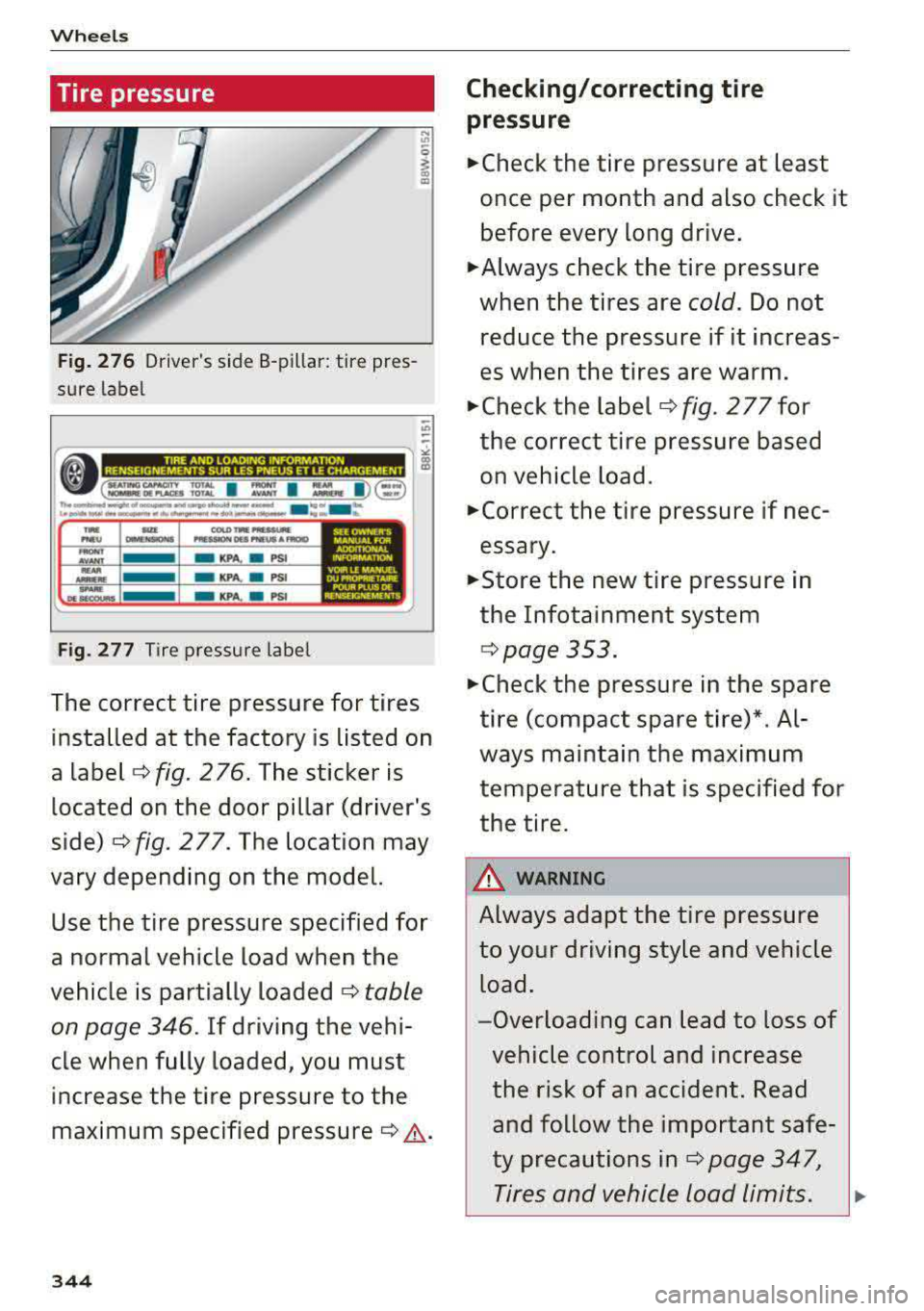
Tire pressure
Fig. 276 Driver's side 8-pillar: tire pres
sure label
io
-
i' 9 ~ c=- =_ -_,_, -- --... - .- -- .- -- .-~ t='I
- - ----_ l i
_NOlall!:Ol,ua.s fOTAL AYA>lf .t.MICftf I/ ~ n,.....,...__ ........ .,._... ..... ._....,. . ... ... l ..................... ......,....,..,.......,.... ... -..
-KP a PSI
-KPA. a PSI J
l== ===·
=KP ='A.= ·=PSl = ~~~~
Fig. 277 Tir e pr essur e lab el
The correct tire pressure for tires
installed at the factory is listed on
a
label ¢ fig. 2 76. The sticker is
located on the door pillar (driver's
side)
¢ fig. 2 77. The location may
vary depending on the model.
Use the tire pressure specified for
a normal vehicle load when the
vehicle is partially
Loaded¢ table
on page 346.
If driving the vehi
cle when fully loaded, you must increase the tire pressure to the
maximum specified
pressure ¢ A-
344
Checking/correcting tire
pressure
,..Check the tire pressure at least
once per month and also check it
before every long drive .
.,..Always check the tire pressure
when the tires are
cold. Do not
reduce the pressure if it increas
es when the tires are warm.
.,.Check the Labe l ¢fig. 277for
the correct tire pressure based
on vehicle load.
.,..Correct the tire pressure if nec
essary .
.,..Store the new tire pressure in
the Infotainment system
¢ page 353 .
.,.Check the pressure in the spare
tire (compact spare tire)*. Al
ways maintain the maximum
temperature that is specified for
the tire.
A WARNING
Always adapt the t ire pressure
to your driving style and vehicle load.
-Overloading can lead to loss of vehicle control and increase
the risk of an accident. Read and follow the important safe
ty precautions in
¢ page 347,
Tires and vehicle load limits.
Page 353 of 403

Wheels
the vehicle placard or tire inflation pressure la
bel, you should determine the proper tire
inflation pressure for those tires).
As an added safety feature, your vehicle has been
equipped with a tire pressure monitoring system (TPMS) that illuminates a low tire pressure tell
tale when one or more of your tires is significant
ly under-inflated. Accordingly, when the low tire
pressure telltale illuminates, you should stop and
check your tires as soon as possible, and inflate
them to the proper pressure . Driving on a signifi
cantly under-inflated tire causes the tire to over
heat and can lead to tire failure. Under-inflation
also reduces fuel efficiency and tire tread life,
and may affect the vehicle's handling and stop
ping ability.
Please note that the TPMS is not a substitute for
proper tire maintenance, and it is the driver's re
sponsibility to maintain correct tire pressure,
even if under-inflation has not reached the level
to trigger illumination of the TPMS low tire pres
sure telltale.
Your vehicle has also been equipped with a TPMS
malfunction indicator to indicate when the sys
tem is not operating properly. The TPMS mal
function indicator is combined with the low tire
pressure telltale. When the system detects a
malfunction, the telltale will flash for approxi
mately one minute and then remain continuously
illuminated . This sequence will continue upon
subsequent vehicle start-ups as long as the mal
function exists .
When the malfunction indicator is illuminated,
the system may not be able to detect or signal low tire pressure as intended. TPMS malfunctions
may occur for a variety of reasons, including the
installation of replacement or alternate tires or
wheels on the vehicle that prevent the TPMS
from functioning properly. Always check the TPMS malfunction telltale after replacing one or
more tires or wheels on your vehicle to ensure
that the replacement or alternate tires and
wheels allow the TPMS to continue to function
properly .
352
· If the tire pressure monitoring indicator
appears
The tire pressure indicator in the instrument
cluster informs you if the tire pressure is too low
or if there is a system malfunction.
Using the ABS sensors, the tire pressure monitor
ing system compares the tire tread circumfer
ence and vibration characteristics of the individu
al tires. If the pressure changes in one or more
tires, this is indicated in the instrument cluster
display with an indicator light
[I] and a message.
If only one tire is affected, the location of that
tire will be indicated.
The tire pressures must be stored in the Infotain
ment system again each time the pressures
change (switching between partial and full load
pressure) or after changing or replacing a tire on
your vehicle
c:> page 353. The tire pressure moni
toring system only monitors the tire pressure you
have stored . Refer to the tire pressure label for
the recommended tire pressure for your vehicle
c:> page 344, fig . 2 77.
Tire tread circumference and vibration character
istics can change and cause a tire pressure warn
ing if:
- the tire pressure in one or more tires is too low
- the tires have structural damage
- the tire was replaced or the tire pressure was
changed and it was not stored
c:> page 353
- tires that are only partially used are replaced
with new tires
Indicator lights
[I]-Loss of pressure in at least one tire c:> ,&..
Check the tires and replace or repair if necessary.
Check/correct the pressures of all four tires and
store the pressure again in the Infotainment sys
tem
c:> page 353.
mm (Tire Pressure Monitoring System) Tire
pressure: malfunction! See owner's manual.
If
mm appears after switching the ignition on or
while driving and the
[I] indicator light in the in
strument cluster blinks for approximately one minute and then stays on, there is system mal-
function. Try to store the correct tire pressures
IJJ,,,