ABS AUDI A4 AVANT 2008 User Guide
[x] Cancel search | Manufacturer: AUDI, Model Year: 2008, Model line: A4 AVANT, Model: AUDI A4 AVANT 2008Pages: 368, PDF Size: 46.19 MB
Page 222 of 368
__ ....,;;C;..;.h.;.; i.;.;ld ;;,;,__; S;;;.; a;;;;. f;;..; e;;;.; t~ y""------------------------------------------------
Children who weigh more than about 80 lbs (36 kg) and are at least
4 ft . 9 in. tal l can genera lly use the veh ic le's three po int lap a nd
shou lder belts . Chi ldren should use a lap belt only in very excep
tiona l situations and on ly if no child restraint system for the child's
size and weight or safer a lternative means of transportation of the
child is available. In these exceptiona l situations, the use of a lap
belt is better t han permitting t he ch ild to re main total ly unre
strained. But remember : a lap be lt cannot provide the same level of
protection as a proper c hild restraint or a t hree -poi nt lap and
shou lder be lt if the child is big enough . A lso, using a lap belt for
younger chi ldre n, who s hould be us ing a chi ld restrai nt, may v iola te
l aws in your state or Province .
N ever use a lap belt alone to rest ra in a chi ld that we ig hs less than
about 80 lbs (36 kg) and w ho is less t han 4'9" ta ll. A lways remember
t hat chi ld ren do not have the pronounced pelv ic structure requ ired
f or t he proper function o f lap belts . If a lap belt is o nly restra int
system available, then the chi ld's safety absolutely requires that the
l ap be lt be fastened snug ly and as low as possible around t he pelv is
l et a lap belt pass over the chi ld's stomach or abdomen .
& WARNING
Using wrong child restraints or improperly installed child
restraints can cau se seriou s personal injury or death in a crash.
• Failure to properly route safety belt s over a child's body will
cau se severe injurie s in a crash . The lap belt portion of the three
point belt a s well as any lap belt alone must always pass as low as
po ssible acros s the pelvis, never over the stomach or abdomen.
• An improperly worn safety belt will not provide the best protec
tion in a crash and may cause serious personal injury . Al ways
make sure that children and other vehicle occupants properly
wear available restraint sy stem s. Carefully follow the in struction s
prov ided by the manufacturers of child restraints .
•
Installing a child safety seat
Securing a child safety seat using a safety
belt
S afe ty belts for the rea r seats and the fr ont pa ssenger can
be locke d with the c onvertible locking retract or to prop
erly secure child safety seats.
T he safe ty belts emergency locking re tracto rs fo r the rea r sea ts
sa fety be lts a nd for t he front passenger's seat safety belt have a
conve rtible lock ing ret ractor for child rest ra ints . The safety belt
must be loc ked so t hat belt webbing ca nnot unree l. The retractor
can be activated to lock the safety be lt and prevent the safety be lt
webbi ng from l oosen ing up dur ing normal dr ivi ng. A c hild sa fe ty
seat can only be properly instal led when the safety belt is locked so
t hat t he ch ild and c hild safety seat will s tay in place .
A lways remember: Even though your vehicle is equipped with an
Advanced Ai rbag sys tem, al l c h ild ren, especially those 12 years and
younger, should always r ide in the back seat proper ly restra ined for
their age and size.
& WARNING
Improperly installed child safety seats increase the risk of serious
per sonal injury and death in a collision .
• Always make sure that the safety belt retractor is locked when
installing a child safety seat. An unlo cked safety belt retra ctor
cannot hold the child safety seat in pla ce during normal driving or
in a crash.
• Alway s buckle the child safety seat firmly
in place even if a
c hild is not sitting in it. A loose child safety seat can fly around
during a sudden stop or in a collision
• Alway s make sure that the rear seat backre st to which the
center rear safety belt is attached is securely latched whenever
the rear center safety belt is being u sed to se cure a child re straint.
_,.
Page 238 of 368
-L-__;l.:..n ..::t ..::e :.:..11 :.:..ig ,.,_;: e:.:..n .:.. t:....:. te.::..::. c.:..h :.:..n.:.. o::..:..: lo~g~ y ___________________________________________ _
Intelligent technology
Notice about data recorded by
vehicle control modules
Your vehicle is not equipped with an Event Data Recorder (EDR),
installed by some manufacturers for the express purpose of
capturing data for retrieval after an accident or crash event . EDR's
are sometimes called "crash recorders" .
Some state laws restrict the retrieval or downloading of data stored
by EDR's that were insta lled in a vehicle for the express purpose of
retrieving data after an accident or crash event without the owner's
consent.
Although your vehicle is not equipped with an EDR, it is equipped
with a number of electronic control modules for various vehicle
systems such as, for example, engine function, emission control, as
we ll
as for the airbags and safety belts.
These electronic control modules also record vehicle-related data
during normal vehicle operation for diagnostic and repair purposes .
The recording capacity of the electronic control modules is limited
to data (no sound is recorded) and only a small amount of data is
actually recorded over a very limited period of time and stored when
a system fault or other condition is sensed by a control unit. Some
of the data then stored may relate to vehic le speed, d irection,
braking as well as restraint system use and performance in the
event of a crash or other condition . Stored data can only be read and
down loaded with special equipment. •
Electronic Stabilization Program (ESP)
General information
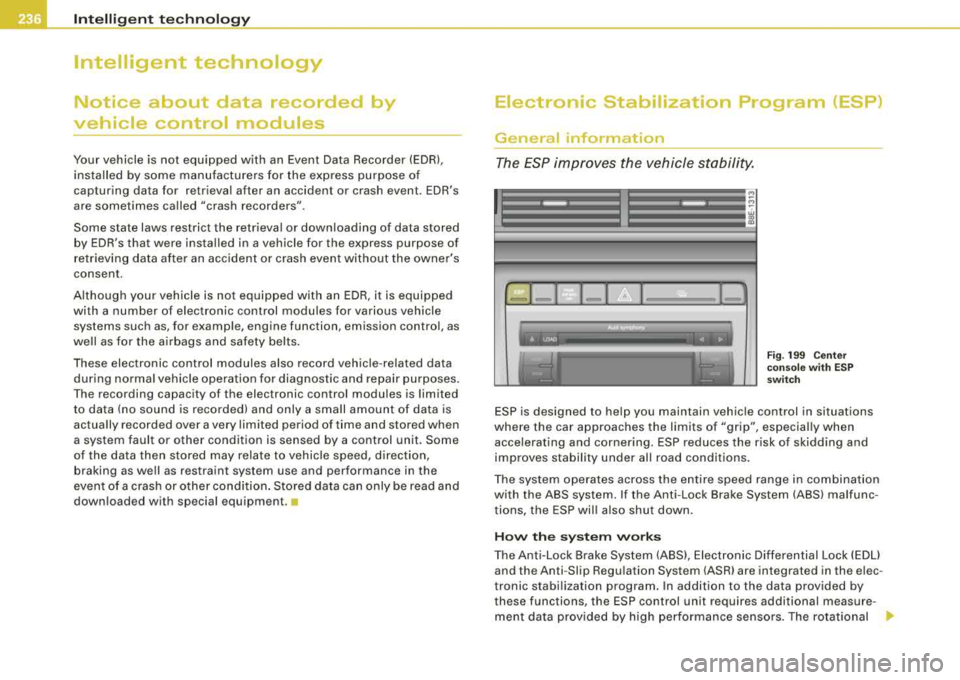
The ESP improves the vehicle stability.
(X) CD
Fig. 199 Center
console with ESP
sw itch
ESP is designed to he lp you maintain vehic le control in situations
where the car approaches the limits of "grip", especial ly when
acce lerating and cornering. ESP reduces the risk of skidding and
improves stability under al l road conditions.
The system operates across the entire speed range in combination
with the ABS system . If the Anti-Lock Brake System (ABS) malfunc
t ions, the ESP will a lso shu t down.
How the system works
The Anti-Lock Brake System (ABS), Electronic Differential Lock (EDU
and the Anti -Slip Regu lation System (ASR) are integrated in the e lec
tronic stabilization program . In addition to the data provided by
these functions, the ESP control unit requires additional measure
ment data provided by high performance sensors. The rotational
.,,.
Page 239 of 368
_________________________________________ ___:l:.:.. n !.!t ~e :.:.11 :.!.ig ~e :.:..n !.!t :... t::.: e::.: c~ h:..:.:..,: n~o =.!l~o ~g Lly '.,_ _l!III
speed of the vehicle about its vertica l axis, the lateral acce leration
ac ting on the veh ic le, the brake pressure and the s teering ang le a re
a ll measured .
The direction in which the driver wishes to travel is determined with
the aid of the steering angle and veh icle speed and is continua lly
compared with the actual behavior of the vehicle. If the two do not
match, -for example, when the vehicle starts hydrop la ning on a
wet road -
, ESP will au tomatical ly brake the appropria te wheel to
correct the problem .
The vehicle is then stabi lized by the forces acting on the whee l
during braking . If the vehicle is
oversteering (r ea r tends to skid out
of the turn), t he brakes are main ly app lied on the whee l that is on
the outside of the curve . In the case of a vehicle that is
understeering
(tendency to s lide out of the curve) , the bra kes are applied at the
rear whee l that is on the inside of the curve. An acoustic signal indi
cates when ESP brake appl ication cuts in
=> & .
The system operates across the entire speed range in combination
wi th the ABS system
~ page 240. If the Ant i- Lock Brake Sys te m
(ABS) malfunctions, the ESP wi ll be out of act ion as well.
Ac tivat ion
When you turn on the engine, ESP will automatica lly be activated
and will perfo rm a self -test.
You can activate a deactivated ESP or deact ivated ASR as requ ired
by pressing the
=> page 236, fig. 199 button.
D eac tiva tion
Norma lly, the ESP should always be on .
When necessary, you can deact ivate Anti -Slip Regulat ion (ASR) or
the Electronic Stabilization Program (ESP) by pressing the button
=> page 236, fig. 199 .
• Dea ctivating A SR: Tap briefly on the ESP button . In certain excep
t iona l situations (e .g. driving wit h tire chains or a t a forced pace
around a track), the Anti-S lip Regu lation (ASR) can be deactivated
Controls and equip
ment Safety first Vehicle operation
=> page
238 . The ESP check light flashes . T ap the ESP button again
t o r eact ivate ASR. The ESP check light g oes out .
• Deactiv ating ESP : Press the ESP button for more than 3 seconds .
W ith ESP deactivated, the ESP check ligh t illum inates cons tant ly .
Press the ESP button again to reactivate ESP . The ESP check light
g o es out .
& WARNING
The Electronic Stabilization Program i s neve rthele ss subject to the
laws of physi cs . It is part icularly important to pa y attent ion to thi s
fact on we t and slippery roads . It is therefore important that you
always adapt your driving to the condit ion of the road and traffic
c onditions. Do not allow the inc reased safety provided by the Elec
tronic Stabiliz ation Program sy stem to lull you into a ccepting
additional safety ri sk s.
• Plea se note that when ESP or ASR is dea ctivated , the drive
wheels can spin on icy and slippery roads and the vehicle can
break a way -da nger of skidding! •
Electronic differential lock (EDL)
The elec tr o nic differen tial l ock mon itors t he r ota tion al
speed of the drive wheels .
Gener al not es
The elec tronic d if f erential l ock (EDU helps the ca r to start mov ing,
accelerate and c limb a grad ient on surfaces providing poor or
a lmost n o grip. W ithout EDL, th is w ould be difficult, if no t impos
sib le.
How the system works
The EDL operates automatical ly. It monitors the rotational speed of
the drive whee ls on an ax le with the he lp of t he ABS senso rs
=> page 2 40 . If a noticeable difference in rotational speed between
the drive wheels on one axle is de tected (e .g. on sl ippery grou nd
on .,,.
Vehicle care Do-it-yourself service Technical data
Page 240 of 368

-Intelligent technology
------~----- ~~--------------------------------------
one side), the spinning wheel is braked, thereby transferring power
to the other drive wheel or wheels (all- wheel drivel. This is done up
to a speed of about 60 mph (100 km/h). Noises from the brake
system signal that wheel spin is being control led.
Driving off
When driving off, always be sure to keep road conditions in mind as
you accelerate. If one drive wheel spins because it is on a surface
with less grip, gradual ly increase the pressure on the accelerator
pedal until the car starts to move. The wheel less able to transfer
power spins.
Overheating of brakes
To prevent the disc brake of the braked wheel from overheating if
subjected to excessive loads, the EDL cuts out temporarily. The
veh ic le remains operational and behaves in the same way as a
vehic le without EDL.
As soon as the brake has cooled down, EDL switches on again auto
matically.
& WARNING
• When accelerating on slippery surfaces, such as on ice or snow,
always be careful when depressing the accelerator pedal. Even
with the EDL working, the drive wheels can spin and reduce your
ability to control your car . - Risk of crash!
• The increased safety afforded by EDL does not mean that you
ca n take safety risks. Always adapt your driving style to the road
conditions and traffic situation.
[ i ] Tips
If a fault occurs in the ABS, the EDL is also not functioning. This is
indicated by the ABS warning
light => page 21. •
Anti-Slip Regulation System (ASR)
The Anti-Slip Regulation System prevents the driven
wheels from spinning when the car is accelerating.
General notes
The Anti-Slip Regulation System (ASR) is integrated in the electronic
stabilization program (ESP) . When the vehicle starts up and acceler
ates, the wheels are prevented from sp inning by adjus tin g the
engine power to match the amount of grip availab le from the road
surface.
How the system works
ASR performs automatical ly, i.e . w ithout the driver's intervention.
With the aid of the ABS
sensors=> page 240, ASR monitors the
speed of the driven wheels. If the wheels start to spin, the engine
power is reduced automatically until the tires find enough grip to
lock onto the road surface. The system is active across the entire
speed range.
The ASR works in conjunction with the ABS. If a malfunction shou ld
occur in the ABS, the ASR will also be out of act ion.
Activation
The ESP is automatica lly activated when the eng ine is started, and
it performs a self-test. You can activate a deactivated ASR, if
requ ired, by pressing
t h e=> page 236, fig . 199 button .
Deactivation
You can deactivate the ASR, if required, by pressing the button (for
less than 3
seconds) => page 236, fig. 199. With the ASR deactivated,
the ESP check light flashes,
see=> page 22.
Normally, the ESP shou ld always be on, however, it may be advanta
geous to turn off the system in certai n special cases when some
degree of wheel spin is desired such as :
• when driving with snow chains
Page 241 of 368
____________________________________________ ln_t_ e_ l_ li _,..g "- e_ n
_ t_t_e _c_ h_ n_o _l_o _....g ,_,y'-----'""
• when driving in deep snow or on a loose surface (to allow the
wheels to dig in to reach firm ground)
• when trying to "rock" the vehicle free when it has become stuck .
The system should be reactivated once you are no longer in such
situations.
Both, the ABS and EDL systems are still functioning even if the ESP
is switched off.
& WARNING
The increased safety afforded by ASR does not mean that you can
take safety risks. Always adapt your driving style to the road conditions and traffic situation.
[ i] Tips
To ensure that the ASR works properly, all four wheels must be fitted
with identical tires Any differences in rolling radius of the tires can
cause the system to reduce engine power when this is not desired.
See
also::::;, page 305, "New tires and replacing tires and wheels". •
Braking
General information
What affects braking efficiency?
Operating conditions and driving habits
The brakes on today's automobiles are still subject to wear,
depending largely on operating conditions and driving
habits::::;, &.
On vehicles which are driven mostly in stop -and -go city traffic or
which are driven hard, the brake pads should be checked by your
authorized Audi dealer more often than specified in the
Mainte
nance
& Warranty booklet.
Controls and equip ment Safety first Vehicle operation
On steep slopes, you should use the braking effect of the engine
.
This way, you prevent unnecessary wear on the brake system. If you
must use your brakes, do not hold the brakes down continuously.
Pump the brakes at intervals.
Moisture or road salt
Under certain conditions, for example, when driving through water
or very heavy rain, or even after washing your vehicle, the braking
effect can be reduced due to moisture (or in freezing conditions ice)
on the brake pads. A few cautious brake applications should dry off
the brake pads or remove any ice coatings.
The effectiveness of the brakes can be reduced when the vehicle is
driven on a salt -covered road and the brakes are not used. Likewise,
you clean off accumulated salt coating from brake discs and pads
with a few cautious applications of the
brake::::;, &.
Corrosion
There may be a tendency for dirt to build up on the brake pads and
corrosion to form on the discs if the car is not driven regularly or
only for short trips with little use of the brakes .
If the brakes are not used frequently, or if corrosion has formed on
the discs , it is advisable to clean off the pads and discs by braking
firmly a few times from a moderately high
speed ::::;,& .
Faults in the brake system
If you should notice a sudden increase in brake pedal travel, then
one of the two brake circuits may have
failed::::;, &.
Low brake fluid level
Malfunctions can occur in the brake system if the brake fluid level is
too low. The brake fluid level is monitored electronically.
& WARNING
• You should perform braking maneuvers for the purpose of
cleaning the brake system only if road conditions permit. Other
road users must not be put at risk - you may cause an accident!
.,.
Vehicle care Do-it-yourself service Technical data
Page 242 of 368

llffl.___l_n _t _e _ll _ig =- e_n _ t_ te_ c_h _n_ o_ lo-'g'"'-=- y ___________________________________________ _
&, WARNING (continued )
• Before des cending a steep grade , reduce speed and shift trans
mi ssion into a lo wer gear or lower driving po sition . Do not ride the
brake s or hold the pedal down too long or too often . This could
cau se the brake s to get hot and dimini sh braking efficiency .
• Do not ride the brakes by resting your foot on the ped al when
you do not intend to brake. This may cause the brakes to overheat, premature wear and in creased stopping distan ce.
• Under certain climati c and operating conditions such a s
passing through water, driving in heavy rain or after washing the
v ehicle , the effectiveness of the brakes can be reduced . In winter ,
ice can a ccumulate on the brake pads , linings , discs and drums .
Cautiously apply brakes for a te st. Brakes will dry and ice coating s
will be cleaned off after a few cautious brake applicat ions .
• Driving for an extended period of time on salt-co vered roads
without using your brakes can also affect braking effi ciency . Clean
off accumulated salt coating from brake discs and pads with a few
c autious brake appli cations .
• If you damage the front spoiler , or if you install a different
spoiler , be sure the air flow to the front brakes is not obstructed .
Otherwise the brake system could overheat reducing the effective
ness of the entire brake system .
• Failure of one brake circuit will impair the braking capability
resulting in an increased stopping distance . Avo id driving the
vehicle and have it towed to the nearest Audi dealer or qualified
workshop .•
Brake booster
T he brake booster add s ex tra braking power.
The bra ke booster works wit h vacuum pressure which is created
only whe n th e e ng in e is
runn ing=> &,.
& WARNING
• Never let the vehi cle roll to a stop with the engine shut off .
• If the brake booster is not working , for example when towing
your vehicle , or because the brake booster has somehow been
damaged, the brake pedal must be pre ssed considerably harder to
make up for the lack of booster assistance . •
Functioning of Anti-Lock Brake System (ABS)
A BS preven ts th e wh eels fr om lock ing up und er b rak ing.
T he ABS contributes effectively to vehicle contro l since it prevents
th e w heels from
lo cki ng w he n t he brakes a re a ppli ed. T h is mea ns
that the vehicle remains steerable and is less likely to skid.
With ABS you do not need to pump the brake . Just hold the brake
pedal down .
However, do not expect that the ABS shortens braking distance
u nder all circum sta nces. Whe n driving o n gravel or on newly fa lle n
snow on top of icy surfaces, braking distance may be even longer,
t herefore, under these ci rcums tances, it is espec ial ly i mpo rtant th at
you driv e slowly and with great care.
How the ABS system works
An automatic check is made when a speed of about 4 mph (6 km/h)
i s r eac hed . Wh en th is happe ns, a pumpi ng noi se can be hea rd.
I f a n indiv idual wheel be gins to rotat e too slowly i n relation to
vehic le speed and tends to lock, the ABS automatical ly reduces
brake pressur e to prevent tha t whee l from loc king .
Th is a utomatic adjustment process wi ll cause a
slight vibration of
t he brake peda l a nd s om e noi ses t o a lert y ou th at ve hicle spee d
must be adapted to existing road and traffic conditions. _..
Page 243 of 368

____________________________________________ ln_t_ e_ l_ li _,..g "- e_ n
_ t_t_e _c_ h_ n_o _l_o _....g ,_,y'-----'IJIII
& WARNING
Although the ABS is very effective, always remember that braking
capability is limited by tire traction. Always adjust your driving
speed according to the road and traffic conditions. Do not let the
extra safety afforded by the ABS tempt you into taking extra risks.
The ABS cannot overcome the laws of physics.
[ i] Tips
• If ABS is not functioning properly, a warning light will come on.
See~ page 21.
• If a fault occurs in the ABS , the EDL is also not functioning. This
is indicated by the ABS warning light. •
Brake assistant
The brake assistant is designed to achieve the optimum
braking effect.
The brake assistant helps to increase the effective braking power
and thus to achieve a shorter stopping distance . If the driver
presses the brake pedal very quickly, the brake assistant automati
cally boosts the braking force to the maximum level, up to the point
where the anti-lock brake function (ABS) intervenes to stop the
wheels from locking. You should then keep the brake pedal pressed
until the vehicle has braked to the required speed. The brake assis
tant switches itself off as soon as you release the brake pedal.
The brake assistant will not be operative if there is a malfunction in
the ABS.
Controls and equip
ment Safety first
Vehicle operation
& WARNING
Please remember that the accident risk always increases if you
drive too fast, especially in corners or on a slippery road, or if you
follow the vehicle ahead of you too closely. An increased accident
risk cannot be compensated even by the brake assistant, so
always maintain a safe speed. •
Servotronic® -advanced power
steering system
The power steering systems uses the power of the
running engine to allow precise steering with little effort. Your Audi is equipped with the electronically controlled
Servotronic® advanced power steering system. It adjusts
the degree of steering assistance to the roadspeed.
The advanced Servotronic ® power steering system senses the road
speed and electronically adjusts power assistance to provide
comfortable and safe steering response exactly matched to the
vehicle speed .
Power steering will not work if the engine is off. As a result, the
steering wheel will be hard to turn.
The power steering fluid level is checked during the scheduled
maintenance services.
0 Note
If there is an electronic malfunction, servotronic will still function
like a conventional power steering system, providing a constant
steering support force that is no longer proportionate to the vehicle
speed . This is most noticeable when turning the steering wheel at
low speeds (for example when parking), -more effort will be
required than usual.
.,.
Vehicle care Do-it-yourself service Technical data
Page 250 of 368

lllffl.___T_ r_a _il _e_ r_ t_o _vv_ i_ n """g"'- ---------------------------------------------------
Trailer towing
Driving with a trailer
General information
Your Audi was designed primarily for passenger transpor
tation.
If you plan to tow a trailer, please remember t hat the add it ional load
wi ll affect durability, economy and performance.
Trailer towing not only p laces more stress on the veh icle, it a lso ca lls
for more concentration from the driver.
For th is reasons, always fo llow the operating and dr iving instruc
t ions provided and use common sense. •
Technical requirements
Trailer hit ch
Use a weight -carrying hitch conforming to the gross trailer weight.
The hitc h must be suitab le for your veh ic le and tra iler and must be
mounted securely on the vehicle's chassis at a technically sound
l ocation. Use only a tra iler hitch with removable bal l mount. A lways
check with the trai ler hitch manufacturer to make sure that you are
using t he correct hitch .
Do not use a bumper hit ch .
The hitch must be installed in such a way that it does not interfere
with the impact-absorb ing bumper system . No mod ifications
shou ld be made to the vehicle exhaust and brake systems. From
time to time, check that all hitch mount ing bo lts re main securely
fastened.
When you are not towing a trai ler, remove the trailer hit c h ball
mount. Th is prevents the hitch from causing damage s hou ld your
vehic le be struck from
behind ~& .
Tire pre ssure
When towing a trailer, inf late the tires of your vehic le to the cold tire
pressure listed under "Full load" on the s ticker on the right door
jamb . Inflate trai ler tires to tra iler and tire manufacturers' specifica
t ions.
Lights
T he head ligh t settings shou ld be checked with the trailer at tached
before driving off. Have the head lights adjusted as necessary so
t hat you can see t he road ahead bu t not bl ind oncom ing traffic.
Check to make sure both vehicle and trailer lights are working prop
e rly .
Engine cool ing sy stem
Towing a t railer makes the eng ine work ha rder. It is imp ortant tha t
the cooling system's performance stands up to the additiona l
strain. Make sure that the coo ling system has enoug h fluid.
Traile r br ake s
If your tra ile r i s eq uipped wi th a braki ng system, check to be s ure
that it conforms to al l regu lations .
T he tra iler hydraulic brake system must no t be direct ly connected to
the vehic le's hydrau lic brake system .
Safety chains
Be sure trailer safety chains are properly connected from the trai ler
t o the h itch on the vehicle. Leave enough s lack in t he chains to
permit turning corners. When you install safety chains, make sure
they will not drag on the road when you are driving.
T he chains shou ld cross under t he trailer tongue to prevent it from
dropping in case of separation from the hitch. _,,,
Page 253 of 368
![AUDI A4 AVANT 2008 User Guide Traile r to win g -______________ _,..,_lflllll
[ i] Tip s
• Do not tow a trailer during the break-in period of your vehicle.
• If you tow a trailer, your Audi may require](/img/6/57552/w960_57552-252.png "AUDI A4 AVANT 2008 User Guide Traile r to win g -______________ _,..,_lflllll
[ i] Tip s
• Do not tow a trailer during the break-in period of your vehicle.
• If you tow a trailer, your Audi may require")
Traile r to win g -______________ _,..,_l'flllll
[ i] Tip s
• Do not tow a trailer during the break-in period of your vehicle.
• If you tow a trailer, your Audi may require more frequent mainte
nance due to the extra load
=> page 346 . •
Parking on a slope
Do not park with a trailer on a slope. If it cannot be
avoided, do so only after doing the following:
Wh en p arkin g:
-Apply the foot brake.
- Have someone place chocks under both the veh ic le and
the trailer wheels .
- Wit h chocks in p lace, s lowly release t he brakes until
wheel blocks absorb t he load.
- T urn t he wheels towards the curb .
- Apply the parking brake.
- Place an automatic transmission in
P , respect ively a
manual transmission in first or reverse gear.
Wh en re starting aft er p arking:
- Start the e ngine .
- Shift transmission into gear.
- Re lease the parking brake and slowly pull out and away
from the wheel blocks.
- Stop and have someone retrieve the whee l blocks.
Controls and equip
ment Safety first Vehicle operation
[ i
] Tip s
If you move the selector lever of the automatic transmission to P
before applying the parking brake and before blocking the wheels,
you may have to use more force later to move the lever out of the
P
position .•
Vehicle care Do-it-yourself service Technical data
Page 263 of 368
_____________________________________________ C_ l_ e _a_ n_ in~ g_a
_ n_d_ p_ r_ o_ t
_ e_ c_t _io _ n __ ffllll
Chassis
Have the undercoating checke d for dam age from time to
ti m e.
The lower body shell of your Audi is a lso thoroughly protected
against corros ion.
Any damage to the undercoating caused by road hazards shou ld be
repa ired promptly.
& WARNING
Too mu ch undercoating in the wrong place s can cause a fire.
• Do not apply additional undercoating or ru stproofing on or
near the e xhau st manifold , ex haust pipe s, cata lyti c con verter or
heat sh ields . While driving , the sub stance used for underco ating
could overheat and cau se a fire.
• Alw ays read and heed all WARNINGS and other informat ion
=> pa ge 254 . •
Care of interior
Aluminum trim
Use on ly neutral-pH products to remove spots and depos its from
a lum inum surfaces. Chrome care products and alka line cleaners
wi ll attack aluminum s urfaces and ca n damage them over t ime.
& WARNING
Alway s re ad and heed all WARNING S and the inform ation
=> pag e 254. •
Ap plies to veh ic les: with Fab rics an d fabric cove rings
Fabrics and fabric coverings
Fabrics a nd fabr ic coverings (e .g. seats, doo r tr im panels, etc .)
shou ld be c leaned at regular intervals with a vacuum cleaner. This
re moves surface d irt part ic les which could become embedded in
the fabric through use . Steam cleaners shou ld not be used, because
the steam tends to push the dirt deeper into the fab ric a nd lock it
there .
Norm al cleaning
Genera lly, we recommend using a soft sponge or a lint -free
m icrof iber c lo th to the clean fabric . Brushes should on ly be used for
carpets and floor mats, since other fabric surfaces could be harmed
by brushes.
Norma l sur face stains ca n be cleaned us ing a commercially ava il
able foam cleaner. Spread the foam on the surface of the fabric with
a soft sponge and work it in ge ntly . Do not saturate t he fabr ic. Then
pat the foam dry us ing absorbent, dry cloths (e .g . microfiber cloth)
a n d vacuum i t after it has dr ied comple tely.
Cleaning stains
Stains caused by beverages (e .g. coffee, fru it ju ice, etc.l can be
treated with a mild detergent solution. Apply the detergent so lution
with a sponge . In the case of stubborn stains, a de tergen t paste can
be applied direct ly to the stain and worked into the fabric . After
wards, use c opious a mounts of c lean water to rem ove the
remaining detergent . Apply the water with a damp cloth or sponge
a n d pat the fabric dry with an absorbe nt, dry c loth .
Stains from choco late or makeup should have detergent paste (e .g.
ox -ga ll soap) rubbed into them. Afterwards, remove the soap with
water (damp sponge).
A lcoho l can be used to treat stains from grease, oi l, lipstick or a ba ll
point pen . Melted grease or dye must be patted off us ing abs orbent
material. It may be necessary to retreat the areas with detergent
paste and water . .,,,
Vehicle care