brake fluid AUDI A4 AVANT 2008 User Guide
[x] Cancel search | Manufacturer: AUDI, Model Year: 2008, Model line: A4 AVANT, Model: AUDI A4 AVANT 2008Pages: 368, PDF Size: 46.19 MB
Page 277 of 368
Checking and filling -
------------ ----=---a::;;._...a
©
©
(i)
Coolant expansion tank ( ... L) ...... ... .. ..... .. ... .
Windshield/headlight washer container
( 0 ) ...... . .
Power steering reservoir (green cap)
& WARNING
Before you check anything in the engine compartment, always
read and heed all WARNINGS
=> & in "Working in the engine
compartment" on
page 273. •
Applies to vehicles: with 6 -cy lin d er engine
3.2 liter , 6-cylinder engine (255 hp)
281
291
241
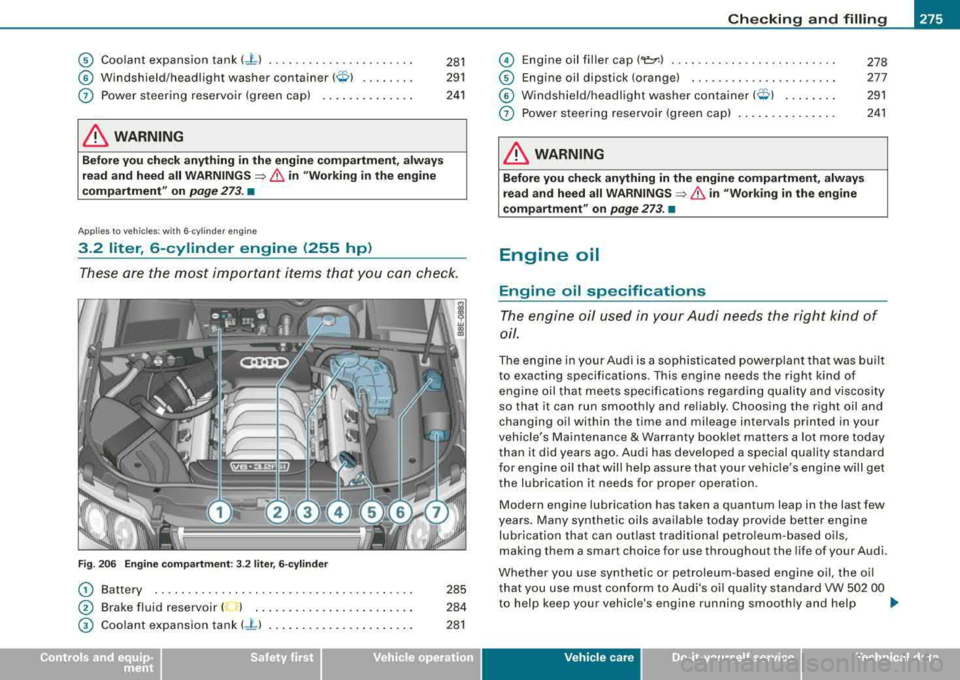
These are the most important items that you can check.
Fig . 206 Engine compartment: 3 .2 liter , 6-cylinder
CD
0
©
Battery .. ............... ... .. ...... .... ...... .
Brake fluid reservoir (
... ) . .. ... ... .... .... ...... .
Coo lant expansion tank
(J _)
285
284
281
©
©
©
(i)
Engine oil filler cap (
Windshield/headlight washer container
( O ) ... .... .
Power steering reservoir (green cap)
& WARNING
Before you check anything in the engine compartment , always
read and heed all WARNINGS
=> & in "Working in the engine
compartment" on
page 273. •
Engine oil
Engine oil specifications
278
277
291
241
The engine oil used in your Audi needs the right kind of
oil.
The engine in your Audi is a sophisticated powerplant that was built
to exacting specifications . This engine needs the right kind of
engine oil that meets specifications regarding quality and viscosity
so that it can run smoothly and re liably . Choosing the right oil and
changing oil within the time and mileage intervals printed in your
vehicle's Maintenance
& Warranty booklet matters a lot more today
than it did years ago. Audi has developed a special quality standard
f or engine oil that wil l help assure that your vehicle's engine wi ll get
the lubrication it needs for proper operation .
Modern engine lubrication has taken a quantum leap in the last few
years. Many synthetic oils available today provide better engine
lubrication that can outlast traditional petroleum-based oils,
making them a smart choice for use throughout the life of your Audi .
Whether you use synthetic or petroleum -based engine oil, the oil
that you use must conform to Audi's oi l quality standard VW 502 00
to help keep your vehicle 's engine running smoothly and help
.,_
Ve hic le care Technical data
Page 286 of 368

ffl...__C_ h_ e_c _k_ i_n ..::g a- a_n_ d_ f_ il _li_ n""" g:::a.-___________________________________________ _
Brake f luid
Checking brake fluid level
The brake fluid level c an be checked with a quick glance .
Fig. 212 Engin e
co mp artm ent: B rak e
f lu id rese rvoi r
Before you check a nything in the e ngine compartment,
alway s re ad and he ed all WARNINGS ~ & in "Working in
the engi ne com partment" on
page 273.
- Pull the rubber st rip @ up partially and lift the cover @
slightly~ fig. 212 .
- Read the brake fluid level from the brake fluid reservoi r
@. The brake fluid level must be between the "MIN" and
"MAX" markings.
The brake fluid reservoir is located at the rear partition of the engine
compartment on the le ft side
~ page 275.
The fluid level may drop slightly after some time due to the auto
matic adjustment of the brake pads. This is not cause for alarm.
If the brake fluid level fal ls
considerably below the "MIN" mark, the
brake warning/indicator light (U .S . models :
BRAKE, Canadian models:
0) will come on=> page 23 and~ page 31 . Do not continue to
opera te the vehicle. The complete brake system should be thor
oughly checked by an authorized Audi dealer or qua lified workshop
and the cause corrected. If the brake fluid level is too low, the brake
warning/indicator light will illuminate . Contact an authorized Audi
dea ler
immedi atel y.•
Changing brake fluid
H ave the brake fluid changed by an experienced techni
cian.
Brake fluid absorbs mo isture from the air . If the water content in the
brake fluid is too high, corrosion in the brake system may result
after a period of time. The bo iling point of the brake fluid wil l a lso
decrease considerably and decrease braking performance.
Therefore, the brake fluid must be changed
e ver y tw o year s. Always
use new brake fluid which conforms to Federal Motor Vehic le Stan
dard "FMVSS 116 DOT
4".
The brake fluid rese rvo ir can be difficult to reach, therefore, we
recommend that you have the brake fluid changed by your autho
rized
Audi dealer . Your dealer has the correct tools, the right brake
fl uid and the know-how to do this for you.
& WARNING
• Brake fluid is po is o nou s. It m ust be stored only in the clo se d
orig inal container out of the re ach of children!
• Brake f ailure can resu lt from old o r inapp ropriat e brake fluid .
Ob serve the se precaution s:
- Use only brake fl uid that me ets SAE spe cific atio n
J 1703 and
conform s to F ederal Motor Vehicle Standard 11 6. Alway s check
with y our authorized A ud i dealer t o ma ke sure you are u sing
th e c orrect br ake fluid . The correct type of brake fluid i s al so
i ndicated on the brake flu id re ser voir .
..,_
Page 287 of 368
___________________________________________ C_ h_e _c_ k_ i_n ~g _ a_n _d_ f_il _li _n ~g __ _
& WARNING (continued)
-The brake fluid must be new. Heavy use of the brakes can
cause a vapor lock if the brake fluid is left in the system too
long. This can seriously affect the efficiency of the brakes as
well as your safety. This could result in an accident.
0 Note
Brake fluid will damage the paint of your vehicle.
W For the sake of the environment
Because of the problem of proper disposal of brake fluid as well as
the special tools required and the necessary expertise, we recom
mend that you have the brake fluid changed by your authorized Audi
dealer. •
Battery
General information
Under normal operating conditions, the battery in your Audi does
not need any maintenance. With
high outside temperatures it is
advisable however to check the fluid level at regular intervals
through the transparent battery housing. Also check the fluid level
each time you charge the battery. After charging the battery
~ page 289, you should likewise check the battery acid level.
Have the battery checked when you take your vehicle in for service.
You are well advised to replace a battery that is older than 5 years.
Preserving battery charge on a vehicle not operated
for a long time
Some components of the electrical equipment (for example, the
electronic immobilizer) will keep drawing a low current even when the car is
not running
. This will eventually drain the battery
completely if your vehicle is left sitting for a long period of time
without being driven . To prevent this, either charge the battery
occasionally or disconnect the battery negative (ground) cable.
Winter operation
During the winter months, battery capacity tends to decrease as
temperatures drop . This is because more power is also consumed
while starting, and the headlights, rear window defogger, etc., are
used more often.
Avoid unnecessary power consumpt ion, particularly in city traff ic or
when traveling only short distances. Let your authorized Audi dealer
check the capacity of the vehicle battery before winter sets in
~ page 289. A well charged battery will not only prevent starting
problems when the weather is cold, but will also last longer.
[ i] Tips
If your vehicle is left standing for several weeks at extremely low
temperatures, the vehicle battery should be removed and stored
where it will not freeze. This will prevent it from being damaged and
having to be replaced. •
Location of the vehicle battery
The vehicle battery is located in the plenum chamber at the back of
the engine
compartment~ page 275.
The positive(+) battery terminal is protected by a plastic cover. This cover must be removed to access to the positive(+) terminal when
connecting jumper cables to start the engine .
& WARNING
Before you check anything in the engine compartment, always
read and heed all WARNINGS
~ & in "Working in the engine
compartment" on
page 273. •
Vehicle care
Page 295 of 368
________________________________________________ T_ i
_ r_e _s_ a_n_ d_ w_ h_ e_e _ l_s __ lllll
Tires and wheels
Tires
General notes
Tires may be the least appreciated and most abused parts
of a motor vehicle.
T ires may be the least appreciated and most abused parts of a
motor vehic le. Tires are, however, one of the most important parts
of a vehicle, particu lar ly considering the comparat ive ly sma ll patch
of rubber on each tire that assures that a ll-important contact
between you, your vehicle and the road .
Maintaining the correct tire pressure, making sure that your vehicle
and i ts tires do not have to carry more weight than they can safely
handle, avoiding damage from road hazards and regular ly
inspecting tires for damage inc luding cuts, s lashes irregular wear
and overa ll condition are the most important things that you can do
to help avoid sudden tire failure including tread separation and
b lowou ts .
Av oiding d am ag e
If you have to drive over a curb or similar obstacle, drive very slowly
and as close as possible at a right angle to the curb.
A lways keep chemica ls including grease, o il, gasoline a nd brake
fluid off the tires.
I nspect the t ires regularly for damage (cuts, cracks or blisters, etc .l.
Remove any foreign bodies embedded in the treads.
Storing tire s
Mark tires when you remove them to indicate the direction of rota
t ion . This ensu res you to be ab le to mou nt them correctly w he n you
reinstal l them. When removed, the whee
ls or tires should be stored in a coo l, dry
and preferably dark place.
St ore tires in a vertical posit ion i f th ey are not mounted on r ims, in
a horizontal position if they are mounted on rims.
New tire s
New tires have to be broken in => &.
The tread dept h of new tires may vary, according to the type and
make of tire and the tread pattern .
Hidden damage
Damage to tires and rims is often not readily visible. If you notice
unusua l vibration or t he veh ic le pul ls to one side, this may indicate
that one of the tires has been damaged . The tires must be checked
immediately by an author ized Audi dealer or qualified workshop .
Unidire ction al tires
A unidirectio nal tire can be ide ntif ied by arr ows on the s idewa ll, t hat
point in the direction the tire is designed to rotate. You must fo llow
the specified direct ion of ro tation . This is necessary so t hat these
tires can deve lop their optimum characteristics regarding grip, road
noise, wear and hydroplaning resistance . For more info rmation
=> page 324.
& WARNING
Ne w tire s or tire s that are old , wo rn o r damaged cannot p ro vide
maximum control and braking abilit y.
• New tires tend to be slippery and mu st be brok en in . To redu ce
the ri sk of lo sing control , a c ollision and seriou s per sonal injuries ,
dri ve w ith special ca re for the fi rst 350 mile s (560 km l.
• Driving with worn or damaged tire s can lead to lo ss of control ,
sudden tire fa ilure , in cluding a blowout and sudden deflation ,
.,_
Vehicle care
Page 306 of 368
___ T_ ir_e _ s_ a_ n
_ d_ w_ h_ e_ e_ls _________________________________________________ _
make, there w ill be six to eight of t hem evenly p laced around the
tir e. M arks o n the tire s idewall ( for example "TWI " or oth er sy mb ols)
indicate th e positions of the tread wear indicators. Worn tires must
b e re placed . Di fferen t fig ure s m ay apply i n other
c ountr ies=> & .
Tire pressure
Incorr ect tir e p ress ure c auses prematu re wear a nd can ca use
sudden tir e blow -out . For th is r eason, tir e pressur e must b e check ed
at leas t once a month
=> pa ge 299 .
Dri ving style
Drivi ng fa st aro und curv es, heavy acce le ra ti on and ha rd bra kin g
increase tire wear .
Rotating tires for more even wear
For all four tires on your vehic le to have the same service life, we
r ecom mend t hat the front a nd rea r tires ar e rotate d accord ing to the
tire manufacturer 's suggested tire rotation interva ls. Please
r e m emb er t he fo llo wi ng :
• Ti re rotation interva ls m ay d iffer from th e vehic le servic e inter
vals outl ined in y our M aintenance and Warran ty Boo kle t.
• T he longer one tire is used in one location on the vehicle, the
mor e it wea rs a t ce rtain points ; the re fo re, we rec omm end that yo u
fo llow t he ti re manufactu rer's su ggested tir e rotat ion int ervals .
• Vehi cle s with front -wh eel d rive e xper ience mo re trea d wea r on
the front wheels compared to al l-wheel drive (quattro®l .
• Ple as e ro tat e ti res as
sh ow n=> page 303, fig. 220.
• Extra care must be taken when rotating direction -specific tires
=> pag e 32 4.
Wheel balancing
T he wheels on n ew vehic les are bala nced. However, various situa
tions during eve ryday driving can cause them to become unba l
ance d, res ulting i n vi brat ions you ca n us ual ly f eel thro ugh t he
steering whee l. U
nba lanc ed wh eels must be rebalanced to avoid excessive wear on
s tee ring, s uspen sio n an d tir es. A w heel m ust also be reba la nced
when a new tire is install ed.
Incorrect wheel alignment
Incorrect whee l alignment can cause excessive tire wear, impairing
t he sa fety o f the vehicl e. If ti res sh ow ex cessiv e w ear, h av e the
whee l al ignm ent check ed by an autho riz ed Aud i d eal er or qualifi ed
w ork shop.
All Wheel Drive
Ve hicl es wi th qu attr o® must alw ays h ave t ires of t he sa me siz e,
construction and tread type . For deta ils
see=> page 242 .
& WARNING
Sudden tire failure can lead to loss of control , a crash and serious
personal injury!
• Never drive a vehicle when the tread on any tire is worn down
to the wear indicators .
• Especially in wet and slick driving situations , a preferably large
profile depth of the tires is necessary , and an approximately
similar profile depth of the front and rear axle tires.
• The diminished driving safety , caused by too small of a tire
profile, is negatively perceivable especially in handling , in danger
of hydroplaning when driving through deep puddles and ponds,
when driving around curves , and in braking behavior.
• Worn tires are a safety hazard , they do not grip well on wet
roads and increase your risk of "hydroplaning" and loss of control.
• Always keep chem icals that can cause tire damage , such as
grease, oil, gasoline and brake fluid away from tires .
• Tires age even if they are not being used and can fail suddenly ,
especially at high speeds. Tires that are more than 6 years old can
only be used in an emergency and then with special care and at
lower speeds .
~
Page 354 of 368
111'1_....::::A::.:l:.!: p :.:h..:.: a:::.:: b:.::e :.:t::i c::.::: a.:..l ..:.: in :..:.:: d:.:e :.:x::..... ___________________________________________ _
A
ABS (Anti- lock Brake System)
Warning/indicator lights ... .... .... 21
Accessories . .... .... .... .... .... ... 348
acoust ic park assist . . . . . . . . . . . . . . . . . 139
Adap tive light .. ... .... ... .. ...... ... 75
defective . . . . . . . . . . . . . . . . . . . . . . . . 35
Adding Engine coo lant
282
Engine oi l ... ... .. .... .... ... .... 278
Windshield washer fluid .... .... .. 291
Additiona l accessories .. ...... ...... . 348
Additives Eng ine oi l .. ....... ....... ....... 278
Adjustable steering whee l column .. ... 134
Adjusting Instrument cluster il lumina tion ... .. . 15
Steering wheel co lumn . ...... .... 134
Advanced A irbag System . .... ... .... 191
Ch ildren ... ........... .... ... ... 211
Components ...... .... ... .... ... 194
Fr ont airbags . . . . . . . . . . . . . . . . . . . . 192
How the c ompone nts wo rk togethe r 195
Monitoring . . . . . . . . . . . . . . . . . . . . . . 198
PASSE NGER AIR BAG O FF light ..... 199
Weight -sensing mat ....... ... .... 211
Air conditioner . . . . . . . . . . . . . . . . . . . . . 128
See also Climate controls . . . . . . . . . . 125
Air conditioning Switching on and off 128
A ir distribution
C limate controls . ...... ... .... ... 130 Air outlets
Adjusting the outlets for rapid defrosting/de fogging .. ...... .... 131
Cl imate con trols ...... .... .... ... 131
Air quality sensor . . . . . . . . . . . . . . . . . . . 129
Air recirculation .. ... .... .... .... ... 128
Clima te controls .. .... ..... .. .... 129
When should I use the air recircu lation?
129
Airbag Warning/indicator lights .... ... .... 20
Airbag system . . . . . . . . . . . . . . . . . . 187 , 205
Car e ...... .... .... .... .... .... .. 201
Child restraints .... .... .... .... .. 212
Componen ts (front airbags) .... ... . 194
Danger of fitting a chi ld safety seat on the
front passenger seat . . . . . . . . . . . . 189
Disposal .. ....... .... .... .... ... 201
Front airbags . .... ... .... .... .... 191
How do the front
ai rbags work? .... 196
How many airbags does my vehicle have? 194
I mportant things to know ....... .. 1 87
I ndicator light ... .. .... .... ... ... 198
Monitoring . . . . . . . . . . . . . . . . . . . . . . 198
Repairs ...... .... ... .... .... .... 201
Side airbags ... ...... .... ... .. ... 203
Side curtain airbags (SIDEGUARD) .. 207
When must the sys tem be inspec ted? ...
198
Alloy w heels . .... .... .... .... .... .. 260
All -wh ee l driv e 242
Winter tir es ..... .... .... ... .. ... 310 A
lternator
See Generator . . . . . . . . . . . . . . . . . . . . 22
Aluminum al loy wheels . ...... .... ... 260
Ambient light ing . ....... .... ... .. .... 82
Anti-free ze
See Engine coolant system ........ 280
Anti -glare inside day -ni ght mi rro r .. ... . 90
An ti- lock B rake System (ABS)
How the ABS system works . ....... 240
Warning/indicator l ights ........... . 21
Anti -Slip R egulation Syst em (ASR)
How the sys tem works .... .... .... 238
An ti- theft systems
Anti -theft ala rm system .. ...... .... 64
Electronic immobilizer .. ... .... ... . 5 4
Tilt sensors . .... .... ... .... .... ... 65
Armrest Adjusting ...... .... ... .... ..... . 102
Storage bi n
Ashtray 1
02
Front . .... .... .... .... ... .... ... 119
Rear ...... .... .... .... ... .... ... 119
ASR Anti- Slip Regulation System .... ... 238
Asterisk What does it mean when something is marked with an asterisk? .. ... .... .. 6
Attachment hooks ... .... .... .... ... 112
Aud i Service Repa ir Manuals and Lite rature
346
Page 355 of 368
Alph ab eti ca l ind ex -
-------------=----
AUTO
Climate controls ...... .... ...... .. 127
Switching on .................... 127
When should I use AUTO? ......... 127
Auto Safety Hotline ................. . 175
Auto-C heck Contro l ...... .... ... .... .. 28
Au toma tic transmission ...... .... .. 30
Manua l transmission .. ...... .... .. 29
Automa tic a ir recircu lation ........... 129
Automatic belt retractor .......... .... 181
Automat ic car was h
See Washing ...... .... ... .... .... 255
Automatic headlight control ........... 73
Automatic Sh ift Lock (ASU .. ..... 145, 152
Automatic transmission 6-speed automatic transmission 143, 144
Ign it ion key safety lock . ...... .... . 136
Shift but tons .. ...... .... .... 148, 155
Steering wheel wit h tiptronic® . 148,155
See also mu ltit ronic™ ... .. ...... .. 149
Automat ic trans mission (6 -speed)
Automat ic Shift Lock (ASU ... .. ... . 145
Driving .. .. .. .... .... ..... .. .... 1 43
Dynamic shift program ... .... .... . 146
Fa il- safe mode . ...... .... .... .... 149
Kic k-down ... .... .... .... ... .... . 146
Manual shift program (tiptronic®) .. 147
Average speed ....................... 41
Avoid damaging the vehicle .. ...... .. 245
Controls and equip
ment Safety first
B
Battery .....
.... .... .... .... ... 285, 288
Battery location ins ide the eng ine
compartment .. ...... .... .... ... 285
Charging . ............ ........... 289
Checking battery acid level . ........ 288
Connecting .... .. ..... .... .... ... 290
Disconnecting ............ .... ... 290
Important warnings when working on the
battery ... .. .... .... .... .... ... 286
Removing the battery ... .. .... .... 290
Replacing the battery ............. 29 1
Winter operation . ................ 285
Working on the battery ............ 286
Bat tery vo ltage .. ... ... .... .... .... .. 35
Before driving ...................... 167
Blended gasoline . .... ............... 267
Body cavity sealing ...... .... .... ... . 260
Booster seats .......... .... .... ..... 218
How do I properly instal l a booster seat in
my vehicle? ... .. .... .... .... ... 218
Safety inst ructions ... .. .... .... ... 218
Brake assista nt ..... .... .... .... .... 241
Brake booster .......... ...... .... ... 240
Brake f luid
Changing the brake flu id ...... .... 284
Check ing the brake fluid leve l ...... 284
Reservoi r .... .... .... ..... .. .... . 28 4
What is the correct brake f luid level? 284
What shou ld I do if
t he brake fluid warning
l igh t comes on? ... .. .... .... .... 284 Brake system
...... .... .... .... .. 31,284
Anti -lock Brake System (ABS) ........ 21
Brake fluid ....................... 284
Brake f lu id spec ificat ions for refi ll and
replacement ..... .... .... .... ... 28 4
Brake pads ...................... 244
Warning/indicator lights ...... ...... 23
Brakes ...... .... .... .... ... .... .... 239
Adverse cond itions affec ting bra ke
performance ...... .... .... ..... 239
Break -in period ....... ........ ...... 243
Brake pads ........... .... .... ... 244
Tires .. .... ....... .... ...... ..... 243
Bu lbs .. ...... .... .... ... .... .... ... 328
C
Ca lif o rnia Pr opo sit ion 65 War ning ... .. 274
Batte ry specific . ...... .... .... .... 287
Capacities .......................... 343
Car care . .... .... ........... .... .... 254
Interior .... ... .... .... .... .... ... 261
Plastic and vinyl .... ............. . 258
Weatherstrips .... ... .. ...... .... . 259
Ca re of exterior ..... .... .... .... .... 254
Care, service and disposal Safety belt tensioner .............. 186
Cargo area
See Loading the luggage compartment .
173
Cargo net .......................... 108
Catalytic converter ...... .... .... .... 24 4
Vehicle operation Vehicle care Do-it-yourself service Technical data
Page 358 of 368
___ A_l-=- p _h_ a_ b_e _t_ic _ a_l _in _ d_e _x ____________________________________________ _
Starting .. .. .. ...... .... .... 135, 136
Starting with jumper cables ... .... 330
Stopping . .... .... .... ... .... ... 137
Engine compartment ... .. .... .... ... 274
Safety instructions . . . . . . . . . . . . . . . 273
Working the engine compartment .. 273
Engine coolant system . ...... ...... . 280
Adding coolant .. ...... .......... 282
Checking coo lant leve l .. .. .... .... 281
Checking the engine coo lant leve l .. 281
Radiator fan . . . . . . . . . . . . . . . . . . . . . 283
Engine coolant temperature Gauge ...... ...... .... ........... 13
Engine cooling system Ma lfunction .. .... ..... .. .... .... . 31
Engine data ...... .... .... .......... 343
Engine hood Closing . ...... ..... .. .... ...... . 273
How to release the hood . . . . . . . . . . 272
Engine oil ...... .... .... .... ... .... 275
Adding ... .... ... .... .... ...... . 278
Additives . . . . . . . . . . . . . . . . . . . . . . . 278
Changing ... .. .... .... ...... .... 279
Checking the engine oi l level .. .... . 277
Indications and conditions requiring extra
checking ..... .. .... .... ... .... 277
Oil consumption .. .... .... ... .... 277
Oil grades . . . . . . . . . . . . . . . . . . . . . . . 275
Recommended o il check interva ls .. 277
Specification and viscosity . . . . . . . . 275
Engine oil level .. .... .... .... ... .... . 34
Engine oil pressure Malfunction ...... ..... .. .... .... . 32 Engine oil sensor defective
....... .... . 34
Environment Break -in period .. ...... .... .... .. 243
Catalytic converter .. ...... .... ... 244
Disposing of your vehicle battery ... 291
Driving at high speeds .. .... .... .. 245
Driving to minimize pollution and noise . 245
Fuel ... ...... .... ... .. .... .... .. 269
Fuel economy ....... ...... .... .. 245
Leaks under your vehicle ... .... ... 273
Letting the vehicle stand and warm up .. 246
Proper disposa l of drained brake fluid
284
Proper disposal of drained engine
coo lant ...... ............. ..... 282
Proper disposa l of drained engine oil
278 ,279
Recycling used eng ine oil .. .... ... 278
Un leaded fuel ..... .... ... .... ... 267
What should I do with an old battery?
291
EPC
See Electronic power control .. ... .. . 23
ESP
See Electronic stabi ll ization program
(ESP) . ... .... .... ........ ... 22, 236
Event Data Recorder (EDR) .. ....... .. 236
Expansion tank .. .... ... .... .... .... 281
F
Fahrenheit
Switching between Fahrenheit and Centigrade . ...... .... ...... .... 128
Fan Adjusting the fan speed .. ...... ... 129
Climate controls ................. 129
Radiator ...... .... .... ...... .... 283
Fastening eyes ... .... .... .... .... .. 108
Flat tire ............................. 50
Changing .. .... .... ... .... .... .. 318
Flat tire changing .. ...... .... .... .... 50
Floor mats .. ... ... .... .... .... .... . 172
Fog lights ........................... 76
Fo lding master key with remote control . 52
Foot pedals .. .. .. .... .... .... ...... 17 2
For the sake of the environment Gaso line fumes and the environment 269
Letting your engine warm up ....... 136
Reducing engine noise by early upshifting .... .... ... .... .... ... 13
Reducing engine noise by upshift ing
early . .... .... .... ... .... .... ... 13
Refueling .... .... .... ....... .... 269
Saving fuel by early upshifting . .... . 13
Saving fuel by upshifting early .. .... 13
Using the rear window defogger 131, 132
Front airbags
Description . .... .... ... .... .... .. 191
How they work .. .... ... .... .... .. 196
Front ashtray . . . . . . . . . . . . . . . . . . . . . . . 119
Front fog lights .... .... .... .... .... .. 76
Page 366 of 368
-Alphabetical index _ _e ____________________________________ _
Waxing .... .... ....... .... .... ... .. 257 Why safety belts? ....... .... .... 176, 177 y
Wear indica tor ..................... 303 Windows
Weatherstrips .... ... .... .... .... ... 259 Cleaning ........................ 258 Yellow symbols ... .... .... ...... ..... 33
Weights ........................... 341 Convenience close/open feature ..... 59
What happens if you wear your safety be lt too Defogging · · · · · · · · · · · · · · · ·
...... 131
loose? ........................ 182 Defrosting ...................... 131
What happens to unbelted occupants? . 178 Rapid defrosting/defogging ........ 131
What impairs driving safety? .. ...... . 167
What should I do after changing a wheel? .. 300
What should I do after replacing whee ls? ...
300
Wheel bolts Torque ......................... 311
Wheel change . . . . . . . . . . . . . . . . . . . . . . 318
Wheels .. .... .... .... ....... .... ... 293
Cast a lloy ... .. .... .... .......... 260
Checking tire pressure ............ 299
Cold tire inflation pressure ...... .. 297
Genera l notes .... .... .... ...... . 293
G lossary of tire and loading terminology
294
New tires and whee ls . . . . . . . . . . . . . 305
Stee l whee ls .......... .......... 259
Tires and vehicle load limits . . . . . . . 301
When must a safety belt be replaced? .. 180
When must the airbag system be inspected? 198
When should I adjust the tire pressures?
300
When should I check the tire pressures? 300 Windshield washer fluid
Low level .... ....... ...... .... ... 34
Windshield wipers Installing new wiper b lades ......... 88
Washer reservoir . . . . . . . . . . . . . . . . . 291
Winter driving Windows . . . . . . . . . . . . . . . . . . . . . . . 258
Winter operation
Battery .. .... ....... ...... .... .. 285
Coolant system .................. 280
Ti res ....... .. .... .... .... ... ... 242
Winter tires .............. .......... 310
All -whee l drive ... .... ....... ..... 310
Wiper and washer system .. .... .... ... 85
Intermittent wiping ...... ....... ... 85
One-tap wiping ...... ...... .... ... 85
Rear window wiper .......... .. .... 86
Wiper blades Installing new wiper blades ....... .. 88
Replacing rear window wiper blades . 89
Worn brake pads .. ........ ... .... .... 34
X
Where can I find the tire pressures for my Xenon headlights ..... .... .... .... ... 79
car? ...... ... .... .... .... .... . 299 Xenon-L ights ... .. ...... .... ... .. ... 328