change wheel AUDI A4 AVANT 2008 User Guide
[x] Cancel search | Manufacturer: AUDI, Model Year: 2008, Model line: A4 AVANT, Model: AUDI A4 AVANT 2008Pages: 368, PDF Size: 46.19 MB
Page 301 of 368
________________________________________________ T_ i
_ r_e _s_ a_n_ d_ w_ h_ e_e _ l_s __ fflll
The correct tire pressure for the spore wheel is located on a label
either on the driver's side B-pillar or inside the fuel filler flap.
Because technical changes may be made to vehicle equipment
during the model year, always compare the tire size designation on
the tire pressure label on your vehicle with the tires on your vehicle.
Make sure that the tire size information on the vehicle label is the
same as the size of the tires on the vehicle. This is especially impor
tant if the vehicle belongs to someone else or you bought the
vehicle with different rims/tires or you bought the vehicle as a previ
ously owned vehicle .
Remember, your safety and that of your passengers also depends
on making sure that load limits are not exceeded. Vehicle load
includes everybody and everything in and on the vehicle. These load
limits are technically referred to as the vehicle's Gross Vehicle
Weight Rating ("GVWR"l. The Gross Axle Weight Rating ("GAWR"l is
the maximum load that can be applied at each of the vehicle's two
axles. The Gross Vehicle Weight Rating and the Gross Axle Weight
Rating are listed on the safety compliance sticker label located
either on the driver's side B-pillar or on the inside of the fuel filler
flap. The tire pressure label on your Audi lists the maximum
combined weight of all of the occupants and luggage or other cargo
that the vehicle can carry. For the location of the tire pressure label
=> page 297, fig. 217.
& WARNING
Overloading a vehicle can cause loss of vehicle control, a crash or
other accident, serious personal injury, and even death.
• Carrying more weight than your vehicle was designed to carry
will prevent the vehicle from handling properly and increase the risk of a loss of vehicle control.
• The brakes on a vehicle that has been overloaded may not be
able to stop the vehicle within a safe distance.
• Tires on a vehicle that has been overloaded can fail suddenly
causing loss of control and a crash.
& WARNING (continued)
• Always make sure that the total load being transported -
including the weight of a trailer hitch and the tongue weight of a
loaded trailer -does not make the vehicle heavier than the
vehicle's Gross Vehicle Weight Rating.
& WARNING
• Incorrect tire pressures and/or underinflation can lead to a
serious or fatal accident.
• Incorrect tire pressures and/or underinflation cause increased
tire wear and can affect the handling of the vehicle.
• Incorrect tire pressures and/or underinflation can also lead to
sudden tire failure, including a blowout and sudden deflation,
causing loss of vehicle control. •
Checking tire pressure
The correct tire pressure for the tires originally installed
on your vehicle is listed on the tire pressure label located
either on driver's side B-pillar or inside the fuel filler flap.
The recommended tire pressures are on the tire pressure label and
in the
table=> page 297, "Cold tire inflation pressure". This means
that the pressure must be checked and adjusted when the tire has
not been driven for more than a couple of miles (kilometers) at low
speeds during the previous three hours. Air in the tires expands
when the tire heats up as a result of internal friction as it flexes in
use. The tire pressure is higher when the tire has warmed up than
when it is "cold."
It is the inflation pressure in a "cold" tire that counts. Therefore, you
should never let air out of a warm tire to match "Cold tire inflation
pressure"
recommendations=> page 297. The tires would then be
underinflated and could fail suddenly. .,._
Vehicle care
Page 303 of 368
________________________________________________ T_ i
_ r_e _s_ a_n_ d_ w_ h_ e_e _ l_s __ l'III
& W ARNING (continued )
• The driver is respon sible for the correct tire pre ssure s for all
tire s on the vehicle. The applicable pressure values are located on
a st icker on the driver 's side B-pillar or on the inside of the fuel
filler flap.
• Only when all tire s on the vehicle are filled to the correct pres
sure , the tire pressure monitoring system * can work correctly .
• The use of incorrect tire pressure values can lead to accidents
or other damage. Therefore it is essential that the driver observe
the specified tire pressure values for the tires and the correct pres
sures for the function of the tire pressure monitoring system*.
• Always inflate tires to the recommended and correct tire pres
sure before driving off.
• Driving with underinflated tires bend more , letting them get
too hot resulting in tread separation , sudden tire failure and loss
of control.
• Ex cessive speed and /overloading can cause heat build -up ,
sudden tire failure and loss of control .
• If the tire pressure is too low or too high, the tires will wear
prematurely and the vehicle will not handle well.
• If the tire is not flat and you do not have to change a wheel
immediately, drive at reduced speed to the nearest service station
to che ck the tire pressure and add air as required .
0 Note
Driving without valve stem caps can cause damage to the tire
valves. To preve nt th is, a lways make s ure th at f acto ry installed va lve
stem caps on al l whee ls are securely mounted on the va lve .
~ For the sake of the environment
Underinflated tires will a lso increase the fuel consumpt io n. •
Tires and vehicle load limits
There are limits to the amount of load or weight t hat any vehic le and
any tire can carry . A ve hicle that i s ove rloa ded will not handle well
and is more d iff icu lt to stop . Overload ing can not only lead to loss
o f vehi cle control, but can also damag e impor tan t p arts o f the
vehic le and can lead to sudden tire failure, including a blowout and
sudde n defla tion that ca n cause the veh ic le to c ra sh .
Your sa fety a nd t hat o f your passe ngers a lso depe nds o n maki ng
s u re that load li mits are not exceeded. Vehic le load incl udes every
b ody and everythi ng i n and on t he vehicle . T he se l oa d limi ts are
technical ly referred to as the ve hic le's
Gross Vehicle Weight Rating
("GVW R"l.
T he "GVWR" includes the wei ght of the basic vehic le, all factory
in sta lled acces so ries, a full t an k of f uel, o il, c oolant a nd oth e r flu ids
p lus max imum load . T he maximum load inc ludes th e number o f
p asse ngers tha t th e ve hicle i s intended t o carry ("seat ing ca paci ty")
with an assu med weight o f 150 l bs (68 kg) fo r each passe nger at a
designated seating position and the total weight of any luggage in
th e v ehic le. I f you tow a trai ler, the we ig ht o f the tra iler hitch a nd th e
tongue weight of the loaded trailer must be inc luded as part of the
ve hicle lo ad .
The
Gross Axle Weight Rating ("GAWR") is t he maximum load that
ca n b e app lie d at eac h of th e veh icle's two axle s.
T he G ross Ve hicle We ight Rati ng a nd th e G ross A xle Wei ght R ati ng
are listed on the safety comp liance stic ker label located either on
t he driver 's si de B-pi lla r o r on the in sid e of t he fue l fille r fl ap. You r
Aud i has 5 seating posit ions, 2 in the front and 3 in the rear for total
sea ting ca paci ty of 5. Each sea ting p osit ion has a safe ty b elt
=> page 176, "Saf ety be lts" .
The fact that there is an upper limit to your vehicle's Gro ss Vehicle
W eight Rat ing m eans that th e total weight o f whatever is b ein g
carried in the vehic le (including the weight of a traile r hitc h and the
ton gue we ight of the loaded tr aile r) is lim it e d. Th e m or e passe ng ers
~
Vehicle care
Page 320 of 368

___ w_ h_ a_t _ d_ o_ l_d _ o_ n_ o_w _ ? ______________________________________________ _
Storing the replaced wheel
- Place the replaced wheel inside the spare wheel well in
the luggage compartment.
- Tighten the knurled retaining screw clockwise to secure
the wheel in place.
- Disengage and lower the floor panel before you close the
luggage compartment lid again.
& WARNING
Loose items in the passenger compartment can cause serious
personal injury during hard braking or in an accident.
• Never store the spare wheel or jack and tools
in the passenger
compartment.
• Always store all jacking equipment, tools, and the spare wheel
in the luggage compartment.
• Tighten the knurled retaining screw for the spare wheel
securely.
[ i] Tips
Check the inflation pressure of the spare tire periodically to keep the
tire ready for use. •
Wheel change
Before changing a wheel
Follow these points for your own and your passenger's
safety when replacing a wheel.
After you experience a tire failure, pull the car well away
from moving traffic and try to reach
level ground before
you
stop ~& .
-All passengers should leave the car and move to a safe
location (for instance, behind the
guardrail) ~& .
-Apply the parking brake firmly ~& .
-Move selector lever to position P on an automatic trans-
mission; put manual transmission in
first gear~& .
-If you are towing a trailer: unhitch the trailer from your
vehicle.
- Take the
tool case and the spare tire ~ page 316 out of
the luggage compartment.
& WARNING
You or your passengers could be injured while changing a wheel if
you do not follow these safety precautions:
• If you have a flat tire, move a safe distance off the road. Turn off
the engine, turn the emergency flasher on and use other warning
devices to alert other motorists.
• Make sure that passengers wait
in a safe place away from the
vehicle and well away from the roadway and traffic.
• To help prevent the vehicle from moving suddenly and possibly
slipping off the jack, always fully set the parking brake and block
the wheel diagonally opposite the wheel being changed . When one
front wheel is lifted off the ground, placing the Automatic Trans-
~
Page 321 of 368
What do I do now? 11111111
-----------------------------------
& WARNING (continued)
mission in "P" (Park), or engaging a gear in a manual transmission
will
not prevent the vehicle from moving.
• Before you change a wheel, be sure the ground is level and firm.
If necessary, use a sturdy board under the jack.
• After installing the spare wheel, make sure that you remount
the flat tire/wheel in its storage area properly and tighten the
knurled retaining screw securely . •
Changing a wheel
When you change a wheel, follow the sequence described
below step-by-step and exactly in that order.
1. Remove the decorative wheel cover*. For more details
see also
=> page 320, "Decorative wheel covers" or
=> page 320, "Wheels with cap -covered wheel bolts".
2. Loosen the wheel bolts => page 321.
3.
Locate the proper mounting point for the jack and align
the jack below that
point=> page 321.
4. Lift the car with the jack => page 321.
5.
Take the flat wheel off and then put the spare on
=> page 323.
6. Tighten all wheel bolts lightly.
7.
Lower the vehicle with the jack.
8. Use the wheel bolt wrench and
firmly tighten all wheel
bolts=> page 321.
9. Put the decorative wheel cover* back on.
LJ}. WARNING
Always read and head all WARNINGS and information :::::> & in
"Raising the vehicle" on
page 321 and :::::, page 324. •
After changing a wheel
A wheel change is not complete without the following
actions.
-Store and secure the replaced wheel in the spare wheel
well.
-Put the tool case and the jack back in place in the luggage
compartment.
-Check the tire pressure on the spare wheel immediately
after mounting it.
- As soon as possible, have the
tightening torques on all
wheel bolts checked with a torque wrench. The correct
tightening torque is
90 ft lb (120 Nml.
- Have the flat tire
replaced as soon as possible.
[ i] Tips
• If you notice while changing a tire that the wheel bolts are
corroded and difficult to turn, then they should be replaced before
you check the tightening torque.
• Drive at reduced speed until you have the tightening torques
checked .•
Do -it -yourself service
Page 322 of 368
lllffll....__W_ h_ a_ t_d_ o_ l _d _o_ n_ o_ vv_ ? ______________________________________________ _
Applies to vehi cles : wi th deco ra tive wheel co vers
Decorative wheel covers
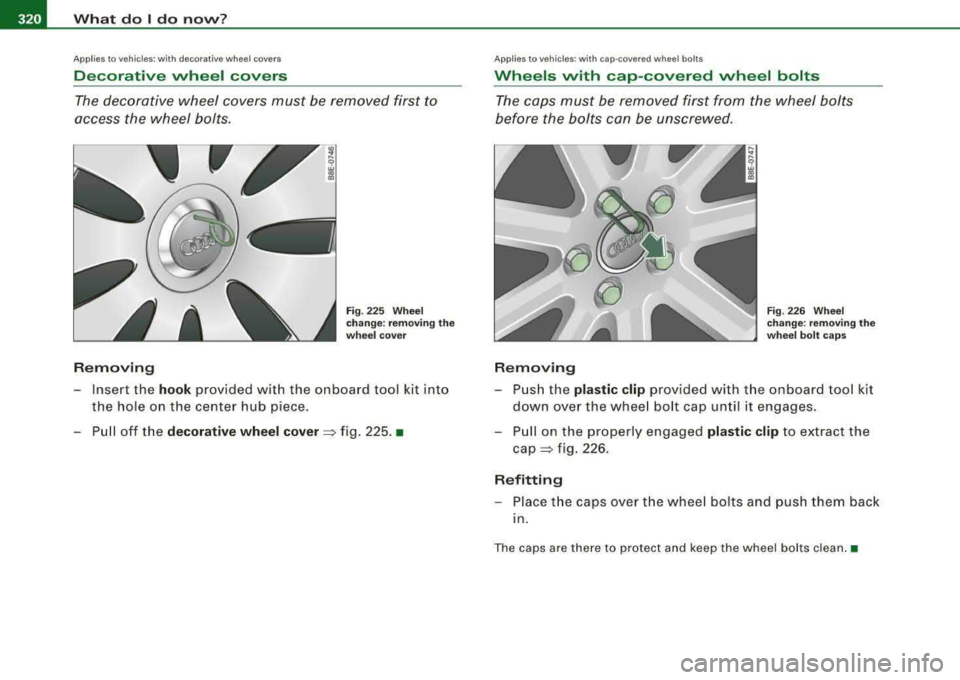
The decorative wheel covers must be removed first to
access the wheel bolts.
Removing
Fig. 225 Wheel
change : removing the
wheel cover
-Insert the hook provided with the onboard tool kit into
the hole on the center hub piece.
-Pull off the decorative wheel cover => fig. 225 . •
App lies to ve hicles: w it h c ap-co vered whee l bolts
Wheels with cap-covered wheel bolts
The caps must be removed first from the wheel bolts
before the bolts can be unscrewed.
Removing
Fig. 226 Wheel
change: removing the
wheel bolt caps
-Push the plastic clip provided with the on board tool kit
down over the wheel bolt cap until it engages.
-Pull on the properly engaged plastic clip to extract the
cap=> fig. 226.
Refitting
-Place the caps over the wheel bolts and push them back
in.
The caps are there to protect and keep the wheel bolts clean. •
Page 324 of 368
-What do I do now? Pt'l:f....__ ______________ _
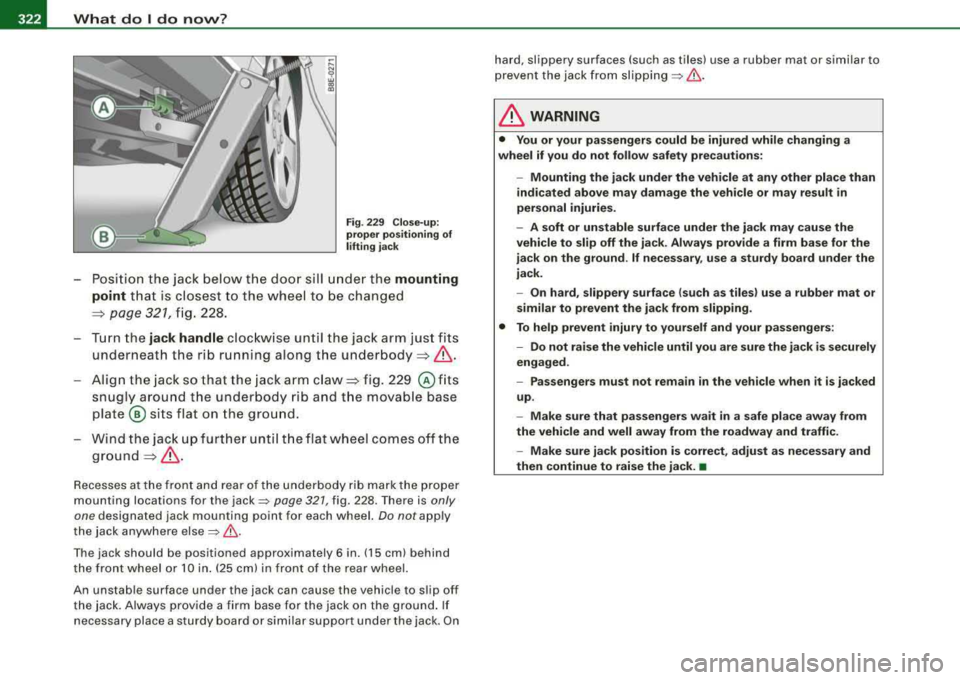
Fig. 229 Clo se- up:
pr ope r pos itio ning of
l ifting ja ck
- Posi tion the jack below the doo r si ll un der the mounting
point
t h at is c losest to the whee l to be changed
=> page 321, fig . 228.
- Turn the
jack handle cloc kw ise unt il the jack arm jus t fits
underneath the rib running along th e under body
=> & .
Align the jack so that th e jack arm claw=> fig. 229 @ fits
snugly arou nd the under bod y rib and t he movab le base
plate @ sits flat on the ground.
W ind t he jac k up fur ther until th e fl at wh eel comes off th e
g roun d=> & .
Recesses a t the fron t a nd r ear of th e u nderbody rib ma rk the prop er
mounting locations for the
jack~ page 321 , fig. 228. There is only
one
designated jack mo unting point fo r each w hee l. Do not apply
the jack anywhere else
=> & -
The jack should be positioned approximately 6 in. (15 cm) behind
t he fron t whe el or 10 in . (25 cm) in fron t of t he rear whee l.
An unstab le surface unde r the jack can cause the vehicle to s lip off
the jac k. Alwa ys provi de a fir m base fo r the jack on the g roun d. If
necessary place a sturdy board or simi lar support under the jack . On hard
, slippery surfaces (su ch as tiles) use a rubber mat or simi lar to
p revent the jack fr om
slippi ng => & .
& WARNING
• You or your pa ssengers could be injured while changing a
wheel if you do not follow safety precaut ions:
- Mounting the jack under the veh icle at any other place than
indicated above may damage the vehicle or may result in
personal injuries .
- A soft or unstable surfa ce under the ja ck may cause the
vehicle to slip off the ja ck. Always provide a firm base for the
jack on the gro und .
If nece ss ary , use a sturdy board under the
jack .
- On hard , slippery surface (such as tiles) use a rubber mat or
similar to prevent the jack from slipping .
• To help prevent injury to yourself and your passengers :
- Do not raise the vehicle until you are sure the jack i s securely
engaged .
- Passengers must not remain in the vehicle when it is jacked
up .
- Make sure that pa ssengers wait in a s afe pla ce away from
the vehicle and well away from the roadway and traffic .
- Make sure jack position is correct , adjust as necessary and
then continue to raise the jack .
•
Page 325 of 368
What do I do now? -
------------------'
Taking the wheel off /putting the spare on
Follow these instructions step-by-step for changing the
wheel
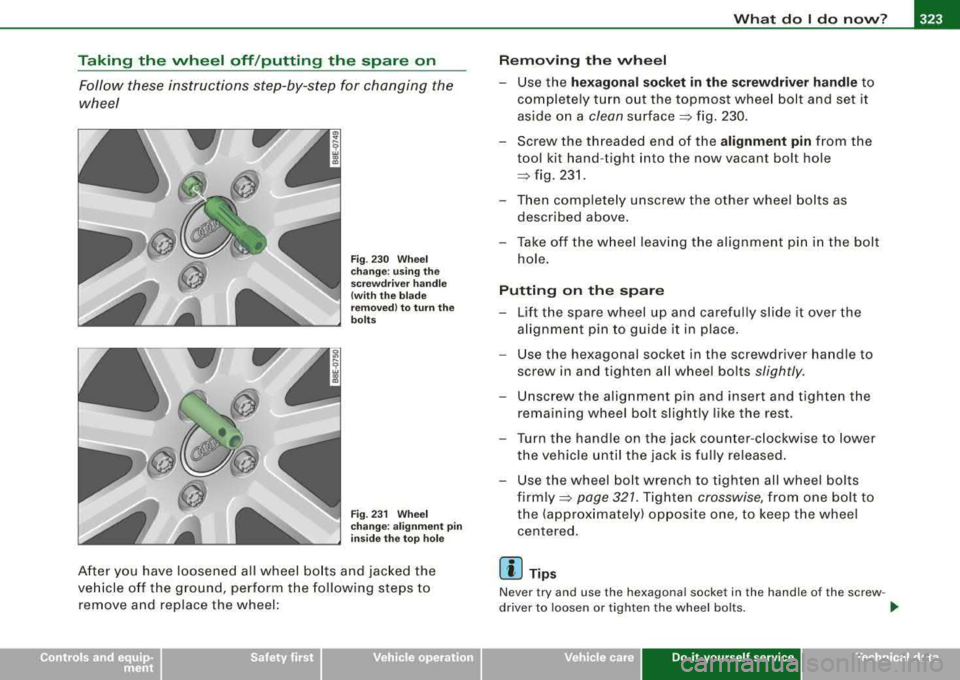
Fig . 230 Wheel
change : using the
screwdriver handle
(with the blade
removed) to turn the
bolts
Fig . 231 Wheel
change : alignment pin
inside the top hole
After you have loosened all wheel bolts and jacked the
vehicle off the ground, perform the following steps to
remove and replace the wheel:
Removing the wheel
-Use the hexagonal socket in the screwdriver handle to
completely turn out the topmost wheel bolt and set it
aside on a
clean surface => fig. 230.
-Screw the threaded end of the alignment pin from the
tool kit hand -tight into the now vacant bolt hole
=> fig. 231 .
-Then completely unscrew the other wheel bolts as
described above.
-Take off the wheel leaving the alignment pin in t he bolt
hole.
Putting on the spare
-Lift the spare wheel up and carefully slide it over the
alignment pin to guide it in place.
-Use the hexagonal socket in the screwdriver handle to
screw in and t ighten all wheel bolts
slightly .
-Unscrew the alignment pin and insert and tighten the
remaining wheel bo lt slightly like the rest.
-Turn the handle on the jack counter-clockwise to lower
the vehicle until the jack is fully released.
-Use the wheel bolt wrench to tighten all wheel bolts
firmly =>
page 327. Tighten crosswise, from one bolt to
the (approximately) opposite one, to keep the wheel
centered.
[ i] Tips
Never try and use the h exagonal socket in the handle of the screw -
driver to loosen or tighten the wheel bolts.
.,
Do-it-yourse lf service irechnical data
Page 326 of 368
____ w_ h_ a_t _ d_ o_ l_d _ o_ n_ o_w _ ? ______________________________________________ _
• Pull the reversible b lade from the screwdriver before you use the
h exago nal soc ket i n the ha ndle to tur n the wheel bo lts.
• When mounting tires with
unidirectional tread design make sure
th e trea d pat tern is po inte d the rig ht
way => page 324.
• T he whee l bo lts should be clean and easy to turn. Check for dirt
and c orrosio n on the m ating su rfaces of bo th the whee l a nd th e
hub . Remove a ll dirt from these surfaces before remou nting the
w heel. •
Tires with unidirectional tread design
T ir es wit h unid irectio nal tr ea d d esign must b e moun ted
with th eir tread pattern po int ed the r ight direction .
Using a spare tire with a tread pattern intended for use
in a specific direction
Whe n usi ng a s pa re t ire wi th a tre ad patte rn inte nd ed for use in a
specific direct ion, please note the followin g:
• The di rec tio n of rot ation is marked by an arr ow on th e s ide o f the
tir e.
• If the s pare tir e ha s to be ins talle d in th e inco rrect directi on i n the
event of a flat tire, use th e spar e tire on ly temporarily since the tire
w ill n ot be a ble to achieve it s optimum pe rform ance cha rac te ri sti cs
wi th r egar d to a qua plani ng , noise an d w ear .
• W e rec om mend th at p arti cula r att ent ion be pai d to this fac t
dur in g wet weath er and that you adjust your sp eed to match road
c o nd it io ns.
• R eplace the flat ti re with a new one and have it instal led on your
v e hi cle as soo n as poss ib le to re st ore th e hand ling a dva ntages of a
p roper ly pointed direction -dependent t ire.•
Notes on wheel change
P lease read the information => page 305 , "N ew tire s and replacing
t ir es a nd whe els" if you are going to use a spa re tire w hich is
different from the t ires on you r ve h ic le.
Aft er you ch ange a tire:
• Check the tire pressure on the spare immediately after
mounting .
• Have the wheel bolt tightening torque checked with a torque
wrench as soon as possible by your authorized Audi dealer or a qualified service station .
• On steel and alloy wheel rims , the wheel bolts are correctly tight
ened with a torque of 90 ft lb (120 Nm ).
• If you notice while changing a tire that the wheel bolts are
corroded and difficult to turn while changing a tire , they should be
replaced before you check the tightening torque.
• Replace the flat tire with a new one and have it installed on your
vehicle as soon as possible . Remount the wheel cover.
Until then, drive with extra care and at reduced speeds .
& WARNING
• If you are going to equip your vehi cle with tires or rims which
differ from those which were factory installed , then be sure to read
the information
=> page 305 , "New tires and replacing tires and
wheels ".
• Always make sure the damaged wheel or even a flat tire and
the jack and tool kit are properly secured in the luggage compart
ment and are not loose in the passenger compartment .
• In an accident or sudden maneuver they could fly forward ,
injuring anyone in the vehicle .
• Always store damaged wheel, jack and tools securely in
luggage compartment . Otherwise, in an accident or sudden
Page 345 of 368
_____________________________________________________ D_a_ t_ a _ ___.11111
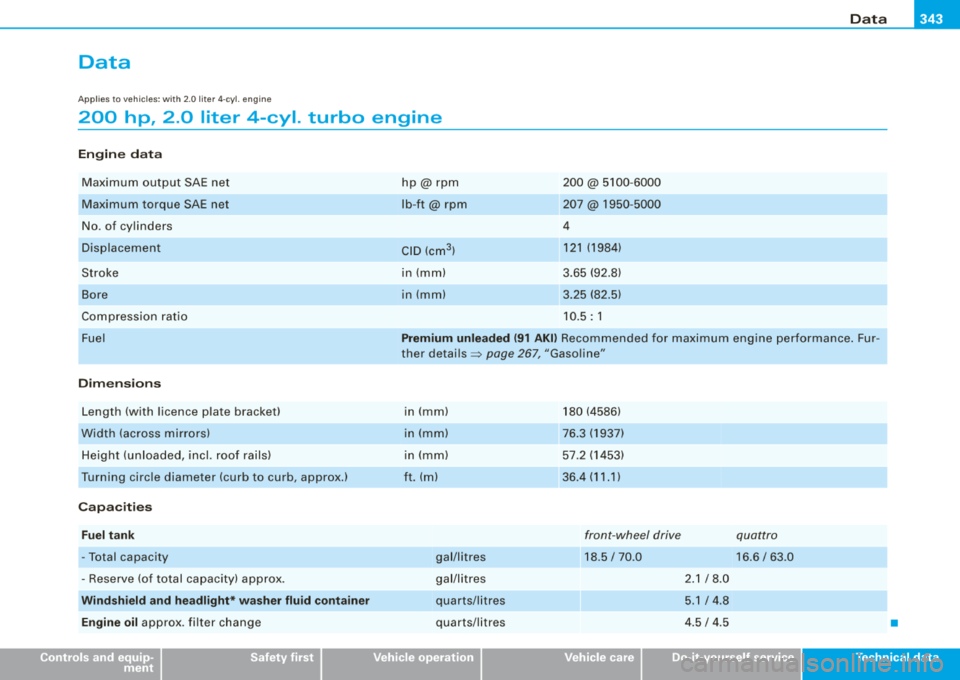
Data
Ap plies to vehicles : w ith 2 .0 lite r 4-cyl. engine
200 hp, 2.0 liter 4-cyl. turbo engine
En gin e da ta
Maximum output SAE net
Maximum torque SAE net
No . of cy linders
Displacement
Stroke Bore
Compression rat io
Fuel
Dim ensio ns
Length (with licence plate bracket)
Width (across mirrors)
Height (unloaded, incl. roof rails)
T urning circle diameter (curb to curb,
approx.!
Ca pac itie s
F u el t ank
-Total capacity
- Reserve (of total capacity) approx.
Wind shield and headlight * w as her fluid contain er
Engine oil
approx. fi lter change
Controls and equip
ment Safety first
hp@ rpm
lb-ft@ rpm
C ID (cm
3l
in (mm)
in (mm)
200 @ 51 00 -6000
207
@ 1950 -5000
4
121 (1984)
3.65 (92.8) 3.25 (82.5) 10.5: 1
Pr emium unle aded (91 AKI) Recommended for maximum engine performance. Fur
ther
details=> page 267, "Gasoline"
in (mm)
in (mm)
i n ( mm)
ft. (ml
gal/litres
ga l/litres
quarts/I it res
quarts/I it res
180 (4586)
76.3 (1937)
57 .2 (1453)
36.4 (11.1
l
front-wheel drive
18.5 / 70.0
2.1 / 8.0
5.1 / 4.8
4.5 / 4.5
quattro
16.6 / 63.0
•
Vehicle operation Vehicle care Do-it-yourself service Technical data
Page 346 of 368
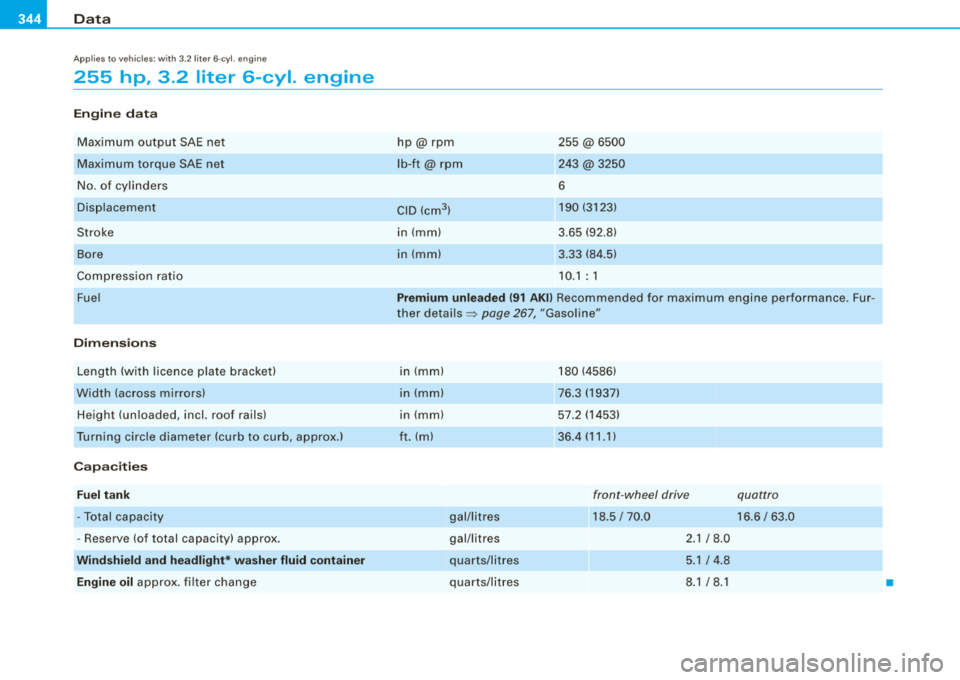
llffl __ D_ a_ ta ______________________________________________________ _
Applies to vehi cles: with 3 .2 liter 6-c yl. engine
255 hp, 3.2 liter 6-cyl. engine
En gin e data
Maximum output SAE net
Maximum torque SAE net
No. of cylinders
Disp lacement
Stroke
Bore
Compress ion ratio
Fuel
Dim ension s
Length (with licence plate bracket)
Width (across mirrors) Height (un loaded, incl. roof rails)
Turning circle diameter (curb to curb, approx .)
Ca pac ities
Fuel tan k
-Total capacity
-Reserve (of total capacity) approx.
Windshield and headlight* wa sher fluid container
Engine oil
approx. fi lter change hp@rpm
lb-ft@ rpm
CID (cm
3l
in (mm)
in (mm) 255@ 6500
243 @3250
6
190 (3123)
3 .65 (92 .8)
3 .33 (84 .5)
10.1 : 1
P remium unle aded (91 AKI) Recommended for maximum engine performance . Fur
t her
details~ page 267, "Gasoline"
in (mm)
in (mm)
in (mm)
ft . (ml
gal/litres
gal/litres
quarts/litres
quarts/litres 1
80 (4586)
76.3 (1937)
57.2 ( 1453)
36 .4 ( 11 .1 l
front -wheel drive
18.5 / 70 .0
2.1 / 8 .0
5 .1 / 4.8
8 .1 / 8 .1 quattro
16.6 / 63 .0
•