manual transmission AUDI A4 AVANT 2008 User Guide
[x] Cancel search | Manufacturer: AUDI, Model Year: 2008, Model line: A4 AVANT, Model: AUDI A4 AVANT 2008Pages: 368, PDF Size: 46.19 MB
Page 150 of 368
___ T_ r
_ a_ n_s _m_ i_s _s _i_o _n ___________________________________________________ _
Switching to manual shift program
With the selector lever in D, push lever to the right. The
display will show
6 5 4 3 2 1 as soon as the selector lever
is switched over. The gear you select will also be high
lighted in the display =>
page 147, fig. 151.
To upshift
- Push the selector lever forward to the plus position
=>
page 147, fig. 150 0-
To downshift
- Push the lever to the minus position Q .
When accelerating, the transmission will automatically shift into the
next higher gear before the engine reaches the maximum RPM .
When accelerating, if you apply a light throttle, the tiptronic® will
automatically shift from 1st to 2nd gear to save fuel. If you apply a
heavy throttle, the transmission will stay in the gear engaged until
near maximum RPM are reached, or until the driver manually shifts
into a higher gear.
If you take your foot off the accelerator pedal when driving down a
steep incline, the tiptronic® will downshift from the selected gear
into the next lower gear based on road speed and engine RPM. The
automatic downshifting is interrupted as soon as you apply throttle
again.
[ i ] Tips
• When you shift into the next lower gear, the engine will down
shift only when there is no possibility of over -revving.
• When the kickdown comes on, the transmission will shift down
to a lower gear depending on vehicle and engine speeds. •
The tiptronic® is inoperative when the transmission is in the fail
safe mode .•
Ap plies to v ehi cle s: with tipt ronic -st ee ring whee l
Steering wheel with tiptronic ®
The shift buttons on the steering wheel allow the driver to
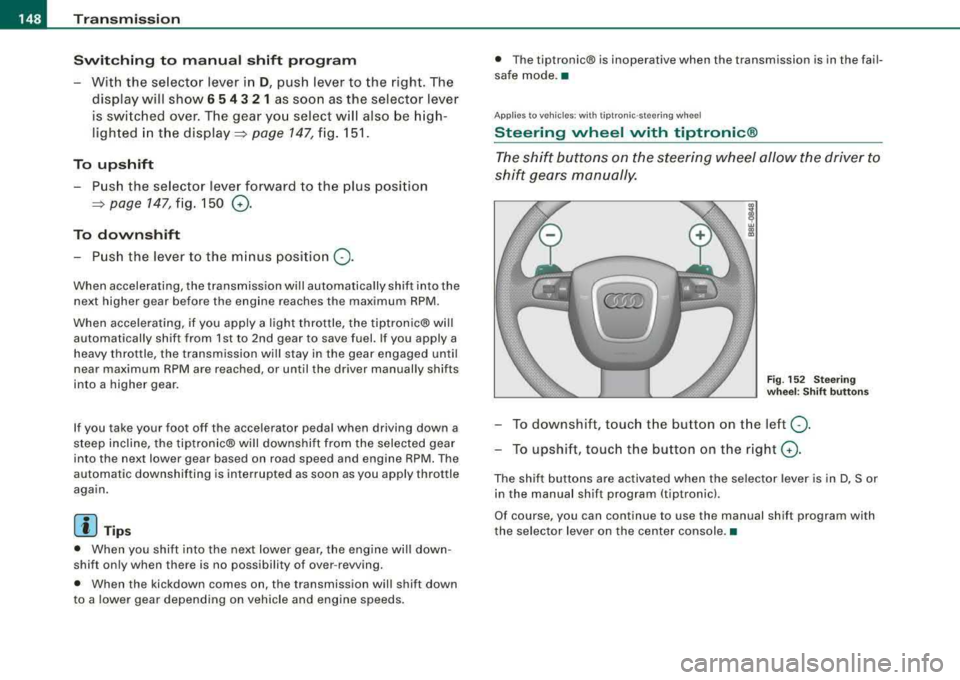
shift gears manually.
Fig. 152 Steering
wheel: Shift buttons
-To downshift, touch the button on the left Q.
- To upshift, touch the button on the right 0-
The shift buttons are activated when the selector lever is in D, Sor
in the manual shift program (tiptronic).
Of course, you can continue to use the manual shift program with
the selector lever on the center console. •
Page 154 of 368
-
Transmission
----------------
Select R only when the vehicle is at a full stop and the engine is
running at idle
speed~ & in "Driving the multitronic™" on
page 750.
Before you move the selector lever to R, press both, the button in the
handle of the selector lever
and the brake pedal at the same time.
When the ignition is on, the backup lights illuminate when the selector lever is moved into R.
N -Neutral
Shift to this position for standing with brakes applied ~ page 152.
When the vehicle is stationary or at speeds below 3 mph (5 km/h),
you must always apply the footbrake before and while moving the
lever out of
N .
Do not use N for coasting downhill.
D -Normal driving position for forward
Depending on the load on the engine, vehicle speed and the
dynamic control program, the transmission will select the
optimal
gear ratio.
In certain circumstances it may be advantageous to temporarily
switch to the manual shift program to manually select gear ratios to
match specific driving
conditions ~ page 154.
When the vehicle is stationary or at speeds below 3 mph (5 km/h),
you must always apply the footbrake before and while moving the
lever to
D out of N.
S -Sport position
Select this position for sportier performance. In this position, the
transmission will not upshift as soon, allowing the vehicle to use
the increased power available at higher engine speeds to achieve livelier acceleration.
Before you move the selector lever from
D to S, press the button in
the handle of the selector lever. When the vehicle is stationary or at speeds below 3 mph (5 km/h),
you must always apply the foot brake before and while moving the
lever to
S out of N.
& WARNING
Read and follow all WARNINGS ~ & in "Driving the multitronic™"
on
page 150.
0 Note
Coasting downhill with the transmission in N and the engine not
operating will result in damage to the automatic transmission and
possibly the catalytic converter. •
Applies to vehi cles : wi th mu ltitroni c'" Continuous ly Variable Transm ission (CVT )
Automatic Shift Lock (ASL )
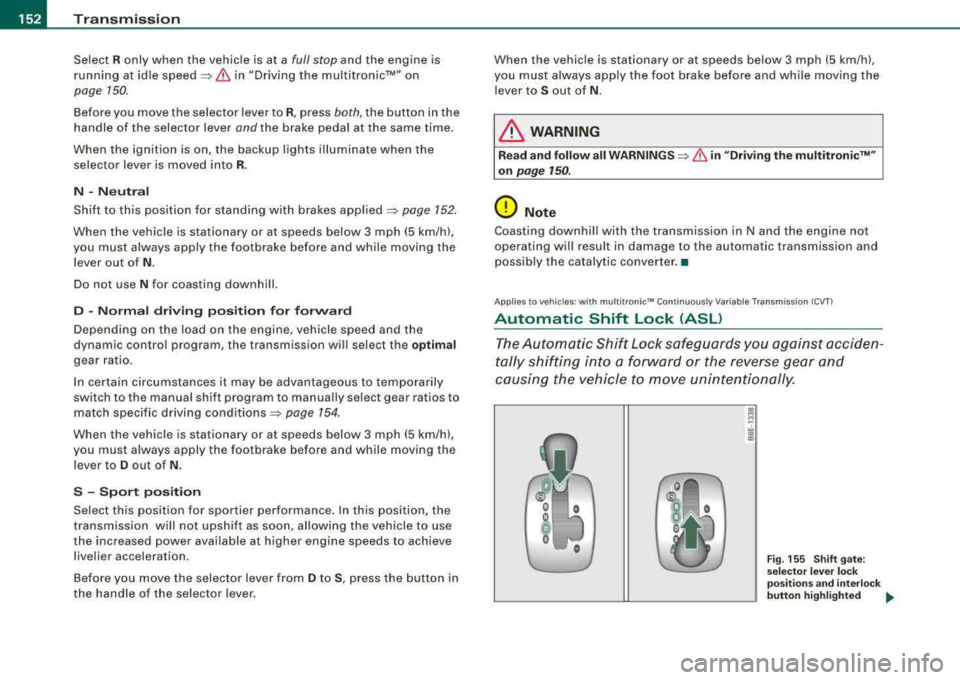
The Automatic Shift Lock safeguards you against acciden
tally shifting into a forward or the reverse gear and
causing the vehicle to move unintentionally.
~ M -w a, .,
Fig. 155 Shift gate:
selector lever lock
positions and interlock
button highlighted
..
Page 156 of 368
___ T_ ra_ n_ s_ m_ is_ s_ io_ n _____________________________________________________ _
heavy acceleration. This gives best fuel efficiency, with early
upshifting and delayed downshifting.
The transmission will automatically select the
sporty shift programs
when you drive at higher speeds, or with heavy acceleration and
frequently changing speeds. Upshifts are delayed to make full use
of engine power. Downshifting takes place at higher engine speeds
than in the economy programs.
The selection of the most suitable shift program is a continuous,
automatic process. The driver can a lso make the transmission
switch to a sporty program by
quickly pressing down the gas pedal.
This causes the transmission to shift down into a lower gear ratio
and makes quick acceleration possible (to pass another vehicle) You
do not need to press the gas pedal into the kickdown range. After
the transmission has upshifted, the original program is selected
according to your driving style .
An additiona l shift program allows the automatic transmission to
select the proper gear for uphill and downhill gradients.
This prevents the transmission from shifting up and down unneces
sari ly on hills. The transmission will shift down to a lower gear ratio
when the driver presses the brake pedal on a downhill gradient. This
makes use of the braking effect of the engine without the need to
shift down manually .
If you are driving in hills and mountains, the transmission will
continuously adjust the gear ratio to the road grade. If you press the
brake pedal when driving downhill, the transmission will downshift
automatically . This increases the braking effect of the engine.
If the cruise control is on when you are traveling downhill, the trans
mission will automatical ly select a lower gear ratio in order to main
tain the set vehicle speed . This will cause the engine speed to
increase. •
Applies to vehi cles : wi th mu ltit roni c™ Con tinu ousl y V ariabl e Tra nsmi ssio n lC VT I
tiptronic ® manual shift program
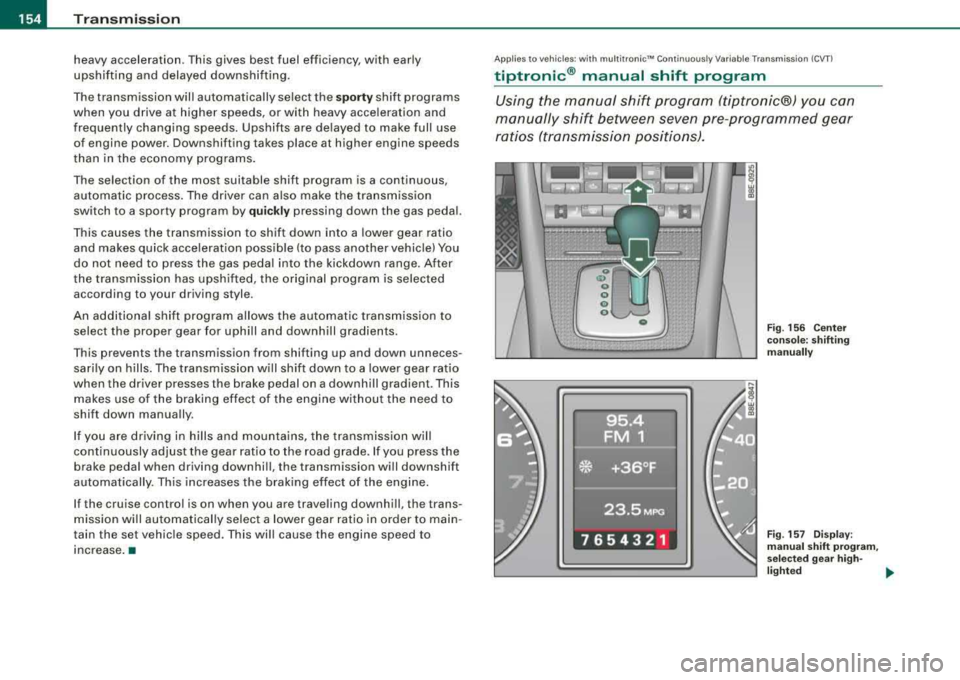
Using the manual shift program (tiptronic®) you can
manually shift between seven pre-programmed gear
ratios (tran smission positions).
Fig. 156 Center
console: shifting
manually
Fig . 157 Display:
manual shift program,
se lecte d gear high -
lighted ~
Page 157 of 368
_______________________________________________________ T:...:.; ra::.:.. n:.:s:.: m
:..:.:.:.: is:::: s::.:.: io::.:.. n:__J""
Swi tching to ma nual s hift pro gra m
- With the selector lever in
D, push lever to the right. The
display will show7
6 5 4 3 2 1 as soon as the selector lever
is switched over. The gear you select wi ll also be h igh
lighted in the
display => page 154, fig. 157.
To up shift
- Push the selector lever forward to the plus position
=> page 154, f ig. 156 G) .
To d ownshift
- P ush the lever to the mi nus positio n
Q.
When accelerating, the transmission will automatically shift into the
next higher gear before the engine reaches the maximum RPM .
When accelerating, if you apply a light throttle, the tiptronic® wil l
automatically shift into the next higher gear to save fuel. If you apply
a heavy throttle, the transmission will stay in gear engaged until
near maximum RPM are reached, or until the driver manually shifts
into a higher gear.
If you take your foot off the accelerator pedal when driving down a
steep incline, the tiptronic ® wi ll downshift from the selected gear
into the next lower gear based on road speed and engine RPM . The
automatic downshifting is interrupted as soon as you apply throttle
again .
[ i ] Tips
• When you shift into the next lower gear, the engine will down
shift only when there is no possibility of over-revving.
• When the kick -down comes on, the transmission will sh ift down
to a lower gear depending on vehicle and engine speeds.
• The tiptronic® is inoperative when the transmission is in the fail
safe mode. •
Controls and equip
ment
Ap plies to vehi cles: with mult it r o ni c™ Cont inuo usly V ariab le Tr ansm iss io n (CV Tl -not
a vail abl e at the t ime of p rin ting
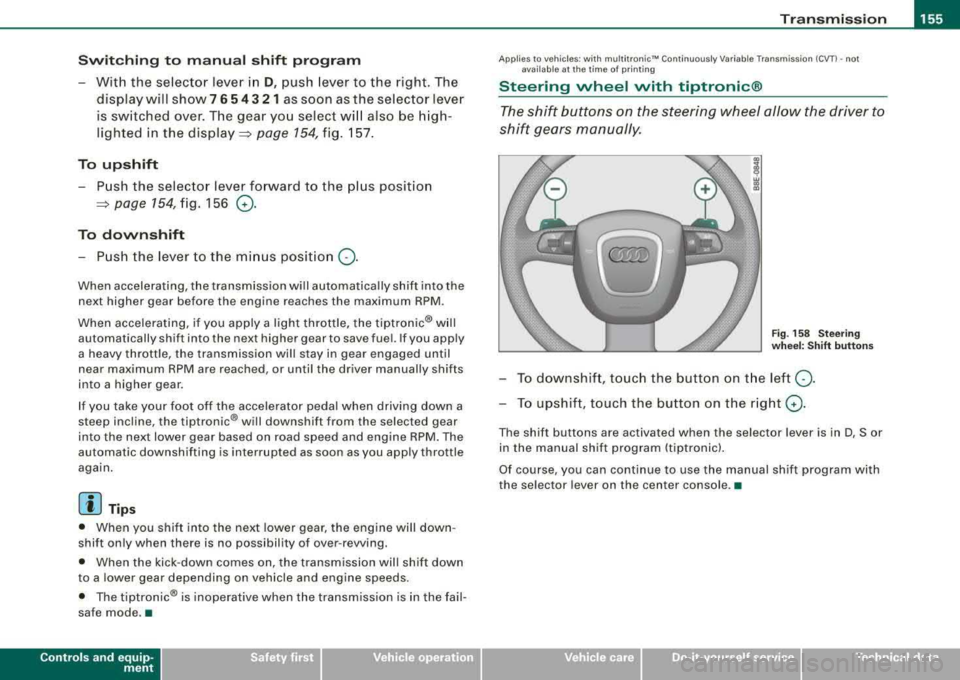
Steering wheel with tiptronic ®
The shift buttons on the steering wheel allow the driver to
shift gears manually .
Fig. 158 Stee ring
w hee l: S hift butt ons
To d ownshif t, touch the button on t he left Q .
To upshift, touch the button on the right G) .
The shift buttons are activated when the selector lever is in D, Sor
in the manual shift program (tiptronicl.
Of course, you can continue to use the manual shift program with
the selector lever on the center console. •
irechnical data
Page 253 of 368
![AUDI A4 AVANT 2008 User Guide Traile r to win g -______________ _,..,_lflllll
[ i] Tip s
• Do not tow a trailer during the break-in period of your vehicle.
• If you tow a trailer, your Audi may require](/img/6/57552/w960_57552-252.png "AUDI A4 AVANT 2008 User Guide Traile r to win g -______________ _,..,_lflllll
[ i] Tip s
• Do not tow a trailer during the break-in period of your vehicle.
• If you tow a trailer, your Audi may require")
Traile r to win g -______________ _,..,_l'flllll
[ i] Tip s
• Do not tow a trailer during the break-in period of your vehicle.
• If you tow a trailer, your Audi may require more frequent mainte
nance due to the extra load
=> page 346 . •
Parking on a slope
Do not park with a trailer on a slope. If it cannot be
avoided, do so only after doing the following:
Wh en p arkin g:
-Apply the foot brake.
- Have someone place chocks under both the veh ic le and
the trailer wheels .
- Wit h chocks in p lace, s lowly release t he brakes until
wheel blocks absorb t he load.
- T urn t he wheels towards the curb .
- Apply the parking brake.
- Place an automatic transmission in
P , respect ively a
manual transmission in first or reverse gear.
Wh en re starting aft er p arking:
- Start the e ngine .
- Shift transmission into gear.
- Re lease the parking brake and slowly pull out and away
from the wheel blocks.
- Stop and have someone retrieve the whee l blocks.
Controls and equip
ment Safety first Vehicle operation
[ i
] Tip s
If you move the selector lever of the automatic transmission to P
before applying the parking brake and before blocking the wheels,
you may have to use more force later to move the lever out of the
P
position .•
Vehicle care Do-it-yourself service Technical data
Page 275 of 368

Checking and filling -
-----------------------------==--------=--
& WARNING (continued)
ment. Wait until no steam or coolant can be seen or heard before
carefully opening the hood.
•
Closing the engine hood
- Pull the hood down until the pressure from the strut is
reduced.
- Let the hood
drop down and latch in place. Do not try to
push
it shut; it may fail to engage =:>& .
& WARNING
A hood that is not completely latched could fly up and block your
view while driving.
• When you close the engine hood, check it to make sure the
safety catch has properly engaged. The hood should be flush with
the surrounding vehicle body parts.
• If you notice while driving that the hood is not secured prop
erly, stop at once and close it. •
Working in the engine compartment
Be especially careful whenever you work in the engine
compartment.
Whenever you must perform any work in the engine compartment,
for example checking and filling different fluids, there is a risk of
injury, burns and accidents. To prevent personal injury always
observe the following WARNINGS . The engine compartment of any
vehicle is a hazardous area
=> & .
• I I • • I
& WARNING
To help avoid injury, before you check anything under the hood:
• Turn off the engine.
• Remove the ignition key .
• Apply the parking brake.
• Move selector lever of automatic transmission to
"P" (Park);
put manual transmission in Neutral.
• Always let the engine cool down. Hot components will burn
skin on contact.
• To reduce the risk of being burned, never open the hood if you
see or hear steam or coolant escaping from the engine compart
ment. Wait until no steam or coolant can be seen or heard before
carefully opening the hood.
• Keep children away from the engine compartment.
• Never spill fluids on hot engine components. They can cause a
fire.
• Never touch the radiator fan. The auxiliary electric fan is
temperature controlled and can switch on suddenly.
• Never open the coolant reservoir cap when the engine is still
warm . The coolant system is pressurized and hot coolant could
spray out.
• Protect your face, hands and arm from steam or hot engine
coolant by placing a thick rag over the cap when you open the
coolant reservoir .
• If work on the fuel system or the electrical system is necessary: -Always disconnect the battery.
- Never smoke or work near heaters or open flames. Fluids in
the engine compartment could start a fire .
- Keep an approved fire extinguisher immediately available.
• To avoid electrical shock and personal injury while the engine
is running or being started, never touch:
- Ignition cables
.,_
Vehicle care
Page 276 of 368

lffll...__C_ h_ e_c _k _ i_n ..::g ,_ a_n_ d_ f_il _li _n....: g==-- --------------------------------------------
& WARNING (continued )
-Other components of the high voltage electronic ignition
system .
• If you must perform a che ck or repair with the engine running:
- Fir st, fully apply the parking brake , move selector lever of
automatic transmission to
" P " (Park ); put manual transmission
in Neutral.
- Alway s use extreme caution to prevent clothing , jewelry , or
long hair from getting caught in the radiator f an, V -belts or
other moving part s, or from contacting hot parts. Tie ba ck hair
before starting , and we ar no clothing that will hang or droop
into the engine.
• Min imize e xposure to emission and chemical hazards
=> & .
& WARNING
California Proposition 65 Warning :
• Engine exhaust , some of its constituents , and certa in vehicle
c omponents contain or emit chemicals known to the State of Cali
fornia to cause cancer and birth defects and reproductive harm . In
addition , certain fluids contained in vehicles and certain products
of component wear contain or emit chemical s known to the State
of California to cause cancer and birth defects or other reprodu c
tive harm.
• Battery posts, terminal s and related accessories contain lead
and lead compounds , chemicals known to the State of California
to cause cancer and reproductive harms . Wash hands after
handling.
0 Note
When a dding f luids, always make sur e tha t they are poured i nto the
prop er container or filler opening, otherwise serious damage to
ve hicle syste ms wi ll occur .
ffi For the sake of the environment
To detect leaks i n time, inspect the veh icle floor pan from unde r
neath regularly. If you see spots from oil or other vehicle fluids, have
your veh ic le i nspected by a n authori zed Audi dealer. •
Engine compartment
Applies to v ehic les: with 2 .0 I tur bo, 4-cy linder -e n gi ne
2 .0 I, 4-cy linder turbo engine (200 hp)
T hese are th e mo st impo rtant items that you ca n check .
Fig . 205 Engine comp artment : 2 .0 I , 4-cylind er turbo
G) Battery ... ..... .. ... .... ... ...... ... .. .. ... .. .
0 Engine oil fil le r cap (
© Engine oil dipstick ( orange) .. .... .. .... .... ... .. .
285
2 78
2 8 4
277 ....
Page 320 of 368

___ w_ h_ a_t _ d_ o_ l_d _ o_ n_ o_w _ ? ______________________________________________ _
Storing the replaced wheel
- Place the replaced wheel inside the spare wheel well in
the luggage compartment.
- Tighten the knurled retaining screw clockwise to secure
the wheel in place.
- Disengage and lower the floor panel before you close the
luggage compartment lid again.
& WARNING
Loose items in the passenger compartment can cause serious
personal injury during hard braking or in an accident.
• Never store the spare wheel or jack and tools
in the passenger
compartment.
• Always store all jacking equipment, tools, and the spare wheel
in the luggage compartment.
• Tighten the knurled retaining screw for the spare wheel
securely.
[ i] Tips
Check the inflation pressure of the spare tire periodically to keep the
tire ready for use. •
Wheel change
Before changing a wheel
Follow these points for your own and your passenger's
safety when replacing a wheel.
After you experience a tire failure, pull the car well away
from moving traffic and try to reach
level ground before
you
stop ~& .
-All passengers should leave the car and move to a safe
location (for instance, behind the
guardrail) ~& .
-Apply the parking brake firmly ~& .
-Move selector lever to position P on an automatic trans-
mission; put manual transmission in
first gear~& .
-If you are towing a trailer: unhitch the trailer from your
vehicle.
- Take the
tool case and the spare tire ~ page 316 out of
the luggage compartment.
& WARNING
You or your passengers could be injured while changing a wheel if
you do not follow these safety precautions:
• If you have a flat tire, move a safe distance off the road. Turn off
the engine, turn the emergency flasher on and use other warning
devices to alert other motorists.
• Make sure that passengers wait
in a safe place away from the
vehicle and well away from the roadway and traffic.
• To help prevent the vehicle from moving suddenly and possibly
slipping off the jack, always fully set the parking brake and block
the wheel diagonally opposite the wheel being changed . When one
front wheel is lifted off the ground, placing the Automatic Trans-
~
Page 321 of 368
What do I do now? 11111111
-----------------------------------
& WARNING (continued)
mission in "P" (Park), or engaging a gear in a manual transmission
will
not prevent the vehicle from moving.
• Before you change a wheel, be sure the ground is level and firm.
If necessary, use a sturdy board under the jack.
• After installing the spare wheel, make sure that you remount
the flat tire/wheel in its storage area properly and tighten the
knurled retaining screw securely . •
Changing a wheel
When you change a wheel, follow the sequence described
below step-by-step and exactly in that order.
1. Remove the decorative wheel cover*. For more details
see also
=> page 320, "Decorative wheel covers" or
=> page 320, "Wheels with cap -covered wheel bolts".
2. Loosen the wheel bolts => page 321.
3.
Locate the proper mounting point for the jack and align
the jack below that
point=> page 321.
4. Lift the car with the jack => page 321.
5.
Take the flat wheel off and then put the spare on
=> page 323.
6. Tighten all wheel bolts lightly.
7.
Lower the vehicle with the jack.
8. Use the wheel bolt wrench and
firmly tighten all wheel
bolts=> page 321.
9. Put the decorative wheel cover* back on.
LJ}. WARNING
Always read and head all WARNINGS and information :::::> & in
"Raising the vehicle" on
page 321 and :::::, page 324. •
After changing a wheel
A wheel change is not complete without the following
actions.
-Store and secure the replaced wheel in the spare wheel
well.
-Put the tool case and the jack back in place in the luggage
compartment.
-Check the tire pressure on the spare wheel immediately
after mounting it.
- As soon as possible, have the
tightening torques on all
wheel bolts checked with a torque wrench. The correct
tightening torque is
90 ft lb (120 Nml.
- Have the flat tire
replaced as soon as possible.
[ i] Tips
• If you notice while changing a tire that the wheel bolts are
corroded and difficult to turn, then they should be replaced before
you check the tightening torque.
• Drive at reduced speed until you have the tightening torques
checked .•
Do -it -yourself service
Page 342 of 368
ffl,...__G_ e_ n_ e_r_a _ l_ i
_ n_ f_ o_ rm_ a
_ t_io _ n _______________________________________________ _
General information
Explanation of technical data
Some of the technical data listed in this manual require
further explanation.
The technical da ta for your vehicle are listed in the charts starting
on => page 343. This chapter p rovides general information, notes
and restrictions which apply to these data. •
Vehicle identification
The key data ore given on the vehicle identification
number (VIN) plate and the vehicle data sticker.
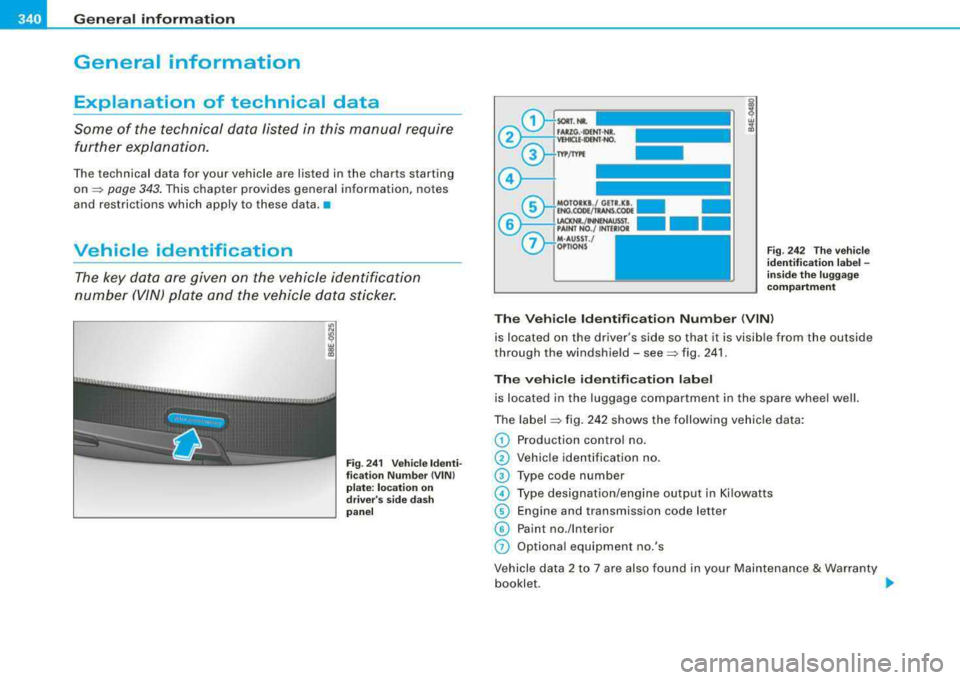
Fig . 241 Vehicle Identi
fication Number (VIN)
plate: location on
driver's side dash
panel Fig
. 242 The vehicle
identification label
-
inside the luggage
compartment
The Vehicle Identification Number (VIN}
is located on the driver's side so that it is visible from the outside
through the windshield -
see:::::, fig. 241.
The vehicle identification label
is located in the luggage compartment in the spare wheel well.
The
label => fig. 242 shows the following vehicle data:
G) Production control no.
0 Vehicle identification no .
© Type code number
© Type designation/engine output in Kilowatts
© Engine and transmission code letter
© Pain t no./lnt erior
0 Optional equipment no.'s
Vehicle data 2 to 7 are also found in your Maintenance
& Warranty
booklet .
..,.