towing AUDI A4 AVANT 2008 User Guide
[x] Cancel search | Manufacturer: AUDI, Model Year: 2008, Model line: A4 AVANT, Model: AUDI A4 AVANT 2008Pages: 368, PDF Size: 46.19 MB
Page 250 of 368

lllffl.___T_ r_a _il _e_ r_ t_o _vv_ i_ n """g"'- ---------------------------------------------------
Trailer towing
Driving with a trailer
General information
Your Audi was designed primarily for passenger transpor
tation.
If you plan to tow a trailer, please remember t hat the add it ional load
wi ll affect durability, economy and performance.
Trailer towing not only p laces more stress on the veh icle, it a lso ca lls
for more concentration from the driver.
For th is reasons, always fo llow the operating and dr iving instruc
t ions provided and use common sense. •
Technical requirements
Trailer hit ch
Use a weight -carrying hitch conforming to the gross trailer weight.
The hitc h must be suitab le for your veh ic le and tra iler and must be
mounted securely on the vehicle's chassis at a technically sound
l ocation. Use only a tra iler hitch with removable bal l mount. A lways
check with the trai ler hitch manufacturer to make sure that you are
using t he correct hitch .
Do not use a bumper hit ch .
The hitch must be installed in such a way that it does not interfere
with the impact-absorb ing bumper system . No mod ifications
shou ld be made to the vehicle exhaust and brake systems. From
time to time, check that all hitch mount ing bo lts re main securely
fastened.
When you are not towing a trai ler, remove the trailer hit c h ball
mount. Th is prevents the hitch from causing damage s hou ld your
vehic le be struck from
behind ~& .
Tire pre ssure
When towing a trailer, inf late the tires of your vehic le to the cold tire
pressure listed under "Full load" on the s ticker on the right door
jamb . Inflate trai ler tires to tra iler and tire manufacturers' specifica
t ions.
Lights
T he head ligh t settings shou ld be checked with the trailer at tached
before driving off. Have the head lights adjusted as necessary so
t hat you can see t he road ahead bu t not bl ind oncom ing traffic.
Check to make sure both vehicle and trailer lights are working prop
e rly .
Engine cool ing sy stem
Towing a t railer makes the eng ine work ha rder. It is imp ortant tha t
the cooling system's performance stands up to the additiona l
strain. Make sure that the coo ling system has enoug h fluid.
Traile r br ake s
If your tra ile r i s eq uipped wi th a braki ng system, check to be s ure
that it conforms to al l regu lations .
T he tra iler hydraulic brake system must no t be direct ly connected to
the vehic le's hydrau lic brake system .
Safety chains
Be sure trailer safety chains are properly connected from the trai ler
t o the h itch on the vehicle. Leave enough s lack in t he chains to
permit turning corners. When you install safety chains, make sure
they will not drag on the road when you are driving.
T he chains shou ld cross under t he trailer tongue to prevent it from
dropping in case of separation from the hitch. _,,,
Page 251 of 368
____________________________________________________ T_r_a _i_le _ r_t_ o _ w_ i
_ n...; g=- ---
Trailer lights
Trailer lights must meet all regulations. Be sure to check with your
authorized Audi dealer for correct wiring, switches and relays .
Mirrors
If you are unable to see the traffic behind you using the regular
outside mirrors, then you
must install extended mirrors. It is impor
tant that you
always have clear vision to the rear .
& WARNING
After removing the trailer hitch, do not store it in your vehicle. In
case of sudden braking, the hitch could fly forward and injure you
or your passengers. •
Operating instructions
Maximum trailer weight
A trailer for your vehicle is limited to a typical class 1 or class 2
trailer .
Trailer load distribution
Be sure the load in the trailer is held securely in place to guard
against shifting, be it forward, backward or sideways.
Never allow a passenger to ride in a trailer~ & in "Driving instruc
tions".
Tire pressure
When towing a trailer, inflate the tires of your vehicle to the cold tire
pressure listed under "Full load" on the sticker on the right door
jamb. Inflate trailer tires to trailer and tire manufacturers' specifica
tions .
Controls and equip
ment Safety first Vehicle operation Lights
The
headlight settings should be checked with the trailer attached
before driving off. Adjust as necessary so that you can see the road
ahead but not blind oncoming traffic.
Check proper working of vehicle and trailer lights .
Power Supply
The power supply to the trailer is disconnected when the ignition
key is removed.
Safety chains
Be sure trailer safety chains are properly connected from the trailer
to the hitch on the vehicle . Leave enough slack in the chains to
permit turning corners. When you install safety chains, make sure
they will not drag on the road when you are driving.
The chains should cross under the trailer tongue to prevent it from
dropping in case of separation from the hitch.•
Driving instructions
Driving with a trailer always requires extra care and
consideration.
To obtain the best possible handling of vehicle and trailer,
please note the following:
- Do not tow a loaded trailer when your car itself is not
loaded.
- Be especially careful when passing other vehicles.
- Observe speed limits.
- Do not drive at the maximum permissible speed.
- Always apply brakes early.
- Monitor the temperature gauge.
Vehicle care Do-it-yourself service Technical data
Page 252 of 368
III.___T_ r_a _il _e_ r_ t_o _vv_ i_ n """g"'- ---------------------------------------------------
W eig ht d is tri buti on
Towing a loaded tra iler wit h an empty car resu lts in a high ly
unstable distribution of weight . If this cannot be avoided drive at
ve ry low speeds only to avo id the risk of losing steering control.
A "ba lanced" rig is easier to operate and control. This means that
the tow vehicle should be loaded to the extent possible and permis
sib le whi le keeping the trailer as light as possib le under the circum
stances. Whenever possible, transfer some cargo to the luggage
compar tment of the tow veh icle whi le observi ng tongue load
requirements and vehicle loading considerations.
Speed
T he higher the speed, the more difficu lt it becomes for the driver to
contro l the rig . Do not drive at the maximum permissible speed.
Reduce your speed even more under unfavorable load, weather or
wind conditions -part icularly when going dow nh ill.
Reduce vehicle speed
immedi ately if the trailer shows the slightest
sign of swaying.
Do not tr y to stop the s waying by a cceler ating .
Observe speed limits . In some areas speeds for veh ic les towi ng
trai lers are lower than for regular vehicles.
Always app ly brakes early. When driving downhi ll, shift into lower
gear to use the engine braking effect to slow down the vehicle. Use
of the brakes alone can cause them to overheat and fail.
C oo la nt tempe ra tu re
The coola nt temperature gauge => page 13 must be observed care
ful ly. If the needle moves close to the upper end of the scale, reduce
speed immediately and/or switch off the air conditioner.
If the coolant te mperature warning light in the instrument cluster
starts
flashing -~-, pul l off the road, stop and let the engine idle for
about two minutes to prevent heat build -up .
& WARNING
An yone not p rop erl y res trained in a mo ving vehicl e is at a much
gre ate r risk in an accident. Never let an yone rid e in your car who
is not p rop erl y wear ing the re stra int s pro vided b y Aud i. •
Trailer towing tips
Important to know
Your vehicle handles differently when towing a tra iler because of
the additional weight and weight distribution. Safety, performance
and economy wi ll great ly depend on how carefu lly you load your
trai ler and operate your rig.
Before you actual ly tow your tra iler, practice turning, stoppi ng and
backing up in an area away from traffic. Keep practicing unti l you
have comp letely become familiar with the way yo ur vehicle -trailer
combination behaves and responds .
Backing up is difficu lt and requires practice. Backing up with a
trai ler genera lly requ ires steering action oppos ite of that when
backing up your vehic le without a trailer.
Mainta in a greater distance between you r vehic le and the one in
front of you. You will need more room to stop.
To compensate for the trai ler, you wi ll need a larger than normal
t urning radius .
When passing, remember that you cannot accelerate as fast as you nor mally wou ld because of t he added load . Make sure yo u have
enough room to pass. After passing, al low plenty of room for your
trai ler before changing lanes again .
Avo id jerky starts, sharp turns or rapid lane changes.
Page 305 of 368
5. Determine the combined weight of luggage and cargo being loaded on the
vehicle. That weight may not safely
exceed the available cargo and luggage
load capacity calculated in Step 4.
6. If your vehicle will be towing a trailer, load from your trailer will be transferred
to your vehicle. Consult this manual to
determine how this reduces the avail
able cargo and luggage load capacity of
your vehicle.
- Check the tire sidewall(::::>
page 305,
fig. 221) to determine the designated
load rating for a specific tire.•
Tires and wheels 1111
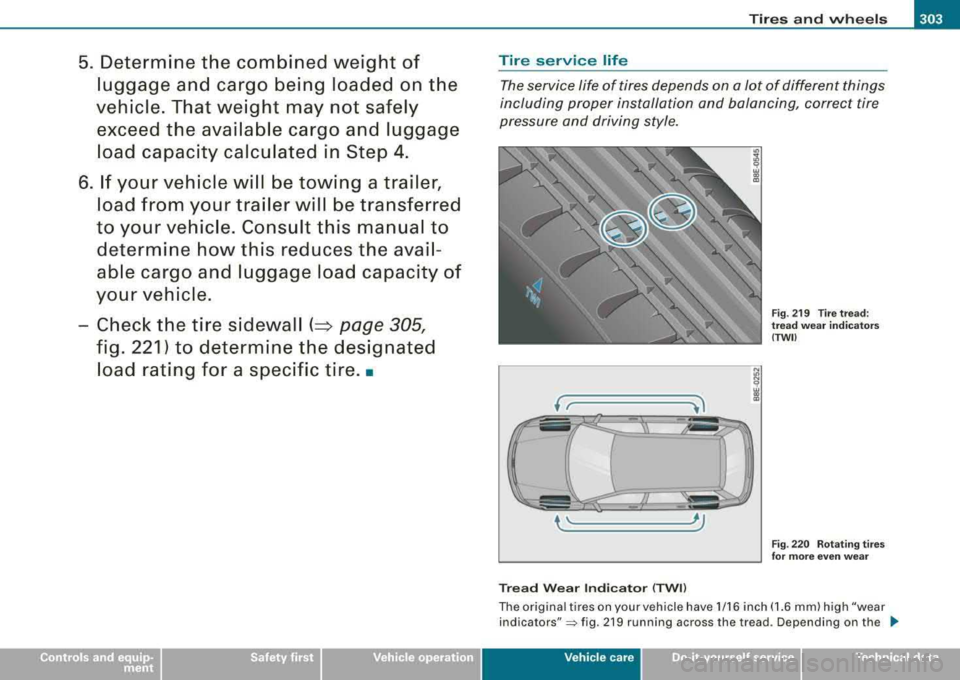
Tire service life
The service life of tires depends on a lot of different things
including proper installation and balancing, correct tire
pressure and driving style.
•,
.._ ____________ __,
Tread Wear Indicator {TWI)
Fig. 219 Tire tread:
tread wear indicators
(TWO
Fig . 220 Rotating tires
for more even wear
The origina l tires on your vehicle have 1 /16 inch (1.6 mm) high "wear
indicators"=> fig . 219 running across the tread . Depending on the .,.
Vehic le care irechnical data
Page 318 of 368
lllffll....__W_ h_ a_ t_d_ o_ l _d _o_ n_ o_ vv_ ? ______________________________________________ _
What do I do now?
Jack, tools and spare wheel
Jack and tools
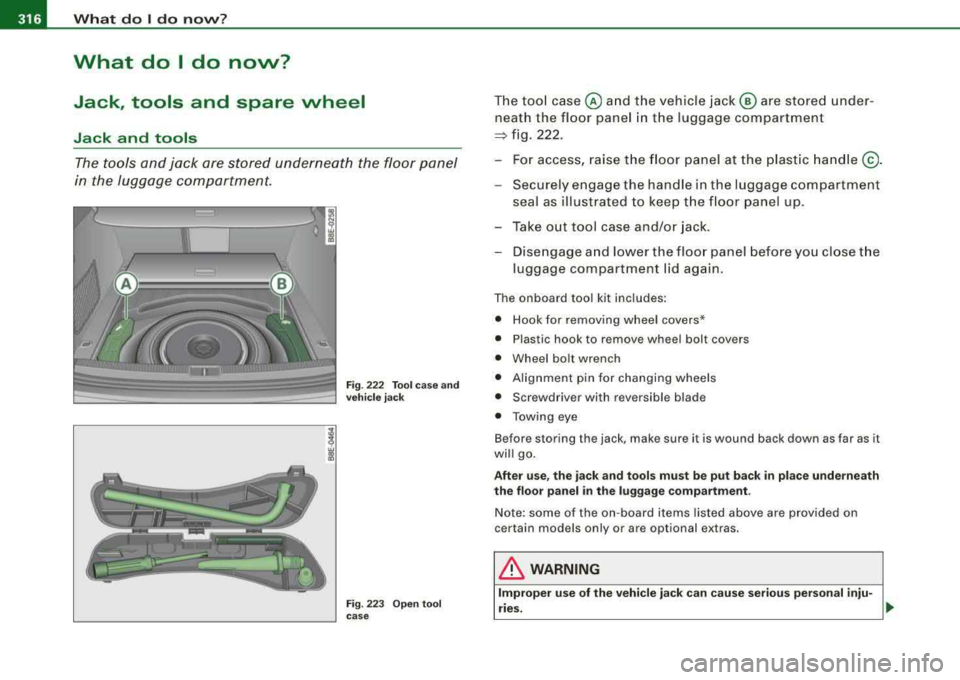
The tools and jack are stored underneath the floor panel
in the luggage compartment.
F ig. 222 Tool case and
ve hicle jack
Fi g. 223 O pen too l
case
The tool case @ and the vehicle jack@ are stored under
neath the floor panel in the luggage compartment
=> fig. 222.
- For access, raise t he floor panel at the plastic ha ndle @ .
- Securely engage the handle in the luggage compartment
seal as illustrated to keep the floor panel up.
- Take out tool case and/or jack.
- Disengage and lower the floor panel before you close the
luggage compartment lid again.
The onboard tool kit inc ludes:
• Hook for removing wheel covers*
• Plastic hook to remove wheel bolt covers
• Wheel bo lt wrench
• Alignment pin for changing wheels
• Screwdriver with reversible blade
• Towing eye
Before storing the jack, make sure it is wound back down as far as it
will go.
Afte r use, th e ja c k a nd tools m us t b e put bac k in pl ace u nderneath
th e floor p an el in th e lu g gage c omp artment .
Note: some of the on -board items listed above are provided on
certain models only or are optional extras.
& WARNING
Improper us e of th e vehi cle ja ck ca n ca use se rious pe rso nal inju
r ies.
Page 320 of 368

___ w_ h_ a_t _ d_ o_ l_d _ o_ n_ o_w _ ? ______________________________________________ _
Storing the replaced wheel
- Place the replaced wheel inside the spare wheel well in
the luggage compartment.
- Tighten the knurled retaining screw clockwise to secure
the wheel in place.
- Disengage and lower the floor panel before you close the
luggage compartment lid again.
& WARNING
Loose items in the passenger compartment can cause serious
personal injury during hard braking or in an accident.
• Never store the spare wheel or jack and tools
in the passenger
compartment.
• Always store all jacking equipment, tools, and the spare wheel
in the luggage compartment.
• Tighten the knurled retaining screw for the spare wheel
securely.
[ i] Tips
Check the inflation pressure of the spare tire periodically to keep the
tire ready for use. •
Wheel change
Before changing a wheel
Follow these points for your own and your passenger's
safety when replacing a wheel.
After you experience a tire failure, pull the car well away
from moving traffic and try to reach
level ground before
you
stop ~& .
-All passengers should leave the car and move to a safe
location (for instance, behind the
guardrail) ~& .
-Apply the parking brake firmly ~& .
-Move selector lever to position P on an automatic trans-
mission; put manual transmission in
first gear~& .
-If you are towing a trailer: unhitch the trailer from your
vehicle.
- Take the
tool case and the spare tire ~ page 316 out of
the luggage compartment.
& WARNING
You or your passengers could be injured while changing a wheel if
you do not follow these safety precautions:
• If you have a flat tire, move a safe distance off the road. Turn off
the engine, turn the emergency flasher on and use other warning
devices to alert other motorists.
• Make sure that passengers wait
in a safe place away from the
vehicle and well away from the roadway and traffic.
• To help prevent the vehicle from moving suddenly and possibly
slipping off the jack, always fully set the parking brake and block
the wheel diagonally opposite the wheel being changed . When one
front wheel is lifted off the ground, placing the Automatic Trans-
~
Page 329 of 368

Fuses and bulbs -
----------------
0 Note No. Equipment Amps
• On no account should fuses be repaired (e.g. patched up with tin 13 Steering column module 10
foil or wire) as this may cause serious damage elsewhere in the elec -14 Brake lights 10
trical circuit or cause fire.
15 Instrument cluster, Navigation system 10
• If a fuse blows repeatedly, do not keep replacing it. Instead, have
the cause for the repeated short circuit or overload tracked and Garage door opener
5
fixed.
•
Level, tire pressure control, park assist,
17 light/rain sensor 10
Fuse list Automatic headlight range control, left 5
Fuses which can be replaced. 19 Fog lights, rear fog light 15
20
Not used
No. Equipment Amps
21 Not used
1 Air conditioner 10 Front doors 15
2
Footwell illumination 5 23 Rear doors 15
3 Heated washer jets 5 Central convenience electrical system 20
4 Radiator fan 5 25 Heater blower 30
5
Telephone, oil level sensor, multifunction 10 26 Rear window defogger 30
switch, rear heated Seat, shift gate
27 Socket for trailer towing (controller) 30
6
Air conditioner (air quality sensor), air pressure 5 28 Fuel pump 20 sensor
Electronic Stabilization Program (ESP), brake
29 Not used
7 light switch, clutch pedal switch, steering angle 10 Power sunroof 20
sensor Automatic transmission, mirror dimming, diag-
31 15 8 Telephone 5 nosis socket
9 Brake booster (vacuum pump) 15 Towing assembly 15
10
Automatic headlight beam adjustment, auto -5 33 Cigarette
lighter 20
matic headlight range control, right
Electrical socket 20
11
Airbag 5 35 Luggage compartment socket 20
12
Diagnosis socket 10 Windshield wiper system 30
Do -it -yourself service
Page 332 of 368
lllft!l.,___E
_ m_ e_r-=g =-e_ n_c ..:y:- s_ i_ t _u _a_ t_ i_ o _n_ s _______________________________________________ _
Emergency situations
General
This section i s intended for trained emergency crews and working
personnel who have the necessary tools and equipment to perform
these operations.
•
Starting by pushing or towing
0 Note
Vehicles with an automatic transmission cannot be started by
pushing or towing . •
Starting with jumper cables
If n ece ssary, the eng in e can b e star ted by conne cting it to
the battery of another veh ic le .
If th e engin e shou ld fai l to start because of a discharged or weak
b at te ry, the batt ery can be co nnected t o the ba ttery of
another
ve hic le, us ing a pair of jumper cables to start the engine.
Jumper cables
Use
only jumper cables of sufficient ly large cross se ction to safe ly
c a rry the st ar ter curr ent. Refer to th e m anuf actu rer's specific ations.
Us e on ly j um per ca bles with
isolated term ina l clam ps and prop erly
marked for distinction:
plus (+l cable in most c ases c olored red
minus (- l cable in most cases co lored black .
& WARNING
Batteries contain electricity , acid, and gas . Any of these can cause
very serious or fatal injury. Follow the instructions below for safe
handling of your vehicle 's battery.
• Always shield your eyes and avoid leaning over the battery
whenever possible .
• A discharged battery can already freeze at temperatures just
below 32 °F (0 °Cl. Before connecting a jumper cable, the frozen
battery must be thawed completely , otherwise it could explode.
• Do not allow battery acid to contact eyes or skin . Flush any
contacted area with water immediately .
• Improper use of a booster battery to start a vehicle may cause
an explosion.
• Vehicle batteries generate e xplosive gases . Keep sparks, flame
and lighted cigarettes away from batteries.
• Do not try to jump start any vehicle with a low ac id level in the
battery.
• The voltage of the booster battery must also have a 12-Volt
rating . The capacity (Ahl of the booster battery should not be
lower than that of the discharged battery . Use of batteries of
different voltage or substantially different
" Ah " rating may cause
an e xplosion and personal injury .
• Never charge a frozen battery. Gas trapped in the ice may cause
an explosion .
• Never charge or use a battery that has been frozen . The battery
case may have be weakened.
• Use of batteries of different voltage or substantially different
capacity (Ah ) rating may cause an explosion and injury . The
capacity (Ah l of the booster battery should not be lower than that
of the discharged battery . ..,_
Page 334 of 368
-Emergency situations PW--------=----=---------------
4. Connect clamp on opposite end of negative cable to the
negative(-) terminal© of the discharged vehicle battery
@.
- Check that all screw plugs on the battery cells are
screwed in firmly. If not, tighten plugs prior to
connecting clamp on negative battery terminal.
Starting the engine
-Start the engine of the vehicle with the booster battery.
Run the engine at a moderate speed.
- Start engine with discharged vehicle battery in the usual
manner .
- If the engine fails to start: do not keep the starter
cranking for longer than 10 seconds. Wait for about 30
seconds and then try again.
- With engine running, remove jumper cables from both
vehicles in exact
reverse order.
The battery is vented to the outside to prevent gases from entering
the vehicle interior.
Make sure that the jumper clamps are well connected with their
metal parts in full contact with the battery terminals .
& WARNING
To avoid serious personal injury and damage to the vehicle, heed
all warnings and instructions of the jumper cable manufacturer. If
in doubt, call for road service.
• Jumper cables must be long enough so that the vehicles do not
touch.
• When connecting jumper cables, make sure that they cannot
get caught in any moving parts in the engine compartment.
& WARNING (continued)
• Before you check anything in the engine compartment, always
read and heed all
WARNINGS:::::, page 265, "Engine compartment".
0 Note
Improperly connected jumper cables can damage or destroy the
generator .
• Always connect POSITIVE (+l to POSITIVE(+), and NEGATIVE (-l to
NEGATIVE (- l terminal.
• Check that all screw plugs on the battery cells are screwed in
firmly. If not, tighten plugs prior to connecting clamp on negative
battery terminal.
• Please note that the procedure for connecting a jumper cable as
described above applies specifically to the case of your vehicle
being jump started. When you are giving a jump start to another
vehicle, do not connect the minus 1-1 cable to the minus (-1 terminal
on the discharged battery @::::, page 331, fig. 234. Instead, securely
connect the minus (-l cable to either a massive metal component
that is firmly bolted to the engine block or to the engine block itself .
If the battery that is being charged does not vent to the outside,
escaping battery gas could ignite and explode! •
Emergency towing with commercial
tow truck
General hints
Your Audi requires special handling for towing.
The following information is to be used by commercial tow truck
operators who know how to operate their equipment safely.
• Never tow your Audi, towing will cause damage to the engine
and transmission. .,_
Page 335 of 368
Emergency situations -
----------------=-----'
• Never wrap the safety chains or winch cables around the brake
lines.
• To prevent unnecessary damage, your Audi must be transported
with a car carrier (flat bed truck).
• To load the vehicle on to the flat bed, use the towing loop found
in the vehicle tools and attach to the front or rear anchorage
=> page 333 and => page 334.
& WARNING
A vehicle being towed is not safe for passengers. Never allow
anyone to ride in a vehicle being towed, for any reason. •
Front towline eye
Do not install the front towline eye until it is needed.
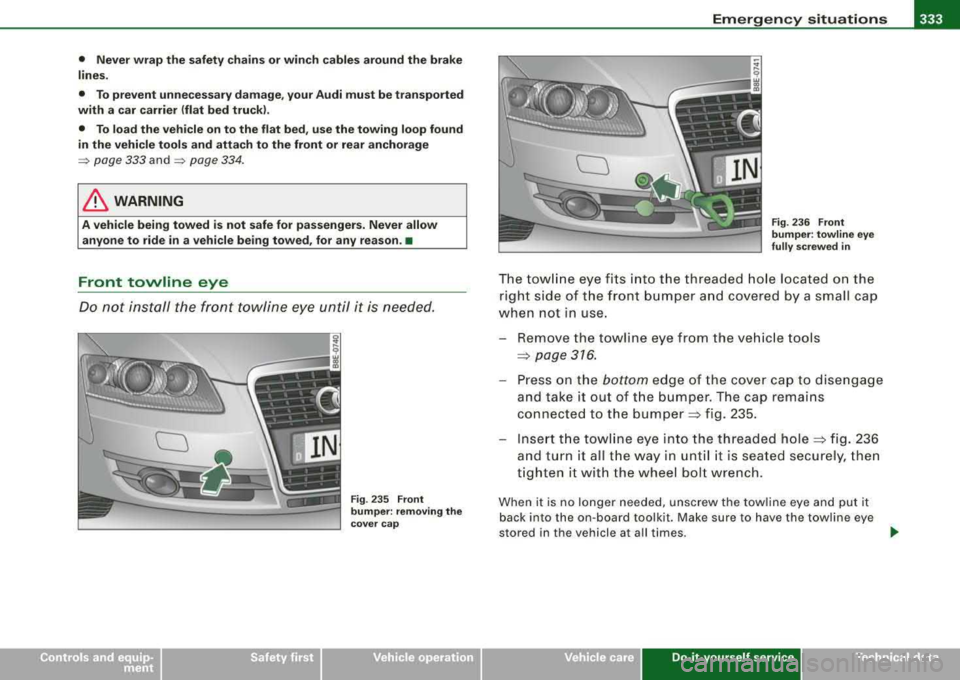
Fig. 235 Front
bumper: removing the
cover cap Fig. 236 Front
bumper: towline eye
fully screwed in
The towline eye fits into the threaded hole located on the
right side of the front bumper and covered by a small cap
when not in use .
-Remove the towline eye from the vehicle tools
=} page 316.
-Press on the bottom edge of the cover cap to disengage
and take it out of the bumper. The cap remains
connected to the bumper :::} fig. 235.
-Insert the towline eye into the threaded hole:::} fig. 236
and turn it all the way in until it is seated securely, then
tighten it with the wheel bolt wrench.
When it is no longer needed, unscrew the towline eye and put it
back into the on-board toolkit. Make sure to have the towline eye
stored in the vehicle at all times. .,_
Do-it-yourse lf service irechnical data