weight AUDI A4 AVANT 2008 User Guide
[x] Cancel search | Manufacturer: AUDI, Model Year: 2008, Model line: A4 AVANT, Model: AUDI A4 AVANT 2008Pages: 368, PDF Size: 46.19 MB
Page 142 of 368
___ O_ n_ t_h _e_ r_o _ a_ d ____________________________________________________ _
Cruise control
General information
The cruise control system allows you to maintain a
constant speed.
The cruise control system allows you to maintain and constant
driving speed when driving faster than 18 mph (30 km/h) -to the
extent this is possible with the given engine power and braking
characteristics. This allow you to take your foot off the "gas" and
rest it, especially on long trips .
The indicator light CRUISE (USA)/
•l'l (CDNl in the instrument cluster
illuminates when the system is on .
& WARNING
• To help keep the vehicle under control, do not use the cruise
control system when driving on winding or slippery roads (as
caused by heavy rain or loose gravel on the road surface), or in
heavy or varying traffic.
• Only use the cruise control when traffic, road and weather
co nd itions allow you to drive at a steady speed.
[ i] Tips
The cruise control cannot maintain a constant speed when driving
downhill. The vehicle will accelerate under its own weight. Down
shift to a lower gear or use the brakes to slow down .•
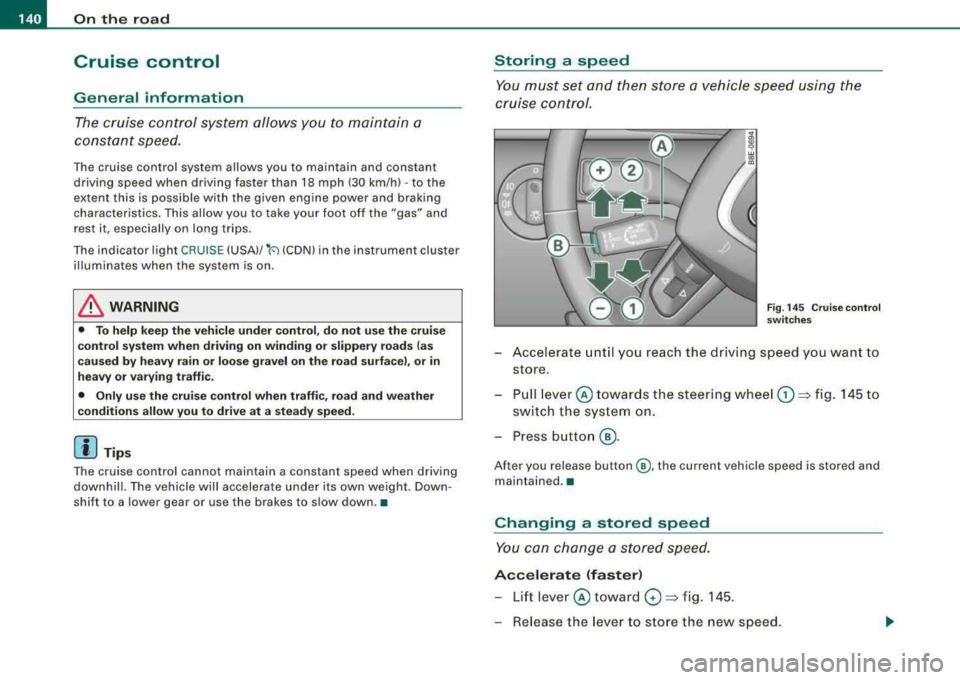
Storing a speed
You must set and then store a vehicle speed using the
cruise control.
Fig. 145 Cruise control
switches
- Accelerate until you reach the driving speed you want to
store.
- Pull
lever © towards the steering wheel G) => fig. 145 to
switch the system on.
- Press button
@.
After you release button @, the current vehicle speed is stored and
maintained .•
Changing a stored speed
You can change a stored speed.
Accelerate (faster)
-Lift lever © toward 0 => fig. 145 .
- Release the lever to store the new speed.
Page 176 of 368
___ D_ r
_ i_v _i_n ..;::g :;_ S_ a_ f_ e_, ly'----------------------------------------------------
& WARNING
Improperly stored luggage or other items can fly through the
vehicle causing serious personal injury in the event of hard braking
or an accident. To help reduce the risk of serious personal injury:
• Always put objects, for example, luggage or other heavy items
in the luggage compartment .
• Always secure objects in the luggage compartment using the
tie-down hooks and suitable straps .
& WARNING
Heavy loads will influence the way your vehicle handles. To help
reduce the risk of a loss of control leading to serious personal
injury :
• Always keep in mind when transporting heavy objects, that a
change in the center of gravity can also cause changes in vehicle
handling:
-Always distribute the load as evenly as possible.
- Place heavy objects as far forward in the luggage compart-
ment as possible.
• Never exceed the Gross Axle Weight Rating or the Gross
Vehicle Weight Rating specified on the safety compliance sticker on the left door jamb. Exceeding permissible weight standards
can cause the vehicle to slide and handle differently.
• Please observe information on safe
driving => page 166.
& WARNING
To help prevent poisonous exhaust gas from being drawn into the
vehicle, always keep the rear lid closed while driving.
• Never transport objects larger than those fitting completely
into the luggage area because the rear lid cannot be fully closed.
& WARNING (continued)
• If you absolutely must drive with the rear lid open, observe the
following notes to reduce the risk of poisoning :
- Close all windows,
- Close the power roof*,
- Open all air outlets in the instrument panel,
- Switch off the air recirculation,
- Set the fresh air fan to the highest speed.
& WARNING
Always make sure that the doors, all windows, the power roof*
and the read lid are securely closed and locked to reduce the risk
of injury when the vehicle is not being used.
• After closing the rear lid, always make sure that it is properly
closed and locked.
• Never leave your vehicle unattended especially with the rear lid
left open. A child could crawl into the vehicle through the luggage
compartment and close the rear lid becoming trapped and unable
to get out . Being trapped in a vehicle can lead to serious personal
injury.
• Never let children play in or around the vehicle.
• Never let passengers ride in the luggage compartment . Vehicle
occupants must always be properly restrained in one of the
vehicle's seating positions.
[ i] Tips
Air circulation helps to reduce window fogging. Stale air escapes to
the outside through vents in the trim panel, on the left side of the
luggage compartment. Be sure to keep these slots free and open. •
Page 177 of 368
Driving Safely -
--------------=-='------'
Tie-downs
The luggage compartment is equipped with four tie
downs to secure luggage and other items.
Use the tie -downs to secure your cargo properly => page 173,
"Loading the luggage compartment".
In a collision, the laws of physics mean that even smaller items that
are loose in the vehicle will become heavy missiles that can cause
serious injury. Items in the vehicle possess energy which vary with
vehicle speed and the weight of the item. Vehicle speed is the most
significant factor.
For example, in a frontal collision at a speed of 30 mph (48 km/h),
the forces acting on a 10 lbs. (4,5 kg) object are about 20 times the
normal weight of the item. This means that the weight of the item
would suddenly be about 200 lbs. (90 kg). You can imagine the inju
ries that a 200 lbs . (90 kg) item flying freely through the passenger
compartment could cause in a collision like this.
& WARNING
Weak, damaged or improper straps used to secure items to tie
downs can fail during hard braking or in a collision and cause
serious personal injury.
• Always use suitable mounting straps and properly secure
items to the tie-downs in the luggage compartment to help
prevent items from shifting or flying forward as dangerous
missiles.
• When the rear seat backrest is folded down, always use suit
able mounting straps and properly secure items to the tie-downs
in the luggage compartment to help prevent items from flying
forward as dangerous missiles into the passenger compartment.
• Never attach a child safety seat tether strap to a tie-down.
•
Controls and equip
ment Safety first Vehicle operation
Reporting safety defects
If you believe that your vehicle has a defect which could cause a
crash or could cause injury or death, you should immediately inform
the National Highway Traffic Safety Administration (NHTSAl in addi
tion to notifying Audi of America, Inc. If NHTSA receives similar
complaints, it may open an investigation, and if it finds that a safety
defect exists in a group of vehicles, it may order a recall and remedy
campaign. However, NHTSA cannot become involved in individual
problems between you, your dealer, or Audi of America, Inc.
To contact NHTSA, you may call the Vehicle
Safety Hotline toll-free at 1-888-327-4236 (TTY:
1-800-424-9153);
go to
http://www.safercar.gov;
or write to: Administrator, NHTSA, 400 Seventh
Street, SW., Washington, DC 20590.
You can also obtain other information about
motor vehicle safety from
http://www.safercar.gov. •
Vehicle care Do-it-yourself service Technical data
Page 180 of 368
___ s_a_ f_ e_ t-= y_ b_e_ l_ t _s _______________________________________________ _
T he physical principles are simple . Both the vehicle and the passen
gers possess energy wh ich varies w ith vehicle speed and body
weight . Engineers cal l this energy "kinetic energy ."
The higher the speed of the vehicle and the greater the vehicle's
weight, the more energy that has to be "absorbed" in the crash.
Vehicle speed is the most significant factor . If the speed doub les
from 15 to 30 mph (25 to 50 km/h), the energy increases 4 times!
Because the passengers of this vehicle are not using safety belts
~ page 177, fig. 167, they will keep moving at the same speed the
vehic le was moving just before the crash, until something stops
them
-here, the wall ~ page 177, fig . 168 .
The same principles apply to people sitting in a vehicle that is involved in a frontal collision . Even at city speeds of 20 to 30 mph
(30 to 50 km/h), the forces acting on the body can reach one ton
(2,000 lbs, or 1,000 kg) or more. At greater speeds, these forces are
even higher.
People who do not use safety belts are a lso not attached to their
vehic le. In a frontal collision they will also keep moving forward at
the speed their vehicle was trave lling just before the crash. Of
course, the laws of physics don't just apply to frontal collisions, they
determine what happens in all kinds of accidents and coll isions .•
What happens to occupants not wearing
safety belts?
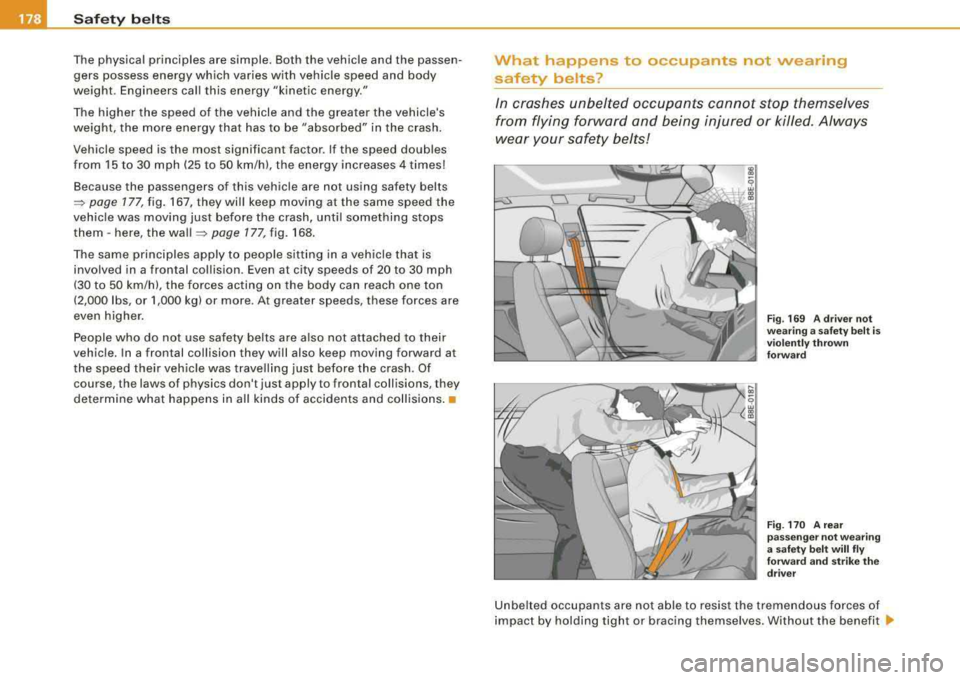
In crashes unbelted occupants cannot stop themselves
from flying forward and being injured or killed . Always
wear your safety belts!
0
F ig . 169 A driver not
wear ing a safety belt is
v iol ently thr own
forwa rd
Fig. 17 0 A rear
passenge r not wearing
a safe ty belt w ill
fly
for wa rd a nd strik e the
dr iver
Unbelted occupants are not able to resist the tremendous forces of
impact by holding tight or bracing themselves . Without the benefit ._
Page 191 of 368
__________________________________________________ A_ i_ r _b _a-' g=- s_ y=-- s_t _e _m ______ lfflll
Child restraints on the front seat - some
important things to know
- Be sure to read the important information and head the
WARNINGS for important details about children and
Advanced
Airbags=> page 210.
Even though your vehicle is equipped with an Advanced Airbag
System, make certain that all children, especially those 12 years and
younger, always ride in the back seat properly restrained for their
age and size . The airbag on the passenger side makes the front seat
a potentially dangerous place for a child to ride. The front seat is not
the safest place for a child in a forward -facing child safety seat. It
can be a very dangerous place for an infant or a child in a rearward
facing seat.
The Advanced Airbag System in your vehicle has been certified to comply with the Requirements of United States Federal Motor
Vehicle Safety Standard 208 as applicable at the time your vehicle
was manufactured.
The Standard requires the front airbag on the passenger side to be
turned off ("suppressed") if a child up to about one year of age
restrained in one of the rear-facing or forward-facing infant
restraints listed in Federal Motor Vehicle Safety Standard 208 with
which the Advanced Airbag System in your vehicle was certified has been installed on the front passenger seat. For a listing of the child
restraints that were used to certify compliance with the US Safety
Standard ::::, page 212.
The PASSENGER AIR BAG OFF light in the instrument panel tells you
when the front Advanced Airbag on the passenger side has been
turned off by the electronic control unit.
Each time you turn on the ignition, the
PASSENGER AIR BAG OFF
light will come on for a few seconds and:
• will stay on if the front passenger seat is not occupied,
Controls and equip
ment Safety first
Vehicle operation
• will stay on if there is a small child or child restraint on the front
passenger seat,
• will go off if the front passenger seat is occupied by an adult as
registered by the weight-sensing
mat ::::, page 198, "Monitoring the
Advanced Airbag System" .
The
PASSENGER AIR BAG OFF light comes on when the control unit
detects a total weight on the front passenger seat that requires the
front airbag to be turned off.
If the total weight on the front passenger seat is more than that of
a typical 1 year-old child but less than the weight of a small adult,
the front airbag on the passenger side can deploy (the
PASSENGER
AIR BAG OFF
light does not come on). If the PASSENGER AIR BAG
OFF
light does not come on, the front airbag on the passenger side
has not been turned off by the electronic control unit and can
deploy if the control unit senses an impact that meets the condi
tions stored in its memory.
For example, the airbag may deploy if:
• a small child that is heavier than a typical 1 year-old child is on
the front passenger seat (regardless of whether the child is in one
of the child safety seats
listed ::::, page 212), or
• a child who has outgrown child restraints is on the front
passenger seat.
If the front passenger airbag is turned off, the
PASSENGER AIR BAG
OFF
light comes on in the instrument cluster and stays on.
The front airbag on the passenger side may
not deploy (the
PASSENGER AIR BAG OFF light does not illuminate and stay lit) even
if a small adult or teenager, or a passenger who is not sitting upright
with their back against a non-reclined backrest with their feet on the
vehicle floor in front of the seat is on the front passenger seat
=> page 168, "Proper seating position for the driver".
If the front passenger airbag deploys, the Federal Standard requires
the airbag to meet the "low risk" deployment criteria to reduce the risk of injury through interaction with the airbag . "Low risk" deploy
ment occurs in those crashes that take place at lower decelerations _,,.
Vehicle care Do-it-yourself service Technical data
Page 193 of 368
/b, WARNING (continued )
• Improper installation of child restraints can reduce their effec
tiveness o r even prevent them from providing any protection .
• An improperly installed child restraint can interfere with the
airbag a s it deploys and ser iously injure or even kill the child -
even with an Advanced Airbag System .
• Alway s carefully follow the manufacturer's instructions
provided with the child safety seat or carrier .
• Never place additional items on the seat that can in crease the
total weight registered by the weight -sensing mat and can cause
injury in a crash. •
Front airbags
Description of front airbags
The air bag sys tem can pr ovi de s upp lem ental pro tecti on
t o p rop erly restr ained front se a t oc cupants.
Safety first
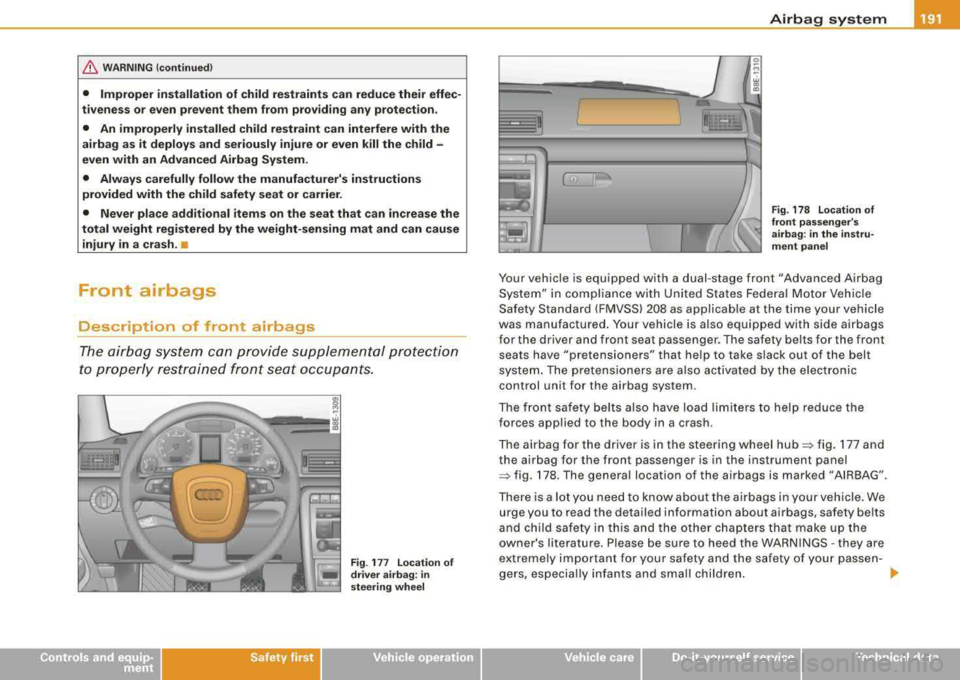
Fig . 177 Location of
driver airb ag : in
s teering wheel
( I p
Airbag system
Fig. 178 Location of
front pa ssen ger 's
airbag : in the instru
ment p anel
Your vehic le is equipped with a dual -stage front "Advanced Airbag
System" in compl ia nce wi th Uni ted Sta tes Federa l Motor Ve hic le
Safety Standard (FMVSSl 208 as applicable at the time your vehicle
w as manufactured . Your vehicle is a lso equipped with side airbags
fo r the driver and front seat passenger . The safety belts for the front
seats have "pretensioners" that he lp to take s lack out of the belt
syste m. The p re te nsioners a re a lso activated by t he elec tronic
control unit for the airbag system.
The front safety belts a ls o have loa d lim iters to help reduce the
forces app lied to the body in a crash .
The airbag fo r the driver is in the steering wheel
hub => fig. 177 and
the airbag for t he front passenger is in the instrument pane l
=> fig. 178. The genera l location of the airbags is marked "AIRBAG" .
Th ere is a l ot you nee d t o know abou t the airbags in y our ve hicle. We
urge you to read the detailed information about airbags, safety be lts
and c hild safe ty in this and the ot her c hapt ers that mak e up the
owner 's lit erature. P lease be sure to heed the WARN INGS -they are
extremely importa nt for you r safety a nd the safety of you r passe n-
g ers, especially infants and small children.
..,
irechnical data
Page 195 of 368
__________________________________________________ A_ i_ r _b _a-' g=- s_ y=-- s_t _e _m ______ lllll
a listing of the child restraints that were used to certify your
veh ic le 's compliance wi th the US Safety
Standa rd => page 212,
• weight less than a threshold leve l stored in the contro l unit is
de tected on the fro nt passenger sea t.
When a person is detected on the front passenger seat, weighing mo re t han the total weight of a c hild that is about 1 yea r old
restra ined in one of the rear -facing or forward -facing infant
restraints (listed in Federa l Motor Vehicle Safety Standard 208 with
wh ic h the Adva nced Airba g System in your ve hicle was certified),
the front airbag on the passenger side may or may not deploy.
The
PASSENGER AIR BAG OFF l ight c omes on whe n the e le ctr oni c
control unit detects a total weight on the front passenger seat that
r equi res t he front a irbag to be tu rned o ff . I f the
PASSENGER AIR BAG
OFF
light does not come on, the front airbag on the passenger s ide
has no t been tu rned off by t he con tro l uni t and can dep loy if the
co ntrol unit se nses an i mpact that meets t he conditio ns store d in its
memo ry .
I f t he total we ig ht on the front passe nge r seat is more than t hat of
a typical
1 year -old, but less than the we ight of a small adult, the
fr ont airbag on the passe nger s ide may dep loy (the
PASSENGER AIR
BAG OFF
l ight does not come on) .
For example, the airbag may deploy if:
• a small c hild t hat is heavier than a typ ical 1 yea r-old child is on
the front passenger seat (regard less of whether the child is in one
o f t he child sa fe ty sea ts
liste d=> page 212),
• a child who has outgrown chi ld restraints is on the front
passenge r seat .
I f the front passenger airbag is turned off, the
PASSENGER AIR BAG
OFF
light in the ce nter of the i nstrument pa nel wi ll come on and stay
on.
T he front airbag on the passenger side may
not deploy (the
PASSENGER AIR BAG OFF ligh t does not illum inate a nd stay lit) if:
• a small adult or teenager is on the front passenger seat
Controls and equip
ment Safety first
Vehicle operation
• a passenger who is not s itting upright with their back against a
no n-rec li n ed bac kres t wi th th eir fee t on th e ve hicle flo or in fro nt of
the seat is on the front passenger seat.
If the front passenger airbag deploys, the Federal Standard requi res
the airbag to meet t he "low r isk" deploy ment cr iteria to help reduce
the risk of injury th roug h interaction with the airbag. "Low risk"
dep loyment occu rs in those cras hes t hat take place a t lo wer decel
erations as defined in the electronic control
unit=> page 198.
Always remember: Even though yo ur vehicle is equ ipped w ith
Advanced Airbags, the safest p lace for children is properly
res tra ined on the back sea t. Please be s ure to rea d th e impo rtant
i nformat io n i n t he sections tha t follow a nd be sure to heed a ll of the
WA RNIN GS .
& WARNING
To reduce the risk of injury when an airbag inflates, always wear
safety belts properly .
• If you are unrestrained , leaning forward , sitting sideways or out
of position in any way , your risk of injury is mu ch higher .
• You will al so receive serious injuries and could even be killed if
you are up again st the airbag or too close to it when it inflates -
even with an Advanced
Airbag => page 187.
& WARNING
A child in a rearward-facing child safety seat installed on the front
passenger seat will be ser iously injured and can be killed if the
front airbag inflate s -even with an Advanced Airbag System.
• Although the Advan ced Airbag System in your vehicle is
designed to turn off the front airbag when a rearward -facing child
restraint has been installed on the front passenger seat , nobody
can ab solutely guarantee that deployment is impo ssible in all
c onceivable situat ions that may happen during the useful life of
your vehicle. _,,.
Vehicle care Do-it-yourself service Technical data
Page 196 of 368
___ A_ ir_b _ a_ g=- s--=- y_s _t _e _m _________________________________________________ _
&, WARNIN G (continu ed )
• The inflating airbag will hit the child s afety seat or infant
car rier with gre at for ce and will sma sh the child safe ty se at and
c hild agai nst the ba ckre st, center arm re st, door , or roof .
• Alwa ys in sta ll re arw ard -f aci ng child re str aint s in the b ack se at .
• If you mu st in stall a rearw ard facing child safety seat on the
front p assenger se at be cause of e xce pti ona l ci rc um stan ce s a nd
the PASSENGER AIR BAG OFF light doe s not come on and stay on ,
immedi atel y insta ll the re ar-f a cing child s afet y s ea t in a re ar
se ating position and h av e the airb ag sy stem inspe cted by your
Audi dealer .
& WARNING
If, in e xception al c ir cum sta nces, you mu st in sta ll a forward -f ac in g
c hild re straint on the front p assenger 's seat:
• Alway s mak e sure the forward-f acing seat ha s been designed
and certified by it s manufacturer for u se on a front seat with a
p asseng er front and side airb ag .
• Never put the forw ard -fa cing child re straint up again st or very
near the instrument panel.
• Alway s move the p assenger seat into it s re armost position in
the se at's fore and aft adju stment range , as far a way from the
a irbag a s pos sible , before installing the forward -f a cing child
rest raint . The ba ckrest must be ad justed to an upright po sitio n.
• Make sure that the PASSENGER AIR BAG OFF light come s on
a nd stay s on all th e time whenever the ignit ion i s swi tched on .
•
Advanced Airbag System components
The front passenger seat in your vehicle has a lot of very impo rtant
parts of the Advanced A irbag System in it . These parts include the
we ight -sensing mat , sensors, wiring, brackets , and more. The func -tion of the system in the front passenger seat is checked by the e
lec
tronic contro l unit w hen t he ignit ion is on . The co ntrol uni t monitors
the Advanced Airbag System and turns the airbag indicator light on
whe n a malfunction i n the system components is detected. T he
function of the airbag ind icator light is described in greater detai l
below. Because the front passenger seat contains important parts
o f the Advanced Airbag System, you must take care to prevent it
from being damaged . Damage to the seat may prevent the
Advanced Airbag for the front passenger seat from do ing its job in
a crash .
The front Adva nc ed Airbag S ystem consi sts of th e
following :
• Crash sensors in the front of the ve hicle that measure veh ic le
acce leration/deceleration to provide information to the Advanced
A irbag System about t he severity of t he crash .
• An electronic control unit, with integrated crash sensors for front
and side impacts. The control unit "dec ides" whethe r to fire the
front airbags based on the information received from the crash sensors . The control unit also "dec ides" whether the safety be lt
pretensioners should be activated.
• A dual -stage Advanced Airbag with gas generator for the driver
inside the steering wheel hub.
• A dual-stage Advanced A irbag and gas generator inside the
instrument pane l for the front passenger .
• A we ight -sensing mat under the upholstery padding of the front
passenger seat cushion that measures the tota l weight on the seat .
T he information registered is sent continuously to the electronic
control un it to regu late dep loyment of the front Advanced Airbag on
the passenger side .
• An airbag monitor ing system and indicator light in the instru
ment
cluster=> page 198 .
• The PASSENGER AIR BAG OFF light comes on and stays on in t he
center of the instrument panel
=> page 199, fig . 180 and te lls you
when the fron t Advanced Airbag on the passenger side has been
turned off.
~
Page 197 of 368

Airbag system 111111
-------------------------------------------- -=-:~--___.
• A sensor below the safety belt latch for the front seat passenger
t o m easure the tens io n on t he sa fety be lt. T he tension on the safe ty
belt and the weight registered by the weight -sensing mat help the
contr ol unit "decide" whe the r the front ai rbag for the fron t
passenger seat should be turned off or
not=> page 189, "Child
r est ra ints on the front seat - some important th ings to know".
• A sensor in the safety belt latch for the driver and for the front
seat passenge r that senses whether t hat safety bel t is la tched or no t
and transmits this information to the e lectronic control unit.
& WARNING
Damage to the front pas senger seat can pre vent the front airbag
from working properly.
• Improper repair or disassembly of the front passenger and
driver seat will prevent the Advanced Airbag System from func
tioning properly .
• Repairs to the front passenger seat must be performed by qual
ified and properly trained workshop personnel .
• Never remove the front pa ssenger or driver seat from the
vehi cle .
• Ne ver remo ve the upholstery from the front passenger seat .
• Never disassemble or remove parts from the seat or disconnect
wires from it .
• Never carry sharp objects in your pockets or place them on the
seat . If the weight -sen sing mat in the passenger seat i s pun ctured
it cannot work properly.
• Never carry things on your lap or carry objects on the
passenger seat . Such items can increase the weight registered by
the weight -sensing mat and send the wrong informat ion to the
airbag control unit .
• Never store items under the front passenger seat . Parts of the
Advanced Airbag System under the passenger seat could be
d amaged , preventing them and the airbag system from working
properly.
Controls and equip ment Safety first
Vehicle operation
& WARNING (continued )
• Never place seat covers or replacement upholstery that have
not been specifically appro ved by Audi on the front seat s.
• Seat covers can prevent the Advanced Airbag System from
recognizing child restraint s or occupants on the front passenger
seat and prevent the side airbag in the seat backrest from
deploying properly.
• Never use cushions, pillows , blankets or similar items on the
front passenger seat. The additional padd ing will prevent the
weight-sensing mat in the seat from accurately registering the
child restraint or person on the seat and prevent the Ad vanced
Airbag System from functioning properly .
• If you mu st use a child re straint on the front pas senger seat
and the child restraint manufacturer's instru ctions require the use
of a towel , foam cu shion or something el se to properly position
the child restraint , make certain that the PASSENGER AIR BAG OFF
light comes on and stays on whenever the child restraint i s
installed on the front passenger seat.
• If the PASSENG ER AIR BAG OFF light does not come on and stay
on , immed iately install child re straint in a re ar seat ing position
and have the airbag sy stem inspected by your Audi dealer . •
How the Advanced Airbag System
components work together
The front Advanced Airbag System and the side airbags supplement
the prote ction off ered by the fro nt three -p oi nt safe ty belts with
pretensioners and load limiters and the adjustable head restra ints
to help reduce the risk of injury in a wide range of accident and
crash situations. Be sure to read the important informat ion about
safety and heed the WARNI NGS in this chapter.
Dep loyment of the Adva nced Ai rbag Sys tem a nd th e activation of
the safety belt pretensioners depends on the dece leration
measu red by the crash senso rs and registered by the electro nic _.,
Vehicle care Do-it-yourself service Technical data
Page 198 of 368
___ A_ ir_b _ a_ g
=-- s
-=- y_s _t _e _m _________________________________________________ _
control unit . Crash severity depends on speed and deceleration as
well as the mass and stiffness of the vehicle or object involved in the crash .
When the electronic control unit registers a low severity crash and
the safety belt is being used, the airbag will not deploy. If the safety belt is not being used, the first stage deploys, followed by the
second stage after a much later time in the crash sequence .
If the electronic contro l unit registers a crash of medium severity,
t he fi rst stage of the airbag deploys followed by the second stage at
a much later time in the crash sequence -regardless of whether the
safety be lt is be ing used or not. In higher severity crashes as regis
tered by the e lectronic contro l unit , both the first and second stages
deploy almost at the same time .
On the passenger side, regardless of sa fety belt use, the airbag w ill
be turned off if the weight on the passenger seat is less than th e
amount programmed in the electronic contro l un it . The front airbag
on the passenger side wi ll also be turned off if one of the child
safety seats that has been certified under Federa l Motor Vehic le
Safety Standard 208 has been recognized on the seat. The
PASSENGER AIR BAG OFF ligh t comes on and stays on to tel l you
when the front Advanced Airbag on the passenger side has been
turned
of f=> page 189 , "Child restraints on the front seat -some
important things to know".
& WARNING
To reduce the ri sk of inju ry when an airbag infl ates , always wear
s afety belts properly .
• If you a re unrestr ained , leaning forward , sitting sideway s or out
of po sition in any way , your risk of injury i s much high er.
• You will al so rece ive se riou s injur ie s a nd could e ven be killed if
y ou are up again st the airbag or too close to it when it inflates -
e ven with an Advanced
A irbag => page 187. •
More important things to know about front
airbags
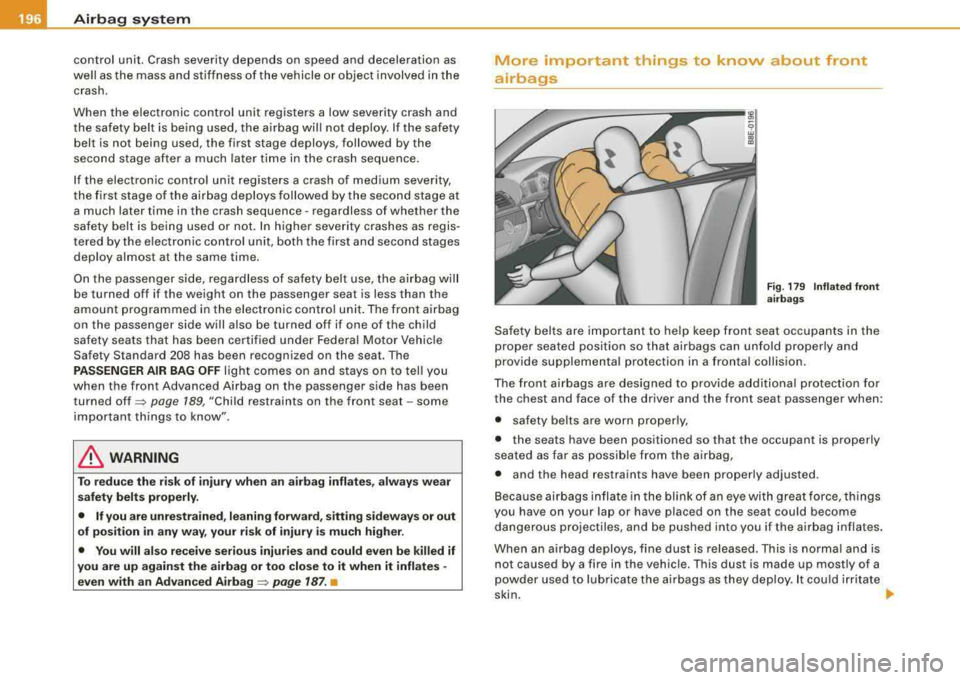
Fig . 179 Inflate d fr ont
airbag s
Safety belts are important to he lp keep front seat occupants in the
proper seated position so that airbags can unfold properly and
provide supplemental protection in a fronta l collision.
The front airbags are designed to provide additiona l protect ion for
the chest and face of the driver and the front seat passenger when:
• safety be lts are worn properly,
• the seats have been pos itioned so that the occupant is properly
seated as far as p ossi ble from the airbag,
• and the head restra ints have been properly adjusted.
Because airbags inflate in the blink of an eye with great force , thi ngs
you have on your lap or have placed on the seat cou ld become
dangerous projectiles, and be pushed into you if the airbag inf lates .
When an airbag deploys, fine dust is released. This is norma l and is
not caused by a fire in the vehic le. This dust is made up most ly of a
powder used to lubricate t he airbags as they deploy . It could irritate
skin.
~