child lock AUDI A4 AVANT 2008 Owner's Manual
[x] Cancel search | Manufacturer: AUDI, Model Year: 2008, Model line: A4 AVANT, Model: AUDI A4 AVANT 2008Pages: 368, PDF Size: 46.19 MB
Page 224 of 368
llfflJ_....:::C:.:.h :.:.i::.::
ld :...:: S::.::a :.:f .:::e ::.::t .!..y ____________________________________________ _
& WARNING
Rearward-facing child restraints:
• A child in a rearward-facing child safety seat installed on the
front passenger seat will be seriously injured and can be killed if
the front airbag inflates -even with an Advanced Airbag System.
• The inflating airbag will hit the child safety seat or infant
carrier with great force and will smash the child safety seat and
child against the backrest, center arm rest, door or roof.
• Always be especially careful if you must install a rearward
facing child safety seat on the front passenger seat in exceptional
circumstances.
• A tight tether strap on a rearward-facing child restraint
attached to the front passenger seat can put too much pressure
on the weight-mat in the seat and register a heavier weight in the
Advanced Airbag System. The heavier weight registered can make
the system work as though an adult were on the seat and deploy
the Advanced Airbag when it must be suppressed causing serious or even fatal injury to the child.
• Make sure that the PASSENGER AIR BAG OFF light comes on
and stays on all the time whenever the ignition is switched on.
• If the PASSENGER AIR BAG OFF light does not come on and stay
on, immediately install the rear-facing child safety seat in a rear
seating position and have the airbag system inspected by your
Audi dealer. •
Activating the convertible locking retractor
Use the convertible locking retractor to secure a child
restraint.
Always heed the child safety seat manufacturer's instruc
tions when installing a child restraint in your vehicle. To
activate the convertible locking retractor:
-Place the child restraint on a seat, preferably on the rear
seat.
-Slowly pull the belt all the way out.
-Route it around or through the child restraint belt path
=>& .
-Push the child safety seat down with your full weight to
get the safety belt really tight.
-Insert the belt tongue into the buckle for that seating
position.
-Guide the safety belt back into the retractor until the belt
lies flat and snug on the child safety seat.
-You should hear a "clicking" noise as the belt winds back
into the inertia reel. Test the convertible locking retractor
by pulling on the belt. You should no longer be able to
pull the belt out of the retractor. The convertible locking
retractor is now activated.
-Make sure that the red release button is facing away from
the child restraint so that it can be unbuckled quickly.
-Pull on the belt to make sure the safety belt is properly
tight and fastened so that the seat cannot move forward
or sideways more than one inch (2.5 cm).
& WARNING
Using the wrong child restraint or an improperly installed child
restraint can cause serious personal injury or death in a crash.
• Always make sure that the safety belt retractor is locked when
installing a child safety seat. An unlocked safety belt retractor
cannot hold the child safety seat in place during normal driving or
in a crash.
~
Page 225 of 368
____________________________________________ C_ h_ i_ ld _ S_a_ f_e _t .:..Y _ .... 911
& WARNING (continued)
• Always buckle the child safety seat firmly in place even if a
child is not sitting in it. A loose child safety seat can fly around
during a sudden stop or in a crash.
• Always make sure the seat backrest to which the child restraint
is installed is in an upright position and securely latched into place
and cannot fold forward. Otherwise, the seat back with the child
safety seat attached to it could fly forward in the event of an acci
dent or other emergency situation.
• Always read and heed all WARNINGS whenever using a child
restrained in a vehicle is being used
=> page 210. Special precau
tions apply when installing a child safety seat on the front
passenger
seat=> page 189, "Child restraints on the front seat -
some important things to know" .•
Deactivating the convertible locking retractor
The convertible locking retractor for child restraints will
be deactivated automatically when the belt is wound all
the way back into the retractor.
- Press the red button on the safety belt buckle. The belt
tongue will pop out of the buckle.
- Guide the belt all the way back into its stowed position.
Always let the safety belt retract completely into its stowed position.
The safety belt can now be used as an ordinary safety belt without
the convertible locking retractor for child restraints.
If the convertible locking retractor should be activated inadvert
ently, the safety belt must be unfastened and guided completely
back into its stowed position to deactivate this feature. If the
convertible locking retractor is not deactivated, the safety belt will
gradually become tighter and uncomfortable to wear.
Controls and equip ment Safety first Vehicle operation
LJ}. WARNING
Improperly installed
child safety seats increase the risk of serious
personal injury and death in a collision.
• Never unfasten the safety belt to deactivate the convertible
locking retractor for child restraints while the vehicle is moving.
You would not be restrained and could be seriously injured in an
accident.
• Always read and heed all WARNINGS whenever using a child
restrained in a vehicle is being used
=> page 210. Special precau
tions apply when installing a child safety seat on the front
passenger
seat => page 189, "Child restraints on the front seat -
some important things to know" .•
Additional Information
What types of child restraint anchors are
available and hovv are they related to child
safety?
For years, child restraints have been installed using the safety belts
already present in every vehicle.
Since September 1, 1999, child restraint manufacturers have been
providing tether straps that attach the top of the child restraint to
the vehicles structure, on most of their forward-facing systems in order to comply with U.S. Federal regulations for child restraint
performance in a crash. Vehicle manufacturers are required to
phase -in tether anchorages for attachment of the tether strap in
their U.S. vehicles beginning September 1, 1999.
The combination of the tether anchorages and the lower anchor ages is now generally called the LATCH system for "Lower Anchor
and Tether for Children".
.,._
Vehicle care Do-it-yourself service Technical data
Page 231 of 368
/b, WARNING (continued)
• Always read and heed the important information and WARN
INGS about child safety and the installation of child restraint
systems=> page 210, "Child Safety" .•
Mounting and releasing the anchorage hook
If you use a child restraint system with hooks or other
latches attached to adjustable straps.
Mounting
- Press the anchorage hook with the spring catch release
onto the lower anchorage so that the anchorage hook
locks into place.
- Pull on the anchorage hook to make sure that it has
securely engaged the lower anchorage.
- Tighten the strap following the child restraint manufac
turer 's instructions.
Releasing
- Loosen the tension on the strap following the child
restraint manufacture r's instructions .
- Depress the spring catch on the hook.
- Hold the spring catch in depressed position.
- Move the hook in the d irect ion of the vehicle floor so that
there is enough space to release the anchorage hook
from the lower anchorage.
Safety first
Child Safety
LJ}. WARNING
• Improper installation of child restraints will increase the risk of
injuries in a crash.
• Always refer to the child restraints manufacturer's instructions
for proper installation of the child restraint and proper use of the lower anchorages or safety belts in your vehicle.
•
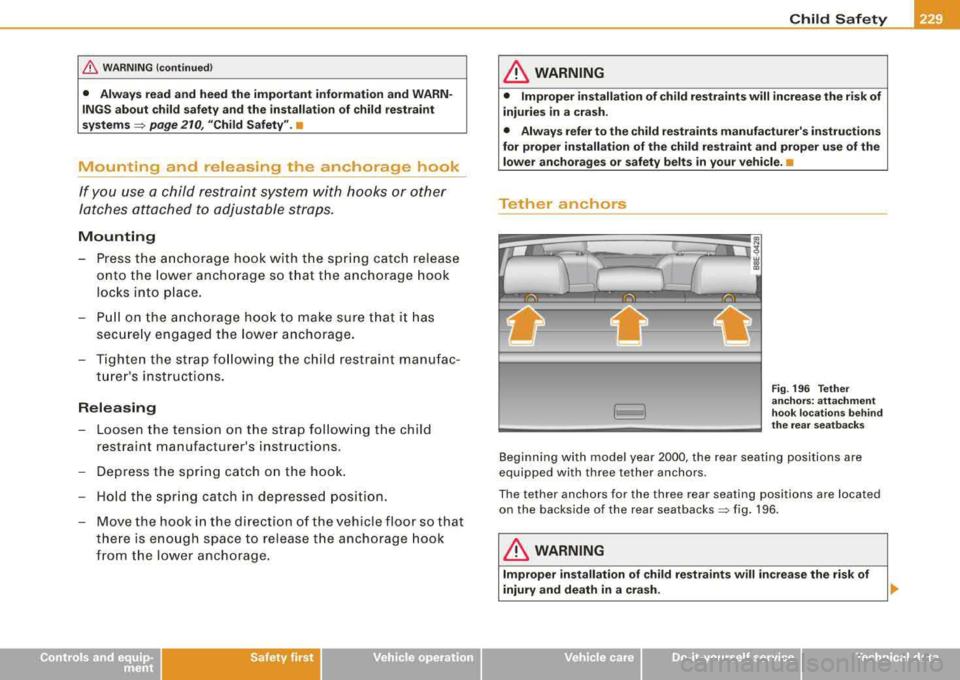
Tether anchors
Fig. 196 Tether
anchors: attachment
hook locations behind
the rear seatbacks
Beginning with model year 2000, the rear seating positions are
equipped with three tether anchors .
The tether anchors for the three rea r seating positions are located
on the backside of the rear seatbacks
=> fig. 196.
LJ}. WARNING
Improper installation of child restraints will increase the risk of
injury and death in a crash.
•
Technical data
Page 275 of 368

Checking and filling -
-----------------------------==--------=--
& WARNING (continued)
ment. Wait until no steam or coolant can be seen or heard before
carefully opening the hood.
•
Closing the engine hood
- Pull the hood down until the pressure from the strut is
reduced.
- Let the hood
drop down and latch in place. Do not try to
push
it shut; it may fail to engage =:>& .
& WARNING
A hood that is not completely latched could fly up and block your
view while driving.
• When you close the engine hood, check it to make sure the
safety catch has properly engaged. The hood should be flush with
the surrounding vehicle body parts.
• If you notice while driving that the hood is not secured prop
erly, stop at once and close it. •
Working in the engine compartment
Be especially careful whenever you work in the engine
compartment.
Whenever you must perform any work in the engine compartment,
for example checking and filling different fluids, there is a risk of
injury, burns and accidents. To prevent personal injury always
observe the following WARNINGS . The engine compartment of any
vehicle is a hazardous area
=> & .
• I I • • I
& WARNING
To help avoid injury, before you check anything under the hood:
• Turn off the engine.
• Remove the ignition key .
• Apply the parking brake.
• Move selector lever of automatic transmission to
"P" (Park);
put manual transmission in Neutral.
• Always let the engine cool down. Hot components will burn
skin on contact.
• To reduce the risk of being burned, never open the hood if you
see or hear steam or coolant escaping from the engine compart
ment. Wait until no steam or coolant can be seen or heard before
carefully opening the hood.
• Keep children away from the engine compartment.
• Never spill fluids on hot engine components. They can cause a
fire.
• Never touch the radiator fan. The auxiliary electric fan is
temperature controlled and can switch on suddenly.
• Never open the coolant reservoir cap when the engine is still
warm . The coolant system is pressurized and hot coolant could
spray out.
• Protect your face, hands and arm from steam or hot engine
coolant by placing a thick rag over the cap when you open the
coolant reservoir .
• If work on the fuel system or the electrical system is necessary: -Always disconnect the battery.
- Never smoke or work near heaters or open flames. Fluids in
the engine compartment could start a fire .
- Keep an approved fire extinguisher immediately available.
• To avoid electrical shock and personal injury while the engine
is running or being started, never touch:
- Ignition cables
.,_
Vehicle care
Page 285 of 368
___________________________________________ C_ h_e _c_ k_ i_n ~g _ a_n _d_ f_il _li _n ~g __ ffllll
not available, do not use a different additive. Use plain water
instead until you can get the correct additive and can restore the
correct ratio. This should be done as soon as possible.
If you have lost a considerable amount of coolant, then you should
add cold antifreeze and cold water only when the engine is cold .
Always use
new engine coolant when refilling.
Do not fill coolant above the "MAX" mark. Excess coolant will be
forced out through the pressure relief valve in the cap when the engine becomes hot.
& WARNING
• The cooling system is under pressure and can get very hot.
Reduce the risk of scalding from hot coolant by following these
steps.
-Turn off the engine and allow it to cool down.
-Protect your face, hands and arms from escaping fluid and
steam by covering the cap with a large, thick rag.
- Turn the cap slowly and very carefully in a counter-clockwise
direction while applying light, downward pressure on the top
of the cap.
- To avoid being burned, do not spill antifreeze or coolant on
the exhaust system or hot engine parts. Under certain condi
tions, the ethylene glycol in engine coolant can catch fire .
• Antifreeze is poisonous. Always store antifreeze in its original
container and well out of the reach of children.
• If you drain the coolant, it must be caught and safely stored in
a proper container clearly marked
"poison".
0 Note
• Coolant pollutes the environment and could cause an engine
fire. Excess coolant will be forced out through the pressure relief
valve in the cap when the engine becomes hot. •
If, in an emergency , only water can be added, the correct ratio
between water and antifreeze=>
page 280 must be restored as soon
as possible.
~ For the sake of the environment
Drained coolant should not be reused . Always dispose of used
coolant while observing all environmental regulations.•
Radiator fan
The radiator fan switches on automatically by itself.
The radiator fan is driven by the engine via the V -belt. The viscous
clutch regulates the speed of the fan according to the temperature
of the coolant.
An auxiliary electric radiator fan* switches on and off depending on
coolant temperature and other vehicle operating conditions .
After you switch the engine off, the auxiliary fan can continue
running for up to 10 minutes -even with the ignition off. It can even
switch on again later by
itself =>& , if
• the temperature of the engine coolant rises due to the heat
build-up from the engine in the engine compartment, or
• the engine compartment heats up because the vehicle is parked
in intense sunlight .
& WARNING
• To reduce the risk of personal injury never touch the radiator
fan.
• The auxiliary electric fan is temperature controlled and can
switch on suddenly even when the engine is not running .
• The auxiliary radiator fan switches on automatically when the
engine coolant reaches a certain temperature and will continue to
run until the coolant temperature drops. •
Vehicle care
Page 354 of 368
111'1_....::::A::.:l:.!: p :.:h..:.: a:::.:: b:.::e :.:t::i c::.::: a.:..l ..:.: in :..:.:: d:.:e :.:x::..... ___________________________________________ _
A
ABS (Anti- lock Brake System)
Warning/indicator lights ... .... .... 21
Accessories . .... .... .... .... .... ... 348
acoust ic park assist . . . . . . . . . . . . . . . . . 139
Adap tive light .. ... .... ... .. ...... ... 75
defective . . . . . . . . . . . . . . . . . . . . . . . . 35
Adding Engine coo lant
282
Engine oi l ... ... .. .... .... ... .... 278
Windshield washer fluid .... .... .. 291
Additiona l accessories .. ...... ...... . 348
Additives Eng ine oi l .. ....... ....... ....... 278
Adjustable steering whee l column .. ... 134
Adjusting Instrument cluster il lumina tion ... .. . 15
Steering wheel co lumn . ...... .... 134
Advanced A irbag System . .... ... .... 191
Ch ildren ... ........... .... ... ... 211
Components ...... .... ... .... ... 194
Fr ont airbags . . . . . . . . . . . . . . . . . . . . 192
How the c ompone nts wo rk togethe r 195
Monitoring . . . . . . . . . . . . . . . . . . . . . . 198
PASSE NGER AIR BAG O FF light ..... 199
Weight -sensing mat ....... ... .... 211
Air conditioner . . . . . . . . . . . . . . . . . . . . . 128
See also Climate controls . . . . . . . . . . 125
Air conditioning Switching on and off 128
A ir distribution
C limate controls . ...... ... .... ... 130 Air outlets
Adjusting the outlets for rapid defrosting/de fogging .. ...... .... 131
Cl imate con trols ...... .... .... ... 131
Air quality sensor . . . . . . . . . . . . . . . . . . . 129
Air recirculation .. ... .... .... .... ... 128
Clima te controls .. .... ..... .. .... 129
When should I use the air recircu lation?
129
Airbag Warning/indicator lights .... ... .... 20
Airbag system . . . . . . . . . . . . . . . . . . 187 , 205
Car e ...... .... .... .... .... .... .. 201
Child restraints .... .... .... .... .. 212
Componen ts (front airbags) .... ... . 194
Danger of fitting a chi ld safety seat on the
front passenger seat . . . . . . . . . . . . 189
Disposal .. ....... .... .... .... ... 201
Front airbags . .... ... .... .... .... 191
How do the front
ai rbags work? .... 196
How many airbags does my vehicle have? 194
I mportant things to know ....... .. 1 87
I ndicator light ... .. .... .... ... ... 198
Monitoring . . . . . . . . . . . . . . . . . . . . . . 198
Repairs ...... .... ... .... .... .... 201
Side airbags ... ...... .... ... .. ... 203
Side curtain airbags (SIDEGUARD) .. 207
When must the sys tem be inspec ted? ...
198
Alloy w heels . .... .... .... .... .... .. 260
All -wh ee l driv e 242
Winter tir es ..... .... .... ... .. ... 310 A
lternator
See Generator . . . . . . . . . . . . . . . . . . . . 22
Aluminum al loy wheels . ...... .... ... 260
Ambient light ing . ....... .... ... .. .... 82
Anti-free ze
See Engine coolant system ........ 280
Anti -glare inside day -ni ght mi rro r .. ... . 90
An ti- lock B rake System (ABS)
How the ABS system works . ....... 240
Warning/indicator l ights ........... . 21
Anti -Slip R egulation Syst em (ASR)
How the sys tem works .... .... .... 238
An ti- theft systems
Anti -theft ala rm system .. ...... .... 64
Electronic immobilizer .. ... .... ... . 5 4
Tilt sensors . .... .... ... .... .... ... 65
Armrest Adjusting ...... .... ... .... ..... . 102
Storage bi n
Ashtray 1
02
Front . .... .... .... .... ... .... ... 119
Rear ...... .... .... .... ... .... ... 119
ASR Anti- Slip Regulation System .... ... 238
Asterisk What does it mean when something is marked with an asterisk? .. ... .... .. 6
Attachment hooks ... .... .... .... ... 112
Aud i Service Repa ir Manuals and Lite rature
346
Page 356 of 368
111'1_....::::A::.:l:.!: p :.:h..:.: a:::.:: b:.::e :.:t::i c::.::: a.:..l ..:.: in :..:.:: d:.:e :.:x::..... ___________________________________________ _
Centigrade
Switching between Centigrade and Fahre nheit ...... .... .... ... ....
128
Changing a flat tire .. .... .... .... 50,318
Changing a wheel ................... 318
Changing engine oil ...... .... ...... . 279
Chassis
Undercoating .. .... .... .... .... ..
261
CHECK button . . . . . . . . . . . . . . . . . . . . . . . 16
Checking
Battery acid leve l . . . . . . . . . . . . . . . . .
288
Eng ine coo lant level . ... .. .... .... 281
Checking tire pressure ............... 299
Child restraint
Danger of using child restraints in the front seat . . . . . . . . . . . . . . . . . . . . . .
189
Child restraints
What types of chi ld restraint anchors are
ava ilable? . .... .... .... ........
223
Where can I get additional information
about child restraints? ... .... ....
224
Child safety .. .... .... ....... ... 210 ,215
Additional information .... .... .... 229
Booster seats . . . . . . . . . . . . . . . . . . . . 218
Convertible child safety seats . . . . . . 216
Convertible locking retractor . . . . . . . 220
Guidance fixtures for lower anchorages
226
Important safety instructions for using
ch ild safety seats .... .... ... ....
213
Important things to know when driving
with chi ldren ...................
210
Infant seats ..................... 215
Installing a child restraint using the
LATCH system ... ... .... .... ....
228
Lower anchorages .... ....... .... . 225
Mounting and re leasing the anchorage
hook .... .... ...... .... ... .. ...
229
Older children and safety belts 219
Safety belts and o ld er children .. ... 219
Tether anchors ...... .... .... .... 229
Tether strap .. ....... .... .... .... 230
Which rest raint system should my o lder
chi ld wear? .. ...... .... ... .. ...
219
Child safety lock ... .... ... .. ...... ... 63
child safety seat
LATCH system ....... .... .... ....
228
Child safety seats .............. .... . 215
Convertible locking retractor ....... 220
How do I properly insta ll a child safety
· h ' I 7 213 seat in my ve 1c e, .. .... .... ... .
Installing .... .... ... .. .... ......
220
Safety instructions .... .... .... ... 213
Cigarette lighter ........ .... ... .. ... 120
Cleaning
Alcantara (synthetic suede) ........
264
Engine compartment .. ... ... .. ... 265
Fabrics and fabric coverings ... .... 261
Instrument pane l .. ... .. ...... .... 262
Interior ...... .... ... .. .... .... .. 261
Leather . . . . . . . . . . . . . . . . . . . . . . . . . 263
P lastic and vinyl . .... .... ... .. ... 258
Plastic parts . .... .... .... ... .... . 262
Safety belts . . . . . . . . . . . . . . . . . . . . . 265
Trim strips . .... .... ... .... .... .. 257
trim strips . .... ...... .... ... .. ... 258
Cleaning and protection ........ .... . 254
Climate controls ...... .... .......... 125
Air distribution .... .... ..... .. ... 130
Air outlets . .... .... ... ........... 131
Air recirculation ... .... .... ..... .. 128
AUTO (standard setting) .... .... ... 127
Automatic a ir recircu lation ... ..... 129
controls . . . . . . . . . . . . . . . . . . . . . . . . 126
Defrosting/defogging .... .... .... . 131
Description ... .... .... ........... 125
ECON .... ... .. .... ...... .... .... 128
Fan .. .... .... .... .... ... .... ... 129
Key -coded setting . .... .... .... ... 132
Recommended settings ........... 125
Setting the temperature .... .... ... 127
Switching between Fahrenheit and
Centigrade . .... .... .... .... ....
128
Switching the air conditioning on and off
128
Using the c limate control economically ..
132
Warm and cold ... .... .... .... ... 125
Clock ... .... .... .... ... .. ...... .... . 14
Closing
Power sunroof ....................
68
Coat hooks . . . . . . . . . . . . . . . . . . . . . . . . . 124
Co ld tire inflation pressure .... .... ... 297
Coming-home-function .... .... ...... . 77
Compartments in the door trims ..... . 124
Compass mirror .. .... .... ..... .. .... 93
Consumer Information .... ........... 345
Continuously Variable Transmission (CVT)
See multitronic™ .. .... ........... 149
Page 357 of 368
Alphabetical index -
-------------=----
Convertible child seats
How do I properly ins ta ll a conve rtible
child seat in my vehicle? ......... 216
Safety instructions . ...... ...... .. 216
Convertible locking retractor
Act ivating .. .. .... .... ........... 222
Deactivating ...... .... ........... 223
Using to secure a child safety seat 220,
222
Coolant system ... .. .... .... ........ 280
Coo ling System
Expansion tank .... ....... ... .... . 281
Cornering light .. .... .... ...... .... .. 75
Cruise control . ...... .... ........... 140
Changing a stored speed .... ... .. . 140
Setting and storing a vehic le speed . 140
Switching off . ........... .... .... 141
Switching off temporari ly .......... 141
Switching on .... .... .... .... .... 140
Warning/indicator lights .. ... .... ... 21
Cruising range .................. ..... 40
Cup holder ......................... 118
D
Data .............................. 343
Data recorder ... .... .... .... ..... .. . 236
Date display ......................... 14
D aytime running lights ................ 74
dEF indication .............. ......... 15
Defogging the windows .. .... .... .... 131
Defrosting the windows ...... .... .... 131
Defrosting /defogging windows .. .... .. 131
Controls and equip
ment Safety first
Determining
correct load limit ..... .. . 302 Dynamic shift program ... .... ...... .. 153
Digita l clock .. ...... ..... .. .... .... .. 14
Setting the time ..... ...... .... .... 14
E
Digita l compass ...................... 93
Dimensions . ....... ... .. .... .... ... 341
Dipstick Location .... .... ... .. .... .... ... 277
Doors, power locks .. ...... ....... .... 58
Drive Information System Help .. ...... .... ... .. .... .... .... 43
Driver
See Seating position ........... ... 168
Driver information display ....... .... .. 24
Mi les (ki lometers) to empty .... ... .. 26
Open door or rear lid warning .. .... . 26
Outside
temperatu ire disp lay ....... . 25 ECON
When should I use ECON? ...... ... . 128
EDL Electronic differential lock .... .... . 237
Ele ctrically heated front seats ..... ... . 132
Electronic differential lock
Warning/indicator lights ...... .... .. 21
Electronic differential lock (EDU
How the system works ............ 237
Elect ronic immobilizer . ... .... .... .... 16
Electronic power contro l
EPC warning/indicator light ....... .. 23
Parking brake warning .. .... ... .. .. 29 Electronic stabilization program
(ESP)
Sound system display
...... .... .... 25 How
the system works ............ 236
Text messages .. ....... ...... .... . 29 Warning/indicator
lights ...... ...... 22
Driver Informa tion System Emergency
closing
Menu display .. ... .... .... .... ... . 41 Power sunroof ...
.... ........... .. 69
Practical example .................. 44 Emergency
flasher .. ... .... .... ...... 79
Setting .. .... ....... ...... .... .... 43 Warning/indicator
lights ...... ...... 22
Types of disp lay ..... ...... ... .... . 42 Emergency
locking ................... 61
Driver's seat memory ................ 100 Emergency
starting ... .... ... .... .... 330
Assigning the keys ....... ... .. .... 102
Emergency towing .................. 332
Recalling a seat position .. .... .... . 101
Emergency un locking (on ly manually)
Storing a seat position ............ 101
Rear lid . ... .. .... .... ...... .... .. 62
Driver's seat cushion extension ...... .. 100
Engine
Driving messages .... .... .... .... .... 29
4-cylinder (200 hp) ...... .. .... .... 274
Driving safely ....... ... .. .... .... ... 166 6-cylinder (255
hp) ................ 275
Driving time ... .. ...... .... ... .. .... . 40 Coolant
......................... 280
Dup licate key .... .... .... ...... ... .. . 52 Hood ......
...... .... ...... ..... 272
Vehicle operation Vehicle care Do-it-yourself service Technical data
Page 359 of 368

Alph ab eti ca l ind ex -
-------------=-----
Front seats
Adjusting .... .... ....... .... .... 169
Adjusting the manual seats .... .... . 96
Child restraints in the front seat .... 189
Heated seats . . . . . . . . . . . . . . . . . . . . . 132
Front seats adjustment Importance for safe driving and riding 95
Frontal c ollisions and the laws of physics ..
177
Fuel Fuel gauge ...... .... .... ... .... .. 16
Fuel consumption Average ....... .. .... .... .... ..... 40
F uel filler flap
Un locking the fuel fi ller flap by hand 271
F uel gauge .... .... .... .... .... .... .. 16
Fuel supp ly
Addi tives ... .. .... .... ...... ... .. 267
Blended gasol ine ... .. .... ... .... . 267 Fuse arrangement
............. .... .. 327
G
Garage door opener ... .... .... .... .. 157
Gas discha rge lamps .. ...... .... ... . 328
Gauges Engine coolant temperature ......... 13
Fuel gauge .. ....... .... .... ...... 16
Speedometer ... .. .... .... .... ... . 15
Tachome te r .. ... .... .... .... .... . 13
Tr ip odometer .. ...... .... .... ... . 15
Gearsh ift lever .... .. ... .. .... .... ... 142
Genera l il lustration
Instruments and controls .. .... ..... 11
Generator Warning/ind ica tor lights ...... .... .. 22
G lossary of tire and loading term inology ...
29 4
Fuel fi ller neck ... .... .... ...... .. 268 G love compartment ... .. .... .... .... 122
Fuel gauge ...... .... .... ... .... .. 16 Light .... .... .... .... .... .... ... . 81
Fuel tank capacity ............. 16,268 Gross Veh ic le Weight Rating (GVWR) ... 341
Gaso line .. ....... .... .... ....... 267
Gaso line additives ................ 268
H
Instantaneous fuel consumption ..... 41
Octane rating .................... 267 Head restraints ..
.... .... .... ....... 171
Recommendation .... .... ..... .. . 267 Adjusting
....... ... .. .... .... ... 171
Re fuel ling ....................... 269 Rear seats
.......... ...... .... ... 106
Un locking the fuel fi ller flap by hand 271 Headl
ight
Fuel supp ly too low .. .... .... .... .... . 34 Defective .....
........ ............ 35
Fue l tank Headlight
range co ntr ol
Capacity ... .. .... .... ... .... .... 268 de
fective ..... ... .... .... .... .... . 34
Capacity (ga llons/l it res) .. ...... .... 1 6 Headlight washer reservoir ........... 291 Headlights
.. ... .... ... .. ...... .... .. 72
Adaptive light .. .... ............. .. 75
Front fog l ig hts .................... 76
Switching off ..................... 72
Switching on .......... ........ .... 72
Washer system . ....... ... .... .... . 87
Heated rear seats ...... .... .... .... ... .. 133
Heated outside mirrors ... .... .... ..... 91
Heated seats rear . ... .. .... .... ... .... ..... .. 1 33
Heated washer jets Wiper and washer system ........... 85
Heavy cl othing and safety belts .. ...... 1 80
High beam ....... ........ ....... . 72, 80
Warning/ind icator lights ........ .... 23
High vo ltage warning label ........... 340
Ho melink® U niversal Rad io- Frequency Re-
mote Contro l .. .. .... ...... .... . 157
Hood Opening ...... .... ... .... .... ... 272
Release lever ....... ... .... .... ... 272
Hor n ... .... .... .... .... ... .... .... . 1 1
How many airbags does my vehicle have? ..
19 4
How often shou ld I check my tire pressures?
300
How safety be lt tensioners work ....... 185
How to increase the loading surface .. . 104
Hydroplaning ..... ... .... .... ...... . 30 4
Controls and equip
ment Safety first Vehicle operation
Vehicle care Do-it-yourself service Technical data
Page 360 of 368
-Alphabetical index
---=------------------------------------------------
I
Ignition key 135
Ignition lock ... ... .. .... .... ...... . 135
Electronic immobiliz er ..... ........ 54
Ignition lock posit ions .... .... ...... . 135
167
185
Impor
tant things to do before driving ..
Improperly worn safety belts
Ind icator light
Airbag system . . . . . . . . . . . . . . . 198 , 199
PASSENGER AIR BAG OFF ......... 199
Indica tor lights . . . . . . . . . . . . . . . . . . . 12, 19
Infant seats . . . . . . . . . . . . . . . . . . . . . . . . 215
How do I properly install an infa nt seat in
my vehicle? .............. ...... 215
Safety instructions . . . . . . . . . . . . . . . 215
Ins ide rear view mirror .... ....... .... . 90
Installing child safety seats
Safety belts . . . . . . . . . . . . . . . . . . . . . 220
Inst rument cluster il lum ination ........ 15
In strument panel
Illum ination ...... ........ ... .... . 78
Inst rument panel and controls .. ....... 12
Ins truments and controls
Genera l ill ustration .... ....... .... . 11
In terior lights ....................... 81
Ambient lighting .................. 82
Luggage compartment ............. 83
Rear ............................ 82
J
Jack and tools . . . . . . . . . . . . . . . . . . . . . . 316 Jumper cables
.......... .... .... .... 331
Jump -starting 330
K
Key ...... ..... .. ...... .... ... .. .... 52
Battery replacement . . . . . . . . . . . . . . . 54
Coded settings .. .... ....... ..... 132
Convenience opening and closing of windows ... .... ... .. .... .... ... 59
Emergency key . . . . . . . . . . . . . . . . . . . 52
Key replacement . . . . . . . . . . . . . . . . . . 52
Master key .......... ...... .... ... 52
Valet key . . . . . . . . . . . . . . . . . . . . . . . . . 52
Key-coded settings Climate controls .. ........ ....... 132
Keyl ess entry remote control
Keys 53, 56
Electronic immobilizer ...... .... ... 16
Kick-down ...... ....... ...... .. 146, 153
L
LATCH ............................ 225
Description ...................... 225
Guidance fixtures for lower anchorages .
226
Ins talling a child restraint .. .. .. ... 228
Location ......... .... .... .... ... 225
Mounting and re leasing the anchorage
hook .. ...... ...... .... ... .. ... 229
Leather ..... .. ...... ... .. .... .... .. 262
Cleaning ........................ 263
Le aving -home-function ............... 77 Lifting jack
......... .... .... .... .... 321
Lifting points ...... ...... ... .. .... .. 336
Lifting/raising the vehic le ............ 335
Light sensor defective ................ 34
Light sensor package
Automatic headlight contro l .. .. ... . 73
Lights Coming-home/leaving-home-function 77
Emergency flasher ................ 79
Front fog lights ............... .... 76
Headlights ....................... 72
High beam ..... .. .... .... .... . 72, 80
High beam warning/indicator light .. . 23
Instrument pane l il lumination . ...... 78
Rear fog lights ..... ............... 76
Side marker lights ................. 72
Turn signals ...................... 80
Xenon headlights ...... ..... .. .... 79
Loading the luggage compartment ... . 173
Loading the roof rack .. ....... .... ... 117
Locking Power locking switch .............. 59
Rear lid .......................... 61
Remote control . . . . . . . . . . . . . . . . . . . 56
Using the key .. .... .... ..... .. .... 58
Lower anchorage locator button ...... 225
Luggage Stowing ........................ 173
Luggage compartment Attachment hooks . ........ .... ... 112
Cargo net .... .... .... ........... 108
Fastening eyes ................... 108
Light ............................ 83