roof AUDI A4 AVANT 2008 Owner's Manual
[x] Cancel search | Manufacturer: AUDI, Model Year: 2008, Model line: A4 AVANT, Model: AUDI A4 AVANT 2008Pages: 368, PDF Size: 46.19 MB
Page 263 of 368
_____________________________________________ C_ l_ e _a_ n_ in~ g_a
_ n_d_ p_ r_ o_ t
_ e_ c_t _io _ n __ ffllll
Chassis
Have the undercoating checke d for dam age from time to
ti m e.
The lower body shell of your Audi is a lso thoroughly protected
against corros ion.
Any damage to the undercoating caused by road hazards shou ld be
repa ired promptly.
& WARNING
Too mu ch undercoating in the wrong place s can cause a fire.
• Do not apply additional undercoating or ru stproofing on or
near the e xhau st manifold , ex haust pipe s, cata lyti c con verter or
heat sh ields . While driving , the sub stance used for underco ating
could overheat and cau se a fire.
• Alw ays read and heed all WARNINGS and other informat ion
=> pa ge 254 . •
Care of interior
Aluminum trim
Use on ly neutral-pH products to remove spots and depos its from
a lum inum surfaces. Chrome care products and alka line cleaners
wi ll attack aluminum s urfaces and ca n damage them over t ime.
& WARNING
Alway s re ad and heed all WARNING S and the inform ation
=> pag e 254. •
Ap plies to veh ic les: with Fab rics an d fabric cove rings
Fabrics and fabric coverings
Fabrics a nd fabr ic coverings (e .g. seats, doo r tr im panels, etc .)
shou ld be c leaned at regular intervals with a vacuum cleaner. This
re moves surface d irt part ic les which could become embedded in
the fabric through use . Steam cleaners shou ld not be used, because
the steam tends to push the dirt deeper into the fab ric a nd lock it
there .
Norm al cleaning
Genera lly, we recommend using a soft sponge or a lint -free
m icrof iber c lo th to the clean fabric . Brushes should on ly be used for
carpets and floor mats, since other fabric surfaces could be harmed
by brushes.
Norma l sur face stains ca n be cleaned us ing a commercially ava il
able foam cleaner. Spread the foam on the surface of the fabric with
a soft sponge and work it in ge ntly . Do not saturate t he fabr ic. Then
pat the foam dry us ing absorbent, dry cloths (e .g . microfiber cloth)
a n d vacuum i t after it has dr ied comple tely.
Cleaning stains
Stains caused by beverages (e .g. coffee, fru it ju ice, etc.l can be
treated with a mild detergent solution. Apply the detergent so lution
with a sponge . In the case of stubborn stains, a de tergen t paste can
be applied direct ly to the stain and worked into the fabric . After
wards, use c opious a mounts of c lean water to rem ove the
remaining detergent . Apply the water with a damp cloth or sponge
a n d pat the fabric dry with an absorbe nt, dry c loth .
Stains from choco late or makeup should have detergent paste (e .g.
ox -ga ll soap) rubbed into them. Afterwards, remove the soap with
water (damp sponge).
A lcoho l can be used to treat stains from grease, oi l, lipstick or a ba ll
point pen . Melted grease or dye must be patted off us ing abs orbent
material. It may be necessary to retreat the areas with detergent
paste and water . .,,,
Vehicle care
Page 278 of 368
___ C_ h_ e_c _k _ i_n ~g _ a_n_ d_ f_il _li _n_ g~--------------------------------------------
prevent the formation of harmful deposits, sometimes called
"sludge", that over time can lead to expensive repairs.
At the time of printing, engine oils available in the U .S . and Canada
that meet the exacting specifications of Audi oil standard VW 502 00
are synthetic engine oils. This does not mean, however, that every
synthetic engine oil will meet Audi oil standard VW 502 00. So
always be sure that you use an approved oil.
To help prevent the formation of harmful deposits use only oil with
the following specifications printed on the oil container:
Audi oil standard VW 502 00
Oil container labels may carry the specification singly or in combi
nation with other designations and oil quality standards.
Viscosity
Engine oils are graded according to their viscosity. The proper
viscosity grade oil for your engine depends on climactic or seasonal
condi tions where you drive. You can use oil wi th a viscosity grade of
SAE 5W40 across all temperature ranges for normal driving condi
tions .
However, if engine oil viscosity grade SAE 5W40 is not available, you
can also use viscosity grade SAE 5W-30 or SAE 0W-40 as long as it
meets Audi oil quality standard VW 502 00 specifications.
Because engine oil that meets the Audi oil standard may not be
available everywhere when you need it, we strongly recommend
that you always carry with you an extra quart (liter) of oil that
expressly conforms to the VW 502 00 specification, in case you have
to top off the oil while on the road.
Only if the level of the oil is at or below the minimum mark on the
oil dipstick -and no oil that expressly conforms to Audi oil standard
VW 502 00 specifications is available - may you top off with a high
quality engine oil, preferably synthetic -based , that meets ACEA A3,
ACEA A5 or ACEA B5, API SL or ILSAC GF -3 specifications, but even
then, only in viscosity grades SAE 5W -40, SAE 5W -30, or SAE 0W -40 .
However, during the entire time between oil change intervals, never top off with more than a total of 0
.5 qt/liter engine oil that does not
conform to Audi oil specification VW 502 00.
For more information about engine oil that has been approved for
your vehicle, please contact either your authorized Audi dealer or
Audi Customer Relations at 1 (800) 822-2834 or visit our web site at
www.audiusa.com or www.audicanada.ca. Here you will also find a
current list of oils (manufacturers, brand names etc.) that conform
to Audi oil standard VW 502 00.
Changing the engine oil
The engine oil and oil filter must be changed according to the
mileage (kilometers) and time intervals specified in your vehicle's
Maintenance & Warranty booklet. Do not exceed these intervals -
harmful deposits from old engine oil can reduce engine perfor
mance and can lead to expensive engine repairs.
Changing the oil at the recommended intervals is so very important
because the lubricating properties of oil decrease gradually during
normal vehicle use. If you are not sure when you have your oil
changed, ask your authorized Audi Service Advisor.
Under some circumstances the engine oil should even be changed
more frequently . Change oil more often if you drive mostly short
distances, operate the vehicle in dusty areas or mostly under stop
and-go traffic conditions, or when you use your vehicle where
temperatures stay below freezing point for long periods.
Detergent additives in the oil will make fresh oil look dark after the
engine has been running for a short time. This is normal and is not
a reason to change the oil more often than recommended.
Damage or malfunctions due to lack of maintenance
It is essential that you change your oil at the recommended intervals
using only engine oil that complies with Audi oil standard
VW 502 00. Your Limited New Vehicle Warranty does not cover
damage or malfunctions due to failure to follow recommended
maintenance and use requirements as set forth in the Audi Owner's
Manual and Maintenance & Warranty booklet. Your dealer will have
to deny warranty coverage unless you present to the dealer proof in
.,_
Page 297 of 368
__________________________________________________ T_ ir_e_ s_ a_ n_d _ w_ h_ e_ e_l_s _____ llll
Groove
means the space between two adjacent tread ribs.
L oa d ratin g (code)
means the maximum load that a t ire is rated to carry for a given
inflation pressure. You may not find this information on all tires
because it is not required by law.
M ax imum l oad r atin g
means the load rat ing for a t ire at the maximum permiss ib le infla
tion pressure for that tire.
Ma ximum l oaded vehicle we ight
means the sum of :
(al Curb weight
(b) Accessory weight
(c) Vehicle capacity weight, and
(d) Production opt ions weight
M ax imum (permissibl e) infl ati on press ure
means the maximum cold inflatio n pressure to wh ich a t ire may be
inflated. Also ca lled "maximum inflation pressure ."
No rm al occ upant we ight
means 150 lbs. (68 ki lograms) times the number of occupants
seated in the vehicle up to the total seati ng capacity of your vehicle .
Occupant distributi on
means distribution of occupants in a vehicle .
Outer diameter
means the overal l diameter of an inflated new tire.
Ove rall width
means the linear distance between the exteriors of the sidewa lls of
an inf lated t ire, including elevations due to labe ling, decorat ions, or
protective bands or ribs .
Ply
means a layer of rubber -coated para lle l cords.
Pr odu ction opt io ns weig ht
means the comb ined weight of those installed regular product ion
options weighing over 5 lbs . (2.3 kg) in excess of those standard
items which they replace, not previously cons idered in curb weight
or accessory weight, inc luding heavy duty brakes, ride levelers, roof
rack, heavy duty ba ttery, and specia l trim .
Radi al pl y tir e
means a pneumat ic tire in which the ply cords that extend to the
beads are laid at substantially 90 degrees to the centerline of the
tread .
Recomm ended infl ati on p ress ure
see => page 294, "Cold tire inflat io n pressure".
Reinfor ced tir e
means a tire designed to operate at higher loads and at higher infla
tion pressures then the corresponding standard tire. Reinforced
t ires my be ide ntified as "XL", "xi", "EXTRA LOAD", or "RF" on the
sidewall.
Rim
means a metal support for a tire or a tire and tube assembly upon
wh ich the t ire beads are seated.
Rim di ameter
means nom inal d iameter o f the bead seat. I f you change your whee l
size, you wi ll have to purchase new tires to match the new rim diam
eter.
Rim siz e design ation
means rim diameter and width.
R im width
means nominal distance between rim flanges .
Vehicle care
Page 328 of 368

1119....__F_ u_ s_ e_s _ a_n _ d_ b_ u_lb _ s _______________________________________________ _
Fuses and bulbs
Fuses
Repl ac ing a fu se
A problem in the electrical system may be caused by a
blown fuse.
Fig . 232 End face of
instrument panel :
removing cover plate
to access fuses
Fig . 233 Fuse carrier
behind the instrument
panel end face, cover
removed
- Switch off the ignition and the electrical component
affected.
- Carefully pry the face cover off the instrument panel
using the ignition key or a
screwdriver ~ fig. 232.
- Check the fuse listing on the next pages to find out which
fuse belongs to the component which has failed
~ page 327, "Fuse list".
- Remove the blown fuse with the plastic clip provided.
The clip is located on the holder in the fuse box.
- Replace a blown fuse (recognizable by the melted metal
strip inside) with a fuse of the same amperage .
- Firmly snap the cover back onto the instrument panel
face.
The various electrical circuits are protected by fuses. The fuses are
clustered in a centralized unit. The unit is located behind the face
panel at the end of the instrument panel. The crank for operating
the sunroof in case of a power failure is also stored behind the face
panel ~ page 70.
Two spare fuses and a sticker identifying the fuses are located on
the inside of the fuse box cover.
You are well advised to keep a supply of spare fuses in your vehicle.
Fuses with the proper ampere ratings are available at your Audi
d ea le r.
& WARNING
Never replace a fuse with one that has a higher amperage rating.
• A fuse with a too high amperage could damage the electrical
part and cause a fire.
~
Page 329 of 368

Fuses and bulbs -
----------------
0 Note No. Equipment Amps
• On no account should fuses be repaired (e.g. patched up with tin 13 Steering column module 10
foil or wire) as this may cause serious damage elsewhere in the elec -14 Brake lights 10
trical circuit or cause fire.
15 Instrument cluster, Navigation system 10
• If a fuse blows repeatedly, do not keep replacing it. Instead, have
the cause for the repeated short circuit or overload tracked and Garage door opener
5
fixed.
•
Level, tire pressure control, park assist,
17 light/rain sensor 10
Fuse list Automatic headlight range control, left 5
Fuses which can be replaced. 19 Fog lights, rear fog light 15
20
Not used
No. Equipment Amps
21 Not used
1 Air conditioner 10 Front doors 15
2
Footwell illumination 5 23 Rear doors 15
3 Heated washer jets 5 Central convenience electrical system 20
4 Radiator fan 5 25 Heater blower 30
5
Telephone, oil level sensor, multifunction 10 26 Rear window defogger 30
switch, rear heated Seat, shift gate
27 Socket for trailer towing (controller) 30
6
Air conditioner (air quality sensor), air pressure 5 28 Fuel pump 20 sensor
Electronic Stabilization Program (ESP), brake
29 Not used
7 light switch, clutch pedal switch, steering angle 10 Power sunroof 20
sensor Automatic transmission, mirror dimming, diag-
31 15 8 Telephone 5 nosis socket
9 Brake booster (vacuum pump) 15 Towing assembly 15
10
Automatic headlight beam adjustment, auto -5 33 Cigarette
lighter 20
matic headlight range control, right
Electrical socket 20
11
Airbag 5 35 Luggage compartment socket 20
12
Diagnosis socket 10 Windshield wiper system 30
Do -it -yourself service
Page 343 of 368

_________________________________________________ G_ e_ n_ e_r _a _l_ i_n _f_o _ r_ m_ a_ t
_ i
_ o _ n
__ __
T he sa fe ty co mplia nce s ticke r
is your assurance t hat your new vehicle complies with a ll applicable
Federa l Motor Vehic le Safety Standards which were in effect at the
t ime the veh ic le was manufactured . You can find t his st icker on the
left door jamb. It shows the mon th and year of production and the
vehic le identification number of your vehic le (perforation) as well as
the Gross Veh icle Weight Rating (GVWR) and the Gross Axle Weight
Rating (GAWRl.
Th e high volt ag e wa rning la bel
is located on the lock carrier .
The spark ignition syste m mee ts all requirement s of the Canadi an
Interf ere nc e-C au si ng Equipm ent Regulati ons. •
Weights
Gross Veh icle Weight R ating
The G ross Veh ic le Weight Rat ing (GVWR), and the Gross Ax le Weight
Rating (GAWR) for front and rear are listed on a sticker on the left
door jamb .
The Gross Vehicle Weight Rating includes the we ight of the basic
vehic le plus fu ll fuel tank, oil and coolant, plus maximum load,
whic h inc ludes passenger weight ( 150 lbs/68 kg per designated
seating position) and luggage weight.
Gr oss Axle Weight Ra ting
The Gross Ax le Weight Rating is the maximum load that can be
app lied at each axle of the
veh ic le =:> & .
Vehicl e cap acit y w eight
The vehicle capacity weight (max. load) is listed either on the
driver's side 8 -pillar or inside the fuel fi ller f lap .
Controls and equip
ment Safety first Vehicle operation
Roof
weight
The maximum permissible roof we ight is
165 lb (75 kg ). The roof
weight is made up of the weight of the roof rack system and the
weight of the object being
transported =:> page 117, "L oading the
roof rack".
LJ}. WARNING
• The actual Gr oss Axle Weight R atin g at the front and re ar ax les
s hould not ex ceed the permi ssible w eight s, and th eir combination
mu st not e xceed the Gr oss Vehicle Weight R atin g.
• Exceeding pe rmi ssible weight ratin gs can re sult in vehicle
d am age , acc ident s and per son al inju ry.
0 Note
• The vehicle capacity weight figures apply when the load is
distr ibuted even ly in t he ve hicle (passengers and l uggage). When
transporting a heavy load in the luggage compartment, carry the
load as near to the rear axle as possib le so that the vehic le's
handling is not impaired .
• Do not exceed the maxim um permissib le axle loads or the
maximum gross vehic le weight. Always remember that the vehic le's
handling wi ll be affected by the extra load . Therefore, adjust your
speed according ly.
• Always observe local reg ulations. •
Dimensions
The specifications refer to the basic mode l. Differences may occur
depending on the mode l type and options ordered, for example, tire
sizes.
..,
Vehicle care Do-it-yourself service Technical data
Page 345 of 368
_____________________________________________________ D_a_ t_ a _ ___.11111
Data
Ap plies to vehicles : w ith 2 .0 lite r 4-cyl. engine
200 hp, 2.0 liter 4-cyl. turbo engine
En gin e da ta
Maximum output SAE net
Maximum torque SAE net
No . of cy linders
Displacement
Stroke Bore
Compression rat io
Fuel
Dim ensio ns
Length (with licence plate bracket)
Width (across mirrors)
Height (unloaded, incl. roof rails)
T urning circle diameter (curb to curb,
approx.!
Ca pac itie s
F u el t ank
-Total capacity
- Reserve (of total capacity) approx.
Wind shield and headlight * w as her fluid contain er
Engine oil
approx. fi lter change
Controls and equip
ment Safety first
hp@ rpm
lb-ft@ rpm
C ID (cm
3l
in (mm)
in (mm)
200 @ 51 00 -6000
207
@ 1950 -5000
4
121 (1984)
3.65 (92.8) 3.25 (82.5) 10.5: 1
Pr emium unle aded (91 AKI) Recommended for maximum engine performance. Fur
ther
details=> page 267, "Gasoline"
in (mm)
in (mm)
i n ( mm)
ft. (ml
gal/litres
ga l/litres
quarts/I it res
quarts/I it res
180 (4586)
76.3 (1937)
57 .2 (1453)
36.4 (11.1
l
front-wheel drive
18.5 / 70.0
2.1 / 8.0
5.1 / 4.8
4.5 / 4.5
quattro
16.6 / 63.0
•
Vehicle operation Vehicle care Do-it-yourself service Technical data
Page 346 of 368
llffl __ D_ a_ ta ______________________________________________________ _
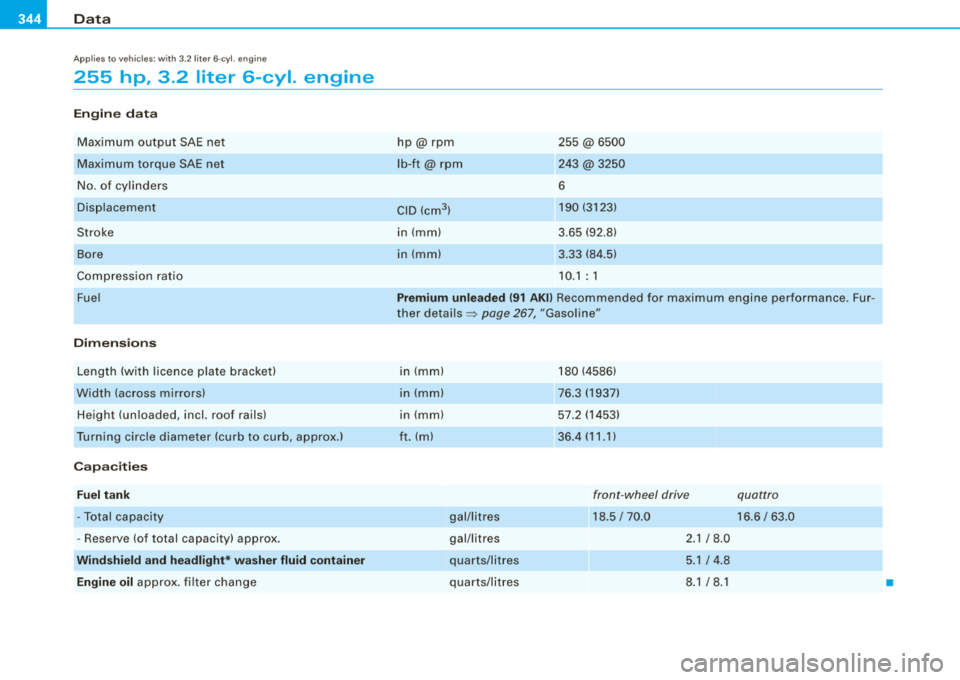
Applies to vehi cles: with 3 .2 liter 6-c yl. engine
255 hp, 3.2 liter 6-cyl. engine
En gin e data
Maximum output SAE net
Maximum torque SAE net
No. of cylinders
Disp lacement
Stroke
Bore
Compress ion ratio
Fuel
Dim ension s
Length (with licence plate bracket)
Width (across mirrors) Height (un loaded, incl. roof rails)
Turning circle diameter (curb to curb, approx .)
Ca pac ities
Fuel tan k
-Total capacity
-Reserve (of total capacity) approx.
Windshield and headlight* wa sher fluid container
Engine oil
approx. fi lter change hp@rpm
lb-ft@ rpm
CID (cm
3l
in (mm)
in (mm) 255@ 6500
243 @3250
6
190 (3123)
3 .65 (92 .8)
3 .33 (84 .5)
10.1 : 1
P remium unle aded (91 AKI) Recommended for maximum engine performance . Fur
t her
details~ page 267, "Gasoline"
in (mm)
in (mm)
in (mm)
ft . (ml
gal/litres
gal/litres
quarts/litres
quarts/litres 1
80 (4586)
76.3 (1937)
57.2 ( 1453)
36 .4 ( 11 .1 l
front -wheel drive
18.5 / 70 .0
2.1 / 8 .0
5 .1 / 4.8
8 .1 / 8 .1 quattro
16.6 / 63 .0
•
Page 349 of 368

_______________________________________________ C
_ o_ n
_ s_u _ m_ e_ r_l_ n _f_o _ r_ m_ a_ t
_ i
_ o _ n
__ lllll
W For the sake of the environm ent
By regularly ma intain ing your vehicle, you help make sure that emis
sion standards are maintained, thus minimizing adve rse effects on
the e nv ironment. •
Important considerations for you and your
vehicle
T he increasing use of elec tronics, sophisticated fue l injection and
emission con trol systems, and t he gene rally increasing tec hn ical
complexity of today's automobiles, have steadily reduced the scope
of maintenance and repai rs which can be carried ou t by vehic le
owners.
Also , safety and environmental concerns p lace very strict
limits on the nature of repairs and adjustments to engine and trans
m iss ion parts whic h an owne r can perform.
Maintenance , adjustments and repairs usua lly require special tools ,
t es ting dev ices a nd othe r eq uipment availab le to s pec ial ly t rai ned
workshop personne l in order to assure proper performance , reli
abil ity and safe ty of the vehicle and its many sy stems .
Im proper maintena nce, adjustments and repairs can impa ir the
operation and reliability of your vehicle and even void your vehicle
wa rranty. T here fore, proof o f servic ing in acc orda nce with the main
tenance schedule may be a condition for upholding a possib le
warranty cla im made with in t he war ran ty per iod .
Above all, operationa l safety can be adversely affected, creating
unnecessary risks for you and your passengers.
I f in doubt about any servicing, have it do ne by your auth orized Audi
dea ler or any other properly equipped and qua lified workshop . We
str ongly u rge y ou to give yo ur auth orized Au di d ealer the oppo rtu
n ity to perform all scheduled maintenance and necessary repairs .
Yo ur dealer has the faci lit ies, origi nal par ts an d trained specia lis ts
to keep your vehic le running proper ly.
Controls and equip ment Safety first
Vehicle operation
Performing limited maintenan ce yourself
The following pages des cribe a li mi ted numbe r of proced ures wh ic h
can be performed on your vehicle with ordinary tools, should the
need a rise a nd trained pers onnel be unavaila ble. Before perfo rm ing
any of these procedures, a lways t horoughly read all o f the app li
cable text and carefu lly fo llow the instructions given. Always rigor
ously observe the
WARNINGS provided.
Before you check anything in the engine compartment , always read
and heed all
WARNINGS ~ & and~ & in "Wo rking i n th e engine
compartment" on
page 273.
& WARNING
• Serious personal injury may occur as a result of improperly
performed maintenance , adjustments or repairs .
• Always be e xtremely careful when working on the veh icle .
Always follow commonly accepted safety practice s and general
common sense . Never risk personal injury .
• Do not attempt any of the maintenance, checks or repairs
described on the following pages if you are not fully familiar with
the se or other procedures with respect to the vehicle , or are uncer
tain how to pro ceed .
• Do not do any work without the proper tools and equipment .
Have the necessary work done by your authorized Audi dealer or
another properly equipped and qualified work shop .
• The engine compartment of any motor vehicle is a potentially
hazardous area . Never reach into the area around or touch the
radiator fan . It is temperature controlled and can switch on
s uddenly -even when the engine is off and the ignition key has
been removed . The radiator fan swit ches on automat ically when
the coolant reaches a certain temperature and will continue to run
until the coolant temperature drops .
• Alway s remove the ignition key before anyone gets under the
vehi cle .
.,_
Vehicle care Do-it-yourself service Technical data
Page 356 of 368
111'1_....::::A::.:l:.!: p :.:h..:.: a:::.:: b:.::e :.:t::i c::.::: a.:..l ..:.: in :..:.:: d:.:e :.:x::..... ___________________________________________ _
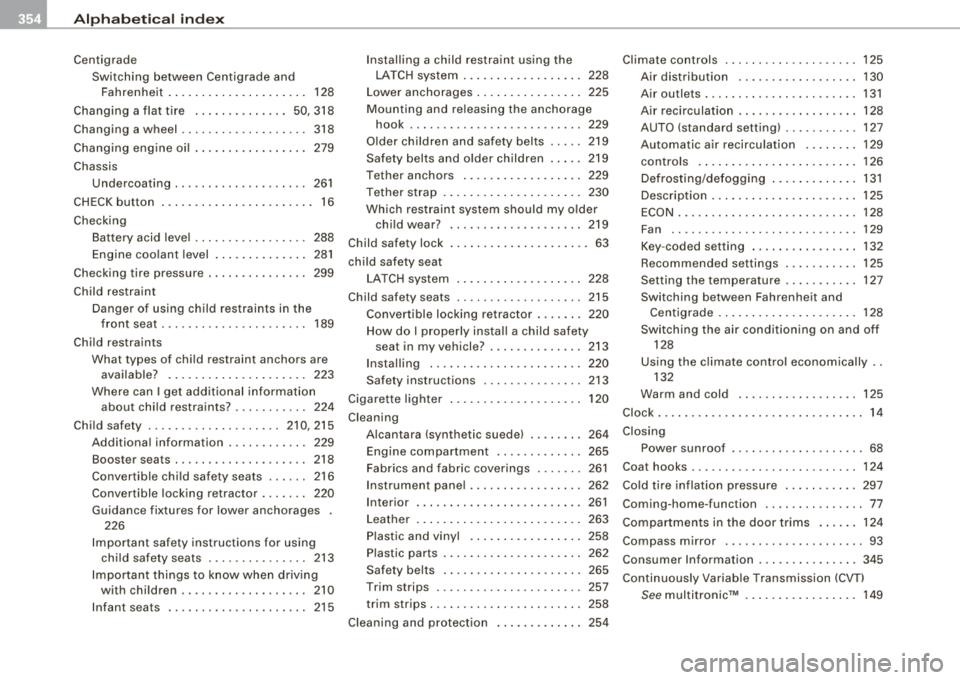
Centigrade
Switching between Centigrade and Fahre nheit ...... .... .... ... ....
128
Changing a flat tire .. .... .... .... 50,318
Changing a wheel ................... 318
Changing engine oil ...... .... ...... . 279
Chassis
Undercoating .. .... .... .... .... ..
261
CHECK button . . . . . . . . . . . . . . . . . . . . . . . 16
Checking
Battery acid leve l . . . . . . . . . . . . . . . . .
288
Eng ine coo lant level . ... .. .... .... 281
Checking tire pressure ............... 299
Child restraint
Danger of using child restraints in the front seat . . . . . . . . . . . . . . . . . . . . . .
189
Child restraints
What types of chi ld restraint anchors are
ava ilable? . .... .... .... ........
223
Where can I get additional information
about child restraints? ... .... ....
224
Child safety .. .... .... ....... ... 210 ,215
Additional information .... .... .... 229
Booster seats . . . . . . . . . . . . . . . . . . . . 218
Convertible child safety seats . . . . . . 216
Convertible locking retractor . . . . . . . 220
Guidance fixtures for lower anchorages
226
Important safety instructions for using
ch ild safety seats .... .... ... ....
213
Important things to know when driving
with chi ldren ...................
210
Infant seats ..................... 215
Installing a child restraint using the
LATCH system ... ... .... .... ....
228
Lower anchorages .... ....... .... . 225
Mounting and re leasing the anchorage
hook .... .... ...... .... ... .. ...
229
Older children and safety belts 219
Safety belts and o ld er children .. ... 219
Tether anchors ...... .... .... .... 229
Tether strap .. ....... .... .... .... 230
Which rest raint system should my o lder
chi ld wear? .. ...... .... ... .. ...
219
Child safety lock ... .... ... .. ...... ... 63
child safety seat
LATCH system ....... .... .... ....
228
Child safety seats .............. .... . 215
Convertible locking retractor ....... 220
How do I properly insta ll a child safety
· h ' I 7 213 seat in my ve 1c e, .. .... .... ... .
Installing .... .... ... .. .... ......
220
Safety instructions .... .... .... ... 213
Cigarette lighter ........ .... ... .. ... 120
Cleaning
Alcantara (synthetic suede) ........
264
Engine compartment .. ... ... .. ... 265
Fabrics and fabric coverings ... .... 261
Instrument pane l .. ... .. ...... .... 262
Interior ...... .... ... .. .... .... .. 261
Leather . . . . . . . . . . . . . . . . . . . . . . . . . 263
P lastic and vinyl . .... .... ... .. ... 258
Plastic parts . .... .... .... ... .... . 262
Safety belts . . . . . . . . . . . . . . . . . . . . . 265
Trim strips . .... .... ... .... .... .. 257
trim strips . .... ...... .... ... .. ... 258
Cleaning and protection ........ .... . 254
Climate controls ...... .... .......... 125
Air distribution .... .... ..... .. ... 130
Air outlets . .... .... ... ........... 131
Air recirculation ... .... .... ..... .. 128
AUTO (standard setting) .... .... ... 127
Automatic a ir recircu lation ... ..... 129
controls . . . . . . . . . . . . . . . . . . . . . . . . 126
Defrosting/defogging .... .... .... . 131
Description ... .... .... ........... 125
ECON .... ... .. .... ...... .... .... 128
Fan .. .... .... .... .... ... .... ... 129
Key -coded setting . .... .... .... ... 132
Recommended settings ........... 125
Setting the temperature .... .... ... 127
Switching between Fahrenheit and
Centigrade . .... .... .... .... ....
128
Switching the air conditioning on and off
128
Using the c limate control economically ..
132
Warm and cold ... .... .... .... ... 125
Clock ... .... .... .... ... .. ...... .... . 14
Closing
Power sunroof ....................
68
Coat hooks . . . . . . . . . . . . . . . . . . . . . . . . . 124
Co ld tire inflation pressure .... .... ... 297
Coming-home-function .... .... ...... . 77
Compartments in the door trims ..... . 124
Compass mirror .. .... .... ..... .. .... 93
Consumer Information .... ........... 345
Continuously Variable Transmission (CVT)
See multitronic™ .. .... ........... 149