warning lights AUDI A4 AVANT 2008 Owner's Manual
[x] Cancel search | Manufacturer: AUDI, Model Year: 2008, Model line: A4 AVANT, Model: AUDI A4 AVANT 2008Pages: 368, PDF Size: 46.19 MB
Page 77 of 368
& WARNING
Never use daytime running lights to see where you are going . They
are not bright enough and will not let you see far enough ahead for
safety , espe cially at dusk or when it is dark . Be aware of changes
in outside light conditions when you are driving and respond by
switching on your lo w beams
io.
0 Note
• With the light switch at the O or :oo, position , only your front fog
lights remain turned on when it turns dark outside . Even though
your instruments appear well lit, the road ahead of you is not. The light pattern provided by fog lights alone is not sufficient for safe
driving in poor light or darkness. Therefore:
• Always be aware of changes in outside light conditions while
you are driving. Respond in time to fading daylight by turning the
light switch to position
io (or "AUTO" if your car is equipped with
th is featu re)
to turn on your headlights .•
Controls and equip
ment
Clear vision
App lies to veh ic les: w ith adaptive ligh t
Adaptive light
W he n driv ing around bends , the relevan t area of t he road
is bett er illumi nated .
Fig. 72 Ad aptiv e light
when driving
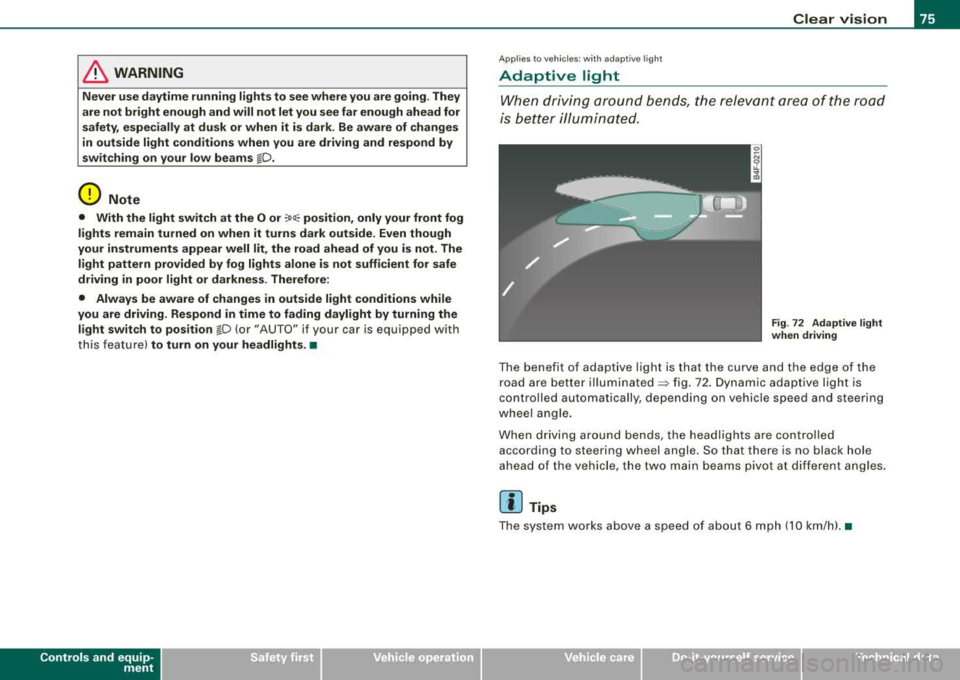
T he benefit of adapt ive light is that the curve and the edge of the
r oad a re be tter
il lu mina te d ~ fig. 72 . D yn ami c ada ptive ligh t is
controlled automatically, depending on vehicle speed and steering
whee l a ng le .
W hen driv ing arou nd bends, the headl ights a re co ntrolled
according to steering wheel angle. So that there is no black hole
a he ad of the vehi cle, the tw o main be ams pivot a t differ ent a ng le s.
[ i] Tips
Th e s ystem works abov e a sp eed o f about 6 mph (10 km /h ). •
Page 81 of 368

• USA models: illumin ation of the in strument clu ste r (gauge s and
needle s), dash and center con sole around the gear shift lever i s
c ontrolled by a light sen sor l oca ted in the in strument panel . The
instrument panel illum ination will automatic ally become dimmer
a s the d aylight f ade s aw ay a nd e ventuall y will go out completel y
wh en out side light is very low . Thi s is to remind you , the driver , to
s witch on the he adlight s before it get s too dark.
• Canada model s: instrument panel illum ination will sta y br ight
rega rdle ss of the inten sity of ambient light . Al ways be aw are of
changes in outside light conditions while you are driving . Respond
in time to fading daylight by tu rning the light switch to position
1[D
(or "AUTO" if your car is equipped with this feature) to turn on your
he adlight s.
•
App lies to veh icle s: w it h xe non head lig hts
Xenon headlights
After sta rting the engine, the xenon head lights are automatica lly
adjusted to the load and angle of the veh ic le ( for example, during
accel eration and braking) . This prevents oncoming traffic from
experienc ing unnecessary headlight glare from your xenon head
lights.
I f the system is not operating properly, a warning symbol in the
Auto-Check Control is
displayed=> page 34. •
Controls and equip
ment
Cl ea r vision
Emergency flasher ~
The emergency flasher ma kes other motorists aware that
you or your vehicle are in an emergency situation .
Fig. 77 Ce nter
co nso le: e merg en cy
fl as he r sw it ch
- Press the switch &1. ~ fig. 77, to switch t he eme rgency
flasher on or off.
When the emergency flasher is on, all four turn signal blink at the
same time. The turn signal indicator lights ¢
9 in the instrument
c luster, as we ll as the light in the emergency flasher
switch ~ blink
likewise.
The emergency flasher wi ll automatically switch on if you are in an
accident where the airbag has deployed .
[ i] Tip s
You shou ld switch on the emergency flasher when :
• you are the las t vehicle standing in a traffic jam so that any other
vehicles coming can see you, or when
• your vehicle has broken down or you are in an emergency situa -
tion, o r when _.,
Page 89 of 368
Intermittent wiping
- P ush the wiper lever forward towards the dashboard and
to the first posit ion
G) => page 86, fig. 87. The rear
wi ndow wiper will wipe t he wi ndow approx. every six
seco nds .
Automatic w iper /washer fun ction
- P ush the wiper lever forward to the second stop, position
@ , and hold it there for as long as you want t he rear
wiper/washer to operate.
- Release the lever again . th e wiper will keep run ning fo r
approx. four seconds.
Switching intermittent wiper a ction off
- Pull the lever all the way b ack to t he orig inal posit ion.
& WARNING
Wipe r blades are cruci al for safe dr iv ing! Only in good cond ition
a re the y able to clea r the windo ws properly to provide unre
s tricted vi sibility . Worn or frayed wiper blades a re a safety hazard!
~ page 88 , "In stalling new wiper bl ades "
0 Note
In freezing or near freezing conditions:
• Always check that the wiper blades are not frozen to the glass
before you turn the wiper on. Loosen a wiper blade which is frozen
in place before operating the wiper to prevent damage to the wiper
b lade or the wiper moto r.
• Do not use the wiper to clear a frosted window. Using the wipers
as a convenient ice scraper will destroy the wiper blades. •
Controls and equip
ment
Clear v ision
Ap plies to vehicles : wi th h eadl igh t w as her sy ste m
Headlight washer system
The headlight w asher system cleans the headligh ts .
Fig . 88 Headlight
wa sher jet fully
e xte nded .
-Operate the windshield wiper/washer system wi th the
head lights switched
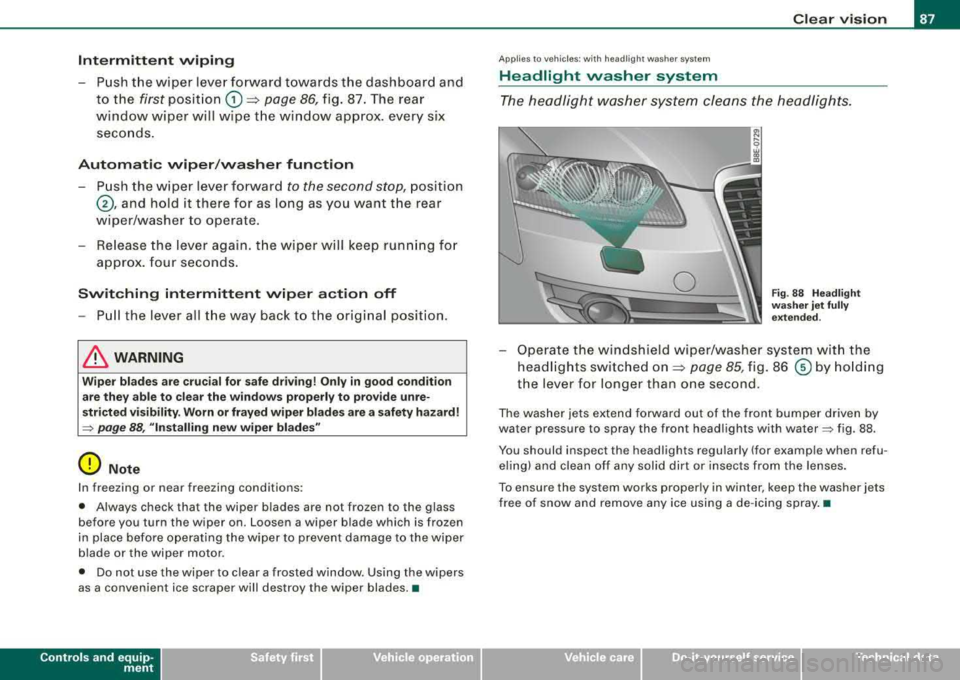
on=> page 85 , fig. 86 © b y hold ing
the lever for longer than one second .
The washer jets extend forward out of the fron t bumper driven by
water pressure to spray the front head lights with
water~ fig. 88 .
You should inspect the headlights regu lar ly (for example when refu
e ling) and c lean off any solid dirt or i nsects from the lenses .
To ensure the system works proper ly in winter , keep the washer jets
free of snow and remove any ice using a de -icing spray .•
irechnical data
Page 93 of 368

Disabling auto dimming
- Press button © =>page 90, fig. 92 briefly, -the green
indicator light ® goes out .
Activat ing /reactivating auto dimming
- Press button © briefly, -the green indicator light ®
goes on.
Au toma tic dimming func tion
The automatic dimming function is activated every t ime the ignition
is turned on . The green indicator light is lit to indicate auto dimming
is active.
When dimming is activated, the inside mirror will darken
automati
cally
in respo nse to the amount of light striking the mirror (such as
headlights from rearward approaching vehicles) . Even in dimming
mode, the mirror surface turns b right when:
• the interior light is sw itched on
• reverse gear is engaged.
& WARNING
The glass of the ins ide rearview mirror i s layered and contain s an
ele ctrolyte to achie ve it s properties . Be aware of liquid ele ctrolyte
le aking from a broken mirror gla ss. This liquid can cau se irritation
to skin , eye s, and re spir atory sy stem . If you get ele ctrolyte in your
e yes or on your skin , immed iately rinse with plenty of water . If irri
t a tion per sis ts, s eek medical attention .
0 Note
Liquid electrolyte leaked from a broken mirror glass wi ll damage any
p lastic surfaces it comes in contact with. Clean up spi lled electrolyte
immedia tely w ith c lear water and a sponge.
Controls and equip
ment
Clear v ision
[ i ] Tips
• If you switch off the automatic dimming function on the in side
mirror , automatic dim ming of the out side mirrors will l ikewise be
di sabled .
• Check to make sure there are no objects preventing light from
reaching the inside mirror.
• Do not attach any stickers to the windshield in front of the light
sensor, as this would interfere with both the automatic operation of
the headlights and the automatic dimming of the inside mirror.
• Be aware that au tomatic dimming of the inside mirror can on ly
operate properly if the rear window sun blind * is retracted .•
Outside mirrors
The outside mirrors are electrically adjusted (power
mirrors)
Fig . 93 Forwa rd
s ecti on of dri ver 's
ar mr est : pow er mirr or
co ntr ols
....
irechnical data
Page 125 of 368
Seats and storage -
-----------------=------'
To close glove compartment
-Push the glove compartment lid upward until the lock
engages.
The light will illuminate when the parking/headlights are turned on
and the glove compartment is open.
In the glove compartment lid, you will find a place to store a pen and
a pad of paper .
& WARNING
To reduce the risk of personal injury in an accident or sudden stop,
always keep the glove compartment closed while driving. •
Storage compartment for small objects Ca
Fig. 133 Center
console: storage
compartment
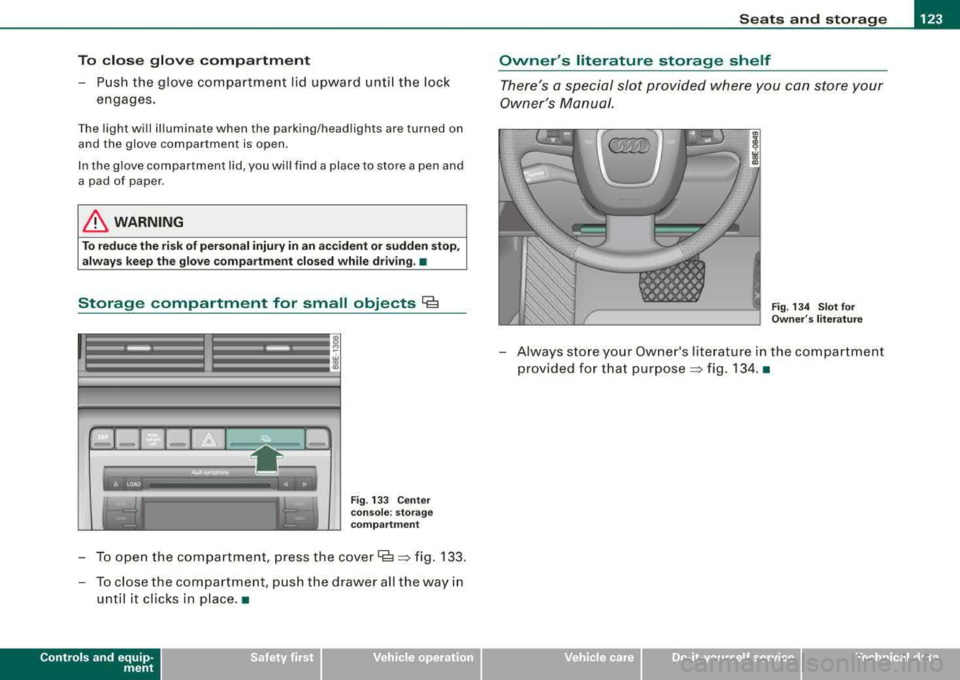
To open the compartment, press the cover Cs => fig . 133.
- To close the compartment, push the drawer all the way in
until it clicks in place .•
Controls and equip
ment
Owner 's literature storage shelf
There's a special slot provided where you can store your
Owner 's Manual.
Fig. 134 Slot for
Owner 's literature
- Always store your Owner's literature in the compartment
provided for that purpose
=> fig. 134. •
irechnical data
Page 147 of 368
_______________________________________________________ T:...:.; ra::.:.. n:.:s:.: m
:..:.:.:.: is::::s::.:.: io::.:.. n:__JIIII
Select R only when the vehicle is at a full stop and the engine is
running at idle
speed.~ & in "Driving the 6 -speed automatic trans
mission" on
page 143.
Before you move the selector lever to R, press both, the button in the
handle of the selector lever
and the brake peda l at the same time.
When the ignition is on, the backup lights i lluminate when the
selector lever is moved into R.
N -Neutral
Shift to this position for standing with brakes applied ~ page 145.
When the vehicle is stationary or at speeds below 3 mph (5 km/h),
you must always apply the footbrake before and while moving the
lever out of
N.
D -Normal driving position for forward
Position Dis for norma l city and highway driving. It ranges from zero
to top speed and all six gears automatically shift, depending on
engine load, driving speed and automatically selected shift
programs.
When the vehicle is stationary or at speeds below 3 mph (5 km/h),
you must always apply the foot brake before and whi le moving the
lever out of
N to D or S.
In certain circumstances it may be advantageous to temporarily
switch to the manual shift program to manually se lect gear ratios to
match specific driving
conditions~ page 147.
S -Sport position
Selec t this position for sportier performance. In this position, the
eng ine wi ll not upshift as soon, allowing the vehic le to use the
increased power avai lable at higher engine speeds to achieve live
lier acceleration.
Before you move the selector lever from
D to S, press the button in
the handle of the selector lever.
Controls and equip
ment
LJ}. WARNING
• Always read and heed WARNINGS ~ & in "D riving the 6-speed
automatic transmission" on
page 143.
0 Note
Coasting downhill with the transmission in N and the engine not
operating will result in damage to the automatic transmission and
possibly the catalytic converter. •
Applie s to vehicles: wi th G·sp eed automatic tra nsm iss ion
Automatic Shift Lock (ASL )
Automatic selector lever lock prevents you from acciden
tally shifting into a forward gear or into reverse , thus
causing the vehicle to move unintentionally.
Fig. 149 Shift gate:
selector lever lock
positions and interlock
button highlighted
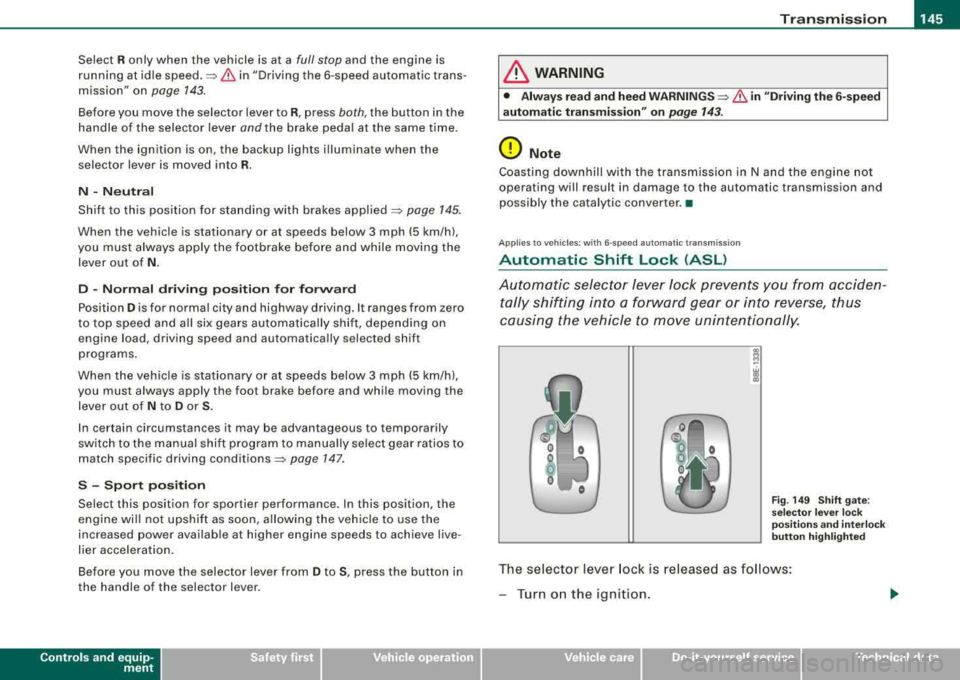
The selector lever lock is re lease d as follows:
-Turn on the ignition .
irechnical data
Page 154 of 368
-
Transmission
----------------
Select R only when the vehicle is at a full stop and the engine is
running at idle
speed~ & in "Driving the multitronic™" on
page 750.
Before you move the selector lever to R, press both, the button in the
handle of the selector lever
and the brake pedal at the same time.
When the ignition is on, the backup lights illuminate when the selector lever is moved into R.
N -Neutral
Shift to this position for standing with brakes applied ~ page 152.
When the vehicle is stationary or at speeds below 3 mph (5 km/h),
you must always apply the footbrake before and while moving the
lever out of
N .
Do not use N for coasting downhill.
D -Normal driving position for forward
Depending on the load on the engine, vehicle speed and the
dynamic control program, the transmission will select the
optimal
gear ratio.
In certain circumstances it may be advantageous to temporarily
switch to the manual shift program to manually select gear ratios to
match specific driving
conditions ~ page 154.
When the vehicle is stationary or at speeds below 3 mph (5 km/h),
you must always apply the footbrake before and while moving the
lever to
D out of N.
S -Sport position
Select this position for sportier performance. In this position, the
transmission will not upshift as soon, allowing the vehicle to use
the increased power available at higher engine speeds to achieve livelier acceleration.
Before you move the selector lever from
D to S, press the button in
the handle of the selector lever. When the vehicle is stationary or at speeds below 3 mph (5 km/h),
you must always apply the foot brake before and while moving the
lever to
S out of N.
& WARNING
Read and follow all WARNINGS ~ & in "Driving the multitronic™"
on
page 150.
0 Note
Coasting downhill with the transmission in N and the engine not
operating will result in damage to the automatic transmission and
possibly the catalytic converter. •
Applies to vehi cles : wi th mu ltitroni c'" Continuous ly Variable Transm ission (CVT )
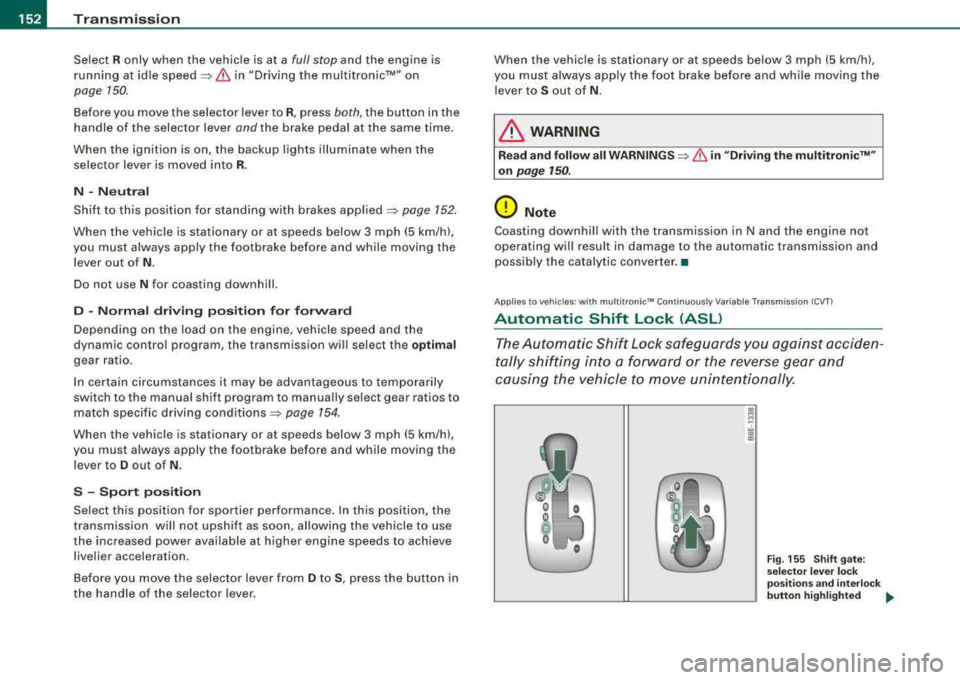
Automatic Shift Lock (ASL )
The Automatic Shift Lock safeguards you against acciden
tally shifting into a forward or the reverse gear and
causing the vehicle to move unintentionally.
~ M -w a, .,
Fig. 155 Shift gate:
selector lever lock
positions and interlock
button highlighted
..
Page 169 of 368
________________________________________________ D_r_iv _ i
_ n..; g::;_ S_ a_ fe---' ly'-----"'
Important things to do before driving
Safety is everybody's job! Vehicle and occupant safety
always depends on the informed and careful driver.
For your safety and the safety of your passengers, before
driving always:
- Make sure that all lights and signals are operat ing
correctly.
- Make sure that the tire pressure is correct.
- Make sure that all windows are clean and afford good
visibility to the outside.
- Secure all luggage and other items
carefully=> page 122.
-Make sure that nothing can interfere with the pedals.
- Adjust front seat, head restraint and mirrors correctly for your height .
- Instruct passengers to adjust the head restraints
according to their height.
- Make sure to use the right child restraint correctly to
protect
children => page 210, "Child Safety".
- Sit properly in your seat and make sure that your passen
gers do the
same => page 95, "General recommenda
tions".
- Fasten your safety belt and wear it properly. Also instruct
your passengers to fasten their safety belts properly
=> page 176. •
Controls and equip
ment Safety first
Vehicle operation
What impairs driving safety?
Safe driving is directly related to the condition of the
vehicle, the driver as well as the driver's ability to concen
trate on the road without being distracted.
The driver is responsible for the safety of the vehicle and all
of its occupants. If your ability to drive is impaired, safety
risks for everybody in the vehicle increase and you also
become a hazard to everyone else on the road
=>& .There
fore:
Do not let yourself be distracted by passengers or by
using a cellular telephone .
NEVER drive when your driving ability is impaired (by
medications, alcohol, drugs, etc.).
- Observe all traffic laws, rules of the road and speed limits
and plain common sense .
- ALWAYS adjust your speed to road, traffic and weather
conditions.
- Take frequent breaks on long trips. Do not drive for more
than two hours at a stretch.
- Do NOT drive when you are tired, under pressure or when
you are stressed .
& WARNING
Impaired driving safety increases the risk of serious personal
injury and death whenever a vehicle is being used. •
Vehicle care Do-it-yourself service Technical data
Page 179 of 368
Before driving off, always:
-Fasten your safety belt and make sure you are wearing it
properly.
- Make sure that your passengers also buckle up and prop erly wear their safety belts.
- Protect your children with a child restraint system appro-
priate for the size and age of the children.
The warning light {} in the instrument cluster lights up when the
ignition is switched on as a reminder to fasten the safety belts . In
addition, you will hear a warning sound.
After the ignition is switched on, the warning tone will come on for about 6 seconds a long with a{} warning light in the instrument
cluster if either the driver or (on USA models only) front seat
passenger has not fastened their safety belt. As soon as the driver
and front seat passenger have fastened the safety belt, the warning
tone will stop and the warning light will go out.
I f both the driver and front seat passenger have not buckled -up
within about 24 seconds after the warning tone has stopped, the
warning tone will sound again for about 6 seconds. The warning
tone will sound repeatedly for about 6 seconds at 24 second inter
vals until both the driver and front passenger have buckled-up. The
safety belt warning system is active for about 5 minutes and during
this time the warning light in the instrument cluster will stay on .
Fasten your safety belt now and make sure that your passengers
also properly put on their safety belts.
•
Safety first
Safety belts
Why safety belts?
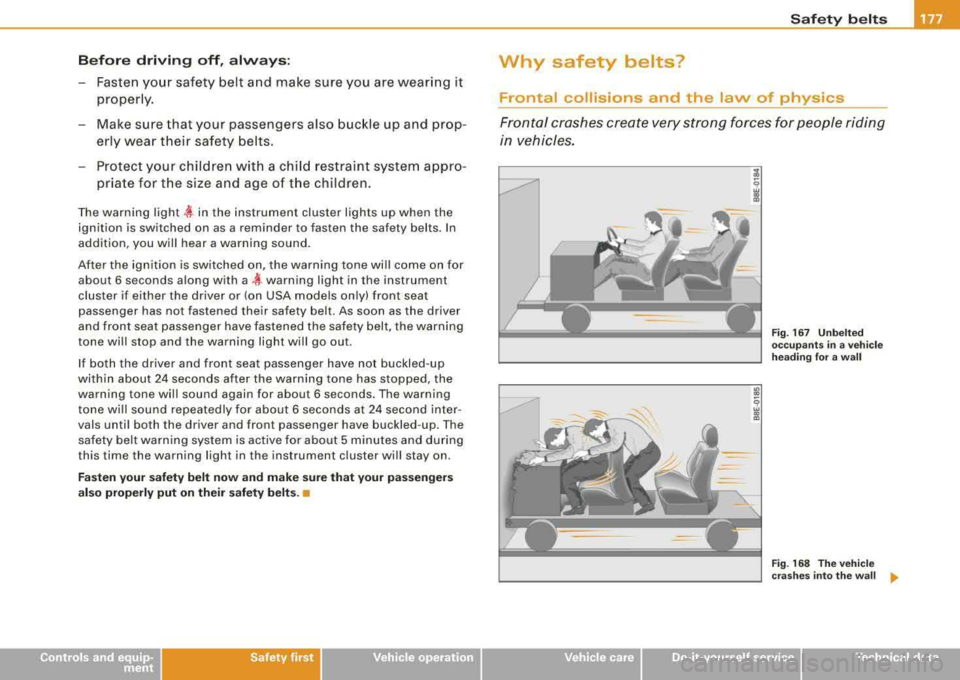
Frontal collisions and the law of physics
Frontal crashes create very strong forces for people riding
in vehicles.
"' "' 9 w
"' a,
Fig. 167 Unbelted
occupants in a vehicle
heading for a wall
Fig . 168 The vehicle
crashes into the wall
jlJ>
Technical data
Page 248 of 368

lffll.,__ __ D_r_ i_v _i_n _.g..,_ a_ n_d_ e_ n_v _ i
_ r_o _ n_ m_ e_ n_ t _______________________________________________ _
one half. Never drive faster than the posted speed limit and weather
conditions permit. •
Reducing unnecessary idling
Even when your car is just idling it burns up fuel.
- Shut the engine off when you are not driving the vehicle .
- Do not warm up the vehic le by letting the engine run at
id le .
It makes sense to shut off the engine in traff ic jams, when waiting
for tra ins to pass at rai lroad crossings , or at traffic lights that have
long waits on red. Turning the engine off for just 30 -40 seconds
saves more fue l than is burned starting the engine again .
It takes a long time for the engine to warm up fu lly when it is
running at idle. However, wear and noxious emiss ions are espec ially
high when the engine is warming up . So you should drive away as
soon as you sta rt the engine and avoid running at high rpms w hile
the engine is sti ll warming up.
0 Note
Do not leave engine idling unattended after starting . If warning
lights should come on to indicate improper operation, they would
go unheeded. Extended id ling also produces heat, which could
resu lt in overheating or other damage to the vehic le or other
property .•
Regular maintenance
A badly tuned engine unnecessarily wastes a lot of fuel.
- Have your ve hicle serviced at regular intervals .
By having your vehicle regularly serviced by an Audi dealer helps to
ensure that it runs properly and economical ly . The cond ition of your
vehic le not only affects its safety and abi lity to hold its value, it also
affects
fuel consumpt ion .
Check your oil ea ch time you fill your t ank .
The amount of oil used is related to engine load and speed.
I t is norma l for the oi l consumption of a new engine to reach its
lowest value after a certain mi leage has been driven.
You must drive your vehicle about 3,000 miles (5,000 kilometers) before you can properly assess oil consumption .
This also applies to fue l consump tion and engine output .
0 Note
• Have your vehicle maintained properly and in accordance with
t he service recom mendat io n s in your Maintenance
& Wa rranty
booklet. Lack of proper ma intenance as well as improper use of the
vehic le wi ll impai r the function of the emission cont rol system and
cou ld lead to damage.
• Do no t alte r or remove any component of the Emission Contro l
System unless approved by the manufacturer .
• Do not alte r or remove any dev ice, such as heat shields,
switches, ignition wires, valves, which are designed to protec t your
vehic le's Emission Control System and other important veh ic le
components .•
Fewer short trips
Fuel consumption will alw ays be rel atively high on short
t r ips.
- Try to avo id driving short dis ta n ces wi th a cold engine. ~