belt AUDI A4 AVANT 2008 Repair Manual
[x] Cancel search | Manufacturer: AUDI, Model Year: 2008, Model line: A4 AVANT, Model: AUDI A4 AVANT 2008Pages: 368, PDF Size: 46.19 MB
Page 222 of 368
__ ....,;;C;..;.h.;.; i.;.;ld ;;,;,__; S;;;.; a;;;;. f;;..; e;;;.; t~ y""------------------------------------------------
Children who weigh more than about 80 lbs (36 kg) and are at least
4 ft . 9 in. tal l can genera lly use the veh ic le's three po int lap a nd
shou lder belts . Chi ldren should use a lap belt only in very excep
tiona l situations and on ly if no child restraint system for the child's
size and weight or safer a lternative means of transportation of the
child is available. In these exceptiona l situations, the use of a lap
belt is better t han permitting t he ch ild to re main total ly unre
strained. But remember : a lap be lt cannot provide the same level of
protection as a proper c hild restraint or a t hree -poi nt lap and
shou lder be lt if the child is big enough . A lso, using a lap belt for
younger chi ldre n, who s hould be us ing a chi ld restrai nt, may v iola te
l aws in your state or Province .
N ever use a lap belt alone to rest ra in a chi ld that we ig hs less than
about 80 lbs (36 kg) and w ho is less t han 4'9" ta ll. A lways remember
t hat chi ld ren do not have the pronounced pelv ic structure requ ired
f or t he proper function o f lap belts . If a lap belt is o nly restra int
system available, then the chi ld's safety absolutely requires that the
l ap be lt be fastened snug ly and as low as possible around t he pelv is
l et a lap belt pass over the chi ld's stomach or abdomen .
& WARNING
Using wrong child restraints or improperly installed child
restraints can cau se seriou s personal injury or death in a crash.
• Failure to properly route safety belt s over a child's body will
cau se severe injurie s in a crash . The lap belt portion of the three
point belt a s well as any lap belt alone must always pass as low as
po ssible acros s the pelvis, never over the stomach or abdomen.
• An improperly worn safety belt will not provide the best protec
tion in a crash and may cause serious personal injury . Al ways
make sure that children and other vehicle occupants properly
wear available restraint sy stem s. Carefully follow the in struction s
prov ided by the manufacturers of child restraints .
•
Installing a child safety seat
Securing a child safety seat using a safety
belt
S afe ty belts for the rea r seats and the fr ont pa ssenger can
be locke d with the c onvertible locking retract or to prop
erly secure child safety seats.
T he safe ty belts emergency locking re tracto rs fo r the rea r sea ts
sa fety be lts a nd for t he front passenger's seat safety belt have a
conve rtible lock ing ret ractor for child rest ra ints . The safety belt
must be loc ked so t hat belt webbing ca nnot unree l. The retractor
can be activated to lock the safety be lt and prevent the safety be lt
webbi ng from l oosen ing up dur ing normal dr ivi ng. A c hild sa fe ty
seat can only be properly instal led when the safety belt is locked so
t hat t he ch ild and c hild safety seat will s tay in place .
A lways remember: Even though your vehicle is equipped with an
Advanced Ai rbag sys tem, al l c h ild ren, especially those 12 years and
younger, should always r ide in the back seat proper ly restra ined for
their age and size.
& WARNING
Improperly installed child safety seats increase the risk of serious
per sonal injury and death in a collision .
• Always make sure that the safety belt retractor is locked when
installing a child safety seat. An unlo cked safety belt retra ctor
cannot hold the child safety seat in pla ce during normal driving or
in a crash.
• Alway s buckle the child safety seat firmly
in place even if a
c hild is not sitting in it. A loose child safety seat can fly around
during a sudden stop or in a collision
• Alway s make sure that the rear seat backre st to which the
center rear safety belt is attached is securely latched whenever
the rear center safety belt is being u sed to se cure a child re straint.
_,.
Page 224 of 368
llfflJ_....:::C:.:.h :.:.i::.::
ld :...:: S::.::a :.:f .:::e ::.::t .!..y ____________________________________________ _
& WARNING
Rearward-facing child restraints:
• A child in a rearward-facing child safety seat installed on the
front passenger seat will be seriously injured and can be killed if
the front airbag inflates -even with an Advanced Airbag System.
• The inflating airbag will hit the child safety seat or infant
carrier with great force and will smash the child safety seat and
child against the backrest, center arm rest, door or roof.
• Always be especially careful if you must install a rearward
facing child safety seat on the front passenger seat in exceptional
circumstances.
• A tight tether strap on a rearward-facing child restraint
attached to the front passenger seat can put too much pressure
on the weight-mat in the seat and register a heavier weight in the
Advanced Airbag System. The heavier weight registered can make
the system work as though an adult were on the seat and deploy
the Advanced Airbag when it must be suppressed causing serious or even fatal injury to the child.
• Make sure that the PASSENGER AIR BAG OFF light comes on
and stays on all the time whenever the ignition is switched on.
• If the PASSENGER AIR BAG OFF light does not come on and stay
on, immediately install the rear-facing child safety seat in a rear
seating position and have the airbag system inspected by your
Audi dealer. •
Activating the convertible locking retractor
Use the convertible locking retractor to secure a child
restraint.
Always heed the child safety seat manufacturer's instruc
tions when installing a child restraint in your vehicle. To
activate the convertible locking retractor:
-Place the child restraint on a seat, preferably on the rear
seat.
-Slowly pull the belt all the way out.
-Route it around or through the child restraint belt path
=>& .
-Push the child safety seat down with your full weight to
get the safety belt really tight.
-Insert the belt tongue into the buckle for that seating
position.
-Guide the safety belt back into the retractor until the belt
lies flat and snug on the child safety seat.
-You should hear a "clicking" noise as the belt winds back
into the inertia reel. Test the convertible locking retractor
by pulling on the belt. You should no longer be able to
pull the belt out of the retractor. The convertible locking
retractor is now activated.
-Make sure that the red release button is facing away from
the child restraint so that it can be unbuckled quickly.
-Pull on the belt to make sure the safety belt is properly
tight and fastened so that the seat cannot move forward
or sideways more than one inch (2.5 cm).
& WARNING
Using the wrong child restraint or an improperly installed child
restraint can cause serious personal injury or death in a crash.
• Always make sure that the safety belt retractor is locked when
installing a child safety seat. An unlocked safety belt retractor
cannot hold the child safety seat in place during normal driving or
in a crash.
~
Page 225 of 368
____________________________________________ C_ h_ i_ ld _ S_a_ f_e _t .:..Y _ .... 911
& WARNING (continued)
• Always buckle the child safety seat firmly in place even if a
child is not sitting in it. A loose child safety seat can fly around
during a sudden stop or in a crash.
• Always make sure the seat backrest to which the child restraint
is installed is in an upright position and securely latched into place
and cannot fold forward. Otherwise, the seat back with the child
safety seat attached to it could fly forward in the event of an acci
dent or other emergency situation.
• Always read and heed all WARNINGS whenever using a child
restrained in a vehicle is being used
=> page 210. Special precau
tions apply when installing a child safety seat on the front
passenger
seat=> page 189, "Child restraints on the front seat -
some important things to know" .•
Deactivating the convertible locking retractor
The convertible locking retractor for child restraints will
be deactivated automatically when the belt is wound all
the way back into the retractor.
- Press the red button on the safety belt buckle. The belt
tongue will pop out of the buckle.
- Guide the belt all the way back into its stowed position.
Always let the safety belt retract completely into its stowed position.
The safety belt can now be used as an ordinary safety belt without
the convertible locking retractor for child restraints.
If the convertible locking retractor should be activated inadvert
ently, the safety belt must be unfastened and guided completely
back into its stowed position to deactivate this feature. If the
convertible locking retractor is not deactivated, the safety belt will
gradually become tighter and uncomfortable to wear.
Controls and equip ment Safety first Vehicle operation
LJ}. WARNING
Improperly installed
child safety seats increase the risk of serious
personal injury and death in a collision.
• Never unfasten the safety belt to deactivate the convertible
locking retractor for child restraints while the vehicle is moving.
You would not be restrained and could be seriously injured in an
accident.
• Always read and heed all WARNINGS whenever using a child
restrained in a vehicle is being used
=> page 210. Special precau
tions apply when installing a child safety seat on the front
passenger
seat => page 189, "Child restraints on the front seat -
some important things to know" .•
Additional Information
What types of child restraint anchors are
available and hovv are they related to child
safety?
For years, child restraints have been installed using the safety belts
already present in every vehicle.
Since September 1, 1999, child restraint manufacturers have been
providing tether straps that attach the top of the child restraint to
the vehicles structure, on most of their forward-facing systems in order to comply with U.S. Federal regulations for child restraint
performance in a crash. Vehicle manufacturers are required to
phase -in tether anchorages for attachment of the tether strap in
their U.S. vehicles beginning September 1, 1999.
The combination of the tether anchorages and the lower anchor ages is now generally called the LATCH system for "Lower Anchor
and Tether for Children".
.,._
Vehicle care Do-it-yourself service Technical data
Page 226 of 368
___ C_h_ i_ld _ S_ a_ f_ e_ t--= y'-------------------------------------------------
(The term " ISOFIX" regarding lower anchorages had been used by
Audi and other man ufacturers in the pas t, but LATC H is now the
standard name for the new child restraint anchorage system.)
Some chi ld restraint system manufacture rs have been providing
tet her straps on certain mode ls of their child restra int systems ,
either as standard equipment or as a retrofit, for several years .
Chec k w ith the manu factu rer o f th e ch ild restra int syste m for tether
strap avai labili ty .
T o provide a simpler and more practicab le way to attach the child
restraint system on the vehicle seat, U .S . Federal regulations require
t he phase -in of lowe r ancho rages in vehicles and devices on new
child restraint systems to attach to the veh icle anchorages.
Ch ild restraint system manufacturers will probably offer two k inds
o f lower a nchorages on their child safety seats
T hey cou ld come with :
• hooks or ot her latches attached to adjustable st raps or
• rigid latches on bars that extend out the back of the ch ild
r est raint and are re leased w ith release but tons a t the bottom of the
child restra int.
I n addition to the LA TCH lower anchorages, both of these child
r estra int syst ems use tether straps to help keep the c hild restraint
system firmly in p lace .
•
Where can I get additional information about
child restraint application and usage?
T here are a n umbe r of so urces of additional info rma tion abo ut child
r estra int selection, i nsta llat io n and usage :
NH TSA advises that the best chi ld safety seat is the one that fits
your c hild and f its in your ve hicle, a nd that y ou will u se c orrectly and
consistent ly.
T ry befo re you buy! National Highway Traffic Safety Administration
Tel. : (888) DAS H-2 -DOT
www.nhtsa .dot .gov
Nation al SAFE KIDS Camp aign
Tel.: (202) 662 -0600
www .sa fek ids.org
Safety BeltSafe U .S .A
T el.:
(800! 745 -SAFE (Eng lish)
Tel. : (800) 7 47-SANO (S pan is h )
www.carseat.org
Transport Canada
T el. : (800) 333 -037 1
www .tc.gc.ca
Audi Client Relations
Tel. : (80 0) 82 2-2834
•
Page 229 of 368
Child Safety -
---------------''------'
lower anchorages and help protect the seat material from
possible damage when installing child restraints that have
rigid lower anchorages and not straps with hooks.
Installing the guidance fixtures
- Push down on the seat cushion so that the lower anchor
ages are visible.
- Hold the guidance fixture with the part number facing downward and push it in the direction of the arrow onto
the
anchorage => fig. 193.
- Make sure that each of the two guidance fixtures per seat snaps into place.
Removing the guidance fixtures
- Remove the child restraint according the child restraint
manufacturer's instructions.
- Push down on the seat cushion so that the lower anchor
ages are visible.
- Pull off the guidance fixtures from the lower anchorages.
- Always remove the guidance fixtures and keep them in a
safe place when not in use.
You may find it easier to install child restraints equipped with hooks
attached to straps without the guidance fixtures in place. If this is
the case, remove the guidance fixtures by pulling them off the
anchorages. However, the guidance fixtures can help you to locate
the
LATCH anchorages.
& WARNING
Improper use of tether anchorages or lower anchorages can cause
serious personal injury in a crash.
Controls and equip ment Safety first Vehicle operation
& WARNING
(continued)
• Always carefully follow the child restraint manufacturer's
instructions for proper installation and use of child restraint
systems.
• Never use the
LATCH or tether anchorages to attach safety
belts or other kinds of occupant restraints.
• Child restraint tether attachments and lower attachments are
only designed to secure a child restraint that has been equipped
to use these anchorages.
• Tether anchorages and lower anchorages are designed to with
stand only those loads imposed by correctly fitted child restraints.
Under no circumstances can they be used safely for adult or child
safety belts or harnesses.
• Never mount more than one child restraint to a single tether or
to a lower anchorage point. Attaching two child restraints to a
single anchorage point can cause the anchorage to fail and cause
serious personal injury in a crash.
0 Note
• Remove the guidance fix tures before folding the rear seatback to
prevent damaging the seat cushion.
• If you leave the guidance fixtures ins talled for several days , they
could leave a mark on the upholstery on the seat cushion and back
rest in the area that the guidance fixtures were ins talled. The uphol
stery would also be permanently stretched around the guidance
fixtures. This applies especially to leather seats .
[ i] Tips
• Always remove the guidance fixtures when not in use.
• Please keep the guidance fixtures in a safe place with the vehicle
when not in use .•
Vehicle care Do-it-yourself service Technical data
Page 230 of 368
___ C_h_ i_ld _ S_ a_ f_ e_ t--= y'-------------------------------------------------
Installing a child restraint using the lower
anchorages of the LATCH system
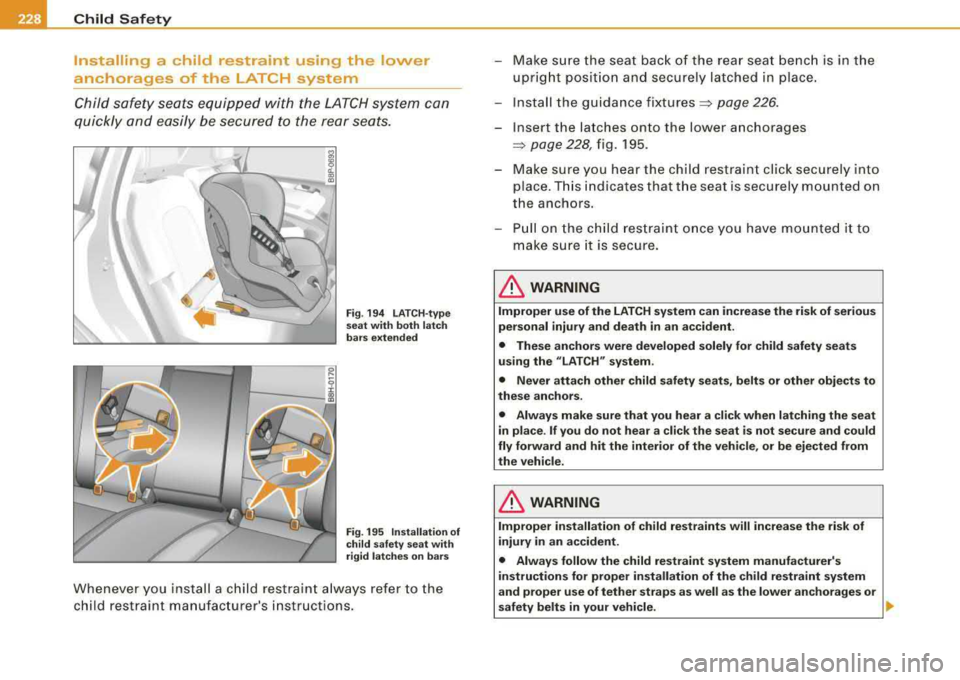
Child safety seats equipped with the LATCH system can
quickly and easily be secured to the rear seats.
Fig . 194 LATCH-type
seat with both latch
bars extended
Fig . 195 Installation of
child safety seat with
rigid latches on bars
Whenever you install a child restra int always refer to the
child restra int manufacturer's instructions.
-Make sure the seat back of the rear seat bench is in the
upright position and securely latched in place.
- Insta ll the guidance
fixtures ~ page 226.
- Insert the latche s onto the lower anchorages
=> page 228, fig. 195.
- Make sure you hear the child restraint click securely into
place. This indicates that the seat is securely mounted on
the anchors.
-Pull on the child restraint once you have mounted it to
make sure it is secure.
& WARNING
Improper use of the LATCH system can increase the risk of serious
personal injury and death in an accident.
• These anchors were developed solely for child safety seats
using the
" LATCH" system .
• Never attach other child safety seats, belts or other objects to
these anchors.
• Always make sure that you hear a click when latching the seat
in place. If you do not hear a click the seat is not secure and could
fly forward and hit the interior of the vehicle, or be ejected from
the vehicle.
& WARNING
Improper installation of child restraints will increase the risk of
injury in an accident.
• Always follow the child restraint system manufacturer's
instructions for proper installation of the child restraint system
and proper use of tether straps as well as the lower anchorages or
safety belts in your vehicle.
.,..
Page 231 of 368
/b, WARNING (continued)
• Always read and heed the important information and WARN
INGS about child safety and the installation of child restraint
systems=> page 210, "Child Safety" .•
Mounting and releasing the anchorage hook
If you use a child restraint system with hooks or other
latches attached to adjustable straps.
Mounting
- Press the anchorage hook with the spring catch release
onto the lower anchorage so that the anchorage hook
locks into place.
- Pull on the anchorage hook to make sure that it has
securely engaged the lower anchorage.
- Tighten the strap following the child restraint manufac
turer 's instructions.
Releasing
- Loosen the tension on the strap following the child
restraint manufacture r's instructions .
- Depress the spring catch on the hook.
- Hold the spring catch in depressed position.
- Move the hook in the d irect ion of the vehicle floor so that
there is enough space to release the anchorage hook
from the lower anchorage.
Safety first
Child Safety
LJ}. WARNING
• Improper installation of child restraints will increase the risk of
injuries in a crash.
• Always refer to the child restraints manufacturer's instructions
for proper installation of the child restraint and proper use of the lower anchorages or safety belts in your vehicle.
•
Tether anchors
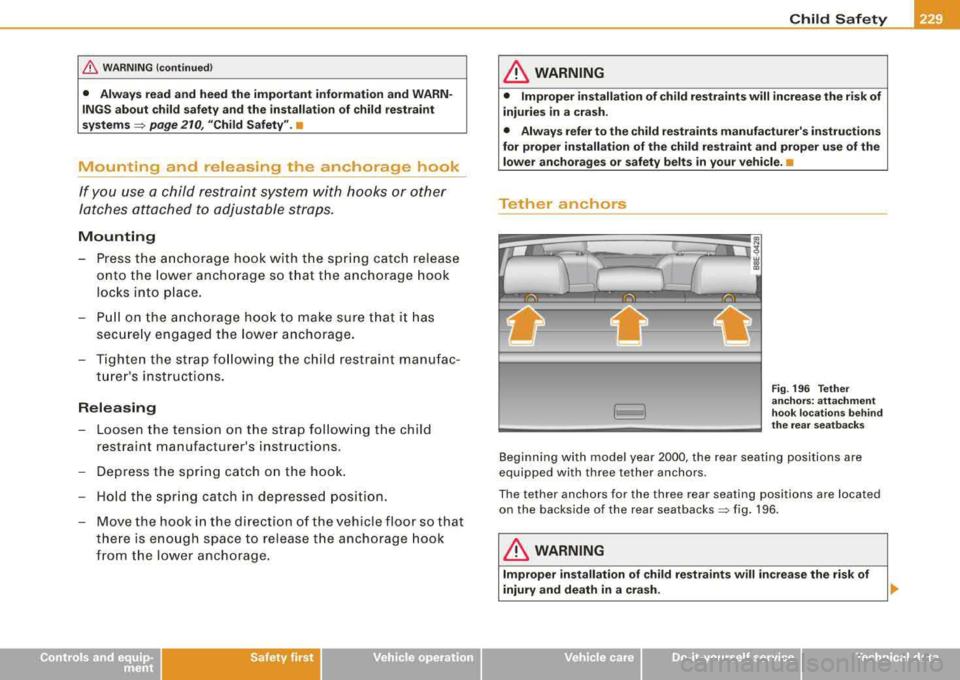
Fig. 196 Tether
anchors: attachment
hook locations behind
the rear seatbacks
Beginning with model year 2000, the rear seating positions are
equipped with three tether anchors .
The tether anchors for the three rea r seating positions are located
on the backside of the rear seatbacks
=> fig. 196.
LJ}. WARNING
Improper installation of child restraints will increase the risk of
injury and death in a crash.
•
Technical data
Page 232 of 368
•----=C:...:.h.:..: i.:..:ld ~ S=- a=- f.:....: e=- t~ Y:___ _____________________________________________ _
& W ARNING (continued )
• Improper use of child restraint anchors (tether anchors ) could
lead to injury in a collision . The anchors are des igned to withstand
only those loads imposed by correctly fitted child restraints .
• Never mount t wo child restraint systems on one LATCH lower
anchor point .
• Never attach two ch ild restraint systems to one tether strap or
tether anchorage .
• Always follow the instructions provided by the manufacturer of
the child re straint you intend to install in your Audi.
• Never use child restraint tether anchorages to secure safety
belts or other kinds of occupant restraints.
• Never attach a tether strap to a tie-down hook in the luggage
compartment.
• Never secure or attach any luggage or other items to the LATCH
lower anchorages or to the tether anchors.
• If a tether or other strap is used to attach a child restraint to the
front passenger seat , make sure that it is not so tight , that it
causes the weight-sensing mat to measure more weight than is
actually on the seat.
• The heavier weight registered can make the system work as
though an adult were on the seat and deploy the Advan ced Airbag
when it must be suppressed causing serious or even fatal injury to
the child .•
Tether strap
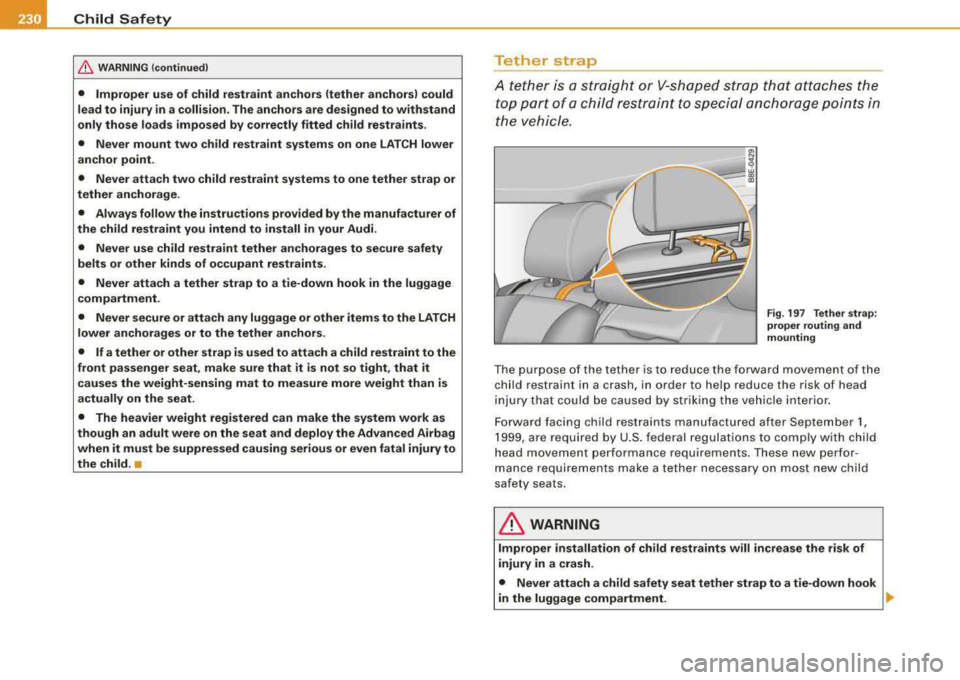
A teth er is a stra ight o r V -shap ed stra p th at attach es t he
t op par t o f a chil d rest rai nt t o spe cial anc hora ge p oints i n
the vehi cle.
Fig . 197 Tether strap:
proper rou ting and
mounting
The pur pose o f the tet her i s to reduce the forwar d move ment of th e
chi ld restraint in a crash, in order to he lp reduce the risk of head
i n jury t hat could be cause d by str ikin g th e v ehicle inte rior.
Forward facing child restraints manufactured after September
1 ,
19 99, a re requ ired by U .S . federal reg ula tio ns t o co mply w ith chi ld
head movement performance requirements. Th ese new perfor
mance requirements make a tether necessary on most new c hild
sa fety seats.
& WARNING
Improper installation of child restraints will increase the ris k of
injury in a crash .
• Never attach a child safety seat tether strap to a tie -down hook
in the luggage compartment.
...
Page 238 of 368
-L-__;l.:..n ..::t ..::e :.:..11 :.:..ig ,.,_;: e:.:..n .:.. t:....:. te.::..::. c.:..h :.:..n.:.. o::..:..: lo~g~ y ___________________________________________ _
Intelligent technology
Notice about data recorded by
vehicle control modules
Your vehicle is not equipped with an Event Data Recorder (EDR),
installed by some manufacturers for the express purpose of
capturing data for retrieval after an accident or crash event . EDR's
are sometimes called "crash recorders" .
Some state laws restrict the retrieval or downloading of data stored
by EDR's that were insta lled in a vehicle for the express purpose of
retrieving data after an accident or crash event without the owner's
consent.
Although your vehicle is not equipped with an EDR, it is equipped
with a number of electronic control modules for various vehicle
systems such as, for example, engine function, emission control, as
we ll
as for the airbags and safety belts.
These electronic control modules also record vehicle-related data
during normal vehicle operation for diagnostic and repair purposes .
The recording capacity of the electronic control modules is limited
to data (no sound is recorded) and only a small amount of data is
actually recorded over a very limited period of time and stored when
a system fault or other condition is sensed by a control unit. Some
of the data then stored may relate to vehic le speed, d irection,
braking as well as restraint system use and performance in the
event of a crash or other condition . Stored data can only be read and
down loaded with special equipment. •
Electronic Stabilization Program (ESP)
General information
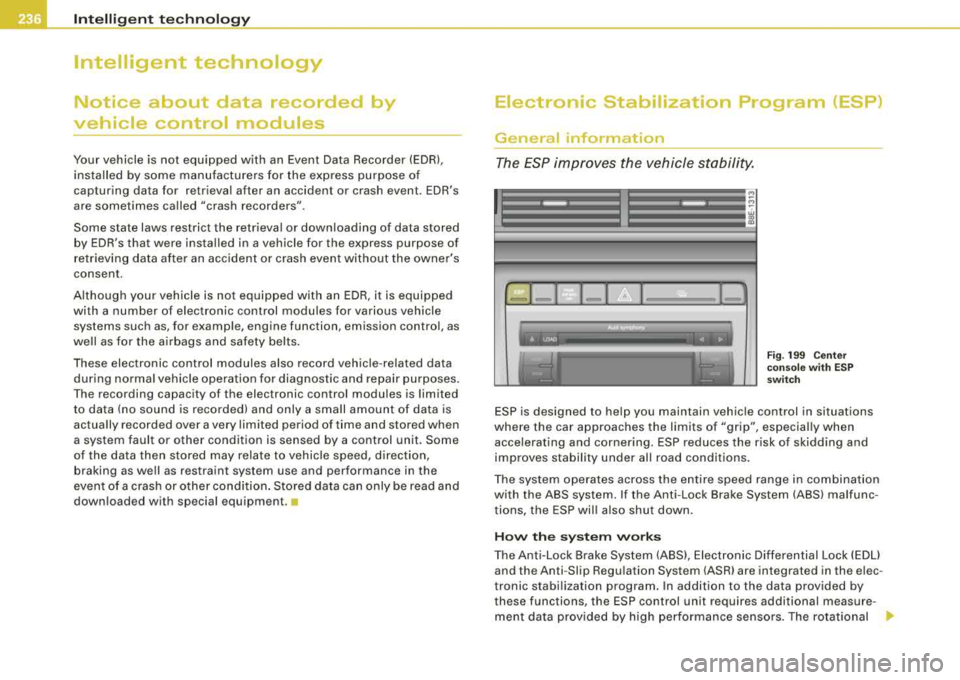
The ESP improves the vehicle stability.
(X) CD
Fig. 199 Center
console with ESP
sw itch
ESP is designed to he lp you maintain vehic le control in situations
where the car approaches the limits of "grip", especial ly when
acce lerating and cornering. ESP reduces the risk of skidding and
improves stability under al l road conditions.
The system operates across the entire speed range in combination
with the ABS system . If the Anti-Lock Brake System (ABS) malfunc
t ions, the ESP will a lso shu t down.
How the system works
The Anti-Lock Brake System (ABS), Electronic Differential Lock (EDU
and the Anti -Slip Regu lation System (ASR) are integrated in the e lec
tronic stabilization program . In addition to the data provided by
these functions, the ESP control unit requires additional measure
ment data provided by high performance sensors. The rotational
.,,.
Page 265 of 368
____________________________________________ ...:C :..: l:..: e :.: a:.: n:....:..:..: in~ g~ a~n .:..:d=-.! p::.. r
:..: o:::..:. te:::..::: c:..::t ..:..:io :::.:..: n'.,__ffllll
soiling, etc.I, you will need to be somewhat careful with these
leathers, and a certain type of care is required. For example, dark
clothing materials can discolor leather seats (especially if such
clothing is damp and was not dyed correctly). Dust and dirt particles
in pores, folds, and seams can have an abrasive effect and can
damage the leather surface as well as weaken seams.
The leather shou ld be c leaned regularly as needed. After having
been used for a relatively long time, your leather seats will acquire
a rich aged finish . This is a characteristic of natural leather and a
sign of true quality.
In order to maintain the value of this natural product over the life of
your vehic le , you should fo llow the recommendations below:
0 Note
• To keep your leather from bleaching out, do not allow it to be
exposed to bright sunlight for long periods of time. If you have to
leave the vehicle parked outside for long periods, cover the leather
to protect it from direct exposure to sunlight.
• Sharp objects on c lothing, such as zippers, rivets or sharp pieces
on belts can leave permanent scratches or scrape marks on the
surface of the leather.
[ i ] Tips
• After each time you clean the leather and at regu lar intervals, use
a leather preservative creme that contains UV -blockers and that
works into the leather. This creme wil l nourish and moisturize the
leather, helping it to breathe and stay supple . It also helps to build
up a protective coating on the surface .
• Clean the leather every 2 -3 months, and clean any areas that get
soiled.
• Remove fresh marks made by ballpoint pens, ink, lipstick, shoe
polish, etc . as soon as possible.
• Preserve the color of the leather as needed by using a special
colored leather care creme to touch up areas of uneven color .•
• I I • • I
Ap plies to veh ic les : wi th n atural leat her
Cleaning and caring for leather upholstery
and trim
Natural leather requires special care and attention.
Normal cleaning
-Clean soiled areas with a slightly moistened cotton or
woolen cloth.
More stubborn dirt
-More stubborn dirt can be removed using a cloth satu
rated with a mild soap solution (2 tablespoons mild
liquid soap).
-Never allow the soap solution to saturate the leather, and
make certain that no water soaks into the seams.
Wipe off the soap solution with a soft, dry cloth .
Cleaning spots
-Remove fresh water-based spots (such as coffee, tea,
juices, blood) with an absorbent cloth or paper towel.
-Remove fresh grease or oil-based spots (such as butter,
mayonnaise, chocolate) with an absorbent cloth or paper
towel, or use the cleaner from the leather care kit if the
spot has not yet penetrated into the surface of the
leather.
-Use an oil/grease dissolving spray, if oil/grease spots
have dried on.
-Remove specific kinds of spots (ballpoint pen, felt
marker, fingernail polish, water-based paint, shoe polish,
etc.) with a spot remover specifically formulated for
leather. _.,
Vehicle care