warning AUDI A4 CABRIOLET 2009 Owners Manual
[x] Cancel search | Manufacturer: AUDI, Model Year: 2009, Model line: A4 CABRIOLET, Model: AUDI A4 CABRIOLET 2009Pages: 340, PDF Size: 77.32 MB
Page 241 of 340
![AUDI A4 CABRIOLET 2009 Owners Manual _____________________________________________ C_ l_ e _ a_ n_ in--= g--- a_n _d___, p_ r _o_ te_ c_t _io _ n __ lftll
•
[ i ] Tip s
Open Ve lcro fasteners on your cloth ing can damage the](/img/6/57553/w960_57553-240.png "AUDI A4 CABRIOLET 2009 Owners Manual _____________________________________________ C_ l_ e _ a_ n_ in--= g--- a_n _d___, p_ r _o_ te_ c_t _io _ n __ lftll
•
[ i ] Tip s
Open Ve lcro fasteners on your cloth ing can damage the")
_____________________________________________ C_ l_ e _ a_ n_ in--= g'--- a_n _d___, p_ r _o_ te_ c_t _io _ n __ lftll
•
[ i ] Tip s
Open Ve lcro fasteners on your cloth ing can damage the seat cover .
Please make sure that Ve lcro fasteners are closed .•
Plastic parts and instrument panel
A lways use a c lean cloth moistened in clear water to clean these
areas . For persistent dirt use an Audi approved
solvent-free plastic
cleaner/protectant.
& WARNING
Solvents can change the properties of some plastics and make it
harder for the airbag to deploy .
• Never clean the instrument panel or the surfa ce of Airbag
module s with c leaning produ cts that contain sol vents .
• Products containing solvent s will make the surface of th is part
porous .
• Serious injuries can re sult if plastic parts come loo se when the
airbag is deployed .
• Alway s read and heed all WARNINGS and the information
~ page 230 .
0 Note
Cleaning agents containing solvents wil l attack the material and can
change the way it be haves. •
Applies to veh ic les : wi th n atural leat her
Natural leather
Audi makes great effor ts to maintain the proper ties,
n at ural look an d feel of in terior le ather.
General
We offer many different types of leather on our vehic les . Most are
d iff erent types of nappa leather, which has a smoo th surface and
comes in various co lors .
The in tens ity of the c olor de termines the visua l characteristics and
appearance. I f the surface of the leather has a typ ical natu ra l loo k,
then the leather is a nappa leather that has been left in a re latively
natura l condition. This leathe r off ers pa rticu larly good com fort and
breathes we ll. Fine veins, closed grains, insect bites, skin folds, and
su btle varia tions in c olor remain visib le . These characterist ics
demonstrate that the material is natural.
Natura l nappa lea ther is not c ove red by a color finish. It is th erefo re
more sensitive to soiling and wear, which is something you need to
consider if children, animals or other factors might prove to be
particularly hard on the leather .
By contrast, leather types that are covered by a colored finish layer
are m ore dura ble. This has a pos itive effect on the lea ther's resis
tance to wear and soiling in daily use. On the other hand, the typical
c haracte ristics of natura l leather are barely or not appa re nt.
However , this does not mean that the leather itse lf is of inferior
quality.
Care and handling
Because of the exclusive nature of the types of leat her that Audi
uses and their unique properties (such as sensitivity to oi ls, grease ,
s o iling, etc.), y ou will need to be somewhat ca ref ul w ith t hese
leathers, and a certain type of care is required . For example, dark
c lothing materials can discolor leathe r seats (especially if such
clothing is damp and was not dyed correctly!. Dust and dirt particles .,_
Vehic le care
Page 243 of 340
_______________________________________________ C_l_e _a_ n_ in ____ g ___ a_n_ d ___ p_r _o _t_ e_ c_ t _i _o _ n __ llllll
•
Leather care
-Every half year use an approved leather care product
(available from your Audi dealer) to care for the leather.
- Apply the product very sparingly .
- Wipe it off with a damp cloth.
If you have any questions about cleaning and caring for the leather
in your vehicle, it is best to contact your authorized Audi dealer, who
will be glad to help you and tell you about our full range of leather
care products, such as:
• Leather cleaning and care kit
• Cremes to care for colored leather
• Spot removers for ballpoint pens, shoe polish, etc.
• Oil/grease dissolving spray
• New and upcoming products.
& WARNING
Always read and heed all WARNINGS and the information
=:> page 230.
0 Note
• Never use chemical solvents (e.g. lighter fluid, turpentine),
waxes, shoe polish or similar products on the leather surfaces in
your Audi.
• To avoid damage, have stubborn stains removed by a commer
cial cleaning specialist. •
Applies to veh ic les : wi th A lcantara up holste ry
Cleaning Alcantara ® (synthetic suede)
Removing dust and dirt
- Moisten a cloth, squeeze out excess water and wipe down
the seat surfaces.
Removing stains
- Moisten a cloth with lukewarm water or with diluted
ethyl (rubbing) alcohol.
- Dab at the stain. Start at the outside and work inwards.
Once the stain is no longer visible, use a soft dry cloth or
tissue to soak up the moisture.
Do not use leather cleaning products on Alcantara.
You may use a suitable shampoo for removing dust and dirt.
Dust and grit in the pores and seams can scratch and damage the
surface. If the car is left standing in the sun for long periods, the
Alcantara should be protected against direct sunlight to prevent it
from fading. Slight color variations will develop in normal use and
are not an indication of material deterioration .
0 Note
• Never use chemical solvents (e .g. lighter fluid, turpentine),
waxes, shoe polish or similar products on Alcantara ® surfaces.
• To avoid damage , have stubborn stains removed by a commer
cial cleaning specialist.
• Do no t use brushes, stiff sponges or similarly abrasive cleaning
aids. •
Vehic le care
Page 244 of 340
___ C_ le_ a _ n_i_n ~g _ a_ n_ d __ p_r _o _t _e _c_ t_ i_o _n ___________________________________________ _
Safety belts
Only well-maintained safety belts work reliably when
needed.
Heavily soiled safety belts may not retract properly.
- Keep belts clean.
- For cleaning, use a mild soap and water solution. Let
belts dry thoroughly and away from direct sunlight.
- Do not allow inertia reel safety belts to retract before
they are completely dry.
- Check the condit ion of your safety belts
regularly.
& WARNING
Damaged safety belts can break in a crash .
• Anything that might damage your safety belts could mean that
you and your passengers would not be adequately protected in an
accident.
• Safety belt performance depends on correct installation. Never
remove belts from the vehicle to clean them.
• Do not use chemical cleaning agents, bleach or dyes. They have
corrosive properties which weaken the webbing.
• When cleaning your safety belts, inspect them for damage. If
you discover damage, see your Audi dealer.
• Always read and heed all WARNINGS and the information
=:> page 230. •
Engine compartment
Be especially careful when cleaning the engine compart
ment.
Always switch off the ignition before cleaning the engine :::::, &.
Plenum panel
Remove leaves from the plenum panel in front of the windshield
under the engine hood. This prevents the water drain holes from
becoming blocked, and it prevents debris from entering the vehicle
interior through the heating and ventilation ducts.
Corrosion protection
The engine compartment and transmission have been corrosion
protected at the factory.
Good anti-corrosion treatment is very important, particularly in the
winter. If the vehicle is frequently driven on salt treated roads, the
entire engine compartment and plenum panel should be thor
oughly cleaned at the end of winter and retreated to prevent salt
damage. At the same time, the underside of the vehicle should be
washed as well.
I f the engine compartment is cleaned at any time with grease
removing solutions
21 , or if you have the engine washed, the anti
corrosion treatment is almost always removed as well. It is therefore
essential to have a long-lasting corrosion protection reapplied to all
surfaces, seams, joints and components in the engine compart
ment.
& WARNING
Be aware: The engine compartment of any motor vehicle is a
potentially hazardous area.
• Before working in the engine compartment, be sure to read the
information :::::,
page 242. .,.,
21 Use only the correct cleaning solutions. Never use gasoline or diesel fuel.
Page 245 of 340
_____________________________________________ C_ l_ e _a_ n_ in_ g_a _ n_d_ p_ r_ o_ t _e_ c_t _io _ n __ _
•
& WARNING (continued)
• Before reaching into the front plenum panel, always remove the
ignition key. Otherwise, the windshield wiper system could unin
tentionally be switched on, possibly causing personal injury from
the moving wiper linkage.
• Never reach into the area around or touch the radiator fan. The
auxiliary fan is temperature controlled and can switch on suddenly
- even when the ignition is off .
• Do not wash, wax or dry the engine with the engine running .
Moving or hot parts could injure you.
• Do not clean the underside of the chassis, fenders, wheel
covers , or other hard to reach parts without protecting your hands
and arms. You may cut yourself on sharp-edged metal parts .
• Always read and heed all WARNINGS and other information
=> page 230. •
Vehic le care
Page 248 of 340
Fuel supply and filling your fuel tank
The labe l on the inside of the fuel filler flap tells you the correct fuel
f o r your vehicle . Fo r m ore inf ormatio n about f uel specifica tions, see
~ page 244.
Y our vehicle fuel tank has an on -b oard refuelling vapor recove ry
system. This feature he lps to preve nt fuel vapors from escap ing
from the tank and polluting the environment while you refue l you r
veh ic le . I n o rder t o fill the tank properly while protec ting the envi
ronmen t, please follow this re fueling procedure carefully .
L1}. WARNING
Under normal operating conditions , never carry additional fuel
containers in your car. Gas canisters and other containers used to
transport fuel can be dangerous . Such containers , full or empty,
may leak and could cau se a fire in a collision . If you must transport
fuel to use for your lawn mower , snow blower , etc ., be very careful
and alway s ob serve local and state laws regarding the u se , tran s
portat ion and storage of su ch fuel container s. Make certain the
c ontainer meets industry standard s (ANSI/ASTM F852 -861 .
0 Note
Never d rive your vehic le un til the fue l tank is co mpletely empty . The
irregular supply of fuel can cause misfiring . Gasoline could enter
t he exhaus t system and damage the catalytic converter . •
Refuelling
Fi g. 191 Rig ht v ehi cle
si de , st andi ng beh ind
the rear whe el:
opening the fuel filler
flap ,
F ig . 19 2 Fuel cap
s itting on th e opened
fuel filler f lap
W hen a dding fuel, th e i gnit io n a nd any ce llular ph ones in
th e v ehicl e m ust be sw itch ed off.
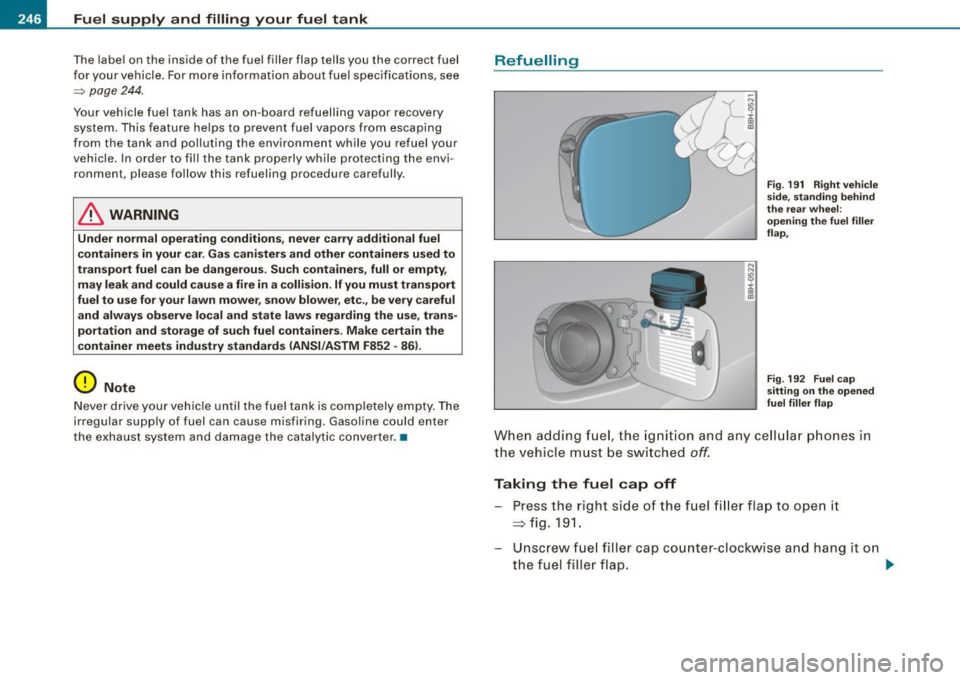
Taking the fuel cap off
Press the rig ht side o f the f uel fi ller fla p to ope n it
=> fig .19 1.
Unsc rew fuel filler cap co unter-clock wise and han g it o n
t h e fuel fille r flap .
~
Page 249 of 340
•
Refuelling procedure
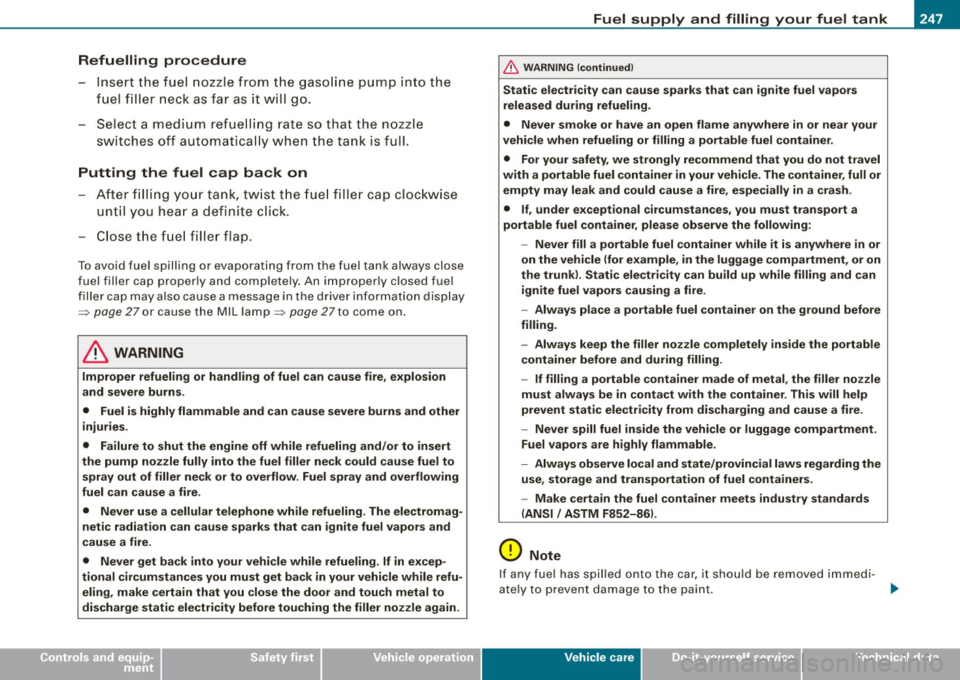
-Insert the fue l nozzle from the gaso line pump i nto the
fue l fi ller neck as far as it w il l go.
- Select a medium refue lling rate so that the nozzle
swi tches off automatica lly w hen the tank is ful l.
Putting the fuel cap back on
-Aft er fillin g yo ur ta nk, twist th e fue l fille r cap clockw is e
unt il you hear a de finit e cli ck .
- Cl ose the fue l fille r flap.
To avo id fu el sp illing or evapora ting from the fuel tan k always close
fu el filler cap p rop erly and co mplet ely . An i mprope rly clo sed fue l
fi ller cap may a lso cause a messa ge in the dr iver in fo rm ation display
=>
page 27 or cause the MIL lamp=> page 27 to come on.
,& WARNING
Improper refueling or handling of fuel can cause fire, explosion
and severe burns .
• Fuel is highly flammable and can cause severe burns and other
injuries .
• Failure to shut the engine off while refueling and /or to insert
the pump nozzle fully into the fuel filler ne ck could cause fuel to
spray out of filler neck or to overflow. Fuel spray and overflowing
fuel can cause a fire .
• Never use a cellular telephone while refueling . The electromag
netic radiation can cause sparks that can ignite fue l vapors and
c ause a fire .
• Never get ba ck into your vehicle wh ile refueling . If in e xcep
tional circumstan ces you must get ba ck in your vehicle while refu
eling , make certain that you close the door and touch metal to
di scharge static electricity before touching the filler nozzle again.
Fu el supply and filling your fu el tank
& W ARNING (continued )
Static electricity can cause sparks that can ignite fuel vapors
released during refueling .
• Never smoke or have an open flame anywhere in or near your
vehicle when refueling or filling a portable fuel container.
• For your safety , we strongly recommend that you do not travel
with a portable fuel container in your vehicle. The container , full or
empty may leak and could cause a fire , especially in a crash .
• If, under e xcept ional circumstances , you must transport a
portable fuel container, please observe the following:
-Never fill a portable fuel container while it is anywhere
in or
on the vehicle (for example , in the luggage compartment , or on
the trunk) . Static electricity can build up while filling and can
ignite fuel vapors causing a fire.
- Always place a portable fuel containe r on the ground before
filling.
- Always keep the filler nozzle completely inside the portable
container before and during filling .
- If filling a portable container made of metal , the filler nozzle
must always be in contact with the container. Thi s will help
prevent static ele ctricity from discharging and cause a fire.
- Never spill fuel inside the vehicle or luggage compartment .
Fuel vapors are h ighly flammable .
- Always observe local and state/provincial laws regarding the
use , storage and transportation of fuel conta iners.
- Make certain the fuel container meets indu stry standards
(ANSI / ASTM F852-86).
0 Note
If any fuel has spil led onto the car , it should be removed immedi -
ate ly to prevent da mage to the pa int. _,.
Vehic le care
Page 251 of 340
_____________________________________________ C_h_ e_ c _ k_in -= g_a _ n_d _ f_il _li _n """g ;;..._ ____.ffllll
Checking and filling
Engine hood
Releasing the engine hood
The engine hood is released from inside the vehicle.
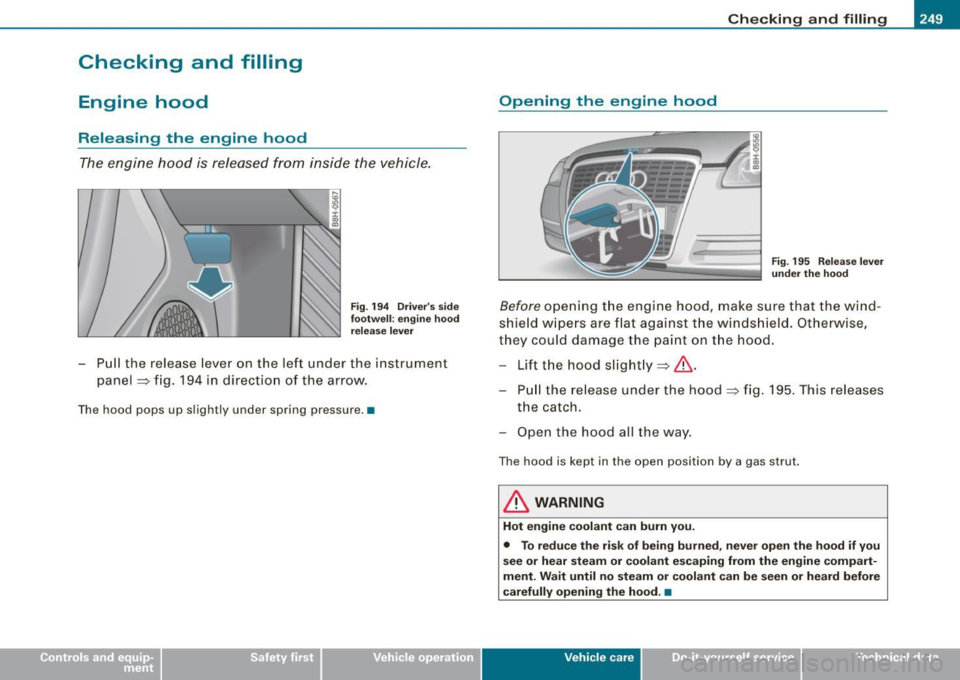
Fig . 194 Driver's side
footwell: engine hood
release lever
-Pull the release lever on the left under the instrument
panel => fig. 194 in direction of the arrow.
The hood pops up slightly under spring pressure .•
Opening the engine hood
Fig. 195 Release lever
under the hood
Before opening the engine hood, make sure that the wind
shield wipers are flat against the windshield. Otherwise,
they could damage the paint on the hood.
Lift the hood slightly =>& .
- Pull the release under the hood
=> fig. 195. This releases
the catch.
- Open the hood all the way.
The hood is kept in the open position by a gas strut .
& WARNING
Hot engine coolant can burn you .
• To reduce the risk of being burned, never open the hood if you
see or hear steam or coolant escaping from the engine compart
ment. Wait until no steam or coolant can be seen or heard before
carefully opening the hood. •
Vehicle care irechnical data
Page 252 of 340
-~_C_ h_e _c _ k_ i_ n ...:::g:;..._ a_n_ d_ f_ i_ll _in ....;g:::;.._ ___________________________________________ _
Closing the engine hood
-Pull t he hood down until the pressure from the strut is
reduced.
- Let t he hood
drop down and latch in place. Do not try to
push it shut;
it may fai l to engage ~& .
& WARNING
A hood that is not completely latched could fly up and block your
view while driving.
• When you close the engine hood, check it to make sure the
safety catch has properly engaged. The hood should be flush with
the surrounding vehicle body parts.
• If you notice while driving that the hood is not secured prop
erly, stop at once and close it. •
Working in the engine compartment
Be especially careful whenever you work in the engine
compartment.
Whenever you must perform any work in the engine compartment,
for example checking and filling different fluids, there is a risk of injury, burns and accidents. To prevent personal injury always
observe the following WARNINGS. The engine compartment of any
vehicle is a hazardous area
~ 6 .
& WARNING
To help avoid injury, before you check anything under the hood :
• Turn off the engine.
• Remove the ignition key.
• Apply the parking brake.
& WARNING (continued)
• Move selector lever of automatic transmission to "P" (Park);
put manual transmission in Neutral.
• Always let the engine cool down. Hot components will burn
skin on contact.
• To reduce the risk of being burned, never open the hood if you
see or hear steam or coolant escaping from the engine compart
ment. Wait until no steam or coolant can be seen or heard before
carefully opening the hood .
• Keep children away from the engine compartment.
• Never spill fluids on hot engine components. They can cause a
fire.
• Never touch the radiator fan. The auxiliary electric fan is
temperature controlled and can switch on suddenly.
• Never open the coolant reservoir cap when the engine is still
warm. The coolant system is pressurized and hot coolant could
spray out.
• Protect your face, hands and arm from steam or hot engine
coolant by placing a thick rag over the cap when you open the
coolant reservoir.
• If work on the fuel system or the electrical system is necessary :
- Always disconnect the battery .
- Never smoke or work near heaters or open flames. Fluids in
the engine compartment could start a fire.
- Keep an approved fire extinguisher immediately available.
• To avoid electrical shock and personal injury while the engine
is running or being started, never touch :
- Ignition cables
- Other components of the high voltage electronic ignition
system.
• If you must perform a check or repair with the engine running:
~
Page 253 of 340
_____________________________________________ C_h_ e.::...::. c.:..k .:..in ;..:.:= g:.....:.; a.:..n :....:d ::....:. f.:.:il .:.:li .:..n :.::g:!-- ----J-
& WARNING (conti nued )
-First , fully apply the parking brake , move selector lever of
automatic transmis sion to "P " (Park) ; put manual transmiss ion
in Neutral.
- Always u se extreme caut ion to prevent clothing, jewelry , or
long hair from getting caught in the radiator fan, V-belts or
other moving parts , or from conta cting hot parts. Tie back hair
before starting , and wear no cloth ing that will hang or droop
into the engine.
• Minimize exposure to emission and chemical hazards
~ & .
& WARNING
California Proposition 65 Warning :
• Engine exhaust , some of its constituents , and certa in vehicle
components contain or emit chemicals known to the State of Cali
fornia to cause cancer and birth defects and reproductive harm . In
addition , certain fluids contained in vehicles and certain produ cts
of component wear contain or emit chemicals known to the State
of California to cause cancer and birth defects or other reproduc
tive ha rm .
• Battery post s, terminals and related acces sories contain lead
and lead compounds , chemicals known to the St ate of California
to cause cancer and reproductive harms. Wash hands after
handling.
0 Note
When adding f luids, always make sure that they are poured into the
p roper container o r filler opening, otherwise se rio us damage to
vehicle systems will occur .
W For the sake of the environment
To detect lea ks i n tim e, inspect t he v ehi cle floor pa n from u nde r
neath regularly. If you see spots from oil or other vehicle fluids, have
y o ur v ehicl e inspected by an author ized Au di dea ler. •
Engine compartment
App lies to veh icles: with 2 .0 I turbo, 4-cylinder •engine
2.0 I , 4-cylinder turbo engine (200 hp )
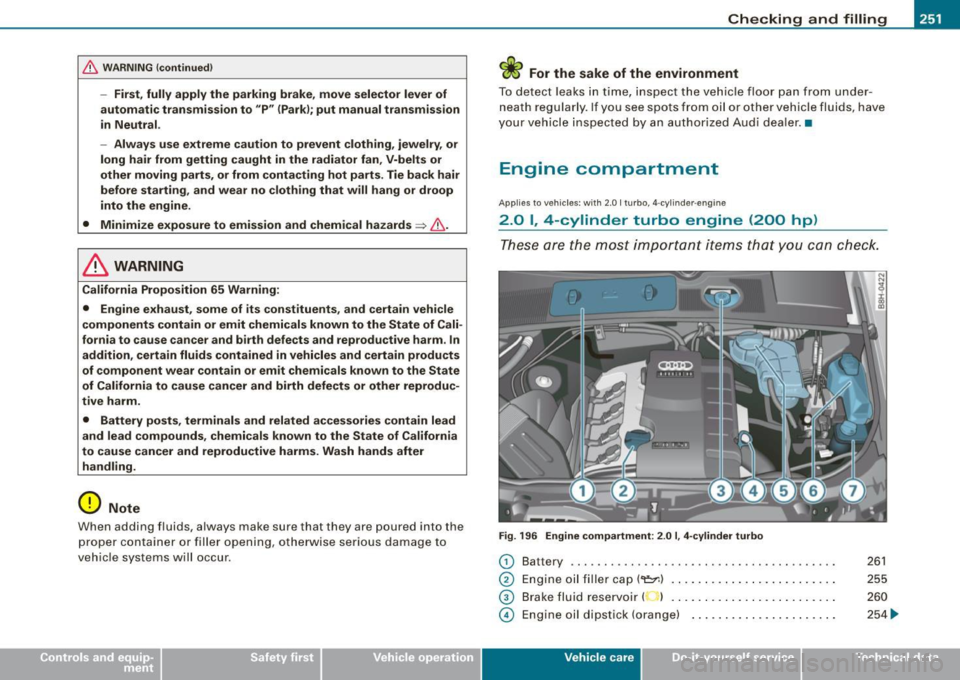
The se are th e m ost important items that you can check .
Fig. 196 Engine comp art m ent : 2 .0 I, 4-cy lind er turbo
G) Battery ..................................... •..
0 Engine oi l fi lle r ca p ('1:::r.l ..... ... ... ....... .... .. .
© Bra ke fluid reservoir ( ) ..... ... .... ... ... ... .. . .
© Engine oil dipstick (orange) ........ .......... ... .
Vehic le care
N
N
I
261
255
2 60
25 4 ...
irechnical data
Page 254 of 340
-Ch
ecking and filling
_ _..;:::;__=----------------
©
©
0
Coolant expansion tank (.J_ J .. .. .. .. . ... .. .. .... .
Windshield/head light washer container ( O ) ..... .. .
Po wer steering re servoi r
& WARNING
Before you check anything in the engine compartment , always
read and heed all WARNINGS
=> & in "Working in the engine
c ompartment " on
page 250. •
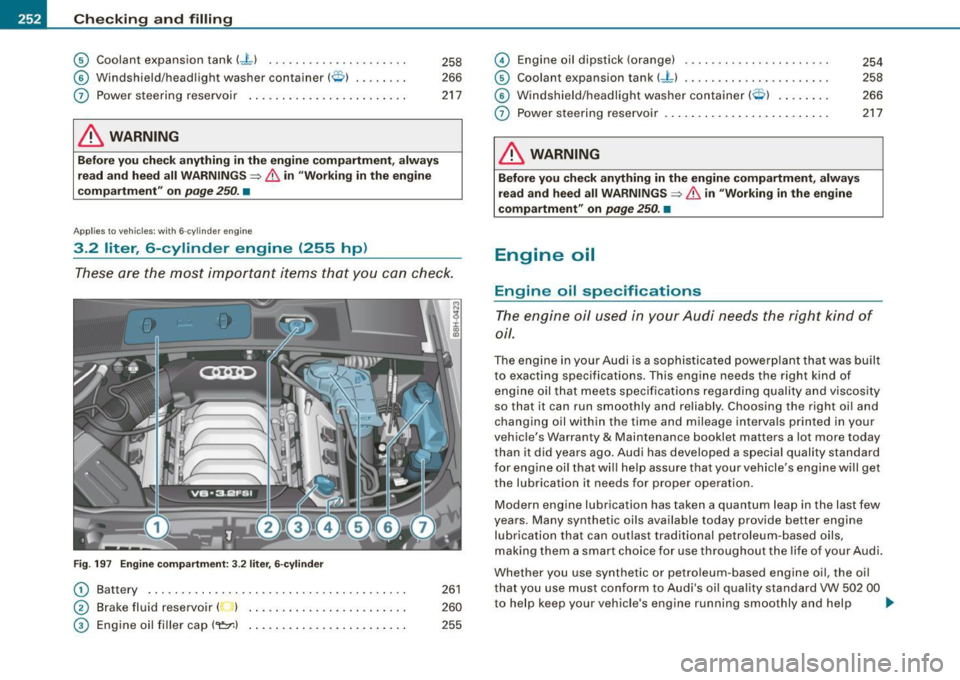
Applies to veh icles : w ith 6 ·cy lind er engine
3.2 liter , 6-cylinder engine (255 hp)
258
266
217
Th ese a re t he most im por tan t it em s th at you c an ch eck.
F ig . 197 Engine compartment : 3.2 liter , 6- cylinder
G) Battery ... ... .. ...... .... ... .... .... .... ..... .
0 Bra ke fluid reservoir ( l ....... .. .. .. .. ...... .. .
© Engine oil fi ller cap ('t:::n) ..•. ..• ..... .•. ...• ..•..
26 1
260
255
©
©
©
0
Engine oil dipstick (orange) ...... ..... ... .... ... .
Coolant expansion tank
( -L J .. ... ... . .... ... ... .. .
W indshield/headligh t washer c ontainer (O l .. .... . .
Powe r steering rese rvoir
& WARNING
Before you check anything in the engine compartment, always
read and heed all WARNINGS
=> & in "Working in the engine
compartmen t" on
page 250. •
Engine oil
Engine oil specifications
254
258
266
2 17
The engine oil used in your Audi needs the right kind of
oil.
The engi ne in y our Audi is a sophisticated powe rp lan t tha t was built
to exacting specifications. This engine needs the right kind of
eng ine oil that meets specifications regarding quality and viscos ity
so that it can run smoothly and reliably . Choosing the right oil and
changing oil within the time and mileage interva ls printed in your
vehic le's Warranty
& Maintenance booklet matters a lot more today
than it did years ago. Audi has developed a special quality standa rd
f or e ngin e oil tha t w ill help assure that your vehicle's engine will get
the lubrication it needs for proper operation.
Modern engine lubrication has taken a quantum leap i n the last few
years. Many synthetic oils ava ilable today provide better engine
lubrication that can o utlast traditional petro leum -based oil s,
making them a smart choice for use throughout the life of your Audi.
Whether you use synthetic or petro leum -based engine oil, the oi l
tha t you use mus t conform to Audi 's oi l qual ity standard VW 502 00
to help keep your vehicle's engine running smoothly and help ._