ABS AUDI A4 CABRIOLET 2009 User Guide
[x] Cancel search | Manufacturer: AUDI, Model Year: 2009, Model line: A4 CABRIOLET, Model: AUDI A4 CABRIOLET 2009Pages: 340, PDF Size: 77.32 MB
Page 162 of 340
___ S_a_ f_ e_ t-= y_ b_e_ l_ t _s _______________________________________________ _
- Make sure that your passengers also buckle up and prop
er ly wea r th eir sa fe ty be lts.
Protect your children with a child restraint system appro
pria te for t he size and age o f the children.
The warning light~ in the instrument cluster lights up when the
ignition is switched on as a reminder to fasten the safety belts. In
addition, you will hear a warning sound.
After the ignition is switched on, the warning tone will come on for about 6 seconds a long w ith a-~ warning light in the instru ment
cluster if the driver has not fastened his safety belt . As soon as the
driver has fastened his safety belt, the warning tone will stop and
the warning light will go out .
I f the driver has not buckled -up within about 24 seconds after the
warn ing tone has stopped, the warn ing tone will sound again for
about 6 seconds. The warning tone will sound repeated ly for about
6 seconds at 24 second intervals unti l the driver has buckled-up . The
safety belt warning system is active for about 5 minutes and during
this time the wa rning light in the instrument c luster will stay on.
Fa sten you r safety belt no w and make sure that your pa ssengers
also properl y put on the ir saf ety belts. •
Why safety belts?
Frontal collisions and the law of physics
Frontal crashes create ve ry strong forces for pe ople ri ding
in vehicles.
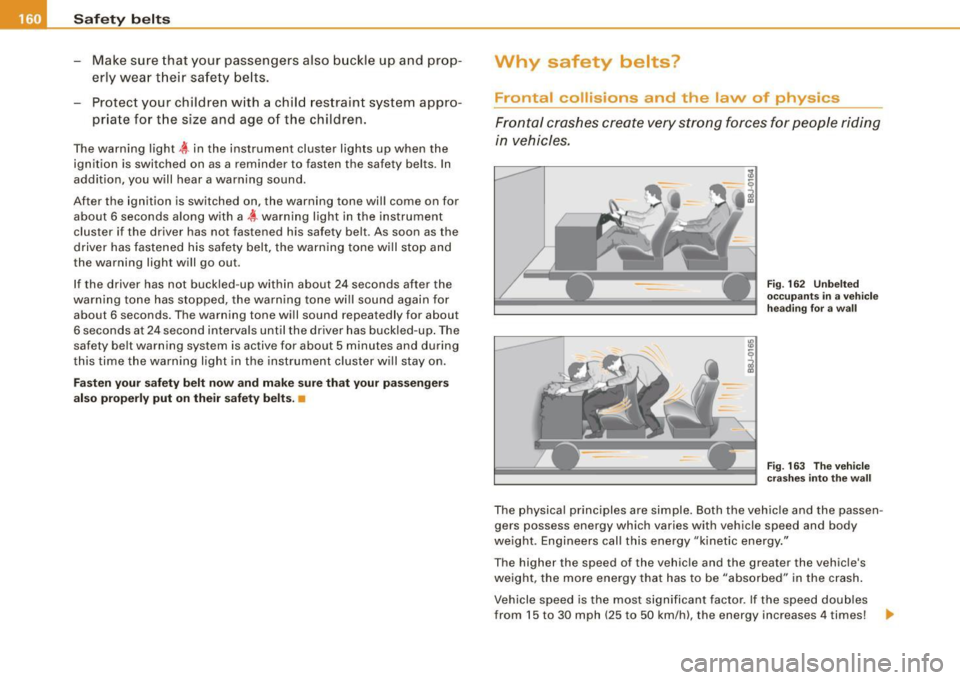
Fig . 16 2 Unbel ted
occ upants in a ve hicle
h ead in g fo r a wall
F ig . 16 3 T he vehi cle
c ras he s in to t he wa ll
The physica l principles are simple. Both the vehicle and the passen
gers possess energy which varies with vehicle speed and body
we ight . Engineers call this energy "kinetic energy ."
The higher the speed of the vehicle and the greater the vehicle's
we ight, the mo re energy that has to be "absorbed" in the crash .
Vehicle speed is the most significant factor. If the speed doub les
from 15 to 30 mph (25 to 50 km/h), the energy increases 4 times!
~
Page 164 of 340
--~S~a ~f ~e ~t l'.y ...: b~ e~lt =:s!._ _____________________________________________ _
Safety belts protect
People think it's possible to use the hands to brace the
body in a minor collision . It's simply not true!
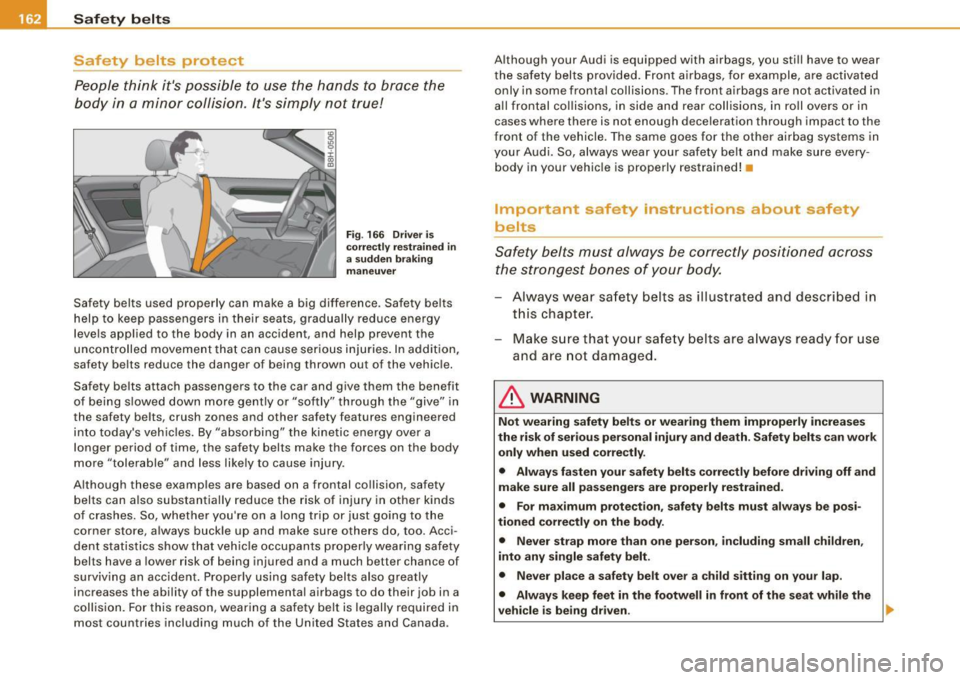
Fig . 166 Dri ver is
co rrec tly r est rai ned i n
a s ud den braking
man euv er
Safety belts used properly can make a big difference . Safety belts
help to keep passengers in their seats, gradually reduce energy levels app lied to the body in an accident, and help prevent the
uncontrolled movement that can cause serious injuries . In addition,
safety be lts reduce the danger of being thrown out of the vehic le.
Safety belts attach passengers to the car and give them the benefit
of being s lowed down more gently or "sof tly" through the "give" in
the safety belts, crush zones and other safety features engineered
into today's vehicles. By "absorbing" the kinetic energy
over a
longer period of time, the safety belts make the forces on the body
more "tolerable" and less likely to cause injury.
Although these examples are based on a frontal co llision, safety
belts can a lso substantially reduce the risk of injury in other kinds
of crashes. So, whether you're on a long tr ip or just going to t he
corner store, always buckle up and make sure others do, too. Acci
dent statistics show that vehic le occupants properly wearing safety
belts have a lower risk of being injured and a much better chance of
s u rviv ing an acc ident. Proper ly using safety belts also great ly
increases the abi lity of the supplementa l airbags to do their job in a
coll ision. For this reason, wearing a safety be lt is legally required in
most countries including much of the United States and Canada . Although your Audi is equipped with airbags, you sti
ll have to wear
t he safety belts provid ed. Fron t airbags, for example, are activated
only in some frontal collisions. The front airbags are not activated in
a ll frontal co llisions, in side and rear collisions, in ro ll
ove rs or in
cases where there is not enough dece leration through impact to the
front of the vehicle. The same goes for the other ai rbag systems in
your Audi. So, a lways wear your safety belt and make sure
eve ry
body in your vehic le is properly restrained! •
Important safety Instructions about safety
belts
Safety belts must always be correctly positioned across
the strongest bones of your body.
Always wear safety belts as illustrated and described in
this cha pte r.
Make s ure tha t your sa fe ty belts ar e always ready for us e
and are not damaged .
& WARNING
Not wearing safety belts or wearing them improperl y increases
the risk of serious per sonal injury and death . Safety belt s can w ork
only when used corre ctl y.
• Alway s fa sten yo ur safety belt s correctl y before driving off and
make sure all pa ssenger s are properl y restrained .
• For m aximum protection , safet y belts must alw ays be po si
tion ed corre ctly on the body .
• Never strap mo re than one person , including sm all children ,
into any single safety belt.
• Never pla ce a s afety belt ove r a child sitting on your lap .
• Alway s ke ep feet in the footwell in front of the seat while the
vehicle is being dr iven .
~
Page 175 of 340
Airbag syst em -----------------=~-
& WARNIN G (cont in u ed)
• Airb ag work m ost effectiv ely when u sed with properly worn
sa fet y be lt s .
• Ther efore , always wear your safety belt s and ma ke sure that
eve rybod y in your vehi cle is prope rly re str ained.
& WARNING
A person on the front p assenger se at, espe cially infant s and small
c hildren , will re ceive seriou s injuries and can ev en be killed by
being t oo clos e to the airbag when it infl ates.
• Although the Adva nced Airbag System in your ve hicle i s
de signed to turn off the front passenger airb ag i f a n infant or a
s mall child i s on the front pa ssenger seat , nobody can absolutely
gu ara ntee that deployment under these spe cial co nditio ns is
impos sible in all conceivable situations that m ay happen during
the useful life of your vehicle.
• The Adv an ced Airbag Sy stem can deploy in a ccordance with
the "lo w risk" option unde r the U .S. Feder al Stand ard if a child t hat
is heavier than the typi cal on e-year old child i s on th e front
pa sse nger seat an d the other condition s for airb ag dep loym ent
are met.
• Acc ident stat istics have sh own that children are gen erally s afer
in the rear se at area than in the front seating posit ion .
• For th eir own safet y, all children , espe cially 12 yea rs and
younger , should alway s ride in th e back properly r estrained for
their age and size. •
Advanced front airbag system
Your vehicle is equipped with a front Advanced Airbag System in
compliance with United States Federal Motor Vehicle Sa fety Stan
dard 208 as applicable at the time your vehicle was manufactured.
Controls and equip
ment Safety first Vehicle operation
The front Advanced Airbag System supplements the safety belts to
provide additional protection for the driver's and front passenger's
heads and upper bodies in frontal crashes. The airbags inflate only
in frontal impacts when the vehic le deceleration is high enough.
The front Advanced Airbag System for the front seat occupants is not a substitute for your safety belts . Rather, it is part of the overall
occupant restraint system in your vehicle. A lways remember that
the airbag system can only help to protect you, if you are sitting
upright, wear ing your safety be lt and wear ing it proper ly . This is why
you and your passengers must a lways be properly restrained, not
just because the law requires you to be .
The Advanced A irbag System in your veh ic le has been certified to
meet the "low risk" requirements for 3 and 6 year -o ld children on the
passenger side and very small adults on the driver side. The low risk
deployment criteria are intended to he lp reduce the risk of injury
through interact ion with the front airbag that can occur, for
examp le, by being too close to the steering whee l and instrument
panel when the airbag inflates.
In addition, the system has been certified to comply with the
"suppression" requirements of the Safety Standard, to turn off the
front airbag for infants 12 months old and younger who are restrained on the front passenger seat in child restraints that are
listed in the Standard~
page 192, "Child restraints and Advanced
Airbags".
"S uppression" requi res the front ai rbag on the passenger side to be
turned off if:
• a child up to about one year of age is restrained on the front
passenger seat in one of the rear-facing or forward-facing infant
restraints listed in Federal Motor Vehicle Safety Standard 208 with
wh ich the Advanced Airbag System in your vehicle was certified. For
a listing of the child restraints that were used to certify your
vehic le's compliance wi th the US Safety Standard ~
page 192,
• weight less than a threshold leve l stored in the control unit is
detected on the front passenger sea t. _.
Vehicle care Do-it-yourself service Technical data
Page 176 of 340
___ A_ ir_b _ a_ g~ s_ y_s _t _e _m _________________________________________________ _
When a person is detected on the front passenger s eat, wei ghing
mo re tha n th e to ta l w eigh t of a c hild th at is a bout 1 year old
r estra in ed in one of th e rear -faci ng or forward -fac ing infa nt
r e str aints (lis ted i n Fede ra l M otor Veh icle Safe ty Sta ndard
2 08 with
which the Advanced Airba g Syst em in your vehic le was certified),
the fro nt a irbag on the pas senge r side may or may not dep loy.
Th e
PASSENGER AIR BAG OFF lig ht comes on when th e elect ro ni c
control unit detects a total weight on the front passenger seat that
r e qui re s th e front airbag to b e tu rn ed off. If the
PASSENGER AIR BAG
OFF
light does not come on, the front airbag on the passenger side
h as not been tu rned off by the co ntro l unit and can dep loy i f the
control unit senses an impact that meets the conditions stored in its
m emo ry .
I f the t otal we ight on the fro nt passe nger seat is more than t hat o f
a typical
1 year -old, but less than the we ight of a sma ll adult, the
fr ont airba g on the passen ger side may dep loy (the
PASSENGER AIR
BAG OFF
li ght does not come onl.
For example , the airbag may deploy if:
• a sma ll child that is heav ie r th a n a t ypica l 1 year-old ch ild is on
the front passenger seat (regardless of whether the chi ld is in one
o f th e c hild sa fety seats listed~
page 192),
• a ch ild who has ou tg rown chi ld restrain ts is o n the front
p asse nger seat.
I f the front passenge r airbag is turned off, the
PASSENGER AIR BAG
OFF
l ig ht in the ce nter of t he i nstrum ent panel wi ll co me on and stay
on.
T he fr ont airb ag o n the pa ssenger side ma y
not deploy ( the
PASSENGER AIR BAG OFF li g ht does not illu mina te and stay l it) i f:
• a small adult o r teenager is on the front passenger seat
• a passe nge r w ho is no t sitt ing uprig ht wi th their bac k aga inst a
non -reclined bac krest with their fee t on the veh icle floor in front of
the seat is on th e fr on t pass enger s eat.
I f the front passenger ai rbag deploys, the Federa l Standard requires
th e a irbag to m eet th e "low r isk" dep loy ment criter ia to he lp redu ce the risk of injury throu
gh interact ion with the airbag. "Low risk"
d ep loy ment o ccurs in th ose cra shes that ta ke pla ce a t low er dec el
erations as defined in the electronic contro l unit~
page 17 9.
Always remember: Even though your vehic le is equipped with
A dva nced Ai rbags , the sa fest place fo r chi ld re n i s p roperly
restra ined on the back seat. Please be s ure to read the important
i nfo rmatio n in th e sect io ns t hat follow and b e su re to hee d all o f the
WAR NINGS.
& WARNING
To reduce the risk of injury when an airbag inflates , always wear
safety belts properly.
• If you are unrestrained, leaning forward , sitting sideways or out
of posit ion in any way, your risk of injury is much higher.
• You will also receive serious injuries and could even be killed if
you are up against the airbag or too close to it when it inflates -
even with an Advanced Airbag=> page 168 .
& WARNING
A child in a rearward -facing child safety seat installed on the front
passenger seat will be seriously injured and can be killed if the
front airbag inflates -even with an Advanced Airbag System.
• Although the Advanced Airbag System in your vehicle is
designed to turn off the front airbag when a rearward -facing child
restraint has been installed on the front passenger seat , nobody
can absolutely guarantee that deployment is impossible in all
conceivable situations that may happen during the useful life of
your vehicle.
• The inflating airbag will hit the child safety seat or infant
carrier with great force and will smash the child safety seat and
child against the backrest , center arm rest , door, or roof .
• Alway s install rearward -facing child restraints in the back seat . •
Page 185 of 340
__________________________________________________ A_ i_ r _b _a...; g::- s_ y=--- s_t _e _m ___ lffllll
& WARNING (continued )
• Always make sure that the side airbag can inflate without inter
ference :
- Never install seat covers or replacement upholstery over the
front seatbacks that have not been specifically approved by
Audi.
- Never use additional seat cushions that cover the areas
where the side airbags inflate.
- Damage to the original seat covers or to the seam in the area
of the side airbag module must always be repaired immedi
ately by an authorized Audi dealer.
• The airbag system can be activated only once. After an airbag
has inflated, it must be replaced by an authorized Audi dealer or
qualified technician who has the technical information , training
and special equipment nece ssary.
• The airbag system can be deployed only once . After an airbag
has been deployed , it must be replaced with new replacement
part s designed and approved especially for your Audi model
version. Replacement of complete a irbag systems or airbag
components must be performed by qualified workshops only .
Make sure that any airbag service action is entered in your Audi
Warranty
& Maintenance booklet under AIRBAG REPLACEMENT
RECORD .
• In accidents when an airbag is deployed , the vehicle battery
s eparates the alternator and the starter from the vehicle electrical
system for safety reasons with a pyrotechnic circuit interrupter.
-Work on the pyrotechnic circuit interrupter must only be
performed by a qualified dealer -risk of an accident !
- If the vehi cle or the circuit interrupter is scrapped , all appli
cable safety precautions must be followed . •
Controls and equip ment Safety first
Vehicle operation
Other things that can affect Advanced Airbag
performance
Changing the vehicle 's suspension system can cha nge the way that
the Advanc ed Ai rbag Syste m perfor ms in a cras h. Fo r ex amp le,
u sing tire -rim combinations not a pproved by Audi, lowering the
ve hicle , c hang ing the st iffness o f the suspe nsion, inclu din g the
spr ings, s uspension struts, shock absorbers etc. can change the
fo rc es that ar e meas ured by th e a irbag sens ors and sent to the e lec
tronic control un it. Some suspens ion changes can, for example,
in crea se th e fo rc e leve ls meas ured by th e se nsors and ma ke t he
airbag system dep loy in crash es in wh ich it wou ld not dep loy if the
c h anges had no t been m ade . Ot her k in ds of cha nge s m ay red uce
the fo rce levels measured by the sensors and p revent t he airba g
fr om depl oyin g whe n it should.
T he sensors in the safe ty b elt b uckle fo r the driver a nd front
passenger seat te ll the electronic control module if the safety belt is
l a tc h e d or not. If the s afe ty be lt is bei ng use d, t he fr ont ai rbag w ill
dep loy at a s lightly higher rate of vehic le dece leration than if the
sa fe ty belt is not be ing used . T here for e, in a partic ular co lli sion , it is
possible t hat an airbag will not dep loy at a seating position w here
the safe ty belt is b ein g us ed b ut will infl ate a t th e po siti on w here the
safety belt is not being used. It is important that nothi ng interfere
with the safety belt b uck les so that the sensors can send the correct
i nformat ion about safety b elt use to the electronic control un it.
& WARNING
Changing the vehicle's suspension including use of unapproved
tire -rim combinations can change Advanced Airbag performance
and increase the risk of serious personal injury in a crash.
• Never install suspension components that do not have the
same performance characteristics as the components originally
installed on your vehicle .
• Never use tire-r im combinations that have not been approved
by Audi. .,.
Vehicle care Do-it-yourself service Technical data
Page 202 of 340
___ C_h_ i_ld _ S_ a_ f_ e_ t_ y ______________________________________________ _
child is available. In these exceptional situations, the use of a lap
belt is better than permitting the chi ld to remain totally unre
strained . But remember: a lap belt cannot provide the same level of
protec tion as a proper child restraint or a t hree -point lap and
shoulder belt if the child is big enough . Also, using a lap belt for
younger child ren, who should be using a chi ld restraint, may violate
l aws in your state or Prov ince .
Never use a lap belt alone to restrain a chi ld that weighs less than
about 80 lbs (36 kg) and who is less than 4'9" ta ll. A lways remember
that chi ldren do not have the pronounced pelvic structure required
for the proper function of lap belts. If a lap belt is only restraint
system available, then the child's safety absolutely requires that the
l ap be lt be fastened snug ly and as low as possible around the pelv is
let a lap belt pass over the chi ld's stomach or abdomen .
& WARNING
Using wrong child restraints or improperly in stalled child
restraint s can cau se serious personal inju ry or death in a cr ash.
• Fa ilure to properl y route safety belts over a child's body will
c au se severe injurie s in a crash . The lap belt portion of the three
point belt a s well a s any l ap belt alone mu st al way s pass as low as
po ssible acros s the pelvi s, never over the stom ach or abdomen.
• An improperl y worn saf ety belt will not pr ovide the best prote c
tion in a cra sh and may cau se ser iou s personal injury . Alwa ys
m ake sure that childr en and other vehicle occ upant s properl y
wear available restraint sy ste m s. Carefully follow the in struction s
pro vided by the manuf acturer s of child re strai nts. •
Installing a child safety seat
Securing a child safety seat using a safety
belt
Safe ty belts for the rear seats and the fr ont passenger can
be locked with the c onvertible locking retractor to prop
erly secure child safety seats.
The safety belts emergency locking retractors fo r the rear seats
safety be lts and for the front passenger's seat safety belt have a
conve rtible locking ret ractor for child restraints . The safety belt
must be locked so that belt webbing cannot unreel. The retractor
can be activated to lock the safety be lt and prevent the safety belt
webbing from loosening up during normal dr iving. A child safety
seat can only be properly instal led when the safety belt is locked so
that t he child and child safety seat w ill s tay i n place .
Always remember: Even though your vehicle is equipped with an
Advanced Airbag system, al l children, especially those 12 years and
younger, should always ride in the back seat p roperly restra ined for
their age and size.
& WARNING
Improperly in stalled child safety seat s increa se the risk of s erious
per sonal inju ry a nd death in a colli sion .
• Alway s m ake sure that the safe ty belt retrac tor is locked wh en
i nstalling a child safety seat . An unl ocked safety be lt retra ctor
cannot hold the ch ild safety seat in pla ce during normal driv ing or
in a cras h.
• Alway s buckle the child safety seat firml y in place even if a
c hild i s not sitting in it. A loo se child safet y seat can fl y around
during a sudden stop or in a coll ision
• If the b ackre st i s not se cu rely l atched , the ch ild and the ch ild
restraint will be thrown forward together with the bac krest and .,
Page 214 of 340

-In
te llig ent tec hnolo gy --=---=-=-------------
Intelligent technology
Notice about data recorded by
vehicle control modules
Your vehicle is not equipped with an Event Data Recorder (EDRl,
installed by some manufacturers for the express purpose of
capturing data for retrieval after an accident or crash event . EDR's
are sometimes called "crash recorders" .
Some state laws restrict the retrieva l or downloading of data stored
by EDR's that were insta lled in a vehicle for the express purpose of
retrieving data after an accident or crash event without the owner's
consent.
Although your vehicle is not equipped with an EDR, it is equipped
with a number of electronic control modules for various vehicle systems such as, for examp le, engine function, emission control, as
we ll as for the airbags and safety belts.
T hese electronic control modules also record vehic le-rela ted da ta
during norma l ve hicle operation for diagnost ic and repair purposes .
The recording capacity of the electronic control modules is limited
to data (no sound is recorded) and only a small amount of data is
actually recorded over a very limited period of time and stored when
a system fault or other condition is sensed by a control unit. Some
of the data then stored may relate to vehic le speed, d irection,
braking as we ll as restraint system use and performance in the
event of a crash or other condition . Stored data can only be read and
down loaded with special equipment. •
Electronic Stabilization Program (ESP)
General information
The ESP improves the vehicle s tability.
I
A F ig . 19 0 Cen ter
co nsol e w ith ESP
sw itch
ESP is designed to he lp you maintain vehic le control in situa tions
where the car approaches the limits of "grip", especially when acce lerating and cornering . ESP reduces the risk of skidding and
improves stability under all road conditions .
The syst em opera tes across the en tire speed range in combination
with the ABS system. If the Anti-Lock Brake System (ABS) malfunc
tions, the ESP wil l a lso shut down .
How th e sys te m work s
The Anti-Lock Brake System (ABS) , E lectronic Differential Lock (EDU
and the Anti -Sl ip Regu lation System (ASR) are integrated in the e lec
tronic stabi li z ation program. In addition to the data provided by
these functions, the ESP control unit requires additional measure ment data provided by high performance sensors . T he rotational
speed of the vehic le about its ver tica l axis, t he late ral acce leration
acting on the vehic le, the brake pressure and the steering ang le are
a ll measured .
Page 215 of 340

The direction in which the driver wishes to travel is determined with
the aid of the steering angle and vehicle speed and is continua lly
compared with the actual behavior of the vehicle. If the two do not
match, -for example, when the vehicle starts hydrop laning on a
wet road -, ESP will automatical ly brake the appropriate wheel to
correct the problem.
The veh icle is then stabi lized by the forces act ing on the whee l
during braking. If the vehicle is oversteering (rear tends to skid out
of the turn), the brakes are mainly app lied on the whee l that is on
the outside of the curve. In the case of a vehicle that is understeering
(tendency to s lide out of the curve), the brakes are applied at the
rear wheel that is on the inside of the curve . An acoustic signal indi
cates when ESP brake application cuts in =>
&.
The system operates across the entire speed range in combinat ion
with the ABS system => page 216 . If the Anti -Lock Brake System
(ABS) malfunctions, the ESP wi ll be out of act ion as well.
Activa tion
When you turn on the engine, ESP w ill automatica lly be activated
and will perform a self -test .
The system can be activated o r deactivated by pressing the butto n
=> page 212, fig . 190 . The warning light comes on when the system
is switched off .
Normally, the ESP should a lways be on, however, it may be advanta
geous to turn off the system in certain specia l cases when some
degree o f wheel spin is desired such as :
• when driving with snow chains
• when driving in deep snow or on a loose surface (to allow the
whee ls to dig in to reach firm ground)
• when trying to "rock" the vehicle free whe n it has become stuck .
The system shou ld be reactivated once you are no longer in such
situations.
Both , the ABS and EDL systems are still functioning even if the ESP
is switched off .
Controls and equip
ment Safety first Vehicle operation
Int
ellig ent tec hnol ogy
& WARNING
The Ele ctron ic Stab ilization Program is neve rth ele ss s ubje ct to th e
law s of phy sic s. It is p art icularly important to pay at tent ion to thi s
f ac t on wet and slipper y ro ad s. It i s therefore important th at yo u
alway s adapt your driving to the condition of the road and traffic
c onditio ns. Do not allo w the in crea sed safety prov ided by t he Ele c
tronic Stabilization Program sy stem to lull you into a ccepting
addition al safety ri sk s.
• Plea se note that when ESP i s deactivated , the drive wheel s can
s pin on icy and slippery ro ads a nd the vehi cle can break away -
d anger of skidding ! C
E lectronic differential lock CEDL)
The electronic differential lock monitors the rotational
speed of the drive wheels.
Gener al notes
The electronic differential lock (EDU helps the car to start moving,
accelerate and c limb a gradien t on surfaces providing poor or
a lmost no grip . Without EDL, this would be difficult , if not impos
sible.
How the syst em works
The EDL operates automat ical ly . It monito rs the rotationa l speed of
the drive whee ls on an axle with the he lp of the ABS sensors
=> page 216 . If a noticeable difference in rotational speed between
the drive wheels on one axle is de tected (e.g. on slippery grou nd on
one side), the spinning wheel is braked, thereby transferring power
to the other drive wheel or wheels (a ll -whee l drive) . This is done up
to a speed of about 60 mph ( 100 km/h). Noises from the brake
system signal that wheel spin is being control led.
~
Vehicle care Do-it-yourself service Technical data
Page 216 of 340
___ ln_ te_ ll..,,ig ..,_ e_ n_t _t_ e_ c_ h _ n_o _ l_o _,.g= y,_ __________________________________________ _
Driving off
When driving off, always be sure to keep road conditions in mind as
you accelerate. If one drive wheel spins because it is on a surface
with less grip, gradually increase the pressure on the accelerator
pedal until the car starts to move. The wheel less able to transfer
power spins.
Overheating of brakes
To prevent the disc brake of the braked wheel from overheating if
subjected to excessive loads, the EDL cuts out temporarily. The
vehicle remains operational and behaves in the same way as a
vehicle without EDL.
As soon as the brake has cooled down, EDL switches on again auto matically.
& WARNING
• When accelerating on slippery surfaces, such as on ice or snow,
always be careful when depressing the accelerator pedal. Even
with the EDL working, the drive wheels can spin and reduce your ability to control your car. -Risk of crash!
• The increased safety afforded by EDL does not mean that you
can take safety risks. Always adapt your driving style to the road
conditions and traffic situation.
[ i] Tips
If a fault occurs in the ABS, the EDL is also not functioning. This is
indicated by the ABS warning light=>
page 20. •
Anti-Slip Regulation System (ASR)
The Anti-Slip Regulation System prevents the driven
wheels from spinning when the car is accelerating.
General notes
The Anti-Slip Regulation System (ASR) is integrated in the electronic
stabilization program (ESP). When the vehicle starts up and acceler
ates, the wheels are prevented from spinning by adjusting the
engine power to match the amount of grip available from the road
surface.
How the system works
ASR performs automatically, i.e. without the driver's intervention.
With the aid of the ABS sensors=>
page 276, ASR monitors the
speed of the driven wheels. If the wheels start to spin, the engine
power is reduced automatically until the tires find enough grip to
lock onto the road surface. The system is active across the entire
speed range.
Th e ASR works in conjunction with the ABS. If a malfunction should
occur in the ABS, the ASR will also be out of action.
& WARNING
The increased safety afforded by ASR does not mean that you can
take safety risks. Always adapt your driving style to the road
conditions and traffic situation.
[ i] Tips
To ensure that the ASR works properly, all four wheels must be fitted
with identical tires Any differences in rolling radius of the tires can
cause the system to reduce engine power when this is not desired.
S ee also =>
page 279, "New tires and replacing tires and wheels". •
Page 218 of 340
___ ln_ te_ ll..,,ig ..,_ e_ n_t _t_ e_ c_ h _ n_o _ l_o _,.g= y,_ __________________________________________ _
& WARNING (continued)
• Do not "ride the brakes" by resting your foot on the pedal when
you do not intend to brake. This may cause the brakes to overheat, premature wear and increased stopping distance.
• Under certain climatic and operating conditions such as
passing through water, driving in heavy rain or after washing the
vehicle, the effectiveness of the brakes can be reduced. In winter,
ice can accumulate on the brake pads, linings, discs and drums .
Cautiously apply brakes for a test. Brakes will dry and ice coatings
will be cleaned off after a few cautious brake applications .
• Driving for an extended period of time on salt-covered roads
without using your brakes can also affect braking efficiency. Clean
off accumulated salt coating from brake discs and pads with a few
cautious brake applications.
• If you damage the front spoiler, or if you install a different
spoiler, be sure the air flow to the front brakes is not obstructed.
Otherwise the brake system could overheat reducing the effective
ness of the entire brake system.
• Failure of one brake circuit will impair the braking capability
resulting in an increased stopping distance. Avoid driving the
vehicle and have it towed to the nearest Audi dealer or qualified
workshop. u
Brake booster
The brake booster adds extra braking power.
The brake booster works with vacuum pressure which is created
only when the engine is running~ &.
& WARNING
• Never let the vehicle roll to a stop with the engine shut off.
• If the brake booster is not working, for example when towing
your vehicle, or because the brake booster has somehow been
& WARNING (continued)
damaged, the brake pedal must be pressed considerably harder to
make up for the lack of booster assistance. •
Functioning of Anti-Lock Brake System (ABS)
ABS prevents the wheels from locking up under braking.
The ABS contributes effectively to vehicle control since it prevents
the wheels from
locking when the brakes are applied. This means
that the vehicle remains steerable and is less likely to skid.
With ABS you do not need to pump the brake. Just hold the brake
pedal down.
However , do not expect that the ABS shortens braking distance
under
all circumstances. When driving on gravel or on newly fallen
snow on top of icy surfaces, braking distance may be even longer,
therefore, under these circumstances, it is especially important that
you drive slowly and with great care.
How the ABS system works
An automatic check is made when a speed of about 4 mph (6 km/h)
is reached. When this happens, a pumping noise can be heard.
If an individual wheel begins to rotate too slowly in relation to
vehicle speed and tends to lock, the ABS automatically reduces brake pressure to prevent that wheel from locking.
This automatic adjustment process will cause a
slight vibration of
the brake pedal and some noises to alert you that vehicle speed
must be adapted to existing road and traffic conditions.
& WARNING
Although the ABS is very effective, always remember that braking
capability is limited by tire traction . Always adjust your driving
speed according to the road and traffic conditions. Do not let the .,_