air condition AUDI A4 CABRIOLET 2009 User Guide
[x] Cancel search | Manufacturer: AUDI, Model Year: 2009, Model line: A4 CABRIOLET, Model: AUDI A4 CABRIOLET 2009Pages: 340, PDF Size: 77.32 MB
Page 116 of 340
• .___w __ a _r _m _ a _n_d_ c_ o _ ld __________________________________________________ _
Moreover, the air conditioning switches on again whenever you
press the fan speed or temperature buttons.•
Automatic air recirculation [~I
If outside air is polluted, an air quality sensor in the
vehicle will automatically s witch on the air recirculation .
Switching on air recirculation
-Press [~ J:::::, page 777,fig.130.
Switching off air recir culation
Press~ again, or
- press [AUTO J, or
- press[ ~).
The automat ic air recirculat ion mode should nor mally be left
switched on at a ll times.
The system is ready to operate approximately 30 seconds afte r yo u
turn on the ignition or start the vehicle. Fresh air enters the vehicle only during this initialization period .
I f the
air quality sensor in the air conditioning sys tem detects
exhaust fumes in the outside air, the control unit wil l either pass the
incoming a ir through the pol lution filter, or automatically switch on
the air recirculation .
The air conditioning syste m wi ll aut omatically swi tch o n the ai r
recirculation if it senses that the outside air is very po lluted. At the
same time, it wil l not al low any outside air to ente r the vehic le until
the a ir quality has improved .
T he air recircula tion operates for a maximum of
12 minutes. If the
w indows s tart to fog up whi le the air rec ircula tion is on, press[@!.
Under certain operating conditions (for example, if 1@1 or
[ci;;,, I are
pressed) the air recircu lation automatically switches off . If "ECON" is pressed, or if the temperature is below
-8 °C, the air recirculation
will operate on ly for
12 sec onds. •
Adjusting the fan speed 8 0
The automaticall y selected fan speed can be increased or
de crease d.
D
D
=
D
:c
"' "'
D
D
F ig . 131 Fa n speed
butt ons a nd di splay
ind ication
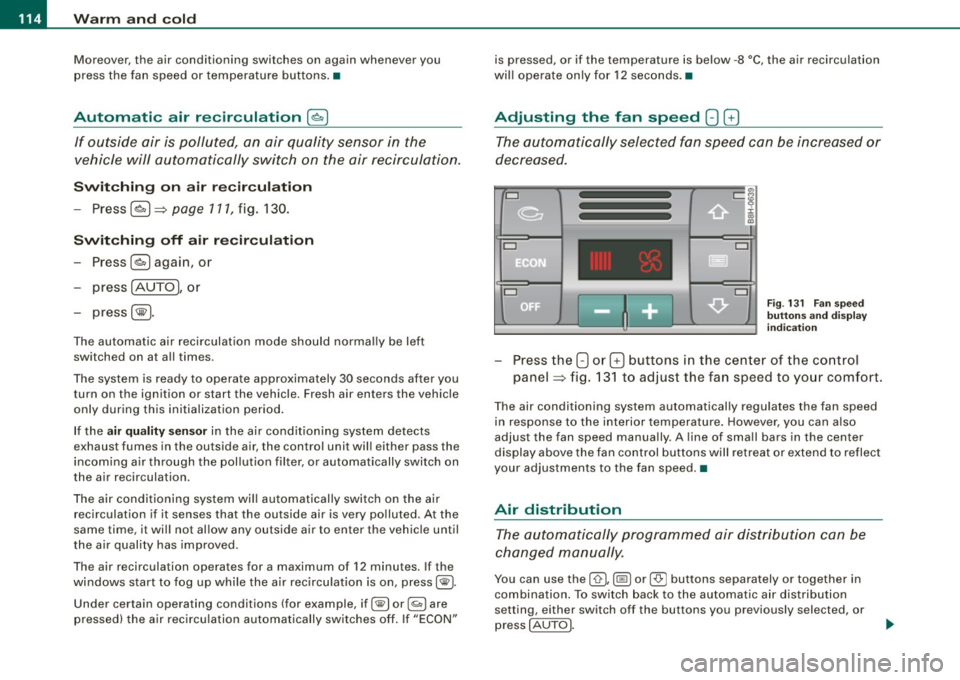
Press the 8 or G buttons in the center of the co ntrol
panel :::::, fig. 13 1 to adjust the fan speed to your comfort.
The air conditioning system automatical ly regulates the fan speed
in respo nse to the i nterior temperature . However, you can a ls o
adjust the fan speed manually . A line of sma ll bars in the center
display above the fan control but tons will retreat or ex tend to reflect
your adjustments to the fan speed .•
Air distribution
The aut omatically pr ogr am med air dis tribution ca n be
c ha nged m anu ally.
You can use the [ 0 I, (@ ] or [-0- J buttons separately or together in
combina tion . To swi tch back to the au tomatic air distribution
setting, either switch off the buttons you previously selected, or
press
[ AUTO J.
Page 117 of 340
Warm and cold -_______________ ____,
Each of the three buttons has its own specific function (the refer
ence numbers refer to the air outlets)
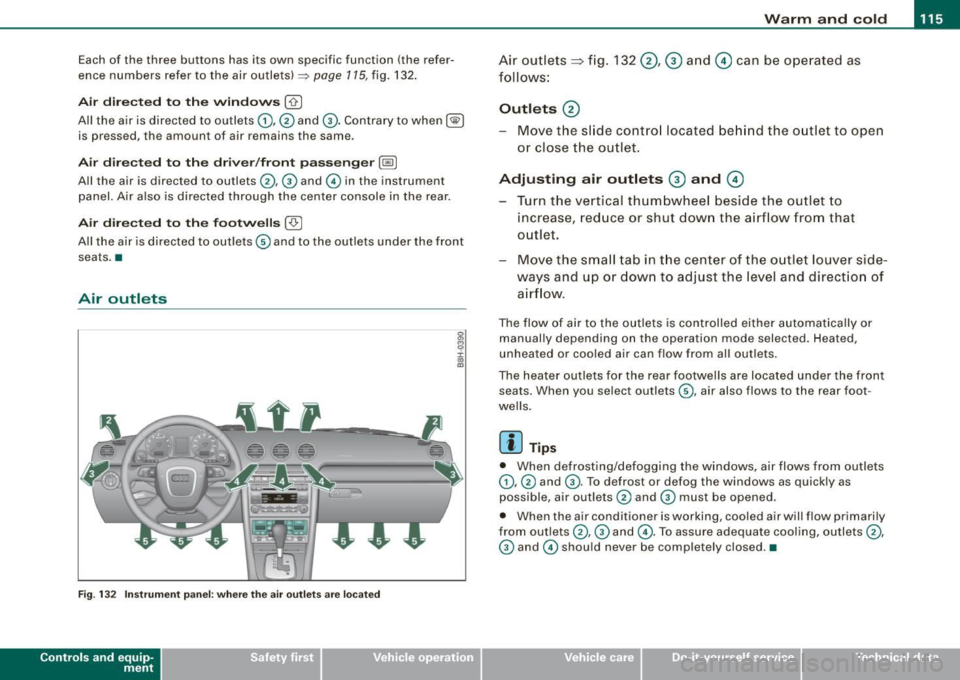
~ page 115, fig . 132 .
Air di recte d t o th e w indows [-0 ]
All the air is directed to outlets 0),@ and G). Contrary to when [@I
is pressed, the amount of air remains the same.
Ai r d irecte d to th e driv er /fr ont passe nge r[~ ]
All the air is directed to outlets @,© and © in the instrument
panel. Air also is directed through the center console in the rear .
Air directed to th e fo otwell s ( ,O. I
All the air is directed to outlets © and to the outlets under the front
seats. •
Air outlets
Fig. 132 Instr ume nt pane l: w here t he ai r outlets are l ocate d
Contro ls and eq uip
ment
Air outlets => fig . 132 @ , ® and 0 can be o perated as
follows :
Outlets @
Move the slide contro l located be hind the outlet to open
or close the outlet .
Adjusting air outlets ® a nd 0
Turn the vertical thumbwheel beside the ou tlet to
increase, red uce o r shut down the a irflow from that
o utlet.
Move the small tab in t he center of the o utlet louver side
ways and up or dow n to adjust the level and direct io n of
a irfl ow.
The flow of air to the outlets is controlled either automa tically or
manually depending on the opera tion mode selected . Heated,
unheated or cooled air can flow from all out le ts.
The heater outlets for the rear footwells are located under the front seats . When you select outlets
G) , air also flows to the rear foot
we lls.
[ i ] Tips
• When defrosting/defogging the windows, air flows from outlets
0) , © and ®· To defrost or defog the windows as quickly as
possible, air outlets © and © must be opened.
• When the air conditione r is working, cooled air will flow primarily
from outlets @, G) and
@. To assure adequate cooling, outlets@,
© and © should never be completely closed .•
~ehicle care irechnical data
Page 118 of 340
![AUDI A4 CABRIOLET 2009 User Guide • .___w_ a_ r_ m __ a_n_ d_ c_ o_ld ________________________________________________ _
Defrosting/defogging the windshield[@]
The windshield and side windows are quickly defrosted or
de](/img/6/57553/w960_57553-117.png "AUDI A4 CABRIOLET 2009 User Guide • .___w_ a_ r_ m __ a_n_ d_ c_ o_ld ________________________________________________ _
Defrosting/defogging the windshield[@]
The windshield and side windows are quickly defrosted or
de")
• .___w_ a_ r_ m __ a_n_ d_ c_ o_ld ________________________________________________ _
Defrosting/defogging the windshield[@]
The windshield and side windows are quickly defrosted or
defogged
- Press[@]=> page 111, fig. 130.
- Press[@] again or press !AUTO] to switch off the
defroster.
The temperature is automatical ly controlled. Maximum airflow is
primarily b lown in through out lets
0 , © and 0 => page 115 .
Outlets © can be opened and closed with the controls behind
them . Outlets © and
0 must be opened so the windows can be
defrosted as quickly as possible .
By pressing[ @], air recirculation and ECON are switched off. •
Defrosting/defogging the rear window QiP
The rear window defogger removes moisture fr om the
rear window.
- Press the QuJ switch to switch the rear window defogger
on a nd off.
The rear window defogger works only when the ignition is switched
on. The ligh t in the switch will illum inate when the defogger is on.
When the outside temperature is warmer than 32 °F
(0 °C), the rear
window defogger switches off automatically after about ten
m inutes .
'£> For the sak e of the environment
Swi tch off the defogger when the rear window is c lear. When you
save e lectricity, you save fuel. •
Using the climate controls economically
Using the climate controls pru dently can help save fuel.
When you use the air conditioner, engine power is reduced
and fuel consump tion increases. To save fuel, yo u sh ould
use the air conditio ner on ly when necessary. Also please
n ote th e follow ing points:
- If you want to save fuel, activate ECON.
- If you are goi ng to drive with the power top down, use
ECON.
'£> For the sake of the environment
By reducing the amount of fue l you use, you also reduce the amount
of pol lutants emitted into the air .•
App lies to vehic les: with elec tr ically heated seats
Electrically heated front seats
With the i gnition on, the seat cushion and backrest of the
fron t seats can be heated.
Fig . 133 C enter
c o n sole: thumbwh eels
fo r fr ont seat heati ng ....
Page 149 of 340
________________________________________________ D_r_iv _ i _n...: g=--- S_ a_ fe--= ly'---------"'
- Make sure that all lights and signals are operating
correctly.
- Make sure that the tire pressure is correct.
- Make sure that all windows are clean and afford good
visibility to the outside.
- Secure all luggage and other items carefully~
page 107.
-Make sure that nothing can interfere with the pedals.
- Adjust front seat, head restraint and mirrors correctly for
your height.
- Instruct passengers to adjust the head restraints
according to their height.
- Make sure to use the right child restraint correctly to
protect children~
page 190, "Child Safety".
- Sit properly in your seat and make sure that your passen
gers do the same
~ page 92, "General recommenda
t ions" .
- Fasten your safety belt and wear it properly. Also instruct
your passengers to fasten their safety belts properly
~ page 159. •
What impairs driving safety?
Safe driving is directly related to the condition of the
vehicle, the driver as well as the driver's ability to concen
trate on the road without being distracted.
The driver is responsible for the safety of the vehicle and all
of its occupants. If your ability to drive is impaired, safety
risks for everybody in the vehicle increase and you also
Controls and equip
ment Safety first Vehicle operation
become a
hazard to everyone else on the road ~& .There
fore:
- Do not let yourself be distracted by passengers or by
using a cellular telephone.
- NEVER drive when your driving ability is impaired (by
medications, alcohol, drugs, etc.I.
- Observe all traffic laws, rules of the road and speed limits
and plain common sense.
- ALWAYS adjust your speed to road, traffic and weather
conditions.
- Take frequent breaks on long trips. Do not drive for more
than two hours at a stretch.
- Do NOT drive when you are tired, under pressure or when
you are stressed.
& WARNING
Impaired driving safety increases the risk of serious personal
injury and death whenever a vehicle is being used. •
Vehicle care Do-it-yourself service Technical data
Page 170 of 340
___ A_ ir_b _ a_ g~ s_ y_s _t _e _m _________________________________________________ _
Airbag system
Important things to know
Importance of wearing safety belts and
sitting properly
Airbags are only supplemental restraints. For airbags to
do their job, occupants must always properly wear their
safety belts and be in a proper seating position.
For your safety and the safety of your passengers, before
driving off, a lways:
- Adjust the driver's seat and steering wheel properly
=>
page 148,
- Adjust the front passenger's seat properly => page 93,
- Wear safety belts properly=> page 162,
- Always properly use the proper child restraint to protect
children=>
page 190 .
In a collision airbags must inflate within the blink of an eye and with
considerable force . Th e suppl emental airbags can caus e injuries if
the driver or the front seat passenger are not seated proper ly . There
fore in order to help the airbag to do its job, it is impor tant, both as
a driver and as a passenger to sit properly at all times.
By keeping room between your body and the steering wheel and the
front of the passenger compartment, the airbag can inflate fully and
completely and prov ide supplementa l protection in certain frontal
collisions ~
page 148, "Proper occupant seating positions" . For
details on the operation of the seat adjustment controls~
page 93
and ~ page 96.
It's especially important that chi ldren are proper ly restrained
~ page 190.
There is a lot that the driver and the passengers can and must do to
help the individual safety features installed in your Audi work
together as a system.
Proper seating posi tion is important so that the front airbag on the
driver side can do its job. If you have a physical impairment or
condition that prevents you from sitting properly on the driver seat
with the safety belt properly fastened and reaching the pedals, or if
you have concerns with regard to the function or operation of the
Advanced Airbag System, please contact your authorized Audi
dea ler or qua lif ied workshop, or call Audi Customer CARE at 1-800 -
822 -2834 for possible modifications to your vehicle .
When the airbag system deploys, a gas generator wi ll fill the
airbags, break open the padded covers, and inflate between the
steering wheel and the driver and between the instrument panel
and the front passenger. The airbags will deflate immediately after
deployment so that the front occupants can see through the wind
shield again without interruption .
All of this takes p lace in the blink of an eye, so fast that many people
don't even rea lize that the airbags have dep loyed. The airbags also
inflate with a great deal of force and nothing should be in their way
when they deploy . Front airbags in combination with properly worn
safety bel ts slow down and limit the occupant's forward movement.
Together they help to prevent the driver and front seat passenger
from hitting parts of the inside the vehicle while reducing the forces acting on the occupant during the crash . In this way they help to
reduce the risk of injury to the head and upper body in the crash .
Airbags do not protect the arms or the lower parts of the body.
Both front airbags w ill not in flate in al l frontal collisions . The trig
gering of the airbag system depends on the vehic le deceleration
rate caused by the collision and registered by the electronic contro l
unit. If this rate is below the reference value programmed into the
control unit, the airbags will not be triggered, even though the car
may be badly damaged as a result of the collision . Vehicle damage, .,
Page 175 of 340
Airbag syst em -----------------=~-
& WARNIN G (cont in u ed)
• Airb ag work m ost effectiv ely when u sed with properly worn
sa fet y be lt s .
• Ther efore , always wear your safety belt s and ma ke sure that
eve rybod y in your vehi cle is prope rly re str ained.
& WARNING
A person on the front p assenger se at, espe cially infant s and small
c hildren , will re ceive seriou s injuries and can ev en be killed by
being t oo clos e to the airbag when it infl ates.
• Although the Adva nced Airbag System in your ve hicle i s
de signed to turn off the front passenger airb ag i f a n infant or a
s mall child i s on the front pa ssenger seat , nobody can absolutely
gu ara ntee that deployment under these spe cial co nditio ns is
impos sible in all conceivable situations that m ay happen during
the useful life of your vehicle.
• The Adv an ced Airbag Sy stem can deploy in a ccordance with
the "lo w risk" option unde r the U .S. Feder al Stand ard if a child t hat
is heavier than the typi cal on e-year old child i s on th e front
pa sse nger seat an d the other condition s for airb ag dep loym ent
are met.
• Acc ident stat istics have sh own that children are gen erally s afer
in the rear se at area than in the front seating posit ion .
• For th eir own safet y, all children , espe cially 12 yea rs and
younger , should alway s ride in th e back properly r estrained for
their age and size. •
Advanced front airbag system
Your vehicle is equipped with a front Advanced Airbag System in
compliance with United States Federal Motor Vehicle Sa fety Stan
dard 208 as applicable at the time your vehicle was manufactured.
Controls and equip
ment Safety first Vehicle operation
The front Advanced Airbag System supplements the safety belts to
provide additional protection for the driver's and front passenger's
heads and upper bodies in frontal crashes. The airbags inflate only
in frontal impacts when the vehic le deceleration is high enough.
The front Advanced Airbag System for the front seat occupants is not a substitute for your safety belts . Rather, it is part of the overall
occupant restraint system in your vehicle. A lways remember that
the airbag system can only help to protect you, if you are sitting
upright, wear ing your safety be lt and wear ing it proper ly . This is why
you and your passengers must a lways be properly restrained, not
just because the law requires you to be .
The Advanced A irbag System in your veh ic le has been certified to
meet the "low risk" requirements for 3 and 6 year -o ld children on the
passenger side and very small adults on the driver side. The low risk
deployment criteria are intended to he lp reduce the risk of injury
through interact ion with the front airbag that can occur, for
examp le, by being too close to the steering whee l and instrument
panel when the airbag inflates.
In addition, the system has been certified to comply with the
"suppression" requirements of the Safety Standard, to turn off the
front airbag for infants 12 months old and younger who are restrained on the front passenger seat in child restraints that are
listed in the Standard~
page 192, "Child restraints and Advanced
Airbags".
"S uppression" requi res the front ai rbag on the passenger side to be
turned off if:
• a child up to about one year of age is restrained on the front
passenger seat in one of the rear-facing or forward-facing infant
restraints listed in Federal Motor Vehicle Safety Standard 208 with
wh ich the Advanced Airbag System in your vehicle was certified. For
a listing of the child restraints that were used to certify your
vehic le's compliance wi th the US Safety Standard ~
page 192,
• weight less than a threshold leve l stored in the control unit is
detected on the front passenger sea t. _.
Vehicle care Do-it-yourself service Technical data
Page 176 of 340
___ A_ ir_b _ a_ g~ s_ y_s _t _e _m _________________________________________________ _
When a person is detected on the front passenger s eat, wei ghing
mo re tha n th e to ta l w eigh t of a c hild th at is a bout 1 year old
r estra in ed in one of th e rear -faci ng or forward -fac ing infa nt
r e str aints (lis ted i n Fede ra l M otor Veh icle Safe ty Sta ndard
2 08 with
which the Advanced Airba g Syst em in your vehic le was certified),
the fro nt a irbag on the pas senge r side may or may not dep loy.
Th e
PASSENGER AIR BAG OFF lig ht comes on when th e elect ro ni c
control unit detects a total weight on the front passenger seat that
r e qui re s th e front airbag to b e tu rn ed off. If the
PASSENGER AIR BAG
OFF
light does not come on, the front airbag on the passenger side
h as not been tu rned off by the co ntro l unit and can dep loy i f the
control unit senses an impact that meets the conditions stored in its
m emo ry .
I f the t otal we ight on the fro nt passe nger seat is more than t hat o f
a typical
1 year -old, but less than the we ight of a sma ll adult, the
fr ont airba g on the passen ger side may dep loy (the
PASSENGER AIR
BAG OFF
li ght does not come onl.
For example , the airbag may deploy if:
• a sma ll child that is heav ie r th a n a t ypica l 1 year-old ch ild is on
the front passenger seat (regardless of whether the chi ld is in one
o f th e c hild sa fety seats listed~
page 192),
• a ch ild who has ou tg rown chi ld restrain ts is o n the front
p asse nger seat.
I f the front passenge r airbag is turned off, the
PASSENGER AIR BAG
OFF
l ig ht in the ce nter of t he i nstrum ent panel wi ll co me on and stay
on.
T he fr ont airb ag o n the pa ssenger side ma y
not deploy ( the
PASSENGER AIR BAG OFF li g ht does not illu mina te and stay l it) i f:
• a small adult o r teenager is on the front passenger seat
• a passe nge r w ho is no t sitt ing uprig ht wi th their bac k aga inst a
non -reclined bac krest with their fee t on the veh icle floor in front of
the seat is on th e fr on t pass enger s eat.
I f the front passenger ai rbag deploys, the Federa l Standard requires
th e a irbag to m eet th e "low r isk" dep loy ment criter ia to he lp redu ce the risk of injury throu
gh interact ion with the airbag. "Low risk"
d ep loy ment o ccurs in th ose cra shes that ta ke pla ce a t low er dec el
erations as defined in the electronic contro l unit~
page 17 9.
Always remember: Even though your vehic le is equipped with
A dva nced Ai rbags , the sa fest place fo r chi ld re n i s p roperly
restra ined on the back seat. Please be s ure to read the important
i nfo rmatio n in th e sect io ns t hat follow and b e su re to hee d all o f the
WAR NINGS.
& WARNING
To reduce the risk of injury when an airbag inflates , always wear
safety belts properly.
• If you are unrestrained, leaning forward , sitting sideways or out
of posit ion in any way, your risk of injury is much higher.
• You will also receive serious injuries and could even be killed if
you are up against the airbag or too close to it when it inflates -
even with an Advanced Airbag=> page 168 .
& WARNING
A child in a rearward -facing child safety seat installed on the front
passenger seat will be seriously injured and can be killed if the
front airbag inflates -even with an Advanced Airbag System.
• Although the Advanced Airbag System in your vehicle is
designed to turn off the front airbag when a rearward -facing child
restraint has been installed on the front passenger seat , nobody
can absolutely guarantee that deployment is impossible in all
conceivable situations that may happen during the useful life of
your vehicle.
• The inflating airbag will hit the child safety seat or infant
carrier with great force and will smash the child safety seat and
child against the backrest , center arm rest , door, or roof .
• Alway s install rearward -facing child restraints in the back seat . •
Page 181 of 340

__________________________________________________ A_ i_ r _b _a...; g::- s_ y=--- s_t _e _m ___ __
& WARNING (continued )
airbag dur ing braking or in a sudden maneuver . Objects ne ar the
airbags can become proje ctiles and cau se injury , particularly when
the seat is reclined .
• Never tilt the front passenger seat backrest forward when the
vehicle is moving . An inflating airbag will force the backrest back
ward and can injure rear seat occupants.
_& WARNING
The fine dust created when airbags deploy can cause breathing problems for people with a history of asthma or other breathing
conditions.
• To reduce the risk of breathing problems, those with asthma or
other respiratory conditions should get fresh air right away by
getting out of the vehicle or opening windows or doors.
• If you are in a collis ion in which airbags deploy, wash your
hands and face with mild soap and water before eating.
• Be careful not to get the dust into your eyes , or into any cuts or
scratches .
• If the residue should get into your eyes, flush them w ith
water. •
Monitoring the Advanced Airbag
System
Airbag monitoring indicator light :~
Two sep arate in dica tors m onitor the fu ncti on of th e
Adv anced A irba g Sys tem: the airbag moni tor ing in dica to r
l ight and t he
PASSENGER AIR BAG OFF light.
The Advanc ed A ir b ag S yst em (includ ing the e lec tronic co ntro l unit,
sensor c ircuits and system wiring) is monitored continuously to
Controls and equip ment Safety first Vehicle operation make sure that it is functioning properly whenever the ignition is on
.
Eac h tim e you tu rn on t he ignit io n, th e airbag monitoring ind ica tor
light
fl wi ll come on for a few seconds (self diagnostics) .
The system must be inspected when the indicator l ight ~:
• do es not com e on when the ig nit ion is sw itch ed on,
• does not go out a few seconds after you have switched on the
i gni tion , or
• comes on while driving.
I f an a irbag s ystem malfu ncti on is detec ted , the indi cator light will
first start flash ing to catch the driver's attention and then sta y on
co nti nuou sly to serve as a constant r eminder to h ave the sys tem
inspected immediately.
If a malf unctio n occurs that t urns the front airbag on the passenger
s id e off , the PASS ENGER AIR BAG OFF light w ill come on a nd s ta y on
whenever the ig nition is on.
_& WARNING
An airbag system that is not functioning properly cannot provide
s upplemental protect ion in a frontal crash .
• If the airbag indicator light comes on , it means that there may
be something wrong with the Advanced Airbag System . It is
possible that the airbag will inflate when it is not supposed to, or
will not inflate when it should .
• Have the airbag system inspected immediately by your Audi
dealer. •
Vehicle care Do-it-yourself service Technical data
Page 182 of 340
___ A_ ir_b_ a..::g =-- s__,y:.... s_ t _e_ m ___________________________________________________ _
PASSENGER AIR BAG OFF light
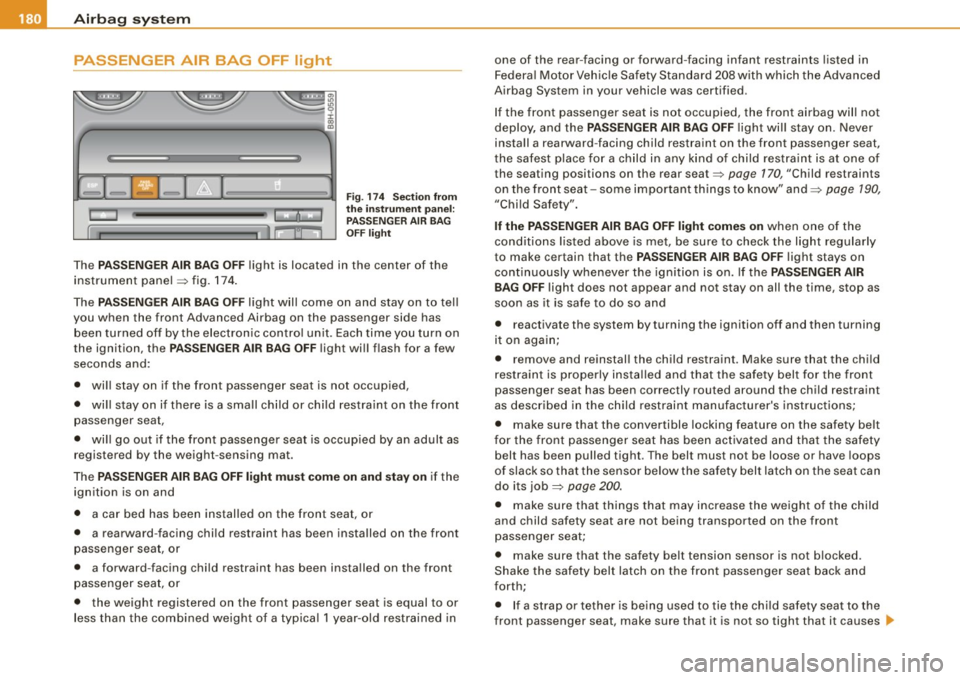
............. Fig. 174 Section from
the instrument panel:
PASSENGER AIR BAG
OFF light
The PASSENGER AIR BAG OFF light is located in the center of the
instrument panel
~ fig. 174.
The
PASSENGER AIR BAG OFF light will come on and stay on to tell
you when the front Advanced Airbag on the passenger side has
been turned off by the electronic control unit . Each time you turn on
the ignition , the
PASSENGER AIR BAG OFF light will flash for a few
seconds and :
• will stay on if the front passenger seat is not occupied,
• will stay on if there is a small child or child restraint on the front
passenger seat,
• will go out if the front passenger seat is occupied by an adult as
registered by the weight -sensing mat .
The
PASSENGER AIR BAG OFF light must come on and stay on if the
ignition is on and
• a car bed has been installed on the front seat, or
• a rearward-facing child restraint has been installed on the front
passenger seat, or
• a forward-facing child restraint has been installed on the front
passenger seat, or
• the weight registered on the front passenger seat is equal to or
less than the combined weight of a typical 1 year-old restrained in one of the rear-facing or forward-facing infant restraints
listed in
Federal Motor Vehicle Safety Standard 208 with which the Advanced
Airbag System in your vehicle was certified .
If the front passenger seat is not occupied, the front airbag will not
deploy, and the
PASSENGER AIR BAG OFF light will stay on. Never
install a rearward -facing child restraint on the front passenger seat,
the safest place for a child in any kind of child restraint is at one of
the seating positions on the rear seat~
page 170, "Child restraints
on the front seat- some important things to know" and~
page 190,
"Child Safety".
If the PASSENGER AIR BAG OFF light comes on when one of the
conditions listed above is met, be sure to check the light regularly
to make certain that the
PASSENGER AIR BAG OFF light stays on
continuously whenever the ignition is on. If the
PASSENGER AIR
BAG OFF
light does not appear and not stay on all the time, stop as
soon as it is safe to do so and
• reactivate the system by turning the ignition off and then turning
it on again;
• remove and reinstall the child restraint. Make sure that the child
restraint is properly installed and that the safety belt for the front
passenger seat has been correctly routed around the child restraint
as described in the child restraint manufacturer's instructions;
• make sure that the convertible locking feature on the safety belt
for the front passenger seat has been activated and that the safety
belt has been pulled tight . The belt must not be loose or have loops
of slack so that the sensor below the safety belt latch on the seat can
do its job
~ page 200.
• make sure that things that may increase the weight of the child
and child safety seat are not being transported on the front
passenger seat;
• make sure that the safety belt tension sensor is not blocked.
Shake the safety belt latch on the front passenger seat back and
forth;
• If a strap or tether is being used to tie the child safety seat to the
front passenger seat, make sure that it is not so tight that it causes _,,
Page 214 of 340

-In
te llig ent tec hnolo gy --=---=-=-------------
Intelligent technology
Notice about data recorded by
vehicle control modules
Your vehicle is not equipped with an Event Data Recorder (EDRl,
installed by some manufacturers for the express purpose of
capturing data for retrieval after an accident or crash event . EDR's
are sometimes called "crash recorders" .
Some state laws restrict the retrieva l or downloading of data stored
by EDR's that were insta lled in a vehicle for the express purpose of
retrieving data after an accident or crash event without the owner's
consent.
Although your vehicle is not equipped with an EDR, it is equipped
with a number of electronic control modules for various vehicle systems such as, for examp le, engine function, emission control, as
we ll as for the airbags and safety belts.
T hese electronic control modules also record vehic le-rela ted da ta
during norma l ve hicle operation for diagnost ic and repair purposes .
The recording capacity of the electronic control modules is limited
to data (no sound is recorded) and only a small amount of data is
actually recorded over a very limited period of time and stored when
a system fault or other condition is sensed by a control unit. Some
of the data then stored may relate to vehic le speed, d irection,
braking as we ll as restraint system use and performance in the
event of a crash or other condition . Stored data can only be read and
down loaded with special equipment. •
Electronic Stabilization Program (ESP)
General information
The ESP improves the vehicle s tability.
I
A F ig . 19 0 Cen ter
co nsol e w ith ESP
sw itch
ESP is designed to he lp you maintain vehic le control in situa tions
where the car approaches the limits of "grip", especially when acce lerating and cornering . ESP reduces the risk of skidding and
improves stability under all road conditions .
The syst em opera tes across the en tire speed range in combination
with the ABS system. If the Anti-Lock Brake System (ABS) malfunc
tions, the ESP wil l a lso shut down .
How th e sys te m work s
The Anti-Lock Brake System (ABS) , E lectronic Differential Lock (EDU
and the Anti -Sl ip Regu lation System (ASR) are integrated in the e lec
tronic stabi li z ation program. In addition to the data provided by
these functions, the ESP control unit requires additional measure ment data provided by high performance sensors . T he rotational
speed of the vehic le about its ver tica l axis, t he late ral acce leration
acting on the vehic le, the brake pressure and the steering ang le are
a ll measured .