brake fluid AUDI A4 CABRIOLET 2009 User Guide
[x] Cancel search | Manufacturer: AUDI, Model Year: 2009, Model line: A4 CABRIOLET, Model: AUDI A4 CABRIOLET 2009Pages: 340, PDF Size: 77.32 MB
Page 232 of 340
___ C _l_e _a _ n_ in_g ~_ a_n _ d ____ p ____ r_ o _t _e _c_ t_ i_o _n _____________________________________________ _
Cleaning and protection
General information
Regular care preserves vehicle value.
Any automob ile is exposed to industria l fumes, corrosive road salt,
muddy dog feet, etc . A well cared for Audi can look like new many
yea rs a fter purchase. Regu lar and correct care wil l co ntribut e to
maintaining the beauty and value of your Audi.
Furthermore , good care may be a condition for substantiating a
warranty claim should co rros ion damage or paint defect s occur .
Your authorized Audi dea ler has a variety of dedi cated vehicle- care
product s
and can advise which ones to use for cleani ng the exterio r
and interior of your vehicle.
Whethe r you use products recom mended by A udi or other co mmer
cially availab le cleaning agents, please make sure you app ly them
correctly.
& WARNING
• Cleaning agents may be poisonous. Keep them out of the reach
of children .
• Heed all caution label s.
• Always read directions on the container before u sing any
p roduct. Follow the direction s carefully .
• Most chemical cleaners are concentrated and have to be
d iluted.
• Use spot removing fluids only in well ventilated areas .
• Do not use gasoline , kerosene , die sel fuel , na il polish remo ver
or other volatile fluids . They may be toxic, flammab le or hazardous
in other way s. Do not wash , wax or dry the vehicle with the igni
tion on or the eng ine running.
& WA RNIN G (continued )
• Do not clean the unde rsides of chassis , fenders , wheel cover s,
etc . without protecting your hands and arms. You may cut yourself
on sh arp -edged metal part s.
• Moisture and ice on brake s may impair braking eff iciency
=> page 215 , "General info rmation ". Test the brakes ca refully each
time you wash the vehicle.
cleaning products should not disposed of in the household waste. •
Care of exterior
Washing
Frequent washing pro tects the vehi cle.
The bes t protection aga inst envi ron mental influences is frequent
washing and waxing .
Ho w o ften t his is required depends on:
• How much the vehicle is used
• Where the vehic le is parked (garage, in the ope n under t rees,
etc.)
• The sea so nal and wea the r condi tions
• Environmental influences
The longe r bir d droppings, i nsects, tree resin, road and indust ria l
grime, tar, soot, road salt and other materials remain on the vehicle
b ody, the mo re las ting thei r des tructive effects will be . _,,,
Page 252 of 340
-~_C_ h_e _c _ k_ i_ n ...:::g:;..._ a_n_ d_ f_ i_ll _in ....;g:::;.._ ___________________________________________ _
Closing the engine hood
-Pull t he hood down until the pressure from the strut is
reduced.
- Let t he hood
drop down and latch in place. Do not try to
push it shut;
it may fai l to engage ~& .
& WARNING
A hood that is not completely latched could fly up and block your
view while driving.
• When you close the engine hood, check it to make sure the
safety catch has properly engaged. The hood should be flush with
the surrounding vehicle body parts.
• If you notice while driving that the hood is not secured prop
erly, stop at once and close it. •
Working in the engine compartment
Be especially careful whenever you work in the engine
compartment.
Whenever you must perform any work in the engine compartment,
for example checking and filling different fluids, there is a risk of injury, burns and accidents. To prevent personal injury always
observe the following WARNINGS. The engine compartment of any
vehicle is a hazardous area
~ 6 .
& WARNING
To help avoid injury, before you check anything under the hood :
• Turn off the engine.
• Remove the ignition key.
• Apply the parking brake.
& WARNING (continued)
• Move selector lever of automatic transmission to "P" (Park);
put manual transmission in Neutral.
• Always let the engine cool down. Hot components will burn
skin on contact.
• To reduce the risk of being burned, never open the hood if you
see or hear steam or coolant escaping from the engine compart
ment. Wait until no steam or coolant can be seen or heard before
carefully opening the hood .
• Keep children away from the engine compartment.
• Never spill fluids on hot engine components. They can cause a
fire.
• Never touch the radiator fan. The auxiliary electric fan is
temperature controlled and can switch on suddenly.
• Never open the coolant reservoir cap when the engine is still
warm. The coolant system is pressurized and hot coolant could
spray out.
• Protect your face, hands and arm from steam or hot engine
coolant by placing a thick rag over the cap when you open the
coolant reservoir.
• If work on the fuel system or the electrical system is necessary :
- Always disconnect the battery .
- Never smoke or work near heaters or open flames. Fluids in
the engine compartment could start a fire.
- Keep an approved fire extinguisher immediately available.
• To avoid electrical shock and personal injury while the engine
is running or being started, never touch :
- Ignition cables
- Other components of the high voltage electronic ignition
system.
• If you must perform a check or repair with the engine running:
~
Page 253 of 340
_____________________________________________ C_h_ e.::...::. c.:..k .:..in ;..:.:= g:.....:.; a.:..n :....:d ::....:. f.:.:il .:.:li .:..n :.::g:!-- ----J-
& WARNING (conti nued )
-First , fully apply the parking brake , move selector lever of
automatic transmis sion to "P " (Park) ; put manual transmiss ion
in Neutral.
- Always u se extreme caut ion to prevent clothing, jewelry , or
long hair from getting caught in the radiator fan, V-belts or
other moving parts , or from conta cting hot parts. Tie back hair
before starting , and wear no cloth ing that will hang or droop
into the engine.
• Minimize exposure to emission and chemical hazards
~ & .
& WARNING
California Proposition 65 Warning :
• Engine exhaust , some of its constituents , and certa in vehicle
components contain or emit chemicals known to the State of Cali
fornia to cause cancer and birth defects and reproductive harm . In
addition , certain fluids contained in vehicles and certain produ cts
of component wear contain or emit chemicals known to the State
of California to cause cancer and birth defects or other reproduc
tive ha rm .
• Battery post s, terminals and related acces sories contain lead
and lead compounds , chemicals known to the St ate of California
to cause cancer and reproductive harms. Wash hands after
handling.
0 Note
When adding f luids, always make sure that they are poured into the
p roper container o r filler opening, otherwise se rio us damage to
vehicle systems will occur .
W For the sake of the environment
To detect lea ks i n tim e, inspect t he v ehi cle floor pa n from u nde r
neath regularly. If you see spots from oil or other vehicle fluids, have
y o ur v ehicl e inspected by an author ized Au di dea ler. •
Engine compartment
App lies to veh icles: with 2 .0 I turbo, 4-cylinder •engine
2.0 I , 4-cylinder turbo engine (200 hp )
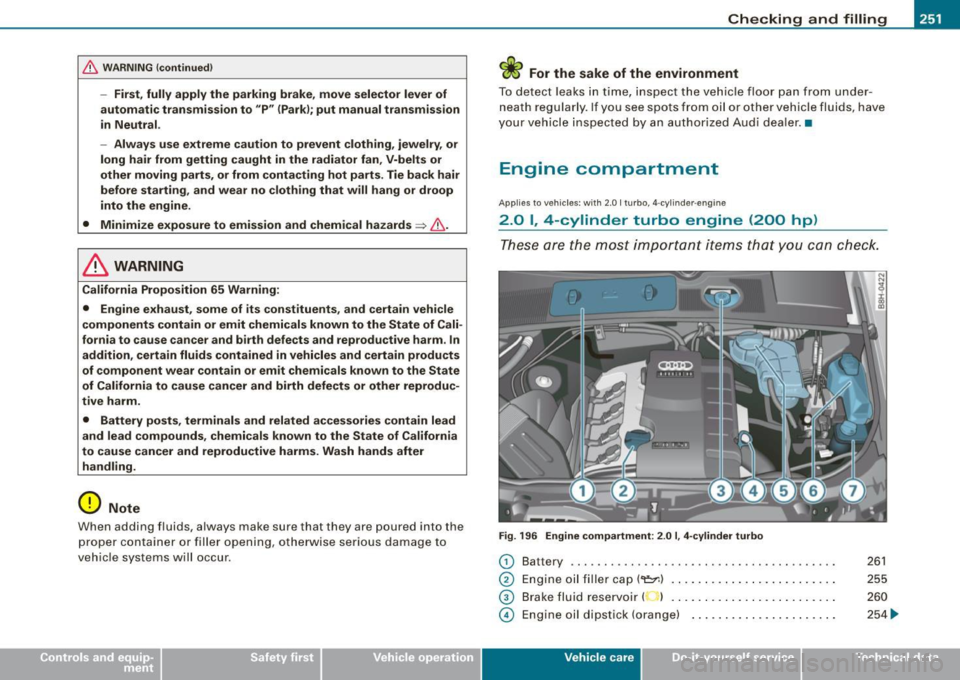
The se are th e m ost important items that you can check .
Fig. 196 Engine comp art m ent : 2 .0 I, 4-cy lind er turbo
G) Battery ..................................... •..
0 Engine oi l fi lle r ca p ('1:::r.l ..... ... ... ....... .... .. .
© Bra ke fluid reservoir ( ) ..... ... .... ... ... ... .. . .
© Engine oil dipstick (orange) ........ .......... ... .
Vehic le care
N
N
I
261
255
2 60
25 4 ...
irechnical data
Page 262 of 340
•---=C:.:h..:. e=-= c..:.k :..:.in =-=-= g~ a..:.n :.:d::....:. f.:.:il .:.:li ..:.n :..::g:!..- ___________________________________________ _
0 Note
• Coolant pollutes the environment and could cause an engine
fire. Excess coolant will be forced out through the pressure relief
valve in the cap when the engine becomes hot.
• If, in an emergency, only water can be added, the correct ratio
between water and antifreeze~
page 257must be restored as soon
as possible.
<£> For the sake of the environment
Drained coolant should not be reused. Always dispose of used
coolant while observing all environmental regulations. •
Radiator fan
The radiator fan switches on automatically by itself.
The radiator fan is driven by the engine via the V-belt. The viscous
clutch regulates the speed of the fan according to the temperature
of the coolant.
An auxiliary electric radiator fan* switches on and off depending on coolant temperature and other vehicle operating conditions.
After you switch the engine off, the auxiliary fan can continue running for up to 10 minutes - even with the ignition off. It can even
switch on again later by itself~&, if
• the temperature of the engine coolant rises due to the heat
build -up from the engine in the engine compartment, or
• the engine compartment heats up because the vehicle is parked
in intense sunlight.
& WARNING
• To reduce the risk of personal injury never touch the radiator
fan .
_& WARNING (continued)
• The auxiliary electric fan is temperature controlled and can
switch on suddenly even when the engine is not running .
• The auxiliary radiator fan switches on automatically when the
engine coolant reaches a certain temperature and will continue to
run until the coolant temperature drops. •
Brake fluid
Checking brake fluid level
The brake fluid level can be checked with a quick glance.
Fig. 203 Engine
compartment: Brake
fluid reservoir
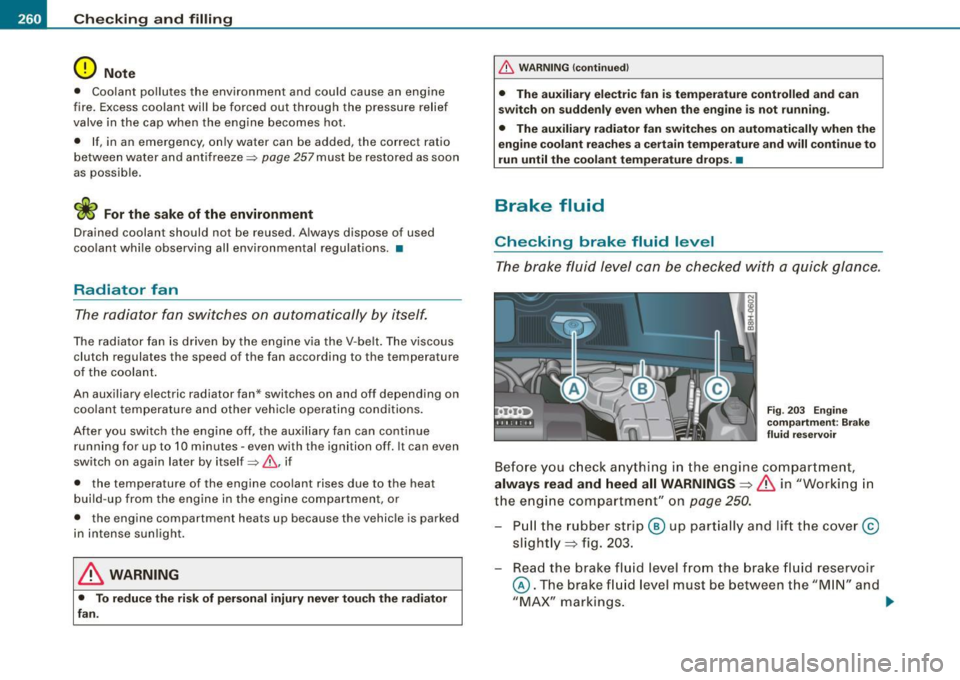
Before you check anything in the engine compartment,
always read and heed all WARNINGS:::::, & in "Working in
the engine compartment" on
page 250.
Pull the rubber strip@ up partially and lift the cover @
slightly :::::, fig. 203.
- Read the brake fluid level from the brake fluid reservoir
©. The brake fluid level must be between the "MIN" and
"MA X" markings. _..
Page 263 of 340
_____________________________________________ C_ h_ e _ c_k _in ---= g'--- a_n _d_ f_il _li _n __.,g==----•
•
The brake fluid reservoir is located at the rear partition of the engine
compartment on the left side~
page 252 .
The fluid level may drop slightly after some time due to the auto
matic adjustment of the brake pads. This is not cause for alarm .
If the brake fluid level falls
considerably below the "MIN" mark, the
brake warning/indicator light (U .S. models :
BRAKE, Canadian models :
(CD) ) wi ll come on
~ page 23 and ~ page 30. Do not continue to
operate the vehicle. The complete brake system should be thor
oughly checked by an authorized Audi dealer or qualified workshop
and the cause corrected . If the brake fluid level is too low, the brake
warning/indicator light will illuminate. Contact an authorized Audi
dea ler
immediately .•
Changing brake fluid
Have the brake fluid changed by an experienced techni
cian.
Brake fluid absorbs moisture from the air . If the water content in the
brake fluid is too high, corrosion in the brake system may result
after a period of time. The boiling point of the brake fluid wil l also
decrease considerably and decrease braking performance.
Therefore, the brake fluid must be changed
every two years. Always
use new brake fluid which conforms to Federa l Motor Vehic le Stan
dard "FMVSS 116 DOT 4".
The brake fluid reservoir can be difficult to reach, therefore, we
recommend that you have the brake fluid changed by your autho
rized
Audi dealer. Your dealer has the correct tools, the right brake
fluid and the know -how to do this for you.
& WARNING
• Brake fluid is poisonous. It must be stored only in the closed
original container out of the reach of children!
& WARNING (continued)
• Brake failure can result from old or inappropriate brake fluid.
Observe these precautions :
- Use only brake fluid that meets SAE specification
J 1703 and
conforms to Federal Motor Vehicle Standard 116. Always check
with your authorized Audi dealer to make sure you are using
the correct brake fluid. The correct type of brake fluid is also
indicated on the brake fluid reservoir .
- The brake fluid must be new . Heavy use of the brakes can
cause a vapor lock if the brake fluid is left in the system too
long. This can seriously affect the efficiency of the brakes as
well as your safety . This could result in an accident.
0 Note
Brake fluid wil l damage the paint of your vehicle .
ci> For the sake of the environment
Because of the problem of proper disposal of brake fluid as well as
the special tools required and the necessary expertise, we recom
mend that you have the brake fluid changed by your authorized Audi
dealer. •
Battery
General information
Under normal operating conditions, the battery in your Audi does
not need any maintenance. With
high outside temperatures it is
advisab le however to check the fluid level at regular intervals
through the transparent battery housing. Also check the fluid level
each time you charge the battery . After charging the battery
~ page 265, you shou ld likewise check the battery acid level. ...
Vehic le care
Page 278 of 340
-~_T_ ir_e_ s_ a_ n_d _ w_ h_ e_e _l_s _________________________________________________ _
and is more difficult to stop. Overloading can not only lead to loss
of vehic le contro l, but can also damage important parts of the
vehic le and can lead to sudden tire failure, including a blowout and
sudden deflation that can cause the vehicle to crash .
Your safety and that of your passengers also depends on making sure that load limits are not exceeded . Vehicle load includes every
body and everything in and on the veh icle . These load lim its are
technically referred to as the vehicle's
G ross Vehicle Weight R ating
("GVWR").
The "GVWR" includes the weight of the basic vehic le, all factory
installed accessories, a ful l tank of fuel, oil, coolant and other fluids
p lus maximum load. The maximum load includes the number of
passengers that the vehicle is intended to carry ("seating capacity")
with an assumed we ight of 150 lbs (68 kg) for each passenger at a
designated seating position and the total weight of any luggage in
t he vehicle. If you tow a trai ler, the weight of the trailer hitch and the
tongue weight of the loaded trai ler must be included as part of the
vehic le load .
T he
G ros s Axle Weight Rating ("GAWR") is the maximum load that
can be applied at each of the vehicle's two axles .
The Gross Vehicle Weight Rat ing and the Gross Axle Weight Rating
are listed on the safety compliance sticker labe l located either on
the d river's side B -pillar o r on t he inside of the f ue l fi ller flap. Yo ur
Audi has 4 seating positions, 2 in the front and 2 in the rear for total
seating capaci ty of 4. Each seating posi tion has a safety belt
=>
page 159, "Safety be lts" .
T he fact that there is an upper limit to your vehicle's Gross Vehicle
Weight Rating means that the total weight of whatever is being carried in the vehicle (including the weight of a trailer hitch and the
tongue weigh t of the loaded trailer) is lim ite d. The more passengers
in the vehicle or passengers who are heavier than the standard
weights assumed mean that less weight can be carried as luggage.
The tire pressure labe l on your Audi also lists the maximum
combined weight of a ll of the occupants and luggage or othe r cargo that the vehicle can carry
. For the location of the label=>
page 271,
f ig. 207 .
& WARNING
Overloading a vehicle can cau se lo ss of vehicle control , a cra sh or
other a ccident , seriou s personal injury , and even de ath .
• Carrying more weight th an your vehi cle w as designed to ca rry
will prevent the vehi cle from handling properly and in cre ase the
ri sk of the lo ss of vehicle control.
• The brakes on a veh icle th at ha s been overloaded ma y not be
able to stop the vehicle within a safe distance .
• Tire s on a vehicle that has been overloaded can fail suddenly,
i ncluding a blowout and sudden defla tion , cau sin g los s of control
and a crash .
• Alwa ys make sure that the tot al l oad be ing tran sported -
including the weight of a trai ler hit ch and the tongue weight of a
loaded trailer -does not m ake the vehicle heavie r than the
v ehicle 's Gro ss Vehicle Weight Rat ing .•
Determining correct load limit
U se th e exa mple below to calculat e the
total weight of the passengers and luggage or other things that you plan to
tran sport so that you can make sure that
your vehi cle will n ot be ov erlo ad ed.
~
Page 320 of 340
___ C_ o_n_ s_ u_m _ e_ r_ ln_ f_o _r_m _ a_ t_ i_o _n ______________________________________________ _
& WARN ING (continued )
• The engine compartment of any motor vehicle is a potentially
hazardous area . Never reach into the area around or touch the
radiator fan . It is temperature controlled and can sw itch on
suddenly -even when the engine is off and the ignition key has
been removed . The radiator fan switches on automatically when
the coolant reaches a certain temperature and will continue to run until the coolant temperature drops .
• Always remove the ignition key before anyone gets under the
vehi cle .
• Always support your vehicle with safety stands if it is neces
sary to work underneath the vehicle . The jack suppl ied with the
vehicle is not adequate for this purpose and could collapse causing serious personal injury .
• If you must work underneath the vehicle with the wheels on
the ground, always make sure the veh icle is on level ground , that
the wheels are always securely blocked and that the engine
cannot be sta rted .
• Always make sure the transmission selector lever (automatic
transmission) is in "P " (Park position ) or Neutral (manual transm is
sion) and the park brake is firmly applied.
W For the sake of the environment
• Cha ng ing t he e ngine sett ings will adverse ly aff ect em iss ion
l eve ls. This is detrimenta l to the environment and increases fuel
co nsu mp tio n .
• Always observe environmental regu lations when disposing of
ol d eng ine oil, u sed br ake fluid , d irty e ngin e coo la nt , spe nt batter ies
or worn out tires.
• Undeployed airba g modu les and prete nsioners might be classi
fied as Perchlorate Material -specia l handling may apply, see
www .dtsc.ca .gov/ hazar douswaste/perc hlorat e. When the vehic le o r
parts of the restraint system including airbag modules safety be lts
w it h pr eten sion ers ar e sc ra p pe d, a ll ap pli cab le la w s and reg ula- tions must be observed. Your authorized Audi dealer is familiar with
t
hese requi re m ents and we re co m mend th at you h ave your dealer
perform this service for you .•
Additional accessories,
modifications and parts replacement
Additional accessories and parts
replacement
Always consult an author ized Audi dealer before
pu rchasin g acc ess ori es.
Your vehicle incorporates the latest safety design features ensuring
a high standa rd o f act ive and passiv e safety .
T his saf ety coul d be compromised by non -approved changes to the
vehic le . F or t his reason, if parts have to be replace d, p lease obse rve
t h e f ollow ing po ints when i nsta lling addi tio na l acc essor ies:
App roved Aud i accessories and genuine Audi pa rts a re avai lab le
fr om autho rize d Aud i dea lers.
T hese dealers also have the necessary fac ilities, tools and trained
spec ia lists t o ins tal l the part s and accessor ie s pr oper ly .
& WARNING
Using the wrong spare parts or using non -approved accessories
can cause serious personal injury.
• Use only accessorie s expressly approved by Audi and genuine
Audi spare parts.
• These parts and accessories have been specially designed to
be used on your vehicle .
• Never install accessories such as telephone cradles or
beverage holders on airbag covers or within the airbag deploy-
Page 326 of 340

llffl __ A_l-=- p _h_ a_ b_e _t_ic _ a_l _in _ d_e _x ____________________________________________ _
A
Accessories . . . . . . . . . . . . . . . . . . . . . . . . 318
Acoustic park assist . . . . . . . . . . . . . . . . . 122
Adaptive Light Air outlets
Climate controls .. .... ...... ..... 115
How should I adjus t the air outlets to de
frost my windows as quickly as
possible? . . . . . . . . . . . . . . . . . . . . . . 115 Warning/indicator lights
... ... .... .. 20
When must the system be inspected? . ..
179
All Wheel Drive ... .... .... ...... .... 218
Alloy wheels . . . . . . . . . . . . . . . . . . . . . . . 237
defective ............. ........ .. . 34 Air quality sensor .
.... .... .... .... .. 114 All-whee l drive
adaptive light .. ... .... .... ... ...... . 79 Air recirculation
............... ..... 113
Winter tires .. ......... .... .... .. 284
Adding Engine coolant ... .... .... ...... .
259
Engine oi l ..... .... ... .... .... .. .
255
Windshield washer fluid .... .... . .
266
Additiona l accessories .. ...... ...... . 318
Additives Engine oil . ..... .. ..... ... ...... . 255
Adjusting Instrument cluster illumination .. .... 15
Steering wheel co lumn .... ... .... 118
Adjusting the seats
Manual seats ...... .... ........... 94
Advanced Airbag System . . . . . . . . . . . . 172
Children ... ........... .... ... ... 191
Components ...... .... .......... 175
Front airbags . . . . . . . . . . . . . . . . . . . . 173
How the components work together 176
Monitoring . . . . . . . . . . . . . . . . . . . . . . 179
Weight -sensing mat . .... ... .. .... 191
Air conditioning
See Climate controls . . . . . . . . . . . . . . 110
Air distribution Clima te con trols ... .... ... .... ... 114 Climate controls
...... ...... ... .. 114 Alternator
When should I use the air recircu lation?
114
Air ventilation in the glove compartment ...
108
Airbag system ..... ... .... ..... . 168, 188
Care ... ... .... .... .... .... .... .. 182
Child restraints .............. .... 192
Components (front airbags) .. ... ... 175
Danger of fitting a child safety seat on the
front passenger seat . . . . . . . . . . . . 170
Disposal . . . . . . . . . . . . . . . . . . . . . . . . 182
Front airbags . ....... ..... .... ... 172
How do the front airbags work? . . . . 177
How many airbags does my vehicle have? 175
Important safety instructions on the knee
airbag system .... .... .... .... .. 186
Important things to know ... .... .. 168
Indicator light ... .......... ... ... 179
Knee airbags .... . .. .. ........... 184
Monitoring .... .... .... .... .... .. 179
PASSENGER AIR BAG OFF light ..... 180
Repairs . . . . . . . . . . . . . . . . . . . . . . . . . 182
Side airbags . . . . . . . . . . . . . . . . . . . . . 187
See Generator . . . . . . . . . . . . . . . . . . . . 22
Anti -freeze
S ee Engine coolant system .. ...... 257
Anti-glare inside day-night mirror ...... 88
Anti-lock brake system How the ABS system works . .... ... 216
Warning/indicator lights ........... . 20
An ti- Slip Regulation System (ASR)
How the sys tem works .. ... .... ... 214
Anti-Theft Alarm System Tilt sensors ..... ....... ..... ...... 58
Anti-theft alarm system .. .. .. .... .... . 57
Anti -theft systems
Electronic immobilizer ......... .... 49
Armrest Adjusting ...... .... ..... .. ..... . 100
Storage bin
Ashtray 100
Front ....... .................... 104
Rear .......... .... .... ........ .. 105
Asterisk What does it mean when something is marked with an asterisk? . ..... ... .. 6
Audi Service Repair Manuals and Literature 316
Page 327 of 340
Alph ab eti ca l ind ex -
-------------=----
AUTO
Climate controls .. ...... ..... .... . 112
Switching on .... .... .... .... .... 112
When should I use AUTO? ....... .. 112
Auto Safety Hotl ine .. ..... ... ... .... . 155
Auto-Check Control .. ... ... .... ... .. .. 28
Automat ic air recirculation ........... 114
Automatic belt retractor .... ...... .... 163
Automatic car wash
See Washing .. .... .... ... ...... .. 231
Automatic headlight con trol ....... .... 77
Automatic rollover protection system . . 156
Automatic Shift Lock (ASLl ....... 128, 135
Automatic transm ission
6 -spe ed automatic transmission .... 126
Automatic Shi ft Lock (ASLl .... . 128, 135
Driving ........ ..... ....... ..... 126
Dynamic shif t prog ram ... .... .... . 129
Fail-safe mode ... ...... ........ .. 13 1
Ignition key safety lock ... ... ... .. . 119
Kick-down ... .... .... .... ... .... . 129
Manual sh ift program . ... .... .... . 130
multitronic® ... ... ... .... ... ..... 131
Se lector lever ..... .... ...... . 127, 133
Shift but tons . ... .... .... .... 131, 137
Steering wheel with tiptronic® . 131,137
Average speed ... ... ... ... .. ...... ... 37
Avoid damaging the v ehicle .. ... .... . 22 1
Controls and equip
ment Safety first
B
Battery .
.... .... ...... .... ... .. 261, 264
Charging ...... .. ... ..... .. .. .... 265
Checking battery acid level . .... .... 264
Important warnings when working on the batte ry . .......... .... ... .. ... . 263
Low vol tage symbo l .. ....... .... ... 34
Replacing the battery . ...... .. .... 262
Winter opera tion ... .. ...... ...... 261
Working on the battery .......... .. 263
B efore driving ... ..... .. ...... ...... 146
Blended gasoline ... ... .. .. .. .... .... 244
Body cavity sealing .. .. .. ...... .... .. 237
Boos ter seats .... .... .... .... .... ... 198
How do I properly instal l a booster seat in
my vehicle? . .......... ...... ... 198
Sa fety instructions . .... .... .... ... 198
Brake f luid
Changing the brake fluid .......... 261
Checking the brake fluid leve l .. .... 260
Reservoir . ... .... .... ....... .... . 260
What is the correct brake fluid level? 260
What shou ld I do if the brake fluid warning
light comes on? . ..... ... .... .... 260
Brake system .. ...... .... .... .... ... 260
An ti- lo ck brake system (ABS) ... .... . 20
Brake ass istant . .... .. .... .... ... . 217
Brake booster .... .... .... .... .... 216
Brake flu id .... ... .... .... .... .... 260
Brake f luid specifications for refi ll and
rep lacement . ... ..... ... .... .... 261
Brake pads ...... .... .... .... .... 220
Genera l informa tion ....... .. .... . 215 How does the moisture or road salt affect
the brakes? ....... ... .... .... ... 215
Ma lfunction ... .. .... .... .... .. .. . 30
Warning/indicator lights .. .. .... .... 23
Worn brake pads symbol . ..... .. .. . 33
B reak -in period ...... .... .... .... ... 219
B rake pads ... .... .... .. . .... .... 220
Tires ..... .... .... .... ... .... .. .. 219
Bu lbs ... ... .... ... ... ... .... ...... . 302
C
California Proposition 65 Warning . .... 251
Battery specific ..... ...... .... .... 264
Capacities Eng ine oil .... .... .... ... .... .... 31 4
Fuel tank ..... ...... .. ...... .... . 314
Windshield washer fluid ... .... .... 314
Car care ... .. .... ... .... .... .... .. .. 230
Interior ... .... .... .... ... .... .... 238
Plastic and v inyl .... ... .... .... ... 234
Weatherstr ips . .... .... .... ...... . 236
Care of exterior ..... .... .... .... .. .. 230
Cargo area
See Loading the luggage compartment .
153
Catalytic converter .. ...... ...... .... 220
Centigrade Switching between Centig rade and
Fahrenheit ...... .... .. .. ... .. .. 11 3
Certification . ............ ...... .... . 320
Changing a flat tire ....... ... .... .. .. 293
Chan ging a wheel .... .... ... .... .... 293
Vehicle operation Vehicle care Do-it-yourself service Technical data
Page 330 of 340
IIPJI Alphabetical index _ __,__ ___ ____;_...::.:...::... ___________________________ _
Hood ...... ... ...... .. ... .. .. ... 249
Starting .. .... .... ....... ... 119,120
Starting with jumper cables ....... 304
Stopping . . . . . . . . . . . . . . . . . . . . . . .
120
Engine compartment
Safety instructions . . . . . . . . . . . . . . .
250
Working in the engine compartment 250
Engine coolant .................. ... 258
Checking the engine coo lant level .. 258
Malfunction warning symbol ... ..... 31
Engine coolant level
Checking ... .. .... .... ..........
258
E . I
ngine coo ant system ... .... ....... 257
Adding coolant .................. 259
Radiator fan . . . . . . . . . . . . . . . . . . . . . 260
Engine coolant temperature
Temperature gauge ....... .... ....
13
Engine data ...... ............... ... 314
Engine hood Closing ... .... ... .... .... ...... .
250
How to release the hood . . . . . . . . . . 249
Opening .. .... .... ....... .... ... 249
Engine oil ... ... .... .... .... ... .... 252
Adding ... .. ...... ... .... ...... . 255
Additives . . . . . . . . . . . . . . . . . . . . . . . 255
Changing . .............. ........ 256
Checking the engine oil level ...... . 254
Indications and conditions requiring extra
checking .... .... ....... .... ...
254
Indicator light . . . . . . . . . . . . . . . . . . . . 33
Oil capacity . . . . . . . . . . . . . . . . . . . . .
314
Oil consumption ................. 254
Oil grades . . . . . . . . . . . . . . . . . . . . . . . 252
Recommended oil check intervals .. 254
Sensor defective . . . . . . . . . . . . . . . . . . 33
Specification and viscosity ...... ..
252
Engine oil pressure
Malfunction .. ....... ..... ... .... . 32
Environment Break -in period .... .... .... .... ..
219
Catalytic converter .... .... .... ... 220
Disposing of your vehic le battery ...
262
Driving at high speeds ...... .... .. 221
Driving to minimize pollution and noise .
221
Fuel ......... .... ... .. .... .... .. 246
Fuel economy ....... ...... ...... 221
Leaks under your vehicle . ...... ... 250
Letting the vehicle stand and warm up
222
Proper disposa l of drained brake fluid
261
Proper disposal of drained engine
coo lant ..................... ...
259
Proper disposa l of drained engine oil
255,256
Recycling used eng ine oil ......... 255
Unleaded fuel ... .... ..... .... ... 244
What should I do with an old battery?
262
EPC
See Electronic power control .. ... .. . 22
ESP Electronic stabi lization program ....
212
See also Electronic stabilization program
(ESP) . ... .... .... ........ ......
212
Event Data Recorder (EDR) .. ....... .. 212
Expansion tank .. .. .. .. .. .... .... ... 258
F
Fahrenheit
Switching between Fahrenheit and Centigrade ... .... ..............
113
Fan
Climate controls ... ....... .... ...
114
Radiator ...... .... ........... ... 260
Setting the fan speed 114
Flat tire
Changing .. .... .... ............. 293
Floor mats
Fog lights
153
Front ....... ...... .... ........ ... 79
Folding master key with remote control . 47
Foot pedals . ... .. .... .... .... ...... 152
For the sake of the environment
Gaso line fumes and the environment
246
Letting your engine warm up ....... 120
Reducing engine noise by early
upshifting ......................
13
Refueling ......... ...... ........ 246
Saving fuel by early upshifting . ..... 13
Using the rear window defogger ....
116
Front airbags
Description ......................
172
How they work ..... .... ....... ... 177
Front ashtray . . . . . . . . . . . . . . . . . . . . . . . 104
Front seat adjustment
Safety guide lines .................. 92