child lock AUDI A4 CABRIOLET 2009 User Guide
[x] Cancel search | Manufacturer: AUDI, Model Year: 2009, Model line: A4 CABRIOLET, Model: AUDI A4 CABRIOLET 2009Pages: 340, PDF Size: 77.32 MB
Page 166 of 340
-Safety belts ___ .:,__ _____________________________________ _
Automatic safety belt retractors
Every safety belt is equipped with an automatic belt retractor on the
shoulder bel t. This featu re locks the bel t when the belt is pulled out
fast, during hard braking and in an accident. The belt may also lock
when you drive up or down a steep hill or through a sharp curve. During normal driving the bel t lets you move freely.
Safety belt pretensioners
The safety belts are equipped with a belt pretension er that helps to
tighten the safety belt and remove slack when the pretensioner is
activated. The function of the pretensioner is monitored by a
warning light:::::, page
20, "Airbag system @;".
Switchable locking feature
Every safe ty belt except the one on the driver seat is equipped with
a switchable locking feature that must be used when the safety belt
is used to attach a child seat . Be sure to read the important informa
tion about this feature:::::, page
200.
& WARNING
Improperly positioned safety belts can cause serious injury in an
accident :::::,
page 164, "Safety belt position" .
• Safety belts offer optimum protection only when the seat back
is upright and belts are properly positioned on the body.
• Never attach the safety belt to the buckle for another seat.
Attaching the belt to the wrong buckle will reduce safety belt
effectiveness and can cause serious personal injury.
• A passenger who is not properly restrained can be seriously
injured by the safety belt itself when it moves from the stronger
parts of the body into critical areas like the abdomen.
• Always lock the convertible locking retractor when you are
securing a child seat in the vehicle :::::,
page 202. •
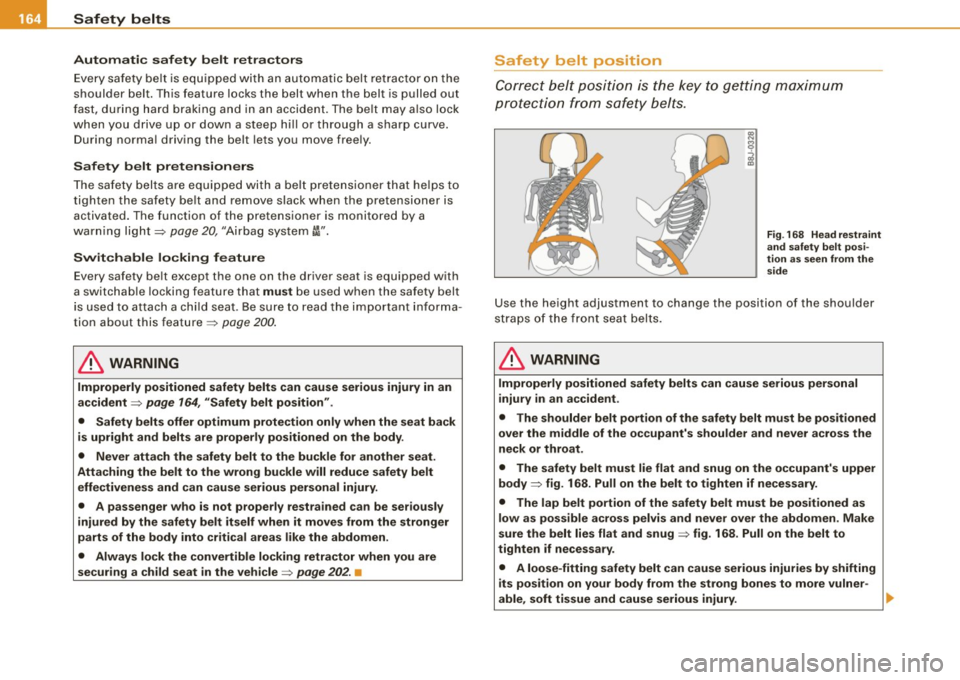
Safety belt position
Correct belt position is the key to getting maximum
protection from safety belts.
Fig . 168 Head restraint
and safety belt posi
tion as seen from the
side
Use the height adjustmen t to change the position of the shoulder
straps of the front seat belts.
in. WARNING
Improperly positioned safety belts can cause serious personal
injury in an accident .
• The shoulder belt portion of the safety belt must be positioned
over the middle of the occupant's shoulder and never across the
neck or throat.
• The safety belt must lie flat and snug on the occupant's upper
body
:::::> fig. 168. Pull on the belt to tighten if necessary.
• The lap belt portion of the safety belt must be positioned as
low as possible across pelvis and never over the abdomen. Make
sure the belt lies flat and snug :::::, fig. 168. Pull on the belt to
tighten if necessary.
• A loose-fitting safety belt can cause serious injuries by shifting
its position on your body from the strong bones to more vulner-
able, soft tissue and cause serious injury. ..,.
Page 182 of 340
___ A_ ir_b_ a..::g =-- s__,y:.... s_ t _e_ m ___________________________________________________ _
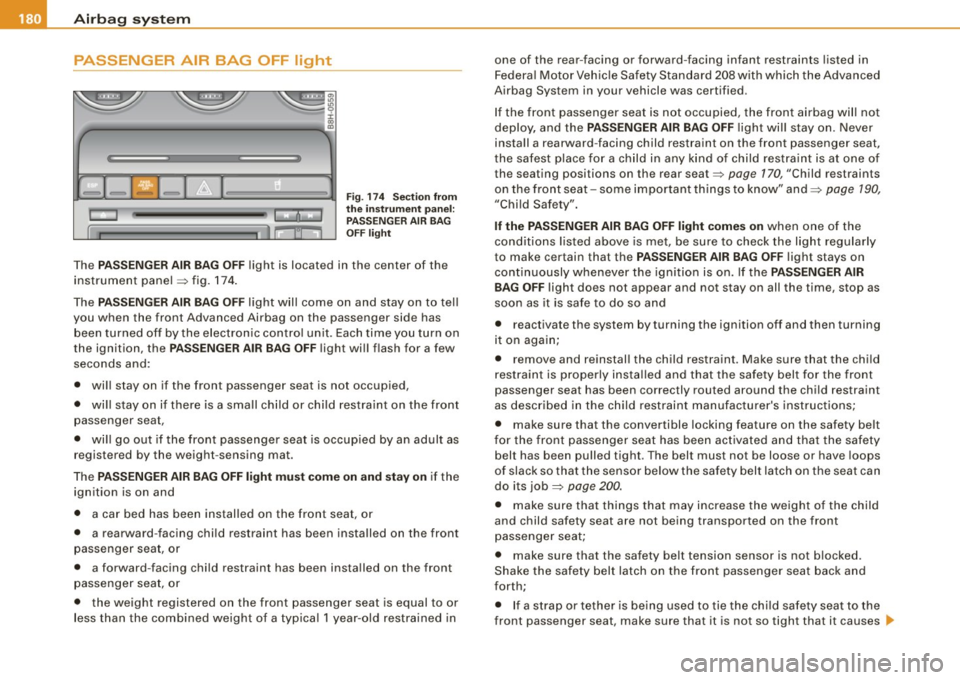
PASSENGER AIR BAG OFF light
............. Fig. 174 Section from
the instrument panel:
PASSENGER AIR BAG
OFF light
The PASSENGER AIR BAG OFF light is located in the center of the
instrument panel
~ fig. 174.
The
PASSENGER AIR BAG OFF light will come on and stay on to tell
you when the front Advanced Airbag on the passenger side has
been turned off by the electronic control unit . Each time you turn on
the ignition , the
PASSENGER AIR BAG OFF light will flash for a few
seconds and :
• will stay on if the front passenger seat is not occupied,
• will stay on if there is a small child or child restraint on the front
passenger seat,
• will go out if the front passenger seat is occupied by an adult as
registered by the weight -sensing mat .
The
PASSENGER AIR BAG OFF light must come on and stay on if the
ignition is on and
• a car bed has been installed on the front seat, or
• a rearward-facing child restraint has been installed on the front
passenger seat, or
• a forward-facing child restraint has been installed on the front
passenger seat, or
• the weight registered on the front passenger seat is equal to or
less than the combined weight of a typical 1 year-old restrained in one of the rear-facing or forward-facing infant restraints
listed in
Federal Motor Vehicle Safety Standard 208 with which the Advanced
Airbag System in your vehicle was certified .
If the front passenger seat is not occupied, the front airbag will not
deploy, and the
PASSENGER AIR BAG OFF light will stay on. Never
install a rearward -facing child restraint on the front passenger seat,
the safest place for a child in any kind of child restraint is at one of
the seating positions on the rear seat~
page 170, "Child restraints
on the front seat- some important things to know" and~
page 190,
"Child Safety".
If the PASSENGER AIR BAG OFF light comes on when one of the
conditions listed above is met, be sure to check the light regularly
to make certain that the
PASSENGER AIR BAG OFF light stays on
continuously whenever the ignition is on. If the
PASSENGER AIR
BAG OFF
light does not appear and not stay on all the time, stop as
soon as it is safe to do so and
• reactivate the system by turning the ignition off and then turning
it on again;
• remove and reinstall the child restraint. Make sure that the child
restraint is properly installed and that the safety belt for the front
passenger seat has been correctly routed around the child restraint
as described in the child restraint manufacturer's instructions;
• make sure that the convertible locking feature on the safety belt
for the front passenger seat has been activated and that the safety
belt has been pulled tight . The belt must not be loose or have loops
of slack so that the sensor below the safety belt latch on the seat can
do its job
~ page 200.
• make sure that things that may increase the weight of the child
and child safety seat are not being transported on the front
passenger seat;
• make sure that the safety belt tension sensor is not blocked.
Shake the safety belt latch on the front passenger seat back and
forth;
• If a strap or tether is being used to tie the child safety seat to the
front passenger seat, make sure that it is not so tight that it causes _,,
Page 195 of 340
_______________________________________________ C_h _i_ld _ S_ a_ f_ e_ t...:; y ______ lllll
C . Forward-facing convertible child restraint systems,
manufactured on or after September 1, 2004:
• Britax Roundabout 161
• Britax Expressway
• Century Encore 4612
• Century STE 1000 4416
• Cosco Olympian 02803
• Cosco Touriva 02519
• Evenflo Horizon V 425
• Evenflo Medallion 254
• Safety First Comfort Ride 22-400
& WARNING
To reduce the risk of serious injury, make sure that the PASSENGER
AIR BAG OFF light comes on and stays on whenever a child restraint is installed on the front passenger seat and the ignition
is switched on.
• Take the child restraint off the front passenger seat and install
it properly at one of the rear seat positions if the PASSENGER AIR
BAG OFF light does not stay on.
• Have the airbag system inspected by your authorized Audi
dealer immediately .
[ i] Tips
The child seats listed in categories A to C have been tested by Audi
only for the Advanced Airbag function. •
Controls and equip
ment Safety first Vehicle operation
Important safety instructions for using child
safety seats
Correct use of child safety seats substantially reduces the
risk of injury in an accident!
As the driver, you are responsible for the safety of every
body in the vehicle, especially children:
- Always use the right child safety seat for each child and
always use it properly~
page 195.
-Always carefully follow the child safety seat manufac
turer's instructions on how to route the safety belt prop
erly through the child safety seat.
- When using the vehicle safety belt to install a child safety
seat , you must first activate the convertible locking
retractor on the safety belt to prevent the child safety
seat from moving~
page 200.
-Push the child safety seat down with your full weight to
get the safety belt really tight so that the seat cannot
move forward or sideways more than one inch (2.5 cm).
- If a strap or tether is being used to tie the child safety
seat to the front passenger seat, make sure that it is not
so tight that it causes the weight-sensing mat to
measure more weight than is actually on the seat.
Always remember: Even though your vehicle is equipped with an
Advanced Airbag system, all children, especially those 12 years and
younger, should always ride in the back seat properly restrained for
their age and size. •
Vehicle care Do-it-yourself service Technical data
Page 197 of 340
& WARNING (continued)
-Always move the front passenger seat into the rearmost
position of the passenger seat's fore and aft adjustment range,
and as far away from the airbag as possible before installing
the child restraint.
- Always make sure that nothing prevents the front
passenger's seat from being moved to the rearmost position in
its fore and aft adjustment range.
- Always make sure that the backrest is in the upright posi
tion.
• Always buckle the child safety seat firmly in place even if a
child is not sitting in it. A loose child safety seat can fly around
during a sudden stop or in a collision.
• Always read and heed all WARNINGS whenever using a child
restrained in a vehicle is being used=>
page 159, "Safety belts",
=>
page 168, "Airbag system" and=> page 190, "Child Safety".
& WARNING
To reduce the risk of serious injury, make sure that the PASSENGER
AIR BAG OFF light comes on and stays on whenever a child
restraint is installed on the front passenger seat and the ignition
is switched on.
• Take the child restraint off the front passenger seat and install
it properly at one of the rear seat positions if the PASSENGER AIR
BAG OFF light does not stay on.
• Have the airbag system inspected by your authorized Audi
dealer immediately. •
Safety first
Child Safety
Child safety seats
Infant seats
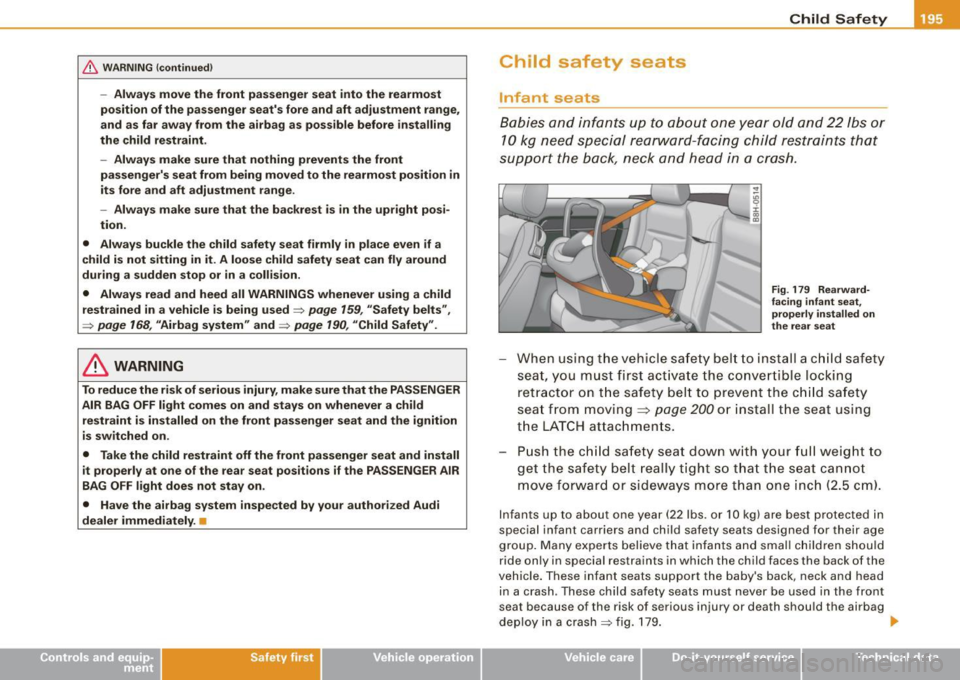
Babies and infants up to about one year old and 22 lbs or
10 kg need special rearward-facing child restraints that
support the back, neck and head in a crash.
Fig. 179 Rearward
facing infant seat,
properly installed on
the rear seat
-When using the vehicle safety belt to install a child safety
seat, you must first activate the convertible locking
retractor on the safety belt to prevent the child safety
seat from moving
=> page 200 or install the seat using
the LATCH attachments.
- Push the child safety seat down with your full weight to
get the safety belt really tight so that the seat cannot
move forward or sideways more than one inch (2.5 cm).
Infants up to about one year (22 lbs. or 10 kg) are best protected in
special infant carriers and child safety sea ts designed for their age
group. Many experts believe that infants and small children should
ride only in special restraints in which the child faces the back of the
vehicle. These infant seats support the baby's back, neck and head
in a crash. These child safety seats must never be used in the front
seat because of the risk of serious injury or death should the airbag
deploy in a crash => fig. 179. .,,.
~ehicle care irechnical data
Page 198 of 340
___ C_h_ i_ ld _ S_ a_ f_ e_ t--= y'------------------------------------------------
& WARNING
Not using a child safety seat, using the wrong child safety seat or
improperly installing a child restraint increases the risk of serious
personal injury and death in a crash.
• Never install rear-facing child safety seats or infant carriers on
the front passenger seat -even with an Advanced Airbag System.
A child will be seriously injured and can be killed when the
inflating airbag hits the child safety seat or infant carrier with
great force and smashes the child safety seat and child against the
backrest, center arm rest, or door=>
page 170, "Child restraints on
the front seat -some important things to know".
• Always install rear-facing child safety seats or infant carriers on
the rear seat.
• Never install a rear-facing child restraint
in the forward-facing
direction. Such restraints are designed for the special needs of
infants and very small children and cannot protect them properly
if the seat is forward-facing.
• If you must install a rearward facing
child safety seat on the
front passenger seat because of exceptional circumstances and
the PASSENGER AIR BAG OFF light does not come on and stay on,
immediately install the rear-facing child safety seat in a rear
seating position and have the airbag system inspected by your
Audi dealer.
• Always read and heed all WARNINGS whenever using a child
restrained in a vehicle is being used=>
page 159, "Safety belts",
=> page 168, "Airbag system" and=> page 190, "Important things
to know". •
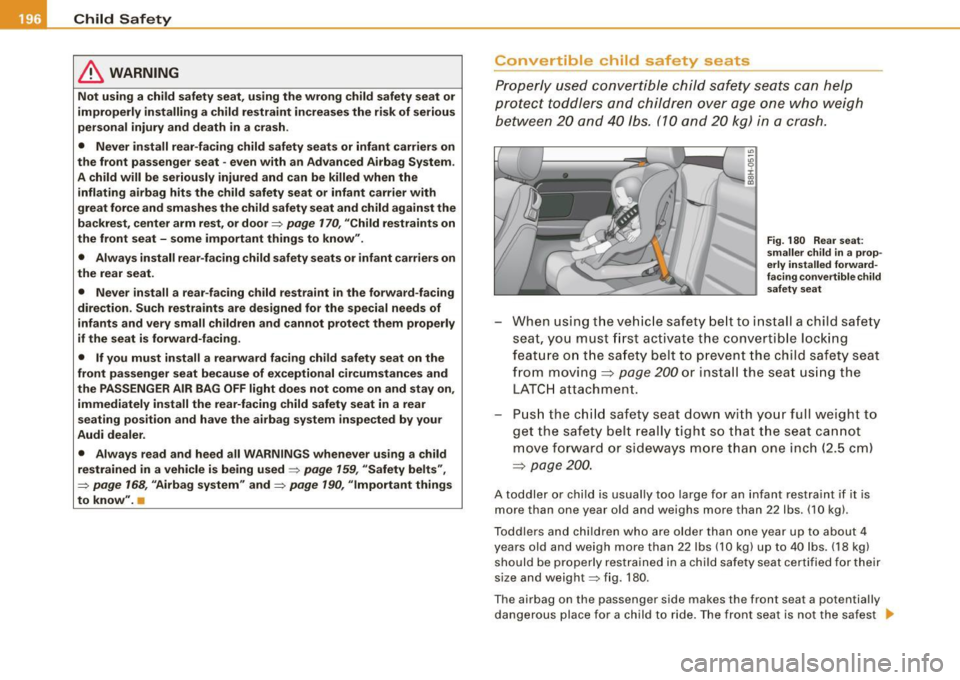
Convertible child safety seats
Properly used convertible child safety seats can help
protect toddlers and children over age one who weigh
between 20 and 40 lbs. (10 and 20 kg) in a crash.
Lil ;;; 0 ± ., IO
Fig. 180 Rear seat:
smaller child in a prop
erly insta lled forward
facing convertible chi Id
safety seat
When using the vehicle safety belt to install a child safety
seat, you must first activate the convertible locking
feature on the safety belt to prevent the child safety seat
from moving =>
page 200 or install the seat using the
LATCH attachment.
Push the child safety seat down with your full weight to
get the safety belt really tight so that the seat cannot
move forward or sideways more than one inch (2.5 cm)
=> page 200.
A toddler or child is usually too large for an infant restraint if it is
more than one year old and weighs more than 22 lbs. (10 kg).
Toddlers and children who are older than one year up to about 4
years old and weigh more than 22 lbs (10 kg) up to 40 lbs. (18 kg)
should be properly restrained in a child safety seat certified for their
size and weight=> fig. 180.
Th e airbag on the passenger side makes the front seat a potentially
dangerous place for a child to ride. The front seat is not the safest ..,_
Page 200 of 340
__ ___;:C;.:.h.:.: i.:.:ld ::.....: S~ a::. f~ e~ t~ y:__ _____________________________________________ _
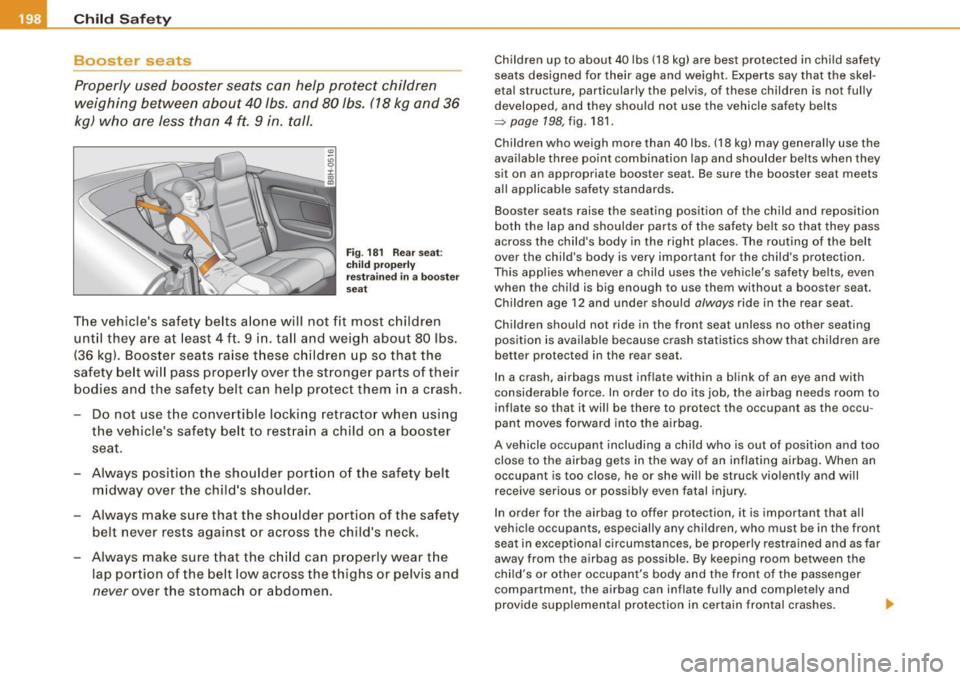
Booster seats
Properly used booster seats can help protect children
weighing between about 40 lbs . and 80 lbs. (18 kg and 36
kg) who are less than
4 ft. 9 in. tall.
Fig . 181 Rear seat:
child properly
restrained
in a booster
seat
The vehicle's safety belts alone will not fit most children
until they are at least 4 ft. 9 in. tall and weigh about 80 lbs.
(36 kg). Booster seats raise these children up so that the
safety belt will pass properly over the stronger parts of their
bodies and the safety belt can help protect them in a crash.
- Do not use the convertible locking retractor when using
the vehicle's safety belt to restrain a child on a booster
seat.
- Always position the shoulder portion of the safety belt
midway over the child's shoulder.
- Always make sure that the shoulder portion of the safety belt never rests against or across the child's neck.
- Always make sure that the child can properly wear the lap portion of the belt low across the thighs or pelvis and
never over the stomach or abdomen .
Children up to about 40 lbs (18 kg) are best protected in child safety
seats designed for their age and weight. Experts say that the skel
etal structure, particularly the pelvis, of these children is not fully
developed, and they should not use the vehicle safety belts
=> page 1981 fig . 181.
Children who weigh more than 40 lbs. (18 kg) may generally use the
available three point combination lap and shoulder belts when they
sit on an appropriate booster seat . Be sure the booster seat meets
all applicable safety standards .
Booster seats raise the seating position of the child and reposition
both the lap and shoulder parts of the safety belt so that they pass
across the child's body in the right places. The routing of the belt
over the child's body is very important for the child's protection.
This applies whenever a child uses the vehicle's safety belts, even
when the child is big enough to use them without a booster seat. Children age 12 and under should
always ride in the rear seat.
Children should not ride in the front seat unless no other seating
position is available because crash statistics show that children are
better protected in the rear seat.
In a crash, airbags must inflate within a blink of an eye and with
considerable force . In order to do its job, the airbag needs room to
inflate so that it will be there to protect the occupant as the occu
pant moves forward into the airbag.
A vehicle occupant including a child who is out of position and too close to the airbag gets in the way of an inflating airbag. When an
occupant is too close, he or she will be struck violently and will
receive serious or possibly even fatal injury .
In order for the airbag to offer protection, it is important that all
vehicle occupants, especially any children, who must be in the front
seat in exceptional circumstances, be properly restrained and as far
away from the airbag as possible. By keeping room between the
child's or other occupant's body and the front of the passenger
compartment, the airbag can inflate fully and completely and
provide supplemental protection in certain frontal crashes . ._
Page 202 of 340
___ C_h_ i_ld _ S_ a_ f_ e_ t_ y ______________________________________________ _
child is available. In these exceptional situations, the use of a lap
belt is better than permitting the chi ld to remain totally unre
strained . But remember: a lap belt cannot provide the same level of
protec tion as a proper child restraint or a t hree -point lap and
shoulder belt if the child is big enough . Also, using a lap belt for
younger child ren, who should be using a chi ld restraint, may violate
l aws in your state or Prov ince .
Never use a lap belt alone to restrain a chi ld that weighs less than
about 80 lbs (36 kg) and who is less than 4'9" ta ll. A lways remember
that chi ldren do not have the pronounced pelvic structure required
for the proper function of lap belts. If a lap belt is only restraint
system available, then the child's safety absolutely requires that the
l ap be lt be fastened snug ly and as low as possible around the pelv is
let a lap belt pass over the chi ld's stomach or abdomen .
& WARNING
Using wrong child restraints or improperly in stalled child
restraint s can cau se serious personal inju ry or death in a cr ash.
• Fa ilure to properl y route safety belts over a child's body will
c au se severe injurie s in a crash . The lap belt portion of the three
point belt a s well a s any l ap belt alone mu st al way s pass as low as
po ssible acros s the pelvi s, never over the stom ach or abdomen.
• An improperl y worn saf ety belt will not pr ovide the best prote c
tion in a cra sh and may cau se ser iou s personal injury . Alwa ys
m ake sure that childr en and other vehicle occ upant s properl y
wear available restraint sy ste m s. Carefully follow the in struction s
pro vided by the manuf acturer s of child re strai nts. •
Installing a child safety seat
Securing a child safety seat using a safety
belt
Safe ty belts for the rear seats and the fr ont passenger can
be locked with the c onvertible locking retractor to prop
erly secure child safety seats.
The safety belts emergency locking retractors fo r the rear seats
safety be lts and for the front passenger's seat safety belt have a
conve rtible locking ret ractor for child restraints . The safety belt
must be locked so that belt webbing cannot unreel. The retractor
can be activated to lock the safety be lt and prevent the safety belt
webbing from loosening up during normal dr iving. A child safety
seat can only be properly instal led when the safety belt is locked so
that t he child and child safety seat w ill s tay i n place .
Always remember: Even though your vehicle is equipped with an
Advanced Airbag system, al l children, especially those 12 years and
younger, should always ride in the back seat p roperly restra ined for
their age and size.
& WARNING
Improperly in stalled child safety seat s increa se the risk of s erious
per sonal inju ry a nd death in a colli sion .
• Alway s m ake sure that the safe ty belt retrac tor is locked wh en
i nstalling a child safety seat . An unl ocked safety be lt retra ctor
cannot hold the ch ild safety seat in pla ce during normal driv ing or
in a cras h.
• Alway s buckle the child safety seat firml y in place even if a
c hild i s not sitting in it. A loo se child safet y seat can fl y around
during a sudden stop or in a coll ision
• If the b ackre st i s not se cu rely l atched , the ch ild and the ch ild
restraint will be thrown forward together with the bac krest and .,
Page 204 of 340
___ C_h_ i_ld _ S_ a_ f_ e_ t_ y ______________________________________________ _
& WARNING (continued)
• A child in a rearward-facing child safety seat installed on the
front passenger seat will be seriously injured and can be killed if
the front airbag inflates -even with an Advanced Airbag System.
• The inflating airbag will hit the child safety seat or infant
carrier with great force and will smash the child safety seat and
child against the backrest, center arm rest, door or roof.
• Always be especially careful if you must install a rearward
facing child safety seat on the front passenger seat in exceptional
circumstances.
• A tight tether strap on a rearward-facing child restraint
attached to the front passenger seat can put too much pressure
on the weight -mat in the seat and register a heavier weight in the
Advanced Airbag System. The heavier weight registered can make
the system work as though an adult were on the seat and deploy
the Advanced Airbag when it must be suppressed causing serious
or even fatal injury to the child.
• Make sure that the PASSENGER AIR BAG OFF light comes on
and stays on all the time whenever the ignition is switched on.
• If the PASSENGER AIR BAG OFF light does not come on and stay
on, immediately install the rear-facing child safety seat in a rear
seating position and have the airbag system inspected by your
Audi dealer. •
Activating the convertible locking retractor
Use the convertible locking retractor to secure a child
restraint.
Always heed the child safety seat manufacturer's instruc
tions when installing a child restraint in your vehicle. To
activate the convertible locking retractor:
- Place the child restraint on a seat, preferably on the rear
seat. -
Slowly pull the belt
all the way out.
- Route it around or through the child restraint belt path
=> &.
- Push the child safety seat down with your full weight to
get the safety belt really tight.
- Insert the belt tongue into the buckle for that seating position.
- Guide the safety belt back into the retractor until the belt
lies flat and snug on the child safety seat.
- You should hear a "clicking" noise as the belt winds back
into the inertia reel. Test the convertible locking retractor
by pulling on the belt. You should no longer be able to
pull the belt out of the retractor. The convertible locking
retractor is now act ivated .
- Make sure that the red release button is facing away from
the child restraint so that it can be unbuckled quickly.
- Pull on the belt to make sure the safety belt is properly
tight and fastened so that the seat cannot move forward
or sideways more than one inch (2.5 cm).
& WARNING
Using the wrong child restraint or an improperly installed child
restraint can cause serious personal injury or death in a crash.
• Always make sure that the safety belt retractor is locked when
installing a child safety seat. An unlocked safety belt retractor
cannot hold the child safety seat in place during normal driving or
in a crash.
• Always buckle the child safety seat firmly in place even if a
child is not sitting in it. A loose child safety seat can fly around
during a sudden stop or in a crash.
Page 205 of 340

Child Safety IJ!III _________________________________ __:::...:....:...:..::.:......:__ ___ ....:.!.-__
& WARNING (continued )
• Always make sure the seat backrest to which the child restraint
is installed is in an upright position and securely latched into place
and cannot fold forward . Otherwise , the seat back with the child
safety seat attached to it could fly forward in the event of an acci
dent or other emergency situation .
• Always read and heed all WARNINGS whenever using a child
restrained in a vehicle is being used
=> page 190 . Special precau
tions apply when installing a child safety seat on the front passenger seat=>
page 170 , "Child restra ints on the front seat -
some important things to know ".•
Deactivating the convertible locking retractor
The c onver tib le l ocking retrac tor for ch ild res tra in ts will
be d ea ctivat ed automat ically wh en the belt i s wound all
th e way ba ck in to the retractor .
-Pre ss th e red bu tton o n the sa fety be lt bu ckle . Th e b elt
t o ngue will pop out of the b uck le .
- Guide the be lt all the w ay b ack in to i ts s to w ed p osition.
A lways l et t he safety belt retract complet ely into its stowed pos itio n.
T he safety belt can now be used as an ord inary safety be lt w ithout
t he conve rtibl e locking retractor for chi ld restrain ts.
I f the converti ble locking retractor should be activated inadvert
en tly, the safet y belt must be unf astened and guid ed completel y
back into its stowed pos ition to deactivat e th is feature. If the
c o nver tible loc kin g re tractor is n ot deac tiva te d , th e safe ty be lt wi ll
g radua lly becom e tighter and uncomfortab le to w ear .
Controls and equip
ment Safety first Vehicle operation
& WARNING
Improperly installed
child safety seats in crease the risk of serious
personal injury and death in a collision.
• Never unfasten the safety belt to deactivate the convertible
locking retractor for child restraints while the vehicle is moving .
You would not be restrained and could be seriously injured in an
accident.
• Always read and heed all WARNINGS whenever using a child
restrained in a vehicle is being used=>
page 190. Special precau
tions apply when installing a child safety seat on the front
passenger seat=>
page 170 , "Child restraints on the front seat -
some important things to know ".•
Additional Information
What types of child restraint anchors are
available and how are they related to child
safety?
F or years, chil d restraints have been installed using the safety belts
a lre ady pre s en t in ev ery ve hicle .
Sinc e Septem ber 1, 1999, c hild restraint manufactur ers have b een
providing tether straps that attach the top of the chi ld rest raint to
th e veh icles structure, on most of t heir forward -facin g syst ems in
order to com ply with U.S. Federal regulations for child restraint
per formanc e in a cras h. V ehi cle m anu fac tur ers a re r equi red to
phase -i n tether ancho rages for attach ment of the tether st rap in
their U.S. veh icles beginni ng Septem ber 1, 1999.
The combi nation of the t ether anc horag es and t he lower anchor
age s is now gene ra lly calle d th e
LATCH system f or "Lo w er An chors
and Tether for Children ". ..,
Vehicle care Do-it-yourself service Technical data
Page 211 of 340

_______________________________________________ C_h _i_ld _ S_ a_ f_ e_ t...:; y ______ __
Mounting and releasing the anchorage hook
If you use a child restraint system with hook-on or push-
on connectors attached to adjustable straps.
Mounting
- Press the anchorage hook with the spring catch release
onto the lower anchorage so that the anchorage hook
locks into place .
- Pull on the anchorage hook to make sure that it has
securely engaged the lower anchorage.
- Tighten the strap following the child restraint manufac
turer's instructions.
Releasing
- Loosen the tension on the strap following the child
restraint manufacturer's instructions .
- Depress the spring catch on the hook or push button to
release the push -on connector catch.
- Hold the spring catch in depressed position.
- Move the hook in the direction of the vehicle floor so that
there is enough space to release the anchorage hook
from the lower anchorage.
& WARNING
• Improper installation of child restraints will increase the risk of
injuries in a crash.
• Always refer to the child restraints manufacturer's instructions
for proper installation of the child restraint and proper use of the
lower anchorages or safety belts in your vehicle. •
Controls and equip ment Safety first Vehicle operation
Vehicle care Do-it-yourself service Technical data