headlights AUDI A4 CABRIOLET 2009 User Guide
[x] Cancel search | Manufacturer: AUDI, Model Year: 2009, Model line: A4 CABRIOLET, Model: AUDI A4 CABRIOLET 2009Pages: 340, PDF Size: 77.32 MB
Page 90 of 340
Clear vision
& W AR NIN G (c ontinued )
• For your saf ety , you sh ould replace the wip er blade s once or
t w ic e a ye ar. S ee your auth oriz ed Audi d ealer for repla cem ent
blades .
0 Note
To prevent damage to the wiper system:
• Always loosen blades which are frozen to the windshield before
operating wipers.
• Do not use gaso line, kerosene, paint thinner, or other solvents on
or near the wiper blades .
• Do not attempt to move the wipers by hand .
[ i ] Tip s
Commercial hot waxes applied by automatic car washes affect the
cleana bility o f the g lass su rface .•
Mirrors
Manual glare-dimming
Standard setting
Move the sma ll lever (located on the bottom edge of t he
m irror) to the front.
Anti -glare setting
- Move the sma ll leve r (located on the bo ttom edge of t he
m ir ro r) to the rea r. •
App lies to vehicles: wi th au tomatica lly dimm ing in side mirro r
Automatically dimming inside mirror
The automatic dimming function can be turned on and off
if required.
D isabling auto dimming
Fig . 100 In side rear
view mi rror
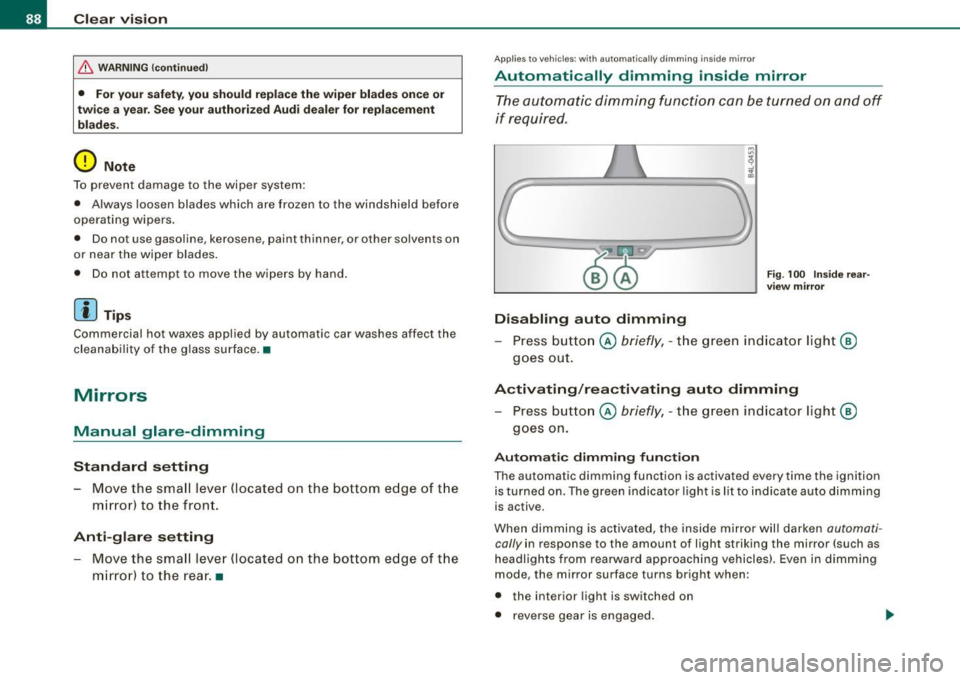
Pr ess button @ briefly, -th e green in dic ato r ligh t®
goes out .
Activating /re activating auto dimming
- Press button @ briefly, -the green indicator light®
goes on.
Au tomatic dimming fun ction
The automatic dimming function is activated every time the ignition
is turned on. The green indicator lig ht is lit to ind ica te auto dimming
is active.
When dimming is activated, the inside mirror will darken
automati
cally
in response to the amount of light striking the mirror (such as
headlights from rearward approaching vehicles). Even in d imm ing
mode , the mirror surface turns bright when :
• the interior light is switched on
• reverse gear is engaged .
Page 91 of 340
& WARNING
The glass of the inside rearview mirror is layered and contains an
electrolyte to achieve its properties. Be aware of liquid electrolyte
leaking from a broken mirror glass. This liquid can cause irritation
to skin, eyes, and respiratory system. If you get electrolyte in your
eyes or on your skin, immediately rinse with plenty of water. If irri
tation persists, seek medical attention.
0 Note
Liquid electrolyte leaked from a broken mirror glass will damage any
plastic surfaces it comes in contact with. Clean up spilled electrolyte
immediately with clear water and a sponge.
[ i] Tips
• If you switch off the automatic dimming function on the inside
mirror, automatic dimming of the outside mirrors will likewise be
disabled.
• Check to make sure there are no objects preventing light from
reaching the inside mirror.
• Do not attach any stickers to the windshield in front of the light
sensor, as this would interfere with the automatic operation of the
headlights and the automatic dimming of the inside mirror.•
Controls and eq uip
ment
Clear vision
Outside mirrors
The outside mirrors are electrically adjusted.
Adjusting the outside mirrors
Fig. 101 Forward
section of driver's
armrest: power mirror
controls
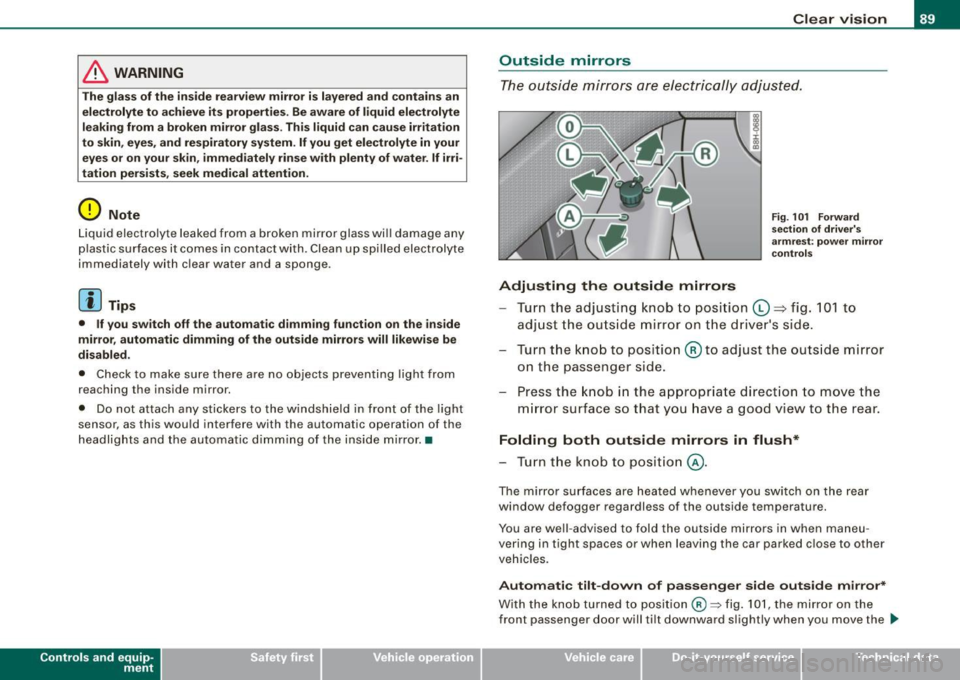
Turn the adjusting knob to position (D => fig. 101 to
adjust the outside mirror on the driver's side.
Turn the knob to position
@ to adjust the outside mirror
on the passenger side.
Press the knob in the appropriate direction to move the
mirror surface so that you have a good view to the rear.
Folding both outside mirrors in flush*
- Turn the knob to position @.
The mirror surfaces are heated whenever you switch on the rear
window defogger regardless of the outside temperature.
You are well -advised to fold the outside mirrors in when maneu
vering in tight spaces or when leaving the car parked close to other
vehicles.
Automatic tilt-down of passenger side outside mirror*
With the knob turned to position@:::::, fig. 101, the mirror on the
front passenger door will tilt downward slightly when you move the .,_
~ehicle care Technical data
Page 92 of 340
Clear vision
selector lever into R (Reverse). This feature provides a better view of
the curb when you are backing into a parking space.
The mirror returns to its initial position as soon as reverse gear is disengaged and vehicle speed is above about 9 mph (15 km/h). The
mirror also returns to its initial position if the switch is moved to the
driver's outside mirror © or@ .
Memory setting for the outside mirrors*
On vehicles with the memory function*, when you store a seat posi
tion in the memory, the position of the outside mirrors is also stored
in the memory =>
page 101.
0 Note
• Curved (i.e. convex) mirror surfaces increase your field of view.
Remember that vehicles or other objects will appear smaller and
farther away than when seen in a flat mirror . If you use this mirror to
estimate distances of following vehicles when changing lanes, you
could estimate incorrectly and cause an accident.
• If the mirror housing is moved unintentionally (for example,
while parking your vehicle), then you must first fold the mirror elec
trically. Do not readjust the mirror housing manually. You could
damage the motor which controls the mirror.
[ i] Tips
I f there should be a malfunction in the electrical system, you can
still adjust the outside mirrors by pressing the edge of the mirror. •
Applie s to vehic les : w ith au tomat ica lly dim ming ou ts id e m irrors
Automatic dimming for the outside mirrors *
The outside mirrors dim at the same time as the inside mirror. When
th e ignition is switched on, the mirrors automatically dim
depending on the amount of flight striking the mirrors (such as
headlights shining into the vehicle from the rear). When you switch on the interior light, or when you move the
selector lever into
R (Reverse), the dimming function stops and the
mirrors return to their original condition (not darkened).
[ i] Tips
The automatic dimming feature on the mirrors will not operate
properly if the light shining on the mirrors is blocked by other
objects .•
Digital compass
Ap plies to veh icles : with digita l compass
Activating or deactivating the compass
The direction is displayed on the interior rear view mirror.
Fig. 102 Inside rear
view mirror: digital
compass activated
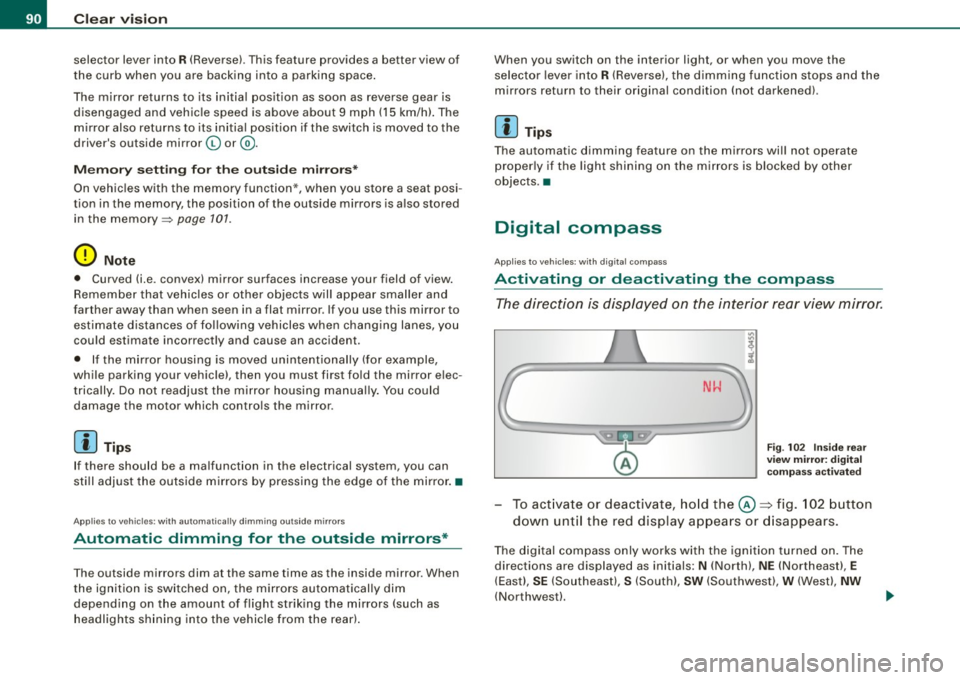
To activate or deactivate, hold the©~ fig. 102 button
down until the red display appears or disappears.
The digital compass only works with the ignition turned on. The
directions are displayed as initials:
N (North), NE (Northeast), E
(East), SE (Southeast), S (South), SW (Southwest), W (West), NW
(Northwest).
Page 121 of 340
___________________________________________________ O_ n_ t_h _e_ r_o _a_ d _ ___,11111
Ignition lock and ignition switch
Ignition lock
T he i gnition k ey sta rts or st ops t he e ngin e.
0
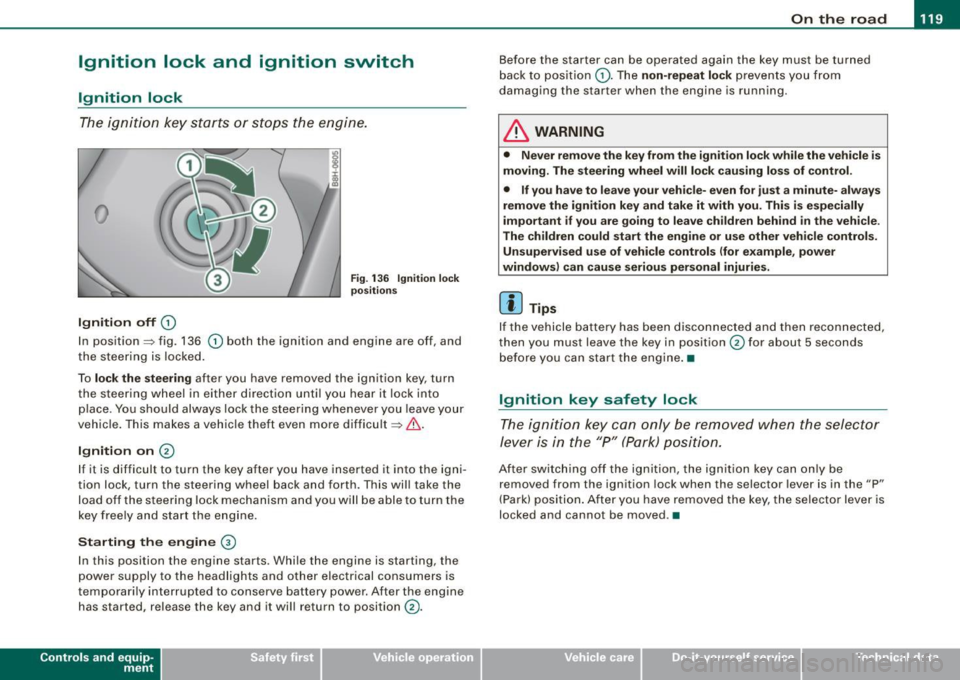
Ignition off 0
Fig. 13 6 Ignition lock
positi ons
In position~ fig. 136 0 both the ignition and engine are off, and
t he stee rin g is locke d.
To
lo ck the steering after you have removed the ignit ion key, turn
t he stee rin g wheel in either direc tion un til you hear it loc k into
p lace . You should always lock the steering whenever you leave your
vehicle . This ma kes a vehic le theft even more difficult ~ & .
Ignition on 0
If it is difficult to turn the key afte r yo u have inserted it into the igni
tion lock, turn the steering wheel back and forth. This will take the
load off the steering lock mechanism and you will be able to turn the
key free ly an d start the engine.
Starting the engine @
In th is position the engine starts . While the engine is starting, the
power supply to the headlights and other electrical consumers is
temporarily interrupted to conserve battery power. After the engine has started, release the key and it wi ll return to position
(v.
Contro ls and eq uip
ment
Before the starter can be operated again the key must be turned
b ack to position
(D . Th e non -repeat lock p re vents y ou fr om
damag ing the starter when the engine is running .
& WARNING
• Never remove the key from the ignit ion lock while the vehicle is
moving. The steering wheel will lock causing loss of control .
• If you have to leave your vehi cle- even for just a minute- always
remove the ignition key and take it with you. This is especially
important if you are going to leave children behind in the vehicle.
The children could start the engine or use other vehicle controls. Unsupervised use of vehicle controls (for e xample , power
windows) can cause serious personal injuries.
[ i ] Tips
If the vehicle battery has been disco nnec ted and then recon nected,
then you must leave the key in position
0 for about 5 seconds
be fore you can start the eng ine .•
Ignition key safety lock
T he i gnit ion key ca n only be remove d when the se lector
lever is in the "P " (Pa rk) pos itio n.
A fte r swi tc h ing o ff th e ig nition, the ig nition key can only be
removed from the ignition lock when the selector lever is in the "P"
(Park) posi tio n. Af ter y ou h ave remo ved the key, the selec to r lever is
locked and cannot be moved. •
~ehicle care irechnical data
Page 234 of 340
-Cleaning and protection P':ft':I _______________ _
& WARNING
• Do not clean the underside of the chassis, fenders, wheel
covers, or other hard to reach parts without protecting your hands
and arms. You may cut yourself on sharp-edged metal parts.
• Always read and heed all WARNINGS and other information
~ page 230.
0 Note
• Never try to remove dirt, mud or dust if the surface of the vehicle
is dry. Never use a dry cloth or sponge, since this could scratch your
vehicle's paint or windows.
• Never wash your car in bright sunlight. Drops of water act as
magnifying lenses and may damage your paint .
• When you wash your car in the winter: if you rinse your vehicle
with a hose, be careful not to aim the stream of water directly at
locks, or at door or hatch openings - they can freeze shut.
• Never use sponges designed to remove insects, or any kitchen
scouring sponges or similar products. They can damage your paint
finish .
• Never use a dry cloth or sponge to clean the headlights. Only use
wet cloths or sponges to prevent scratches . It is best to use soapy
water.
<£> For the sake of the environment
In the interest of the environment, the vehicle should only be
washed in special wash bays. •
Washing your vehicle with a power washer
Cleaning the exterior of your car with a high-pressure
power washer is safe as long as you observe a few simple
rules.
- Before using the power washer, make sure you have read
and understood the WARNINGS~
& in "General infor
mation" on
page 230.
Always follow the operating instructions for the power
washer.
Make sure that the jet on the spray hose produces a "fan
shaped spray".
Do
not hold the spray nozzle too close to soft materials.
When cleaning the vehicle with a power washer always follow the
operating instructions. This applies particularly to the
operating
pressure and the spraying distance. Maintain a sufficient distance
to soft materials such as rubber hoses and sound/vibration dead ening materials {particularly on the underside of the engine hood).
Do not use a jet which sprays water in a
direct stream or one that
has a
rotating jet.
Water temperature should not exceed 140
°F (60 °C).
& WARNING
Never wash tires with a jet that sprays water in a direct stream.
This could cause invisible damage to the tires and weaken them,
even if the spray is from a relatively long distance and for a short
time . Damaged and weakened tires can fail and cause accidents
and personal injury.
0 Note
• Never use a power washer to clean the power top itself.
Page 235 of 340
Cleaning and protection -
----------------
•
• To avoid damaging your vehicle, always make sure that there is
enough d istance between the sprayer and sof t materials like rubber
hoses, plastic parts and sound -deadening materials . Never aim the
sprayer at the same point for a re latively long period of t ime. This
also applies to cleaning headlights and painted bumpers. Remember : the closer the nozzle is to the surface of the material,
the greater the stress on the material. •
Power top care
The power to p requires s pecial c are.
Keeping your top look ing great and making certain that it lasts a
long time depend to a great extent on proper use and care. Remove
bird droppings as soon as possib le, since the corrosive chemicals in
them wi ll cause the rubber impregnation in your top to swell and
possibly allow the fabric to leak.
With normal soiling, all you need to do is c lear the top with a soft
brush and clear water. Always brush in the direction of the fabric
from front to rear.
If the top is very dirty and has spotted areas clean it with a brush
using a convert ib le top cleaner . Always brush in the direction of the
fabric from front to rear . R inse with plenty of clear water, and allow
t he t op to air-dry .
Chamois are not suitab le for drying the top.
Never use gasoline, spot remover, benzene, paint thinner or
solve nts to remove spots . We recommend that you only use
cleaners especia lly formulated for use on convertib le tops , and that
you fol low the produce use d irections carefully. Authorized Audi
dea ls can provide detailed information.
& WARNING
Always read and h eed all WARNINGS and the information
=> page 2 30 .
0 Note
Never use a high -pressure power was her to clean the power top. •
Wind deflector
Clear the wind deflector with water or, if it is heavily soi led, a chem
ica lly neutra l cleaning solution .
& WARNING
Always read and heed all WARNINGS and the information
=> page 2 30 . •
Waxing
W ax pr otects the vehicle's p ain t.
- U se a manua lly ap plied ca r wa x occasi onall y to p ro tect
t h e paint.
A good wax coat ing protects the vehicle paint to a large extent
against the environmental factors listed under=> page 230,
"Washing" and even against slight scratches .
You can use a liquid car wax to protect your paint as soon as one
week after your vehic le has been delivered.
Even if you regular ly use a
waxing process in automa tic car was hes,
we recommend that you manual ly apply a coat of wax to give the
paint ex tra p rotecti on, particular ly if wa ter n o longer beads on the
c lean paint.
Protect plastic body parts with car wax in the same way as the
vehic le body.
Ve hic le care
Page 264 of 340
-~_C_ h_e _c _ k_ i_ n ...,,g,:...._ a_n_ d_ f_ i_ll _in ....;g=---------------------------------------------
Have the battery checked when you take your vehicle in for service .
You are well advised to replace a battery that is older than 5 years.
Disconnecting the battery terminals
Some vehicle functions (power window regulators, for example) are
lost if the battery terminals are disconnected . Th ese functions have
to be relearned after the battery terminals are connected again. To
prevent this, the battery should only be disconnected from the
vehicle electrical system when absolutely necessary for repairs .
Vehicles not driven for long periods
If you are going to let your vehicle stand for a long time and not
drive it, you should remember there are electrical components
which are still functioning and they will draw energy from the
battery and drain it, for example, the engine immobilizer. To prevent
this, you can either charge the battery occasionally to keep it in
good working condition or you can disconnect the negative cable
on the battery.
Winter operation
During the winter months, battery capacity tends to decrease as
temperatures drop. This is because more power is also consumed
while starting, and the headlights, rear window defogger, etc., are
used more often.
Avoid unnecessary power consumption, particularly in city traffic or
when traveling only short distances . Let your authorized Audi dea ler
check the capacity of the vehicle battery before winter sets in
=>
page 265 . A we ll charged battery wil l not only prevent starting
problems when the weather is cold, but will also last longer.
Replacing battery
The new battery must have the same capacity, voltage (12 volts),
amperage, construction and plug sea ling, as the origina l battery.
Specifications are listed on the battery housing. Batteries specially
developed by Audi fulfill the maintenance, output, and safety
requirements. When installing the battery, make sure the ignition and all electrical
consumers are switched off=>
0.
We recommend that you use maintenance -free or cyc le-resis
tant/leak-proof
batteries according to the standards TL 825 06 (from
December 1997) and VW 7 50 73 (from August 2001).
Replacing the battery should be carried by a qualified workshop.
Please follow the instructions on the battery cover.
0 Note
• All work on the battery requires technical knowledge. Please
contact an Audi dealership or another authorized facility for ques
tions about the battery -danger of acid burns and exp losion hazard!
• Make sure the ventilation hose on the side of the battery is
connected, otherwise fumes or battery acid can leak out.
• Battery holder and terminals always have to be secured correctly.
• Before all work on the battery follow the
warnings below=> & in
"Working on the battery" on
page 263.
mend your authorized Audi dealer change the battery for you.
Batteries contain sulfuric acid and lead and must always be
disposed of properly in compliance with all environmental regula
tions . Disposing of vehicle batteries improperly is very dangerous to
the environment . Make sure that the removed battery cannot over
balance, otherwise sulfuric acid might escape!
[ i ] Tips
If your vehicle is left standing for several weeks at extremely low
temperatures, the vehicle battery should be removed and stored
where it will not freeze. This will prevent it from being damaged and
having to be replaced.•
Page 304 of 340
111!11.--___;;F...; u::. s.::..:: e~s :.....:: a..:..n .:..; d::....; b.:..:. u..:..lb ;:..:: s _______________________________________________ _
No.
38
39
41
42
43
Equipment
Central electric, anti -theft alarm system, rear
lid/trunk release
Radio
Horn
Vacant
Electronic Stabilization Program (ESP)
Engine timing
Seat heating
Automatic circuit breakers: Amps
15
20
25
25
15
35
The electric power windows and the electric seat adjusters are
protected with circuit breakers which reset automatically after the
circuit overload has been corrected .
[ i] Tips
• Whenever replacing a fuse, always consult the sticker on the
inside of the fuse panel cover. It contains the most up-to-date infor
mation regarding the fuse arrangement . If in doubt, ask your autho
rized Audi Service advisor.
• Some of the equipment items listed are optional or only avail
able on certain model configurations. •
Bulbs
Replacing light bulbs
For your safety, we recommend that you have your autho
rized Audi dealer replace burned out bulbs for you.
It is becoming increasingly more and more difficult to replace
vehicle light bulbs since in many cases, other parts of the car must first be removed before
you are able to get to the bulb. This applies
especially to the light bulbs in the front of your car which you can
only reach through the engine compartment.
Sheet metal and bulb holders can have sharp edges that can cause
serious cuts, and parts must be correctly taken apart and then prop
erly put back together to help prevent breakage of parts and long
term damage from water that can enter housings that have not
been properly resealed.
For your safety, we recommend that you have your authorized Audi
dealer replace any bulbs for you, since your dealer has the proper
tools, the correct bulbs and the expertise.
Gas discharge lamps (xenon lights)*:
Due to the high electrical voltage, have the bulbs replaced by a qual
ified technician. Headlights with xenon light can be identified by the
high voltage sticker.
& WARNING
Contact with high-voltage components of the electrical system
and improper replacement of gas discharge (Xenon) headlight
bulbs can cause serious personal injury and death.
• Xenon bulbs are pressurized and can explode when being
changed.
• Changing Xenon lamps requires the special training, instruc
tions and equipment.
• Only an authorized Audi dealer or other qualified workshop
should change the bulbs in gas discharge lamps.
& WARNING
There are parts with sharp edges on the openings and on the bulb holders that can cause serious cuts .
~
Page 331 of 340
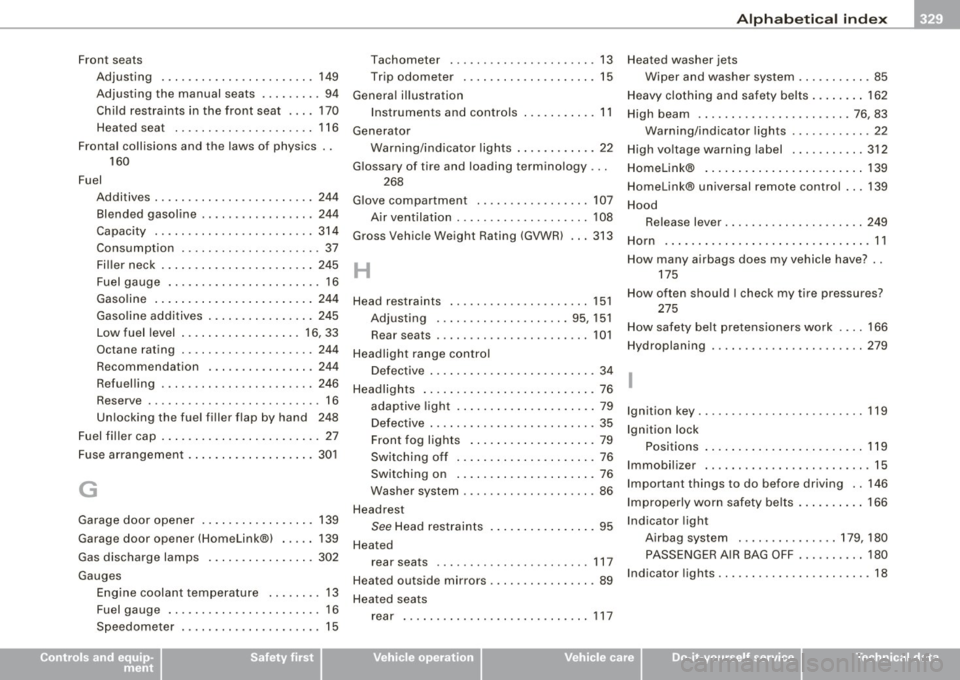
______________________________________________ A_ l_,_ p _h_ a_ b_e _t_i c_ a _ l _in _ d_e _ x __ fflll
Front seats
Adjusting .... ........... .... .... 149
Adjusting the manual seats ........ . 94
Child restraints in the front seat .... 170
Heated seat . . . . . . . . . . . . . . . . . . . . . 116
Frontal collisions and the laws of physics 160
Fuel Additives ............. .... .... ... 244
Blended gasoline ................. 244
Capacity ................. ....... 314
Consumption ..................... 37
Filler neck .. ...... .... ...... ... .. 245
Fuel gauge ...... .... .... ... .... .. 16
Gaso li n e ... .. .... .... ... .... .... 244
Gaso line additives ..... ... .... .... 245
Low fuel level ... .. .... .... .... . 16, 33
Octane rating ............. ....... 244
Recommendation ................ 244
Refuelling ..... ... ....... ..... ... 246
Reserve . .......... ............... 16
Unlocking the fuel filler flap by hand 248
Fuel filler cap . ...... .... .... ... .... .. 27
Fuse arrangement ... .... .... ... .... . 30 1
G
Garage door opener .. ...... .... .... . 139
Garage door opener {Homelink®) ..... 139
Gas discharge lamps .. ...... ... .... . 302
Gauges Eng ine coolant temperature ... ... .. 13
Fuel gauge ....................... 16
Speedome ter . ....... ..... ... .... . 15
Controls and equip
ment Safety first
T
achometer .... ... .. ... ... .. .... . 13
Trip odometer ...... .. .... ....... . 15
Genera l illus tration
Instruments and controls .... ... .. .. 11
Generator Warning/ind icator lights ...... .... .. 22
G lossary of tire and loading terminology .. .
268
G love compar tment . .... .... .... .... 107
A ir vent ilat ion . ........ .... ....... 108
Gross Vehicle Weight Rating {GVWR) ... 313
H
Head restraints .. .... ...... ... ...... 151
Adjusting .......... .......... 95, 151
Rear seats ... , .. , ...... , ........ , 101
Headlight range c ontr ol
Defective ... .. ... .... .... .... .... . 34
Headlights ...... ... .... .... .... .... . 76
adaptive ligh t .... ... .... .... ..... . 79
De fective ... .. ... .... .... .... .... . 35
Fr ont fog light s ...... .... .... .... . 79
Swi tching off .... .... .... .... .... . 76
Switching on .... .... .... .... .... . 76
Washer system .... ........ ........ 86
Headrest
See Head restrain ts . ...... .... .... . 95
Heated rear seats ....... ....... ... .... .. 117
Heated outside mirrors .... .... ....... . 89
Heated seats rear ... .. .... ...... ... .. .... .... 1 17 Heated washer jets
Wiper and washer system ... .... ... . 85
Heavy cl othing and safety belts .. ...... 162
High beam ....................... 76, 83
Warning/ind icator lights ............ 22
High vo ltage warning label ........... 312
Home link® ...... .... ... .... .... ... 1 39
Homelink® universal remote control .. . 139
Hood Release lever ... ........ ... ..... .. 249
Horn . ...... .... .... .... ... .... .... . 11
How many airbags does my vehicle have? ..
175
How often should I check my tire pressures?
275
How safety be lt p retensioners wo rk .... 166
Hydroplaning ....................... 279
I
Ignition key ............ ........ .... . 119
Ign it io n l ock
Positions ...... .... ... .... .... ... 11 9
Immob ilizer ...... ....... .... ....... . 15
Important things to do before driving .. 146
Imp roperly w orn safety be lts .. ....... . 166
Indicator light
Airbag system ............... 179, 180
PASSENGER A IR BAG OFF .......... 180
Indicator lights ... .... .... ..... .. .... . 18
Vehicle operation Vehicle care Do-it-yourself service Technical data
Page 332 of 340
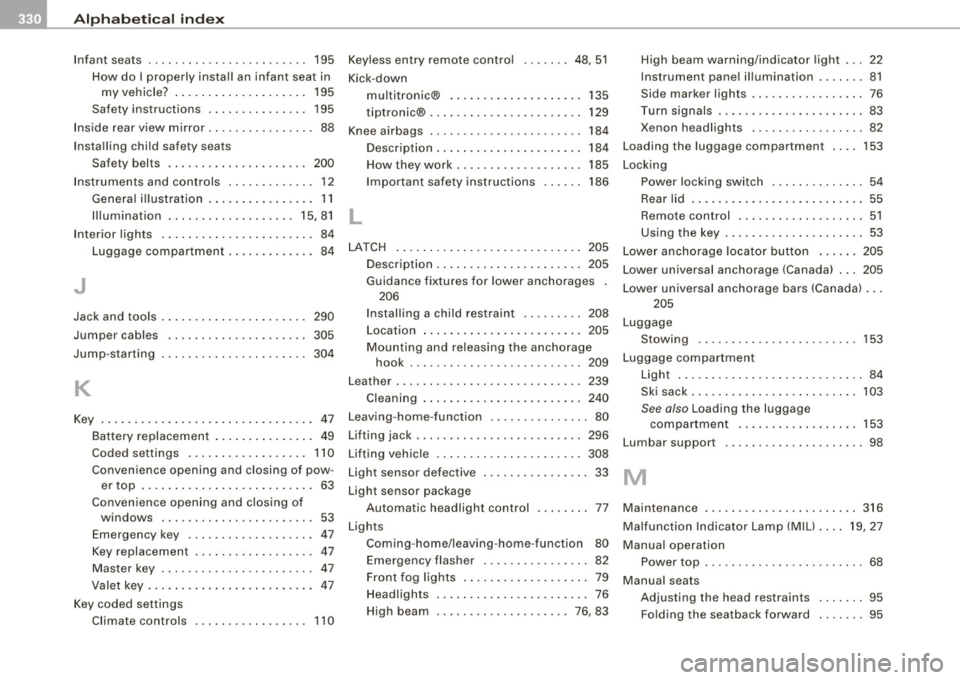
___ A---=- lp_h_ a_b_ e_ t _i_ c _ a_ l_ in_ d_ e_x ______________________________________________ _
Infant seats . . . . . . . . . . . . . . . . . . . . . . . . 195
How do I properly ins tall an infant seat in
my vehicle? ...... .... .... .... .. 195
Safety instructions . . . . . . . . . . . . . . . 195
Inside rear view mirror ..... .. .... .... . 88
Installing child safety seats
Sa fet y bel ts . . . . . . . . . . . . . . . . . . . . . 200
Instruments and controls ............. 12
Genera l ill ustration .... ... .... .... . 11
Illumination ...... ... . ......... 15, 81
Interior lights . ...... ... ........ .... . 84
Luggage compartment .. ...... ... .. 84
J
Jack and tools . . . . . . . . . . . . . . . . . . . . . . 290
Jumpe r cables . . . . . . . . . . . . . . . . . . . . . 305
Jump -starting 304
K
Key ...... ... .... .... .... .... ....... 47
Battery replacement . . . . . . . . . . . . . . . 49
Coded sett ings . . . . . . . . . . . . . . . . . . 110
Conveni ence op ening and closing of pow -
er top . ... .. .... .... .... ........ 63
Convenience opening and closing of w indows ....... ........ .... ... . 53
Emergency key . . . . . . . . . . . . . . . . . . . 47
Key replacement . . . . . . . . . . . . . . . . . . 47
Master key . . . . . . . . . . . . . . . . . . . . . . . 47
Valet key . . . . . . . . . . . . . . . . . . . . . . . . . 47
Key coded s ettings
Clima te con trols ... ...... ... . .... 110 Keyless
entry remote control
Kick -down 48, 51
multitronic® . . . . . . . . . . . . . . . . . . . . 135
tiptronic® ............. .... ... ... 129
Knee airbags . .... ..... .. .... .... ... 184
Description ... ... ... ... .... .... .. 184
How they work . . . . . . . . . . . . . . . . . . . 185
Important safety instructions 186
L
LATCH .................. .... .... .. 205
Description ... ... ... ... .... .... .. 205
Guidance fixtur es for lower anchorages .
206
Installing a child restraint .. .... ... 208
Location ... .. .... .. .. ... .. .. .... 205
Mounting and re leasing the anchorage
hook .... ... .... .. .. .. .. .. .. ... 209
Leather .. ... .. ... .. . ..... .... .... .. 239
Cleaning .............. .... .... .. 240
Leaving-home-function ...... .... .... . 80
Lifting jack .. . ... .... ... .. ...... .... 296
Lifting vehicle . .... ................. 308
Light sensor defec tive . ...... ...... ... 33
Ligh t se nsor package
Auto mat ic headligh t control ... .... . 77
Lights Coming -home /leavi ng-home -function 80
Emergency flasher .......... ...... 82
Front fog lights . ...... .... .... .... 79
Headligh ts . .... ....... .... .... ... 76
High beam .... .... .... .... .... 76 , 83 High bea
m wa rning /indicator light ... 22
Ins trumen t panel illum ination ... .... 81
Side marker lights ..... ... ........ . 76
Turn signals ... .... ... ... . ... ..... 83
Xenon headlights .. .... ... .... .... 82
Load ing the luggag e compartmen t 153
Locking Power locking switch .............. 54
Rear lid .... ... .... ............... 55
R emote control .. .. ........... .. .. 51
Using the key ...... .... ... .... .. .. 53
Lower anchorage locator button ...... 205
Lower universal anchorage (Canada) ... 205
Lower universal anchorage bars (Canada) ...
205
Luggage
Stowing 153
Luggage compartment
Light .......... ....... .. .. .... ... 84
Sk i sack . . . . . . . . . . . . . . . . . . . . . . . . . 103
S ee also Loading the luggage
c ompartment .......... . ... .... 153
Lumbar support . ........... . ... ..... 98
M
Maintenance .. ..... .. .... .... ...... 316
Malfunction Indicator Lamp (MIU .. .. 19 , 27
Manual operat ion
Power top . . . . . . . . . . . . . . . . . . . . . . . . 68
Manual s eats
Adjus ting the h ead restra ints ... .... 95
Fold ing the seatback forward ... ... . 95