steering AUDI A4 CABRIOLET 2009 Owner's Manual
[x] Cancel search | Manufacturer: AUDI, Model Year: 2009, Model line: A4 CABRIOLET, Model: AUDI A4 CABRIOLET 2009Pages: 340, PDF Size: 77.32 MB
Page 171 of 340
__________________________________________________ A_ i_ r _b _a...; g::- s_ y=--- s_t _e _m ___ lJII
repair costs or even the lack of vehicle damage is not necessarily an
indication of whether an airbag should inflate or not .
It is not possible to define a range of vehicle speeds that will cover
every possible kind and angle of impact that will always trigger the
airbags, since the circumstances will vary considerably between
one collision and another. Important factors include, for example,
the nature (hard or soft) of the object which the car hits, the angle of impac t, vehicle sp eed , etc . The front airbags will also not inflate
in side or rear collisions, or in roll-overs.
Always remember : Airbags will deploy only once, and only in certain
kinds of collisions. Your safety belts are always there to offer protec
tion in those situations in which airbags are not supposed to deploy,
or when they have already deployed; for example, when your vehicle
strikes or is struck by another after the first collision.
This is just one of the reasons why an airbag is a suppl em entary
restraint and is not a substitute for a safety belt. The airbag system
works most effectively when used with the safety belts. Therefore ,
always properly wear your safety belts=>
page 159.
& WARNING
Sitting too close to the steering wheel or instrument panel will
decrease the effectiveness of the airbags and will increase the risk
of personal injury in a collision.
• Never sit closer than 10 inches (25 cm) to the steering wheel or
instrument panel.
• If you cannot sit more than 10 inches (25 cm) from the steering
wheel, investigate whether adaptive equipment may be available
to held you reach the pedals and increase your seating distance
from the steering wheel.
• If you are unrestrained, leaning forward, sitting sideways or out
of position in any way, your risk of injury is much higher.
• You will also receive serious injuries and could even be killed if
you are up against the airbag or too close to it when it inflates -
even with an Advanced Airbag.
Controls and equip ment Safety first
Vehicle operation
& WARNING (continued)
• To reduce the risk of injury when an airbag inflates, always
wear safety belts properly~
page 163, "Safety belts".
• Always make certain that children age 12 or younger always
ride in the rear seat. If children are not properly restrained, they
may be severely injured or killed when an airbag inflates.
• Never let children ride unrestrained or improperly restrained in
the vehicle. Adjust the front seats properly.
• Never ride with the backrest reclined.
• Always sit as far as possible from the steering wheel or the
instrument panel~
page 148, "Proper occupant seating posi
tions".
• Always sit upright with your back against the backrest of your
seat.
• Never place your feet on the instrument panel or on the seat .
Always keep both feet on the floor in front of the seat to help
prevent serious injuries to the legs and hips if the airbag inflates.
• Never recline the front passenger's seat to transport objects.
Items can also move into the area of the side airbag or the front
airbag during braking or in a sudden maneuver. Objects near the
airbags can become projectiles and cause injury when an airbag
inflates.
& WARNING
Airbags that have deployed in a crash must be replaced.
• Use only original equipment airbags approved by Audi and
installed by a trained technician who has the necessary tools and
diagnostic equipment to properly replace any airbag in your
vehicle and assure system effectiveness in a crash.
• Never permit salvaged or recycled airbags to be installed in
your vehicle. •
Vehicle care Do-it-yourself service Technical data
Page 175 of 340
Airbag syst em -----------------=~-
& WARNIN G (cont in u ed)
• Airb ag work m ost effectiv ely when u sed with properly worn
sa fet y be lt s .
• Ther efore , always wear your safety belt s and ma ke sure that
eve rybod y in your vehi cle is prope rly re str ained.
& WARNING
A person on the front p assenger se at, espe cially infant s and small
c hildren , will re ceive seriou s injuries and can ev en be killed by
being t oo clos e to the airbag when it infl ates.
• Although the Adva nced Airbag System in your ve hicle i s
de signed to turn off the front passenger airb ag i f a n infant or a
s mall child i s on the front pa ssenger seat , nobody can absolutely
gu ara ntee that deployment under these spe cial co nditio ns is
impos sible in all conceivable situations that m ay happen during
the useful life of your vehicle.
• The Adv an ced Airbag Sy stem can deploy in a ccordance with
the "lo w risk" option unde r the U .S. Feder al Stand ard if a child t hat
is heavier than the typi cal on e-year old child i s on th e front
pa sse nger seat an d the other condition s for airb ag dep loym ent
are met.
• Acc ident stat istics have sh own that children are gen erally s afer
in the rear se at area than in the front seating posit ion .
• For th eir own safet y, all children , espe cially 12 yea rs and
younger , should alway s ride in th e back properly r estrained for
their age and size. •
Advanced front airbag system
Your vehicle is equipped with a front Advanced Airbag System in
compliance with United States Federal Motor Vehicle Sa fety Stan
dard 208 as applicable at the time your vehicle was manufactured.
Controls and equip
ment Safety first Vehicle operation
The front Advanced Airbag System supplements the safety belts to
provide additional protection for the driver's and front passenger's
heads and upper bodies in frontal crashes. The airbags inflate only
in frontal impacts when the vehic le deceleration is high enough.
The front Advanced Airbag System for the front seat occupants is not a substitute for your safety belts . Rather, it is part of the overall
occupant restraint system in your vehicle. A lways remember that
the airbag system can only help to protect you, if you are sitting
upright, wear ing your safety be lt and wear ing it proper ly . This is why
you and your passengers must a lways be properly restrained, not
just because the law requires you to be .
The Advanced A irbag System in your veh ic le has been certified to
meet the "low risk" requirements for 3 and 6 year -o ld children on the
passenger side and very small adults on the driver side. The low risk
deployment criteria are intended to he lp reduce the risk of injury
through interact ion with the front airbag that can occur, for
examp le, by being too close to the steering whee l and instrument
panel when the airbag inflates.
In addition, the system has been certified to comply with the
"suppression" requirements of the Safety Standard, to turn off the
front airbag for infants 12 months old and younger who are restrained on the front passenger seat in child restraints that are
listed in the Standard~
page 192, "Child restraints and Advanced
Airbags".
"S uppression" requi res the front ai rbag on the passenger side to be
turned off if:
• a child up to about one year of age is restrained on the front
passenger seat in one of the rear-facing or forward-facing infant
restraints listed in Federal Motor Vehicle Safety Standard 208 with
wh ich the Advanced Airbag System in your vehicle was certified. For
a listing of the child restraints that were used to certify your
vehic le's compliance wi th the US Safety Standard ~
page 192,
• weight less than a threshold leve l stored in the control unit is
detected on the front passenger sea t. _.
Vehicle care Do-it-yourself service Technical data
Page 177 of 340

Airbag system -----------------=~-
& WARNING (continued)
• If you must install a rearward facing child safety seat on the
front passenger seat because of exceptional circumstances and
the PASSENGER AIR BAG OFF light does not come on and stay on,
immediately install the rear -facing child safety seat in a rear
seating position and have the airbag system inspected by your
Audi dealer.
_& WARNING
If, in exceptional circumstances, you must install a forward-facing
child restraint on the front passenger's seat:
• Always make sure the forward-facing seat has been designed
and certified by its manufacturer for use on a front seat with a
passenger front and side airbag .
• Never put the forward-facing child restraint up against or very
near the instrument panel.
• Always move the passenger seat into its rearmost position in
the seat's fore and aft adjustment range, as far away from the
airbag as possible, before installing the forward-facing child
restraint. The backrest must be adjusted to an upright position.
• Make sure that the PASSENGER AIR BAG OFF light comes on
and stays on all the time whenever the ignition is switched on. •
Advanced Airbag System components
The front passenger seat in your vehicle has a lot of very important
parts of the Advanced Airbag System in it. These parts include the
weight-sensing mat, sensors, wiring, brackets, and more. The func
tion of the system in the front passenger seat is checked by the elec
tronic control unit when the ignition is on. The control unit monitors
the Advanced Airbag System and turns the airbag indicator light on
when a malfunction in the system components is detected. The
function of the airbag indicator light is described in greater detail
Controls and equip ment Safety first Vehicle operation
below.
Because the front passenger seat contains important parts
of the Advanced Airbag System, you must take care to prevent it
from being damaged. Damage to the seat may prevent the
Advanced Airbag for the front passenger seat from doing its job in
a crash.
The front Advanced Airbag System consists of the
following:
• Crash sensors in the front of the vehicle that measure vehicle
acceleration/deceleration to provide information to the Advanced
Airbag System about the severity of the crash.
• An electronic control unit, with integrated crash sensors for front
and side impacts. The control unit "decides" whether to fire the
front airbags based on the information received from the crash sensors. The control unit also "decides" whether the safety belt
pretensioners should be activated.
• An Advanced Airbag with gas generator for the driver inside the
steering wheel hub.
• An Advanced Airbag with gas generator inside the instrument
panel for the front passenger .
• A weight-sensing mat under the upholstery padding of the front
passenger seat cushion that measures the total weight on the seat.
The information registered is sent continuously to the electronic
control unit to regulate deployment of the front Advanced Airbag on
the passenger side.
• An airbag monitoring system and indicator light in the instru
ment cluster ~
page 179.
• The PASSENGER AIR BAG OFF light comes on and stays on in the
center of the instrument panel~
page 180, fig. 174 and tells you
when the front Advanced Airbag on the passenger side has been
turned off .
• A sensor below the safety belt latch for the front seat passenger
to measure the tension on the safety belt. The tension on the safety
belt and the weight registered by the weight -sensing mat help the
control unit "decide" whether the front airbag for the front _,.
Vehicle care Do-it-yourself service Technical data
Page 180 of 340
__ __::_A:::..:..:. ir..::b ~ a::. g::!...: s:::L y..::s :.::t :.::e :.:.m.:..:.... ________________________________________________ _
or the lower parts of t he body. Front airbags on ly supp lement the
th ree p oint safe ty belts in s ome front al c olli sio ns in which the
vehic le dece leration is high enou gh to deploy th e airbags .
Front airbags will not deploy:
• if the ignition is switched off when a crash occ urs,
• i n sid e coll is ions ,
• i n rea r- e nd collisi ons ,
• in rollovers,
• when th e c ras h de cele rat io n measu red by th e airba g sys tem is
l ess than the minimum threshold needed for a irbag deplo yment as
r egi stere d by t he ele ctr onic con trol unit.
The front passenger airbag will also not deploy :
• whe n t he fr ont pass enge r sea t is not occup ied,
• when the weight on the front passenger seat as sensed by the
A dvanced A ir b ag Sys te m in d ica tes th at the fr ont airba g on the
p assenge r side has to be t urned off b y the e lectronic cont rol unit
(t he
PASSENGER AIR BAG OFF ligh t com es o n an d stays o nl.
& WARNING
Sitting in the wrong posit ion can increase the risk of serious injury
in crashes .
• To reduce the risk of injury when the airbags inflate , the driver
and passengers must always sit in an upright position , must not
lean against or place any part of the ir body too close to the area
where the airbags are located.
• Occupants who are unbelted , out of posit ion or too close to the
airbag can be seriously injured by an airbag as it unfolds with
great force in the blink of an eye:::::,
page 170 .
& WARNING
A child in a rearward-facing child safety seat installed on the front
passenger seat will be seriously injured and can be killed if the
front airbag inflates - even with an Advanced Airbag System .
• The inflating airbag will hit the child safety seat or infant
carrier with great force and will smash the child safety seat and
child against the backrest , center arm rest , door or roof.
• Always install rear-facing child safety seats on the rear se at.
• If you must install a rearward facing child safety seat on the
front passenger seat because of exceptional circumstances and
the PASSENGER AIR BAG OFF light does not come on and stay on, i mmediately install the rear-facing child safety seat in a rear
seating position and have the airbag system inspected by your
Audi dealer .
& WARNING
Objects between you and the airbag will increase the risk of injury
in a crash by interfering with the way the airbag unfolds or by
being pushed into you as the airbag inflates .
• Never hold things in your hands or on your lap when the vehicle
is in use.
• Never transport items on or in the area of the front passenger
seat. Objects could move into the area of the front airbags during
braking or other sudden maneuver and become dangerous projec
tiles that can cause serious personal injury if the airbags inflate .
• Never place or attach accessories or other objects (such as cup
holders , telephone brackets , large, heavy or bulky obje cts) on the
doors , over or near the area marked "AIRBAG" on the steering
wheel, instrument panel , seat backrests or between those areas
and yourself . These objects could cause injury in a crash, espe
cially when the airbags inflate .
• Never recline the front passenger's seat to transport objects .
Items can also move into the area of the side airbag or the front ..,
Page 184 of 340
___ A_ ir_b _ a_ g~ s_ y_s _t _e _m _________________________________________________ _
& WARN IN G (c ontinu ed )
seating posit ion and ha ve the airb ag system inspected by your
Audi dealer .
• A t ight tether or other strap on a rearward-fa cing child restr aint
atta ched to the front pas senger se at can put too much pres sure
on the weight-sensing mat in the seat and reg ister more weight
than i s actually on the seat. The heavier weight registered can
make the system work as though an adult were on the seat and
deploy the Advanced Airbag when it must be suppre ssed causing
serious or even fatal injury to the child .
• If, in exc eptional cir cum stance s, you mu st in stall a forward
facing child restraint on the front passenger seat , always move the
seat into its rearmost po sition in the seat's fore and aft adjust
ment range , as far away from the airbag as possible . The ba ckrest
must be adjusted to an upright position. Make sure that the
PASSENGER AIR BAG OFF light comes on and stays on all the time
whenever the ignition is switched on .
& WARNING
• If the PASSENGER AIR BAG OFF light does not go out when an
adult is sitting on the front passenger seat after taking the steps
described above, make sure the adult i s properly seated and
restrained at one of the rear seating position s.
• Have the airbag system inspected by your Audi dealer before
transpo rting anyone on the front passenger seat .
[ i ] Tips
If the weight -sensing mat in the front passenger seat detects an
e m pty seat , the fron t airbag on the passenge r side will be tu rned
off, and PASSENGER AIR BAG OFF will stay on.•
Repair, care and disposal of the airbags
P arts of the airbag system are installed at many different p laces on
your Au di. Insta lli ng, removing, se rvic ing or repa iring a par t in an
area of the vehicle can damage a part of an airbag system and
p revent that system from w orking properly in a c ollisi on.
There are some important things you have to know to make sure
that the effectiveness of the system will not be impai red and that
discarded componen ts do no t cause injury or po llute t he e nv iro n
ment .
& WARNING
Improper care , servicing and repair procedures can increase the
risk of personal injury and death by preventing an airbag from
deploying when needed or deploying an airbag unexpectedly:
• Never cover , obstruct , or change the steering wheel horn pad
or airbag cover or the instrument panel or modify them in any way .
• Never attach any objects su ch as cup holders or telephone
mountings to the surfa ces covering the airbag units .
• For cleaning the horn pad or instrument panel , use only a soft ,
dry cloth or one moistened with plain water. Solvents or cleaner s
c ould damage the airbag cover or change the st iffness or strength
of the material so that the airbag cannot deploy and protect prop
erly .
• Never repair , adju st, or change any parts of the airbag sy stem .
• All work on the steering wheel , instrument panel, front seats or
electrical system (including the installation of audio equipment ,
cellular telephones and CB rad ios , etc .I must be performed by a
qualified technician who has the training and special equipment
necessary .
• For any work on the airbag system, we strongly recommend
that you see your author ized Audi dealer or qualified workshop .
• Never modify the front bumper or parts of the vehicle body .
Page 186 of 340
___ A_ ir_b _a_ g:-- s-=- y_s _t _e _m _________________________________________________ _
& WARNING
Item s s to red betwe en th e safe ty belt b uckle a nd th e cente r
co nso le can c au se the sen sors in the buc kle to send the wro ng
inf orm ation t o the e lec tronic c ontrol m odule and pre vent th e
Adv anced Airb ag System fr om working pr operly .
• Always make su re that n oth ing ca n int erfere with the saf ety
belt buckle s and that they ar e not ob structed.
<£> For the sake of the environment
Undeployed airbag modules and pretensioners might be c lassified
as Perchlorate Material -specia l handling may apply, see
www .dtsc.ca .gov/hazardouswaste/perchlorate. When the vehicle o r
parts of the restraint system including airbag modules safety be lts
with pretensioners are scrapped, all applicable laws and regula
tions must be observed . Your author ized Audi dealer is fami liar with
these requirements and we recommend that you have your dea ler
perform th is service for you. •
Knee airbags
Description of knee airbags
The airbag system can pr ovide supplemental protection
t o properly restrained fron t se at occu pants.
Fi g. 175 Dr iver's
ai rba g
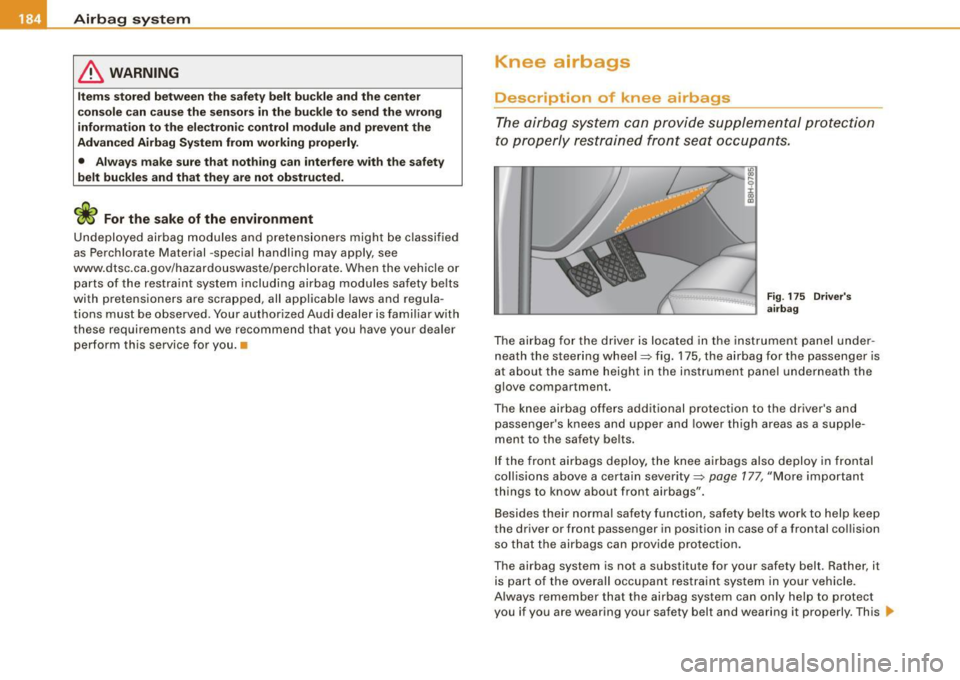
The airbag for the driver is located in the instrument panel under
neath the steering wheel=> fig. 175, the airbag for the passenger is
at about the same height in the instrument panel underneath the
g love compartment.
The knee airbag offers additional protection to the driver 's and
passenger's knees and upper and lower thigh areas as a supple
ment to the safety be lts.
If the front airbags deploy, the knee airbags also deploy in frontal
coll isions above a certain severity=>
page 177, "More important
things to know about front airbags".
Besides their normal safety function, safety be lts work to help keep
the driver or front passenger in position in case of a frontal collision
so that the airbags can provide protection.
The airbag system is not a substitute for your safety belt. Rather, it is part of the overall occupant restraint system in your vehicle.
Always remember that the airbag system can only help to protect
you if you are wearing your safety belt and wearing it properly. This
~
Page 188 of 340
-Airbag system ----=--=---------------------------------
If the front airbags d ep loy, the kne e airbags a lso d ep loy in frontal
c oll is ions abov e a certai n s ev er ity.
Whe n the syst em is dep loy ed, the airba gs start to f ill with a prope l
l ant gas, and inf late bet ween t he lower pa rt of the instr ument pa ne l
and the drive r and the l ower part of th e instru ment pane l a nd th e
front passenge r:::;, page
177 , fig. 173 .
A lth oug h the y are no t a s oft p illow, t hey can "cushion" th e im pact
and in this way they can help to r educe the ris k of injury to the lower
e xt remitie s.
A ll thi s takes place ins ta nta ne ous ly, so fast tha t many p eople don't
even realize that the airbags have deployed. The ai rbags a lso inf late
w it h a gre at d eal o f f orce and it is im por tant for occupa nt safety t hat
nothing sho uld be in their way when they dep loy.
Full y infla ted ai rbags i n co mbina tion wi th properl y w orn safe ty bel ts
s low down and limit the occupant's forward movement and he lp to
r e du ce t he risk .•
Important safety instructions on the knee
airbag system
Air bag s are only sup plemen tal restra ints. Alwa ys wea r
s af ety bel ts co rr e ctly and ride i n a prop er se atin g po sition .
Ther e is a lo t that you and your passe ngers must know a nd do to
he lp the safety belts and airbags to provide supp lemental protec
ti on .
& WARNING
An inflating knee airbag can cause serious injury. Wearing safety
belts incorrectly and improper seating positions increase the risk
of serious personal injury and death whenever a vehicle is being
used .
• The airbag system cannot protect you properly if you are
seated too close to any of the airbag locations . When adjusting
& WARNING (continued )
their seat positions, it is important that both the driver and the
front passenger keep their upper bodies and knees at the
following minimum safe d istances :
-1 O inches (25 cm) between the chest and the steering
wheel /instrument panel .
- 4 inches (10 cm) between the knees and the lower part of the
instrument panel.
• The risk of personal injury increases if you lean forward or to
the side, or if the seat is improperly positioned and you are not
wearing your safety belt. The r isk increases even more should the
airbag deploy .
• Always make sure that the knee airbag can inflate without
interference. Objects between yourself and the airbag can
increase the risk of injury in an accident by interfering with the
way the airbag deploys or by being pushed into you as the airbag
deploys.
-No persons (children) or animals should ride in the footwell
in front of the passenger seat . If the airbag deploys, this can
result in serious or fatal injuries.
- No objects of any kind should be carried in the footwell area
in front of the driver's or passenger's seat. Bulky objects (shop
ping bags , for example) can hamper or prevent proper deploy
ment of the airbag . Small objects can be thrown through the
vehicle if the airbag deploys and injure you or your passengers .
• Make sure there are no cracks , deep scratches or other damage
in the area of the instrument panel where the knee airbags are
located .
• If children are incorrectly seated , their risk of injury increases in
the case of an accident:::;,
page 190, "Child Safety". •
Page 193 of 340
--------------------------------------------~C~ h~ il~d ~S~ a~f e~ t~ YL _III
& WA RNIN G (conti nu ed )
• Alway s install rear-facing child safety se ats on the rear seat.
• If you mu st in stall a rearw ard f acing chi ld safety seat on the
front pa ssenger seat in exc eptional cir cum stance s and the
PA SSENGER AIR BAG OFF light do es not come on and stay on,
im medi ate ly install the re ar-fa cing child safety s eat in a rear
s e ating po sit ion and h ave the airb ag sys tem inspe cted im medi
ately by your Audi de aler .
& WARNING
If, in exceptional circum stance s, you must in stall a forward -facing
c hild re st ra int on the fr ont p ass eng er' s s eat :
• Alway s make sure the forward -facing seat ha s been de signed
and cert ified by it s manufa cturer f or use on a front se at with a
p ass enger front and side airbag .
• Always follow the m anufacturer's instruct ions provided with
the child safety seat or carrier.
• Alway s m ove the pa ss e nger sea t into its rearm ost p osit ion in
the seat' s fo re and aft adju stment r ange , as far away from the
a irb ag as possib le before installing the child r estr aint . The b ack
rest mu st be adju sted to an upr ight po sition.
• Alw ays ma ke sure th at the PAS SENGER AIR BAG OFF light
c ome s on and stay s on all the time whenever the ignition i s
s witched on . •
Advanced front airbag system and children
Your vehicle is equipped with an "Advanced Airbag System" in
compliance with United States Federal Motor Vehicle Sa fety Stan
dard (FMVSS) 208 as applicab le at the time your vehicle was manu
factured .
Controls and equip
ment Safety first Vehicle operation
The Advanced Airbag system in your vehicle has been certified to
meet the " low -risk" requirements for 3 and 6 yea r- old child ren on
the passenger side and small adu lts on the driver side. The low risk
deployment c rite ria are intended to reduce the risk of injury th rough
interaction with the airbag that can occur, for example, by being too
close to the steering whee l and instrument panel when the airbag
in flates . In add ition, the system has been cert ified to comply with
the "suppression" requirements of the Safety Standard, to turn off
the front airbag for infants up to 12 months who are restrained on
the front passenger seat in child restraints that are listed in the
Standard.
Even though your vehic le is equipped with an Advanced Airbag
system, all ch ildren, especially those 12 years and younger, should
a lways ride in the back seat proper ly restrained for the ir age and
s ize . The a irbag on the passenger side makes the front seat a poten
tially dangerous p lace for a chi ld to r ide. The front seat is not the
safest place for a chi ld in a forward -facing child safety seat. It can be
a very dangerous place for an infant or a larger chi ld in a rearward
facing seat. •
Advanced Airbags and the weight-sensing
mat in the front seat
The Advanced Airbag System in your vehicle detects the p resence
of an infant or chi ld in a chi ld restraint on the front passenger seat
using the weight -sensing mat in the seat cushion and the sensor
below the safety belt latch on the front passenger seat that
measures the tension on the safety belt .
The weight -sensing mat measures t otal weight of the ch ild and the
child safety seat and a chi ld blanket on the front passenger seat. The
weight on the front passenge r seat is related to the design of the
child restraint and its "footprint", the size and shape of the bottom
of the child restraint as it sits on the seat. The weight of a child
restraint and its "footprint" vary for different kinds of child .,
Vehicle care Do-it-yourself service Technical data
Page 214 of 340

-In
te llig ent tec hnolo gy --=---=-=-------------
Intelligent technology
Notice about data recorded by
vehicle control modules
Your vehicle is not equipped with an Event Data Recorder (EDRl,
installed by some manufacturers for the express purpose of
capturing data for retrieval after an accident or crash event . EDR's
are sometimes called "crash recorders" .
Some state laws restrict the retrieva l or downloading of data stored
by EDR's that were insta lled in a vehicle for the express purpose of
retrieving data after an accident or crash event without the owner's
consent.
Although your vehicle is not equipped with an EDR, it is equipped
with a number of electronic control modules for various vehicle systems such as, for examp le, engine function, emission control, as
we ll as for the airbags and safety belts.
T hese electronic control modules also record vehic le-rela ted da ta
during norma l ve hicle operation for diagnost ic and repair purposes .
The recording capacity of the electronic control modules is limited
to data (no sound is recorded) and only a small amount of data is
actually recorded over a very limited period of time and stored when
a system fault or other condition is sensed by a control unit. Some
of the data then stored may relate to vehic le speed, d irection,
braking as we ll as restraint system use and performance in the
event of a crash or other condition . Stored data can only be read and
down loaded with special equipment. •
Electronic Stabilization Program (ESP)
General information
The ESP improves the vehicle s tability.
I
A F ig . 19 0 Cen ter
co nsol e w ith ESP
sw itch
ESP is designed to he lp you maintain vehic le control in situa tions
where the car approaches the limits of "grip", especially when acce lerating and cornering . ESP reduces the risk of skidding and
improves stability under all road conditions .
The syst em opera tes across the en tire speed range in combination
with the ABS system. If the Anti-Lock Brake System (ABS) malfunc
tions, the ESP wil l a lso shut down .
How th e sys te m work s
The Anti-Lock Brake System (ABS) , E lectronic Differential Lock (EDU
and the Anti -Sl ip Regu lation System (ASR) are integrated in the e lec
tronic stabi li z ation program. In addition to the data provided by
these functions, the ESP control unit requires additional measure ment data provided by high performance sensors . T he rotational
speed of the vehic le about its ver tica l axis, t he late ral acce leration
acting on the vehic le, the brake pressure and the steering ang le are
a ll measured .
Page 215 of 340

The direction in which the driver wishes to travel is determined with
the aid of the steering angle and vehicle speed and is continua lly
compared with the actual behavior of the vehicle. If the two do not
match, -for example, when the vehicle starts hydrop laning on a
wet road -, ESP will automatical ly brake the appropriate wheel to
correct the problem.
The veh icle is then stabi lized by the forces act ing on the whee l
during braking. If the vehicle is oversteering (rear tends to skid out
of the turn), the brakes are mainly app lied on the whee l that is on
the outside of the curve. In the case of a vehicle that is understeering
(tendency to s lide out of the curve), the brakes are applied at the
rear wheel that is on the inside of the curve . An acoustic signal indi
cates when ESP brake application cuts in =>
&.
The system operates across the entire speed range in combinat ion
with the ABS system => page 216 . If the Anti -Lock Brake System
(ABS) malfunctions, the ESP wi ll be out of act ion as well.
Activa tion
When you turn on the engine, ESP w ill automatica lly be activated
and will perform a self -test .
The system can be activated o r deactivated by pressing the butto n
=> page 212, fig . 190 . The warning light comes on when the system
is switched off .
Normally, the ESP should a lways be on, however, it may be advanta
geous to turn off the system in certain specia l cases when some
degree o f wheel spin is desired such as :
• when driving with snow chains
• when driving in deep snow or on a loose surface (to allow the
whee ls to dig in to reach firm ground)
• when trying to "rock" the vehicle free whe n it has become stuck .
The system shou ld be reactivated once you are no longer in such
situations.
Both , the ABS and EDL systems are still functioning even if the ESP
is switched off .
Controls and equip
ment Safety first Vehicle operation
Int
ellig ent tec hnol ogy
& WARNING
The Ele ctron ic Stab ilization Program is neve rth ele ss s ubje ct to th e
law s of phy sic s. It is p art icularly important to pay at tent ion to thi s
f ac t on wet and slipper y ro ad s. It i s therefore important th at yo u
alway s adapt your driving to the condition of the road and traffic
c onditio ns. Do not allo w the in crea sed safety prov ided by t he Ele c
tronic Stabilization Program sy stem to lull you into a ccepting
addition al safety ri sk s.
• Plea se note that when ESP i s deactivated , the drive wheel s can
s pin on icy and slippery ro ads a nd the vehi cle can break away -
d anger of skidding ! C
E lectronic differential lock CEDL)
The electronic differential lock monitors the rotational
speed of the drive wheels.
Gener al notes
The electronic differential lock (EDU helps the car to start moving,
accelerate and c limb a gradien t on surfaces providing poor or
a lmost no grip . Without EDL, this would be difficult , if not impos
sible.
How the syst em works
The EDL operates automat ical ly . It monito rs the rotationa l speed of
the drive whee ls on an axle with the he lp of the ABS sensors
=> page 216 . If a noticeable difference in rotational speed between
the drive wheels on one axle is de tected (e.g. on slippery grou nd on
one side), the spinning wheel is braked, thereby transferring power
to the other drive wheel or wheels (a ll -whee l drive) . This is done up
to a speed of about 60 mph ( 100 km/h). Noises from the brake
system signal that wheel spin is being control led.
~
Vehicle care Do-it-yourself service Technical data