Brake AUDI A4 CABRIOLET 2009 Workshop Manual
[x] Cancel search | Manufacturer: AUDI, Model Year: 2009, Model line: A4 CABRIOLET, Model: AUDI A4 CABRIOLET 2009Pages: 340, PDF Size: 77.32 MB
Page 253 of 340
_____________________________________________ C_h_ e.::...::. c.:..k .:..in ;..:.:= g:.....:.; a.:..n :....:d ::....:. f.:.:il .:.:li .:..n :.::g:!-- ----J-
& WARNING (conti nued )
-First , fully apply the parking brake , move selector lever of
automatic transmis sion to "P " (Park) ; put manual transmiss ion
in Neutral.
- Always u se extreme caut ion to prevent clothing, jewelry , or
long hair from getting caught in the radiator fan, V-belts or
other moving parts , or from conta cting hot parts. Tie back hair
before starting , and wear no cloth ing that will hang or droop
into the engine.
• Minimize exposure to emission and chemical hazards
~ & .
& WARNING
California Proposition 65 Warning :
• Engine exhaust , some of its constituents , and certa in vehicle
components contain or emit chemicals known to the State of Cali
fornia to cause cancer and birth defects and reproductive harm . In
addition , certain fluids contained in vehicles and certain produ cts
of component wear contain or emit chemicals known to the State
of California to cause cancer and birth defects or other reproduc
tive ha rm .
• Battery post s, terminals and related acces sories contain lead
and lead compounds , chemicals known to the St ate of California
to cause cancer and reproductive harms. Wash hands after
handling.
0 Note
When adding f luids, always make sure that they are poured into the
p roper container o r filler opening, otherwise se rio us damage to
vehicle systems will occur .
W For the sake of the environment
To detect lea ks i n tim e, inspect t he v ehi cle floor pa n from u nde r
neath regularly. If you see spots from oil or other vehicle fluids, have
y o ur v ehicl e inspected by an author ized Au di dea ler. •
Engine compartment
App lies to veh icles: with 2 .0 I turbo, 4-cylinder •engine
2.0 I , 4-cylinder turbo engine (200 hp )
The se are th e m ost important items that you can check .
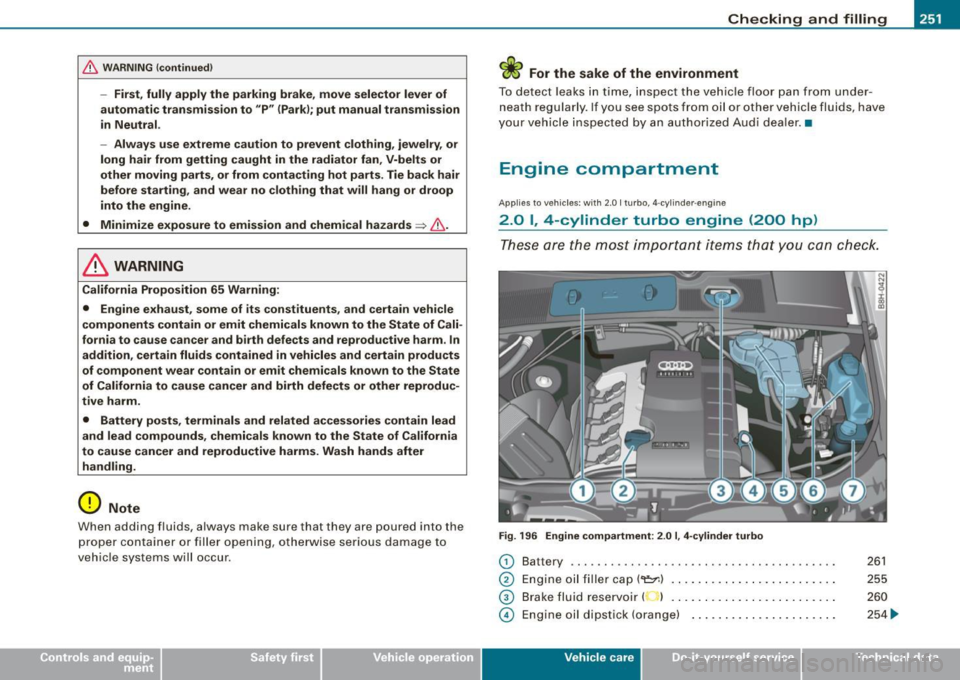
Fig. 196 Engine comp art m ent : 2 .0 I, 4-cy lind er turbo
G) Battery ..................................... •..
0 Engine oi l fi lle r ca p ('1:::r.l ..... ... ... ....... .... .. .
© Bra ke fluid reservoir ( ) ..... ... .... ... ... ... .. . .
© Engine oil dipstick (orange) ........ .......... ... .
Vehic le care
N
N
I
261
255
2 60
25 4 ...
irechnical data
Page 262 of 340
•---=C:.:h..:. e=-= c..:.k :..:.in =-=-= g~ a..:.n :.:d::....:. f.:.:il .:.:li ..:.n :..::g:!..- ___________________________________________ _
0 Note
• Coolant pollutes the environment and could cause an engine
fire. Excess coolant will be forced out through the pressure relief
valve in the cap when the engine becomes hot.
• If, in an emergency, only water can be added, the correct ratio
between water and antifreeze~
page 257must be restored as soon
as possible.
<£> For the sake of the environment
Drained coolant should not be reused. Always dispose of used
coolant while observing all environmental regulations. •
Radiator fan
The radiator fan switches on automatically by itself.
The radiator fan is driven by the engine via the V-belt. The viscous
clutch regulates the speed of the fan according to the temperature
of the coolant.
An auxiliary electric radiator fan* switches on and off depending on coolant temperature and other vehicle operating conditions.
After you switch the engine off, the auxiliary fan can continue running for up to 10 minutes - even with the ignition off. It can even
switch on again later by itself~&, if
• the temperature of the engine coolant rises due to the heat
build -up from the engine in the engine compartment, or
• the engine compartment heats up because the vehicle is parked
in intense sunlight.
& WARNING
• To reduce the risk of personal injury never touch the radiator
fan .
_& WARNING (continued)
• The auxiliary electric fan is temperature controlled and can
switch on suddenly even when the engine is not running .
• The auxiliary radiator fan switches on automatically when the
engine coolant reaches a certain temperature and will continue to
run until the coolant temperature drops. •
Brake fluid
Checking brake fluid level
The brake fluid level can be checked with a quick glance.
Fig. 203 Engine
compartment: Brake
fluid reservoir
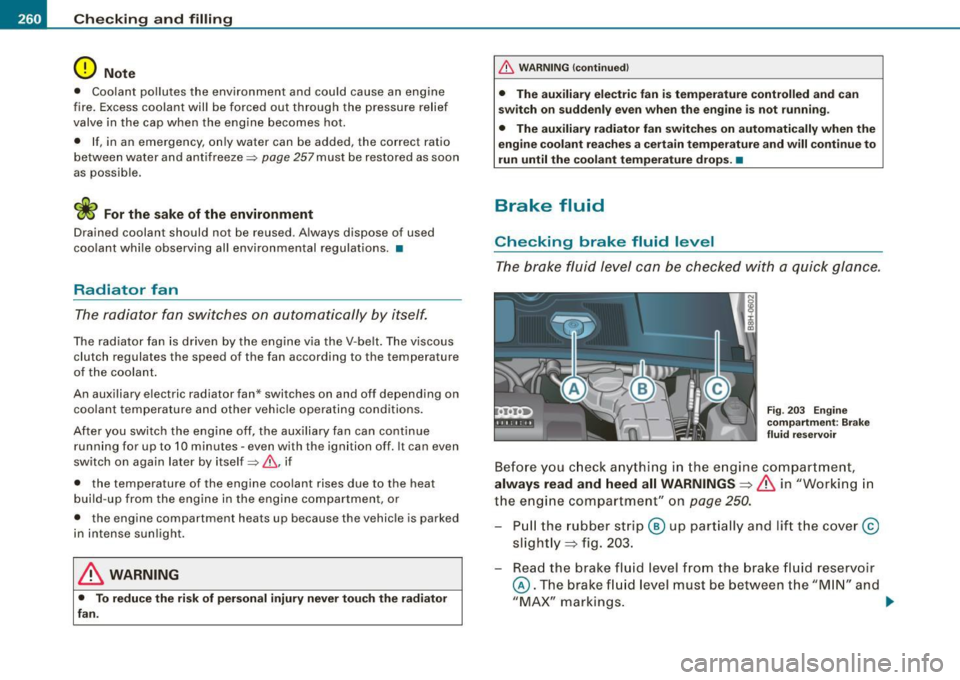
Before you check anything in the engine compartment,
always read and heed all WARNINGS:::::, & in "Working in
the engine compartment" on
page 250.
Pull the rubber strip@ up partially and lift the cover @
slightly :::::, fig. 203.
- Read the brake fluid level from the brake fluid reservoir
©. The brake fluid level must be between the "MIN" and
"MA X" markings. _..
Page 263 of 340
_____________________________________________ C_ h_ e _ c_k _in ---= g'--- a_n _d_ f_il _li _n __.,g==----•
•
The brake fluid reservoir is located at the rear partition of the engine
compartment on the left side~
page 252 .
The fluid level may drop slightly after some time due to the auto
matic adjustment of the brake pads. This is not cause for alarm .
If the brake fluid level falls
considerably below the "MIN" mark, the
brake warning/indicator light (U .S. models :
BRAKE, Canadian models :
(CD) ) wi ll come on
~ page 23 and ~ page 30. Do not continue to
operate the vehicle. The complete brake system should be thor
oughly checked by an authorized Audi dealer or qualified workshop
and the cause corrected . If the brake fluid level is too low, the brake
warning/indicator light will illuminate. Contact an authorized Audi
dea ler
immediately .•
Changing brake fluid
Have the brake fluid changed by an experienced techni
cian.
Brake fluid absorbs moisture from the air . If the water content in the
brake fluid is too high, corrosion in the brake system may result
after a period of time. The boiling point of the brake fluid wil l also
decrease considerably and decrease braking performance.
Therefore, the brake fluid must be changed
every two years. Always
use new brake fluid which conforms to Federa l Motor Vehic le Stan
dard "FMVSS 116 DOT 4".
The brake fluid reservoir can be difficult to reach, therefore, we
recommend that you have the brake fluid changed by your autho
rized
Audi dealer. Your dealer has the correct tools, the right brake
fluid and the know -how to do this for you.
& WARNING
• Brake fluid is poisonous. It must be stored only in the closed
original container out of the reach of children!
& WARNING (continued)
• Brake failure can result from old or inappropriate brake fluid.
Observe these precautions :
- Use only brake fluid that meets SAE specification
J 1703 and
conforms to Federal Motor Vehicle Standard 116. Always check
with your authorized Audi dealer to make sure you are using
the correct brake fluid. The correct type of brake fluid is also
indicated on the brake fluid reservoir .
- The brake fluid must be new . Heavy use of the brakes can
cause a vapor lock if the brake fluid is left in the system too
long. This can seriously affect the efficiency of the brakes as
well as your safety . This could result in an accident.
0 Note
Brake fluid wil l damage the paint of your vehicle .
ci> For the sake of the environment
Because of the problem of proper disposal of brake fluid as well as
the special tools required and the necessary expertise, we recom
mend that you have the brake fluid changed by your authorized Audi
dealer. •
Battery
General information
Under normal operating conditions, the battery in your Audi does
not need any maintenance. With
high outside temperatures it is
advisab le however to check the fluid level at regular intervals
through the transparent battery housing. Also check the fluid level
each time you charge the battery . After charging the battery
~ page 265, you shou ld likewise check the battery acid level. ...
Vehic le care
Page 269 of 340

Tires a nd wh eels BIii ________________________________ :....:.:.....::.=.....::.:..:..:..::..:___:___:..__ __
•
Tires and wheels
Tires
General notes
Tires may be the least appreciated and most abused parts
of a motor vehicle.
Tires may be the least appreciated and most abused parts of a
motor vehicle. Tires are, however, one of the most important parts
of a vehicle, particular ly considering the comparative ly sma ll patch
of rubber on each tire that assures that all -important contact
between you, your vehicle and the road .
Maintaining the correct tire pressure, making sure that your vehicle
and its tires do not have to carry more weight than they can safely
handle, avoiding damage from road hazards and regular ly
inspecting tires for damage inc luding cuts , slashes irregular wear
and overal l condition are the most important things that you can do
to help avoid sudden tire failure including tread separation and
b lowouts .
Avo iding d am age
If you have to drive over a curb or similar obstacle, drive very slowly
and as close as possible at a right angle to the curb.
A lways keep chemica ls including grease, oil, gasoline and brake
flu id off the ti res .
I nspect the tires regularly for damage (cuts, cracks or blisters, etc .!.
Remove any foreign bodies embedded in the treads .
Storing tire s
Mark tires when you remove them to indicate the direction of rota
tion. This ensures you to be ab le to mount them correctly when you
reinstall them. When removed, the whee
ls or tires should be stored in a coo l, dry
and preferably dark place.
Store tires in a vertical position i f they are not mounted on r ims, in
a horizontal position if they are mounted on rims.
N ew tire s
New tires have to be broken in => &.
The tread depth of new tires may vary, according to the type and
make of tire and the tread pattern.
Hidd en d am ag e
Damage to tires and rims is often not readily visible . If you notice
unusua l vibration or the vehic le pul ls to one side, this may indicate
that one of the tires has been damaged . The tires must be checked
immediately by an author ized Audi dealer or qualified workshop .
Uni dir ection al tire s
A unidirect ional tire can be identified by arrows on the sidewa ll, that
point in the direction the tire is designed to rotate. You must fo llow
the specified direction of ro tation . This is necessary so that these
tires can deve lop their optimum characteristics regarding grip, road
noise, wear and hydroplaning resistance . For more information
=> page 298.
Rim s with bolted rim ring *
Light-alloy wheels with a bo lted rim ring consist of several parts .
These parts are screwed together with special bo lts, using a specific
technique. This ensures proper function, seal, safety, and true running of the wheel. For this reason, damaged rims shou ld be
replaced, and you should never repair or dismantle them
=> & .
Rim s with screw -on decorative co vers *
Light-a lloy whee ls can be furnished with interchangeab le decora -
tive covers that are mounted to the rim with se lf -locking bolts. ...
Vehic le care
Page 271 of 340

__________________________________________________ T_ ir_e_ s_ a_ n_d _ w_ h_ e_ e_l_s _ ...... lJII
•
Curb weight
means the weight of a motor vehicle with standard equipment
including the maximum capacity of fue l, oi l, and coolant, air condi
tioning and additional weight of optional equipment.
Extra load tire
means a tire designed to operate at higher loads and at higher infla
tion pressures then the corresponding standard tire . Extra load tires
my be identified as "XL", "xi", "EXTRA LOAD", or "RF" on the side
wa ll.
Gross Axle Weight Rating ("GAWR")
means the load-carrying capacity of a single axle system, measured
at the tire -ground interfaces.
Gross Vehicle Weight Rating ("GVWR ")
means the maximum total loaded weight of the vehicle.
Groove
means the space between two adjacent tread ribs.
Load rating (code)
means the maximum load that a tire is rated to carry for a given
inflation pressure. You may not find this information on al l tires
because it is not required by law.
Maximum load rating
means the load rating for a tire at the maximum permissible infla
tion pressure for that tire.
Maximum loaded vehicle weight
means the sum of :
(a) Curb weight
(b) Accessory weight
(c) Vehicle capacity we ight, and
(d) Product ion options weight
Maximum (permissible) inflation pressure
means the maximum cold inflat ion pressure to which a tire may be
inflated. Also called "maximum inflation pressure."
Normal occupant weight
means 150 lbs. (68 kilograms) times the number of occupants
seated in the vehicle up to the total seating capacity of your vehicle.
Occupant distribution
means distribution of occupants in a vehicle.
Outer diameter
means the overall diameter of an inflated new tire.
Overall width
means the linear distance between the exteriors of the sidewalls of
an inflated tire, including elevations due to labeling, decorations, or
protective bands or ribs.
Ply
means a layer of rubber -coated para lle l cords .
Production options weight
means the combined weight of those installed regular production
options weighing over 5 lbs. (2 .3 kg) in excess of those standard
items which they replace, not previously considered in curb weight
or accessory weight, including heavy duty brakes, ride levelers,
heavy duty batter y, and special trim.
Radial ply tire
means a pneumatic tire in which the ply cords that extend to the
beads are laid at substantially 90 degrees to the centerline of the
tread.
Recommended inflation pressure
see::;, page 268, "Cold tire inflation pressure".
Ve hic le care
Page 275 of 340
Tires and wheels -
----------------
•
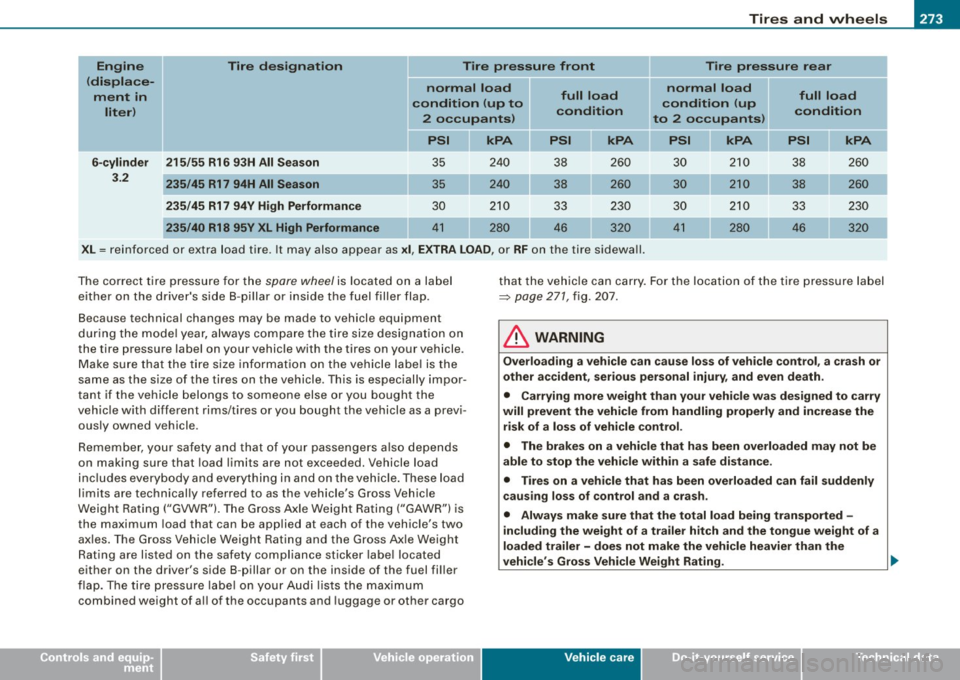
Engine Tire designation Tire pressure front Tire pressure rear
(displace- normal load normal load
ment in full load
full load
liter ) c
ondit ion (up to
condition c
ondition (up
condition
2 occupants ) to 2 occupants)
PSI kPA PSI kPA PSI kPA PSI kPA
6 -cylinder 215 /55 R16 93H All Season 35 240
38 260
30 2
10
38 260
3.2
235/45 R17 94H All Season 35 2
4 0
38 260 30 2
10
38 260
235/45 R17 94V High Performance 30 2 10 3 3 230 30 2 10 33 230
235 /40 R18 95V XL High Performance 41 280 46 320 41 280 4 6 320
XL= reinforced or extra load tire. It may also appear as x i, EXTRA LOAD , or RF on the tire sidewa ll.
The correct tire pressure for the
spare wheel is located on a label
either on the dr iver's side B-pilla r or i nside the fuel filler flap.
Because technical changes may be made to vehicle equipment
dur ing the mode l year, a lways co mpare the tire size designatio n on
the tire pressure label on your vehicle with the tires on your vehicle .
Make sure t hat the tire s ize informa tion o n the vehi cle labe l is the
same as the size of the tires on the vehicle . This is especially impor
t a nt if th e ve hicle belo ngs to someone else or you bough t the
vehic le with different rims/tires or you bought the vehicle as a previ
ously owned vehicle.
Re member, your safety and that of your passeng ers a ls o depends
on making sure that load limits are not exceeded. Vehicle load
inc lude s every body and everyt hin g i n and o n the vehic le . These load
limits are techn ically referred to as the vehicle's Gross Vehic le
Weight Ra tin g ("GVWR") . The Gross Axle Weig ht Ra ting ("GAWR") is
the maximum load that can be applied at each of the veh icle's two
ax les . The Gross Vehic le W eight Rating and the Gross Ax le Weight
Rating are listed on the safety compliance sticker label located
either on the driver's s ide 8 -pillar or on the inside of the fuel fi ller
fl ap. T he ti re pressure labe l on your Aud i lists the max imum
combined weight of a ll of the occupants and luggage or other cargo that the vehicle can car
ry. Fo r the l ocat io n of the tire pressure la bel
=> page 271, fig. 207.
LJ}. WARNING
Overload ing a vehicle can cause loss of vehi cle cont rol , a crash or
other ac cident , serious per sonal injury , and even death .
• Carrying more weight than your vehicle wa s designed to carry
will prevent the vehicle from handling properly and increase the
risk of a loss of vehicle control .
• The brakes on a vehicle that has been overloaded may not be
able to stop the vehi cle within a safe dist ance.
• Tires on a vehicle that has been overloaded can fail suddenly
cau sing lo ss of control and a crash .
• Always make sure that the total load being transported -
including the weight of a trailer h itch and the tongue weight of a
loaded trailer -does not make the vehicle heavier than the
vehi cle 's Gross Vehicle Weight Rating . .,,_
Vehic le care
Page 278 of 340
-~_T_ ir_e_ s_ a_ n_d _ w_ h_ e_e _l_s _________________________________________________ _
and is more difficult to stop. Overloading can not only lead to loss
of vehic le contro l, but can also damage important parts of the
vehic le and can lead to sudden tire failure, including a blowout and
sudden deflation that can cause the vehicle to crash .
Your safety and that of your passengers also depends on making sure that load limits are not exceeded . Vehicle load includes every
body and everything in and on the veh icle . These load lim its are
technically referred to as the vehicle's
G ross Vehicle Weight R ating
("GVWR").
The "GVWR" includes the weight of the basic vehic le, all factory
installed accessories, a ful l tank of fuel, oil, coolant and other fluids
p lus maximum load. The maximum load includes the number of
passengers that the vehicle is intended to carry ("seating capacity")
with an assumed we ight of 150 lbs (68 kg) for each passenger at a
designated seating position and the total weight of any luggage in
t he vehicle. If you tow a trai ler, the weight of the trailer hitch and the
tongue weight of the loaded trai ler must be included as part of the
vehic le load .
T he
G ros s Axle Weight Rating ("GAWR") is the maximum load that
can be applied at each of the vehicle's two axles .
The Gross Vehicle Weight Rat ing and the Gross Axle Weight Rating
are listed on the safety compliance sticker labe l located either on
the d river's side B -pillar o r on t he inside of the f ue l fi ller flap. Yo ur
Audi has 4 seating positions, 2 in the front and 2 in the rear for total
seating capaci ty of 4. Each seating posi tion has a safety belt
=>
page 159, "Safety be lts" .
T he fact that there is an upper limit to your vehicle's Gross Vehicle
Weight Rating means that the total weight of whatever is being carried in the vehicle (including the weight of a trailer hitch and the
tongue weigh t of the loaded trailer) is lim ite d. The more passengers
in the vehicle or passengers who are heavier than the standard
weights assumed mean that less weight can be carried as luggage.
The tire pressure labe l on your Audi also lists the maximum
combined weight of a ll of the occupants and luggage or othe r cargo that the vehicle can carry
. For the location of the label=>
page 271,
f ig. 207 .
& WARNING
Overloading a vehicle can cau se lo ss of vehicle control , a cra sh or
other a ccident , seriou s personal injury , and even de ath .
• Carrying more weight th an your vehi cle w as designed to ca rry
will prevent the vehi cle from handling properly and in cre ase the
ri sk of the lo ss of vehicle control.
• The brakes on a veh icle th at ha s been overloaded ma y not be
able to stop the vehicle within a safe distance .
• Tire s on a vehicle that has been overloaded can fail suddenly,
i ncluding a blowout and sudden defla tion , cau sin g los s of control
and a crash .
• Alwa ys make sure that the tot al l oad be ing tran sported -
including the weight of a trai ler hit ch and the tongue weight of a
loaded trailer -does not m ake the vehicle heavie r than the
v ehicle 's Gro ss Vehicle Weight Rat ing .•
Determining correct load limit
U se th e exa mple below to calculat e the
total weight of the passengers and luggage or other things that you plan to
tran sport so that you can make sure that
your vehi cle will n ot be ov erlo ad ed.
~
Page 281 of 340

__________________________________________________ T_ ir_e _ s_ a_ n _ d_ w_ h_ e_ e_ls _ _____,ffllll
In correct wheel alignment
Inc orrect wheel alignment can cause excessive tire wea r, impairing
the saf ety of the vehicle . If tires s how excessive wear , have the
whee l alig nment chec ked by an autho rized A udi deale r or q ualif ied
workshop .
All Wheel Drive
Vehicles with quattro ® must always have tires of the same si ze ,
cons tructi on and tread type . For details see => page 218 .
& WARNING
Sudden tire failure can lead to loss of control, a crash and serious
personal injury!
• Never drive a vehicle when the tread on any tire is worn down
to the wear indi cators .
• E specially in wet and slick driving situations , a preferably large
profile depth of the tires is necessary , and an approximately
similar profile depth of the front and rear axle tire s.
• The diminished driving safety , caused by too small of a tire
profile , is negatively perceivable especially in handling , in danger
of hydroplaning when driving through deep puddles and ponds ,
when driving around curve s, and in braking behavior.
• Worn t ires are a safety hazard , they do not grip well on wet
roads and increase your risk of "hydroplaning " and loss of control.
• Always keep chemicals that can cause tire damage , such a s
grease , oil , gasoline and brake flu id away from tires.
• Tires age even if they are not being used and can fail suddenly ,
espe cially at high speeds . Tires that are more than 6 years old can
only be used in an emergency and then with special care and at
lowe r speeds.
• Never mount used tire s on your vehicle if you are not sure of
their "previous history ." Old u sed tires may have been damaged
even though the damage cannot be seen that can lead to sudden
tire failure and los s of vehicle control. •
New tires and replacing tires and wheels
New tires and wheels ha ve to be bro ken in.
Fig. 211 Tire spe cification cod es on the sidewall of a tir e
No. Description
©
@
@
@
©
©
Passenger car tire (where applicable)
Nominal w id th of tire in mi llimeters
Ratio of height to width (aspect ratio)
Radia l
ii Rim diameter code
Load index an d sp eed ra ting
Vehic le care irechnical data
Page 284 of 340
-~_T_ ir_e_ s_ a_ n_d _ w_ h_ e_e _l_s _________________________________________________ _
toring system* would not be able to monitor the tire pressure or
warn you if it is necessa ry.
• T he battery inside of the tire pressure sensor has a limited
service life.
• Always drive with the valve stem caps securely mounted. We
r ecommend us ing facto ry insta lled va lve stem caps. Ask you r autho
rized Audi dealer to replace lost va lve stem caps.
T he installation of rep lacement tires with steel cord body p lies in
t he tire sidewall may cause mal functi on of the tir e pressure mo ni
toring system , and is not recommended (cord material information
in mo lded o n th e ti re sid ewa ll) .
Always check your tire pressure monitoring system * indicator after
r eplacing one or mo re ti res on your veh ic le . I f the ti re p ress ure
m onito ring syste m* ind icator flashes, or is o n, your s ystem is not
wo rking properly . Your replacement t ire might be incompatible with
yo ur tir e pressure mon ito ring system* , o r so me compo nen t of th e
tire p ressure monitoring system * may be damaged .
& WARNING
• Using incorrect or unmatched tires and I or wheels or improper
tire and wheel combinations can lead to loss of control , collision
and serious personal injury .
• Always use t ires , rims and wheel bolts that meet the specifica
tions of original factory-installed tires or other combinations that
have been specifically approved by the vehicle manufacturer.
• Tires age even if they are not being used and can fa il suddenly,
espe cially at high speeds . Tires that are more than 6 years old can
only be used in an emergency and then with special care and at
lower speed s.
• Never mount used tire s on your vehicle if you are not sure of
their "previous history ." Old used tire s may have been damaged
even though the damage cannot be seen that can lead to sudden
tire f ailure and loss of vehicle control.
& W ARNING (continued )
• All four wheels mu st be fitted with radial tires of the same type,
size (rolling circumference ) and the same tread pattern. Driv ing
with different tires redu ces vehicle h andling and can lead to a loss
of control.
• If the spare tire is not the same as the tires that are mounted
on the vehicle - for e xample with winter tire s - only u se the spare
tire for a short period of time and drive with extra care . Refit the
normal road wheel as soon as safely possible.
• Never drive faster than the maximum speed for which the tires
on your vehicle are rated because tires that are driven faster than
the ir rated speed can fail suddenly .
• Overloading tires cause heat build-up, sudden tire failure ,
including a blowout and sudden deflation and loss of control .
• Temperature grades apply to tires that are properly inflated and
not over or underinflated .
• For te chnical reasons it is not always possible to use wheels
from other vehicle s -in some cases not even wheels from the
same vehicle model.
• If you install wheel trim discs on the vehicle wheels, make sure
that the air flow to the brakes is not blocked. Redu ced airflow to
the brakes can them to overheat , increasing stopping distances
and causing a collision.
• Run flat tire s may only be used on vehicle s that were equipped
with them at the fa ctory . The vehicle must have a cha ssis designed
for run flat tires and a factory -installed tire pressure monitoring
s ystem that indicate s a loss of tire pressure . Incorre ct use of run
flat tires can lead to vehicle damage or accidents . Check with an
autho rized Audi dealer or t ire specialist to see if your vehicle can
be equipped with run flat tires .
If run flat tires are used , they mu st
be installed on all four wheels . Mixing tire types is not permitted. .,
Page 288 of 340

IIIJIL_T~ ir~e =s~ a~n~ d~ w~ h ~e~e~ l~ s '.,_ ______________________________________________ _
Wheel bolts
Wheel bolts must always be tightened to the correct
torque .
The design of wheel bo lts is matched to the factory installed rims . If
different rims are fitted, the correct wheel bolts with the right length
and correctly shaped bolt heads must be used. This ensures that
whee ls are fitted securely and that the brake system functions
correctly .
I n certain circumstances, you may not use wheel bolts from a
different vehicle -even if it is the same model~ page 318.
& WARNING
Improperl y tightened or maintained wheel bolt s can be come loose
c au sing lo ss of control , a co llis ion and seriou s personal injur y.
• Alwa ys keep the wheel bolt s and the th reads in the wheel hubs
c lean so the wheel bolt s can turn ea sily and be properl y tightened.
• Never gre ase or oil the wheel bolt s and the thre ad s i n the wheel
hub s. They can become lo ose while drivin g if gre ased or oiled ,
e ven if tig hten ed to th e specifi ed torque .
• Onl y use wheel bo lt s th at bel ong to the rim being in sta lled.
• Nev er use differ ent wheel s bolt s on your vehicle.
• Alway s m aintai n the corre ct t ightenin g to rq ue for the whee l
bo lt s to r edu ce the ri sk of a whe el los s. If the tighten ing torque of
t h e w heel bolt s is too l ow, they c an loose n a nd com e out when th e
v ehicl e is mov ing . If th e tighte ning torque is t oo high, the whe el
b ol ts an d threads can be dam ag ed and the whee l can become
loo se .
0 Note
The specified torque for the wheel bolts is 90 ft lb (120 Nm) with a
tolerance of ± 7,4 ft lb(± 10 Nm). Torque whee l bolts diagonally.
After changing a wheel, the torque must be checked as soon as possible with a torque wrench
-preferably by an authorized Audi
dea ler or qua lified workshop .•
Low aspect ratio tires
Your Audi is fac tory-equipped with low aspect ratio tires. These tires
have been thorough ly tested and been selected specifically for your
model for their superb performance, road feel and hand ling under
a variety of driving conditions . Ask your authorized Audi dealer for
more details.
The low aspect ratio of these t ires is ind icated by a numera l of 55 or
l e ss in the tire's size designation . The numera l represents the ratio
of the tire's sidewa ll height in relat ion to its tread w idth expressed
in percentage. Conventiona l tires have a height/width ratio of 60 or
more .
T he perform ance of lo w-as pect-rati o tire s is part ic ul arl y s ensit ive to
improp er infla tion pr essure. It i s there fore important that low
a s pect ra tio tir es are inflated to the sp ec ified pre ssure an d th at th e
i nfl ation pre ssure is regularl y checked and m aintained . T ir e pres
s ure s should b e checked a t lea st once a month and alw ays before a
long trip~ page 274, "Checking tire pressure".
What you can d o to avoid tire a nd rim dama ge
Low aspect ratio tires can be damaged more easi ly by impact with
potho les, curbs, gull ies or ridges on the road, particularly if the tire
is underinflated.
In order to minimize the occurrence of impact damage to the tires
of your vehic le, we recommend that you observe the fo llowing
precautions:
• Always maintain recommended inflation pressures . Check your
tire pressure every 2,000 miles (3,000 km) and add air if necessary .
• Drive careful ly on roads with potholes, deep gullies or ridges.
The impact from driving through or over such obstacles can
damage your tires. Impact with a curb may also cause damage to
your tires . .,_