belt AUDI A4 CABRIOLET 2009 Repair Manual
[x] Cancel search | Manufacturer: AUDI, Model Year: 2009, Model line: A4 CABRIOLET, Model: AUDI A4 CABRIOLET 2009Pages: 340, PDF Size: 77.32 MB
Page 206 of 340
___ C_h_ i_ld _ S_ a_ f_ e_ t_ y ______________________________________________ _
(T he term "ISOFIX" regarding lower anchorages had been used by
Audi and other man ufacturers in the past, but LATC H is now the
standard name for the new child restraint anchorage system.)
Some chi ld restraint system manufacturers have been providing
t e th er straps on certain mode ls of their child restraint systems,
either as standard equipment or as a retrofit, for several years .
Check w ith the manu facturer of the ch ild restra int syste m for tether
strap availabili ty .
T o provide a simpler and more p racticab le way to a ttach the child
restraint system on the vehicle seat, U .S . Federal regulations require
the phase -in of lower anchorages in vehicles and devices on new
child restraint systems to attach to the vehicle anchora ges.
Child restraint system manufacturers will probab ly offer two kinds
o f lower a nchorages on their child safety seats
T hey could come with:
• hook-on o r push-on connectors attached to adjus tab le straps or
• rigid latches on bars that extend out the back of the ch ild
r est raint and are re leased w ith release but tons a t the bottom of the
child restra int.
I n addition to the LATCH lower anchorages, both of th ese child
r estra int syst ems use tether straps to help keep the c hild restrai nt
system firmly in p lace .
Tether an chorages
Your Audi Cabriolet is not equipped with a
LATCH system. It is not
equ ipp ed with top tether anchorages . It is equ ipped wit h lo wer
anchorages on ly.
Your Ca briolet is equipped with the Ac tive Rollover Protect ion
System, which is integrated into the backrest of the rear seat. The
Active Rollove r Protection System deploys upwards to help provide
additional protection in certain coll isions a nd cras h situations. For
this reason, your vehicle is not equipped with top tether anchorages
f or use with forward -facing child restra ints . In Canada
, provincia l law requires that forward -facing child
res tra ints use both t op tethe r anc horages and l owe r an ch orages;
therefore, it is not possible to insta ll a forward -facing chi ld restraint
i n t his vehicle.
In the United States , ch ild restraint installation mus t con form with
the child restraint manufacturer's instructions . Check the instruc
t ions that co me w ith the chi ld rest raint or co ntact the manufactu rer
to determine if the child restraint may be instal led facing forward
w it h out securing the top tether strap .
& WARNING
• Improper installation of child restraints will increa se the risk of
injur y in a crash .
• Alway s carefully follow the child restraints manuf acturer' s
instructions for proper installation of the child restraint and
proper use of the lower anchorages or safety belts in your vehicle .
• Never secure or attach any luggage or other items to the LATCH
lower anchorages. •
Where can I get additional information about
child restraint application and usage?
T here are a number of sources of add itiona l information about child
restra int se lection, i nstallati on a nd usage :
NH TSA advises that the best chi ld safety seat is the one that fits
you r ch ild and fit s in yo ur vehicle, and that you will use co rrectly and
consis tently.
T ry be fore you buy!
National Highway Traffic Safety Admin istratio n
Tel. : (888) DAS H-2- DOT
www.nhtsa.dot .gov
National SAFE KIDS Campaign
Page 207 of 340
Tel.: (202) 662-0600
www.safekids.org
Safety BeltSafe U .S .A
Tel.: (800) 745-SAFE (English)
Tel.: (800) 747-SANO (Spanish)
www.carseat.org
Transport Canada
Tel.: (800) 333-0371
www.tc .gc.ca
Audi Client Relations
Tel.: (800) 822-2834 •
Lower anchorages and tether for
children (LATCH}
Location
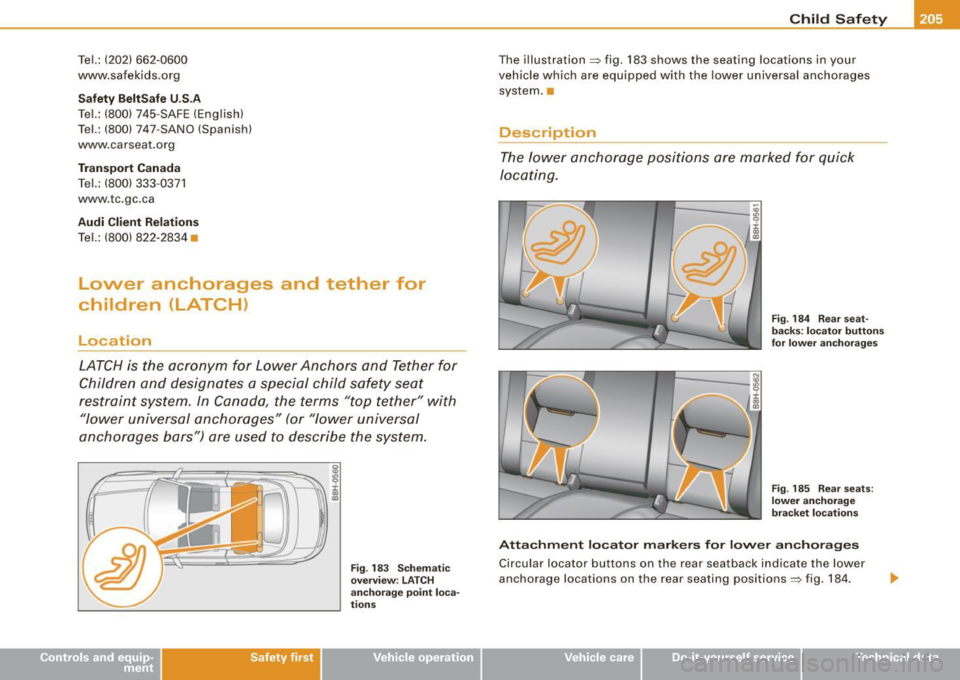
LATCH is the acronym for Lower Anchors and Tether for
Children and designates a special child safety seat
restraint system . In Canada , the terms "top tether" with
"lower universal anchorages" (or "lower universal
anchorages bars") are used to describe the system.
Safety first
I :c 00
"'
Fig. 183 Schematic
overview: LATCH
anchorage point loca
tions
Child Safety
The illustration~ fig. 183 shows the seating locations in your
vehicle which are equipped with the lower universal anchorages system .•
Description
The lower anchorage positions are marked for quick
locating.
Fig. 184 Rear seat
backs : locator buttons
for lower anchorages
Fig . 185 Rear seats:
lower anchorage
bracket locations
Attachment locator markers for lower anchorages
Circular locator buttons on the rear seatback indicate the lower
anchorage locations on the rear seating positions ~ fig. 184.
~ehicle care irechnical data
Page 208 of 340
___ C_h_ i_ld _ S_ a_ f_ e_ t-= y'------------------------------------------------
Lower anchorages
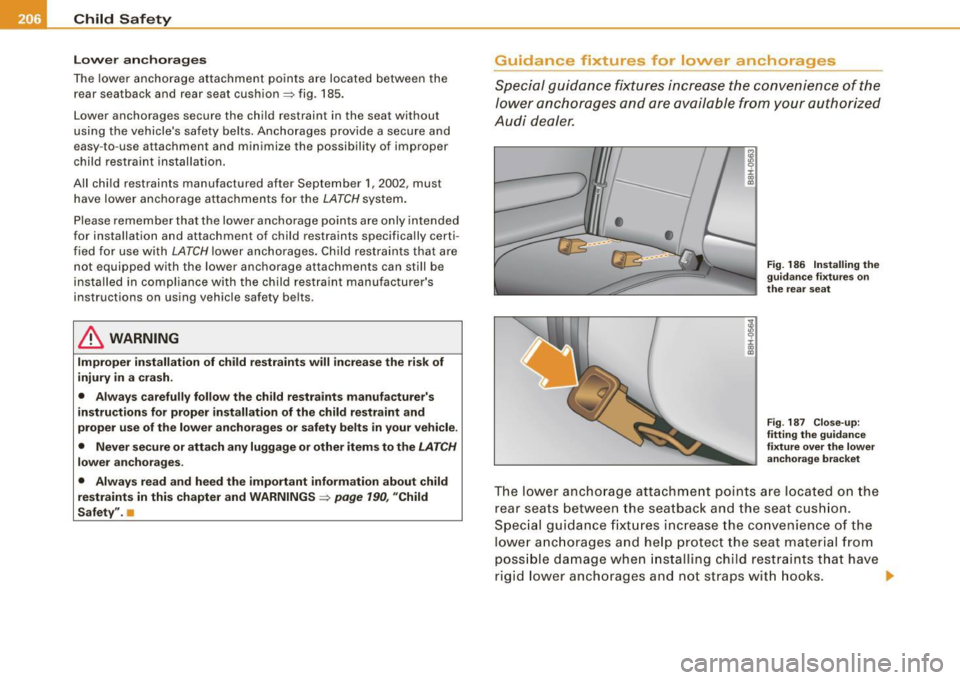
The lower anchorage attachment points are located between the
rear seatback and rear seat cushion=> fig. 185.
Lower anchorages secure the child restraint in the seat without
using the vehicle's safety belts. Anchorages provide a secure and
easy -to -use attachment and minimize the possibility of improper
child restraint installation.
All child restraints manufactured after September 1, 2002, must have lower anchorage attachments for the
LATCH system.
Please remember that the lower anchorage points are only intended
for installation and attachment of child restraints specifically certi
fied for use with
LATCH lower anchorages. Child restraints that are
not equipped with the lower anchorage attachments can still be
installed in compliance with the child restraint manufacturer's
instructions on using vehicle safety belts.
& WARNING
Improper installation of child restraints will increase the risk of
injury in a crash.
• Always carefully follow the child restraints manufacturer's
instructions for proper installation of the child restraint and
proper use of the lower anchorages or safety belts in your vehicle.
• Never secure or attach any luggage or other items to the LATCH
lower anchorages.
• Always read and heed the important information about child
restraints in this chapter and
WARNINGS :::> page 190, "Child
Safety".•
Guidance fixtures for lower anchorages
Special guidance fixtures increase the convenience of the
lower anchorages and are available from your authorized
Audi dealer.
!6
"' 0 ± .,
"'
Fig. 186 Installing the
guidance fixtures on
the rear seat
Fig . 187 Close-up:
fitting the guidance
fixture over the lower
anchorage bracket
The lower anchorage attachment points are located on the
rear seats between the seatback and the seat cushion.
Special guidance fixtures increase the convenience of the
lower anchorages and help protect the seat material from
possible damage when installing child restraints that have
rigid lower anchorages and not straps with hooks. .,
Page 209 of 340

_______________________________________________ C_h _i_ld _ S_ a_ f_ e_ t...: Y _ _____.1!1111
Installing the guidance fixtures
- Push down on the seat cushion so that the lower anchor
ages are visible.
- Hold the guidance fixture with the part number facing downward and push it in the direction of the arrow onto
the anchorage :::::, fig. 187.
- Make sure that each of the two guidance fixtures per seat
snaps into place.
Removing the guidance fixtures
- Remove the child restraint according the child restraint
manufacturer's instructions.
- Push down on the seat cushion so that the lower anchor
ages are visible.
- Pull off the guidance fixtures from the lower anchorages.
- Always remove the guidance fixtures and keep them in a
safe place when not in use.
You may find it easier to install child restraints equipped with hooks
attached to straps without the guidance fixtures in place. If this is
the case, remove the guidance fixtures by pulling them off the
anchorages . However, the guidance fixtures can help you to locate
the
LATCH anchorages.
& WARNING
Improper use of tether anchorages or lower anchorages can cause
serious personal injury in a crash.
• Always carefully follow the child restraint manufacturer's
instructions for proper installation and use of child restraint
systems.
Controls and equip ment Safety first Vehicle operation
& WARNING (continued)
•
Never use the LATCH or tether anchorages to attach safety
belts or other kinds of occupant restraints.
• Child restraint tether attachments and lower attachments are
only designed to secure a child restraint that has been equipped
to use these anchorages.
• Tether anchorages and lower anchorages are designed to with
stand only those loads imposed by correctly fitted child restraints.
Under no circumstances can they be used safely for adult or child
safety belts or harnesses.
• Never mount more than one child restraint to a single tether or
to a lower anchorage point. Attaching two child restraints to a
single anchorage point can cause the anchorage to fail and cause
serious personal injury in a crash.
0 Note
If you leave the guidance fixtures installed for several days, they
could leave a mark on the upholstery on the seat cushion and back
rest in the area that the guidance fixtures were installed. The uphol
stery would also be permanently stretched around the guidance
fixtures. This applies especially to leather seats.
[ i] Tips
• Always remove the guidance fixtures when not in use.
• Please keep the guidance fixtures in a safe place with the vehicle
when not in use .•
Vehicle care Do-it-yourself service Technical data
Page 210 of 340
___ C_h_ i_ld _ S_ a_ f_ e_ t-= y'------------------------------------------------
Install ing a child restraint using the lower
anchorages of the LA TC H system
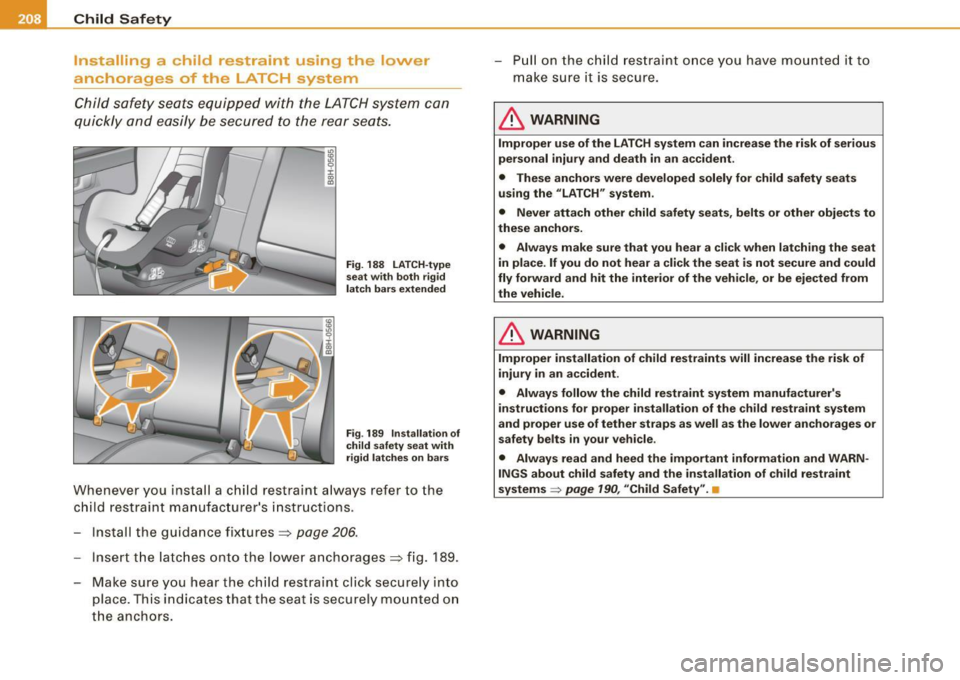
Child safety seats equipped with the LATCH system can
quickly and easily be secured to the rear seats.
Fig. 188 LATCH-type
seat with both rigid
latch bars extended
Fig. 189 Installation of
child safety seat with
rigid latches on bars
Whenever you install a child restraint always refer to the
child restraint manufacturer's instructions.
- Install the guidance fixtures=:>
page 206.
-Insert the latches onto the lower anchorages=:, fig. 189.
Make sure you hear the child restraint click securely into
place. This indicates that the seat is securely mounted on
the anchors. -
Pull on the child restraint once you have mounted it to
make sure it is secure.
& WARNING
Improper use of the LATCH system can increase the risk of serious
personal injury and death in an accident.
• These anchors were developed solely for child safety seats
using the "LATCH" system.
• Never attach other child safety seats, belts or other objects to
these anchors.
• Always make sure that you hear a click when latching the seat
in place. If you do not hear a click the seat is not secure and could
fly forward and hit the interior of the vehicle, or be ejected from
the vehicle.
& WARNING
Improper installation of child restraints will increase the risk of
injury in an accident .
• Always follow the child restraint system manufacturer's
instructions for proper installation of the child restraint system
and proper use of tether straps as well as the lower anchorages or
safety belts in your vehicle.
• Always read and heed the important information and WARN
INGS about child safety and the installation of child restraint
systems ~
page 190, "Child Safety". •
Page 211 of 340

_______________________________________________ C_h _i_ld _ S_ a_ f_ e_ t...:; y ______ __
Mounting and releasing the anchorage hook
If you use a child restraint system with hook-on or push-
on connectors attached to adjustable straps.
Mounting
- Press the anchorage hook with the spring catch release
onto the lower anchorage so that the anchorage hook
locks into place .
- Pull on the anchorage hook to make sure that it has
securely engaged the lower anchorage.
- Tighten the strap following the child restraint manufac
turer's instructions.
Releasing
- Loosen the tension on the strap following the child
restraint manufacturer's instructions .
- Depress the spring catch on the hook or push button to
release the push -on connector catch.
- Hold the spring catch in depressed position.
- Move the hook in the direction of the vehicle floor so that
there is enough space to release the anchorage hook
from the lower anchorage.
& WARNING
• Improper installation of child restraints will increase the risk of
injuries in a crash.
• Always refer to the child restraints manufacturer's instructions
for proper installation of the child restraint and proper use of the
lower anchorages or safety belts in your vehicle. •
Controls and equip ment Safety first Vehicle operation
Vehicle care Do-it-yourself service Technical data
Page 214 of 340

-In
te llig ent tec hnolo gy --=---=-=-------------
Intelligent technology
Notice about data recorded by
vehicle control modules
Your vehicle is not equipped with an Event Data Recorder (EDRl,
installed by some manufacturers for the express purpose of
capturing data for retrieval after an accident or crash event . EDR's
are sometimes called "crash recorders" .
Some state laws restrict the retrieva l or downloading of data stored
by EDR's that were insta lled in a vehicle for the express purpose of
retrieving data after an accident or crash event without the owner's
consent.
Although your vehicle is not equipped with an EDR, it is equipped
with a number of electronic control modules for various vehicle systems such as, for examp le, engine function, emission control, as
we ll as for the airbags and safety belts.
T hese electronic control modules also record vehic le-rela ted da ta
during norma l ve hicle operation for diagnost ic and repair purposes .
The recording capacity of the electronic control modules is limited
to data (no sound is recorded) and only a small amount of data is
actually recorded over a very limited period of time and stored when
a system fault or other condition is sensed by a control unit. Some
of the data then stored may relate to vehic le speed, d irection,
braking as we ll as restraint system use and performance in the
event of a crash or other condition . Stored data can only be read and
down loaded with special equipment. •
Electronic Stabilization Program (ESP)
General information
The ESP improves the vehicle s tability.
I
A F ig . 19 0 Cen ter
co nsol e w ith ESP
sw itch
ESP is designed to he lp you maintain vehic le control in situa tions
where the car approaches the limits of "grip", especially when acce lerating and cornering . ESP reduces the risk of skidding and
improves stability under all road conditions .
The syst em opera tes across the en tire speed range in combination
with the ABS system. If the Anti-Lock Brake System (ABS) malfunc
tions, the ESP wil l a lso shut down .
How th e sys te m work s
The Anti-Lock Brake System (ABS) , E lectronic Differential Lock (EDU
and the Anti -Sl ip Regu lation System (ASR) are integrated in the e lec
tronic stabi li z ation program. In addition to the data provided by
these functions, the ESP control unit requires additional measure ment data provided by high performance sensors . T he rotational
speed of the vehic le about its ver tica l axis, t he late ral acce leration
acting on the vehic le, the brake pressure and the steering ang le are
a ll measured .
Page 242 of 340
___ C_ le_ a _ n_i_n ~g _ a_ n_ d __ p_r _o _t _e _c_ t_ i_o _n ___________________________________________ _
in pores, folds, and seams can have an abrasive effect and can
damage the leather surface as well as weaken seams.
The leather should be cleaned regularly as needed . After having
been used for a relatively long time, your leather seats will acquire
a rich aged finish. This is a characteristic of natural leather and a
sign of true quality.
In order to maintain the value of this natural product over the life of
your vehicle, you should follow the recommendations below :
0 Note
• To keep your leather from bleaching out, do not allow it to be
exposed to bright sunlight for long periods of time. If you have to
leave the vehicle parked outside for long periods, cover the leather
to protect it from direct exposure to sunlight.
• Sharp objects on clothing, such as zippers, rivets or sharp pieces
on belts can leave permanent scratches or scrape marks on the
surface of the leather .
[ i ] Tip s
• After each time you clean the leather and at regu lar intervals, use
a leather preservative creme that contains UV -blockers and that
works into the leather. This creme will nourish and moisturize the leather, helping it to breathe and stay supple . It also helps to build
up a protective coating on the surface .
• Clean the leather every 2 -3 months, and clean any areas that get
soiled.
• Remove fresh marks made by ballpoint pens, ink, lipstick, shoe
polish, etc . as soon as possible.
• Preserve the color of the leather as needed by using a special
colored leather care creme to touch up areas of uneven color .•
Ap plies to vehi cles: w it h n atu ral leather
Cleaning and caring for leather upholstery
and trim
Natural leather requires special care and attention.
Norm al c leaning
- Clean soiled areas with a slig htly mo istened cotton or
woolen cloth.
Mor e stubborn dirt
- More stubborn dirt can be removed using a cloth satu
rated with a mild soap solution (2 tablespoons mi ld
liquid soap).
- Never allow the soap solution to saturate the leather, and
make certain that no water soaks into the seams .
Wipe off the soap solution with a soft, dry cloth.
Cl eaning spot s
- Remove fresh wate r-ba sed spots (such as coffee, tea,
juices, blood) w ith an absorbent c loth or paper towe l.
- Remove fresh greas e or oil-ba sed spots (such as butter,
mayonnaise, chocolate) with an absorbent cloth or paper
towel, or use the c leaner from the leather care kit if the
spot has not yet penetrated into the surface of the leather.
- Use an oil/grease dissolving spray, if oil /gr ease spots
h ave dried on .
- Remove specific kinds of spots (ballpoint pen, felt
marker, fingernail polish, water-based paint, shoe polish,
etc.) with a spot remover specifically formulated for leather . .,_
Page 244 of 340
___ C_ le_ a _ n_i_n ~g _ a_ n_ d __ p_r _o _t _e _c_ t_ i_o _n ___________________________________________ _
Safety belts
Only well-maintained safety belts work reliably when
needed.
Heavily soiled safety belts may not retract properly.
- Keep belts clean.
- For cleaning, use a mild soap and water solution. Let
belts dry thoroughly and away from direct sunlight.
- Do not allow inertia reel safety belts to retract before
they are completely dry.
- Check the condit ion of your safety belts
regularly.
& WARNING
Damaged safety belts can break in a crash .
• Anything that might damage your safety belts could mean that
you and your passengers would not be adequately protected in an
accident.
• Safety belt performance depends on correct installation. Never
remove belts from the vehicle to clean them.
• Do not use chemical cleaning agents, bleach or dyes. They have
corrosive properties which weaken the webbing.
• When cleaning your safety belts, inspect them for damage. If
you discover damage, see your Audi dealer.
• Always read and heed all WARNINGS and the information
=:> page 230. •
Engine compartment
Be especially careful when cleaning the engine compart
ment.
Always switch off the ignition before cleaning the engine :::::, &.
Plenum panel
Remove leaves from the plenum panel in front of the windshield
under the engine hood. This prevents the water drain holes from
becoming blocked, and it prevents debris from entering the vehicle
interior through the heating and ventilation ducts.
Corrosion protection
The engine compartment and transmission have been corrosion
protected at the factory.
Good anti-corrosion treatment is very important, particularly in the
winter. If the vehicle is frequently driven on salt treated roads, the
entire engine compartment and plenum panel should be thor
oughly cleaned at the end of winter and retreated to prevent salt
damage. At the same time, the underside of the vehicle should be
washed as well.
I f the engine compartment is cleaned at any time with grease
removing solutions
21 , or if you have the engine washed, the anti
corrosion treatment is almost always removed as well. It is therefore
essential to have a long-lasting corrosion protection reapplied to all
surfaces, seams, joints and components in the engine compart
ment.
& WARNING
Be aware: The engine compartment of any motor vehicle is a
potentially hazardous area.
• Before working in the engine compartment, be sure to read the
information :::::,
page 242. .,.,
21 Use only the correct cleaning solutions. Never use gasoline or diesel fuel.
Page 253 of 340
_____________________________________________ C_h_ e.::...::. c.:..k .:..in ;..:.:= g:.....:.; a.:..n :....:d ::....:. f.:.:il .:.:li .:..n :.::g:!-- ----J-
& WARNING (conti nued )
-First , fully apply the parking brake , move selector lever of
automatic transmis sion to "P " (Park) ; put manual transmiss ion
in Neutral.
- Always u se extreme caut ion to prevent clothing, jewelry , or
long hair from getting caught in the radiator fan, V-belts or
other moving parts , or from conta cting hot parts. Tie back hair
before starting , and wear no cloth ing that will hang or droop
into the engine.
• Minimize exposure to emission and chemical hazards
~ & .
& WARNING
California Proposition 65 Warning :
• Engine exhaust , some of its constituents , and certa in vehicle
components contain or emit chemicals known to the State of Cali
fornia to cause cancer and birth defects and reproductive harm . In
addition , certain fluids contained in vehicles and certain produ cts
of component wear contain or emit chemicals known to the State
of California to cause cancer and birth defects or other reproduc
tive ha rm .
• Battery post s, terminals and related acces sories contain lead
and lead compounds , chemicals known to the St ate of California
to cause cancer and reproductive harms. Wash hands after
handling.
0 Note
When adding f luids, always make sure that they are poured into the
p roper container o r filler opening, otherwise se rio us damage to
vehicle systems will occur .
W For the sake of the environment
To detect lea ks i n tim e, inspect t he v ehi cle floor pa n from u nde r
neath regularly. If you see spots from oil or other vehicle fluids, have
y o ur v ehicl e inspected by an author ized Au di dea ler. •
Engine compartment
App lies to veh icles: with 2 .0 I turbo, 4-cylinder •engine
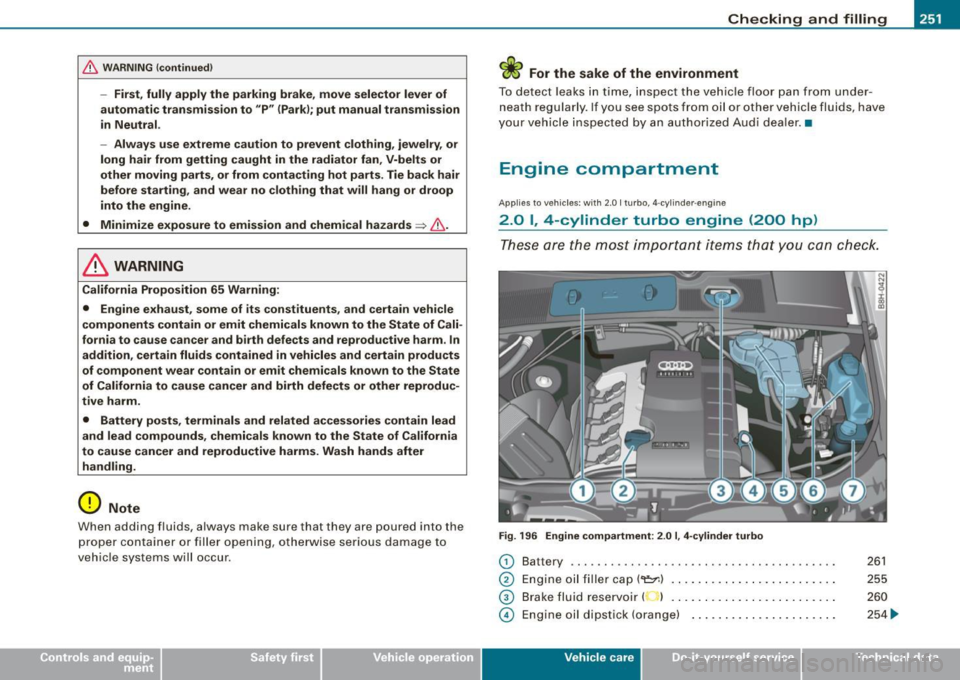
2.0 I , 4-cylinder turbo engine (200 hp )
The se are th e m ost important items that you can check .
Fig. 196 Engine comp art m ent : 2 .0 I, 4-cy lind er turbo
G) Battery ..................................... •..
0 Engine oi l fi lle r ca p ('1:::r.l ..... ... ... ....... .... .. .
© Bra ke fluid reservoir ( ) ..... ... .... ... ... ... .. . .
© Engine oil dipstick (orange) ........ .......... ... .
Vehic le care
N
N
I
261
255
2 60
25 4 ...
irechnical data