catalytic converter AUDI A4 CABRIOLET 2009 Owners Manual
[x] Cancel search | Manufacturer: AUDI, Model Year: 2009, Model line: A4 CABRIOLET, Model: AUDI A4 CABRIOLET 2009Pages: 340, PDF Size: 77.32 MB
Page 5 of 340
Airbag system . . . . . . . . . . . . . . . . . 168 Trailer to\Ning . . . . . . . . . . . . . . . . . . 224
Important things to know . . . . . . . 168 Driv ing with a trailer . . . . . . . . . . . . 224
Front airbags . . . . . . . . . . . . . . . . . . 172 Trailer towing tips . . . . . . . . . . . . . . 226
Monitoring the Advanced Airbag
System . . . . . . . . . . . . . . . . . . . . . . .
179
Knee airbags . . . . . . . . . . . . . . . . . . 184
Side a irbags . . . . . . . • . . . . . . . . . . . 187
Child Safety . . . . . . . . . . . . . . . . . . . . 190
Impor tant things to know . ..... .
Child safety seats ............. .
Insta lling a chi ld safety seat .... . 190
195
200
Add it ional Information ....... .. . 203 Vehicle care . . . . . . . . . . . . . . . 229
Lower anchorages and tethe r for
children (LA TCH) . .. ... ... ... ... .
205 Cleaning and protection . . . . . . . 230
~----
t
Vehicle operation .... ... . 211
212
212
2 12
215
Intelligent
technology ... ... ... .
Notice about data recorded by
ve hicle contro l modules .. ..... .
Electronic Stabilization Program
(ESPJ . .... ... ......... ... ... .. .
B rak ing ..... ... .... .... ... ... .
Servotronic® -advanced power
steering system ............... .
Driving with your quattro® ..... .
Driving and environment .... . . 217
2
18
2 19
The first 1,000 miles (1,500 km) and
afterwards . . . . . . . . . . . . . . . . . . . .
21 9
Catalytic converter . . . . . . . . . . . . .
220
Avoid damaging the ve hicle . . . . . 221
Operate your vehicle economically
and minimize pollution . . . . . . . . .
221
General information ........... .
Care of exterior ................ .
Care of inte rior ...... .... ... ... .
Fue l supply and filling your fuel
tank ........................... .
Gasoline ........... ........... .
Fuel tank ..................... .
Checking and filling .. ... ...... .
Engine hood ......... ......... .
Engine compartment ...... ... . .
Engine oil ..................... .
Engine cooling system ......... .
Brake fluid ................ ... . .
Battery . ... ... ... ............. .
W indshield /headligh t washer
rese rvoir ...................... .
Tires and \Nheels .......... .... .
Tires ..... .. ..... ... .. - . -.. • · · ·
230
230
238
244
244
245
249
249
251
252
257
260
261
266
267
267
Table of contents
Do-it-yourself service ... 289
What do I do no\N? . . . . . . . . . . . . . 290
Trunk escape ha ndle . . . . . . . . . . . . 290
Jack, tools and spare wheel . . . . . . 290
Whee l change .............. .... 293
Fuses and bulbs . . . . . . . . . . . . . . . . 300
Fus es ................. ......... 300
Bulbs .......................... 302
Emergency situations . . . . . . . . . . 304
Genera l ... .. ... .... _ .. _ ...... .. 304
Starting by pushing or towing . . . . 304
Starting with jumper cables . . . . . . 304
Use of jumpe r cables . . . . . . . . . . . . 305
Em ergency towing with commercial
tow truck ... ......... ....... .. .
Lifting vehicle ................. .
Technical data
General information 306
308
311
312
Explanation
of technical data 312
Vehic le ide ntific ation . . . . . . . . . . . . 312
Weights ........................ 313
Dimensio ns . . . . . . . . . . . . . . . . . . . . 313
~ehicle care irechnical data
Page 18 of 340
Inst rum ents and warnin g/indi cato r li ghts
M alfu nction message
If there is a malfunction somewhere in the ins trument cluster, dE F
will appear in the trip odometer and will stay on. Contact your
authorized Audi dea ler to have the prob lem corrected.
Im mob ilizer
Each time you switch on the ignition, the data stored in the vehicle
key are e lectronically scanned to verify that key data and vehicle
data match. If a non -coded or a defective vehic le key is used, the
word
S A FE wi ll appear and remain lit in the upper (trip) odometer
display . If this happens, the vehicle cannot be started=>
page 49. •
Fuel gauge
The fuel gauge works only when the ignition is on .
When the needle reaches the red area, the warning light in the instrument cluster wil l illuminate =>
page 33 [). This means you
have approx imately 2.4 gallons (9 liters) of fuel left in the tank.
Time
t o refu el!
The total tank capacity of your vehicle is listed in=> page 314.
0 Note
Never run the tank completely dry! An irregular supply of fuel can
cause engine misfiring and fuel could enter into the exhaust
system. The catalytic converter could then overheat and be
damaged. •
[ CHE CK] button
You can perform different functions with this button.
I S2YY
0
Fig. 6 C HECK butto n in
th e ins tru men t c lu ste r
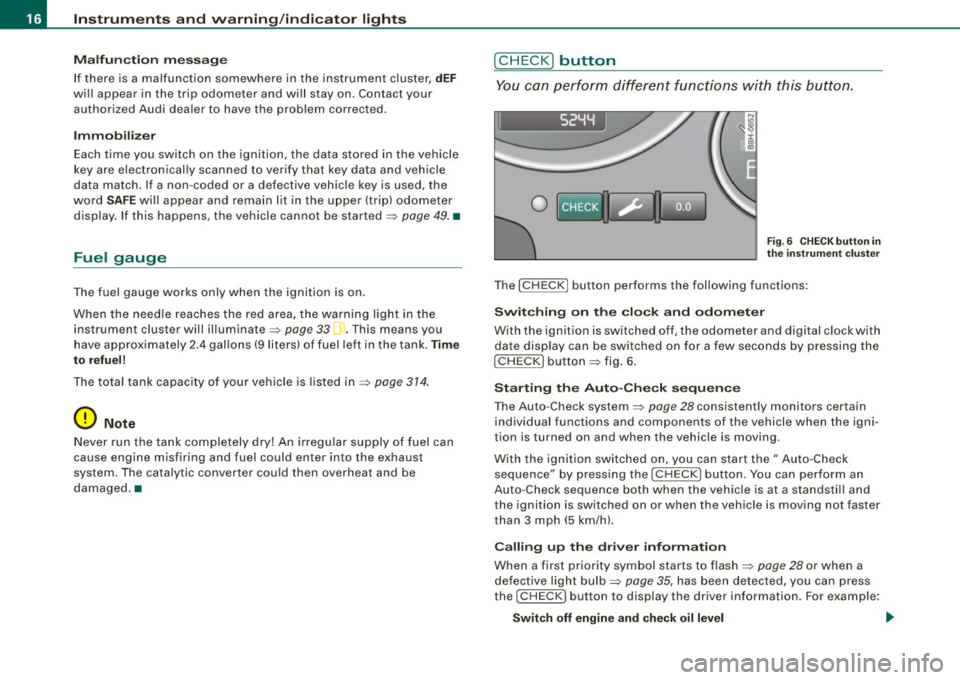
The [ CHECK] button performs the following functions:
S wi tch ing on t he cl ock and odome ter
With the ignition is switched off, the odometer and digital clock with
date disp lay can be switched on for a few seconds by pressing the
[CHECK] button=> fig. 6.
Sta rtin g t he A uto-Che ck se qu ence
The Auto-Check system=> page 28 consistently monitors certain
individual functions and componen ts of the vehicle when the igni
tion is turned on and when the vehicle is moving.
With the ignition switched on, you can start the" Auto-Check
sequence" by pressing the [
CHECK I button. You can perform an
Auto -Check sequence both when the vehic le is at a standstill and
the ignition is switched on or when the veh ic le is mov ing not faster
than 3 mph (5 km/h).
Ca lling up th e dri ver inform ation
When a first priority symbol starts to flash=> page 28 or when a
defective light bulb=>
page 35, has been detected, you can press
the
! CHECK] button to display the driver information. For example:
S witch off engine and chec k oi l le vel
Page 29 of 340
Fuel filler cap not closed properly
M ....
~ :c IX) m
Fig. 14 Center disp lay:
fu el f iller ca p open
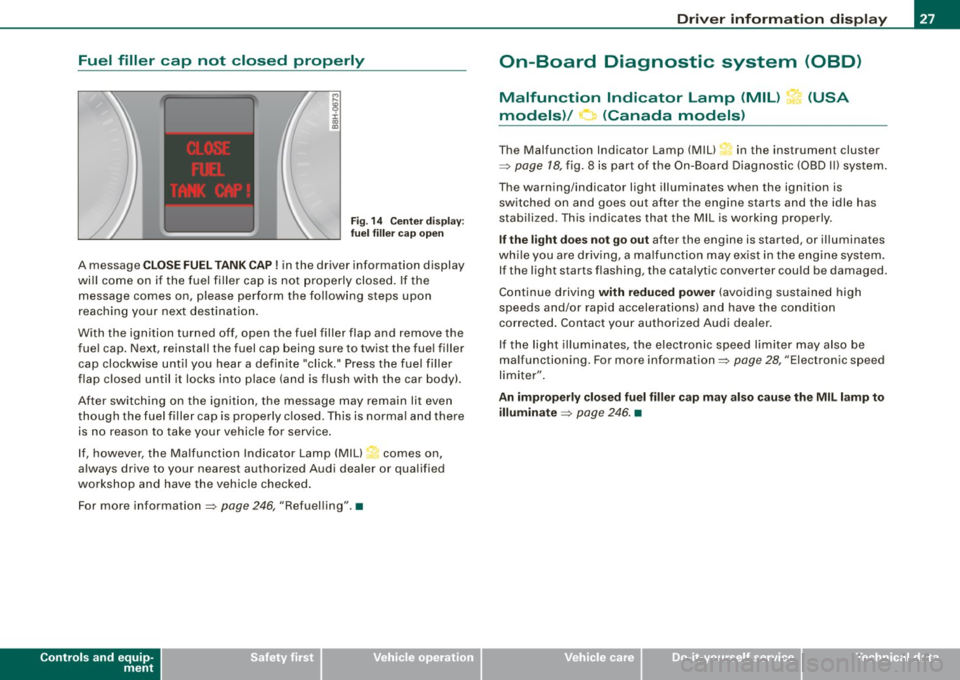
A message C LO SE FUEL TANK CAP! in the driver information display
wi ll come on if the fuel filler cap is not properly closed . If the
message comes on, please perform the following steps upon
reaching your next destination.
With the ignition turned off, open the fuel filler flap and remove the
fue l cap. Next, reinstall the fuel cap being sure to twist the fue l filler
cap clockwise until you hear a definite "click." Press the fuel filler
flap closed until it locks into place (and is flush with the car body).
After switching on the ignition, the message may remain lit even
though the fuel filler cap is properly c losed . This is norma l and there
is no reason to take your vehicle for service .
I f, however, the Malfunction Indicator Lamp (MIU~ comes on,
always drive to your nearest authorized Audi dealer or qualified
workshop and have the vehicle checked .
For more information =>
page 246, "Refuelling".•
Controls and equip
ment
Driv er inf ormati on di spl ay
On-Board Diagnostic system (08D)
Malfunction Indicator Lamp (MIL) ?-1' (USA
models)/ (Canada models)
The Malfunction Indicator Lamp (M IU in the instrument cluster
=>
page 18, fig. 8 is part of the On-Board Diagnostic (OBD I I) system.
The warning/indicator light illuminates when the ignition is switched on and goes out after the engine starts and the idle has
stabi lized. This indicates that the MIL is working properly.
If the l ight doe s not go out after the engine is started, or illuminates
wh ile you are driv ing, a ma lfunc tion may ex ist in the engine system .
If the light starts flashing, the catalytic converter cou ld be damaged.
Continue driving
with r educ ed power (avo iding sustained high
speeds and/or rapid accelerations) and have the condition
corrected . Contact your authorized Audi dea ler.
I f the light illuminates, the electron ic speed limiter may also be
malfunctioning . For more information=>
page 28, "Electronic speed
limiter" .
An improperly clo sed fu el filler cap may also cau se the MIL l amp to
illuminate
=> page 246 . •
Page 130 of 340
• .___T_ r_a _n_ s_ m_ is_ s_io _ n ______________________________________________________ _
R -Reverse
The transmission will automatically select the lowest gear ratio
when you shift into reverse.
Select
R only when the vehicle is at a full stop and the engine is
running at idle speed~
& in "Driving the automat ic transmission"
on
page 126 .
Before you move the selector lever to R, press both the button in the
handle of the selector lever
and the brake pedal at the same time.
When the ignition is on, the backup lights illuminate when the selector lever is moved into
R.
N -Neutral
The transmission is in neutral in this position. Shift to this position
for standing with the brakes applied~
page 128.
When the vehicle is stationary or at speeds below 3 mph (5 km/h),
you must always apply the footbrake before and while moving the
lever out of
N.
D -Normal position for driving forward
Position Dis for normal city and highway driving. It ranges from zero
to top speed and all six gears shift automatica lly, depending on
engine load, driving speed and automatically selected shift
programs. The gear engaged is shown in the right of the display
~ page 127, fig. 140.
When the vehicle is stationary or at speeds below 3 mph (5 km/h),
you must always apply the foot brake before and whi le moving the
lever to
D out of N .
In certain circumstances it may be advantageous to temporarily
switch to the manual shift program to manua lly se lect gear ratios to
match specific driving conditions~
page 130.
S -Sport position
Select this position for sportier performance. In this position, the
t ransmission will not upshift as soon, allowing the vehic le to use the increased power available at higher engine speeds
to achieve live
lier accelera tion .
When the vehicle is stationary or at speeds below 3 mph (5 km/h),
you must always apply the foot brake before and while moving the lever to
S out of N.
& WARNING
Read and follow all WARNINGS ~ & in "Driving the automatic
transmission" on
page 126.
(D Note
Coasting downhil l with the transmission in N and the engine not
running w ill result in damage to the automatic transmission and
possibly the catalytic converter. •
Applies t o veh icles: with 6-speed automat ic transmission
Automatic Shift Lock (ASL)
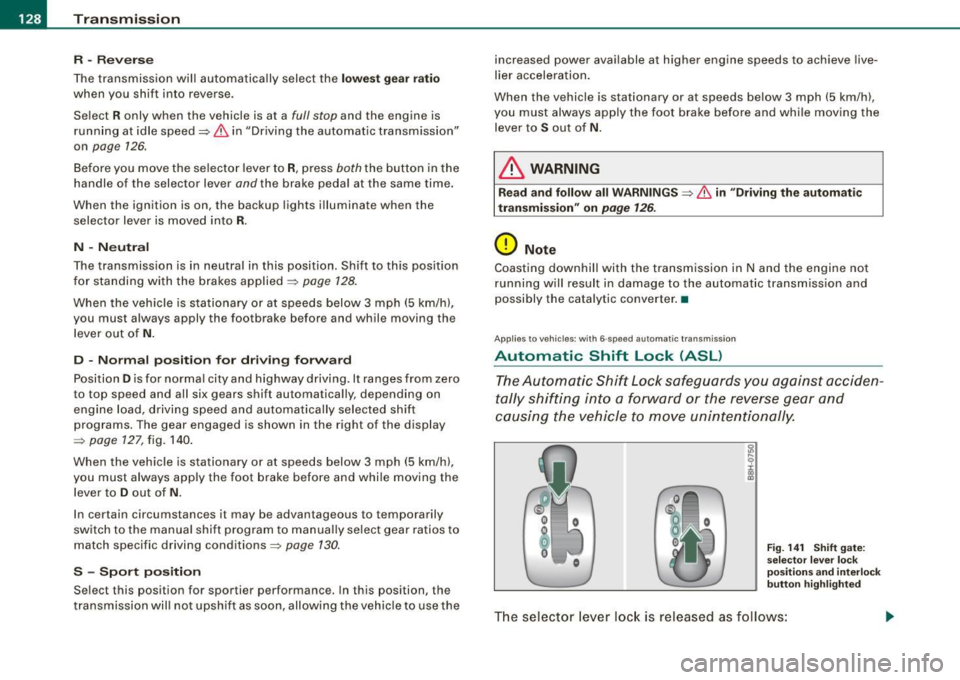
The Automatic Shift Lock safeguards you against acciden
tally shifting into a forward or the reverse gear and
causing the vehicle to move unintentionally.
Fig. 141 Shift gate:
se lector leve r lock
position s and interlock
butt on highlighted
The selector lever lock is released as follows :
Page 136 of 340
....... _T _r_a _ n_ s_m _ i_s _s _i_o _n ______________________________________________________ _
Engage P only when the vehicle is completely stopped=> & in
"Driving the multitronic®" on
page 132
To shift into or out of position P, you must first press and hold the
brake pedal
and then press the release button in the selector lever
handle while moving the selector lever to
P.
R -Reverse
The transmission will automatically select the lowest gear ratio
when you shift into reverse.
Select R only when the vehicle is at a
full stop and the engine is
running at idle speed=>
& in "Driving the multitronic®" on
page 132.
Before you move the selector lever to R, press both, the button in the
handle of the selector lever
and the brake pedal at the same time.
When the ignition is on, the backup lights illuminate when the
selector lever is moved into
R.
N -Neutral
Shift to this position for standing with brakes applied=> page 135.
When the vehicle is stationary or at speeds below 3 mph (5 km/h),
you must always apply the footbrake before and while moving the
lever out of
N.
Do not use N for coasting downhill.
D -Normal driving position for forward
Depending on the load on the engine, vehicle speed and the
dynamic control program, the transmission will select the
optimal
gear ratio.
In certain circumstances it may be advantageous to temporarily
switch to the manual shift program to manually select gear ratios to
match specific driving conditions=>
page 136.
When the vehicle is stationary or at speeds below 3 mph (5 km/h),
you must always apply the footbrake before and while moving the lever to
D out of N.
S -Sport position
Select this position for sportier performance. In this position, the
transmission will not upshift as soon, allowing the vehicle to use the increased power available at higher engine speeds to achieve live
lier acceleration.
When the vehicle is stationary or at speeds below 3 mph (5 km/h),
you must always apply the foot brake before and while moving the
lever to
S out of N.
& WARNING
Read and follow all WARNINGS=> & in "Driving the multitronic®"
on
page 132.
0 Note
Coasting downhill with the transmission in N and the engine not
operating will result in damage to the automatic transmission and
possibly the catalytic converter. •
Page 222 of 340

___ D_ r_i v_ in_,.. g"'- a_ n_ d_ e_ n_ v_i_r _o _n_ m_ e_n_ t _______________________________________________ _
New brake pads
Remember that new brake pads do not have a full braking
effec t during the first 250 miles (400 kilometers) after they
are installed .
New brake pads have to be "burn ished in" before they have optimal
grab =>& .
During the break -in period, you shou ld avoid putting severe loads
on the brakes . Severe loads include, for examp le, sudden hard
braking, in particular at very high speeds or, for example, on moun
tain passes.
& WARNING
Ne w brake p ad s don't h ave the bes t sto pp in g po we r and mu st b e
"brok en-in " durin g the initial 100 to 1 50 m il es ( 150 to 200 kil ome
t e rs) of norm al cit y dri ving . Y o u can com pensat e for thi s by
p re ss ing the br ake p ed al more firm ly. Th is also appli es later w he n
n ew pad s a re in sta lled.
:J
Catalytic converter
It is very important that your emission control system
(catalytic converter) is functioning properly to ensure that
y o ur vehicle is running in an environmentally sound
manner.
- Always use lead-free gasoline=> page 244, "Fuel supply".
- Never run the tank down a ll the way to empty.
- Never put too much motor o il in your engine =>
page 255,
"Adding eng ine oi l 'l:::r.11
•
- Neve r try to push -or tow -s ta rt yo ur vehic le.
The catalytic converter is an efficient "clean-up" device built into the
exhaust system of the vehicle. The catalytic converter burns many
of the po llutants in the exhaust gas before they are released into the
atmosphere.
The exc lusive use of unleaded fue l is critica lly important for the l ife
of the cata lytic converter and proper functioning of the engine.
& WARNING
• Do not p ark or op erate th e veh icle in are as w here the h ot
ex hau st sys tem m ay come in co ntac t w ith dr y gr ass, brush , fuel
s pill or other mater ial which can cau se a fire .
• Do not apply a dditi ona l u nder coating or ru stpr oofing on or
n ea r the exhau st m anifold , exhau st pipe s, ca ta lytic conv ert er or
h eat shie ld s. Dur in g d riving , the sub sta nce use d fo r und ercoa ting
coul d ove rhea t and cause a fire .
0 Note
• Be aware that just one tank filling with leaded fue l wi ll already
seriously degrade the performance of the catalytic converter.
• Do not exceed the correct engine oi l level =>
page 255.
• Do not drive until the fuel tank becomes comp letely empty . The
engine cou ld misfire. Unburned fuel could also get into the exhaust
system and this could cause the catalytic conver ter to overheat .
• Do not turn off the ignition while the vehicle is moving.
• Do not con tinue to operate your vehicle under these conditions,
as otherwise fuel can reach the cata lytic converter . This cou ld result
in overheating of the converter, requiring its rep lacement .
• To assure eff icient operation of the Em ission Control System:
- Have your vehicle maintained properly and in accordance with
the service recommendations in your Warranty
& Maintenance
booklet. •
Page 225 of 340

The engine and catalytic converter have to reach their optimal oper
ating temper ature
to reduce fuel consumption and noxious emis
sions effective ly.
Just after starting, a cold engine in a mid -size car only achieves a
fue l economy of 6-8 miles per gallon (30-40 1/100k m). After about a
half a mile, fuel economy climbs to 12 mpg (201/100 kml. After about
2.5 miles (4 km), the engine is at its proper operating temperature
and fuel economy has reached a normal level. So you can see that
you should avo id short tr ips whenever possib le .
The
outs ide temperat ure is also critical in this regard. Your car
consumes more fuel in the winter than in the summer. •
Controls and equip
ment Safety first Vehicle operation
Driving
and environm ent
Vehicle care Do-it-yourself service Technical data
Page 246 of 340
Fuel supply and filling your fuel tank
Fuel supply and filling your fuel tank
Gasoline
Fuel supply
Using the right fuel helps keep the environment clean and
prevents engine damage.
Fuel recommendation
Th e fuel recommended for your vehicle is unleaded premium grade
gasoline. See also=>
page 314, "Data". Audi recommends using TOP
TIER Detergent Gasoline with a minimum octane rating of 91 AKI (95
RON). For more information on TOP TIER Detergent Gasoline, please
go to the official website (www .toptiergas.coml.
The recommended gasoline octane rating for your engine can also be found on a label located either on the driver's side B-pillar (visible
when the door is open) or inside the fuel filler flap. This rating may
be specified as AKI or RON.
Your vehicle may also be operated using unleaded regular gasoline
with a minimum octane rating of 87 AKl/91 RON. However, using 87
AKl/91 RON octane fuel will slightly reduce engine performance.
Use unleaded gasoline only. Unleaded gasoline is available
throughout the USA, Canada, and in most European countries. We
recommend that you do not take your vehicle to areas or countries
where unleaded gasoline may not be available.
For more information on refueling your vehicle, see=>
page 245.
Octane rating
Octane rating indicates a gasoline's ability to resist engine
damaging "knock" caused by premature ignition and detonation.
The refore, buying the correct grade of gasoline is very important to
help prevent possible engine damage and a loss of engine perfor
mance. Gasoline most commonly used
in the United States and Canada has
the following octane ratings that can usually be found on the filler
pump:
• Pr emium Grade: 91 -96 AKI
• Regular Grade: 87 -90 AKI
Explanation of the abbreviations:
AKI = Anti Kno ck Ind ex= (R+Ml/2 = (RON+MON)/2
RON= Research Octane Number
MON = Motor Octane Number .
0 Note
• Do not use any fuel with octane ratings lower than 87 AKI or 91
RON otherwise expensive engine damage will occur .
• Do
not use leaded gasoline. The use of leaded gasoline will
severely damage your vehicle's catalytic converter and its ability to
control exhaust emissions. •
Blended gasoline
Use of gasoline containing alcohol or MTBE (methyl
tertiary butyl ether)
You may use unleaded gasoline blended with alcohol or MTBE (commonly referred to as oxygenates) if the blended mixture meets
the following criteria:
Blend of gasoline methanol (wood alcohol or methyl alcohol)
• Anti-knock index must be 87 AKI or higher.
• Blend must contain no more than 3% methanol.
• Blend must contain more than 2% co-solvents.
Page 248 of 340
Fuel supply and filling your fuel tank
The labe l on the inside of the fuel filler flap tells you the correct fuel
f o r your vehicle . Fo r m ore inf ormatio n about f uel specifica tions, see
~ page 244.
Y our vehicle fuel tank has an on -b oard refuelling vapor recove ry
system. This feature he lps to preve nt fuel vapors from escap ing
from the tank and polluting the environment while you refue l you r
veh ic le . I n o rder t o fill the tank properly while protec ting the envi
ronmen t, please follow this re fueling procedure carefully .
L1}. WARNING
Under normal operating conditions , never carry additional fuel
containers in your car. Gas canisters and other containers used to
transport fuel can be dangerous . Such containers , full or empty,
may leak and could cau se a fire in a collision . If you must transport
fuel to use for your lawn mower , snow blower , etc ., be very careful
and alway s ob serve local and state laws regarding the u se , tran s
portat ion and storage of su ch fuel container s. Make certain the
c ontainer meets industry standard s (ANSI/ASTM F852 -861 .
0 Note
Never d rive your vehic le un til the fue l tank is co mpletely empty . The
irregular supply of fuel can cause misfiring . Gasoline could enter
t he exhaus t system and damage the catalytic converter . •
Refuelling
Fi g. 191 Rig ht v ehi cle
si de , st andi ng beh ind
the rear whe el:
opening the fuel filler
flap ,
F ig . 19 2 Fuel cap
s itting on th e opened
fuel filler f lap
W hen a dding fuel, th e i gnit io n a nd any ce llular ph ones in
th e v ehicl e m ust be sw itch ed off.
Taking the fuel cap off
Press the rig ht side o f the f uel fi ller fla p to ope n it
=> fig .19 1.
Unsc rew fuel filler cap co unter-clock wise and han g it o n
t h e fuel fille r flap .
~
Page 327 of 340
Alph ab eti ca l ind ex -
-------------=----
AUTO
Climate controls .. ...... ..... .... . 112
Switching on .... .... .... .... .... 112
When should I use AUTO? ....... .. 112
Auto Safety Hotl ine .. ..... ... ... .... . 155
Auto-Check Control .. ... ... .... ... .. .. 28
Automat ic air recirculation ........... 114
Automatic belt retractor .... ...... .... 163
Automatic car wash
See Washing .. .... .... ... ...... .. 231
Automatic headlight con trol ....... .... 77
Automatic rollover protection system . . 156
Automatic Shift Lock (ASLl ....... 128, 135
Automatic transm ission
6 -spe ed automatic transmission .... 126
Automatic Shi ft Lock (ASLl .... . 128, 135
Driving ........ ..... ....... ..... 126
Dynamic shif t prog ram ... .... .... . 129
Fail-safe mode ... ...... ........ .. 13 1
Ignition key safety lock ... ... ... .. . 119
Kick-down ... .... .... .... ... .... . 129
Manual sh ift program . ... .... .... . 130
multitronic® ... ... ... .... ... ..... 131
Se lector lever ..... .... ...... . 127, 133
Shift but tons . ... .... .... .... 131, 137
Steering wheel with tiptronic® . 131,137
Average speed ... ... ... ... .. ...... ... 37
Avoid damaging the v ehicle .. ... .... . 22 1
Controls and equip
ment Safety first
B
Battery .
.... .... ...... .... ... .. 261, 264
Charging ...... .. ... ..... .. .. .... 265
Checking battery acid level . .... .... 264
Important warnings when working on the batte ry . .......... .... ... .. ... . 263
Low vol tage symbo l .. ....... .... ... 34
Replacing the battery . ...... .. .... 262
Winter opera tion ... .. ...... ...... 261
Working on the battery .......... .. 263
B efore driving ... ..... .. ...... ...... 146
Blended gasoline ... ... .. .. .. .... .... 244
Body cavity sealing .. .. .. ...... .... .. 237
Boos ter seats .... .... .... .... .... ... 198
How do I properly instal l a booster seat in
my vehicle? . .......... ...... ... 198
Sa fety instructions . .... .... .... ... 198
Brake f luid
Changing the brake fluid .......... 261
Checking the brake fluid leve l .. .... 260
Reservoir . ... .... .... ....... .... . 260
What is the correct brake fluid level? 260
What shou ld I do if the brake fluid warning
light comes on? . ..... ... .... .... 260
Brake system .. ...... .... .... .... ... 260
An ti- lo ck brake system (ABS) ... .... . 20
Brake ass istant . .... .. .... .... ... . 217
Brake booster .... .... .... .... .... 216
Brake flu id .... ... .... .... .... .... 260
Brake f luid specifications for refi ll and
rep lacement . ... ..... ... .... .... 261
Brake pads ...... .... .... .... .... 220
Genera l informa tion ....... .. .... . 215 How does the moisture or road salt affect
the brakes? ....... ... .... .... ... 215
Ma lfunction ... .. .... .... .... .. .. . 30
Warning/indicator lights .. .. .... .... 23
Worn brake pads symbol . ..... .. .. . 33
B reak -in period ...... .... .... .... ... 219
B rake pads ... .... .... .. . .... .... 220
Tires ..... .... .... .... ... .... .. .. 219
Bu lbs ... ... .... ... ... ... .... ...... . 302
C
California Proposition 65 Warning . .... 251
Battery specific ..... ...... .... .... 264
Capacities Eng ine oil .... .... .... ... .... .... 31 4
Fuel tank ..... ...... .. ...... .... . 314
Windshield washer fluid ... .... .... 314
Car care ... .. .... ... .... .... .... .. .. 230
Interior ... .... .... .... ... .... .... 238
Plastic and v inyl .... ... .... .... ... 234
Weatherstr ips . .... .... .... ...... . 236
Care of exterior ..... .... .... .... .. .. 230
Cargo area
See Loading the luggage compartment .
153
Catalytic converter .. ...... ...... .... 220
Centigrade Switching between Centig rade and
Fahrenheit ...... .... .. .. ... .. .. 11 3
Certification . ............ ...... .... . 320
Changing a flat tire ....... ... .... .. .. 293
Chan ging a wheel .... .... ... .... .... 293
Vehicle operation Vehicle care Do-it-yourself service Technical data