light AUDI A4 SEDAN 2013 Owners Manual
[x] Cancel search | Manufacturer: AUDI, Model Year: 2013, Model line: A4 SEDAN, Model: AUDI A4 SEDAN 2013Pages: 294, PDF Size: 73.71 MB
Page 207 of 294
Your authorized Audi dealer can provide clean
ing products that have been tested and ap
proved for your vehicle .
Care of interior
Infotainment components
The Radio/MM!* display may be clea ned with
a soft cloth and commercially-availab le "LCD
cleaner" . The cloth should be coated lightly
when the cleaning solution when cleaning the
display .
The
MMI* controls must be cleaned first with
a brush so that dirt does not enter the un it or
enter between the buttons and the housing.
Then wiping the controls with a cloth damp
ened with dish detergent and water is recom
mended.
(D Note
- To avoid scratch ing the display, you
shou ld never clean it dry.
- To prevent damage, make s ure fl uids do
not enter the controls.
Aluminum trim
Use only neutral-pH products to remove spots
and depos its from alum inum surfaces.
Chrome care products and alkaline cleaners
will attack alum inum surfaces and can dam
age them ove r time.
A WARNING
Always read and heed all WARNINGS and
other information
r::> page 199.
Fabrics and fabric coverings
Fa brics and fabric coverings (e.g. seats, door
trim panels, etc.) should be cleaned at regular
intervals with a vacuum cleaner. This removes
surface dirt particles which could become em bedded in the fabr ic through use. Steam
cleaners should not be used, because the
steam tends to push the dirt deeper into the
fabric and lock it there.
Cleaning and protection 205
Normal cleaning
Generally, we recommend using a soft sponge
or a lint -free microfiber cloth to the clean fab
ric. Brushes shou ld only be used for carpets
and floor mats, since other fabric surfaces
could be harmed by brushes.
Normal sur face stains can be cleaned using a
commercially available foam cleaner . Spread
the foam on the s urface of the fabric with a
soft sponge and work it in gently. Do not satu
rate the fabric. Then pat the foam dry using
absorbent, dry cloths (e.g. m icrofiber cloth)
and vacuum it after it has dried completely.
Cleaning stains
Stains caused by beverages (e.g. coffee, fr uit
jui ce, etc.) can be treated with a mild deter
gent solution. Apply the detergent solution
with a sponge. In the case of stubborn stains,
a detergent paste can be applied directly to
the stain and worked into the fabric. After
wards, use copious amounts of clean water to
remove the remaining deterge nt. Apply the
water with a damp cloth or sponge and pat
the fabric dry with an absorbent, dry cloth.
Stains from choco late or makeup should have
detergent paste rubbed into them. After
wards, remove the soap with water (damp
sponge).
Alcohol can be used to treat stains from
grease, oil , lipstick or a ballpoint pen. Melted
grease or dye must be patted off using ab
sorbent materia l.
It may be necessary to re
treat the areas with detergent paste and wa
ter.
In the case of genera l soiling of the upho ls
tery and cover material, we recommend hiring
a specia list t hat has the equipment to clean
the seat covers and other fabr ic surfaces by
shampooing and spray extraction.
A WARNING
Always read and heed all WARNINGS and
the information
r::> page 199.
•
•
Page 209 of 294
(D Note
-To keep your leathe r from bleaching out,
do not a llow it to be exposed to bright
sunlight for long periods of time. If you have to leave the vehicle parked outside
for long periods, cover the leather to protect it from d irect exposure to sun
l ight .
- Sharp objects on clothing, such as zip pers, rivets or sha rp pieces on belts can
l eave pe rmanent scratches o r scrape
mar ks on the surface of the leather.
@ Tips
- After each time you clean the leathe r and
at reg ular i nte rva ls, use a leather prese r
vat ive cream th at co ntains UV-blo ckers
and th at wor ks into the leather. This
cream will no urish and moistur ize the
l eather, helping it to breathe and stay
supple . It also helps to b uild up a protec
tive coat ing on the surface.
- Clean the leather every 2 - 3 months,
and clean any areas that get soiled.
- Remove fresh marks made by ba llpoint
pens, in k, lipst ick, shoe polish, etc . as
soon as possib le.
- Preserve the color of the leather as need
ed by using a special colored leather care
cream to touch up areas of uneven color.
Cleaning and caring for leather
upholstery and trim
Applies to vehicles: with natural leather
Natural leather requires special care and at
tention .
Normal cleaning
.,. Clean soiled areas w it h a slightly mo istened
cotton or woolen cloth.
More stubborn dirt
.,. More stubbo rn dirt can be removed using a
cl oth saturated with a m ild soap so lution ( 2
tablespoons mi ld liquid soap) .
Cleaning and protec tion 207
.,. Never allow the soap sol ution to sa turate
the leather, and make certain that no water
soaks into the seams .
.,. Wipe
off the soap so lution with a soft, dry
cloth.
Clean ing spots
.,. Remove fresh wate r-ba sed spots (such as
coffee, tea, juices, blood) with an absorbent
cloth or paper towel.
.,. Remove fresh
grease or oil -based spots
(such as butter, mayonnaise, chocolate) with
an absorbent clot h or pape r towel, or use
the cleaner from the leather care k it if the
spot has not yet penetrated into the surface
of t he leathe r.
.,. Use an oil/grease dissolving spray, if
oil /
grease spot s have dried on.
.,. Remove s pecific kinds of spots (ballpoint
pen, fe lt mar ker, fingernai l polish, water
based pa int, shoe po lish, etc.) with a spot
remover specifically formulated for leather.
Leather care
.,. Every ha lf year use an approved leather care
product (available from your authorized
Audi dea ler) to care for the leather .
.,. App ly the product very spar ingly.
.,. Wipe it
off with a damp cloth.
If you have any q uestions about cleaning and
caring for the leather in your vehicle, it is best
to contact your a uth orized Audi dea ler, who
will be g lad to help you and tell you about our
full range of leather care products, such as:
- Leather cleaning and care kit
- Creams to ca re fo r colored leather
- Spot removers for ballpoint pens, shoe pol-
ish, etc .
- Oil/grease d issolving spray
- New and upcom ing products .
_&. WARNING
Always read and heed all WAR NINGS and
other information
q page 199.
•
•
Page 210 of 294
208 Cleaning and protection
-Never use chemical solvents (e.g . lighter
fluid, turpentine), waxes, shoe polish or
similar products on the leather surfaces
in your Audi.
- To avoid damage, have stubborn stains removed by a commerc ial cleaning spe
cialist.
Cleaning Alcantara ® (synthetic suede)
App lies to vehicles: with A lcantara® up holstery
Removing dust and dirt
,. Moisten a cloth,
squeeze out excess water
and wipe down the seat surfaces .
Removing stains
,. Moisten a cloth with lukewarm water or
with diluted
ethyl (rubbing) alcohol.
,. Dab at the stain. Start at the outside and
work inwards .
,. Once the stain is no longer visible, use a
soft dry cloth or tissue to soak up the mois
ture.
Do not use leather cleaning products on Al
cantara ®.
You may use a suitable shampoo for removing
dust and dirt.
Dust and grit in the pores and seams can
scratch and damage the surface. If the car is
left standing in the sun for long periods, the
Alcantara ® should be protected against direct
sunlight to prevent it from fading . Slight color
variations will develop in normal use and are
not an indication of material deterioration .
IQ) Note
- Never use chemical solvents (e.g . lighter
fluid, turpentine), waxes, shoe polish or
s imilar products on Alcantara ® surfaces .
- To avoid damage, have stubborn stains
removed by a commerc ial cleaning spe
cialist.
- Do not use brushes, st iff sponges or sim
i larly abrasive cleaning aids . Safety belts
Only well-maintained safety belts work relia
bly when needed
.
,. Keep belts clean.
,. For cleaning, use a mild soap and water sol
ution. Let belts dry thorough ly and away
from d irect sunlight.
,. Do not allow inertia reel safety belts to re
tract before they are completely dry.
,. Check the condition of your safety be lts
reg
ularly.
Heavily soiled safety belts may not retract
properly.
A WARNING
-
Damaged safety belts can break in a crash .
- Anyth ing that might damage your safety
be lts could mean that you and your pas
sengers would not be adequate ly pro
tected in an accident.
- Safety belt performance depends on cor
rect installation. Never remove belts
from the vehicle to clean them.
- Do not use chemical cleaning agents,
bleach or dyes. They have corrosive prop
erties which weaken the webbing.
- When cleaning your safety be lts, inspect
them for damage . If you discover dam
age, see your authorized Audi dealer.
- Always read and heed all WARNINGS and
other information ¢
page 199.
Engine compartment
Be especially careful when cleaning the en
gine compartment.
Always switch off the ignition before clean
ing the engine
c.? .&, .
Plenum panel
Remove leaves from the plenum panel in front
of the windshield under the engine hood. This
prevents the water drai n holes from becoming
blocked, and it prevents debris from entering
the vehicle interior through the heating and
ventilat ion ducts .
Page 212 of 294
210 Fuel supply and filling your fuel tank
Fuel supply and filling
your fuel tank
Gasoline
Fuel supply
Using the righ t fuel helps keep the environ
ment cle an and preven ts engine dam age .
Fuel recommendation
The fuel recomme nded for you r vehicle is un
lead ed premium
g rade gasoline . See a lso
¢ pag e 270, Data . Audi recommends usi ng
T OP TIER D eterge nt Gaso line wi th a mini mu m
octa ne ra tin g of 9 1 AKI (95 RON). For more
in fo rmation on TO P TI ER De tergent Gaso line,
p lease go to the officia l webs ite (www.toptier
gas.com).
Th e re commended g asoline oct ane r ating for
your engine can a lso be fo und on a label loca t
e d on the ins ide of the fue l filler flap . This rat
ing may be specified as A KI or RO N.
Your veh icle m ay also be oper ated using un
l ea ded regular g asoline with a min imum o c
tane rating of 87 AKI/91 R ON. However, using
87 AKI/91 RON octa ne f ue l w ill slightly re
d uce eng ine perfo rmance.
Use unleaded gasoline only. Unleaded g aso
line is availab le th rou gho ut the USA, Canada ,
and in most E uropean countries . We recom
mend that you do not ta ke yo ur vehicle t o
areas or countries where unleaded gasoline
may not be avai lable.
F or mo re in format io n on refue ling your ve hi
cle, see
¢ page 212.
Octane rating
Octa ne r ating in dicates a gaso line's abili ty to
res ist engine damaging "knoc k" ca used by
p remature ign ition and detonation. Therefore,
buy ing the correct grade of gaso line is very
important to help prevent possible engine
damage and a loss of engine performance.
Gasoline most commonly used in the Unite d
States a nd Canada has the following octane r
at ings t hat can usu a lly be found on the fi ller
pump:
- Pre mium G ra de: 91 -9 6 A KI
- Regular Grade : 87 -90 AKI
Explanation of the abbreviations:
AKI = Anti K nock Index= (R+M) /2 = (RO N
+ MON)/2
R ON= Resea rch Octane Numb er
MON = Motor Octane Num ber .
(D Note
-Do not use a ny f ue l w it h octane rat ings
lower tha n 87 A KI or 9 1 RO N othe rwise
expensiv e engine damage w ill occur.
- Do
not use leaded gasoline . The use of
lead ed gasoline w ill severely damage
yo ur v ehicl e's catalytic co nve rter a nd its
ability to co ntrol exha ust em ission s.
Blended gasoline
Use of gasoline containing alcohol or
MTBE (methyl tertiary butyl ether)
You may use unleaded g asoline blende d with
alcohol o r MTBE (commonly re ferred to as
oxygenates) if the blende d mixture meets t he
f o llow ing criteria:
Blend of gasoline methanol (wood alcohol or
methyl alcohol)
- Anti -kno ck index mus t be 87 A KI or higher.
- Blend must contain no mor e than 3% me th-
anol.
- Blend must contain more than 2% co-sol-
ve nts .
Blend of gasoline and ethanol (grain alcohol
or ethyl alcohol)
- Anti -knoc k index must be 87 AKI or higher .
- Blend must not conta in mo re than 10%
ethanol.
- Ve hicl es w ith flexible f uel engine: blend
m ust not contain more t han 85% etha no l.
Blend of gasoline and MTBE .,.
Page 217 of 294
Checking and filling Engine hood
Releasing the engine hood
The engine hood is released from inside the
vehicle .
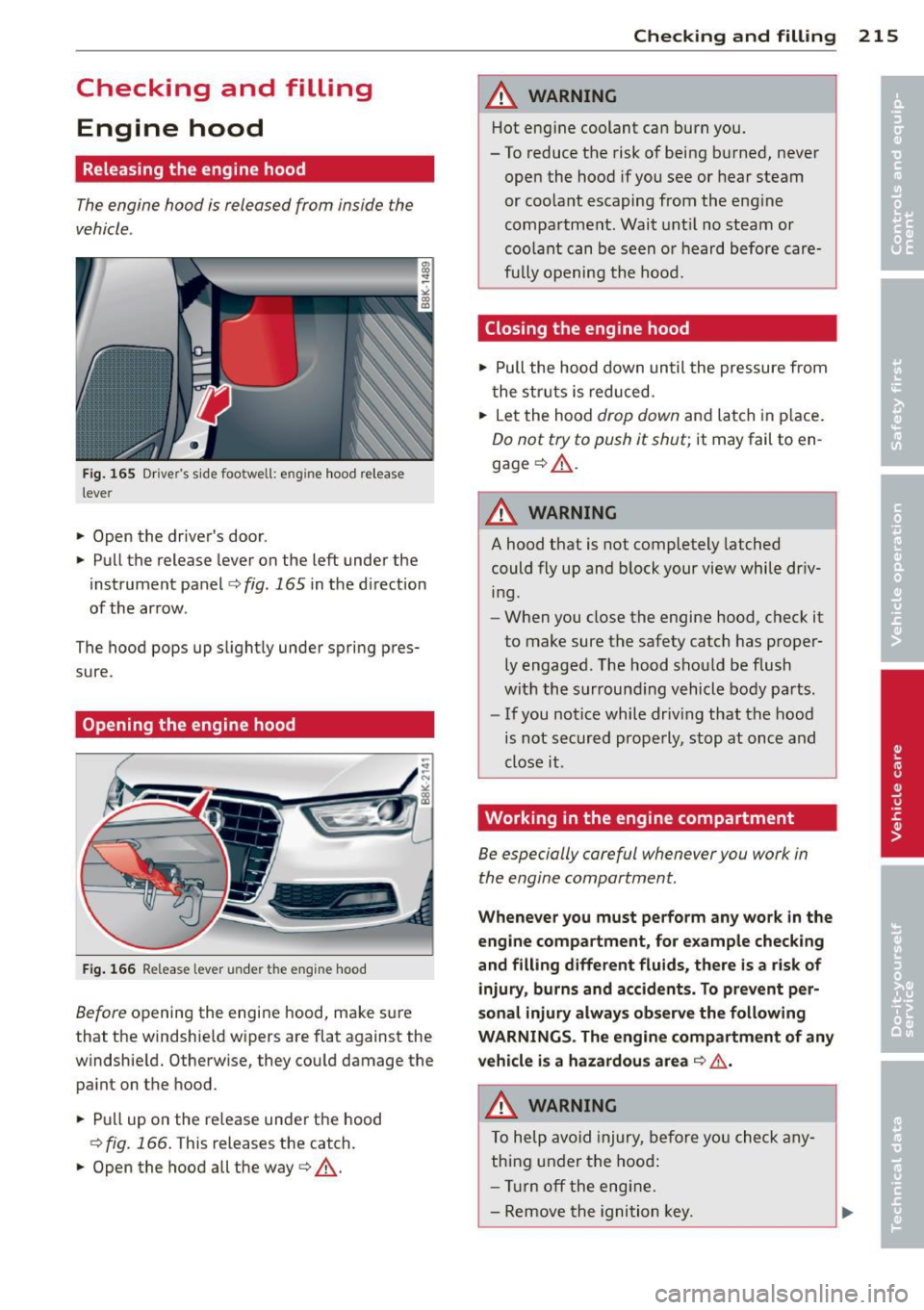
Fig. 165 Dr iver's s ide footwell: engine hood release
lever
"' Open the driver's door .
"' Pull the release lever on the left under the
instrument panel
r=> fig. 165 in the d irection
of the arrow.
The hood pops up slight ly under spring pres
sure.
Opening the engine hood
.... ~- ---=-
Fig . 166 Re lease lever under the engine hood
Before opening the engine hood, make sure
that the windshie ld wipers are flat against the
windshie ld. Otherwise, they could damage the
paint on the hood.
"' Pull up on the release under the hood
r::!> fig. 166 . This releases the catch.
"' Open the hood all the way
c::> &,.
Checkin g and fillin g 215
A WARNING
Hot engine coolant can burn you.
- To reduce the risk of being burned, never
open the hood if you see or hear steam
or coo lant escaping from the eng ine
compartment. Wait unt il no steam or
coolant can be seen or heard before care
fu lly opening the hood.
Closing the engine hood
"' Pull the hood down un til the pressure from
the struts is reduced.
"' Let the hood
drop down and latch in p lace .
Do not try to push it shut; it may fail to en
gage
c;, &, .
A WARNING
--
A hood that is not completely latched
could fly up and b lock your view while dr iv
ing.
- When you close the engine hood, check it
to make sure the safety catch has p roper
ly engaged. The hood should be flush
with the surround ing vehicle body parts.
- If you notice while driv ing that the hood
is not secured prope rly, stop at once and
close it .
Working in the engine compartment
Be especially careful whenever you work in
the engine compartment.
Whene ver you must perform any wo rk in the
eng ine compartment, for e xample checking
and filling different fluids, th ere is a risk of
injury, burns and accident s. To pr event per
sonal injury always observe the following
WARNINGS . The engine compartment of an y
vehicle i s a hazardou s area
c;, Lh, .
A WARNING ~
To help avoid injury, befo re yo u check any
thing under the hood:
- Tu rn off the engi ne.
- Remove the ignition key.
Page 219 of 294
Checking and fillin g 217
Engine compartment
Engine compartment
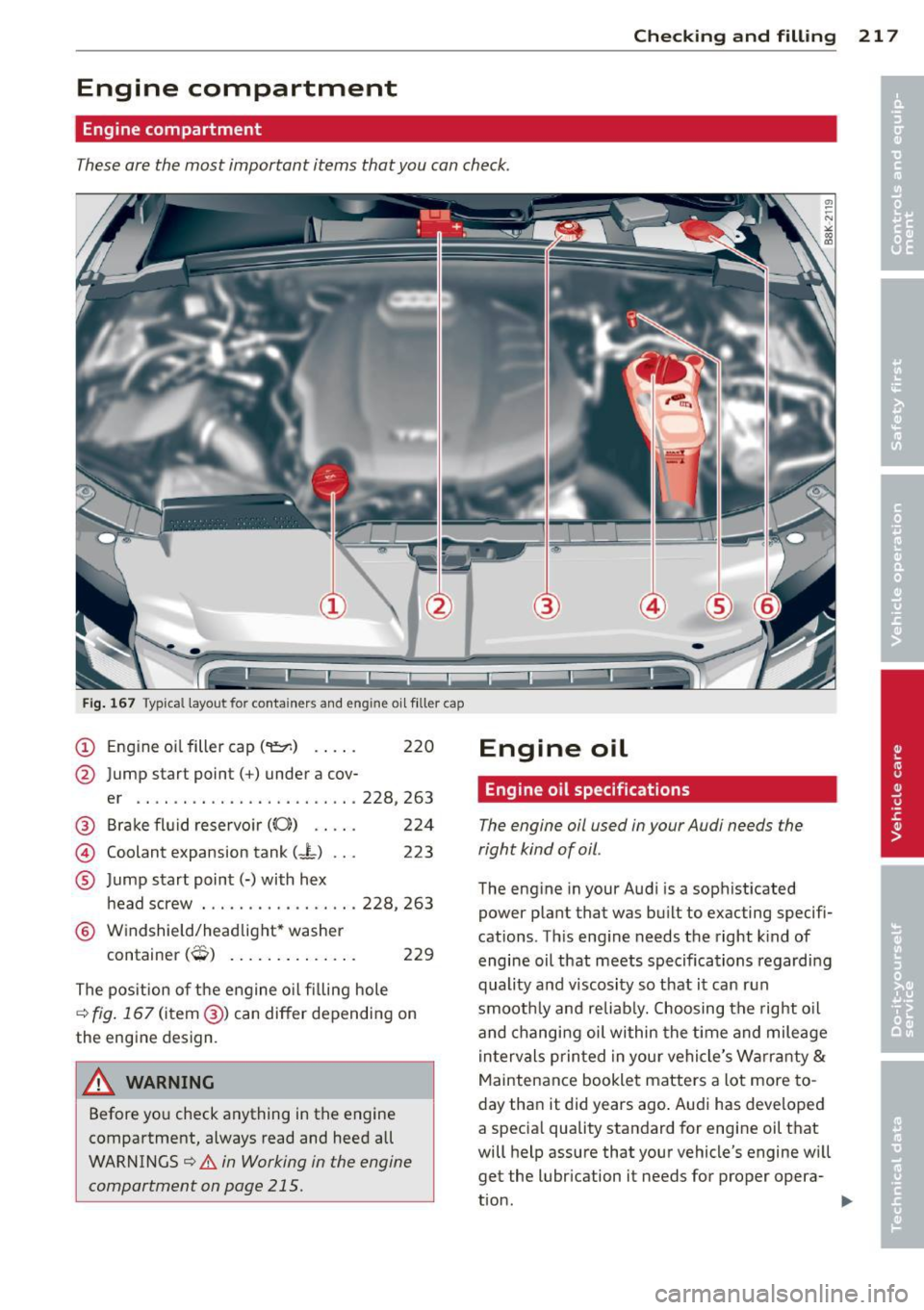
These are the most important items that you can check.
Fig. 167 Typical layout for containers and engine oil filler cap
(D Eng ine oi l filler cap (
er .. .. ... ....... ........ .. 228,263
@ Brake fl uid reservo ir
((0)) . . . . . 224
@ Coolant expansion tank (J-) . . . 223
® Jump start point(-) with hex
head screw ..... .......... .. 228, 263
® Windshie ld/headlight* washer
container
(0) . . . . . . . . . . . . . . 229
The pos ition of the engine o il fi lling hole
¢ fig . 167 (item @) can differ depending on
the eng ine design.
A WARNING
-
Before yo u check anything in the engine
compartment, always read and heed all
WARNINGS¢ &. in Working in the engine
compartment on page 215.
Engine oil
Engine oil specifications
The engine oil used in your Audi needs the
right kind of oil .
The eng ine in your Audi is a sophisticated
power p lant that was bu ilt to exacting specifi
cations . This eng ine needs the right k ind of
engine oil that meets specifications regarding
quality and viscosity so that it can run
smooth ly and reliab ly. Choosing the rig ht o il
and changi ng oil within the t ime and mileage
i n tervals printed in you r vehicle's Warranty
&
Maintenance booklet matters a lot more to
day than it did years ago . Audi has developed
a specia l quality standard for engine oil that
will help assure that your vehicle's engine w ill
get the lubr ication it needs for proper opera-
tion. .,..
Page 221 of 294
temperatures stay below freezing point for l ong periods.
Detergent add itives in the o il w il l make fresh
oil look dark after the eng ine has been run
ning fo r a short time . This is norma l and is not
a reason to change the oi l more often than
recommended.
D am ag e or m alfun ction s due to lack of
ma intenanc e
It is essential that you change your oil at the
r ecommended inte rva ls using only engine o il
t hat complies wi th A udi oi l standard
VW 502 00 . Your Limited New Vehicle War
ranty does not cover damage or malfunctions
d ue to fa ilure to fo llow recommended mainte
nance and use requ irements as set forth in
the Audi Owner's Manua l and Warranty
&
Maintenance book let . Your dea ler will have to
deny warranty coverage u nless you present to
the dea ler p roof in the fo rm of Serv ice or Re
pa ir Orde rs that all s chedu led maintenance
wa s pe rformed in a t imely manner .
Engine oil consumption
The engine in your vehicle dep ends on an ade
quate amount of oil to lubricate and cool all
of its moving parts.
In o rder to provide effective lubrication and
cool ing of i nternal engine components, a ll in
ternal comb ustion eng ines consume a cert ain
amo unt of o il. Oil cons umption varies from
engine to engine and may change significantly
over the life of the engine. Typ ica lly, engines
with a specified break-in per iod (see
¢
page 192) consume more oil during the
break-in per iod than they consume after oil
consumption has stabilized .
Under norma l conditions, the rate of oil con
sumpt ion depends on the quality and viscosity
of the oil, the RPM (revo lutions per m inute) at
which the engine is operated, the amb ient
temperature and road condit ions. Furthe r fac
tors ar e the amount of o il d ilution from wate r
condensation or fuel residue and the ox ida
tion level of the oi l. As any engine is s ubje ct to
Checkin g and fillin g 219
wear as m ileage builds up, the oil consump
tion may increase over time until replacement
of worn components may become necessary.
Wi th a ll these variab les coming into p lay, no
standard rate of oil consumpt ion can be es
tablished or specified. There is no alternative
to regular and frequent check ing of the o il lev
el, see
Note .
If the yellow engine oil leve l warning symbo l
1\1 in the instrument cluster lights up , you
sho uld check the oil leve l as soon as possib le
¢
page 220. Top off the oil at your earliest
convenience ¢
page 220.
A WARNING
Before you check anythi ng i n the engi ne
compartment, always read a nd heed all
WARNINGS¢ .&.
in Working in th e engine
c ompartment on page 215.
(D Note
D riving w ith an insufficient o il level is like
ly to cause sever e damage to the engine .
(D Tips
- The oil pressure warning display. is
not an indicator of the oil le vel. Do not
rely on it . Instead, check the oil level in
your engine at regu lar intervals, pref
erably ea ch time you refuel, and always
before going on a long trip .
-If you have the impression yo ur engi ne
c ons umes ex ce ss ive amoun ts of o il, we
recommend that you consul t an a uthor
ized Aud i dea ler to have the cause of
your concern properly d iagnosed. Keep in
mind that the accurate measu rement of
oil consumption requ ires great care and
may take some t ime. An authorized Aud i
dealer has instructions about how to
measu re oil consumption accurately.
-
•
•
Page 224 of 294
222 Check ing and filling
Engine cooling system
Coolant
The engine coolant performs two functions: it
keeps the engine from overheating and it pro
tects the engine from freezing in the winter .
The cooling system is sealed and generally re
quires little attention.
The cooling system has been filled at the fac
tory with a permanent coolant which does not need to be changed. The coolant consists of a
mixture of water and the manufacturer's gly
col-basedcoolant additive G 13 antifreeze with
anticorrosion add itives (SO% for USA mode ls;
60% for Canadian models). This mixture both
assures the necessary frost protection and protects metal components in the engine's
cooling system from corrosion and scaling. It
a lso raises the boiling point of the coolant .
Do not reduce the concentration of the coo l
ant in the summer by adding plain water .
The
p ro po rti on of c ool ant add it iv e mu st b e at
lea st 50 % but not mo re th an 60%
to main
tain antifree ze protection and cooling efficien
cy. If the coolant frost protect ion is too low,
the coolant could freeze and damage the veh i
cle heating and eng ine cooling system .
For year-round driving, antifreeze is added at
the factory for temperatures down to:
- -31° F(-3S°C)USA
- - 40 ° F ( - 40 °C) Canada.
_& WARNING
Before yo u check anything in the engine
compartment, always read and heed all
WARNINGS
¢ &. in Working in the engine
compartment on page 215.
(]) Note
-
- Before winter sets in, have the coolant
checked to see if the coo lant additive in
your vehicle is s uffic ient to meet the cli
mate cond it ions . Th is is especially impor
tant if you live in a region where the w in
ter is extremely cold . If necessary, in- crease the p
roportion of coo lant additive
to 60%.
- When adding coolant additive to your
cooling system, remember:
- We recommend us ing on ly coolant ad
d itive G12++ or G13 for your veh icle .
This coolant additive is availab le at au
thor ized Audi dealers. Other types of
ant ifreeze can s ignificantly reduce cor
rosion pro tection. The resulting cor ro
sion can cause a loss o f coolant and se
rious engine damage.
- Do not add any type of rad iator leak seal
ant to yo ur vehicle's engine coolant .
Adding radiator repair fl uid may adverse
ly affect the function and performance of
your cooling system and cou ld resu lt in
damage not covered by your New Veh icle
Limited Warranty.
' Checking the engine coolant level
The engine coolant level can be checked with
a quick glance.
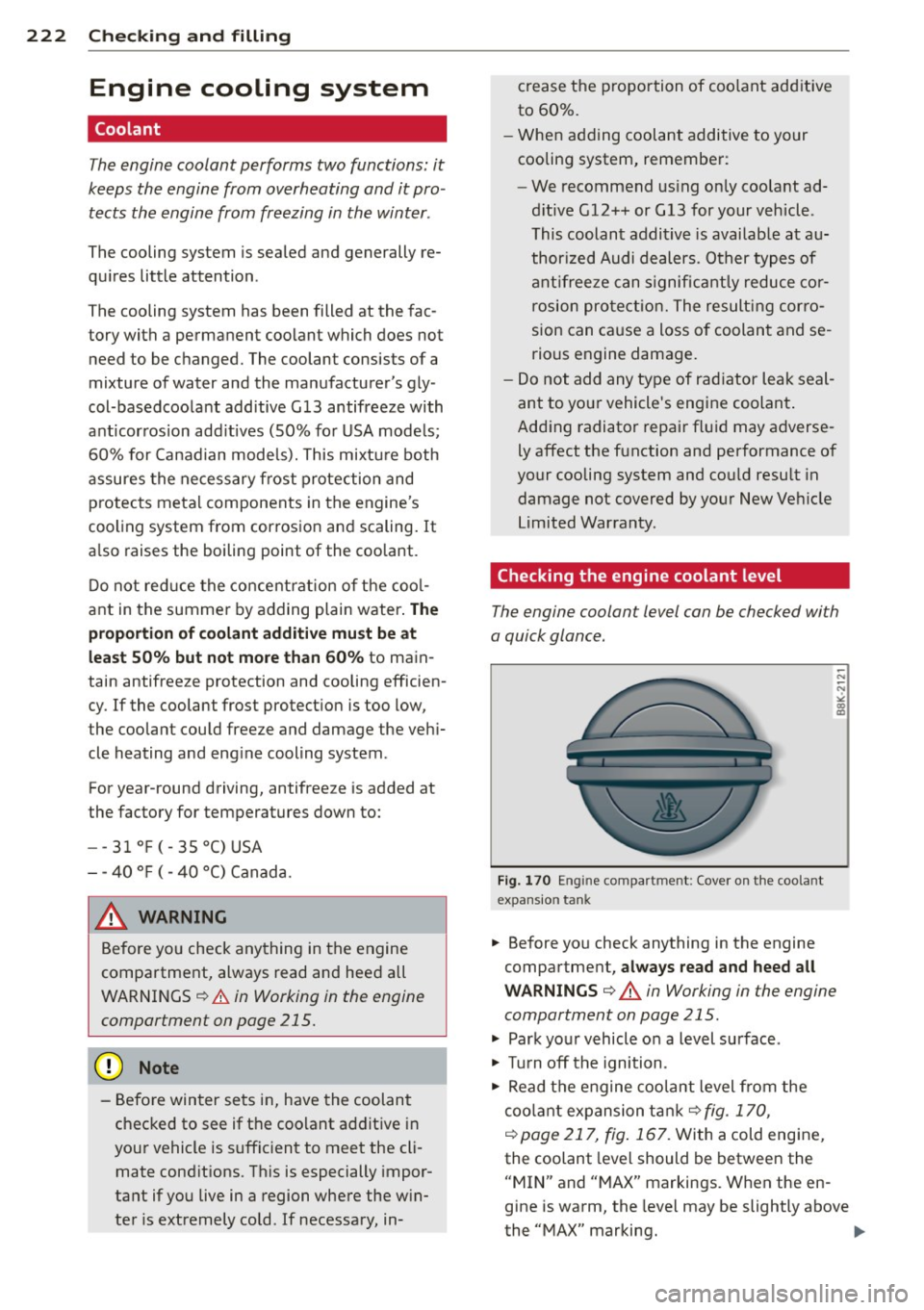
F ig. 170 En gin e compa rtm en t: Cover o n the coo la n t
expans io n ta nk
-"' -"' >< .,
"'
.. Before yo u check anything in the engine
compartment,
alwa ys read and heed all
W ARNINGS ¢ .&. in Working in the engine
compartment on page 215 .
.,. Park your vehicle o n a level surface .
.,. Tu rn off the ignition .
.. Read t he engine coolant level from the
coo la nt expansion tank ¢
fig. 170 ,
r=:> page 217, fig . 167. With a cold engine,
the coolant leve l should be between the
"MIN" and "MAX" markings . When the en
gine is warm, the level may be slightly above
the "MAX" marking.
IJII,
Page 225 of 294
The location of the coolant expansion tank
can be seen in the engine compartment illus
tration
q page 217 .
To obtain an accurate read ing , the eng ine
must be switched off .
The expa nsion tank in you r vehicle is equipped
with an elec tric coolant level sensor.
When the coolant level is too low, the warning
light in the Auto-Check System
q page 18 wi ll
b lin k until you add coo lant and the level has
been restored to norma l. Even t hough the re is
an e lec tric coolant level sensor, we s till rec
ommend you check the coolant leve l from
time to time .
Coolant loss
Coolant loss may indi cate a leak in the coo ling
sys tem. In the event of coolant loss, the cool
ing system should be inspected immedia tely
by your authorized A udi dealer. It is not
enough merely to add coolant.
I n a
s ealed system, losses can occur only if
the boiling point of the coolant is exceeded as
a result of overheating.
A WARNING
The cooling system is unde r press ure and
can get ve ry hot. Reduce the risk of sca ld
ing from hot coolant by following these
steps.
- Turn off the engine and allow it to coo l
down.
- Protect yo ur face, hands and arms from
escaping fluid and steam by covering the
cap with a large, thick rag.
- Turn the cap slowly and very carefu lly in
a counter-clockwise direction wh ile ap
plying light, downward pressure on the
t op of the cap .
- To avoid being bu rned, do not spill ant i
freeze or coo lant on the exhaust system
o r hot eng ine parts . Unde r certai n condi
t ions, the ethy lene g lycol in engine cool
an t ca n catc h fire.
Checkin g and fillin g 223
@ Note
Do not ad d any type of radiator leak sea l
ant to your ve hicle's engine coolant. Add
i ng radiator repa ir flui d may adverse ly af
fect the funct ion and performance of your
cooling system and could result in damage not cove red by your New Vehicle l imi ted
Warranty .
Adding coolant
Be very careful when adding engine coolant.
Before you check anyth ing in the eng ine com
partment,
always read and heed all WARN
INGS q & in Working in the engine compart
ment on page
215 .
.,. Turn off the engine.
.,. let the engi ne cool down.
.,. Place a thick rag over the coolant expansion
tank
q page 222, fig . 170 and carefully turn
the cap counter-clockwise
q &_ .
.,. Add coo la nt.
.,. Twist the cap o n aga in
tightly.
Rep lacement engine coo lant must confo rm to
exact spec ificat ions
q page 222, Coolant. We
recommend using on ly coo lant additive G 12+
+ , G 13 or in an eme rgency G12+. Do
not use a
different additive. In an emergency use pla in
water until you can get the correct additive
and can restore the correct ratio . This sho uld
be done as soon as possible.
If you have los t a cons iderab le amount o f
coolant , then you sho uld add cold antifreeze
and co ld water on ly when the engine is cold.
A lw ays use
new engine coo lant w hen refilling.
Do not f ill coo lant above t he "MAX" mark. Ex
cess coola nt w ill be fo rced o ut through t he
pressure relief valve in the cap when the en
gine becomes hot.
A WARNING
- The cooling system is under pressure and
can get very hot. Reduce the risk of ..,.
•
•
Page 226 of 294
224 Checking and filling
scalding from hot coolant by following
these steps.
- Turn off the eng ine and a llow it to cool
down.
- Protect your face, hands and arms from escaping flu id and steam by cover ing
the cap with a large, thick rag.
- Turn the cap slowly and very carefully
i n a counter-clockwise direction while
apply ing l ight, downwa rd p ress ure on
the top of the cap .
- To avo id being burned, do not sp ill an
tifreeze or coolant on the exhaust sys
tem or hot engine parts . Under certain
conditions, the ethylene glyco l in en
gine coolant can catch f ire .
- Antifreeze is poisonous . Always store an
tifreeze in its or iginal container and we ll
out of the reach of children .
- If you drain the coolant, it must be
caught and safely stored in a proper con
tainer clear ly marked "poison".
@ Note
- Coolant po llutes the env ironment and
could cause an engine fire . Excess coo l
ant will be forced out through the pres
sure relief valve in the cap when the en
gine becomes hot.
- If, in an emergency, on ly water can be
added, the correct ratio between water
and antifreeze
c::> page 222 must be re
stored as soon as possible .
@ For the sake of the environment
Drained coolant should not be re used. Al
ways dispose of used coolant while observ
ing all environmental regulat ions.
Radiator fan
The radiator fan switches on automatically by
itself
The radiator fan is driven by the engine via the
V-be lt . The viscous clutch regulates the speed
of the fan according to the temperature of the
coolant. An a
uxiliary electric radiator fan* switches on
and off depending on coolant temperature
and other vehicle operat ing condit ions .
After yo u sw itch the engine off, the aux iliary
f an can continue running for up to 10 minutes
- eve n wit h the ignition off. It can even switc h
on again later by itself
c::> &. , if
- t he tempe rature of the engine coo lant rises
due to the heat build -up from the engine in
the engine compartment, or
- the engine compa rtment heats up because
the vehicle is parked in i ntense sunlight.
_& WARNING
- To reduce the risk of personal in jury nev
er touch the radiator fan.
- The auxiliary electric fan is temperat ure
controlled and can sw itch on suddenly
even when the engine is not running.
- The a uxiliary radiator fan sw itches on a u
tomatically when the engine coo lant
reaches a certai n temperature and will
continue to run until the coolant temper
ature drops.
Brake fluid
Checking brake fluid level
The brake fluid level can be checked with a
quick glance.
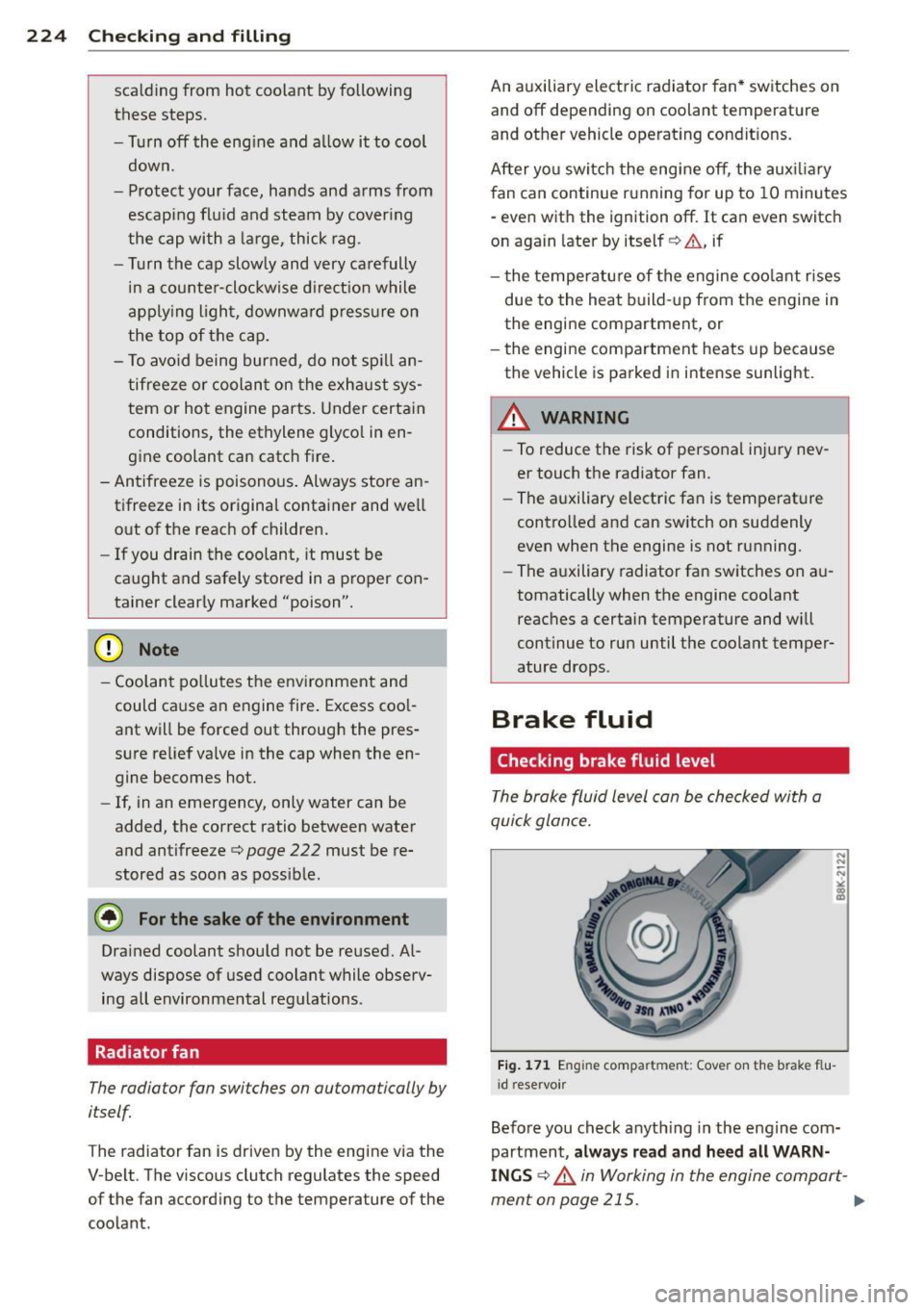
F ig . 17 1 Eng ine compartment: Cover on the brake flu
i d reservo ir
Before you check a nyth ing in the engine com
partment,
always read and h eed all WARN
INGS c::> .&. in Working in the engine compart-
ment on page 215. .,..