ABS AUDI A4 SEDAN 2013 User Guide
[x] Cancel search | Manufacturer: AUDI, Model Year: 2013, Model line: A4 SEDAN, Model: AUDI A4 SEDAN 2013Pages: 294, PDF Size: 73.71 MB
Page 150 of 294
148 Airbag system
-Never place additional items on the seat
that can increase the total weight regis
tered by the weight-sensing mat and can
cause injury in a crash .
Front airbags
Description of front airbags
The airbag system can provide supplemental
protection to properly restrained front seat
occupants.
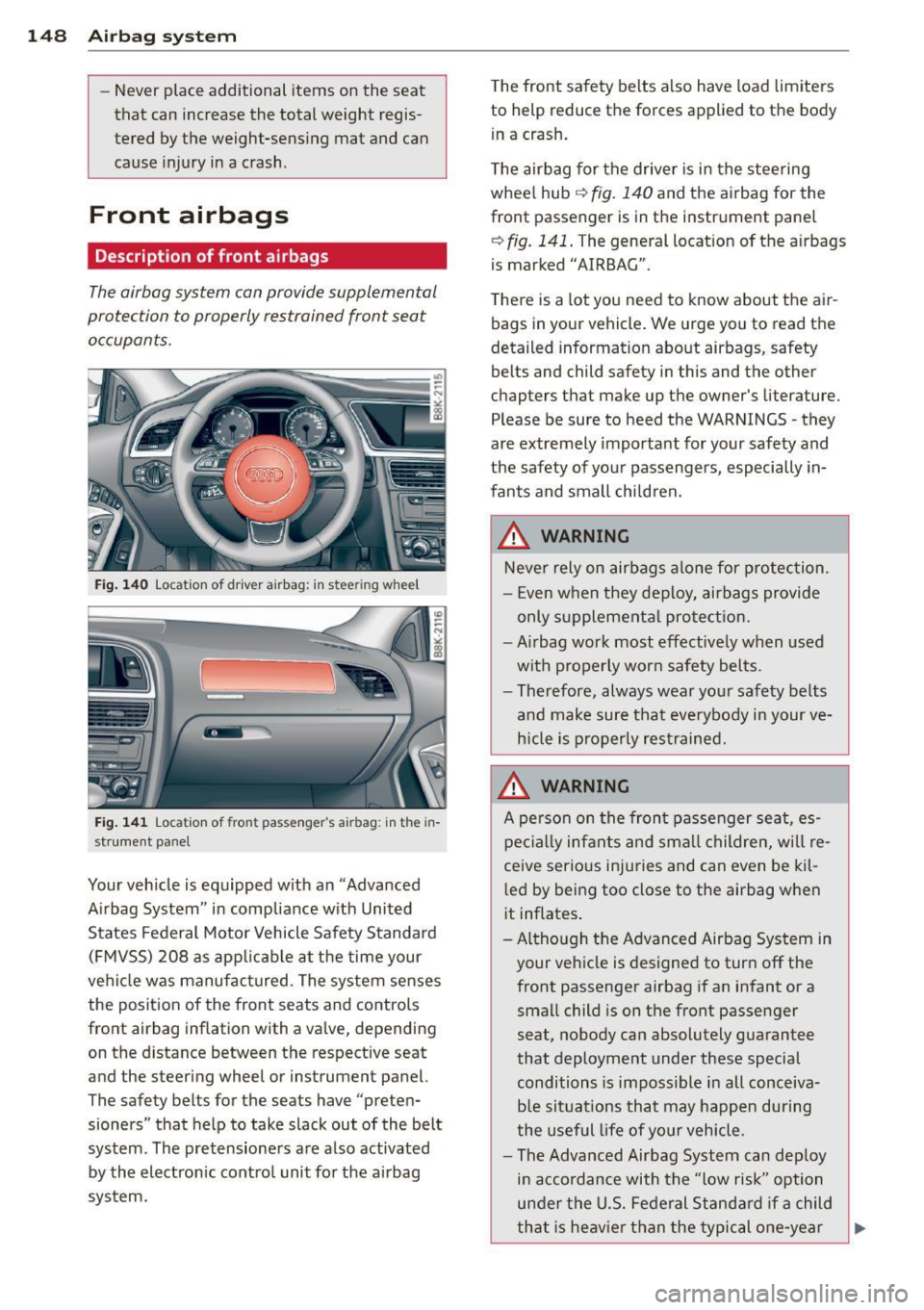
Fig. 140 Locat ion of dr iver airbag: in stee ring wheel
Fig. 141 Loca tion of front pass enger's a irbag: in the in
strument panel
Your veh icle is equipped with an "Advanced
Airbag System" in compliance with United
States Federal Motor Vehicle Safety Standard (FMVSS) 208 as applicable at the time your
vehicle was manufactured . The system senses
the position of the front seats and controls
front airbag inflation with a valve, depend ing
on the distance between the respective seat
and the steering wheel or instrument panel.
The safety belts for the seats have "preten
sioners" that help to take slack out of the belt
system. The pretensioners are also activated by the electronic contro l unit for the airbag
system. The
front safety belts also have load limiters
to help reduce the forces applied to the body
in a crash.
The airbag for the driver is in the steering
wheel hub ¢
fig. 140 and the airbag for the
front passenger is in the instrument panel
~ fig. 141 . The general locat ion of the a irbags
i s marked "AIRBAG".
There is a lot you need to know about the air
bags in your vehicle . We urge you to read the
detailed information about airbags, safety
belts and child safety in this and the other
ch apters that make up the owner 's literature.
Please be sure to heed the WARNINGS -they
are extremely important for your safety and
the safety of your passengers, especially in
fants and small children.
_&. WARNING
Never rely on airbags alone for protection.
- Even when they deploy, airbags provide
only supplemental protection.
-Airbag work most effectively when used
with properly worn safety bel ts.
- Therefore, always wear your safety belts
and make sure that everybody in your ve
h icle is properly restrained.
_&. WARNING
A person on the front passenger seat, es
pecially infants and sma ll children, will re
ceive serious injuries and can even be kil
led by being too close to the airbag when
it inflates .
- Although the Advanced Airbag System in
your vehicle is designed to turn off the
front passenger airbag if an infant or a
small child is on the front passenger
seat, nobody can absolutely guarantee
that deployment under these special
conditions is imposs ible in all conceiva
b le situat ions that may happen during
the useful life of your vehicle .
- The Advanced Airbag System can deploy
in accordance with the "low risk" option
under the U.S. Federal Standard if a child
that is heav ier than the typical one-year
-
.
Page 152 of 294
150 Airbag sys te m
For exa mpl e, the air b ag ma y depl oy if:
- a small child that is heavier than a typical 1
year-o ld child is on the front passenger seat
(regardless of whe ther the child is in one of
the chi ld safety seats listed
¢ page 167),
-a ch ild who has outgrown child rest raints is
on the front passenger seat.
If the front passenger airbag is turned off, the
PA SSENGER AIR BAG OFF light in the cente r
of the instrument panel w ill come on and stay
on.
The front a irbag on the passenger side may
not deploy (the PAS SENGER AIR BAG OFF
light does not illuminate and stay lit) if:
- a small adult or teenager is on the front pas
senger seat
- a passenger who is not sitt ing upright wit h
their back against a non-reclined backrest
with their feet on the veh icle floo r in front
of the seat is on the front passenger seat.
If the front passenger airbag deploys, the Federal Standard requires the airbag to meet
the "low risk" deployment criteria to help re
d uce the risk of inju ry through interaction
with the airbag. " Low risk" deployment occurs
in those crashes that take place at lower de
celerations as defined in the e lectronic control
un it.
¢ page 155
Alw ays remember : Even though you r vehicle
is equipped with Advanced Airbags, the safest
p lace for children is properly restrained on the
back seat . Please be sure to read the impor
tant information in the sect ions that follow
and be sure to heed all of the WARNINGS.
A WARNING
To reduce the risk of injury when an airbag
inf lates, always wear safety belts properly.
- If you are unrestrained, lean ing forward,
sitting sideways or out of position in any
way, your risk of in jury is much higher.
- You w ill also receive serious injuries and
cou ld even be killed if you are up against
the a irbag or too close to it when it in- f
lates - even with an Advanced A irbag
¢page 144.
A WARNING
-A child in a rearward-fac ing ch ild safety
seat installed on the front passenger seat
will be serious ly injured and can be killed if
the front airbag inflates - even with an Ad
vanced A irbag System.
- Although the Advanced Airbag System in your veh icle is designed to turn off the
front airbag when a rearward-facing child restraint has been instal led on the
front passenger seat, nobody can abso
lutely g uarantee that dep loyment is im
possible in all conceivable situations that
may happen during the usefu l life of your
veh icle.
- The inflating airbag will hit the child
safety seat or infant carrier with great
force and will smash the child safety seat
and child aga inst the backrest, center
armrest, door, or roof.
-Always install rearward -facing ch ild re
straints in the back seat.
- If you must install a rearward fac ing
child safety seat on the front passenger
seat because of exceptiona l circumstan
ces and the
PASSENGER AIR BAG OFF
light does not come on and stay on, im
mediately insta ll th e rear-fac ing ch ild
safety seat in a rear seating position and
have the airbag system inspected by your
authorized Audi dealer .
A WARNING
If, in exceptional circumstances, you m ust
insta ll a forward -facing child restraint on
the front passenger's seat:
- Always make sure the forward-facing
seat has been designed and certified by
its manufacturer for use on a front seat
with a passenger front and s ide a irbag.
- Never p ut the forward-facing child re
straint up against or very near the instru- ment panel.
~
Page 161 of 294
dealer is familiar with these requi rements
and we recommend that you have your
dea ler perform this serv ice for you.
Other things that can affect Advanced
Airbag performance
Changing the vehicle's suspension system can
change the way that the Advanced A irbag Sys
tem performs in a crash. For example, us ing
tire-r im combinations not app roved by Aud i,
l owering the vehicle, changing the stiffness o f
the suspension, incl uding the sp rings, s uspen
sion struts, shock absorbers etc. can change
the forces that are measured by the airbag sensors and sent to the electronic control
un it. Some suspension changes can, for exam
ple, increase the force levels measured by the
sensors and make the airbag system deploy in
crashes in wh ic h it would not dep loy if the
changes had not been made. Other k inds of
changes may reduce the force levels meas
u red by the sensors and prevent the a irbag
from deploying when it shou ld .
The senso rs in the safety belt buckle fo r the
d river and front passenger sea t tell the elec
tronic control module if the safety belt is
l atched or not . If the safety belt is being used,
the front airbag will dep loy at a slightly high
er rate of vehicle deceleration than if the safe
ty belt is not being used. Therefore, in a par
ticular co llision, it is poss ible that an airbag
will not deploy at a seating position where the
safety belt is being use d but will inflate at the
position whe re the safety belt is not being
used. It is important tha t nothing i nterfe re
w it h the safety belt buckles so t hat the sen
sors can send t he correct information abo ut
safety belt use to the electronic contro l unit.
.&_ WARNING
Changing the vehicle 's s uspension includ
ing use of unapproved tire-rim c ombina
tions can change Advanced Airbag pe r
formance and increase the risk of ser ious
personal i njury in a crash.
- Never install suspens ion components
that do not have the same performance
A irba g sy stem 159
characteristics as the components o rigi
na lly installed on your vehicle.
- Never use tire-rim com binations that
have not been approved by Audi.
.&_ WARNING
= -
Items stored between the safety be lt
b uckle and the center console can cause
the sens ors in t he buckle to send the
wrong information to the e lectronic con
trol module and prevent the Advanced Air bag Syst em from wo rking properly.
- Always make s ure that nothing can in ter-
fe re with the safety b elt buckles and that
they are no t obstructed.
Side airbags
Description of side airbags
The airbag system can provide supplemental
protection to properly restrained occupants.
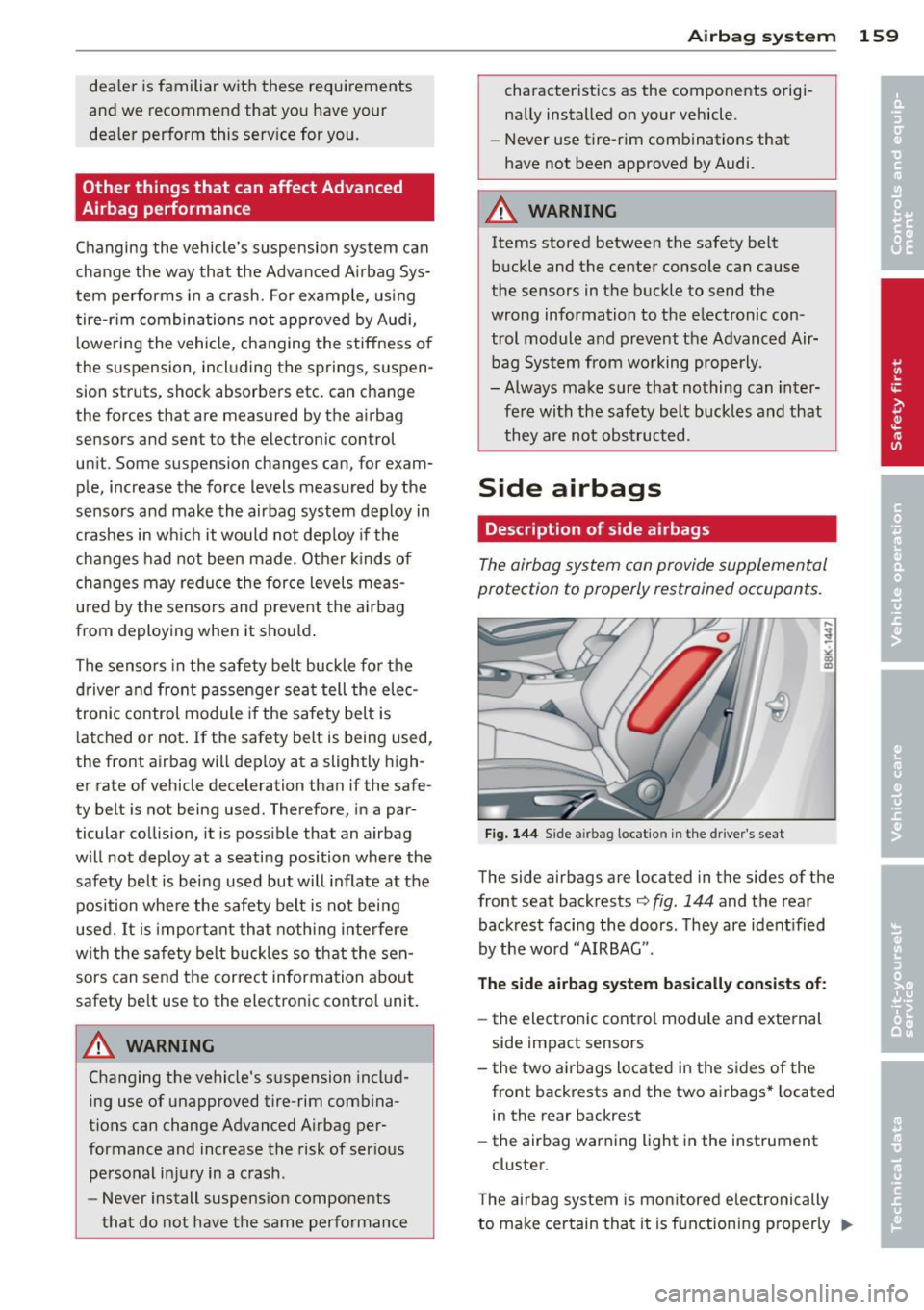
Fi g. 144 Side airbag location in t he drive r's seat
The side airbags are located in the sides of the
front seat backrests¢
fig. 144 and the rea r
backrest faci ng the doors. They are ident ified
by the word "AIRBAG".
The side airbag system basically consists of :
-the electronic control modu le and external
side impact sensors
- the two a irbags located in the sides of the
front backrests and the two a irbags* located
in the rear backrest
- the airbag warn ing light in the instrument
cl uster .
T he airbag system is mo nitored e lec tronically
t o make ce rtain tha t it is f unction ing p ro perly
Ill-
Page 187 of 294
ESC includes and/or works together with the
anti-lock brake system (ABS), brake assist sys
tem, anti -slip regulation (ASR) , e lectronic dif
ferential lock (EDL), dynamic steering* and electronic i nteraxle differential lock* /selective
wheel torque control* . ESC is switched on all
the t ime. I n certain s ituations when you need
less traction, you can switch
off ASR by press
i ng the button~~
page 186, fig. 159 or
~ page 186, fig. 160. Be sure to sw itch ASR
on again when you no longer need less trac
tion.
Anti-lock b ra king s ystem (ABS)
ABS prevents the wheels from locking up
when braking. The vehicle can still be steered
even d uring hard brak ing . Apply ste ady p res
sure to the brake pedal. Do not pump the ped
a l. A pulsing in the brake peda l indicates t hat
the system is he lping you to brake the vehicle .
Brake assist system
The brake assist system can decrease bra king
d istance. It increases braking power when the
d river presses the brake pedal quick ly in eme r
gency situations . You must press and hold the
brake peda l until the situation is over. In
veh icles w ith adaptive cru ise contro l*, the
brake assist system is more sensit ive if the
d istance detected to the veh icle ahead is too
small.
Anti- slip regulati on (ASR)
ASR reduces engine power when the drive
wheels begin to spin and adapts the force to
the road condit ions. This makes it eas ier to
start, accelerate and drive up hills.
Elect ronic diffe renti al lo ck (EDL )
The ED L brakes wheels that are spinning and
transfers the drive power to the other drive
wheel or wheels if the vehicle is equipped with
all-wheel drive*. This function is available up
to about 60 mph (100 km/h) .
In extreme cases, EDL automatica lly switches
off to help keep the brake on the braked whee l
from overheating. EDL w ill switch on again au-
Intellig ent technolog y 185
tomat ica lly when conditions have returned to
norma l.
Dynamic steering*
On vehicles with dynam ic steering*, ESC helps
stab il ize the s teer ing in crit ica l sit uat io ns.
Electronic interaxle differential lock* /
selective wheel torque control*
T he electronic i nteraxle differential lock (front
whee l dr ive) or the se lective whee l to rque
control (all-whee l dr ive) opera tes when dr iv
ing thro ugh curves. The front wheel on the in
side of the c urve or both whee ls on the inside
of the curve are braked selectively as needed .
This min imizes sliding in the front wheels and
allows for more precise driving through
cu rves . The applicable system may not acti
vate when dr iv ing in wet or snowy conditions.
A WARNING
- ESC, ABS , ASR, EDL dynam ic steering*
a nd the elect ronic interaxle differential
loc k* /se lective wheel torque control*
function cannot overcome the laws of
physics. This is especially important on
slippery or wet roads . If the systems be
gin acting to stabilize your vehicle, you
should immediately change yo ur speed
to match the road and traff ic conditions.
Do not let the increased safety provided
by these systems tempt you to take risks .
Doing so will increase the risk of a loss of
veh icle contro l, col lision and ser ious per
sonal injuries.
- Always adapt your speed to road, traffi c
and wea ther conditions. The risk of los
ing con tro l of the vehicle increases when
driving too fast, espec ially through
curves and on slippery or wet roads, and
when dr iv ing too close to vehicles up
ahead. ESC, ABS, the brake ass ist sys
tem, ASR, EDL dynam ic steering* and the
electronic interaxle differentia l lock*/se
lective whee l torque control* function
cannot prevent collisions.
•
•
Page 188 of 294
186 Intelligent technology
-Always accelerate with special care on
even, smooth surfaces such as those that
are wet or covered with ice and snow.
The drive wheels can spin even with
these assistance systems that cannot al
ways help to reduce the risk of loss of ve hicle control.
(i_) Tips
- ABS and ASR only work correctly when
all four wheels are equipped with identi
cal tires . Different tire sizes can lead to a
reduction in engine power.
- You may hear noises when the systems
described are working .
- If the indicator light
I] or l;S (USA
models);tl] (Canada models) appears,
there may be a malfunction ¢
page 19,
¢page 19.
Switching on /off
ESC turns on automatically when you start
the engine .
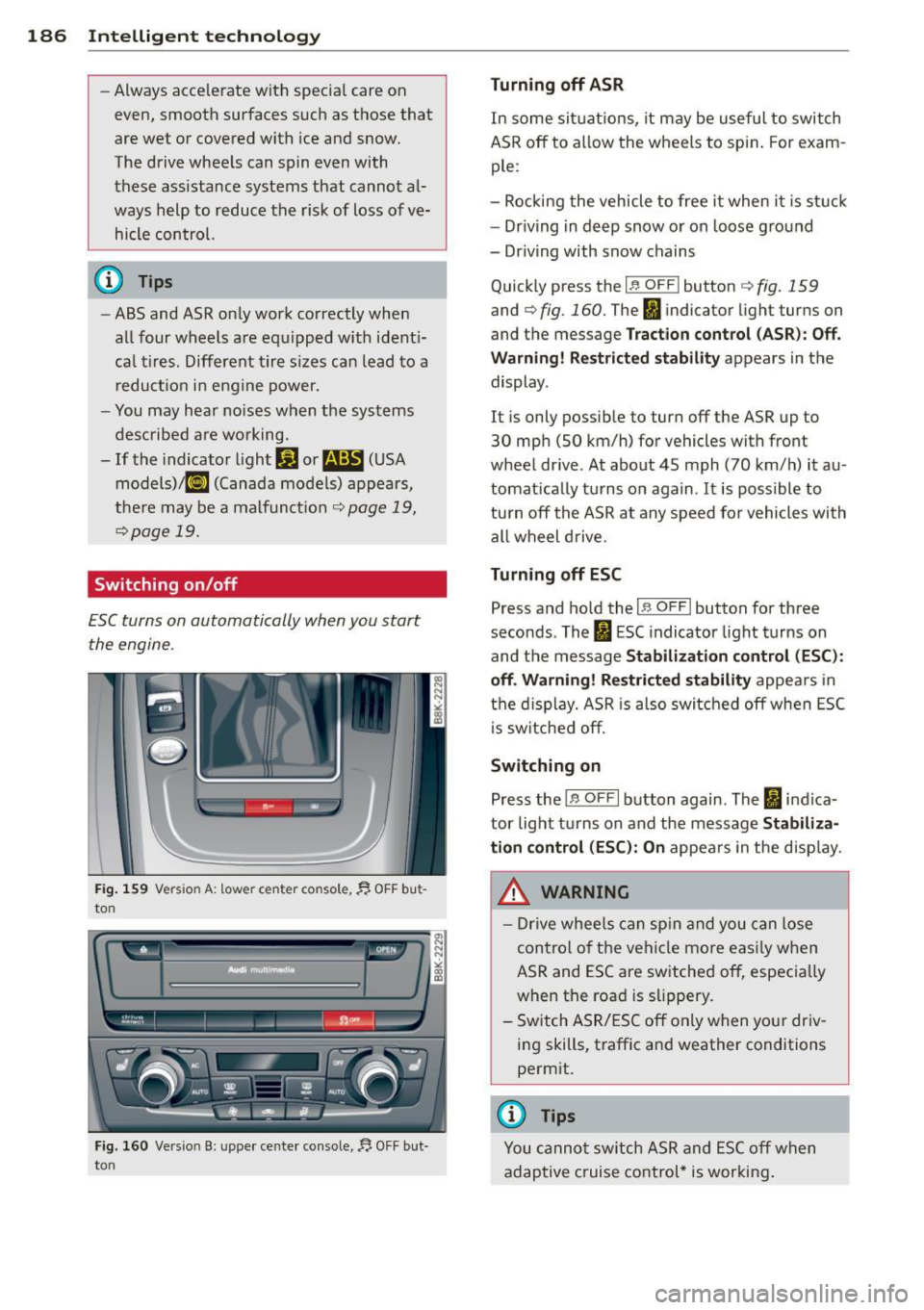
Fig. 159 Vers ion A: low er ce nter c onsol e, 1', OFF but
to n
.... .. [ I _j nw· 1-_, .. _ , 1 -- - .-=---1
I;· . i-a~ -~ ~-,' I ' .;- c;.il..-~ -~ 1,1
~' . -' '
1 ' ...... ~ ... ~- ;. '"~ l __,
Fig. 160 Versio n B: upper ce nter console,!'> OFF but
to n
Turning off ASR
In some situations, it may be useful to switch
ASR
off to allow the wheels to spin. For exam
ple:
- Rocking the vehicle to free it when it is stuck
- Driving in deep snow or on loose ground
- Driving with snow chains
Qu ickly press the
i.i, OFF I button ¢ fig. 159
and¢ fig. 160. The fi indicator light turns on
and the message
Traction control (ASR): Off.
Warning! Restricted stability
appears in the
display .
It is only possible to turn off the ASR up to
30 mph (SO km/h) for vehicles with front
wheel drive . At about 45 mph (70 km/h) it au
tomatically turns on again .
It is possible to
turn
off the ASR at any speed for vehicles with
all wheel drive.
Turning off ESC
Press and hold the I B OFFI button for three
seconds . The
Ii ESC indicator light turns on
and the message
Stabilization control (ESC):
off. Warning! Restricted stability
appears in
the display. ASR is also switched
off when ESC
is switched off.
Switching on
Press the 1 .$ OFFI button again. The 11 indica
tor light turns on and the message
Stabiliza
tion control (ESC): On
appears in the display .
_&. WARNING
- Drive wheels can spin and you can lose
control of the vehicle more easily when
ASR and ESC are switched off, especially
when the road is slippery .
- Switch ASR/ESC
off only when your driv
ing skills, traffic and weather conditions
permit.
(D Tips
You cannot switch ASR and ESC
off when
adaptive cruise control* is working.
-
Page 198 of 294
196 Trailer towing
Trailer towing Driving with a trailer
General information
Your Audi was designed primarily for passen
ger transportation .
If you plan to tow a trai ler, p lease remember
that the additional load will affect durability,
economy and performance .
Trailer towing not on ly places more stress on
the vehicle, it also calls for more concentra
tion from the driver.
For this reason, always fo llow the operating
and driving instructions provided and use
common sense.
Technical requirements
Trailer hitch Use a weight-carrying hitch conforming to the
gross trailer weight. The hitch must be suita
ble for your vehicle and trailer and must be
mounted securely on the veh icle's chassis at a
technically sound location. Use only a trailer
hitch with a removable ball mount. Always
check with the trailer hitch manufacturer to
make sure that you are using the correct
hitch.
Do not use a bumper hitch.
The hitch must be installed in such a way that
it does not interfere with the impact-absorb
ing bumper system . No modifications should
be made to the vehicle exhaust and brake sys
tems . From time to time, check that all hitch
mounting bolts remain securely fastened.
When you are not towing a trailer, remove the
trailer hitch ball mount. This prevents the
hitch from causing damage should your vehi
cle be struck from behind
¢ A.
Trailer brakes
If your tra iler is equipped with a braking sys
tem, check to be sure that it conforms to a ll
regulations . The trailer
hydraulic brake system must not be
direct ly connected to the vehicle's hydraulic
brake system
~ A.
Safety chains
Always use safety chains between your vehicle
and the trai le r.
Trailer lights
T railer lights must meet all regulations. Be
sure to check w ith your authorized Audi dealer
for correct wiring, sw itches, and relays.
Mirrors
If you are unable to see the traffic behind you
using the regular outside mirrors, then you
must install extended mirrors . It is important
that you
always have clear vis io n to the rear.
,8. WARNING
- If a trailer has electrical brakes please
note that these brakes are not activated
by the factory-fitted control unit -risk of
accident!
- Afte r removing the trailer hitch, do not
store it in your vehicle. In case of sudden
braking, the hitch could fly forward and
injure you or your passengers.
Operating instructions
Maximum trailer weight
-
A trailer for your vehicle is limited to a typical
class 1 or class 2 tra iler.
Trailer load distribution Be sure the load in the trailer is held secure ly
in place to prevent it from shifting forward,
backward or sideways.
Never allow a passenger to ride in a trailer
¢ A in Driving instructions on page 197.
Engine cooling system
T owing a trailer makes the engine work hard
er. It is important that the cooling system's
performance is up to the additional load.
Make sure that the cooling system has enough
fluid . .,..
Page 200 of 294
198 Trailer towing
Trailer towing tips
Important to know
Your vehicle hand les different ly when tow ing
a trailer because of the addit ional weight and
different weight distribution . Safety, perform
ance and economy wi ll greatly depend on how
carefully you load your trailer and operate
your rig.
Before you actually tow your trailer, practice
turning, stopp ing and backing up in an area
away from traffic. Keep practicing until you have become completely familiar with the way
your veh icle-trailer combination behaves and
responds.
Backing up is difficult and requires practice.
Backing up with a trai ler generally requires
steering action opposite to that when backing
up your vehicle without a trailer.
Maintain a greater distance between your ve
hicle and the one in front of you. You will need
more room to stop. To compensate for the
trailer, you will need a larger than normal
turning radius .
When passing, remember that you cannot ac
celerate as fast as you normally would be
cause of the added load. Make sure you have
enough room to pass . After passing, allow
plenty of room for your tra iler before chang
in g lanes again.
Avoid jerky starts, sharp turns or rapid lane
changes.
(D Tips
- Do not tow a tra iler dur ing the break-in
period of your vehicle.
- If you tow a trailer, your Audi may re
quire more frequent maintenance due to
the extra load
q page 2 72.
Parking on a slope
Do not park on a slope with a trailer . If it can
not be avoided, do so only after doing the fol lowing :
When parking:
.. App ly the foot brake.
.. Have someone place chocks under both the
vehicle and the trailer wheels .
.,. With chocks in place, slowly release the
brakes until the wheel chocks absorb the
load.
.. Tur n the wheels towards the curb.
.. App ly the parking b rake.
.. Place an automatic transmission* in P, re
spectively a manual transmission in first or reverse gear.
When restarting after parking:
.. App ly the foot brake .
.. Start the engine.
.. Move the se lector lever to D/S, respectively
a manual transmission in first gear.
.. Release the parking brake and slow ly pu ll
out and away from the wheel chocks.
.. Stop and have someone retr ieve the wheel
chocks .
(D Tips
If you move the selector lever of the auto
matic transmission* to P before applying
the parking brake and before blocking the
whee ls, you may have to use more force
lat er to move the lever out of the P posi
tion.
Page 207 of 294
Your authorized Audi dealer can provide clean
ing products that have been tested and ap
proved for your vehicle .
Care of interior
Infotainment components
The Radio/MM!* display may be clea ned with
a soft cloth and commercially-availab le "LCD
cleaner" . The cloth should be coated lightly
when the cleaning solution when cleaning the
display .
The
MMI* controls must be cleaned first with
a brush so that dirt does not enter the un it or
enter between the buttons and the housing.
Then wiping the controls with a cloth damp
ened with dish detergent and water is recom
mended.
(D Note
- To avoid scratch ing the display, you
shou ld never clean it dry.
- To prevent damage, make s ure fl uids do
not enter the controls.
Aluminum trim
Use only neutral-pH products to remove spots
and depos its from alum inum surfaces.
Chrome care products and alkaline cleaners
will attack alum inum surfaces and can dam
age them ove r time.
A WARNING
Always read and heed all WARNINGS and
other information
r::> page 199.
Fabrics and fabric coverings
Fa brics and fabric coverings (e.g. seats, door
trim panels, etc.) should be cleaned at regular
intervals with a vacuum cleaner. This removes
surface dirt particles which could become em bedded in the fabr ic through use. Steam
cleaners should not be used, because the
steam tends to push the dirt deeper into the
fabric and lock it there.
Cleaning and protection 205
Normal cleaning
Generally, we recommend using a soft sponge
or a lint -free microfiber cloth to the clean fab
ric. Brushes shou ld only be used for carpets
and floor mats, since other fabric surfaces
could be harmed by brushes.
Normal sur face stains can be cleaned using a
commercially available foam cleaner . Spread
the foam on the s urface of the fabric with a
soft sponge and work it in gently. Do not satu
rate the fabric. Then pat the foam dry using
absorbent, dry cloths (e.g. m icrofiber cloth)
and vacuum it after it has dried completely.
Cleaning stains
Stains caused by beverages (e.g. coffee, fr uit
jui ce, etc.) can be treated with a mild deter
gent solution. Apply the detergent solution
with a sponge. In the case of stubborn stains,
a detergent paste can be applied directly to
the stain and worked into the fabric. After
wards, use copious amounts of clean water to
remove the remaining deterge nt. Apply the
water with a damp cloth or sponge and pat
the fabric dry with an absorbent, dry cloth.
Stains from choco late or makeup should have
detergent paste rubbed into them. After
wards, remove the soap with water (damp
sponge).
Alcohol can be used to treat stains from
grease, oil , lipstick or a ballpoint pen. Melted
grease or dye must be patted off using ab
sorbent materia l.
It may be necessary to re
treat the areas with detergent paste and wa
ter.
In the case of genera l soiling of the upho ls
tery and cover material, we recommend hiring
a specia list t hat has the equipment to clean
the seat covers and other fabr ic surfaces by
shampooing and spray extraction.
A WARNING
Always read and heed all WARNINGS and
the information
r::> page 199.
•
•
Page 209 of 294
(D Note
-To keep your leathe r from bleaching out,
do not a llow it to be exposed to bright
sunlight for long periods of time. If you have to leave the vehicle parked outside
for long periods, cover the leather to protect it from d irect exposure to sun
l ight .
- Sharp objects on clothing, such as zip pers, rivets or sha rp pieces on belts can
l eave pe rmanent scratches o r scrape
mar ks on the surface of the leather.
@ Tips
- After each time you clean the leathe r and
at reg ular i nte rva ls, use a leather prese r
vat ive cream th at co ntains UV-blo ckers
and th at wor ks into the leather. This
cream will no urish and moistur ize the
l eather, helping it to breathe and stay
supple . It also helps to b uild up a protec
tive coat ing on the surface.
- Clean the leather every 2 - 3 months,
and clean any areas that get soiled.
- Remove fresh marks made by ba llpoint
pens, in k, lipst ick, shoe polish, etc . as
soon as possib le.
- Preserve the color of the leather as need
ed by using a special colored leather care
cream to touch up areas of uneven color.
Cleaning and caring for leather
upholstery and trim
Applies to vehicles: with natural leather
Natural leather requires special care and at
tention .
Normal cleaning
.,. Clean soiled areas w it h a slightly mo istened
cotton or woolen cloth.
More stubborn dirt
.,. More stubbo rn dirt can be removed using a
cl oth saturated with a m ild soap so lution ( 2
tablespoons mi ld liquid soap) .
Cleaning and protec tion 207
.,. Never allow the soap sol ution to sa turate
the leather, and make certain that no water
soaks into the seams .
.,. Wipe
off the soap so lution with a soft, dry
cloth.
Clean ing spots
.,. Remove fresh wate r-ba sed spots (such as
coffee, tea, juices, blood) with an absorbent
cloth or paper towel.
.,. Remove fresh
grease or oil -based spots
(such as butter, mayonnaise, chocolate) with
an absorbent clot h or pape r towel, or use
the cleaner from the leather care k it if the
spot has not yet penetrated into the surface
of t he leathe r.
.,. Use an oil/grease dissolving spray, if
oil /
grease spot s have dried on.
.,. Remove s pecific kinds of spots (ballpoint
pen, fe lt mar ker, fingernai l polish, water
based pa int, shoe po lish, etc.) with a spot
remover specifically formulated for leather.
Leather care
.,. Every ha lf year use an approved leather care
product (available from your authorized
Audi dea ler) to care for the leather .
.,. App ly the product very spar ingly.
.,. Wipe it
off with a damp cloth.
If you have any q uestions about cleaning and
caring for the leather in your vehicle, it is best
to contact your a uth orized Audi dea ler, who
will be g lad to help you and tell you about our
full range of leather care products, such as:
- Leather cleaning and care kit
- Creams to ca re fo r colored leather
- Spot removers for ballpoint pens, shoe pol-
ish, etc .
- Oil/grease d issolving spray
- New and upcom ing products .
_&. WARNING
Always read and heed all WAR NINGS and
other information
q page 199.
•
•
Page 228 of 294
226 Check ing and filling
Have the battery checked when you take your
vehicle in for service. You are well advised to replace a battery that is older than 5 years.
W ith certa in types o f airbag deployment, the
battery is disconnected from the vehicle elec
trica l system for safety reasons¢
& in Re
pair, core and disposal of the airbags on
page 158.
Disconn ect ing the battery terminal s
Some vehicle functions (power window regu
lators, for example) are lost if the battery ter
minals are disconnected . These functions have
to be re learned after the battery terminals are
connected again. To prevent this, the battery
should only be disconnected from the vehicle
electrical system when absolutely necessary
for repairs .
Vehicles not dri ven fo r lo ng p eriod s
If you do not drive your vehicle over a period
of several days or weeks, electrical compo
nents are gradually cut back or switched off.
This reduces energy consumption and main
tains starting capabil ity over a longer period
¢ page 190.
Some of the conven ience functions may not
operate, such as the inter ior lights or the
power seat adjustment. The conven ience
functions will be ava ilable again when you
turn on the ignition and start the eng ine.
Winter operati on
During the winter months, battery capacity
tends to decrease as temperatu res drop . This
is because more power is also consumed while
start ing , and the headlights, rea r window de
fogger, etc., are used more often .
Avoid unnecessary power consumption, par
ticularly in c ity traffic or when traveling on ly
short distances. Let you r authorized Audi
dea ler check the capacity of the vehicle bat
tery before winter sets in
¢ page 228. A well
charged batte ry w ill not only prevent sta rting
prob lems when the weather is cold, but wi ll
a lso last longer.
(D Tips
If your vehicle is left standing for seve ral
weeks at extremely low temperatures, the
vehicle battery sho uld be removed and
stored where it w ill not freeze . This will
prevent it from be ing damaged and having
to be replaced .
Working on the battery
Be especially careful when working on or near
the battery.
The battery is located in the luggage compart
ment under the floor. Before you check any
t hi ng in the luggage compartment,
read and
heed all WARNINGS
¢ ,& .
Always heed the safety warnings , when work
ing on the vehicle battery or the vehicle e lec
trical system to prevent injury.
Th e follo wing WARNINGS are very
important when working on the battery :
Al ways heed the follo wing WARNING SYM
BOLS and safety prec aution s when working
on the battery .
® Always wear eye protection .
,0,. Battery acid contains sulfuric acid . Al
~ way s wear glov es and ey e prot ectio n.
~ No
\!SI -sparks
-flames
-smoking.
A Wh en a battery is charged , it produ ce s
~ hydro gen gas which is e xplosi ve and
c o uld cau se pe rson al injur y.
~ Always keep the battery well out of
'if!:11 reach of children .
_& WARNING
Whenever working on the battery or on
the electrical system, there is the risk of
injury, accident and even fire . Read and
heed the following WARNINGS:
-