wheel AUDI A4 SEDAN 2013 Service Manual
[x] Cancel search | Manufacturer: AUDI, Model Year: 2013, Model line: A4 SEDAN, Model: AUDI A4 SEDAN 2013Pages: 294, PDF Size: 73.71 MB
Page 201 of 294
Cleaning and protect ion
General information
Regular core preserves vehicle value.
Any automobile is exposed to industrial
fumes , corrosive road salt, etc. A well cared
for Audi can look like new many years after
purchase . Regular and correct care w ill con
tr ibute to maintaining the beauty and value of
your Aud i.
Furthermore, good care may be a condition
for substantiating a warranty claim should
corrosion damage or paint defects occur.
Your authorized Audi dealer has a variety of
dedicated vehicle-care products and can ad
vise which ones to use for cleaning the exter i
or and interior of your vehicle.
Whether you use products recommended by
Audi or other commercially available cleaning
agents, please make sure you apply them cor
rectly .
.&, WARNING
-Cleaning agents may be poisonous. Keep
them out of the reach of children.
- Heed all caution labels.
- Always read directions on the container
before using any product. Follow the di
rect ions carefully.
- Most chemical cleaners are concentrated
and have to be diluted .
- Use spot removing fluids only in well
ventilated areas.
- Do not use gasoline, kerosene, d iesel
fuel, nail polish remover or other volatile
fluids. They may be toxic, flammab le or
haza rdous in other ways. Do not wash,
wax or dry the vehicle with the ignition
on or the engine running.
- Do not clean the undersides of chassis,
fenders, wheel covers, e tc. without pro
tecting your hands and arms. You may cut yourself on sharp-edged metal parts.
Cleaning and protection 199
-Moisture and ice on brakes may impair
brak ing effic iency¢
page 187. Test the
brakes carefully each time you wash the
veh icle.
@) For the sake of the environment
Select on ly environmentally friend ly clean
i ng products . Leftover cleaning products
should not d isposed of in the household
waste.
Care of exterior
Washing
Frequent washing protects the vehicle .
The best protection against environmental i n
fluences is
frequent washing and waxing . How
often th is is required depends on:
- How much the veh icle is used
- Where the veh icle is parked (garage, in the
open under trees, etc.)
- The seasonal and weather conditions
- Environmental influences
T he longer b ird droppings, insects, tree resin,
road and indus trial gr ime, tar, soot, road salt
and other materials remain on the vehicle
body, the more lasting their destructive ef
fects will be . High temperatures caused by ex
posure to intense sun light intens ify the corro
sive effect, particularly when humid ity is high
as well.
Under certain circumstances,
weekly washing
may be necessary. Under other cond itions, a
monthly washing and waxing may be ade
quate .
After the winter, the underside of the vehicle
should be thoroughly washed, preferab ly in a
professional car wash .
.&, WARNING ,_
Always read and heed all WARNINGS and
other information¢
page 199 .
•
•
Page 202 of 294
200 Cleaning and protec tio n
Automatic car wash
The vehicle can be washed in almost any
modern automatic car wash .
The vehicle paint is so durable that the vehicle
can normally be washed without problems in
an automatic car wash. However, the effect on
the paint depends to a large extent on the de
sign of the facility, the filtering of the wash
water, the type of wash and care mater ial , etc.
I f the pa int has a dull appearance afte r going
through the car wash or is scratched, bring
this to the attention of the operator immedi
ately.
If necessary, use a different car wash.
Before going through a car wash, be sure to
take the usual precautions such as closing the
windows and the roof . Factory installed an
tennas must not be removed.
I f you have installed additional accessor ies on
the vehicle - such as spoilers, roof rack, etc. -
it is best to ask the car wash operator if these
should be removed .
A WARNING
Always read and heed all WARNINGS and
other information
c;, page 199.
Before washing the vehic le in an automatic
car wash, p lease make sure to retract the
exterior m irrors to prevent them from be
ing damaged.
Washing the vehicle by hand
A lot of water is needed when washing a vehi cle by hand.
• Before you start washing, make sure you
have read and understood the WARNINGS
r:::;, A in General information on page 199 .
• First soak all dried di rt until it is soft, then
rinse it off .
• As you clean your vehicle, start with the
roof and work your way down to the bottom,
us ing a sponge, a sponge glove o r a clean
brush. •
Rinse the sponge or the sponge g love often,
flushing it clean each time .
• Use spec ial car shampoo only for very per
sistent d irt .
• Rinse the car thoroughly with wa ter .
• Use a chamo is leather to gently w ipe the ex-
ter ior dry .
Use a separate sponge for cleaning the
wheels, door sills and other regions exposed
to road dirt . In this way, you will not scratch
the pa int with coarse particles imbedded in
the sponge the next t ime you wash the car.
&_ WARNING
- Do not clean the underside of the chas
sis, fenders, wheel covers, or o ther ha rd
to reach parts withou t protecting you r
hands and arms. You may cut yourself on
sharp-edged metal parts .
-A lways read and heed a ll WARNINGS and
other info rmation
c;, page 199.
{D Note
- N ever try to remove dirt, mud or dust if
t he su rface of the veh icle is dry . Neve r
use a dry cloth or sponge, since this
cou ld scratch your vehicle's paint or win
dows .
- Never wash your car in bright s unli ght .
Drops of wate r act as magn ifying lenses
and may damage your paint .
- When you wash your car in the winter: if
you rinse yo ur vehicle with a hose, be
careful not to aim the stream of water
directly at locks, or at door or hatch
openings - they can freeze shut .
- Never use sponges designed to remove
insects, or any k itchen scouring sponges
o r simi lar p roducts . They can damage
your pai nt finish .
- You should remove debris (such as in
sects) from the headlight lenses on a
regu lar basis, for example when refuel
ing your vehicle . Never use a d ry cloth o r
sponge to clean the headlights. On ly use
wet cloths o r sponges to prevent
scratches. It is best to use soapy water.
-
Page 206 of 294
204 Cleaning and protec tio n
Cast (light) alloy wheels
Cast (light) alloy wheels require special care .
• Wash the whee ls with a sponge or hose
brush every other week.
• For deep cleaning afterwards, use only a
dedicated
aci d-fr ee cast alloy wheel cleaner .
• Rub a coat of
liq uid wax onto the r ims every
t h ree month . Be sure to reach and treat a ll
parts of the rim .
To preserve the decorat ive appearance of the
cast alloy whee ls, some specia l care is neces
sa ry. In addit ion to road dirt and sa lt, b rake
d ust is a lso corros ive. If left on for too long,
b rake dust can cause pitting.
Use only specia l
acid-free cleaners formulated
for a lloy rims . Safe p roducts are available at
your author ized Audi dealer. Never leave the
cleane r on the rims longe r than specified on
the label. If not rinsed off promptly, the acid
contained in some cleaners can attack the
threads on the whee l bolts.
Never use ab rasive or metal polishing clean
ing agents. If the protective coating has been
chipped, e .g. by k icked up road dirt, touch it
up as soon as possible.
A WARNING
- Moisture and ice on brakes may affect
braking efficiency ¢
page 187. Test the
brakes carefully each time you wash the
vehicle .
- Always read and heed all WARNINGS and
other information ¢
page 199.
-
Body cavity sealing
The body cavity sealing does no t need to be
checked.
A ll body cavities which co uld be affected by
corrosion have been thoroughly protected at
the factory.
This sealing does not require any inspection or
addit ional treatment . If any wax should seep
out of the cav ity when the ambient tempera- ture is high, it can be removed with a p
lastic
scraper and a suitable solvent.
A WARNING
-Solvents can be dangerous.
- Benzine is flammab le and toxic. If you
use benzine for removing the wax, keep
sparks, flame and lighted cigarettes
away. Never dump benz ine on the
ground, into open streams or down sew
age drains.
- Be sure to observe all safety and environ
mental regulat ions . Follow all instruc
tions on the container .
- Always read and heed all WARNINGS and
other information ¢
page 199.
, Chassis
Have the undercoating checked for damage
from time to time.
The lower body shell of your Audi is also thor
oughly protected against corros ion.
Any damage to the undercoating caused by road hazards should be repaired prompt ly .
A WARNING
Too much undercoating in the wrong p la
ces can cause a fire.
- Do not app ly additional undercoating or
r u stproof ing on or near the exhaust
manifold, exhaust pipes, catalytic con
verter or heat shields. While driving, the substance used for undercoating could
overheat and cause a fire.
'
- Always read and heed all WARNINGS and
other information ¢
page 199.
Exhaust tail pipes
Road salt and other corrosive materials will
damage the material in the exhaust tail pipes
if they are not cleaned regularly. Do not clean
the tail pipes with wheel cleaner, pa int polish,
chrome polish or other ab rasive cleaners.
Clean the tail pipes with car care products
that are suitable for stainless steel.
Page 211 of 294
Corro sion prot ecti on
The engine compa rtment and transmiss ion
have been corrosion-protect ed at the factory.
Good ant i-corrosion treatment is very impor
tant , particularly in the winter. If the veh icle
is frequent ly driven on sa lt treated roads , the
enti re engine compartment and plenum panel
should be thoroughly cleaned at the end of
wint er and retreated to pr ev ent sa lt damage .
At the same time, the underside of the vehicle
should be washed as we ll.
If the engine compartment is cleaned at any
time with gr ease r emoving solutions
1l, or if
you have the engine washed, the anti-corro sion treatment is a lmost always removed as
well. It is therefore essential to have a long
lasting corrosion protection reapplied to all
surfaces, seams, joints and components in the
e ngine compartment .
.8, WARNING
Be aware: The engine compa rtment of any
motor vehicle is a po ten tially h azardous
area .
- Before working i n the engine compart
ment, be s ure to read the in format ion
Q page 215 .
-Be fore rea ching into the front plenum
pane l, always remove the ignition key .
Otherw ise, the windshield wiper system
cou ld uni ntentiona lly be switched on,
poss ibly causing personal injury from the
moving wiper linkage.
- Never reach into the area around or
touch the radiator fan. The auxiliary fan
is temperature controlled and can switch
on suddenly -even when the ig nition is
off .
- Do not wash, wax or dry the engine w ith
the engine running . Moving or hot parts
cou ld inju re you .
- Do not clean the underside of the chas
sis, fenders, wheel cove rs, or other hard
l ) Use o nly t he co rr ect clean in g s olu tio ns. Ne ve r use ga s
o line or d ie sel fuel.
Cleaning and protec tion 209
to reach parts without protecting your
hands and arms . You may cut yourself on
sharp-edged metal parts.
- Always read and heed a ll WARNINGS and
other information
Q page 199.
•
•
Page 232 of 294
230 Tire s and wheel s
Tires and wheels
Tires
General notes
Tires may be the least appreciated and most
abused parts of a motor vehicle .
Tires may be the least appreciated and most
abused parts of a motor vehicle . Tires are,
however, one of the most important parts of a
vehicle, particularly considering the compara
tive ly small patch of rubber on each tire that
assures that a ll-impo rtant contact between
you, your vehicle and the road.
Maintaining the correct tire pressure, mak ing
sure that your vehicle and its tires do not have
to carry mo re weight than they can safe ly han
d le, avoiding damage from road hazards and
reg ularly inspecting t ires for damage includ
ing cuts, slashes irregu la r wear and ove rall
condition are the most important things that
you can do to he lp avoid sudden tire failure in
cluding tread separat ion and blowouts.
Avoiding damage I f you have to drive over a curb or similar ob
stacle, drive very s low ly and as close as possi
b le at a right angle to the curb.
A lways keep chem ica ls includ ing gre ase, o il,
gasoline and b rake fluid off the ti res .
Inspect the t ires regularly for damage (cuts,
cracks or b listers, etc.). Remove any fo reign
bod ies embedded in the treads.
Storing tires Mark tires when you remove them to indicate
the direction of rotation . Th is ensures you to
be ab le to mount them correctly when you re
install t hem.
When removed, the whee ls or t ires should be
stored in a cool, d ry and preferably dark place .
Store tires in a vertical pos ition if they are not
mounted on r ims, in a horizontal pos it ion if
they are mounted on rims. New tire
s
New t ires have to be broken in¢&,. .
T he tread depth of new t ires may vary, accord
ing to the type a nd make of t ire and the tread
pa tte rn .
Hidden damage
Damage to tires and r ims is ofte n not readily
vis ible . If you notice unusual v ibrat ion or the
vehicle p ulls to one s ide, th is may ind icate
t h at one of the t ires has been damaged . Th e
t ir es m ust be checked immed iate ly by an au
tho rized Aud i dea le r or q uali fied wor ks hop.
Unidirectional t ires
A un idirectional tire can be identified by ar
rows on the s id ewa ll, that po int in the direc
t ion the t ire is desig ned to rotate. You mus t
f ol low the specified d irection of rotation . This
is necessary so that these tires can develop
their optimum characterist ics regarding grip,
road no ise, wear and hyd rop laning resistance.
For more information
¢ page 257.
A WARNING
-New tires or tires that are o ld, worn or
damaged cannot provide maximum con
trol and braking ability .
-
-New tires tend to be slippery and must
also be broken-in. To reduce t he risk of
losing control, a collision and se rious
pe rsonal injuries, drive w it h specia l care
for the first 350 miles (560 km).
- Driving with worn or damaged tires can
le ad to loss of control, sudden tire fail
ure, including a blowou t and sudden de
fl ation, c rashes and seriou s personal in
juries . Have wo rn or damaged t ires re
p laced immediate ly .
- T ires age even if they are not being used
an d can fai l sudden ly, especially at high
speeds. Tires that are more than 6 years
old can only be used in an emergency
and then w ith specia l care and at low
speed.
Page 233 of 294
-Never mount used tires on yo ur vehicle if
you are not sure of their "previous histo
ry." Old used tires may have bee n dam
aged even though the damage cannot be
seen that can lead to sudden tire failure
and loss of vehicle control.
Glossary of tire and loading terminology
Accessory weight
means the comb ined weight (in excess of
those standard items wh ich may be rep laced)
of automati c transmission, power steering,
power br akes, power wi ndows, power sea ts,
radio, and heater, to the ex tent that these
items are avai lab le as factory -installed equip
ment (whether installed or not).
Aspect ratio
means the ratio of the height to the w idt h of
the tire in percent. Numbers of 55 or lower in
d icate a low sidewall fo r improved s teer ing re
sponse and better overall handling on dry
pavement.
Bead
means the pa rt of the t ire that is made of
s teel wires, wrapped or re inforced by ply cor ds
and that is shaped to fit the r im.
Bead separation
means a b reakdown of the bond between
components in the bead.
Cord
means the strands forming the plies in the
tire.
Cold t ir e infl ation pr essure
means the tire pressure recommended by the
vehicle manufacturer for a t ire of a designated
size that has not been dr iven for more than a
couple of miles (kilometers) at low speeds in
the three hour period before the tire pressure i s measu red or adjusted.
Tire s an d wheel s 231
-If you notice un usua l vibration or if the
veh icle pulls to one side when driv ing, a l
ways stop as soon as it is safe to do so and check the wheels and tires for dam
age.
Curb weight
mea ns the weight of a motor ve hicle w ith
standard equipment includ ing t he maximum
capa city of fuel, o il, and coolant, ai r cond i
tion ing a nd addi tional weig ht o f optiona l
equipment .
Extra load tire
means a tire design to operate at higher loads
and at higher inflation pressures than the cor
respondi ng s tanda rd tire. Extra load tires may
be identified as "X L", "xl", "EXTRA LOAD", o r
"R F" on the sidewall .
Gross Axle Weight Rating ( "GAWR ")
mea ns the load-carrying capacity of a single
axle system, measured at the tire-ground in
te rfaces.
Gross Vehicle Weight Rating ( "GVWR ")
means the maximum total loaded we ight of
t h e ve hicle.
Groo ve
means the space between two adjacent tread
ribs.
Load rating (code )
means the maximum load tha t a t ire is rated
to carry for a given inflation pressure. Yo u
may not find this information on all tires be
ca use it is not required by law.
Maximum load rating
me ans the load r ating for a tire at the maxi
mum pe rm issi ble inflat ion pressure for that
ti re .
•
•
...
Page 234 of 294
232 Tires and wheels
Maximum loaded vehicle weight
means the sum of:
(a) Curb weight
(b) Accessory weight
(c) Vehicle capacity weight, and
(d) Production options weight
Maximum (permissible) inflation pressure
means the maximum cold inflation pressu re
to which a tire may be inflated. Also called
"maximum inflation p ressure."
Normal occupant weight
means 150 lbs. (68 kilograms) times the
number of occupants seated in the vehicle up
to the total seating capacity of your vehicle.
Occupant distribution means distribution of occupants in a vehicle .
Outer diameter means the overa ll diameter of an inf lated new
tire.
Overall width
means the linear distance between the exteri
ors of the sidewalls of an inflated tire, includ
ing e levations due to labeling, decorations, or
protective bands or ribs.
Ply
means a layer of rubber-coated parallel cords.
Production options weight
means the comb ined weight of those installed
regular production options weighing over 5
lbs . (2 .3 kg) in excess of those standard items
which they replace, not previously considered
in curb weight or accessory weight, including
heavy duty brakes, r ide leve lers, roof rack,
heavy duty battery, and specia l trim .
Radial ply tire
means a pneumatic tir e in which the p ly cords
that extend to the beads are laid at substan
tially 90 degrees to the centerline of the
tread . Recommended inflation pressure
see
~
page 231, Cold tire inflation pressure.
Reinforced tire
means a t ire design to operate at higher loads
and at h igher inflation pressures than the cor
responding standard tire. Reinforced tires
may be identified as "XL", "xl", "EXTRA LOAD",
o r "R F" on the sidewall.
Rim
means a metal support for a tire or a t ire and
tube assembly upon which the tire beads are
seated.
Rim diameter
means nom inal d iameter of the bead seat. If
you change your wheel s ize, you will have to
purchase new tires to match the new rim di
ameter .
Rim size designation
means rim diameter and width.
Rim width
means nominal distance between rim flanges.
Sidewall
means that portion of a tire between the
t read and bead.
Speed rating (letter code)
means the speed at which a tire is designed to
be driven for extended periods of time. The
ratings range from 93 mph (150 km/h) to
186 mph (298 km/h)
~ page 242. You may
not find this information on all tires because
it is not requ ired by law.
The speed rating letter code, where applica
ble , is molded on the tire sidewall and indi
cates the max imum perm issible road speeds
~ A in Winter tires on page 246.
Tire pressure monitoring system*
means a system that detects when one or
more of a veh icle's tires are underinflated and
illuminates a low tire pressure warning tell
tale.
Page 235 of 294
Tires and wheels 233
Tread
means that portion of a tire that comes into
contact with the road.
Tread separation
means pull ing away of the tread from the tire
carcass .
Treadwear indicators (TWI)
means the projections within the principal
grooves designed to give a visual indication of
the degrees of wear of the tread. See
c:> page 240, Tread Wear Indicator (TWI) for
more informat ion on measuring tir e wear.
Uniform Tire Quality Grading
is a tire information system developed by the
United States National Highway Traffic Safety
Administration (NHTSA) that is designed to help buyers make relative comparisons among
tires. The UTQG is not a safety rating and not a
guaran tee that a tire will last for a prescribed
number of miles (kilometers) or perform in a
certain way.
It simply gives tire buyers addi
tional information to combine with other con
siderat ions, such as pr ice, brand loya lty and
dealer recommendations. Under UTQG, tires
are graded by the tire manufacturers in three
areas: treadwear, traction, and temperature
res istance . The UTQG information on the tires,
mo lded into the sid ewa lls.
U.S . DOT Tire Identification Number (TIN)
This is the t ire's "serial number". It begins
with the letters "DOT" and indicates that the tire
meets all federal standards. The next two
numbers or letters indicate the plant where it
was man ufactured, and the last four numbers
represent the week and year of man ufacture.
For example,
DOT . .. 2212 ...
means tha t the tire was produced in the 22nd
week of 2012. The other numbers are market
ing codes that may or may not be used by the
tire manufacturer . This information is used to
contact consumers if a tire defect requires a
recall.
Vehicle capacity weight
means the rated cargo and luggage load plus
150 lbs. (68 k ilograms) times the vehicle's to
ta l seating capacity as listed on the label lo
cated on the driver's side B-pillar.
Vehicle maximum load on the tire
means that load on an individu al tire that is
determined by distributing to each axle its
share of the maximum loaded vehicle weight
and dividing by two.
Vehicle normal load on the tire
means that loa d on an individua l tire that is
determined by distributing to each axle its
share of the curb weight, accessory weight,
and normal occupant weight (distributed in
accordance with tab le be low
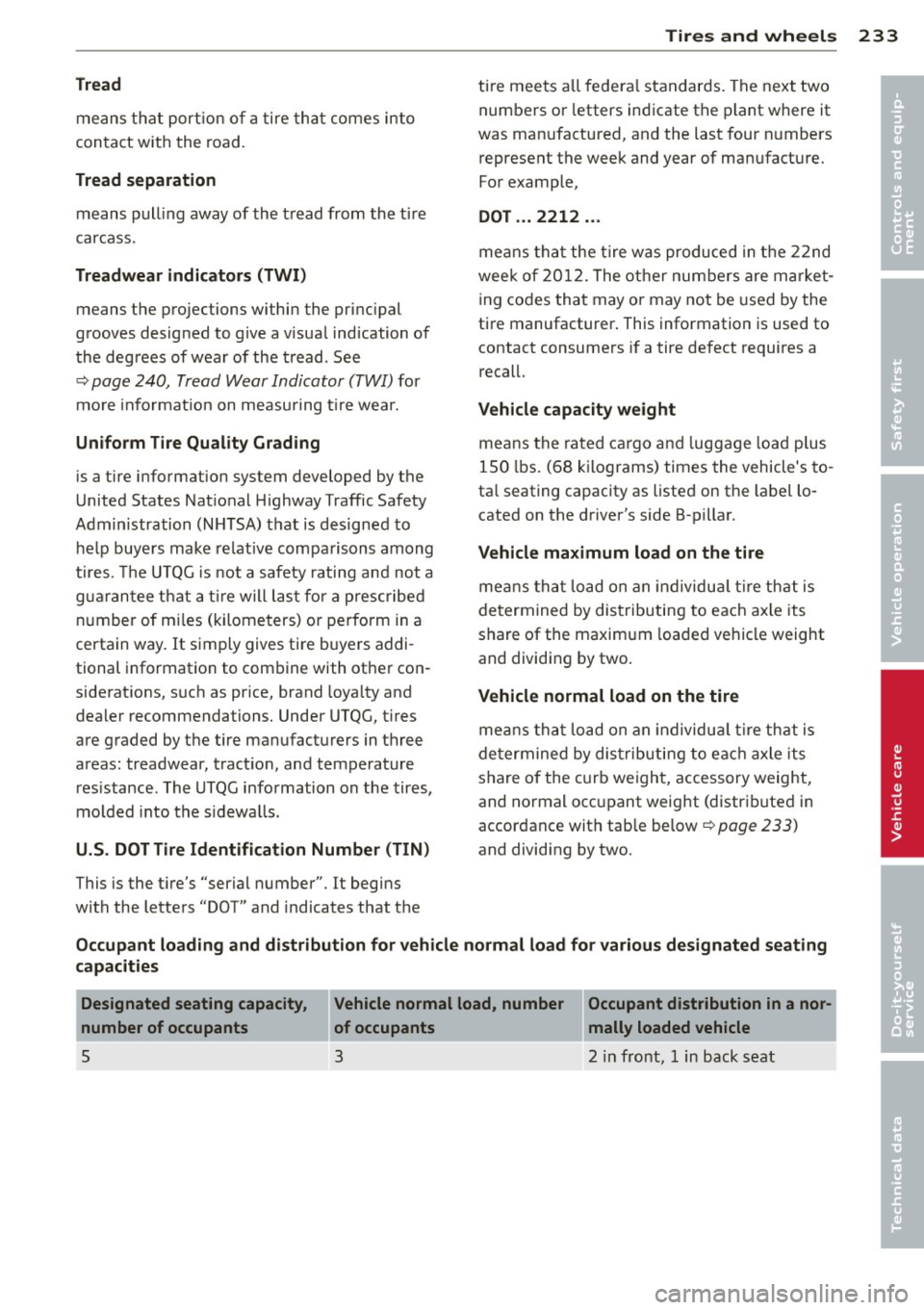
c:> page 233)
and dividing by two.
Occupant loading and distribution for vehicle normal load for various designated seating
capacities
Designated seating capacity,
number of occupants
5
Vehicle normal load, number Occupant distribution in a nor-
of occupants _____ mally loaded vehicle
3 2 in front, 1 in back seat
•
•
Page 236 of 294
234 Tires and wheels
Cold tire inflation pressure
Tire pressure affects the overall handling, performance and safety of a vehicle.
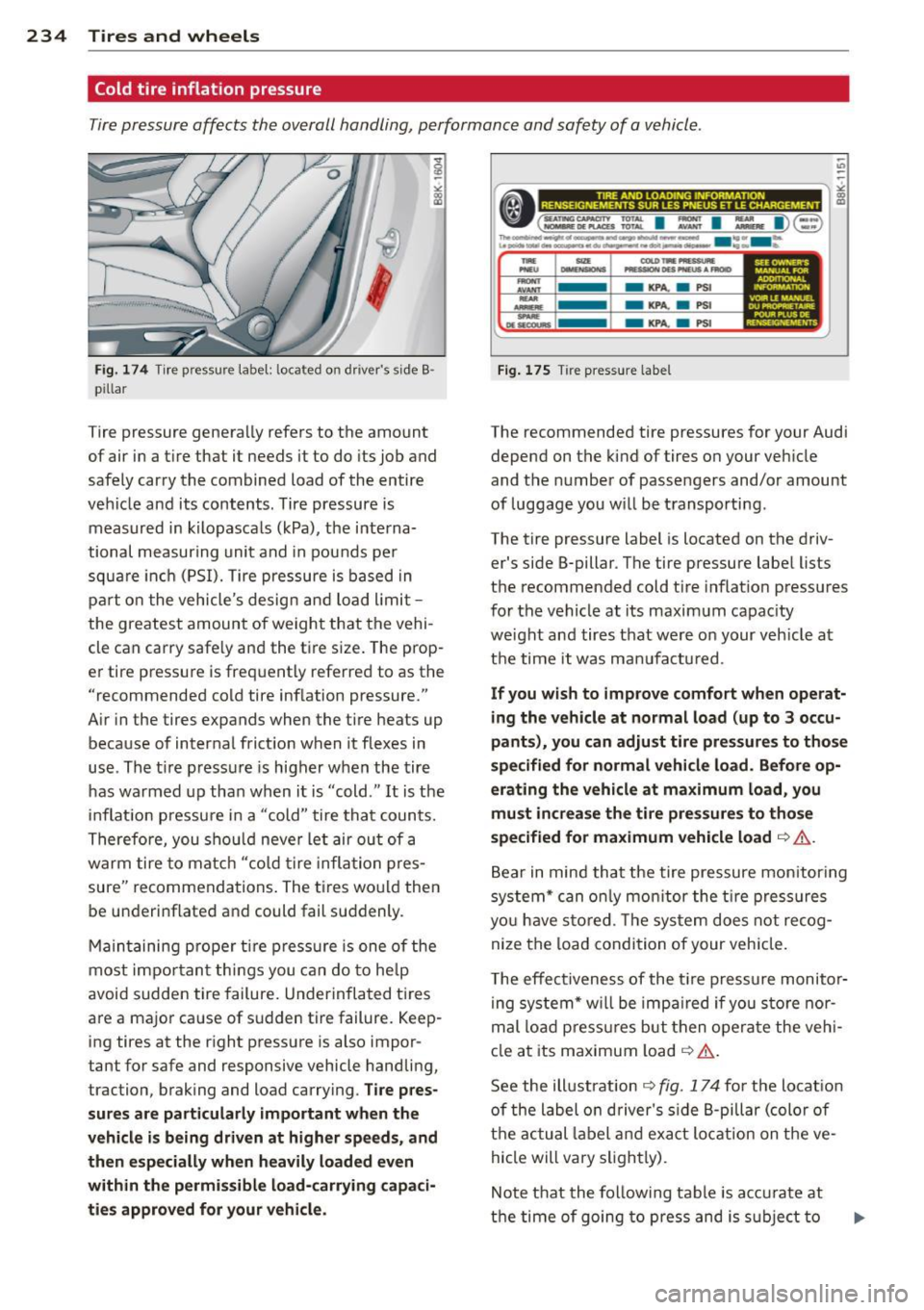
Fig. 174 Tire pressure label: located on driver's side B·
pillar
Tire pressure genera lly refers to the amount
of air i n a tire that it needs it to do its job and
safely carry the combined load of the entire
vehicle and its contents. Tire pressure is measured in kilopasca ls (kPa), the inte rna·
tional measuring unit and in pounds pe r
squa re inch ( PSI). Tire pressure is based in
pa rt o n the vehicle's desig n an d load limit
the greatest amount of weight that the vehi ·
cle can car ry safe ly and the tir e size . The prop·
er tire pressure is freq uent ly referred to as the
"recommended cold tire inflation pressure."
A ir in the tires expands when the tire heats up
because of internal frict ion when it flexes in
use . The t ire p ress ure is higher when the tire
h as warmed up than when i t is "cold ." It is the
in flat io n pressu re i n a "cold" tire that coun ts.
Th erefore, you sho uld neve r let air ou t of a
warm tire to match " co ld tir e infla tion pres
sure" recommendations . The ti res wo uld then
be un derinflated and could fail su ddenly.
M ain taining p roper t ire pr es su re is one o f the
most impo rtan t thi ngs you can do to he lp
avoid sudden tire failure. Underinfla ted ti res
a re a major ca use of s udden tire failure. Keep
ing tires at the right pressure is also impor
tant for safe and responsive vehicle handling,
traction, braking and load carrying .
Tire pres
sures are particularly important when th e
vehicle is being driven at higher speeds , and
then especially when heavily loaded even
within the permissible load -carrying capaci
tie s approved for your vehicle .
------------------.. ,;
•(=~: I : I :,.. I)@ ~
The~-----~---w-o- ....... -e.....i -·· - u ........ -.-..,.0, ... -....,.,...tot~---....... ._.,. -..
....
-..... ...........
- KPA. a PSI
- KPA.
a PSI
-KPA. a PSI
Fig. 17 5 Tire pressure la bel
SU OWNER'S MANUAl FOR AD0"10NAL l10N VOl!ILEMANU£1. DU _,...,
POUR Pl.US DE
REHSEKi.\'IEME NTS
The recommended tire pressures for your Audi
depend on the kind of tires on your ve hicle
and the numbe r of passengers and/or amount
of luggage you w il l be transporting .
The tire pressure label is located on the driv
er's si de B-pillar . T he tire pressure label lists
t h e recommended cold tir e inflat io n pressu res
for the vehicle at its maxim um capac ity
we ight and tires that were on your veh icle at
t h e time it was man ufa ctu red.
If you wish to improve comfort when operat
ing the vehicle at normal load (up to 3 occu
pants), you can adjust tire pre ssure s to tho se
specified for normal vehicle load. Before op
erating the vehicle at maximum load, you
mu st increase the tire pres sures to those
specified for maximum vehicle load
c::> .&, .
Bear in mind that the tire pressure mon itor ing
system * can o nly mo nitor the t ire pres sures
yo u have s to red. The sys tem does n ot recog
nize the load condition of your vehicle.
T he effectivene ss of the t ire p ress ure monito r
ing system* w ill be impa ired if yo u st ore nor
m al lo ad press ures but t hen opera t e the ve hi
cl e a t its ma ximum load
c::> .&. .
See the ill ustration c::> fig. 17 4 for the lo cat ion
o f the label o n driver's side B-pill ar (col or o f
t h e actu al lab el and exac t lo cat ion on the ve
hicle will vary sligh tly).
Note t hat the f ollowing ta ble is ac curate at
th e time of goi ng to press and i s sub ject to
Page 237 of 294
Tires and wheels 235
change. In the event of discrepancies, the tire
pressure label is located on the driver's side B
p ill ar a lways takes precedence.
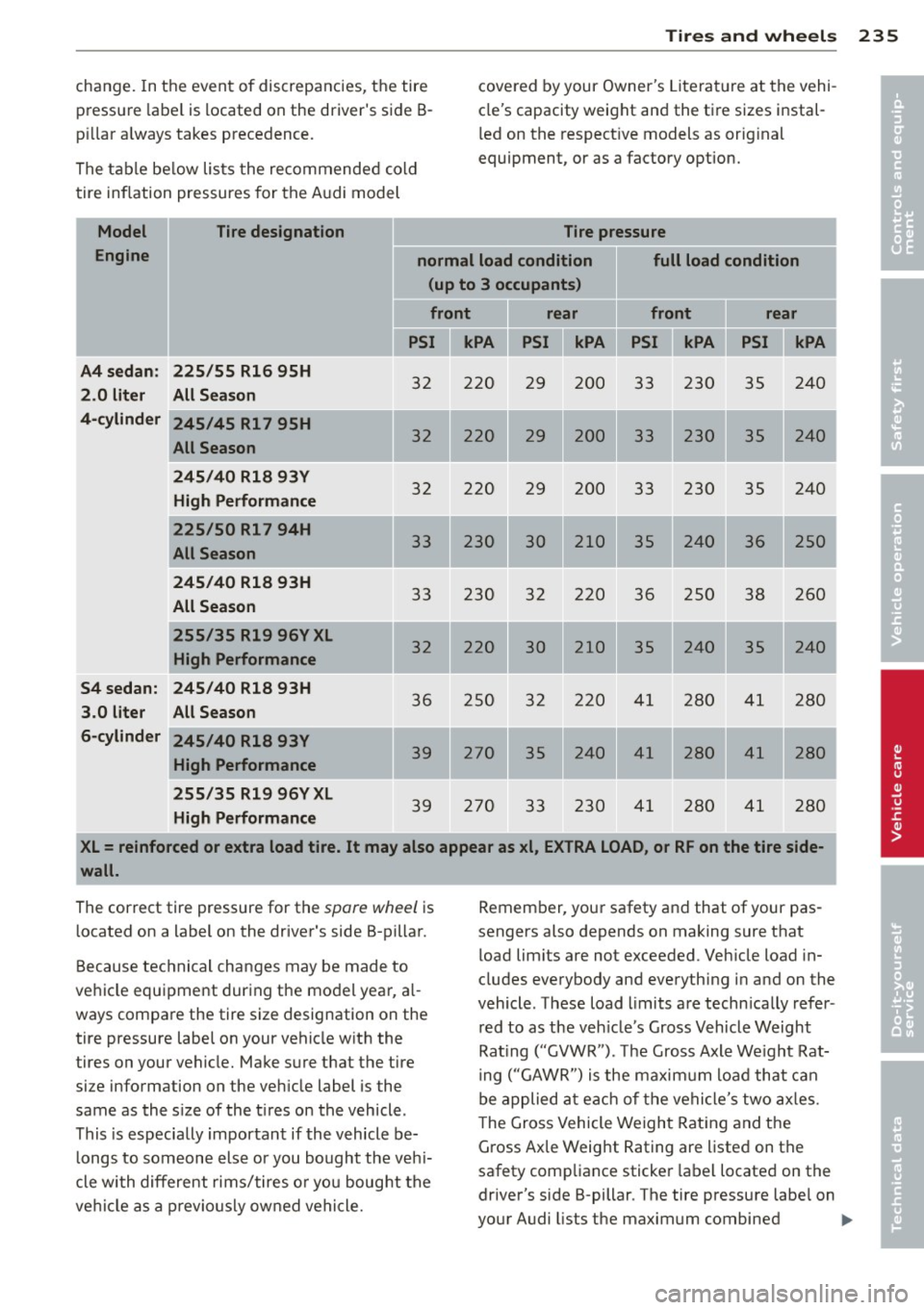
The table below lists the recommended cold
tire inflation pressures for the Audi model
I Model II Tire designation
covered by your Owner 's Literature at the vehi
cle's capacity weight and the tire sizes instal
led on the respective models as orig inal
equipment, or as a factory option.
Tire pressure
Engine normal load condition full load condition
(up to 3 occupants)
front rear
front rear I
PSI Jl kPA PSI Jl kPA PSI Jl kPA
PSI ll kPA
A4 sedan: 225/55 R16 95H
2.0 liter All Season
4-cylinder
245/45 R17 95H
All Season
245/40 R18 93V
High Performance
225/50 Rl 7 94H
All Season
245/40 R18 93H
All Season
255 /35 R19 96V XL
I High Performance
S4 sedan: 245/40 R18 93H
3.0 liter All Season
6-cylinder
245/40 R18 93Y
High Performance
255/35 R19 96V XL
High Performance
32 220
32 220
32 220 33 230
33 230
32
220
36 250
39 270
--. -
39
270 29
200 33 230 35 240
'
29 200 33 230 35 240
J
29 200 33 230 35 240
'
30 210 35 2
40 36 250
32 220 36 250 38 260
30 210 35 240 35 240
I
32
220 41 280 41 280
35 240 41 280 41 280
. -. -
33 230 41 280 41 280
XL= reinforced or extra load tire. It may also appear as xl, EXTRA LOAD, or RF on the tire side·
wall.
The correct tire pressure for the spore wheel is
l ocated on a label on the driver's side 8-pillar.
Because technical changes may be made to
vehicle equipment during the model year, a l
ways compare the tire size designation on the
tire p ressure label on your vehicle with the
tires on your vehicle. Make sure that the tire
size information on the vehicle label is the
same as the size of the t ires on the vehicle .
This is especially important if the vehicle be
longs to someone else or you bought the veh i
cle with different rims/tires or you bought the
vehicle as a previously owned vehicle. Remember, your safety and that of your pas
sengers also depends on making sure that load limits are not exceeded . Veh icle load in
cludes everybody and everything in and on the
vehicle . These load limits are technically refer
red to as the veh icle 's Gross Vehicle Weight
Rat ing ("GVWR") . The Gross Axle We ight Rat
ing (" GAWR") is the maximum load that can
be applied at each of the vehicle 's two axles.
T he Gross Vehicle Weight Rating and the
Gross Axle Weight Rating are listed on the
safety compliance sticker label located on the
driver's side 8-pillar. The tire pressure label on
your Audi lists the maximum combined .,.
•
•