engine coolant AUDI A4 SEDAN 2013 Owners Manual
[x] Cancel search | Manufacturer: AUDI, Model Year: 2013, Model line: A4 SEDAN, Model: AUDI A4 SEDAN 2013Pages: 294, PDF Size: 73.71 MB
Page 12 of 294
10 Instruments and warning/indicator lights
Instruments and warning/indicator Lights
Instruments
Instrument cluster and controls
The instrument cluster is your central source of information.
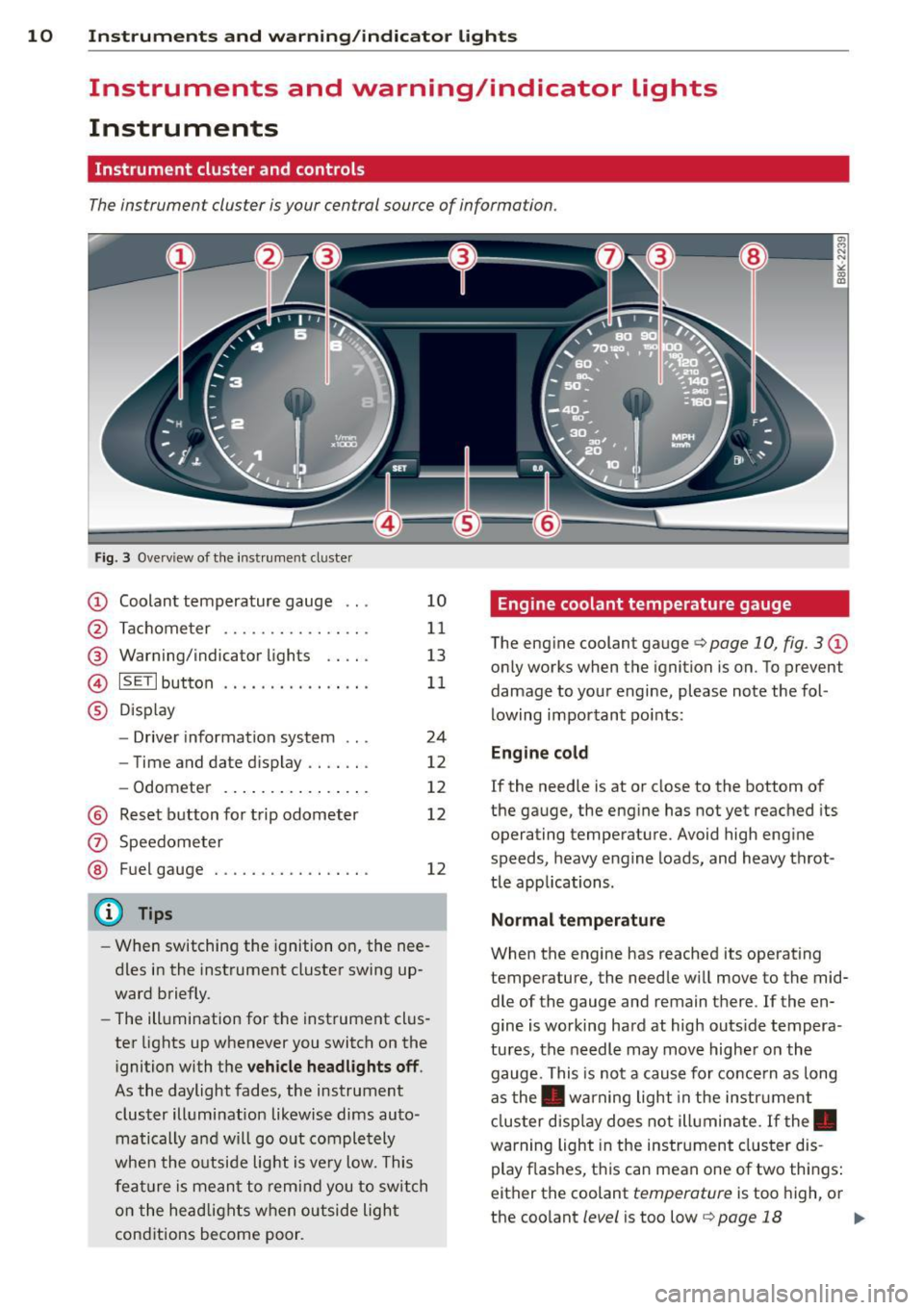
Fig. 3 Ove rv iew of the instrument cluster
CD Coolant temperature gauge .. .
@ Tachometer ........... .. .. .
@ Warning/indicator lights .. .. .
© ISETlbutton .... .... .. .... . .
® Display
- Driver information system .. .
- Time and date d isplay .. .. .. .
- Odometer .......... ... .. .
@ Reset button for trip odometer
(z) Speedometer
@ Fuel gauge . .... ..... .. .. .. .
(D Tips
10
11
13
11
24
12
12
12
12
- When switching the ignition on, the nee
dles in the instrument cluster swing up
ward briefly.
- The illumination for the instrument clus
ter lights up whenever you switch on the
i gnition with the
vehicle headlights off .
As the daylight fades, the instrument
cluster illumination likewise dims auto
matically a nd will go out completely
when the outside light is
very low. This
feature is meant to remind you to switch
on the headlights when outside light
conditions become poor .
Engine coolant temperature gauge
The engine coolant gauge q page 10, fig. 3 CD
only works when the ignition is on. To prevent
damage to your engine, please note the fol
lowing important points:
Engine cold
If the needle is at or close to the bottom of
the gauge, the engine has not yet reached its
operating temperature. Avoid high engine
speeds, heavy engine loads, and heavy throt
tle app lications.
Normal temperature
When the engine has reached its operating
temperature, the needle will
move to the mid
dle of the gauge and remain there . If the en
gine is working hard at high outs ide tempera
tures, the needle may
move higher on the
gauge. This is not a cause for concern as long
as the . warning light in the instrument
cluster display does not illuminate. If the.
warning light in the instrument cluster dis
play flashes, this can mean one of two things:
either the coolant
temperature is too high, or
the coolant
level is too low q page 18 Ill-
Page 13 of 294
Instrument s and warning /indicator lights 11
,&_ WARNING
- Always observe the warning in
¢ page 208, Engine compartment, be
fore opening the hood and checking the
engine coolant level.
- Never open the engine hood if you see or
hear steam, or if you see engine coolant
dripping from the engine compartment.
You could burn yourself. Let the engine cool off first so that you cannot hear or
see any steam or engine coolant .
(D Note
-Mounting additional lights or accessories
in front of the air inlets reduces the cool
i ng effect of the radiator. At h igh outside
temperatures or high engine load, the
engine could overheat.
- The front spo iler has been designed to
properly distribute the cooling air when
the veh icle is moving. If the spoiler is
damaged, this could reduce the cooling
effect and the engine could then over
heat. Ask your authorized Audi dealer for
assistance.
Tachometer (engine rev counter)
The tachometer indicates the engine RPM
(revolutions per minutes).
If engine RPM d rops be low 1,500 , you should
downshift to the next lower gear. The red area
at the end of the scale indicates maximum
permissible engine RPM after the break-in pe
riod. Before reaching this area, move these
lector lever to position D/S or ease your foot
off the accelerator pedal.
(D Note
The tachometer needle@¢ page 10,
fig . 3
shou ld only briefly be in the red
zone: you could damage your engine! The
beg inning of the red zone varies depend
ing on the engine.
@) For the sake of the environment
Upshifting early saves fuel and reduces en
gine noise.
~ button
You can perform different functions with this
button.
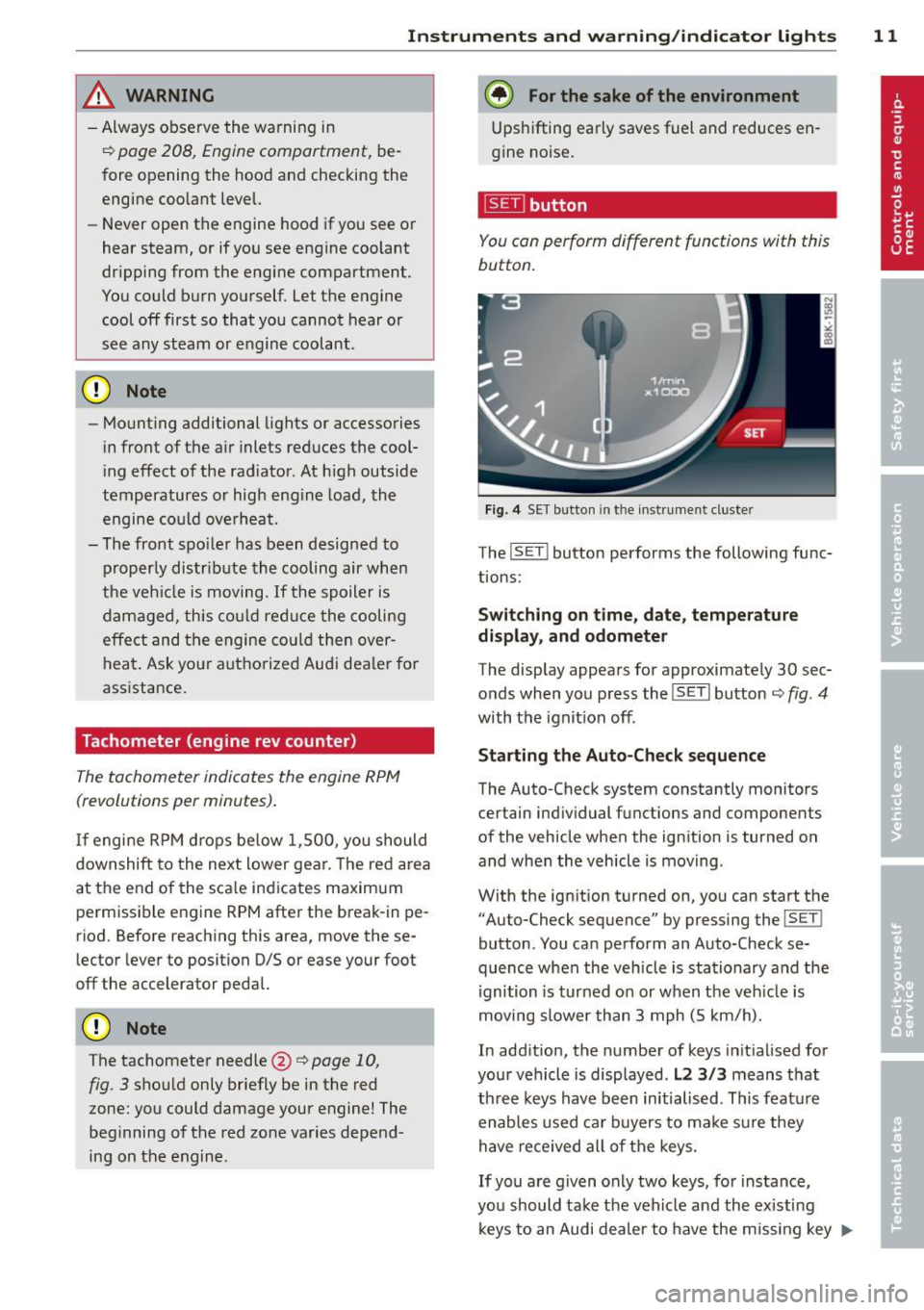
Fig. 4 SET button in th e in strument cluste r
The !SET ! button performs the following func
tions:
Switching on time, date, temperature
display , and odometer
The display appears for approximately 30 sec
onds when you press the
!SET I button ¢ fig. 4
with the ignition off.
Starting the Auto-Check sequence
The Auto-Check system constantly monitors
certain individual functions and components
of the vehicle when the ignition is turned on
and when the vehicle is moving .
With the ignition turned on, you can start the "Auto-Check sequence" by pressing the
! SET !
button . You can perform an Auto-Check se
quence when the vehicle is stationary and the
ignition is turned on or when the veh icle is
moving slower than 3 mph (5 km/h).
In addition, the number of keys init ialised for
your vehicle is disp layed .
L2 3/3 means that
three keys have been initialised. This feature
enables used car buyers to ma ke sure they
have received all of the keys.
If you are given only two keys, for instance,
you should take the vehicle and the existing
keys to an Audi dea ler to have the missing key
II>-
Page 20 of 294
18 Instrum ent s and w arn ing /indic ato r light s
...L Engine cooling system
A malfunction in the engine cooling system
must be repaired as soon as possible .
• Turn off engine and chec k coolant le vel
If the indicator light t urns on and the mes
sage appears, the coo lant temperature is too
high or the coo lant level is too low.
> Pu ll off the road.
> Stop the vehicle .
> Turn off the engine.
> Check coolant level ¢ page 222.
> Add coolant if necessary¢ page 223.
> Continue driving only after the eng ine cool
ant warn ing/ indicator light goes out .
> Contact your authorized Audi dealer for as-
s istance if necessary .
If the engine coolant level is correct, then the radiator fan may be the cause of the malfunc
tion .
• Coolan t tempe rature! Let engine run w ith
v eh icl e s tationary
If the indicator light turns on and the mes
sage appears in trailer mode*, let the engine
run at idle for a few m inutes to cool down.
A WARNING
- If your veh icle should break down for
mechanical or other reasons, park at a
safe distance from moving traffic, turn
off the engine and turn on the hazard
wa rning lights ¢
page 46, Emergency
flashers.
-
- Never open the hood if you see or hea r
steam or coolant escap ing from the en
gine compartment - you risk being scald
ed. Wait until you can no longer see or
hear steam or coo lant escaping .
- The engine compartment of any vehicle
is a dangerous area. Before you perform
any work in the engine compartment,
turn of the eng ine and allow it to cool.
Follow the warning stickers¢
page 208,
Engine compartment .
(D Note
Do not continue driving if the . symbol
ill um inates . There is a malfunction in the
engine cooling system -you could damage
your engine.
@ -Steering column lock
• Stee ring d efec tive ! Do not dri ve vehicle!
If the indicator light turns on and the mes
sage appears, there is an electronic steering
column lock malfunct ion. You cannot switch
the ignit ion on .
Do
not tow yo ur vehicle because it cannot be
steered . Seek professional assista nee.
l!J:I Steering lock : Cont act de ale r!
If the indicator light turns on and the mes
sage appears, there is an e lectronic stee ring
co lumn lock malfunct ion .
Drive to your authori zed A udi dealer immedi
ately to have the ma lfunction corrected .
A WARNING
-
Your vehicle must not be towed in the
event of a malfunction in the elect ronic
steering co lumn lock beca use it cannot be
steered due to the loc ked steering . If it is
towed with the steering locked, there is
the r isk of an accident.
© -Ignition lock
• Ignit ion lo ck defecti ve . Contact dealer!
If the indicator light turns on and the mes
sage appears, do
n ot switch the ignit ion off
because you may not be ab le to sw itch it on
again.
Drive to your authorized A udi dealer immedi
ately to have the malfunction corrected .
On vehicles with convenience key*, the engine
shou ld not be switched
off using the
I S TAR T ENGINE ST OPI button beca use the en
gine cannot be started again after the ignition
has been switched
off. ..,.
Page 70 of 294
68 Warm and cold
Warm and cold Climate controls
Description
The climate control system warms, cools and
adds humidity to the air in the vehicle interior.
It is the most effect ive when the windows and
sunroof are closed . If there is a build-up of
heat inside the vehicle, ventilation can help to
speed up the cooling process.
I n all heating mode functions except
defrost,
the blower on ly switches to a higher speed
once the engine coolant has reached a certain
temperature.
Condensat ion from the cooling system can
drip and form a puddle of water under the ve
hicle. This is normal and does not mean there
is a leak.
Pollutant filter
The pollutant filter removes pollutants s uch
as dust and pollen from the air.
The air pollutants filter must be changed at
the intervals spec ified in you r Warranty
&
Maintenance booklet, so that the air condi
tioner can properly work.
If you drive your vehicle in an area with h igh
a ir po llution, the fi lter may need to be
changed more frequent ly than specified in
your Aud i Wa rranty
& Ma intenance booklet. If
in doubt, ask your authorized Audi Service Ad
visor for advice .
Key coded settings
The climate control settings are automat ically
stored and assigned to the remote control key
that is in use.
A WARNING
Reduced visibility is dangerous and can
cause accidents.
-
- For safe driving it is very important that
all windows be free of ice, snow and con
densation.
- Comp letely familiarize yourself with the
proper use and function of the heating
and ventilation system and especially how to defog and defrost the windows.
- Never use the windshield wiper/washer
system in freez ing weather unt il you
have warmed the windshield first, using
the heating and ventilation system. The
washer solution may freeze on the wind shie ld and reduce visib ility.
(D Note
- If you suspect that the air conditioner
has been damaged, switch the system
off to avoid further damage and have it
inspected by a qualified dealership.
- Repairs to the Audi air conditioner re
quire special technical know ledge and
special tools. Contact an authorized Aud i
dea ler fo r assistance.
@ For the sake of the environment
By reducing the amount of fuel you use,
you also reduce the amount of pollutants
emitted into the air.
(D Tips
-Keep the air intake s lots (in fro nt of the
w indshield) free from ice, snow and de
bris in order to maintain the proper func
tion of the climate control system.
- T he energy management system may
switch the seat heating* or rear window
defroster off temporarily . These systems
are available again as soon as the energy
balance has been restored.
- Air escapes through vents under the rear
window. When placing items of clothing
on the luggage compartment cover, en
sure that the openings are not covered.
Page 199 of 294
Tire pressure
When towing a trai le r, inflate the t ires of your
vehicle to the co ld tire pressure listed under
"Full load" on the label located on the driver's
side B-pillar (vis ible when the door is open).
Inflate trailer tires to trailer and tire manufac
turers' specifications.
Light s
The headlight settings should be checked with
the trailer attached before driving off. Check
to make sure both vehicle and trai ler lights
are working properly.
Safety chains
Be su re tra iler sa fety chains are properly con
nected from the trailer to the hitch on the ve
hicle. Leave enough slack in the chains to per
mit turning corners . When you install safety
chains, make sure they w ill not drag on the
road when you are driving.
The chains shou ld cross under the trai ler
tongue to prevent it from dropping in case of
separatio n from the hitch .
Driving instructions
Driving with a trailer always requires extra
core and consideration.
To obtain the best possible handling o f vehicle
and trai ler, p lease note the following:
.,. Do not tow a loaded trailer whe n your car it
self is not loaded .
.,. Be especia lly careful when passing other
vehicles .
.,. Observe speed limits .
.,. Do not drive at the maximum permissible
speed .
.,. Always apply brakes ea rly .
.,. Monitor the temperature gauge.
Weight di stribution
Towing a loaded trai ler with an empty car re
sults in a highly unstable distribution of
weight . If this cannot be avo ided, drive at very
low speeds only to avoid the risk of losing
steer ing control.
Trailer towing 197
A "balanced" rig is easier to operate and con
trol. This means that the tow vehicle should be loaded to the extent possible and permissi
ble, while keep ing the trailer as light as possi
ble under the c ircumstances. Whenever poss i
ble, transfer some cargo to the luggage com
partment of the tow vehicle while observing
tongue load requirements and vehicle loading
considerations.
Speed
The higher the speed, the more d iff icult it be
comes for the driver to control the rig . Do not
drive at the maximum permissible speed. Re
duce your speed even more if load, weather or
wind conditions are unfavorable -pa rticularly
when going downhill.
Reduce veh icle speed
immediately if the trail
er shows the slightest s ign of sway ing .
Do not
try to stop the swaying by accelerating.
Observe speed limits . In some areas, speeds
for vehicles tow ing tra ilers are lower than for
regular vehicles .
Always apply brakes early. When driving downh ill, shift into a lower gear to use the en
gine braking effect to slow the vehicle . Use of
the brakes alone can cause them to overheat
and fail.
Coolant temperature
The coolant temperature gauge ¢ page 10
must be observed carefully . If the need le
moves close to the upper end of the scale, re
duce speed immediately and/or turn off the
air conditioner.
If the coolant temperature warning light •
in the instrument cluster starts flashing, pull
off the road, stop and let the engine
idle for
about two minutes to prevent heat build -up .
A WARNING
Anyone not properly restrained in a mov
ing vehicle is at a much greater risk in an
accident . Never let anyone ride in yo ur car
who is not properly wearing the restraints
prov ided by Audi.
-
•
•
Page 217 of 294
Checking and filling Engine hood
Releasing the engine hood
The engine hood is released from inside the
vehicle .
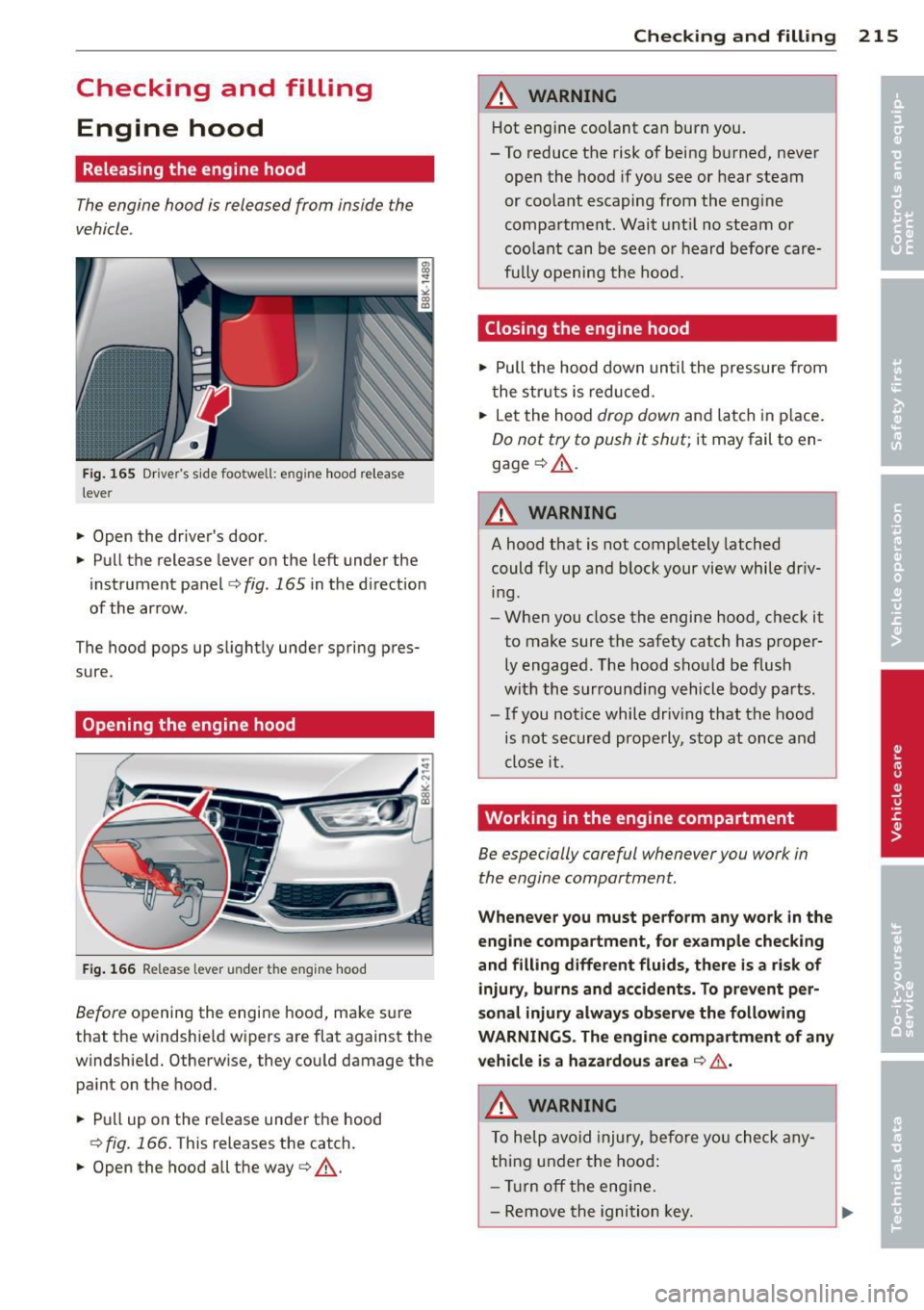
Fig. 165 Dr iver's s ide footwell: engine hood release
lever
"' Open the driver's door .
"' Pull the release lever on the left under the
instrument panel
r=> fig. 165 in the d irection
of the arrow.
The hood pops up slight ly under spring pres
sure.
Opening the engine hood
.... ~- ---=-
Fig . 166 Re lease lever under the engine hood
Before opening the engine hood, make sure
that the windshie ld wipers are flat against the
windshie ld. Otherwise, they could damage the
paint on the hood.
"' Pull up on the release under the hood
r::!> fig. 166 . This releases the catch.
"' Open the hood all the way
c::> &,.
Checkin g and fillin g 215
A WARNING
Hot engine coolant can burn you.
- To reduce the risk of being burned, never
open the hood if you see or hear steam
or coo lant escaping from the eng ine
compartment. Wait unt il no steam or
coolant can be seen or heard before care
fu lly opening the hood.
Closing the engine hood
"' Pull the hood down un til the pressure from
the struts is reduced.
"' Let the hood
drop down and latch in p lace .
Do not try to push it shut; it may fail to en
gage
c;, &, .
A WARNING
--
A hood that is not completely latched
could fly up and b lock your view while dr iv
ing.
- When you close the engine hood, check it
to make sure the safety catch has p roper
ly engaged. The hood should be flush
with the surround ing vehicle body parts.
- If you notice while driv ing that the hood
is not secured prope rly, stop at once and
close it .
Working in the engine compartment
Be especially careful whenever you work in
the engine compartment.
Whene ver you must perform any wo rk in the
eng ine compartment, for e xample checking
and filling different fluids, th ere is a risk of
injury, burns and accident s. To pr event per
sonal injury always observe the following
WARNINGS . The engine compartment of an y
vehicle i s a hazardou s area
c;, Lh, .
A WARNING ~
To help avoid injury, befo re yo u check any
thing under the hood:
- Tu rn off the engi ne.
- Remove the ignition key.
Page 218 of 294
216 Checking and filling
-Apply the parking brake.
- Move selector lever of automatic trans- mission to "P" (Park); put manual trans
mission in Neutral.
- Always let the engine cool down. Hot
components will burn skin on contact.
- To reduce the risk of being burned, never
open the hood if you see or hear steam
or coolant escaping from the engine
compartment . Wait until no steam or
coolant can be seen or heard before care
fully opening the hood .
- Keep children away from the engine com
partment .
- Never spill fluids on hot engine compo
nents. They can cause a fire.
- Never touch the radiator fan. The auxili ary electric fan is temperature controlled
and can switch on suddenly.
- Never open the coolant reservoir cap when the engine is still warm. The cool
ant system is pressurized and hot cool
ant could spray out .
-Protect your face, hands and arm from
steam or hot engine coolant by placing a
thick rag over the cap when you open the coolant reservoir .
- Do not remove the engine cover under
any circumstances. This increases the
risk of burns.
- If work on the fuel system or the electri
cal system is necessary:
- Always disconnect the battery .
- Never smoke or work near heaters or
open flames. Fluids in the engine com
partment could start a fire.
- Keep an approved fire extinguisher im
mediately available.
- To avoid electrical shock and personal in
jury while the engine is running or being
started, never touch:
- Ignition cables
- Other components of the high voltage
electronic ignition system.
- If you must perform a check or repair with the engine running: -
First, fully apply the parking brake,
move selector lever of automatic trans
mission to "P" (Park); put manual
transmission in Neutral.
- Always use extreme caution to prevent
clothing, jewelry, or long hair from get
ting caught in the radiator fan, V-belts
or other moving parts, or from contact ing hot parts. Tie back hair before
starting, and do not wear clothing that
will hang or droop into the engine.
- Minimize exposure to emission and
chemical hazards~&, .
.&_ WARNING
California Proposition 65 Warning:
- Engine exhaust, some of its constituents,
and certain vehicle components contain
or emit chemicals known to the State of
California to cause cancer and birth de
fects and reproductive harm. In addition, certain fluids contained in vehicles and
certain products of component wear con
tain or emit chemicals known to the
State of California to cause cancer and
birth defects or other reproductive harm.
- Battery posts, terminals and related ac
cessories contain lead and lead com
pounds, chemicals known to the State of
California to cause cancer and reproduc
tive harms. Wash hands after handling.
(D Note
When adding fluids, always make sure that
they are poured into the proper container
or filler opening, otherwise serious dam
age to vehicle systems will occur.
@ For the sake of the environment
To detect leaks in time, inspect the vehicle
floor pan from underneath regularly . If
you see spots from oil or other vehicle flu ids, have your vehicle inspected by an au
thorized Audi dealer.
Page 219 of 294
Checking and fillin g 217
Engine compartment
Engine compartment
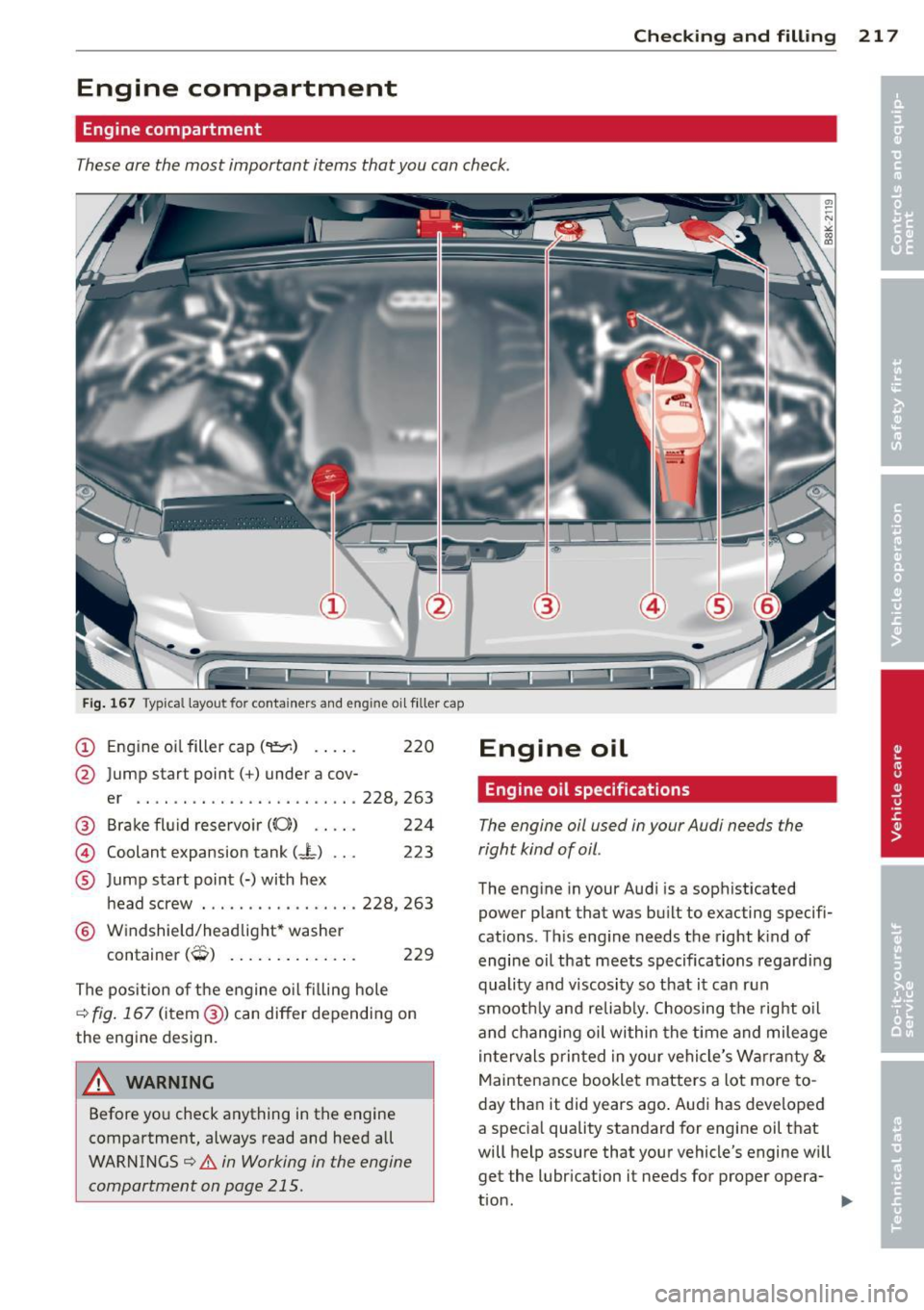
These are the most important items that you can check.
Fig. 167 Typical layout for containers and engine oil filler cap
(D Eng ine oi l filler cap (
er .. .. ... ....... ........ .. 228,263
@ Brake fl uid reservo ir
((0)) . . . . . 224
@ Coolant expansion tank (J-) . . . 223
® Jump start point(-) with hex
head screw ..... .......... .. 228, 263
® Windshie ld/headlight* washer
container
(0) . . . . . . . . . . . . . . 229
The pos ition of the engine o il fi lling hole
¢ fig . 167 (item @) can differ depending on
the eng ine design.
A WARNING
-
Before yo u check anything in the engine
compartment, always read and heed all
WARNINGS¢ &. in Working in the engine
compartment on page 215.
Engine oil
Engine oil specifications
The engine oil used in your Audi needs the
right kind of oil .
The eng ine in your Audi is a sophisticated
power p lant that was bu ilt to exacting specifi
cations . This eng ine needs the right k ind of
engine oil that meets specifications regarding
quality and viscosity so that it can run
smooth ly and reliab ly. Choosing the rig ht o il
and changi ng oil within the t ime and mileage
i n tervals printed in you r vehicle's Warranty
&
Maintenance booklet matters a lot more to
day than it did years ago . Audi has developed
a specia l quality standard for engine oil that
will help assure that your vehicle's engine w ill
get the lubr ication it needs for proper opera-
tion. .,..
Page 224 of 294
222 Check ing and filling
Engine cooling system
Coolant
The engine coolant performs two functions: it
keeps the engine from overheating and it pro
tects the engine from freezing in the winter .
The cooling system is sealed and generally re
quires little attention.
The cooling system has been filled at the fac
tory with a permanent coolant which does not need to be changed. The coolant consists of a
mixture of water and the manufacturer's gly
col-basedcoolant additive G 13 antifreeze with
anticorrosion add itives (SO% for USA mode ls;
60% for Canadian models). This mixture both
assures the necessary frost protection and protects metal components in the engine's
cooling system from corrosion and scaling. It
a lso raises the boiling point of the coolant .
Do not reduce the concentration of the coo l
ant in the summer by adding plain water .
The
p ro po rti on of c ool ant add it iv e mu st b e at
lea st 50 % but not mo re th an 60%
to main
tain antifree ze protection and cooling efficien
cy. If the coolant frost protect ion is too low,
the coolant could freeze and damage the veh i
cle heating and eng ine cooling system .
For year-round driving, antifreeze is added at
the factory for temperatures down to:
- -31° F(-3S°C)USA
- - 40 ° F ( - 40 °C) Canada.
_& WARNING
Before yo u check anything in the engine
compartment, always read and heed all
WARNINGS
¢ &. in Working in the engine
compartment on page 215.
(]) Note
-
- Before winter sets in, have the coolant
checked to see if the coo lant additive in
your vehicle is s uffic ient to meet the cli
mate cond it ions . Th is is especially impor
tant if you live in a region where the w in
ter is extremely cold . If necessary, in- crease the p
roportion of coo lant additive
to 60%.
- When adding coolant additive to your
cooling system, remember:
- We recommend us ing on ly coolant ad
d itive G12++ or G13 for your veh icle .
This coolant additive is availab le at au
thor ized Audi dealers. Other types of
ant ifreeze can s ignificantly reduce cor
rosion pro tection. The resulting cor ro
sion can cause a loss o f coolant and se
rious engine damage.
- Do not add any type of rad iator leak seal
ant to yo ur vehicle's engine coolant .
Adding radiator repair fl uid may adverse
ly affect the function and performance of
your cooling system and cou ld resu lt in
damage not covered by your New Veh icle
Limited Warranty.
' Checking the engine coolant level
The engine coolant level can be checked with
a quick glance.
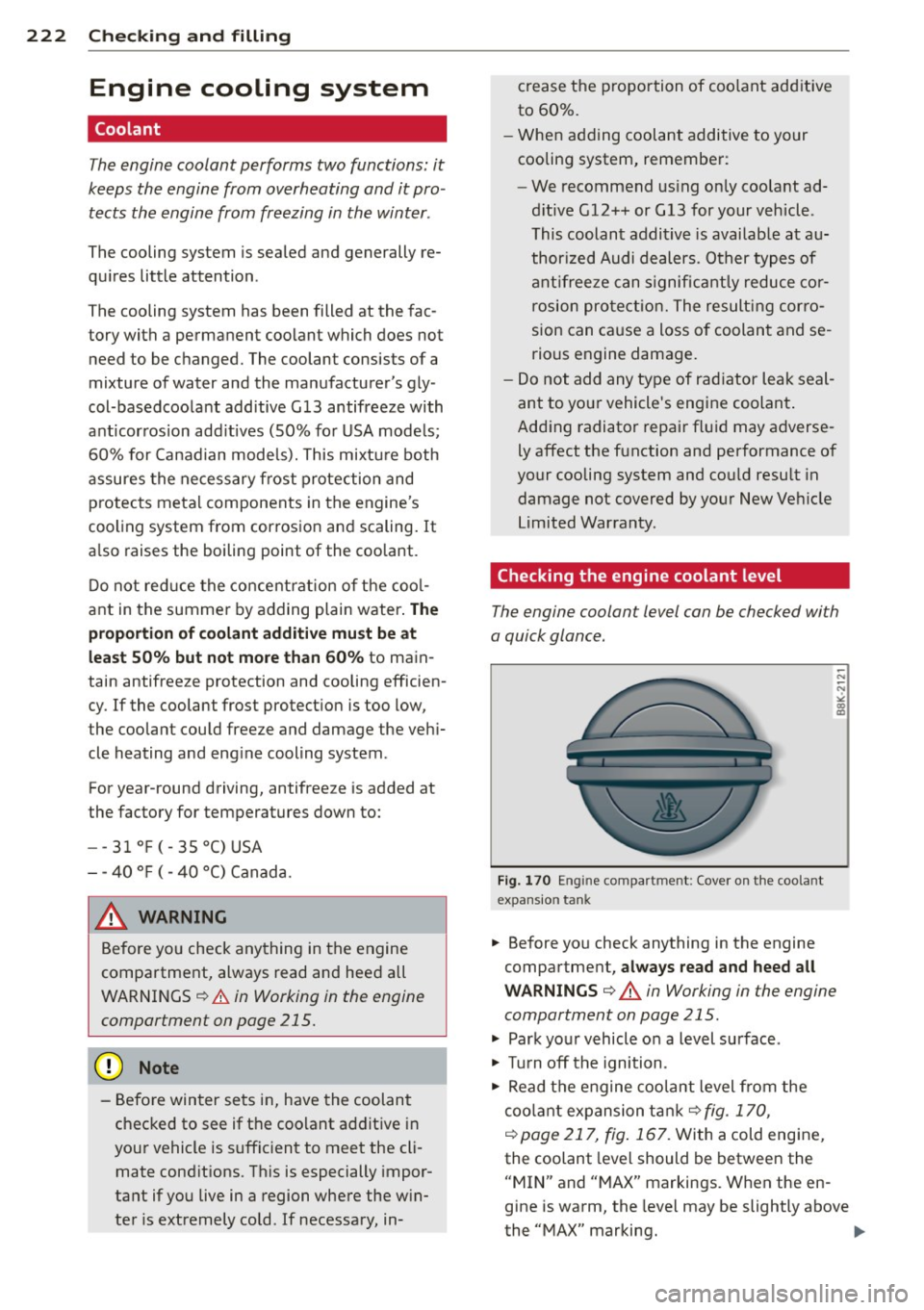
F ig. 170 En gin e compa rtm en t: Cover o n the coo la n t
expans io n ta nk
-"' -"' >< .,
"'
.. Before yo u check anything in the engine
compartment,
alwa ys read and heed all
W ARNINGS ¢ .&. in Working in the engine
compartment on page 215 .
.,. Park your vehicle o n a level surface .
.,. Tu rn off the ignition .
.. Read t he engine coolant level from the
coo la nt expansion tank ¢
fig. 170 ,
r=:> page 217, fig . 167. With a cold engine,
the coolant leve l should be between the
"MIN" and "MAX" markings . When the en
gine is warm, the level may be slightly above
the "MAX" marking.
IJII,
Page 225 of 294
The location of the coolant expansion tank
can be seen in the engine compartment illus
tration
q page 217 .
To obtain an accurate read ing , the eng ine
must be switched off .
The expa nsion tank in you r vehicle is equipped
with an elec tric coolant level sensor.
When the coolant level is too low, the warning
light in the Auto-Check System
q page 18 wi ll
b lin k until you add coo lant and the level has
been restored to norma l. Even t hough the re is
an e lec tric coolant level sensor, we s till rec
ommend you check the coolant leve l from
time to time .
Coolant loss
Coolant loss may indi cate a leak in the coo ling
sys tem. In the event of coolant loss, the cool
ing system should be inspected immedia tely
by your authorized A udi dealer. It is not
enough merely to add coolant.
I n a
s ealed system, losses can occur only if
the boiling point of the coolant is exceeded as
a result of overheating.
A WARNING
The cooling system is unde r press ure and
can get ve ry hot. Reduce the risk of sca ld
ing from hot coolant by following these
steps.
- Turn off the engine and allow it to coo l
down.
- Protect yo ur face, hands and arms from
escaping fluid and steam by covering the
cap with a large, thick rag.
- Turn the cap slowly and very carefu lly in
a counter-clockwise direction wh ile ap
plying light, downward pressure on the
t op of the cap .
- To avoid being bu rned, do not spill ant i
freeze or coo lant on the exhaust system
o r hot eng ine parts . Unde r certai n condi
t ions, the ethy lene g lycol in engine cool
an t ca n catc h fire.
Checkin g and fillin g 223
@ Note
Do not ad d any type of radiator leak sea l
ant to your ve hicle's engine coolant. Add
i ng radiator repa ir flui d may adverse ly af
fect the funct ion and performance of your
cooling system and could result in damage not cove red by your New Vehicle l imi ted
Warranty .
Adding coolant
Be very careful when adding engine coolant.
Before you check anyth ing in the eng ine com
partment,
always read and heed all WARN
INGS q & in Working in the engine compart
ment on page
215 .
.,. Turn off the engine.
.,. let the engi ne cool down.
.,. Place a thick rag over the coolant expansion
tank
q page 222, fig . 170 and carefully turn
the cap counter-clockwise
q &_ .
.,. Add coo la nt.
.,. Twist the cap o n aga in
tightly.
Rep lacement engine coo lant must confo rm to
exact spec ificat ions
q page 222, Coolant. We
recommend using on ly coo lant additive G 12+
+ , G 13 or in an eme rgency G12+. Do
not use a
different additive. In an emergency use pla in
water until you can get the correct additive
and can restore the correct ratio . This sho uld
be done as soon as possible.
If you have los t a cons iderab le amount o f
coolant , then you sho uld add cold antifreeze
and co ld water on ly when the engine is cold.
A lw ays use
new engine coo lant w hen refilling.
Do not f ill coo lant above t he "MAX" mark. Ex
cess coola nt w ill be fo rced o ut through t he
pressure relief valve in the cap when the en
gine becomes hot.
A WARNING
- The cooling system is under pressure and
can get very hot. Reduce the risk of ..,.
•
•