ESP AUDI A5 2008 8T / 1.G Repair Manual
[x] Cancel search | Manufacturer: AUDI, Model Year: 2008, Model line: A5, Model: AUDI A5 2008 8T / 1.GPages: 313, PDF Size: 12.13 MB
Page 252 of 313
Accessories and modifications to the vehicle 250Accessories and modifications to the vehicleAccessories and replacement partsAlways ask your dealer or specialist retailer for advice
before purchasing accessories and replacement parts.Your car is designed to offer a high standard of active and passive
safety. For this reason, we recommend that you ask an Audi dealer
for advice before fitting accessories or replacement parts. Audi
dealers have the latest information from the manufacturer and can
recommend accessories and replacement parts which are suitable
for your requirements. They can also answer any questions you
might have regarding official regulations.
We recommend you to use only Audi accessories and Audi Genuine
parts
®. Audi has tested these parts and accessories for suitability,
reliability and safety. Audi dealers have the necessary experience
and facilities to ensure that the parts are installed properly.
Although the market is constantly scrutinised, Audi cannot judge or
assume responsibility for the reliability, safety and suitability of
non-genuine products - even though in some instances, these parts
may have been approved by an officially recognised technical
testing authority or accompanied by an official approval certificate.
Any retro-fitted equipment which has a direct effect on the vehicle
and/or the way it is driven (e.g. cruise control system or electroni-
cally-controlled suspension) must be approved for use in your
vehicle and bear the e mark (the European Union's approval
symbol).
If any additional electrical components are fitted which do not serve
to control the vehicle itself (for instance a refrigerator box, laptop or
ventilator fan, etc.), these must bear the CE mark (manufacturer
conformity declaration in the European Union).
WARNING
Never attach accessories (such as cup holders or telephone
brackets) to the surfaces covering the airbag units or the areas
around the airbags: this could cause injury if the airbag is
triggered.ModificationsModifications must always be carried out according to
our specifications.Unauthorised modifications to the electronic components or soft-
ware in the vehicle may cause malfunctioning. Due to the way the
electronic components are linked together in networks, other
systems may be affected by the faults. This can seriously impair
safety, lead to excessive wear of components, and also invalidate
the type approval for your vehicle.
You will appreciate that your Audi dealer cannot be held liable for
any damage caused by modifications and/or work performed incor-
rectly.
We recommend that all work should be performed by an Audi work-
shop using Audi Genuine parts
®.
WARNING
Incorrectly performed modifications or other work on your vehicle
can lead to malfunctions and cause accidents.
document_0900452a8179700c.book Seite 250 Donnerstag, 22. März 2007 10:19 10
Page 268 of 313
Self-help 266Starting the engine
The two jump leads must be connected in the correct
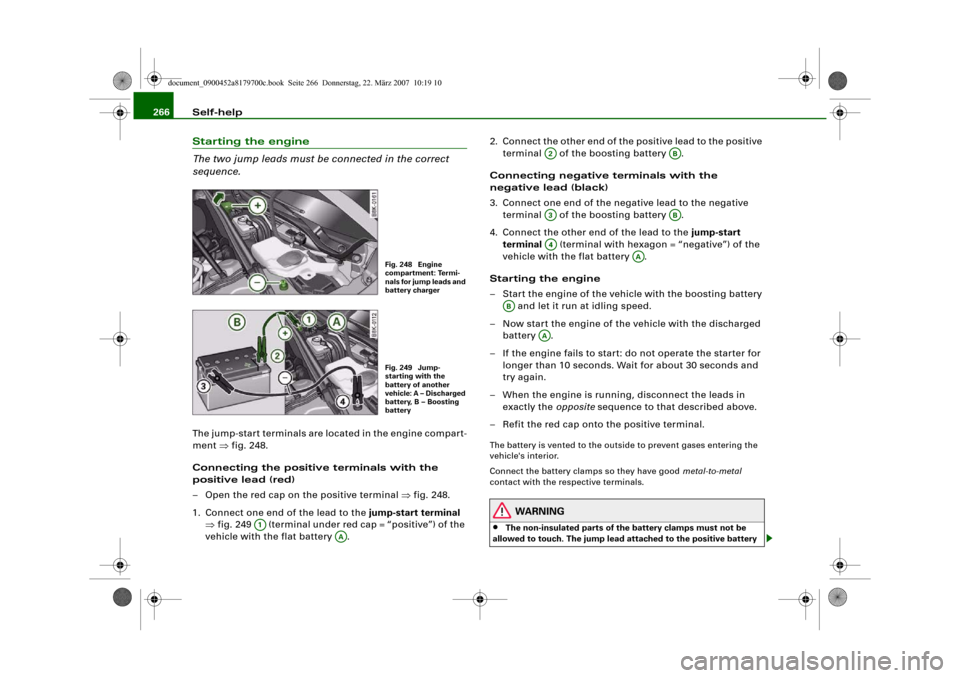
sequence.The jump-start terminals are located in the engine compart-
ment ⇒fig. 248.
Connecting the positive terminals with the
positive lead (red)
– Open the red cap on the positive terminal ⇒fig. 248.
1. Connect one end of the lead to the jump-start terminal
⇒fig. 249 (terminal under red cap = “positive”) of the
vehicle with the flat battery .2. Connect the other end of the positive lead to the positive
terminal of the boosting battery .
Connecting negative terminals with the
negative lead (black)
3. Connect one end of the negative lead to the negative
terminal of the boosting battery .
4. Connect the other end of the lead to the jump-start
terminal (terminal with hexagon = “negative”) of the
vehicle with the flat battery .
Starting the engine
– Start the engine of the vehicle with the boosting battery
and let it run at idling speed.
– Now start the engine of the vehicle with the discharged
battery .
– If the engine fails to start: do not operate the starter for
longer than 10 seconds. Wait for about 30 seconds and
try again.
– When the engine is running, disconnect the leads in
exactly the opposite sequence to that described above.
– Refit the red cap onto the positive terminal.
The battery is vented to the outside to prevent gases entering the
vehicle's interior.
Connect the battery clamps so they have good metal-to-metal
contact with the respective terminals.
WARNING
•
The non-insulated parts of the battery clamps must not be
allowed to touch. The jump lead attached to the positive battery
Fig. 248 Engine
compartment: Termi-
nals for jump leads and
battery chargerFig. 249 Jump-
starting with the
battery of another
vehicle: A – Discharged
battery, B – Boosting
battery
A1
AA
A2
AB
A3
AB
A4
AA
AB
AA
document_0900452a8179700c.book Seite 266 Donnerstag, 22. März 2007 10:19 10
Page 269 of 313
Self-help267
Controls
Safety
Driving tips
General maintenance
Self-help
Technical data terminal must not touch metal parts of the vehicle: this can cause
short circuiting.
•
Do not bend over the batteries – risk of acid burns.
•
The screw plugs on the battery cells must be screwed in firmly.
•
Keep sparks, flame and lighted cigarettes away from batteries:
the gases given off can cause an explosion.
•
If jump-starting another vehicle, position the jump leads in
such a way that they cannot come into contact with any moving
parts in the engine compartment of the other vehicle.Caution
Please note that the above method of connecting the leads is meant
for jump-starting your vehicle. If jump-starting another vehicle, you
should not connect the negative lead (–) to the negative terminal of
the discharged battery, but directly to the engine block or a solid
metal part bolted to the engine block. If the battery of the other
vehicle does not have a gas vent, there is a risk that a mixture of
oxygen and hydrogen gas can accumulate and cause an
explosion.Tow-starting and towing awayGeneral notes
Points to observe when tow-starting or towing awayIf you use a towrope:
Notes for the driver of the towing vehicle
– The towrope must be taut before driving off.– Engage the clutch very gently when starting to move; on
vehicles with automatic gearbox press the accelerator
slowly.
Notes for the driver of the towed vehicle
– The ignition should be switched on so that the turn
signals, horn, windscreen wipers and washers can be
used. Please ensure that the steering wheel is unlocked
when you switch on the ignition, and that it moves freely.
–Put gear lever in neutral (manual gearbox) or move
selector lever to position N (automatic gearbox).
– The brake servo and power steering only work when the
engine is running. Considerably more effort is required
on the brake pedal and steering wheel when the engine
is switched off.
– Ensure that the towrope remains taut at all times when
towing.
Towrope or towbar
It is easier and safer to tow a vehicle with a towbar. You should only
use a towrope if you do not have a towbar.
A towrope should be slightly elastic to reduce the loading on both
vehicles. It is advisable to use a towrope made of synthetic fibre or
similar material.
Attach the tow-rope or tow-bar only to the towing anchorages
intended for this purpose ⇒page 268 or ⇒page 269.
Driving technique
Towing requires some experience – especially when using a
towrope. Both drivers should be familiar with the technique required
for towing. Inexperienced drivers should not attempt to tow-start or
tow away another vehicle.
WARNING (continued)
document_0900452a8179700c.book Seite 267 Donnerstag, 22. März 2007 10:19 10
Page 276 of 313
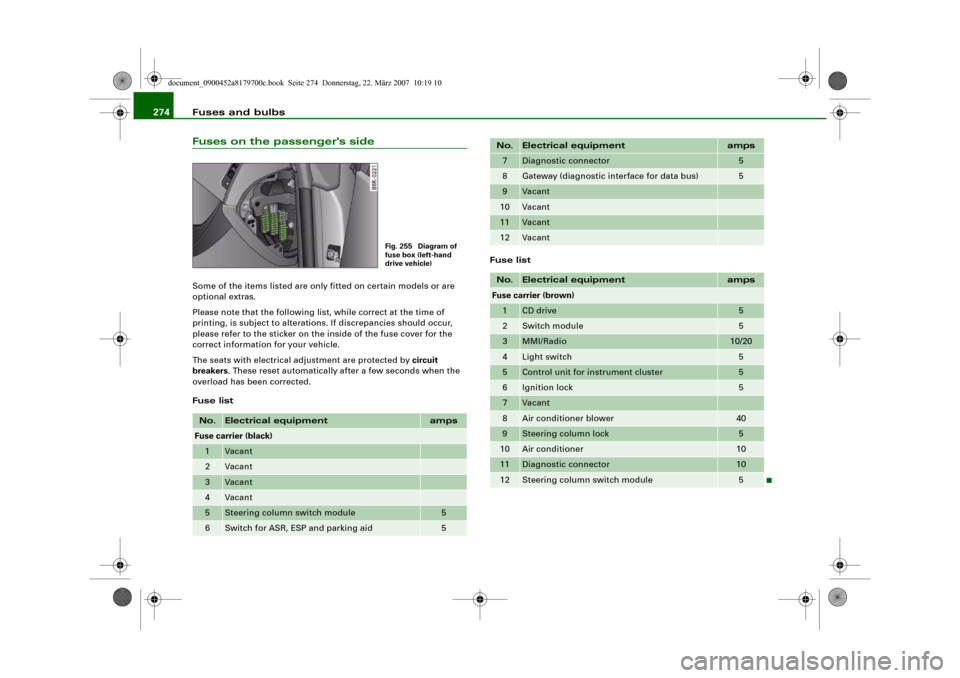
Fuses and bulbs 274Fuses on the passenger's sideSome of the items listed are only fitted on certain models or are
optional extras.
Please note that the following list, while correct at the time of
printing, is subject to alterations. If discrepancies should occur,
please refer to the sticker on the inside of the fuse cover for the
correct information for your vehicle.
The seats with electrical adjustment are protected by circuit
breakers. These reset automatically after a few seconds when the
overload has been corrected.
Fuse listFuse listNo.
Electrical equipment
amps
Fuse carrier (black)1
Vacant
2
Vacant
3
Vacant
4
Vacant
5
Steering column switch module
5
6
Switch for ASR, ESP and parking aid
5
Fig. 255 Diagram of
fuse box (left-hand
drive vehicle)
7
Diagnostic connector
5
8
Gateway (diagnostic interface for data bus)
5
9
Vacant
10
Vacant
11
Vacant
12
Vacant
No.
Electrical equipment
amps
Fuse carrier (brown)1
CD drive
5
2
Switch module
5
3
MMI/Radio
10/20
4
Light switch
5
5
Control unit for instrument cluster
5
6
Ignition lock
5
7
Vacant
8
Air conditioner blower
40
9
Steering column lock
5
10
Air conditioner
10
11
Diagnostic connector
10
12
Steering column switch module
5
No.
Electrical equipment
amps
document_0900452a8179700c.book Seite 274 Donnerstag, 22. März 2007 10:19 10
Page 279 of 313
Fuses and bulbs277
Controls
Safety
Driving tips
General maintenance
Self-help
Technical data
WARNING
•
Take particular care when working on components in the
engine compartment if the engine is warm - risk of burns!
•
Bulbs are sensitive to pressure. The glass can break when you
touch the bulb, causing injury.
•
Incorrect handling of the high-voltage element of xenon gas-
discharge bulbs* can have potentially fatal consequences.
•
When changing bulbs, please take care not to injure yourself on
sharp edges, in particular on the headlight housing.Caution
•
Always remove the ignition key before carrying out any work on
the electrical system - danger of short circuiting!
•
Switch off the lights or parking lights before you change a bulb.
•
Take good care to avoid damaging any components.
•
Removing the lights in particular can lead to the paintwork
becoming damaged. This is another reason why we recommend
having the bulbs changed by a qualified workshop.For the sake of the environment
Please ask your specialist retailer how to dispose of used bulbs in
the proper manner.
Note
Place the parts you have removed on a soft cloth so that they do not
become scratched.
•
Please check at regular intervals that all lighting (especially the
exterior lighting) on your vehicle is functioning properly. This is not
only in the interest of your own safety, but also in that of all other
road users.
•
Before changing a bulb, make sure you have the correct new
bulb.
•
Do not touch the glass part of the bulb with your bare hands, use
a cloth or paper towel instead. Otherwise, the fingerprints left on
the glass will vaporise as a result of the heat generated by the bulb,
be deposited on the reflector and impair its surface.
Bulbs with a bayonet fastenerBulbs with a bayonet fastener must be changed as follows:
Removing the bulb
– Lightly press the defective bulb into the bulb holder, then
turn it anti-clockwise and remove it.
– Do not touch the glass part of the new bulb with your
bare hands, use a cloth or paper towel instead.
Fitting the bulb
– Fit the new bulb, pressing it into the bulb holder, and turn
it clockwise as far as it will go.
– If necessary, use a cloth to remove any fingerprints from
the glass part of the bulb.
Reversing lights
W 16 W
Rear fog light
H 21 W
Number plate lights
5 W
document_0900452a8179700c.book Seite 277 Donnerstag, 22. März 2007 10:19 10
Page 295 of 313
General notes293
Controls
Safety
Driving tips
General maintenance
Self-help
Technical data This applies especially when the vehicle is fully laden.
CapacitiesFuel tank
Windscreen washerVehicle identification data
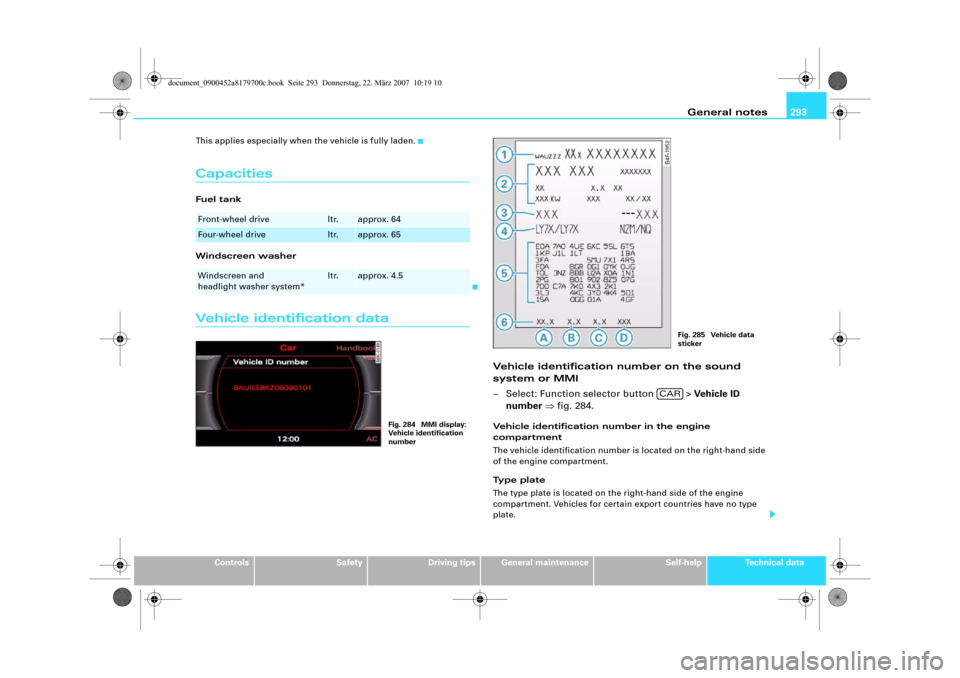
Vehicle identification number on the sound
system or MMI
– Select: Function selector button > Vehicle ID
number ⇒fig. 284.Vehicle identification number in the engine
compartment
The vehicle identification number is located on the right-hand side
of the engine compartment.
Type plate
The type plate is located on the right-hand side of the engine
compartment. Vehicles for certain export countries have no type
plate.
Front-wheel drive
ltr.
approx. 64
Four-wheel drive
ltr.
approx. 65
Windscreen and
headlight washer system*
ltr.
approx. 4.5
Fig. 284 MMI display:
Vehicle identification
number
Fig. 285 Vehicle data
sticker
CAR
document_0900452a8179700c.book Seite 293 Donnerstag, 22. März 2007 10:19 10
Page 305 of 313

Index303
Controls
Safety
Driving tips
General maintenance
Self-help
Technical data Bicycle rack
Trailer . . . . . . . . . . . . . . . . . . . . . . . . . . 211
Biodiesel . . . . . . . . . . . . . . . . . . . . . . . . . . . 227
Bioethanol fuel . . . . . . . . . . . . . . . . . . . . . 227
Blower
Deluxe automatic air conditioner . . . . 96
Deluxe automatic air conditioner plus . .
105
Bonnet
Closing . . . . . . . . . . . . . . . . . . . . . . . . . 232
Opening . . . . . . . . . . . . . . . . . . . . . . . . 230
Releasing . . . . . . . . . . . . . . . . . . . . . . . 230
Boot
SeeLoading luggage compartment . 168
SeeLuggage compartment . . . . . . . . . 77
Boot lid
Central locking system . . . . . . . . . . . . . 48
Manual release . . . . . . . . . . . . . . . . . . . . 49
Brake system
Brake assist system . . . . . . . . . . . . . . . 197
Brake fluid . . . . . . . . . . . . . . . . . . . . . . 238
Brake light defective . . . . . . . . . . . . . . . 36
Brake pads worn . . . . . . . . . . . . . . . . . . 36
Brake servo . . . . . . . . . . . . . . . . . . . . . . 199
Electro-mechanical parking brake . . . 121
General notes . . . . . . . . . . . . . . . . . . . . 199
Malfunction . . . . . . . . . . . . . . . . . . . . . . 31
Warning lamp . . . . . . . . . . . . . . . . . . . . 19
Bulb holder
Bayonet fastener . . . . . . . . . . . . . . . . . 278
Bulb monitor . . . . . . . . . . . . . . . . . . . . . . . . 36Bulbs
Bayonet fastener . . . . . . . . . . . . . . . . . 277
Changing (general notes) . . . . . . . . . . 276
Bulbs, changing . . . . . . . . . . . . . . . . . . . . . 276
Brake lights . . . . . . . . . . . . . . . . . . . . . . 284
Bulb holder with bayonet fastener . 277,
278
Dipped headlights . . . . . . . . . . . . . . . . 280
Front fog lights . . . . . . . . . . . . . . . . . . 283
Main beam headlights . . . . . . . . . . . . 279
Number plate light . . . . . . . . . . . . . . . 288
Rear fog light . . . . . . . . . . . . . . . . . . . . 286
Rear lights . . . . . . . . . . . . . . . . . . . . . . 284
Reversing light . . . . . . . . . . . . . . . . . . . 286
Turn signals (rear) . . . . . . . . . . . . . . . . 284
Business equipment . . . . . . . . . . . . . . . . . 251
CCapacities . . . . . . . . . . . . . . . . . . . . . . . . . . 293
Car keys . . . . . . . . . . . . . . . . . . . . . . . . . . . . 39
Care of vehicle . . . . . . . . . . . . . . . . . . . . . . 220
Catalytic converter . . . . . . . . . . . . . . . . . . 205
Central locking system . . . . . . . . . . . . . . . . 42
Boot lid . . . . . . . . . . . . . . . . . . . . . . . . . . 48
Deadlock mechanism . . . . . . . . . . . . . . 46
Fuel tank flap . . . . . . . . . . . . . . . . . . . . 228
Locking . . . . . . . . . . . . . . . . . . . . . . . . . . 46
Locking and unlocking the vehicle from
inside . . . . . . . . . . . . . . . . . . . . . . . . . . 47
Manual locking . . . . . . . . . . . . . . . . . . . . 48
Opening and closing windows . . . . . . . 50
Switches on driver's door . . . . . . . . . . . 47
Unlocking . . . . . . . . . . . . . . . . . . . . . . . . 46Cetane number . . . . . . . . . . . . . . . . . . . . . 227
Changing a wheel . . . . . . . . . . . . . . . . . . . 260
Changing bulbs
SeeBulbs . . . . . . . . . . . . . . . . . . . . . . . . 276
Chassis number . . . . . . . . . . . . . . . . . . . . . 293
Child safety . . . . . . . . . . . . . . . . . . . . . . . . 185
Child safety seat . . . . . . . . . . . . . . . . . . . . 186
Child seat categories . . . . . . . . . . . . . . 186
Fitting . . . . . . . . . . . . . . . . . . . . . . . . . . 189
ISOFIX system . . . . . . . . . . . . . . . . . . . . 191
On front passenger's seat . . . . . . . . . . 186
Safety notes . . . . . . . . . . . . . . . . . . . . . 185
Cigarette lighter . . . . . . . . . . . . . . . . . . . . . . 87
Cleaning . . . . . . . . . . . . . . . . . . . . . . . . . . . 220
Cleaning Alcantara . . . . . . . . . . . . . . . . . . 226
Cleaning seat covers
Alcantara . . . . . . . . . . . . . . . . . . . . . . . . 226
Natural leather . . . . . . . . . . . . . . . . . . . 225
Textile covers . . . . . . . . . . . . . . . . . . . . 223
Cleaning textile covers and trim parts . . 223
Clock, setting . . . . . . . . . . . . . . . . . . . . . . . . 13
Closing
Bonnet . . . . . . . . . . . . . . . . . . . . . . . . . . 232
Coat hooks . . . . . . . . . . . . . . . . . . . . . . . . . . 92
Colour code . . . . . . . . . . . . . . . . . . . . . . . . 293
Compact temporary spare wheel
SeeSpare wheel . . . . . . . . . . . . . . . . . . 256
Compartment for (sun)glasses . . . . . . . . . 91
Compass in mirror . . . . . . . . . . . . . . . . . . . . 68
Controls and displays
Overview . . . . . . . . . . . . . . . . . . . . . . . . . . 9
Convenience close function . . . . . . . . . . . . 50
document_0900452a8179700c.book Seite 303 Donnerstag, 22. März 2007 10:19 10
Page 307 of 313

Index305
Controls
Safety
Driving tips
General maintenance
Self-help
Technical data Speed warning . . . . . . . . . . . . . . . . . . . . 28
Yellow symbols . . . . . . . . . . . . . . . . . . . 34
Driver messages . . . . . . . . . . . . . . . . . . . . . 30
Driving abroad . . . . . . . . . . . . . . . . . . . . . . 205
Headlights . . . . . . . . . . . . . . . . . . . . . . 205
Unleaded fuel . . . . . . . . . . . . . . . . . . . . 205
Driving away from a standstill . . . . . . . . . 122
Driving away when towing a trailer . . . . 123
Driving safety . . . . . . . . . . . . . . . . . . . . . . 163
Driving time . . . . . . . . . . . . . . . . . . . . . . . . . 25
Dust filter
Deluxe automatic air conditioner . . . . 93
Deluxe automatic air conditioner plus . .
101
DVD player . . . . . . . . . . . . . . . . . . . . . . . . . . 79
Dynamic gear control program . . . . . . . . 133
EEasy-entry function . . . . . . . . . . . . . . . . 71, 73
Economical driving . . . . . . . . . . . . . . . . . . 206
EDL
SeeElectronic differential lock . . . . . . . 18
Electric seat adjustment
SeeSeat adjustment . . . . . . . . . . . . . . . 72
Electric windows . . . . . . . . . . . . . . . . . . . . . 50
Central locking system . . . . . . . . . . . . . 50
Controls . . . . . . . . . . . . . . . . . . . . . . . . . 50
Convenience open/close function . . . . 50
Malfunctions . . . . . . . . . . . . . . . . . . . . . 51
Settings . . . . . . . . . . . . . . . . . . . . . . . . . 51
Electrical accessories
SeeElectrical socket . . . . . . . . . . . . . . . 88Electrical socket . . . . . . . . . . . . . . . . . . 87, 88
Electro-mechanical parking brake . . . . . . 124
Auto release function . . . . . . . . . . . . . 122
Driving away from a standstill . . . . . . 122
Driving away when towing a trailer . . 123
Emergency braking function . . . . . . . 123
Malfunction . . . . . . . . . . . . . . . . . . . . . 123
Operation . . . . . . . . . . . . . . . . . . . . . . . 121
Parking . . . . . . . . . . . . . . . . . . . . . . . . . 122
Releasing and applying . . . . . . . . . . . . 121
Warning lamp . . . . . . . . . . . . . . . . . . 18, 19
Electronic differential lock
How the system works . . . . . . . . . . . . 199
Warning lamp . . . . . . . . . . . . . . . . . . . . . 18
Electronic immobiliser . . . . . . . . . . . . . . . . 14
Electronic stabilisation program
How the system works . . . . . . . . . . . . 196
Warning lamp . . . . . . . . . . . . . . . . . . . . . 16
Emergency braking function . . . . . . . . . . 123
Emergency key . . . . . . . . . . . . . . . . . . . . . . 41
Emergency release
Ignition key . . . . . . . . . . . . . . . . . . . . . . . 41
Emission control systems
Catalytic converter . . . . . . . . . . . . . . . . 205
Diesel particulate filter . . . . . . . . . . . . 205
Emissions . . . . . . . . . . . . . . . . . . . . . . . . . . 293
Engine compartment
Safety notes . . . . . . . . . . . . . . . . . . . . . 231
Engine compartment layout . . . . . . . . . . 232
Engine data
SeePerformance, weights and
dimensions . . . . . . . . . . . . . . . . . . . . 295Engine hood
SeeBonnet . . . . . . . . . . . . . . . . . . . . . . 230
Engine management
(EPC) warning lamp . . . . . . . . . . . . . . . . 15
Engine oil . . . . . . . . . . . . . . . . . . . . . . . . . . 233
Checking oil level . . . . . . . . . . . . . . . . . 234
Consumption . . . . . . . . . . . . . . . . . . . . 234
LongLife Service . . . . . . . . . . . . . . . . . . 233
Topping up . . . . . . . . . . . . . . . . . . . . . . 234
See alsoPerformance, weights and
dimensions . . . . . . . . . . . . . . . . . . . . 295
Engine oil capacity
SeePerformance, weights and
dimensions . . . . . . . . . . . . . . . . . . . . 295
Engine oil pressure
Warning lamp . . . . . . . . . . . . . . . . . . . . . 33
Engine oil sensor
Malfunction . . . . . . . . . . . . . . . . . . . . . . 37
Environmental compatibility . . . . . . . . . . 207
Environmental tips
Filling the tank . . . . . . . . . . . . . . . . . . . 228
Heated rear window . . . . . . . . . . . 98, 107
Leaks . . . . . . . . . . . . . . . . . . . . . . . . . . . 231
Roof carrier . . . . . . . . . . . . . . . . . . . . . . . 85
EPC
SeeEngine management . . . . . . . . . . . 15
ESP
SeeElectronic stabilisation program . . 16
Ethanol fuel . . . . . . . . . . . . . . . . . . . . . . . . 227
Exterior mirrors . . . . . . . . . . . . . . . . . . . . . . 67
document_0900452a8179700c.book Seite 305 Donnerstag, 22. März 2007 10:19 10