change wheel AUDI A5 2015 Owner´s Manual
[x] Cancel search | Manufacturer: AUDI, Model Year: 2015, Model line: A5, Model: AUDI A5 2015Pages: 264, PDF Size: 66.83 MB
Page 212 of 264
Wheels
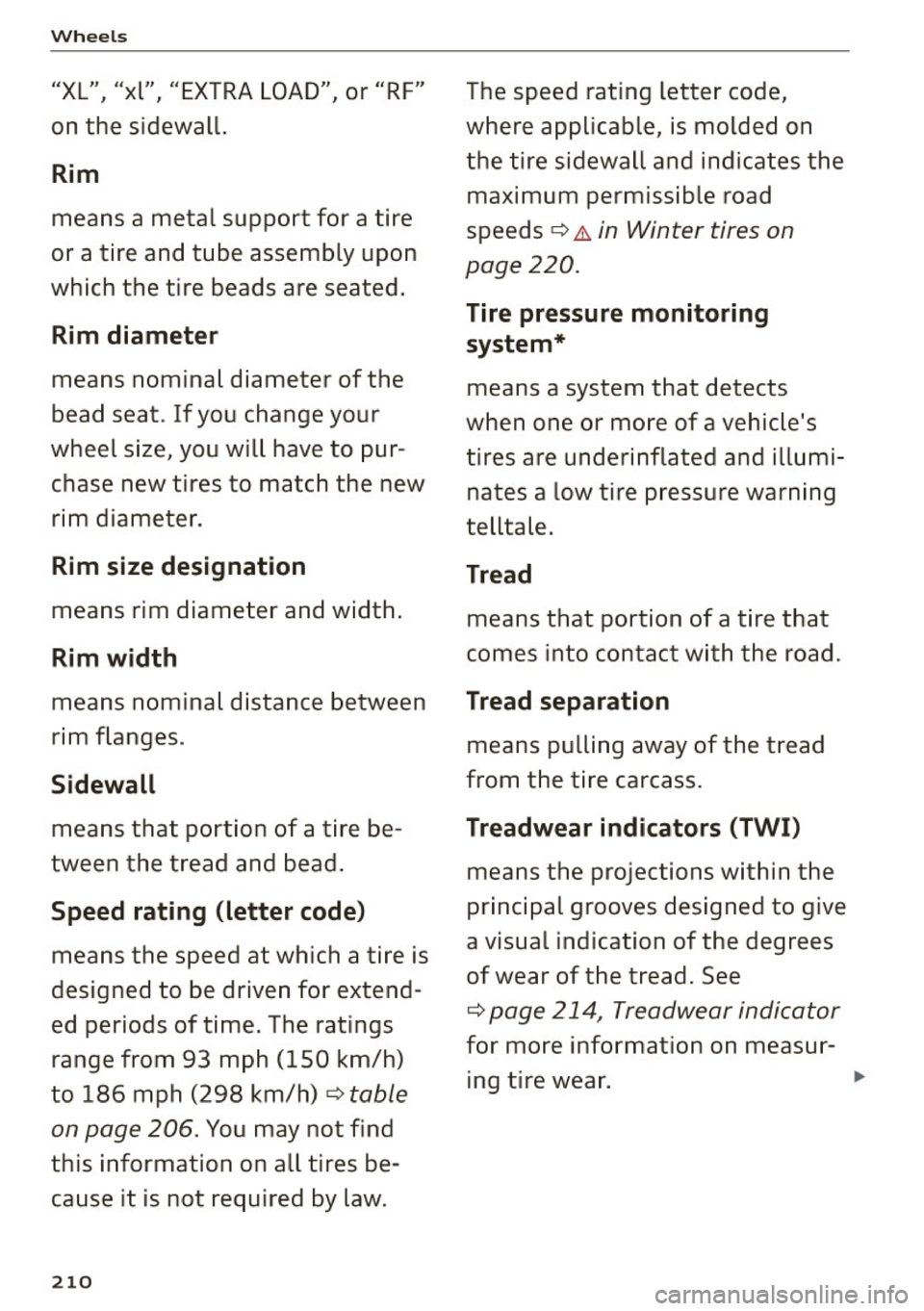
"XL" "xl" "EXTRA LOAD" or "RF" I I I
on the sidewal l.
Rim
means a metal support for a tire
or a tire and tube assembly upon
which the tire beads are seated .
Rim diameter
means nominal diameter of the
bead seat. If you change yo ur
wheel size , you w ill have to pur
chase new tires to match the new rim diameter .
Rim size designation
means rim diameter and width.
Rim width
means nomina l distance between
rim flanges .
Sidewall
means that port ion o f a t ire be
tween the tread and bead .
Speed rating (letter code)
means the speed at which a tire is
designed to be driven for extend
ed periods of t ime. The rat ings
range from 93 mph (150 km/h)
to 186 mph (298 km/h)
¢ table
on page 206 .
You may not find
this information on all tires be
cause it is not required by la w.
2 10
The speed rating letter code ,
where applicable , is mo lded on
the tire sidewall and indicates the maximum permiss ible road
speeds
¢ .&. in Winter tires on
page 220.
Tire pressure monitoring
system*
means a system that detects
when one or mo re of a ve hic le's
tires are under inflated and illumi
na tes a low tire p ressu re warning
tellta le .
Tread
means that portion of a tire that
comes into contact w ith the road.
Tread separation
means pu lling away of the tread
from the t ire carcass.
Treadwear indicators (TWI)
means the projections wi thin the
principal grooves designed to give
a visua l indication of the deg rees
of wear of the tread . See
¢ page 214 , Treadwear indicator
for mo re information on measur
ing t ire wear.
Page 218 of 264
Wheels
c:::> page 217, Tires and vehicle
load limits.
-The tire must flex more if the tire pressure is too low or if
the vehicle speed or load are
too high. This heats the tire up
too much. This increases the
risk of an accident because it
can cause the tire to burst and
result in loss of vehicle con
trol.
-Incorrect tire pressure increas
es tire wear and has a negative
effect on driving and braking
Tire pressure table
Please note that the information
contained in the following table
was correct at the time of print
ing, and the information is sub
ject to change. If there are differ ences between this information
and the tire pressures specified
on the label on the driver's side 8-pillar, always follow the specifica
tion on the 8-pillar label
c:::> page 215, fig. 170.
216
behavior, which increases the
risk of an accident.
(D Note
Replace lost valve caps to re
duce the risk of damage to the
tire valves.
@ For the sake of the environment
Tire pressure that is too low in
creases fuel consumption.
(D Tips
Audi recommends using the
tire pressure specified for a nor
mal load
c:::> page 216 or for a
full load when the vehicle is
partially loaded.
Make sure that the tire designa
tion on your tire matches the des ignation on the tire pressure label
and the tire pressure table.
The following table lists recom
mended tire pressures in cold
tires according to the load and the size of the tires installed. .,.
Page 225 of 264

also reduces fuel efficiency and tire tread life,
and may affect the vehicle's handling and stop
ping ability .
Please note that the TPMS is not a substitute for
proper tire maintenance, and it is the driver's re
sponsibility to maintain correct tire pressure,
even if under-inflation has not reached the level
to trigger illumination of the TPMS low tire pres
sure telltale.
Your vehicle has also been equipped with a TPMS malfunction indicator to indicate when the sys
tem is not operating properly. The TPMS mal
function indicator is combined with the low tire pressure telltale . When the system detects a
malfunct ion, the telltale will flash for approxi
mately one minute and then remain continuously
illuminated. This sequence will continue upon
subsequent veh icle start-ups as long as the mal
function exists.
When the malfunction indicator is illuminated,
the system may not be able to detect or signal
low tire pressure as intended. TPMS malfunctions
may occur for a variety of reasons, including the
installation of replacement or alternate tires or
wheels on the vehicle that prevent the TPMS
from functioning properly. Always check the
TPMS malfunction telltale after replacing one or more tires or wheels on your vehicle to ensure
that the replacement or alternate tires and
wheels allow the TPMS to continue to function properly.
Wheels
If the Tire Pressure Monitoring System
indicator appears
Appl ies to vehicles : wi th t ir e p ress ure mo nito rin g system
The tire pressure indicator in the instrument
cluster informs you if the tire pressure is too low
or if there is a system malfunction.
Fig. 172 Instrument cluster: i ndicator light with message
Using the ABS sensors, the tire pressure monitor
ing system compares the tire tread circumference
and vibration characteristics of the individual
tires .
If the pressure changes in one or more
tires, this is indicated in the instrument cluster
display with an indicator light
[I] and a message .
If only one tire is affected, the location of that
tire will be indicated .
The tire pressures must be stored in the Infotain
ment system again each time the pressures
change (switching between partial and full load
pressure) or after changing or replacing a tire on
your vehicle ¢
page 224. The tire pressure moni
toring system only monitors the tire pressure you have stored. Refer to the tire pressure label for
the recommended tire pressure for your vehicle
r=> page215, fig.171.
Tire tread circumference and vibration character
istics can change and cause a tire pressure warn
ing if:
- the tire pressure in one or more tires is too low .
- the tire has structural damage.
- the tir e was replaced or the tire pressure was
changed and it was not stored ¢
page 224.
-the spare t ire* is installed.
Indicator lights
[I] Loss of pressure in at least one tire¢.& .
Check the tires and replace or repair if necessary .
liJJ,-
223
Page 226 of 264
Wheels
Check/correct the pressures of all four tires and
store the pressure again in the Infotainment sys
tem
c!) page 224.
mm (Tire Pressure Monitoring System) Tire pres
sure: System malfunction!.
If m appears after
switching the ignition on or while driving and the
[I] i ndicator light in the instrument cluster
blinks for approximately one minute and then
stays on, there is system malfunction. Try to
store the correct tire pressures
c:> page 224 . If
the indicator light does turn off or turns on again
after a short period of time, drive to your author
ized Audi dealer or qualified repair facility imme
diately to have the malfunction corrected.
A WARNING
-If the tire pressure indicator appears in the
display, reduce your speed immediately and
avoid any hard steering or braking maneu
vers. Stop as soon as possible and check the
tires and their pressure.
- The driver is responsible for maintaining the
correct tire pressure. You must check the
tire pressure regularly.
-Under certain conditions (such as a sporty
driving style, winter conditions or unpaved
roads), the tire pressure monitoring system
indicator may be delayed.
- Do not use run-flat tires on your vehicle. Us
ing them when not permitted can lead to
vehicle damage or accidents.
(D Tips
- The tire pressure monitoring system can al
so stop working when there is an ESC mal
function.
- Using snow chains may result in a system
malfunction.
- The tires with the identification "AO" or
"RO"
c:> page 212 have been matched with
your Audi tire pressure monitoring system.
We recommend that you use these tires.
224
· Storing tire pressures
App lies to vehicles: wit h tire press ure mo nitor ing system
If the tire pressure changes or a tire is replaced,
it must be confirmed in the Infotainment sys
tem .
.,. Make sure before storing that the tire pressures
of all four tires meet the spec ified values and
are adapted to the load
c!) page 215.
.,. Switch the ignition on.
.,. Select: the
I CARI function button > Tire pres
sure monitoring
control button. Or
.,. Select: the
I CARI function button > Car Sys
tems*
control button > Servicing & checks >
Tire pressure monitoring.
(D Tips
Do not store the tire pressures if snow chains
a re i nsta lied.
Page 229 of 264

M N
0 I-co
rl I.O
"' N
"' rl
the wheel diagona lly opposite the wheel be
ing changed with the folding chocks or ot h
er objects. When one front wheel is lifted
off the ground, placing the Automatic Trans
mission in "P" (Pa rk) wi ll
not prevent the ve
hicle from moving .
- Before you change a wheel, be sure the
ground is level and fi rm.
If necessary, use a
sturdy board under the jac k.
- Always store the vehicle tool kit, the jack*
and the replaced tire in the luggage com
partment c::>
page 118 .
(D Note
If you are chang ing the wheel o n a steep in
cline, use a rock or sim ila r object to block the
opposite whee l to prevent the vehicle from
moving.
@ Tips
Obey a ll laws.
Changing a wheel
When you change a wheel, follow the sequence
described below step -by -step and in exactly that
order.
1. Remove the decorati ve w heel co ver* or the
w he el bolt caps *. For more details see a lso
c::> page 22 7, Decorative wheel covers or
c::> page 228, Wheels with wheel bolt caps .
2. Loosen the whe el bolt s c::> page 228.
3. Lo cate the proper mo unti ng po int for the
jack and align the jack below tha t point
c::> page229.
4. Lift the car wit h the jack c::> page 229.
5. Remove the wheel with the flat tire and then
install the
spare t ire c::> page 230.
6 . Tighten all wheel bo lts light ly.
7 .
Low er the veh icle w ith the jack.
8 . Use the wheel bolt wrench and
firmly tighten
9.
all whee l bolts in a crissc ross pattern
c::> page 228.
Replace t he de corative wh ee l c over* or the
whe el bolt cap s*.
Em erg en cy ass is tan ce
A WARNING
-Always read and follow all WARNINGS and in-
formation
c::> .&. in Raising the vehicle on
page
229 and c::> page 231.
After changing a wheel
A wheel change is not complete without the do
ing the following.
.. Always store the vehicle tool k it, the jack*, and
the replaced t ire in the luggage compartment
c::>page 118.
.. Check the tir e pr essure of the spare ti re as soon
as poss ible .
.. As soon as possib le, have the
tightening to r
que s
on a ll whee l bolts checked wi th a torque
wrench . Th e cor rect tigh tening torque is 90 ft
lbs .
(120 Nm).
.. Have the flat tire
replaced as soon as possible.
@ Tips
- If you not ice tha t the wheel bo lts are cor
roded and difficult to turn while changing a
tire, they should be replaced before you check the tightening torque.
- Dr ive at reduced speed until you have the
tightening torques checked .
Decorative wheel covers
Applies to vehicles: with decorative w heel covers
The decorative wheel covers must be removed
first to access the wheel bolts .
Fig. 1 75 Chang ing a w heel: re m ovi ng t he w heel cove r
227
Page 231 of 264

M N
0 loo
rl I.O
"' N
"' rl
Raising the vehicle
The vehicle must be li~ed with the jack first be
fore the wheel can be removed .
·- ·
Fig . 178 Sill panels: marking s
Fig . 179 S ill: posit ion ing the vehicl e jack
The location of the jack point is indicated by an
indentation on the underside of the vehicle
¢ fig. 178.
.,.. Activate the pa rkin g brake to prevent the vehi
cle from rolling unintentionally .
.,.. Shift into
1st gea r on vehicles with manua l
transmission or move the selector lever to the P
pos ition on vehicles with automatic transmis
sion.
.,.. Find the
marking (imprint) on the sill that is
nearest the wheel that w ill be changed
¢ fig . 178. Behind the marking, there is a lift
ing point
on the sill for the vehicle jac k.
.,.. Turn the
veh icle jack loca ted under the lifting
point on the si ll to raise the jack until the jaw
r:=;, fig. 179 @ covers the notch on the vehicle
¢A ¢ 0 .
.,.. Align the vehicle jack so the jaw @covers the
notch and the base plate @ is flat on the floor.
The base plate @ must be
vertical under the
lifting point @.
Em erg en cy ass is tan ce
.,.. Insta ll the rod on the vehicle jack : Insert the
rod into the opening on the handwheel. Turn
the rod left or r ight to secure it.
.,.. Continue raising the jack with the rod unt il the
wheel lifts off the ground slightly .
Position the vehicle jack
onl y under the designat
ed lifting points on the si ll
Q fig. 178. There is ex
actly
one Location for each wheel. The jack m ust
not be posit ioned at any other location
c:> ,& ¢CI).
So ft g round under the jack can cause the vehicle
to s lip off the jack . Always place the jack on firm
ground. Use a flat, stable support if necessary.
Use a non-s lip surface such as a rubber mat on a
slipper y surfa ce such as tile .
A WARNING
= -
-You or your passengers could be injured
while changing a wheel if you do not fo llow
t hese safety precautions:
- Position the vehicle jack on ly at the desig
nated lifting points and align the jack.
Otherwise, the vehicle jack could slip and
cause an injury if it does not have suffi
c ient hold on the vehicle.
- A soft or unstable surface under the jack
may cause the vehicle to slip off the jack .
Always provide a firm base for the jack on
the ground.
If necessary, use a sturdy
board under the jack.
- On hard, slippery su rface (such as t iles)
use a rubber mat or simi lar to prevent the
ja ck from slipp ing.
- To help prevent injury to yourself and your
passengers:
- Do not raise the vehicle until you are sure
the jack is secure ly engaged.
- Passengers must not remain in the veh icle
when it is jacked up .
- Make sure that passengers wait in a safe
place away from the vehicle and we ll away
from the road and traffic.
- Make sure jack pos ition is correct, adjust
as necessary and then contin ue to raise
the jack .
229
Page 233 of 264

M N
i? co ,...., \!) ..,.,
N ..,., ,....,
Tires with unidirectional tread design
Tires with unidirectional tread design must be
mounted with their tread pattern pointed in the
right dir ection .
Using a spare tire with a tread pattern
intended for use in a specific direction
When us ing a spa re tire w ith a t read pa tte rn in
t e nded fo r use in a specific d ir e ct ion, p lease no te
the following:
- The direction of rotation is marked by an
arrow
on the side of the tire .
-If the spare t ire has to be installed in the incor
rect direction, use the spare tire only tempora
rily since the tire will not be able to achieve i ts
o ptimum performanc e character istics wit h re
gard to aquaplaning, noise and wea r.
- We recommend that you pay pa rticular atten
t io n t o this fact du ring wet weat he r and t hat
yo u adju st yo ur sp eed to match road condi
t ions.
- Re place the fla t tire w ith a new one and have i t
i nsta lled on yo ur vehicle as s oon as po ssible to
re store the han dling a dvan tages o f a un idirec
t io na l tire.
Notes on wheel changing
P lease read the information ¢ page 212, New
tires or wheels
i f you are going to use a spare tire
which is different from the tires on your ve hicle.
Afte r you change a tire:
- Check the tire pressure on the spare immedi
ately after installation.
- Have the wheel bolt tightening torque
checked with a torque wrench as soon as po s
sible by your authorized Audi dealer or quali
fied workshop .
- With steel and alloy wheel rims , the wheel
bolts are correctly tightened at a torque of 90
ft lbs. (120 Nm ).
- If you notice th at the wheel bolt s are corroded
and difficult to turn while changing a tire ,
they should be replaced before you check the
tightening torque .
Emergency assistance
-Replace the flat tire with a new one and have
it installed on your vehicle as soon as possi
ble. Remount the wheel cover .
Until then , drive with extra care and at reduced
speed s.
_& WARNING
- If you are going to e quip your ve hicl e wit h
tires o r rims which differ from those which
were factory installed, then be sure to read
the information ¢
page 212, New tires or
wheels.
- Always make sure the damaged wheel o r
even a flat tire a nd the jack a nd too l kit a re
p roperly secu red in the luggage compart
men t and are not loos e in t he passeng er
compa rt m ent.
- In an acci dent or sudde n man euver they
could fly forwa rd, inj uring a nyone in t he ve
h icle.
- Always s to re damag ed wh eel , jack and tools
s ecure ly in the luggage co mpart ment. Ot h
e rwi se, in an accident o r sud den man euver
they co uld fly forward, causing injury to pas
sen gers in t he ve hicle.
(D Note
D o not use co mmercially ava ilab le tire seal
a nts. O therwise, the e le ct ric al c ompone nts of
the tire pre ssure monit oring sys tem * w ill no
l on ger wor k properly and t he sensor for the
tire pressu re monito ring system * wi ll have to
b e replaced by qu alified workshop.
-
231
Page 255 of 264
M N
i? co ,...., \!) 1.1'1
N 1.1'1 ,....,
H
Headlights
Cleaning system . . . . . . . . . . . . . . . . . . . . . . 50
Defective . . . . . . . . . . . . . . . . . . . . . . . . . . . 21
Headlight range control . . . . . . . . . . . . . . . 21
Left hand drive, right hand drive . . . . . . . . . 46
Travel mode . . . . . . . . . . . . . . . . . . . . . . . . . 46
Headlight washer reservoir . . . . . . . . . . . . . 204
Head restraints . . . . . . . . . . . . . . . . . . . . . . . 115
Adjusting .. ............. .... . 57, 58, 115
Removing/installing . . . . . . . . . . . . . . . . . . 58
Heated exterior m irrors . . . . . . . . . . . . . . . . . . . . . . 47
rear window . . . . . . . . . . . . . . . . . . . . . . . . . 70
seats . . . . . . . . . . . . . . . . . . . . . . . . . . . . . . . 70
windshield washer spray nozzles . . . . . . . . 50
Heating . . . . . . . . . . . . . . . . . . . . . . . . . . . . . . 68
Heavy clothing and safety belts . . . . . . . . . . 123
H igh beam . . . . . . . . . . . . . . . . . . . . . . . . . . . . 45
High voltage warning labe l . . . . . . . . . . . . . 241
Hill descent control . . . . . . . . . . . . . . . . . . . . 86
Home link (garage door opener) . . . . . . . . . . 41
Hood
Opening . . . . . . . . . . . . . . . . . . . . . . . . . . . 191
Release lever . . . . . . . . . . . . . . . . . . . . . . . 191
H orn . . . . . . . . . . . . . . . . . . . . . . . . . . . . . . . . . 8
How are ch ild restra int system anchors relat-
ed to chi ld safety . . . . . . . . . . . . . . . . . . . . . 164
How many airbags does my vehicle have? . . 135
How safety belt pretensioners work 127
I
Ignition
switch ing on/off. . . . . . . . . . . . . . . . . . . . . . 72
Ignition key Emergency unlocking . . . . . . . . . . . . . . . . . . 34
Ignition lock . . . . . . . . . . . . . . . . . . . . . . . . . . 72
Indicator light . . . . . . . . . . . . . . . . . . . . . . . 18
Malfunction . . . . . . . . . . . . . . . . . . . . . . . . . 22
I mba lance (wheels) . . . . . . . . . . . . . . . . . . . 213
Immobilizer . . . . . . . . . . . . . . . . . . . . . . . . . . 12
Important things to do before driving . . . . 112
I mproperly worn safety belts. . . . . . . . . . . . 126
Indicator lights . . . . . . . . . . . . . . . . . . . . . . . . 13
Airbag system . . . . . . . . . . . . . . . . . . . . . . 139
Index
Dynamic steering . . . . . . . . . . . . . . . . . . . . 174
PASSENGER AIR BAG OF F . . . . . . . . . . . . . 139
also refer to Warning/indicator lights . . . . 13
Infant seats . . . . . . . . . . . . . . . . . . . . . . . . . 156
Inflation pressure (tires) . . . . . . . . . . . . . . . 215
Installing the upper tether strap on the an-
chorage . . . . . . . . . . . . . . . . . . . . . . . . . . . . . 167
Instruments . . . . . . . . . . . . . . . . . . . . . . . . . . 10
Adjusting the light ing . . . . . . . . . . . . . . . . . 47
Instruments and controls
General illustration . . . . . . . . . . . . . . . . . . . . 8
Interior lights
Front . . . . . . . . . . . . . . . . . . . . . . . . . . . . . . . 47
Rear . . . . . . . . . . . . . . . . . . . . . . . . . . . . . . . 47
Intermittent (windshield wipers) . . . . . . . . . 50
J
Jump-starting . . . . . . . . . . . . . . . . . . . . . . . . 236
Jumper cables . . . . . . . . . . . . . . . . . . . . . . . . 23 7
K
Key.... .... .... .. ............. .... .. . 32
Battery replacement . . . . . . . . . . . . . . . . . . 33
Check light . . . . . . . . . . . . . . . . . . . . . . . . . . 33
Emergency key . . . . . . . . . . . . . . . . . . . . 32, 74
Ign ition/engine on/off . . . . . . . . . . . . . . . . . 72
Key replacement . . . . . . . . . . . . . . . . . . . . . 32
Mechan ica l key . . . . . . . . . . . . . . . . . . . . 32 , 33
removing . . . . . . . . . . . . . . . . . . . . . . . . . . . 74
unlock ing/loc king . . . . . . . . . . . . . . . . . 34, 36
Kick-down tiptron ic . . . . . . . . . . . . . . . . . . . . . . . . . . . . 87
Knee air bags . . . . . . . . . . . . . . . . . . . . . . . . . 143
Description . . . . . . . . . . . . . . . . . . . . . . . . . 143
How they work . . . . . . . . . . . . . . . . . . . . . . 144
Important safety instructions . . . . . . . . . . 145
L
Lane Change Assistant
refer to side assist . . . . . . . . . . . . . . . . . . . . 98
LATCH . . . . . . . . . . . . . . . . . . . . . . . . . . . . . . 164
Description . . . . . . . . . . . . . . . . . . . . . . . . . 165
Installing a c hild restraint . . . . . . . . . . . . . 165
Location . . . . . . . . . . . . . . . . . . . . . . . . . . . 164
Mounting and releasing the anchorage
hook . . . . . . . . . . . . . . . . . . . . . . . . . . . . . . 165
253