engine oil AUDI A5 2015 Owner´s Manual
[x] Cancel search | Manufacturer: AUDI, Model Year: 2015, Model line: A5, Model: AUDI A5 2015Pages: 264, PDF Size: 66.83 MB
Page 179 of 264
Driving and the
environment
Breaking in
New engine
The engine needs to be run-in during the first
1,000 miles (1,500 km).
For the first 600 miles (1,000 kilometers ):
"' Do not use full throttle .
"' Do not drive at engine speeds that are more
than
2/3 of the max imum permitted RPM .
From 600 to 1,000 miles (1,000 to 1,500
kilometers):
"' Speeds can gradually be increased to the maxi
mum perm issible road or engine speed.
During and after break-in period
"'Do not rev the engine up to high speeds when it
is cold. This applies whether the transmission is
in N (Neutral) or in gear .
After the break-in period
"'Do not exceed maximum engine speed under
any circumstances.
"'U pshift into the next higher gear
before reach
ing the red area at the end of the tachometer
scale
c=> page 10.
During the first few hours of driving, the engine's
internal friction is higher than later when all the
moving parts have been broken in. How well this
break-in process is done depends to a considera
ble extent on the way the vehicle is driven during
the first 1,000 miles (1,500 kilometers).
(D Note
Extremely high engine speeds are automati
cally reduced. However, these rpm limits are
p rog rammed for an engine wel l run- in, not a
new engine.
@) For the sake of the environment
Do not dr ive with unnecessarily high eng ine
speeds -upshifting early saves fuel, reduces
noise and protects the environment.
Driving and the environment
New tires
If your vehicle is running on new tires, drive very
carefully for the fi rst 350 m iles (500 kilometers)
after fitting .
New tires tend to be slippery and must also
be "broken-in". Be sure to remember this dur
ing the first
350 miles (500 kilometers).
Brake gently. Avoid following closely behind
other vehicles or other situations that might
require sudden, hard brak ing .
Avoid damaging the
vehicle
When you are d riving on poor roads, or over
curbs, steep ramps, etc., ma ke certain that low
lying parts such as spoilers and exhaust system
parts do not bottom out and get damaged.
T his is espec ially true for veh icles with low-s lung
chassis (sports chassis)* and fully loaded
vehicles.
Driving through water on
roads
Note the following to avoid vehicle damage when
driving through water, for example on f looded
roads:
- The water must not be any higher than the bot
tom of the vehicle body.
- Do not drive faster than walking speed.
A WARNING
= -
After driving through water, mud, slush, etc.,
the brakes may be s low to take effect because
of wet brake rotors and pads. Dry the brakes
first by braking carefully to restore the full braking effect.
(D Note
Vehicle components such as the engine,
transmission, suspension or electrical system
can be severely damaged by driving through
water . ""
177
Page 180 of 264
Driving and th e environment
(D Tips
- Check the depth of the water before driving
through it.
- Do not stop the veh icle, drive in reverse or
switch the engine
off when driving through
water.
- Keep in mind that oncoming vehicles may
create waves that raise the water level and
make it too deep for your vehicle to dr ive
through safely.
- Avoid driving through sa lt water because it
can cause corrosion.
Catalytic converter
It is very important that your emission control
system (catalytic converter) is functioning prop erly to ensure that your vehicle is running in an
environmentally sound manner .
~ Always use lead-free gasoline¢ page 186,
Fuel supply .
~ Never run the tank down a ll the way to empty .
~ Never put too much motor oil in your engine
¢ page 195, 9::?1 Adding engine oil .
~ Never try to push- or tow -start your veh icle.
The cata lytic conve rter is an eff icient "clean-up"
dev ice bu ilt into the exhaust system of the vehi
cle. The cataly tic converter burns many of the
pollutants in the exhaust gas before they are re
leased into the atmosphere.
The ex clusive use of u nleaded fuel is critically im
por tant for the life of the catalyt ic converte r and
p roper functioning o f the engine.
A WARNING ,..___ -
- The temperature of the exhaust system is
high, both when driving and after stopping
the engine.
- Never touch the exha ust tail pipes once they
have become hot. This could result in burns.
- Do not park o r operate the vehicle in areas
whe re the hot exhaust system may come in
contact with dry grass, brush, fue l spill or
other mater ial which can cause a fire.
- Do not apply additional undercoating or
rustproofing on or near the exha ust man i-
178
fold, exha ust pipes, catalytic converter or
heat shields. During driv ing, the substance
used for undercoat ing could overheat and
cause a f ire.
Cl) Note
- Be aware that just one tank fill ing with
le ad·
ed
fue l w ill already ser iously degrade the
performance of the catalytic converter.
- Do not exceed the correct engine oil level
¢page 195.
-Do not drive until the fue l tank becomes
completely empty. The engine co uld m isfire.
Unburned fuel could also get into the ex
haust system and this could cause the cata
lyt ic converter to overheat.
- Do not turn
off the ignition while the vehicle
is moving .
- Do not continue to operate your veh icle un
der these conditions, as otherwise fuel can
reach the catalytic converter . This could re
sult in overheating of the conve rter, requ ir
ing its replacement.
- T o assure efficient operation of the Emission
Cont ro l System:
- Have your vehicle maintained properly and
in accordance with the se rvice recommen
dations in yo ur Warranty
& Maintenance
booklet.
- Lack of proper maintenance as we ll as im
proper use of the vehicle will impair the
function of the emission control system
and could lead to damage.
(® For the sake of the environment
Even when the Emiss ion C ontrol System is op
e rat ing proper ly, the exhaust gas can have a
sulfur-like exhaust gas sme ll under some op
erat ing states. This depends on the sulfur
content of the fuel being used. Us ing a d iffe r
ent brand of fue l may he lp, or fi llin g the tank
wi th lead-free s uper grade gaso line.
Shutting down vehicle
If you would like you r vehicle to remai n inope ra
tive for a longer period of time, con tact an Audi
o r other spec ia liz ed dealer. They can adv ise you .,.
Page 182 of 264
Driving and th e environment
Regular maintenance
A badly tuned engine unnecessarily wastes a lot
of fuel .
.,. Have your vehicle serviced at regula r intervals.
By having your vehicle regularly serviced by an
authorized Audi dealer he lps to ensure that it
runs properly and economically. The condition of
your vehicle not only affects its safety and ability to hold its value, it also affects
f uel c onsump
tion .
C he ck you r oil e ach t ime you fill you r ta nk .
The amount of oil used is related to engine load
and speed.
It is normal for the oil consumption of a new en
g ine to reach its lowes t va lue after a cer tain mile
age has been d riven .
You must d rive you r vehicle about 3,000 miles
(5 ,000 k ilometers) before you can properly as
sess o il cons umption .
This a lso applies to fuel consumption and engine
output.
(D Note
- Have your vehicle maintained properly and
in accordance w ith the service recommenda
tions in you r Warra nty
& M aintenance book
l et . Lack of p roper m aintenance as well as
i mprope r use of the vehicle will impair the
funct ion of the emission control system and
could lead to damage.
- Do not a lter or remove any component of
the Emission Cont ro l System unless ap
proved by the manufacturer.
- Do not a lter o r remove any dev ice, such as
heat shie lds, switches, ignition wires,
va lves, which are designed to protect your
vehicle's Emiss ion Control System and other
i mportant veh icle components.
180
· Fewer short trips
Fuel consumption will always be relatively high
on short trips .
.,. Try to avoid dr iv ing short distances with a cold
eng ine .
The eng ine and catalytic converter have to reach
their opt imal
oper atin g temperature to reduce
fuel consumpt ion and noxious emissions effec
tively .
Just after starting, a co ld engine in a mid-s ize car
on ly achieves a fuel economy of 6-8 mi les per
gallon (30-40 l/100 km). After about a half a
mile, fuel economy climbs to 12 mpg (20 l/100
km) . After about
2.5 miles (4 km), the eng ine is
at its proper operating temperature and fuel
economy has reached a norma l level. So you can
see that you should avo id short trips whenever
poss ible .
The
out side t emp eratur e is also cr itical in th is re
gard. Your car consumes more fuel in the winter
than in the summer.
Page 189 of 264
M N
i? co ,...., \!) 1.1'1
N 1.1'1 ,....,
fill up at busy gas stations where the seasonal
adjustment is more likely to be made in time.
(D Note
- Fuels containing a high pe rcentage of etha
no l such as ESQ and E85 may only be used in
vehicles with f lexible fuel engines. Using
high ethanol fuel in veh icles not equ ipped
with flexible fuel engines can cause severe
engine damage.
- Methanol fuels which do not meet these re quirements may cause corrosion and dam
age to plastic and rubber components in the
fuel system.
- Do not use fuels that fail to meet the spec i
fied criter ia in this chapter .
- If you are unable to determine whether or
not a particular fuel blend meets the speci
fications, ask your service station or its fuel
supplier .
- Do not use fuel for wh ich the contents can
not be identified.
- Fuel system damage and performance prob
lems resulting from the use of fuels differ
ent from those spec ified are not the respon
s ibility of Audi and are not covered under
the New Vehicle o r the Emission Cont ro l
System Warranties.
- If you experience a loss of fue l economy o r
driveability and pe rformance problems due
to the use of one of these f uel b lends, we
r ecommend that yo u switch to unb lended
fuel.
Ethanol fuel (Bio-ethanol)
Applies to vehicles: with flexible fuel engine
You can recognize vehicles with a flexible fuel
engine by looking at the label on the inside of the fuel filler flap.
Vehicles w ith f lexible fuel engines may be operat
ed with bio-ethanol fuels such as E85 (85% e tha
nol and 15% gasoline) or with unleaded gasoline
(91 AKI/ROZ 95) . The vehicle may also be operat
ed with a m ixt ure of these fuels.
Fu el and R efu elin g
Your f uel consumption wi ll increase when using
bio-ethano l fue ls due to the lower amount of en
ergy contained per unit vo lume in ethano l.
Warming up the fle xible fuel engine in low
t e mperatu res
Due to the chemical composition of b io-ethanol,
a certain amount of fue l ends up in the engine oil
when driving short distances in
very low temper
atures. This fuel evaporates again when the en
gine is warmed up .
II Please w arm up eng ine .
If the driver message appears in the instrument
cluster disp lay, drive with a warm engine to re
duce the oil leve l.
(D Note
-Never fill with methano l or with a h igher
percentage of b io-ethanol than 85% (E85).
A highe r percentage of bio-ethanol in the
fue l can cause damage to the engine or to
the fuel system.
- If you use on ly E85, it is recommended to
fill the fue l tank complete ly w ith unleaded
premium grade gasoline every 5,000 miles.
- If you experience starting, rough id le or hes
itat ion driveab ility problems, fill the fuel
tank complete ly w ith unleaded premium
grade gasoline and drive it normally unt il
the gaso line is used. See your author ized
Audi dea ler if the problem pe rsists.
- Inform your author ized Audi dealer that you
are operating or have operated the vehicle
w ith E85.
- Read and follow the information and t ips
about gasoli ne
c::> page 186 .
(D Tips
It may take longer to start the engine when
the outs ide temperature is
very cold. If possi
ble, use winte rized fue l if tempe ratu res are
below free zin g.
187
Page 194 of 264
Checking and Filling
-To reduce the risk of being burned, never
open the hood if you see or hear steam or
coolant escaping from the engine compart
ment . Wait until no steam or coolant can be
seen or heard before carefully opening the hood.
- Keep children away from the engine com
partment.
- Never spill fluids on hot engine compo
nents. They can cause a fire.
- Never touch the radiator fan. The auxiliary
electric fan is temperature controlled and
can switch on suddenly .
- Never open the coolant reservoir cap when
the engine is still warm. The coolant system
is pressurized and hot coolant could spray
out.
- Protect your face, hands and arm from
steam or hot engine coolant by placing a
thick rag over the cap when you open the
coolant reservoir .
- Do not remove the engine cover under any
circumstances. This increases the risk of
burns.
- If work on the fuel system or the electrical
system is necessary :
- Always disconnect the battery.
- Never smoke or work near heaters or open
flames. Fluids in the engine compartment could start a fire.
- Keep an approved fire extinguisher imme
diately available .
- To avoid electrical shock and personal injury
while the engine is running or being started,
never touch:
- Ignition cables
- Other components of the high voltage electronic ignition system.
- If you must perform a check or repair with
the engine running:
- First, fully apply the parking brake, move
selector lever of automatic transmission
192
to "P" (Park); put manual transmission in
Neutral.
- Always use extreme caution to prevent
clothing, jewelry, or long hair from getting
caught in the radiator fan, V-belts or other
moving parts, or from contacting hot
parts . Tie back hair before starting, and do
not wear clothing that will hang or droop
into the engine.
- Minimize exposure to emission and chemi cal hazards
~ ,& .
A WARNING
California Proposition 65 Warning:
- Engine exhaust, some of its constituents, and certain vehicle components contain or
emit chemicals known to the State of Cali
fornia to cause cancer and birth defects and
reproductive harm. In addition, certain flu
ids contained in vehicles and certain prod
ucts of component wear contain or emit
chemicals known to the State of California
to cause cancer and birth defects or other
reproductive harm.
- Battery posts, terminals and related acces
sories contain lead and lead compounds,
chemicals known to the State of California
to cause cancer and reproductive harms .
Wash hands after handling .
(D Note
When adding fluids, always make sure that
they are poured into the proper container or
filler opening, otherwise serious damage to
vehicle systems will occur.
@ For the sake of the environment
To detect leaks in time, inspect the vehicle
floor pan from underneath regularly. If you
see spots from oil or other vehicle fluids, have
your vehicle inspected by an authorized Audi
dealer.
Page 195 of 264
M N
0 loo
rl I.O
"' N
"' rl
Checking and Filling
Engine compartment
Engine compartment
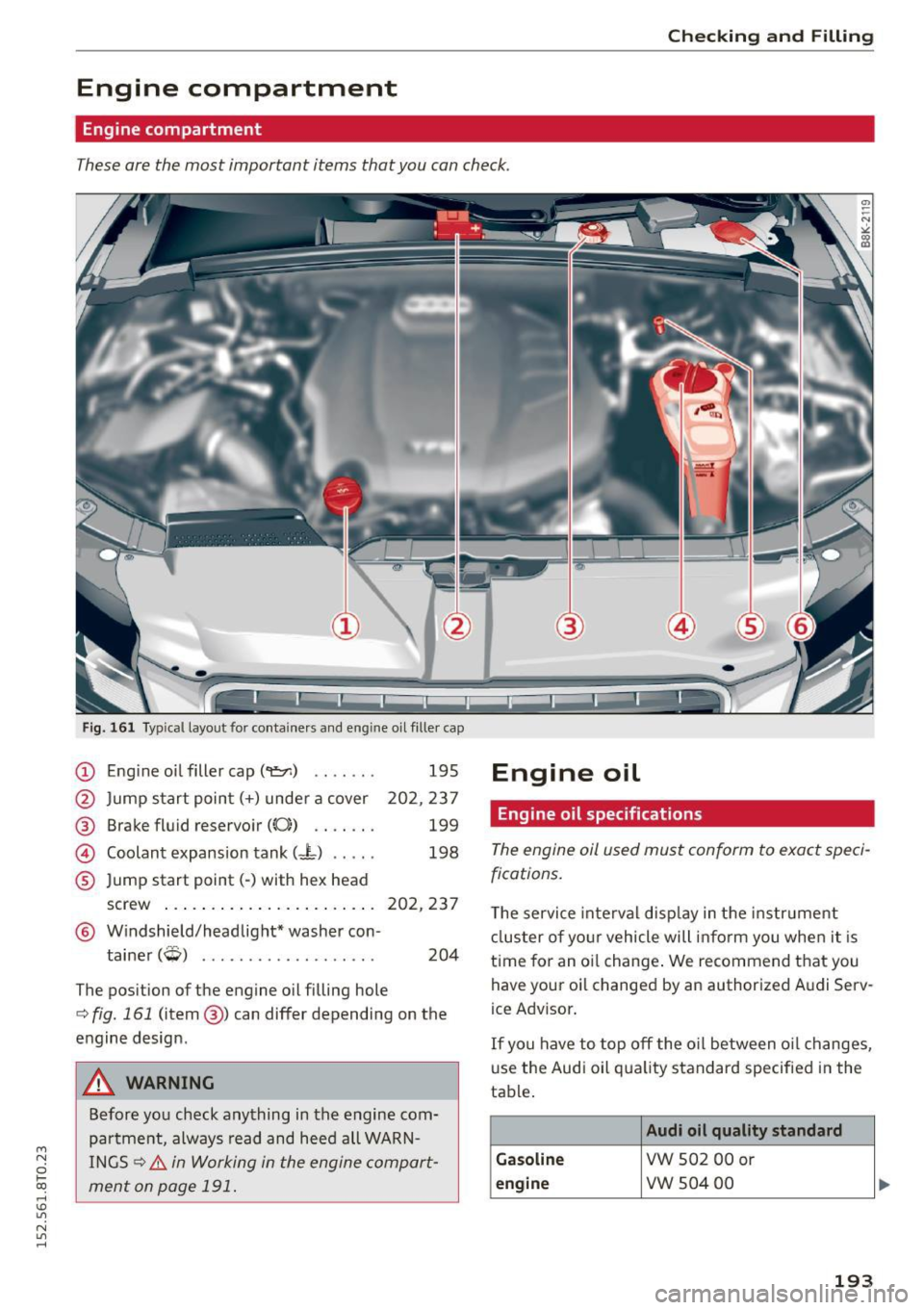
These are the most important items that you can check.
Fig. 161 Typical layout for containers and eng ine oil filler cap
(D Eng ine o il filler cap (
@ Brake fluid reservoir((();) .... .. .
@ Coolant expansion tank (- L) .. .. .
® Jump start point(-) with hex head
195
202,237
199
198
screw ... .. ............... .. . 202, 237
@ Windshield/headlight* washer con-
tainer
(Q) . . . . . . . . . . . . . . . . . . . 204
The position of the engine oil filling hole
c:> fig. 161 (item@) can differ depending on the
engine design .
A WARNING
Before you check anything in the engine com
partment, always read and heed all WARN
INGS
c:> &. in Working in the engine compart
ment on page 191.
Engine oil
Engine oil specifications
The engine oil used must conform to exact speci
fications.
T he service interval disp lay in the instrument
cluster of your vehicle will inform you when it is
time for an oi l change . W e recommend that you
have your oil changed by an authorized A udi Serv
ice Advisor .
If you have to top off the oil between oil changes,
use the Audi oil qua lity standard specified in the
table .
Audi oil quality standard
Ga soline
VW 502 00 or
engine vw 504 00
193
Page 196 of 264
Checking and F ill in g
Using the proper engine o il is important for the
functionality and service life of the engine. Your
engine was factory-fi lled w ith a high-quality o il
which can usually be used throughout the ent ire
year.
@) Note
Your L imited New Vehicle Warranty does not
cover damage or malfunctions due to failure
to follow recommended ma intenance and use
requ irements as set forth in the Audi Ow ne r's
Manual and Wa rranty
& Ma intenance booklet .
- Use only a high quality eng ine oil t hat ex-
pressly comp lies w ith the Audi o il quality
standard specified for your vehicle's e ngine .
Using a ny other oil can cause se rious engine
damage.
- Do not mix any lubricants o r othe r addit ives
i nto the engine oil. Doing so can cause en
g ine damage.
(D Tips
If you need to add oil and there is none availa
ble that meets the Audi o il quality standard
y o ur eng ine requires, you m ay add a total of
no more than 0.5 quart/li ter o f a h igh-quali ty
"synthet ic"oil that meets the fo llowing speci
fications .
- V ehicles wi th gasoline engine: AC EA A3 o r
API SM with a viscosity grade of SAE 0W- 30,
SAE SW -30 or SAE SW-40 .
- Fo r more informa tion abo ut engine oi l that
has been approved for your vehicle, please
contact either you r a uthorized Aud i dea ler
or Audi Customer Relations at
1 (800) 822-2834 or visit o ur web site at
www .aud iusa.com or www .aud icanada .ca .
Engine oil consumption
The engine in your vehicle depends on an ade
quate amount of oil to lubricate and cool all of
its moving parts .
In order to provide effective lubrication and cool
i n g of internal engine components, all interna l
combustion engines consume a certai n amount
of oil. O il consumption var ies from engine to en
g ine and may change significant ly ove r the life of
194
the engine. Typically, eng ines with a specif ied
break-in period (see
¢ page 177) consume mo re
o il dur ing the b reak -in per iod than they consume
after oil consumption has stabili zed.
U nder normal cond itions , the rate of oi l con
s u mption depends on t he qu ality and viscosity of
the oil, the RPM (revolutions per minute) at
which the engine is operated, the ambient tem
perature and road condit ions. Further factors are
the amount of o il di lution from water condensa
tion or fuel residue and the ox idat ion level of the
o il. As any engine is s ubject to wear as mileage
builds up, t he oil consump tion may inc rease ove r
t ime unt il rep lacement of wo rn component s may
become necessary.
With a ll these va riab les coming into p lay, no
sta ndard ra te of oil consumpt ion can be estab
li shed or spe cified . There i s no altern ative to reg
u la r and freq uent checking o f the oil leve l, see
Note .
If the yellow e ngine oi l leve l wa rning symbo l El
in the instr ument cluster lights up, yo u should
chec k the o il level as soon as possible
¢ page 195 . Top off the oil at your ear liest con
venience ¢page 195.
A WARNING
Before you chec k anything in the eng ine com
partment, always read and heed a ll WARN
INGS¢ .&. in Working in the engine compart
ment on page 191.
@ Note
Driving with an insufficient oi l level is likely to
cause severe damage to the engine.
(D Tips
- The oil pressu re warning display. is not
an indicator of the oil level. Do not rely on
it . Instead, check the oil level in your en
gine at regular intervals, preferably each
time you refuel, and always before going on a long trip.
- If you have the impression yo ur engine con
sumes excessive amounts of oil, we r ecom-
mend that yo u consult an au tho rized Audi .,.
Page 197 of 264
M N
0 loo
rl I.O
"' N
"' rl
dealer to have the cause of your concern
properly diagnosed. Keep in mind that the
accurate meas urement of oil cons umption
requires great care and may take some time.
An authorized Audi dealer has instructions
about how to measure oil consumption ac
curately.
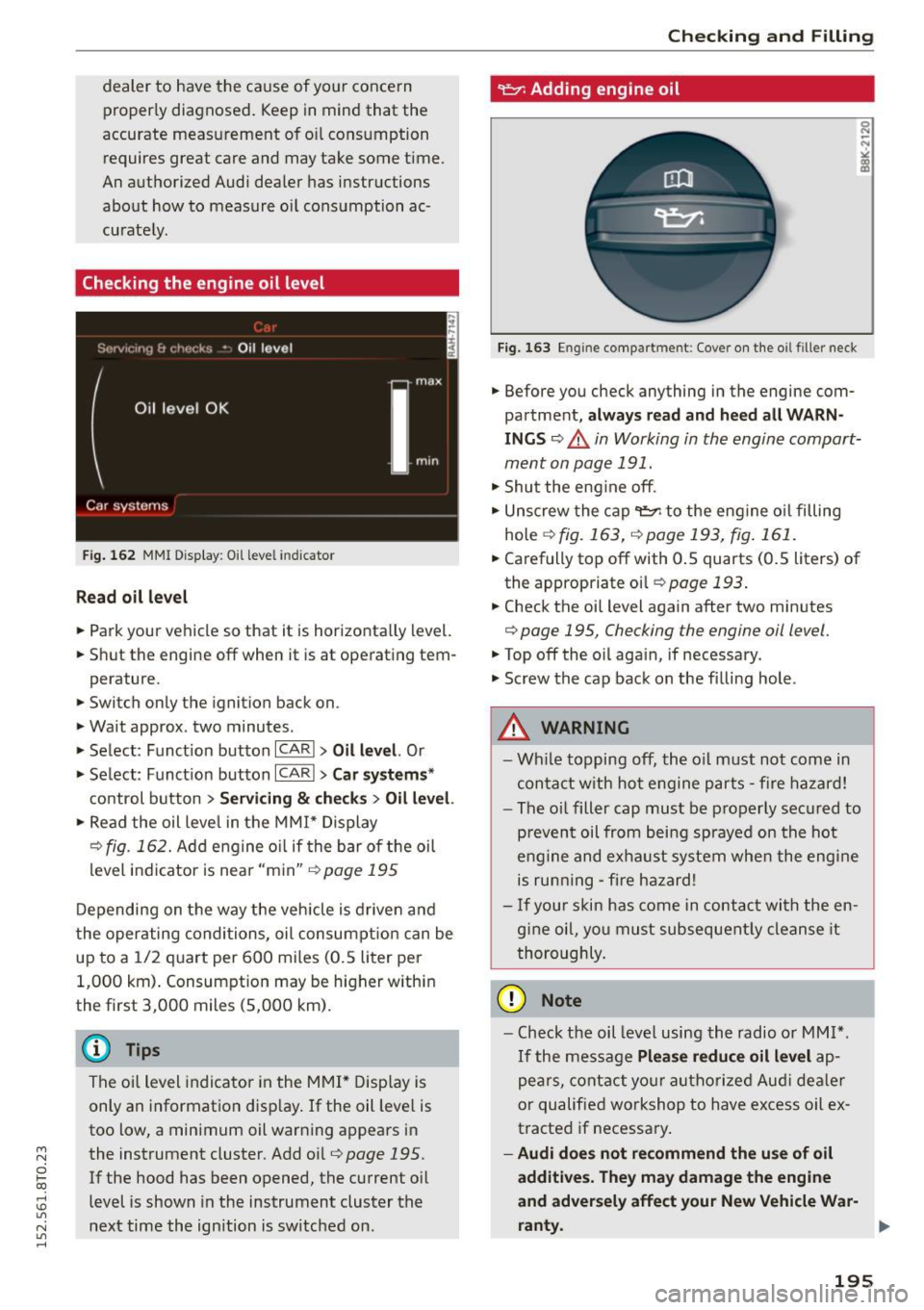
Checking the engine oil level
Fig. 162 MMI Disp lay: Oil level indicator
Read oil level
• Park your vehicle so that it is horizonta lly level.
• Shut the engine off when it is at operating tem-
perature.
• Switch only the ignition back on.
• Wait approx. two minutes.
• Select: Function button
~IC ~A ~R~I > Oil level. Or
• Se lect: Funct ion button
ICARI > Car systems*
control button > Servicing & checks > Oil level.
• Read the oil level in the MMI* Display
r:::>fig. 162. Add engine o il if the bar of the oil
level indicator is near "min"
r:::>page 195
Depending on the way the vehicle is driven and
the operating conditions, oil consumpt ion can be
up to a 1/2 quart per 600 miles (O.S liter per
1,000 km) . Consumption may be higher within
the first 3,000 miles (S,000 km).
@ Tips
The oil level indicator in the MMI* Display is
only an information disp lay. If the oil level is
too low, a minimum oil warn ing appears in
the instrument cluster. Add oil¢
page 195.
If the hood has been opened, the current oil
level is shown in the instrument cluster the
next time the ignition is switched on.
Checking and Filling
~ Adding engine oil
Fig. 163 Engine compartment: Cover on the oil filler neck
• Before you check anything in the engine com
partment,
always read and heed all WARN
INGS
¢ .&. in Working in the engine compart
ment on page 191.
• Shut the eng ine off.
• Unscrew the cap~ to the eng ine oil filling
hole
¢ fig. 163, ¢page 193, fig. 161.
• Carefully top off with 0 . S quarts (0.5 liters) of
the appropriate oi l
¢page 193.
• Check the oil level again after two minutes
¢ page 195, Checking the engine oil level.
• Top off the o il aga in, if necessary.
• Screw the cap back on the filling hole.
A WARNING
-
- Wh ile topping off, the o il must not come in
contact w ith hot engine parts -fire hazard!
- The oil filler cap must be properly secured to
p revent oil from being sprayed on the hot
engine and exhaust system when the engine
is running -fire hazard!
- If you r skin has come in contac t with the en
g in e oi l, you must subsequently cleanse it
thoroughly.
CJ) Note
- Check the oil level using the radio or MMI*.
If the message
Please reduce oil level ap
pears, contact your authorized Audi dealer
or qualified workshop to have excess oil ex
tracted if necessary.
-Audi does not recommend the use of oil
additives. They may damage the engine
and adversely affect your New Vehicle War-
ranty. ..,.
195
Page 198 of 264
Checking and F ill in g
@ For the sake of the environment
- Under no circumstances can the oil come in
contact with the sewage network or the soil.
- Observe and fo llow lega l regu lations when
disposing of empty oil containers .
Changing the engine oil
We recommend that hove your oil changed by on
authorized Audi dealer or a qualified service sta
tion.
Before you check anything in the engine compa rt
ment,
alway s read and heed all WARNINGS ¢ .&.
in Working in the engine comportment on
page 191.
The engine oil must be changed according to the
i n terva ls specified in yo ur Warranty
& Mainte
nance booklet . This is very important because the
lubricat ing propert ies of o il diminish gradua lly
during normal vehicle use.
Under some circ umstances the engine oi l sho uld
be changed more frequent ly . Change oil more of
ten if you drive most ly short distances, operate
the vehicle in dusty areas or under predom inantly
stop-and-go traffic condit ions, or have your vehi
cle where temperatures rema in below freezi ng
for extended periods.
Detergent addit ives in the o il w ill make fresh oil
look dark after the engine has been running for a
short time. This is normal and is not a reason to
cha nge the oil mo re often than recommended .
Because of the problem of proper disposa l, along
with the special tools and necessary expertise re
qu ired, we stro ngly recommend that you have
your oil changed by an autho rized
Aud i deale r or
a qualif ied se rvice stat ion.
If you choose to change your o il yourself, please
note the fo llowing important information :
A WARNING
To reduce the ris k of persona l inju ry if yo u
must c han ge the engine oil in your ve hicle
yo urself:
- Wea r eye p rotection .
196
-
-To reduce t he risk of burns from hot engine
oil, let the engine coo l down to the touch.
- W hen removing the o il drain p lug with your
fingers, stay as far away as possib le. Always
keep your forearm parallel to the ground to
he lp prevent hot oi l from running down your
arm .
- Dra in the oil into a c ontainer designed for
this purpose, one la rge enough to hold at
least the tota l amount of oil in your engine.
- Engine oil is poisonous. Keep it we ll out of
the reach of chi ld ren .
- Continuous contact w it h used eng ine oi l is
ha rmf ul to your skin. Always protect you r
skin by washi ng oil off tho roughly wi th soap
a nd wate r.
(D Note
Never mix oil additives with your engine oil.
These additives can damage your e ngine and
adverse ly affect your Audi Limited New Vehi
cle Warranty.
@ For the sake of the environment
- Before changi ng your oil, first make su re
you know where you ca n prope rly dispose of
the used oil.
- Always dispose of used eng ine oil properly.
Do not d ump it on garden so il, wooded
areas, in to op en st reams o r down sewage
drai ns.
- Recycle used engi ne oil by taking it to a used
eng ine oi l collect ion fac ility in yo ur area, o r
c ontact a service station.
Cooling system
Coolant '
The engine coolant performs two functions: it
keeps the engine from overheating and it pro
tects the engine from freezing in the winter.
The cooling system is sealed and genera lly re
q u ires little attention.
The cooli ng sys tem has been filled at the f actory
wi th a permanent coolan t which does not need to
be changed. The coolant consists of a mixtu re of
jll,,
Page 199 of 264
M N
i? co ,...., \!) 1.1"1
N 1.1"1 ,....,
specially conditio ned water an d the manu fa ctu r
er's glycol-basedcoolant additive Gl3 antifreeze
with anticorrosion additives (50% for USA mod
els; 60% for Canadian models). This m ixture both
assures the necessary frost protection and pro
tects meta l components in the engine's cooling
system from corrosion and scal ing . It also raises
the boiling point of the coolant.
Do not reduce the concentration of the coolant in
the summer by adding plain water .
The p ropor
tion of coolant addit ive must be at l east 50 %
but n ot mor e th an 60 %
to maintain antifreeze
protection and cooling efficiency. If the coolant
frost protection is too low, the coolant cou ld
freeze and damage the vehicle heating and en
gine cooling system.
F or yea r-round driving, antifreeze is added at the
factory fo r temperatures dow n to:
- -31°F(-35°C)USA
- -40 °F ( - 40 °C) Canada.
If you must add coo lant, use a mixture of water
and coolant addit ive. Mixing the coolant additive
with distilled water is recommended.
A WARNING
Before you check anything in the engine com
partment, always read and heed all WARN
INGS
¢ &. in Working in the engine compart
ment on page 191.
(D Note
- Before winter sets in, have the coolant
checked to see if the coolant addit ive in your
vehicle is suffic ient to meet the cli mate con
dit ions. This is especially important if you
li ve in a region where the win ter is extreme
l y co ld. If ne cessary, i ncrease the proport ion
of coo lant add itive to 60%.
- When adding coolant a ddit ive to you r cool
i ng system, remember:
- We recommend using only coolant addi
tive Gl2++ or Gl3 for your ve hicle. This
coolant additive is ava ilable at authorized
Audi dea lers. Other types of ant ifreeze can
significant ly reduce co rrosion protection.
Checking and Fillin g
The resulting corrosion can ca use a loss o f
coolant and serious engine damage.
- Do not add any type of rad iator le ak sealan t
to your vehicle's engine coolant. Adding ra
diator repai r fluid may adverse ly affect the
function and performance of your cooling
system and could result in damage not cov
ered by your New Vehicle Lim ited Warranty.
Checking the engine coolant level
The engine coolant level can be checked with a
quick glance.
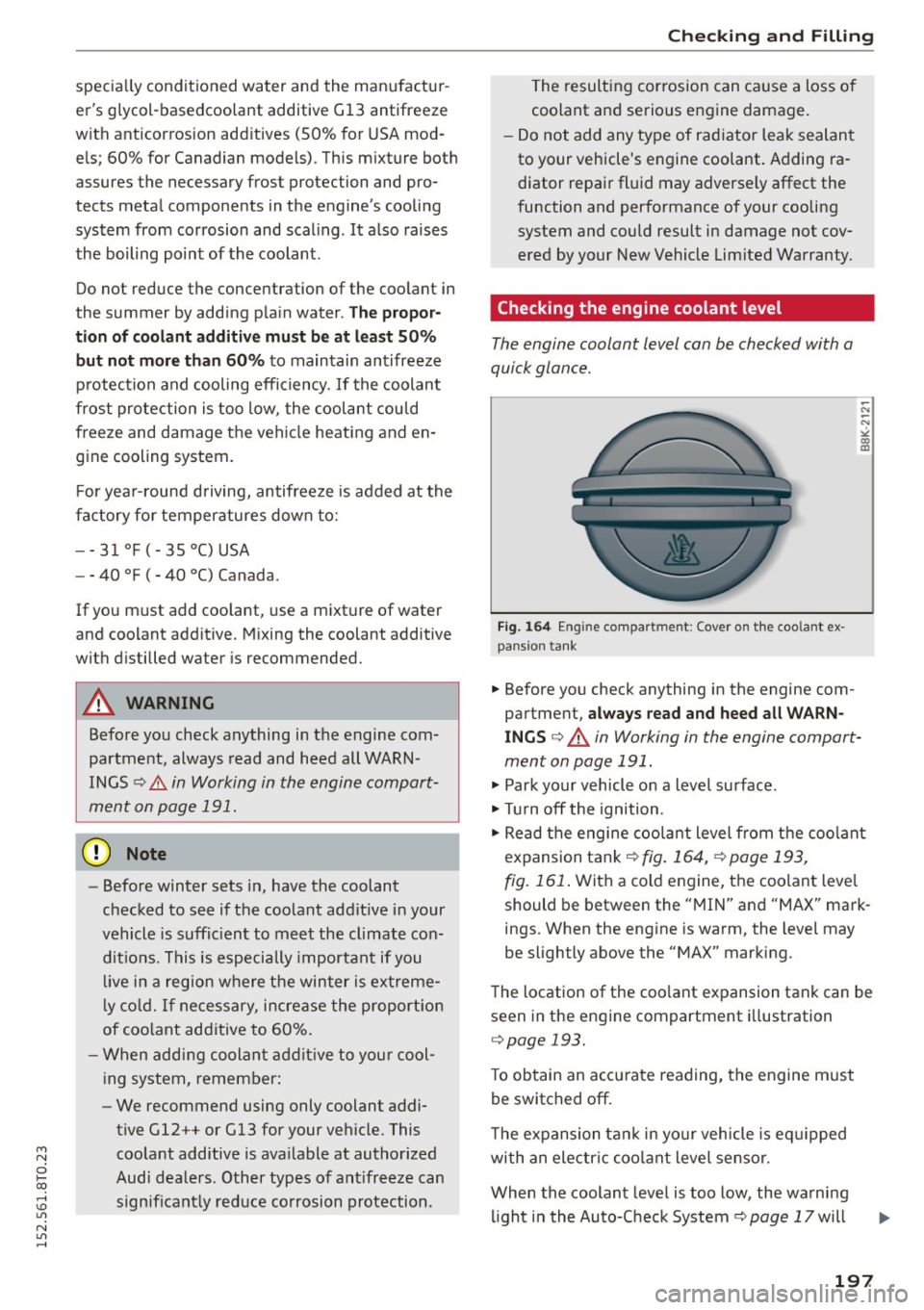
Fi g. 164 Engine compartment: Cover on the coolant ex
pa nsion tank
.. Before you check anything in the engine com
partment,
alwa ys re ad and heed all WARN
INGS ¢ A in Working in the engine compart
ment on page 191.
.. Park your vehicle on a level su rface.
.. Tu rn off the ignition .
.. Read the engine coolant level from the coolant
expansion tank
¢fig . 164, ¢page 193,
fig . 161 .
With a cold engine, the coolant leve l
should be between the "M IN" and "MAX" mark
ings. When the eng ine is warm, the level may
be slightly above the "MAX" marking.
The location of the coo lant expansion tank can be
seen in the engine compartment illustration
¢page 193.
To obtain an a ccur ate reading, the engine m ust
be switched off.
T he expansion tank in yo ur veh icle is eq uipped
with an electric coo lant level senso r.
When the coolant leve l is too low, the wa rn ing
light in the Auto-Check System¢
page 17 will
197