child seat AUDI A5 2015 Owner´s Manual
[x] Cancel search | Manufacturer: AUDI, Model Year: 2015, Model line: A5, Model: AUDI A5 2015Pages: 264, PDF Size: 66.83 MB
Page 34 of 264
Opening and closing
-If the power locking system should fail, you
can still open the fuel tank flap in an emer
gency ~
page 190.
-You are well advised not to keep valuables
inside an unattended vehicle, visible or not.
Even a properly locked vehicle cannot pro
vide the security of a safe.
- If the LED in the upper edge of the driver's
door panel comes on for about 30 seconds
after the vehicle is locked, there is a mal
function in the power locking or the anti
theft warning system. Have the malfunction
corrected by an authorized Audi dealership
or qualified repair facility.
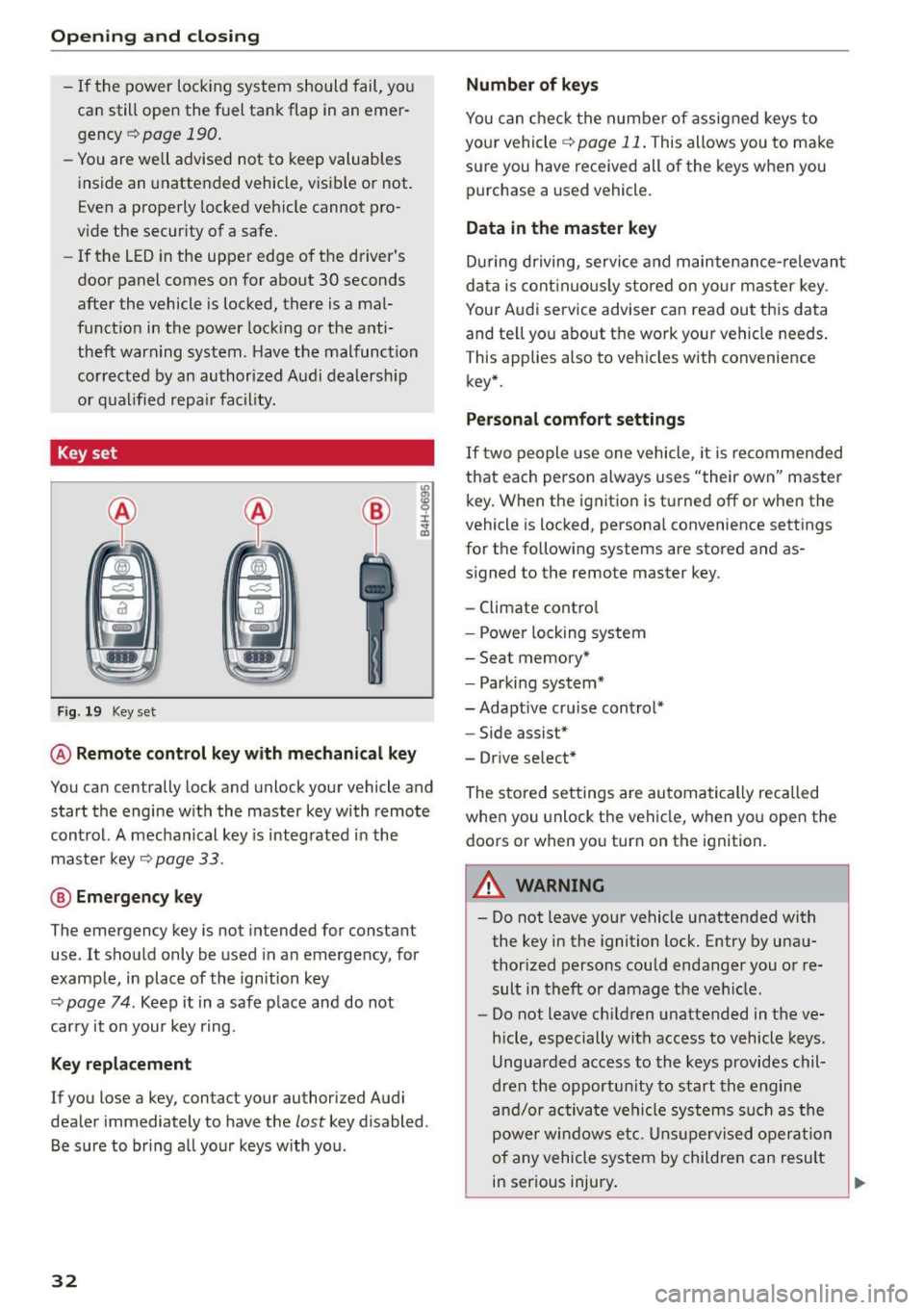
Key set
Fig . 19 Key set
m 0 ±
~
@ Remote control key with mechanical key
You can centrally lock and unlock your vehicle and
start the engine with the master key with remote
control. A mechanical key is integrated in the
master key
~ page 33.
@ Emergency key
The emergency key is not intended for constant
use . It should only be used in an emergency, for
example, in place of the ignition key
~ page 7 4 . Keep it in a safe place and do not
carry it on your key ring.
Key replacement
If you lose a key, contact your authorized Audi
dealer immediately to have the
lost key disabled.
Be sure to bring all your keys with you .
32
Number of keys
You can check the number of assigned keys to
your vehicle
¢ page 11. This allows you to make
sure you have received all of the keys when you purchase a used vehicle.
Data in the master key
During driving, service and maintenance-relevant
data is continuously stored on your master key .
Your Audi service adviser can read out this data
and tell you about the work your vehicle needs.
This applies also to vehicles with convenience
key*.
Personal comfort settings
If two people use one vehicle, it is recommended
that each person always uses "their own" master key. When the ignition is turned off or when the
vehicle is locked, personal convenience settings
for the following systems are stored and as
signed to the remote master key.
- Climate control
- Power locking system
- Seat memory*
- Parking system*
- Adaptive cruise control* - Side assist*
- Drive select*
The stored settings are automatically recalled
when you unlock the vehicle, when you open the
doors or when you turn on the ignition.
A WARNING
-Do not leave your vehicle unattended with
the key in the ignition lock. Entry by unau
thorized persons could endanger you or re
sult in theft or damage the vehicle.
- Do not leave children unattended in the ve
hicle, especially with access to vehicle keys.
Unguarded access to the keys provides chil
dren the opportunity to start the engine
and/or activate vehicle systems such as the
power windows etc. Unsupervised operation
of any vehicle system by children can result
in serious injury.
.
Page 56 of 264
Seat s and storage
Seats and storage
General information
Why is your seat adjustment so important?
The safety belts and the airbag system can only
provide maximum protection if the front seats are correctly adjusted .
There are various ways of adjusting the front
seats to provide safe and comfortable support
for the dr iver and the front passenger . Adjust
your seat properly so that :
- you can easily and quickly reach all the switches
and controls in the instrument panel
- your body is properly supported thus reducing
physical stress and fatigue
- the safety belts and a irbag system can offer
maximum protection
¢ page 129.
In the following sections, you will see exactly
how you can best adjust your seats.
There are special regulat ions and instructions for
installing a child safety seat on the front pas
senger's seat . Always fo llow the information re
garding child safety provided in¢
page 151 ,
Child safety.
_&. WARNING
Refer to¢ page 112, Driving safety for im
portant information, tips, suggestions and
warnings that you should read and follow for
your own safety and the safety of your pas
senge rs.
_&. WARNING
Incorrect seating position of the driver and all
other passengers can resu lt in serious person
al injury.
- Always keep your feet on the floor when the
vehicle is in motion -neve r put your feet on
top of the instr ument pane l, out of the win
dow or on top of the seat cushion. This ap
plies espec ially to the passengers . If your
seat ing position is incorrect, you increase
the risk of injury in the case of sudden brak ing or an accident. If the airbag inflates and
54
the seating position is incorrect, this cou ld
result in personal injury or even death.
- It is important for both the driver and front
passenger to keep a distance of at least
10 inches (25 cm) between themselves and
the steering wheel and/or instrument panel.
If you're sitting any closer than this, the air
bag system cannot protect you properly . In
addition, the front seats and head restraints
must be adjusted to your body height so
that they can give you max imum protect ion.
- Always try to keep as much distance as pos sible between yourself and the steer ing
wheel or instrument pane l.
- Do not adjust the driver's or front passeng
er 's seat while the vehicle is moving. Your
seat may move unexpected ly, causing sud
den loss of vehicle control and persona l in
jury.
If you adjust your seat while the vehicle
is moving, you are out of position.
Driver's seat '
The correct seat position is important for safe
and relaxed driving.
We recommend that you adjust the dr iver's seat
in the following manner:
~ Adjust the seat in fore and aft direction so that
you can easi ly push the pedals to the floor
while keepi ng your knees slightly bent¢ .&,
in
Why is your seat adjustment so important? on
page 54.
~ Adjust the seatback so that when you sit with
your back against the seatback, you can still
grasp the top of the steering wheel.
~ Applies to veh icles with adjustable head re
straints: Adjust the head restraint so the upper
edge is as even as possible with the top of your
head.
If that is not poss ible, try to adjust the
head restra int so that it is as close to this posi
tion as possible ¢
page 57.
_&. WARNING
Never place any objects in the driver's foot
well. An object could get into the pedal area
and interfere with pedal funct ion. In case of
-
Page 57 of 264
M N
0 loo
rl I.O
"' N
"' rl
sudden braking or an accident, you would not
be able to brake or accelerate.
Front passenger's seat
Always move the front passenger seat into the rearmost position .
To avoid contac t with the airbag wh ile i t is de
p loying, do not sit a ny closer to the inst rument
panel than necessary and always wear the three
point safety belt provided adj usted correctly. We
recommend that you adjust the passenger's seat
in the following manner:
• Bring the back rest up to an (a lmost) upright
position .
Do not ride with the seat reclined .
• Applies to vehicles with adjustable head re
stra ints: Adjust the head restra int so the upper
edge is as even as possible with the top of your
head.
If that is not possible, try to adjust the
head restraint so that it is as close to this pos i
t io n as poss ible
¢ page 57.
• Place your feet on the f loor in front of the p as
senger 's seat.
Front seats
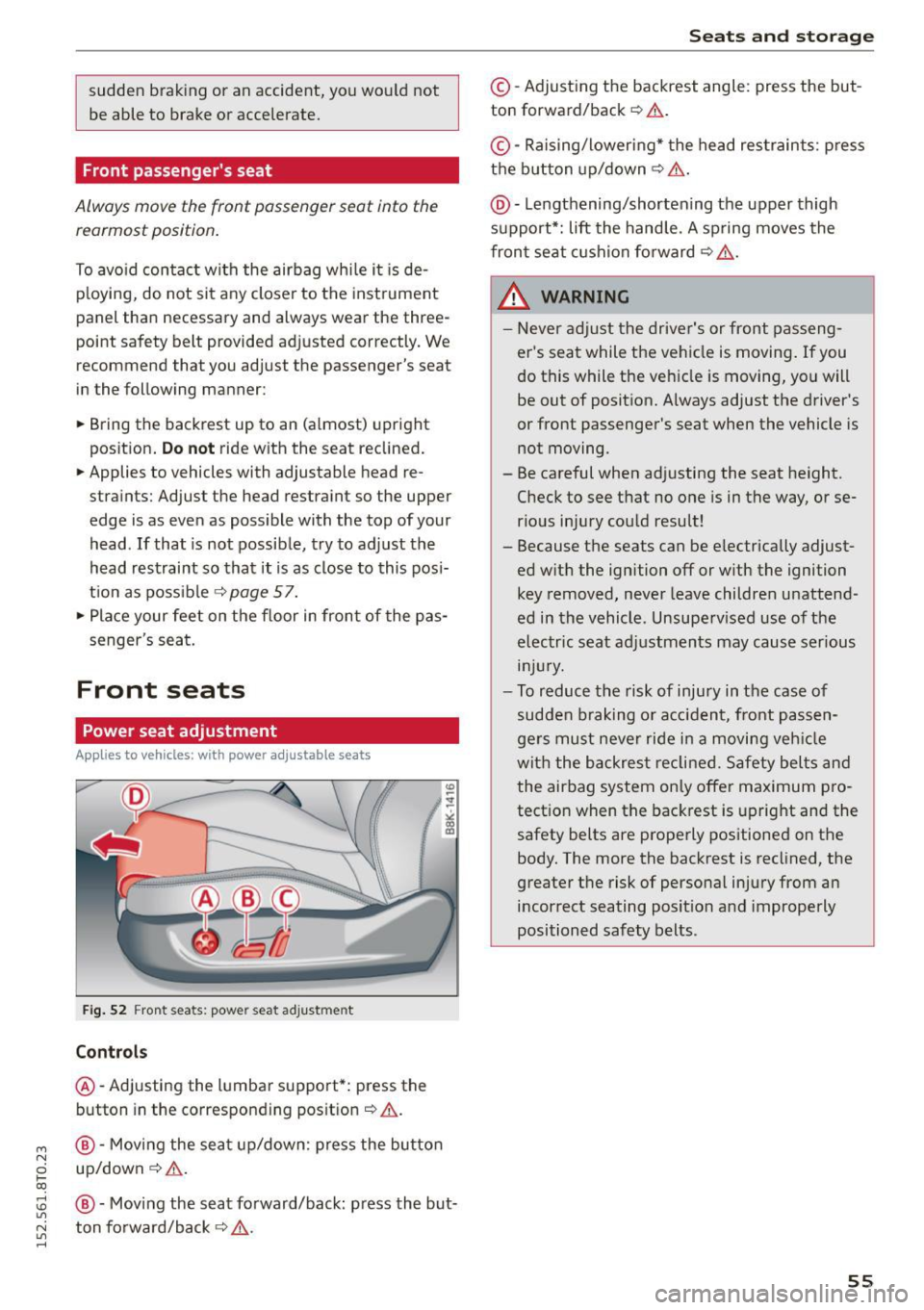
Power seat adjustment
App lies to vehicles : with power adjustable seats
Fig. 52 Front seats: powe r seat a dju st m en t
Controls
@ -Adjusting the l umbar suppo rt*: press the
button in the corresponding pos it io n
c:> & .
@ -Moving the se at up/down: press the bu tto n
up/down ¢ & .
@ -Mov ing the s eat fo rward/back: p ress the but
ton fo rward/back ¢
&,..
Seats and storage
©-Adjust ing the backrest angle : press the but
ton forward/back ¢.&. .
©-Raising/loweri ng* the head res train ts: p ress
t h e b utton up/down¢ &.
@ -Lengthening/shortening the upper thigh
support*: lift the hand le. A sp ring moves the
fron t se at c ushion fo rward ¢
.&..
_& WARNING
-Never a dju st the drive r's or front passeng
er 's seat while the ve hicle is moving .
If you
do this while the ve hicle is moving , you will
be out of position. Always adjust the d river's
or front passenger's seat when the vehicle is
not moving.
- Be careful when adjusting the seat height. Check to see t hat no one is in the way, or se
rious injury cou ld result!
- Because t he seats can be e lectrically adjust
ed w it h the ignition off or w ith the ignition
key removed, never leave children unattend
ed in the vehicle. Unsupe rv ised use of the
elec tric seat ad justments may cause serious
lnJUr y.
-To r educe the risk of inju ry in the case of
sudden b ra king o r ac cident, front passen
ge rs must neve r ride i n a moving veh icle
wit h the b ackres t re clined. Safety bel ts an d
the airbag system only offe r maximum pro
tect ion when the bac krest is upright and the
safety belts are prope rly positioned on the
body. The more the backrest is reclined, the
greater t he risk of personal injury from an
incorrect seating posit io n and improperly
positioned safety belts.
55
Page 60 of 264

Seats and storag e
Rear head restraints
Fig. 58 Rear seats: head restra ints
F ig. 59 Rear head restraints: release
Adjust ing t he he ad rest raints
.. To move the head restraint up, hold it at the
s ides with both hands and slide it upward until
you feel it click into place
c> &.
.. To move the head restraint down, press the
button @
c::> fig. 58 and slide the head restraint
downward.
Remo ving the head re str aints
.. Fold the backrest forward c> page 64.
.. Move the head restra int upward as far as it can
go .
.. Press the release @
c::> fig. 59 with the mechan
ica l key
c::> page 33 a nd the button @ c::> fig. 58.
Pull the head restraint out of the backrest at
the same time¢.&_ .
Inst all ing the head rest raints
.. Slide the posts on the head restra int down into
the gu ides unti l you feel the posts cl ick into
place.
.. Press the button@ ¢
fig. 58 and s lide the head
restraint a ll the way down . Yo u shou ld not be
able to pull the head restraint out of the back
rest .
58
So that the driver can have a better view to the
rear, the head restraints should be pushed down
completely when the rear seats are not occupied .
_& WARNING
-Read and heed all WARNINGS c> page 115,
Proper adjustment of head restraints.
-On ly remove the rear seat head restraints
when necessary in order to install a child
seat ¢
page 159. Install the head restraint
aga in immediately once the chi ld seat is re
moved. Driving w ithout head restraints or
w it h head restra ints that are not properly
adj usted increases the risk of serio us or fa
tal nec k injury dramat ica lly.
- Vehi cles w ith a pass through i n the center
conso le have seating for four. The long cen
ter conso le between t he two rea r seats is
not a seating position . There fore, a safety
be lt is not provided.
(0 Tips
Correct ly adjusted head restraints and sa fety
belts are an extremely effective combination
of safety features .
Memory function
Description
App lies to vehicles: with memory f unction
The memory function allows you to quickly and
eas ily store and recall pe rsonal seating p rofi les
fo r the driver. The memory function is ope rated
th rough the maste r key and the memory bu ttons
in the driver's door .
The driver's seati ng p rofile is stored and assigned
to the master key each t ime the vehicle is locked .
When yo u open the door, the seat profile is auto
matically recalled. If two people use one vehicle,
i t is recommended that each person always uses
"their own" master key .
Up to 2 seat profi les can be stored in the memory
buttons in the d river's door. Once they are stored,
these seat profiles can be selected at any time .
Ill>
Page 62 of 264
Seats and storag e
_& WARNING
Never put waste paper in the ashtray . Hot
ashes or other hot objects in the ashtray could
set waste paper on fire .
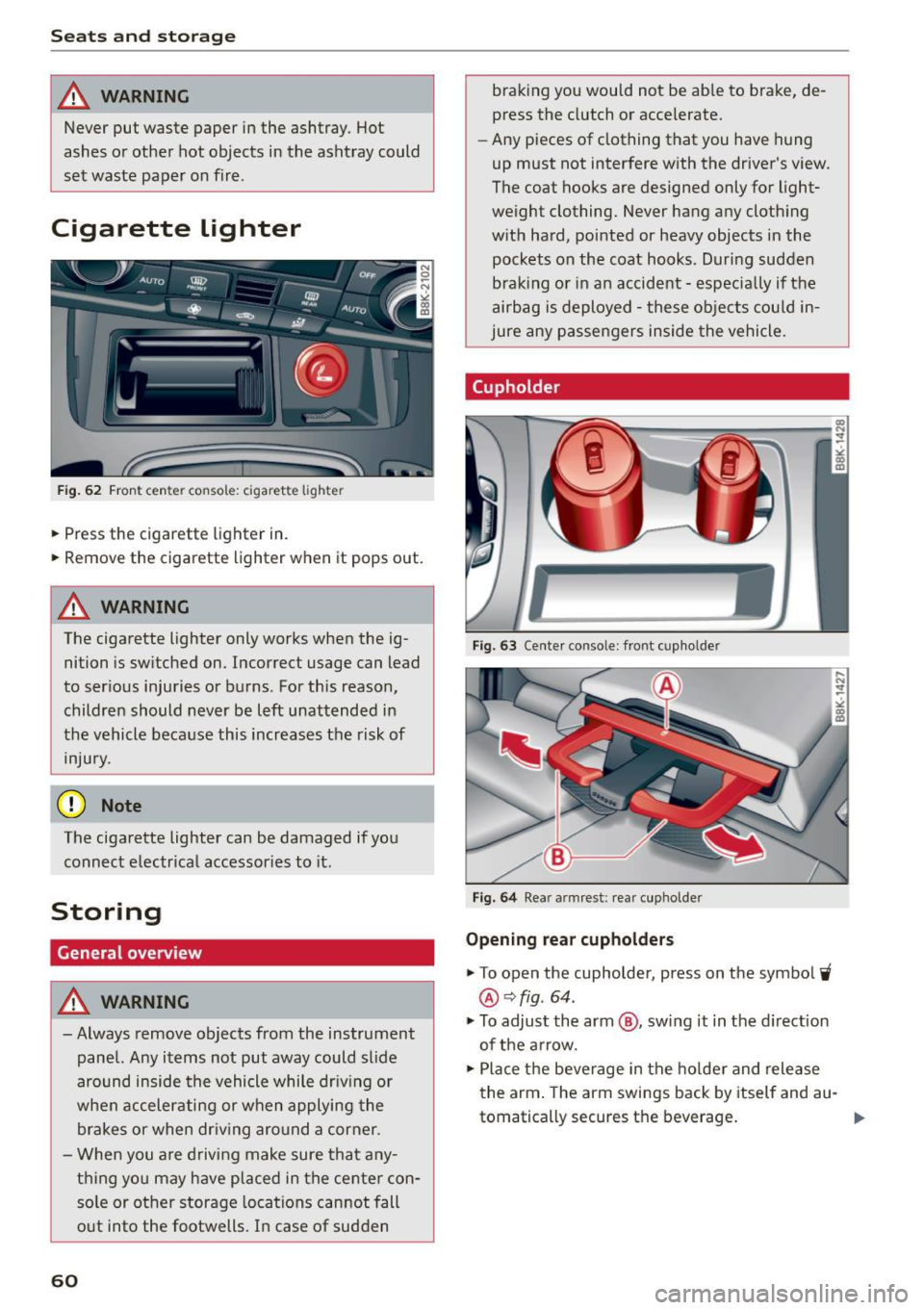
Cigarette Lighter
Fig. 62 Fron t center c onso le: cig arett e lighter
.,. Press the c igarette lighter in .
.,. Remove the cigarette lighter when it pops out .
_& WARNING
The cigarette lighter only works when the ig
nition is sw itched on. Incorrect usage can lead
to ser ious injuries or burns. For this reason,
children should never be left unattended in
the vehicle because this increases the risk of
injury.
(D Note
The ciga rette lighter can be damaged if you
connect electrical accessories to it .
Storing
General overview
_& WARNING
- Always remove objects from the instrument
panel. Any items not put away could slide
around inside the vehicle while dr iv ing or
when accelerating or when applying the brakes or when dr iv ing aro und a corner .
- When you a re driv ing make sure that a ny
thing yo u may have placed in the ce nter con
so le or ot her storage locations can not fall
o ut into the footwells. In case of sudden
60
braking you would not be ab le to brake, de
press the clutch or accelerate.
- Any pieces of clothing that you have hung
up must not interfere with the driver's view .
The coat hooks are designed only for light
weigh t clothing. Never hang any cloth ing
w ith ha rd, pointed or heavy objects in the
pockets on the coat hooks. During sudden
braking or in an accident -espec ially if the
airbag is deployed -these objects cou ld in
jure any p assengers inside the vehicle.
Cupholder
F ig. 63 Center co nsole: front cup holde r
Fig. 6 4 Rea r arm rest: rear cuphol der
Opening re ar cupholders
.,. To open the cupholder, press on the symbol~
®Qfig . 64 .
.,. To adjust the arm @, sw ing it in the d irection
of the a rrow.
.,. Place the beverage in the ho lder and release
the arm . The arm sw ings back by itself and au-
tomatically secures the beverage .
Ill>-
Page 114 of 264
Driving safety
Driving safety
Basics
Safe driving habits
Please remember -safe ty first!
This chapter contains important information,
tips, instructions and warnings that you need to
read and observe for your own safety, the safety
of your passengers and others. We have summar ized here what you need to know about safety
belts, airbags, child restraints as well as child
safety. Your safety is for us
priority number 1. Al
ways observe the information and warnings in
this section - for your own safety as well as that
of your passengers .
The information in this section applies to all
model versions of your vehicle . Some of the fea
tures described in this sections may be standard
equipment on some models, or may be optional
equipment on others. If you are not sure, ask
your authorized Audi dealer.
A WARNING
- Always make sure that you follow the in
structions and heed the WARNINGS in this
Manual.
It is in your interest and in the in
terest of your passengers.
- Always keep the complete Owner's Litera
ture in your Audi when you lend or sell your
vehicle so that this important information
will always be available to the driver and
passengers.
-
- Always keep the Owner's literature handy so
that you can find it easily if you have ques
tions .
Safety equipment
The safety features are part of the occupant re
straint system and work together to help reduce
the risk of injury in a wide variety of occident sit
uations.
Your safety and the safety of your passengers
should not be left to chance. Advances in tech
nology have made a variety of features available
to help reduce the risk of injury in an accident.
112
The following is a list of just a few of the safety
features in your Audi:
-sophisticated safety belts for driver and all pas-
senger seating positions,
- belt force limiters for the front seats,
- belt pretensioners for the seats,
- head restraints for each seating position,
- front airbags,
- side airbags in the front seats,
- side curtain airbags,
- special LATCH anchorages for child restraints,
- adjustable steering column.
T hese individual safety features, can work to
gether as a system to help protect you and your
passengers in a wide range of accidents . These
features cannot work as a system if they are not
always correctly adjusted and correctly used.
Safety is everybody's responsibility!
Important things to do before driving
Safety is everybody's job! Vehicle and occupant
safety always depends on the informed and care
ful driver.
For your safety and the safety of your passen
gers,
before driving always:
.,. Make sure that all lights and signals are operat
ing correctly .
.,. Make sure that the tire pressure is correct.
.,. Make sure that all windows are clean and afford
good visibility to the outside .
.,. Secure all luggage and other items carefully
Q page 60.
.,. Make sure that nothing can interfere with the
pedals .
.,. Adjust front seat, head restraint and mirrors
correctly for your height.
.,. Instruct rear seat passengers to adjust the
head restraints according to their height.
.,. Make sure to use the right child restraint cor
rectly to protect ch ildren
c> page 151 , Child
safety .
.,. Sit properly in your seat and make sure that
your passengers do the same
Q page 54, Seats
and storage.
Page 116 of 264
Driving safety
For detailed information on how to adjust the
driver's seat, see
¢ page 55.
A WARNING
Drivers who are unbelted, out of position or
too close to the airbag can be seriously in
jured by an airbag as it unfolds. To help re duce the risk of serious personal injury:
- Always adjust the driver's seat and the
steering wheel so that there are at least
10 inches (25 cm) between your breastbone
and the steering wheel.
- Always hold the steering wheel on the out
side of the steering wheel rim with your
hands at the 9 o'clock and 3 o'clock posi
tions to help reduce the risk of personal in
jury if the driver's airbag inflates .
- Never hold the steering wheel at the
12 o'clock position or with your hands at
other positions inside the steering wheel
rim or on the steering wheel hub . Holding
the steering wheel the wrong way can cause
serious injuries to the hands, arms and head
if the driver's airbag deploys.
- Pointing the steering wheel toward your
face decreases the ability of the supplemen
tal driver's airbag to protect you in a colli
sion.
- Always sit in an upright position and never
lean against or place any part of your body
too close to the area where the airbags are located .
- Before driving, always adjust the front seats
and head restraints properly and make sure
that all passengers are properly restrained.
- Never adjust the seats while the vehicle is
moving . Your seat may move unexpectedly
and you could lose control of the vehicle.
- Never drive with the backrest reclined or
tilted far back! The farther the backrests are
tilted back, the greater the risk of injury due
to incorrect positioning of the safety belt and improper seating position.
- Children must always ride in child safety
seats
¢page 151. Special precautions ap
ply when installing a child safety seat on the
front passenger seat¢
page 129 .
114
-
Proper seating position for the front
passenger
The proper front passenger seating position is
important for safe, relaxed driving.
For your own safety and to reduce the risk of in
jury in the event of an accident, we recommend
that you adjust the seat for the front passenger
to the following position :
.,. Move the front passenger seat back as far as
possible . There must be a minimum of 10 in
ches (25 cm) between the breastbone and the
instrument panel¢,&. .
.,. Adjust the angle of the seatback so that it is in
an upright position and your back comes in full
contact with it whenever the vehicle is moving.
.,. Applies to vehicles with adjustable head re
straints: Adjust the head restraint so the upper
edge is as even as possible with the top of your head. If that is not possible, try to adjust the
head restraint so that it is as close to this posi
tion as possible .
.,. Keep both feet flat on the floor in front of the
front passenger seat.
.,. Fasten and wear safety belts correctly
¢ page 124.
For detailed information on how to adjust the
front passenger's seat, see ¢
page 54.
A WARNING
Front seat passengers who are unbelted, out
of position or too close to the airbag can be
seriously injured or killed by the airbag as it
unfolds . To help reduce the risk of serious per
sonal injury :
- Passengers must always sit in an upright po sition and never lean against or place any
pa rt of their body too close to the area
where the airbags are located.
- Passengers who are unbelted, out of posi
tion or too close to the airbag can be seri
ously injured by an airbag as it unfolds with
great force in the blink of an eye .
-Always make sure that there are at least 10
inches (25 cm) between the front passen
ger's breastbone and the instrument panel.
Page 117 of 264
M N
i? co ,...., \!) 1.1'1
N 1.1'1 ,....,
-Each passenger must always sit on a seat of
their own and properly fasten and wear the
safety belt belonging to that seat.
- Before driving, a lways ad just the front pas
senger seat and head restraint properly.
- Always keep your feet on the f loor in front
of the seat. Never rest them on the seat, in
strument panel, out of the window, etc. The
airbag system and safety belt will not be able to protect you properly and can even in
crease the risk of injury in a crash .
- Never drive with the backrest recl ined or
t ilted far back! The farther the backrests are
t il ted back, the greater the risk of injury due
to incorrect pos ition ing of the safety belt
and improper seating posit ion.
- Children must always ride in child safety
seats¢
page 151. Spe cial preca utions ap
ply when installing a ch ild safety sea t on the
front passenger seat¢
page 129.
Proper seating positions for passengers in
rear seats
Rear seat passengers must sit upright with both
feet on the floor consistent with their physical
size and be properly restrained whenever the ve hicle is in use.
To reduce the risk of injury caused by an incorrect
seating position in the event of a sudden braking
maneuver or an accident, yo ur passengers on the
rear bench seat must always observe the follow
in g:
~ Make sure that the seatback is securely latched
in the upright pos ition ¢
page 64.
~ Keep both feet flat in the footwell in front of
the rear seat.
~ Fasten and wear safety belts properly
¢ page 124.
~ Make su re that c hildren are always proper ly re
stra ined in a chi ld restraint that is appropriate
for their size and age¢
page 151 .
A WARNING
Passengers who are improperly seated on the
rear seat can be seriously in jured in a crash .
Drivin g s afet y
-Each passenger must always sit on a seat of
their own and proper ly fasten and wear the
safety belt be long ing to that seat.
- Safety belts only offer maximum protection
when the seatback is secure ly latched in the
upright pos ition and the safety belts are
properly pos itioned on the body . By not sit
ting upright, a rear seat passenger increases
the risk of personal injury from improperly
positioned safety belts!
- Always adjust the head restraint p roperly so
that it can give maximum p rotection.
Proper adjustment of head restraints
Applies to veh icles: w it h adjustable head restraints
Correctly adjusted head restraints are an impor
tant part of your vehicle's occupant restraint sys
tem and can help to reduce the risk of injuries in
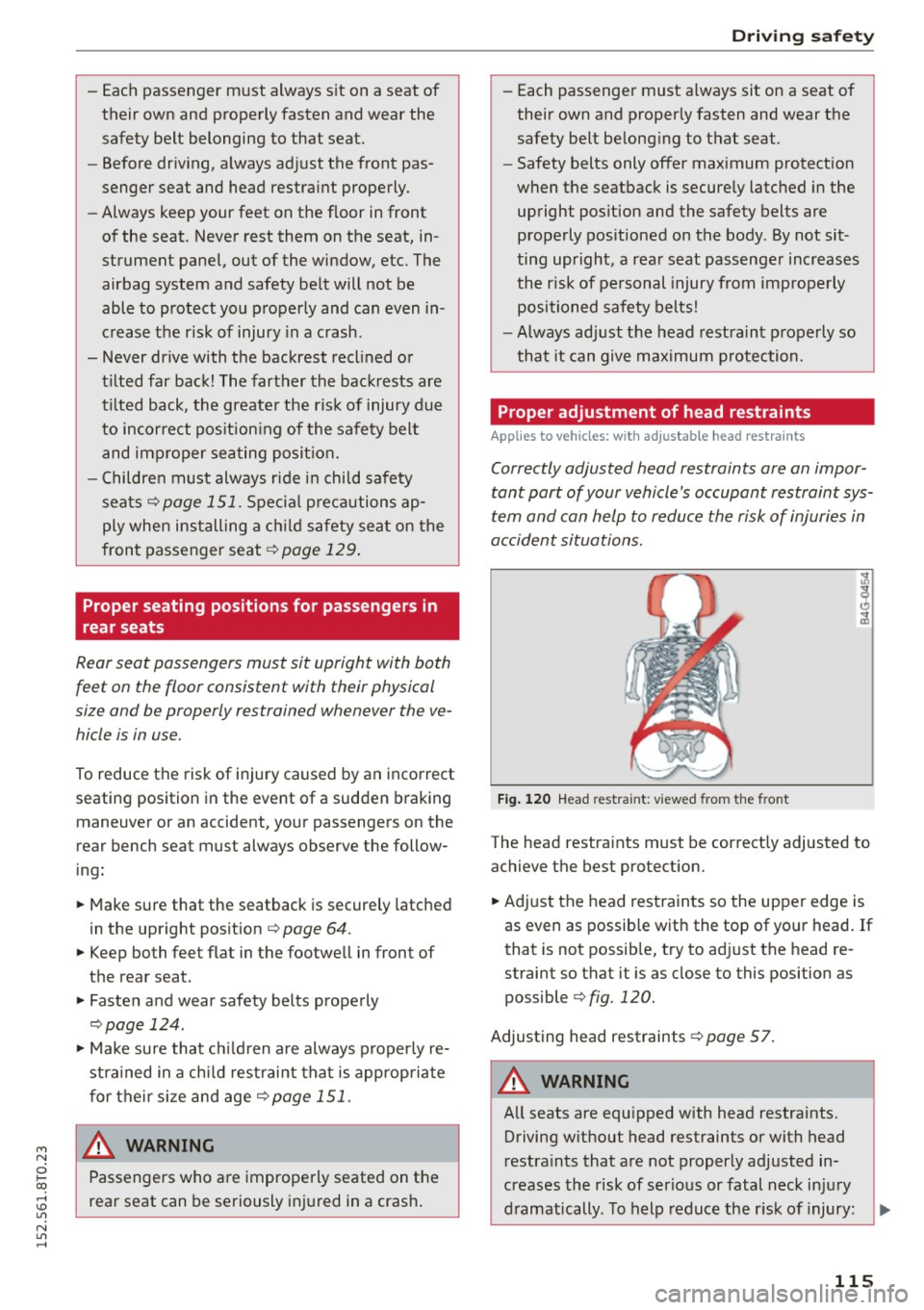
accident situations.
F ig . 1 20 Head restra int: v iewed from t he front
The head restra ints must be cor rectly adjusted to
achieve the best protect ion.
~ Adj ust the head restraints so the upper edge is
as even as possib le w ith the top of your head. If
that is not possible, t ry to ad just the head re
straint so that it is as close to this position as
possible ¢
fig. 120.
Adjusting head restraints ¢page 57.
A WARNING
--
All seats are equ ipped with head restraints.
Driving w ithout head restraints or with head
restra ints that a re not properly adjusted in
creases the risk of serious or fatal neck in ju ry
d ramatically. To help reduce the r isk of injury: ..,.
115
Page 118 of 264
Driving safety
-Always drive with the head restraints in
place and properly adjusted.
- Every person in the vehicle must have a
properly adjusted head restraint.
- Always make sure each person in the vehicle
properly adjusts their head restraint. Adjust
the head restraints so the upper edge is as
even as possible with the top of your head.
If that is not possible, try to adjust the head
restraint so that it is as close to this position
as possib le .
- Never attempt to adjust head restraint wh ile driving .
If you have driven off and
must adjust the driver headrest for any rea
son, first stop the vehicle safely before at
tempting to adjust the head restraint.
- Children must always be properly restrained
in a chi ld restraint that is appropriate for
their age and size ~
page 151 .
Examples of improper seat ing positions
The occupant restraint system can only reduce
the risk of injury if vehicle occupants are properly
seated.
Improper seating positions can cause serious in
jury or death . Safety be lts can only work when
they are properly positioned on the body. Im
proper seat ing pos itions reduce the effectiveness
of safety belts and wi ll even increase the risk of
injury and death by moving the safety belt to crit
ical areas of the body. Improper seating positions
also increase the risk of serious injury and death
when an airbag deploys and strikes an occupant
who is not in the proper seating position. A driver
is responsible for the safety of all vehicle occu
pants and especially for children . Therefore:
~ Never allow anyone to assume an incorrect
seating position when the vehicle is being used
~ .&. -
The following bulletins list only some sample po
si tions that will increase the risk of serious injury
and death . Our hope is that these examples will
make you more aware of seating positions that
are dangerous.
116
Therefore, whenever the vehicle is moving:
-never stand up in the vehicle
- never stand on the seats
- never kneel on the seats
- never ride with the seatback reclined
- never lie down on the rear seat
- never lean up against the instrument panel
- never sit on the edge of the seat
- never s it sideways
- never lean out the window
- never put your feet out the window
- never put your feet on the instrument panel
- never rest your feet on the seat cushion or back
of the seat
- never ride in the footwell
- never ride in the cargo area
A WARNING
Improper seating positions increase the risk
of serious personal injury and death whenever
a vehicle is being used.
- Always make sure that all vehicle occupants stay in a proper seating position and are
properly restrained whenever the vehicle is
being used .
Driver's and front
passenger's footwell
' Important safety instructions
Applies to vehicles : wit h knee airbags
A WARNING
Always make sure that the knee airbag can in
flate without interference. Objects between
yourself and the airbag can increase the risk
of injury in an accident by interfering with the
way the airbag deploys or by being pushed in
to you as the airbag deploys.
- No persons (children) or animals should ride
in the footwell in front of the passenger
seat .
If the airbag deploys, this can result in
serious or fatal injuries.
- No objects of any kind should be carried in
the footwell area in front of the driver's or
passenger's seat. Bulky objects (shopping bags, for example) can hamper or prevent
Page 121 of 264
-Never leave your vehicle unattended espe
cially w ith the rear lid left open. A chi ld
could crawl into the vehicle through the lug
gage compartment and close the rear lid be
coming trapped and unable to get out . Be
ing trapped in a vehicle can lead to serious
persona l inju ry.
- Never let children play in or around the vehi
cle.
- Never let passengers r ide in the luggage
compartment . Veh icle occupants m ust al
ways be properly restrained in one of the ve
hicle's seat ing pos itions.
-Air c irculation helps to reduce window fog
ging . Stale air escapes to the outside
th rough vents in the trim pane l. Be su re to
k eep the se slots free and open.
- The t ire pressure must correspond to the
l oad. The t ire pressure is shown o n the tire
pres sure label. T he tire pressure l abe l is lo
cated on the d river 's side B-pi llar . The t ire
pressure label lists the recommended cold
tire inflation pressures for the vehicle at its
max imum capacity weight and the t ires that
were on your vehicle at the time it was man
ufactured. For recommended tire pressures
for normal load cond it ions, please see chap
te r
c:> page 215.
Tie-downs
App lies to vehicles: wit h tie-downs
The luggage compartment is equipped with four
tie-downs to secure luggage and other items .
Use the tie-downs to secure your cargo proper ly
¢ page 118, Loading the luggage compartment.
In a collision, the laws of phys ics mean that even
sma ller items that are loose in the vehicle w ill
become heavy missiles that can cause serious in
jury. Items in the vehicle possess energy which
va ry w ith vehicle speed and the weight of t he
item . Vehicle speed is the most s ignificant factor .
For example, in a frontal collis ion at a speed of
30 mph (48 km/h), the forces acting on a 10-lb
(4 .5 kg) object are about 20 times the normal
Dr ivin g s afet y
weight o f the item . This means that the weight
of the item would sudden ly be about
200 lbs. (90 kg) . You can imagine the injuries
that a 200 lbs. (90 kg) item flying freely through
the passenger compartment co uld cause in a col
li sion like this .
A WARNING
-Weak, damaged or imprope r straps used to
secure it ems to tie-downs can fail d uring ha rd
b raking o r in a coll is ion and cause seriou s per
son al injury .
- Always use s uitable mount ing straps and
p roperly se cu re i tems to the tie-downs in
the l ugg age compa rtment to he lp prevent
items from sh ifting or flying forward as dan
ge rous missi les.
- W hen the rear seat backrest is folded down,
always use s uita ble mo unting straps an d
properly secu re items to the tie-downs in
the l uggage compa rtment to he lp prevent
items from f ly ing forward as dangerous mis
siles into the passenger compartment.
- Never attach a chi ld safety seat tether strap
to a tie-down.
Reporting Safety Defects
Applicable to U.S.A.
If you belie ve that your vehicle
has a defect which could caus e a
crash or could cause injury or
death, you should immediately in
form the National Highway Traffic
Safet y Adm ini stration (NHTSA) in
addition to notifying Audi of
America, Inc.
If NHTSA re ceives simila r com
pl aint s, it may open an inve stig a
tion , and if it find s that a safety
d efe cts e xis ts in a group of ""
119