spare tire AUDI A5 2020 Owners Manual
[x] Cancel search | Manufacturer: AUDI, Model Year: 2020, Model line: A5, Model: AUDI A5 2020Pages: 302, PDF Size: 81.67 MB
Page 6 of 302
Table of contents
Audi smartphone interface...... al;
Setup... eect ee 211
TrOuUBLESHOOtING wees « & wees « 2 eos so eee 212
Additional settings.............. 213
System settingS.......+seeeeceeveees 213
Software update...............2.000. 214
Connected devices..........-..000005 214
Legalinformation................... 215
Maintenance and Care........... 217
Checking and Filling............. 217
FUClss: + quan ¢ x deme 2 2 seme ey eee & 2 ee 217.
Refuelimgsaiins «+ anawece x a cause « wvensue a © sunnes 218
Emissions control system............. 220
Engine compartment................. 221
ENQineOiles cscceoe s+ serie oo ermace 2 3 ences ¥ es 223
Cooling system. ............ 0. eee eee 227
Braketluid): « s wom as ween a ¢ aewee + & oe 229
Electrical:systemisses «sss ee eee vo wees 229
Battery. ..... 2.00.00 ese eee eee ee 230
Windshield washer system...........- 232
Service interval display............... 233
Wheels.............. 0.0. e eee eee 234
Wheelsiaiid Tires « cass ¢ 2 awe ¢ 2 mean a 5 234
Tire pressure monitoring system....... 252
Care and cleaning................ 254
General information wo. ceo saeco es 254
Car washes...............2..20.00005 254
Cleaning and care information......... 255
Taking your vehicle out of service....... 259
Do-It YOUrSEUT v5 ¢ «gee8 & peas es eee 260
Emergency assistance........... 260
General
information................. 260
EQUIPITICNE sass ¢ ¢ eens + eeen a 3 ces 3s He 260
Tire mobility kit ose: <2 cere ae eee se ees 260
Changingatire..............0.. eee 262
Space-saving spare tire............... 265
JUITIP'SESHEING « cores s « were « ¥ eerws & 2 cores 266
TOWING senses <2 seexsie s > costeine © « serene « o samenes 267
Fuses and bulbs........:6..000005 270
FUSCSiercs i & accaans ao cena ooo mero wom ROI & 270
Bulbs. .... 0... eee eee eee eee eee 274
Customer information........... 275
Data privacy..................000. 275
Image recording............seeeeeees 275
Datamemoniesy. « s sscams sv sume ov ene a 0s 2758
Transmitted information.............. 276
Accessories and technical
CHANGES... 1... eee eee eee 278
Warranty......... 00-000. e eee eee 278
Audi Literature Shop..............00. 278
Driving in other countries............. 278
Maintenance, repairs, and technical
MOGIFIcAatIONS vase x x mem = x saw x 2 sue 278
Accessories and parts................ 280
Reporting Safety Defects.............. 280
Declaration of compliance for
telecommunications equipment and
electronic systems............---0000- 281
Wechinicaldata:... . secs. s wen es ews 283
Identification data................00. 283
Vehicle dataiscs: = s xews 2s eens sp oes ye 283
Index... 0.2... eee 285
Page 244 of 302

Wheels
differently even if they are the
same size > A.
>If you would like to equip your
vehicle with a tire and rim com-
bination that is different from
what was installed at the facto-
ry, consult with an authorized
Audi dealer or authorized Audi
Service Facility before making a
purchase > A.
Because the spare tire® is differ-
ent from the regular tires instal-
led on the vehicle (such as winter
tires or wide tires), only use the
spare tire* temporarily in case of
emergency and drive carefully
while it is in use. It should be re-
placed with a regular tire as soon
as possible.
All four wheels must be equipped
with tires that are the same brand
and have the same construction
and tread pattern so that the
drive system is not damaged by
different tire speeds. For this rea-
son, in case of emergency, only
use a Spare tire* that is the same
circumference as the regular tires.
Z\ WARNING
—Do not use steel rims that are
17 inches or larger. Otherwise,
242
damage to the vehicle and an
accident could result.
—Only use tire/rim combina-
tions and suitable wheel bolts
that have been approved by
Audi. Otherwise, damage to
the vehicle and an accident
could result.
—For technical reasons, it is not
possible to use tires from oth-
er vehicles. In some cases, you
cannot even use tires from the
same vehicle model.
—Make sure that the tires you
select have enough clearance
to the vehicle. Replacement
tires should not be chosen
simply based on the nominal
size, because tires with a dif-
ferent construction can differ
greatly even if they are the
same size. If there is not
enough clearance, the tires or
the vehicle can be damaged
and this can reduce driving
safety and increase the risk of
an accident.
—Only use tires that are more
than six years old when abso-
lutely necessary and drive
carefully when doing so.
—Do not use run-flat tires on
your vehicle. Using them when
Page 246 of 302
Wheels
install the tires from the rear axle
on the front axle and vice versa.
This will allow the tires to have
approximately the same length of
service life.
For unidirectional tires, make sure
the tires are installed according to
the running direction indicated on
the tire sidewall > page 265.
Hidden damage
Damage to tires and rims can of-
ten occur in locations that are hid-
den. Unusual vibrations in the ve-
hicle or pulling to one side may
indicate that there is tire damage.
Reduce your speed immediately.
Check the tires for damage. If no
damage is visible from the out-
side, drive slowly and carefully to
the nearest authorized Audi deal-
er or authorized Audi Service Fa-
cility to have the vehicle inspect-
ed.
Z\ WARNING
Tread that has worn too low or
uneven tread depths on the
tires can reduce driving safety.
This can increase the risk of an
accident because it has a nega-
tive effect on handling, driving
through curves, and braking,
244
and because it increases the
risk of hydroplaning when driv-
ing through deep puddles.
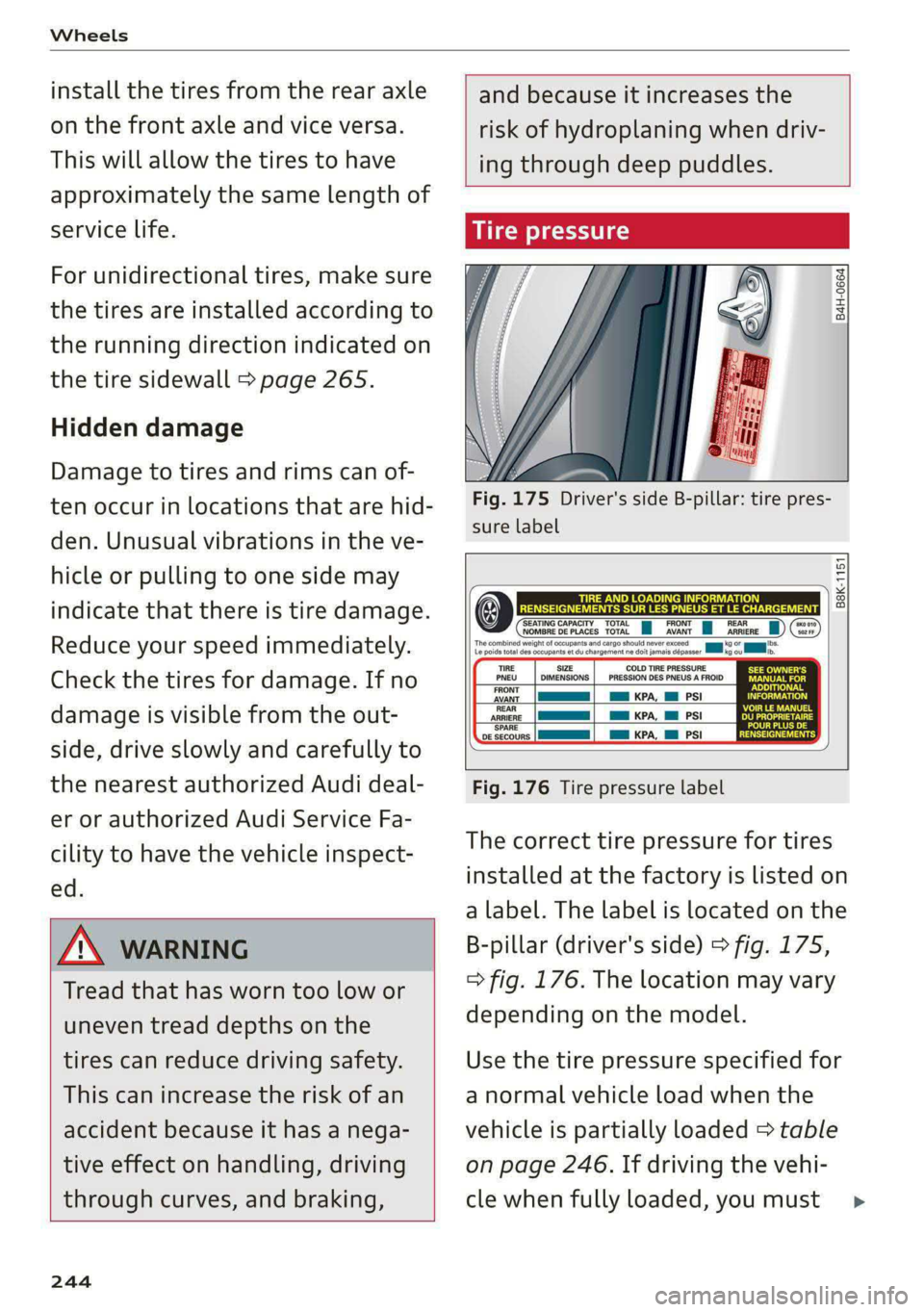
Tire pressure
B4H-0664
Driver's side B-pillar: tire pres- Fig. 175
sure label
B8K-1151
‘SEATING CAPACITY TOTAL JOMBRE DE PLACES TOTAL FRONT, AVANT TEAR
ae
7s or ns
size COLD TIRE PRESSURE
DIMENSIONS | _ PRESSION DES PNEUS A FROID
a KPA, Ml PSI
a KPA, Ml PSI
Ha KPA, MM PSI
PNEU
FRONT
AVANT
REAR
ARRIERE
‘SPARE
DE SECOURS
Fig. 176 Tire pressure label
The correct tire pressure for tires
installed at the factory is listed on
a label. The label is located on the
B-pillar (driver's side) > fig. 175,
> fig. 176. The location may vary
depending on the model.
Use the tire pressure specified for
a normal vehicle load when the
vehicle is partially loaded > table
on page 246. If driving the vehi-
cle when fully loaded, you must >
Page 247 of 302
8W7012721BA
Wheels
increase the tire pressure to the
maximum specified pressure > A.
Checking and correcting tire
pressure
>Check the tire pressure at least
once per month and also check it
before every long drive.
> Always check the tire pressure
when the tires are cold. Do not
reduce the pressure if it increas-
es when the tires are warm.
>Refer to the sticker > fig. 176
for the correct tire pressure.
> Correct the tire pressure if nec-
essary.
> Save the changed tire pressure
> page 253.
> Check the pressure in the spare
tire (compact spare tire)*. Al-
ways maintain the maximum
temperature that is specified for
the tire.
the risk of an accident. Read
and follow the important safe-
ty precautions in > page 247.
—The tire must flex more if the
tire pressure is too low or if
the vehicle speed or load are
too high. This heats the tire up
too much. This increases the
risk of an accident because it
can cause the tire to burst and
result in loss of vehicle con-
trol.
—Incorrect tire pressure increas-
es tire wear and has a negative
effect on driving and braking
behavior, which increases the
risk of an accident.
Z\ WARNING
Always adapt the tire pressure
to your driving style and the ve-
hicle load.
—Overloading can lead to loss of
vehicle control and increase
@) Note
Replace lost valve caps to re-
duce the risk of damage to the
tire valves.
(*) For the sake of the envi-
ronment
Tire pressure that is too low in-
creases fuel consumption.
245
Page 254 of 302

Wheels
ZA WARNING
The temperature grade for this tire is estab-
lished for a tire that is properly inflated and
not overloaded. Excessive speed, underinfla-
tion, or excessive loading, either separately or
in combination, can cause heat buildup and
possible tire failure.
A WARNING
Temperature grades apply to tires that are
properly inflated and not over or underinflat-
ed.
Tire pressure monitoring
system
(1) General notes
Each tire, including the spare (if provided),
should be checked monthly when cold and inflat-
ed to the inflation pressure recommended by the
vehicle manufacturer on the vehicle placard or
tire
inflation pressure label. (If your vehicle has
tires of a different size than the size indicated on
the vehicle placard or tire inflation pressure la-
bel, you should determine the proper tire infla-
tion pressure for those tires).
As an added safety feature, your vehicle has been
equipped with a tire pressure monitoring system
(TPMS)
that illuminates a low tire pressure tell-
tale when one or more of your tires is significant-
ly under-inflated. Accordingly, when the low tire
pressure telltale illuminates, you should stop and
check your tires as soon as possible, and inflate
them to the proper pressure. Driving ona signifi-
cantly under-inflated tire causes the tire to over-
heat and can lead to tire failure. Under-inflation
also reduces fuel efficiency and tire tread life,
and may affect the vehicle's handling and stop-
ping
ability.
Please note that the TPMS is not a substitute for
proper tire maintenance, and it is the driver's re-
sponsibility to maintain correct tire pressure,
even if under-inflation has not reached the level
to trigger illumination of the TPMS low tire pres-
sure telltale.
252
Your vehicle has also been equipped with a TPMS
malfunction indicator to indicate when the sys-
tem is not operating properly. The TPMS mal-
function indicator is combined with the low tire
pressure telltale. When the system detects a
malfunction, the telltale will flash for approxi-
mately one minute and then remain continuously
illuminated. This sequence will continue upon
subsequent vehicle start-ups as long as the mal-
function exists.
When the malfunction indicator is illuminated,
the system may not be able to detect or signal
low tire pressure as intended. TPMS malfunctions
may occur for a variety of reasons, including the
installation of replacement or alternate tires or
wheels on the vehicle that prevent the TPMS
from functioning properly. Always check the
TPMS malfunction telltale after replacing one or
more tires or wheels on your vehicle to ensure
that the replacement or alternate tires and
wheels allow the TPMS to continue to function
properly.
a male emia)
appears
Applies to: vehicles with Tire Pressure Monitoring System in-
dicator
g indicator
The tire pressure indicator in the instrument
cluster informs you if the tire pressure is too low
or if there is a system malfunction.
Using the ABS sensors, the tire pressure monitor-
ing system compares the tire tread circumference
and vibration characteristics of the individual
tires. If the pressure changes in one or more
tires, this is indicated in the instrument cluster
display with an indicator light @ and a message.
If only one tire is affected, the location of that
tire will be indicated.
The tire pressures must be stored again each
time you change the pressures (switching be-
tween partial and full load pressure) or after
changing or replacing a tire on your vehicle
=> page 253. The tire pressure monitoring system
only monitors the tire pressure you have stored.
Refer to the tire pressure label for the recom-
mended tire pressure for your vehicle
=> page 244, fig. 176.
Page 262 of 302

Emergency assistance
Emergency assistance
General information
> Park the vehicle as far as possible from moving
traffic in the event of a breakdown. In the event
of a flat tire, park the vehicle ona level surface.
If you are ona steep hill, be especially careful.
> Set the parking brake.
> Switch the emergency flashers on.
> Have the passengers exit the vehicle. They
should move to a safe place, for example be-
hind a guard rail.
Z\ WARNING
Follow the steps given above. This is for your
protection and the for the safety of others on
the road.
Equipment
e tool kit, tire mobility kit, a
vehicle jack
Applies to: vehicles with the vehicle tool kit, tire mobility kit,
and vehicle jack
ELL POO A
Fig. 177 Luggage compartment: cargo floor cover
The vehicle tool kit, vehicle jack, tire mobility kit
and compressor are stored in the luggage com-
partment under the cargo floor cover.
> Applies to: Coupe/Sportback: To open the front
compartment, lift the cargo floor cover by the
strap @).
> To open the rear compartment, lift the cargo
floor cover by the plastic handle @).
> Applies to: Coupe/Cabriolet: Hook the plastic
handle @) into the luggage compartment seal
or above the power top storage compartment.
260
> Applies to: Coupe/Sportback: To remove the
cargo floor cover completely, pull it toward the
rear using the plastic handle @).
> Applies to: vehicles with spare tire: Turn the
handle counter-clockwise and remove the spare
tire.
> Applies to: Coupe/Cabriolet: Unhook the cargo
floor cover again before closing the luggage
compartment lid.
Depending on vehicle equipment, the vehicle tool
kit, tire mobility kit, and compressor may be lo-
cated under another cover that is secured with a
handwheel.
Applies to: Cabriolet: The vehicle jack is located
under the foam piece. To remove the foam piece,
you must remove the wind deflector*, the com-
pressor securing strap* and the hand wheel.
Applies to: vehicles with vehicle jack in the stor-
age bag: The bag with the vehicle jack is secured
to the tie-downs in the luggage compartment
and must be secured to the tie-downs again after
using it.
ZA WARNING
Applies to: vehicles with vehicle jack in the storage bag
A vehicle jack that is unsecured, incorrectly se-
cured, or not secured in the luggage compart-
ment may slide out of place when braking,
turning, or in an accident, which increases the
risk of injuries to vehicle passengers. To re-
duce the risk of an accident, never transport
the vehicle jack without securing it.
G) Tips
—Insome vehicles, the rear compartment
may not open.
— The vehicle jack in your vehicle is mainte-
nance-free.
Tire mobility kit
Applies to: vehicles with tire mobility kit
> Read and follow the important safety precau-
tions > page 260.
» Set the parking brake.
Page 265 of 302

8W7012721BA
Emergency assistance
> Set the parking brake.
> Select the “P” position.
> When towing a trailer: disconnect the trailer
from your vehicle.
> Lay out the vehicle tool kit > page 260 and the
spare tire > page 265.
> Switch the ignition off.
> Turn the wheel bolt approximately one turn to
the left. To achieve the required torque, hold
the end of the wheel wrench. If the wheel bolt
will not loosen, press carefully on the wheel
wrench with your foot. Hold onto the vehicle se-
curely while doing this and make sure your foot-
ing is stable.
ZA WARNING
The vehicle must also be secured to prevent it
from rolling when using the vehicle jack*. Use
suitable objects to block the front and back of
the wheel that is diagonal from the wheel
with the flat tire.
Removing the caps
B4L-1337
\
®
©
4
&
_——_ A
Fig. 181 Wheel: wheel bolts with caps
?
> Slide the plastic clip from the vehicle tool kit
onto the cap until it engages > fig. 181.
> Remove the cap with the plastic clip.
Loosening the wheel bolts
B8K-1481
Fig. 182 Wheel: loosening the wheel bolt
> Slide the wheel wrench from the vehicle tool kit
all the way onto the wheel bolt.
ZA\ WARNING
To reduce the risk of an accident, only loosen
the wheel bolts gently one turn before raising
the vehicle with the vehicle jack*.
Raising the vehicle
Applies to: vehicles with vehicle jack
2
2 8
Ss a oa
Fig. 184 Sill: positioning the vehicle jack
> Place the vehicle jack from the vehicle tool kit
ona firm surface. Use a flat, stable support if
necessary. On a slippery surface such as tile,
you should use a non-slip pad such as a rubber
mat > A\.
> Find the marking on the sill that is closest to
the tire that will be changed > fig. 183. Behind
the marking, there is a lifting point on the side
sill for the vehicle jack.
> Turn the handwheel to raise the vehicle jack un-
der the lifting point on the side sill until the
263
>
Page 267 of 302

8W7012721BA
Emergency assistance
The wheel bolts must be clean and loosen and
tighten easily. Check the contact surfaces for the
wheel and hub. Contaminants on these surfaces
must be removed before installing the wheel.
ZA\ WARNING
— Read and follow the important information
and notes under > page 241.
— Never use the hex socket in the screwdriver
handle or the hex socket wrench with the
ratchet to loosen or tighten the wheel bolts.
This increases the risk of an accident, be-
cause you will not be able to achieve the cor-
rect tightening specification.
@) Note
When removing or installing the wheel, the
rim
could hit the brake rotor and damage the
rotor. Work carefully and have a second per-
son help you.
Unidirectional tires
A unidirectional tire profile is identified by arrows
on the tire sidewall that point in the running di-
rection. You must always maintain the specified
running direction. This is necessary to ensure the
tire's optimal performance in regard to adhesion,
running noise, and friction, and to reduce the risk
of hydroplaning.
To benefit fully from the advantages of the uni-
directional tire design, you should replace faulty
tires as soon as possible and restore the correct
running direction on all of the tires.
> Reinstall the caps on the wheel bolts if necessa-
ry.
> Store the vehicle tool kit in its designated
place.
> If the removed wheel does not fit in the spare
wheel well, store it securely in the luggage
compartment > page 89.
> Check the tire pressure on the installed wheel
as soon as possible.
> Correct the tire pressure and store it in the MMI
=> page 253.
> The wheel bolt tightening specification must be
90 ft lbs (120 Nm). Have it checked as soon as
possible with a torque wrench. Drive carefully
until then.
> Have the faulty wheel replaced as quickly as
possible.
Space-saving spare tire
Applies to: vehicles with space-saving spare tire (compact
spare tire)
The spare tire is intended for short-term use only.
Have the damaged tire checked and replaced if
necessary by an authorized Audi dealer or author-
ized Audi Service Facility as soon as possible.
There are some restrictions on the use of the
compact spare tire. The compact spare tire has
been designed specifically for your type of vehi-
cle. Do not replace it with the spare tire from an-
other type of vehicle.
The compact spare tire is located in the luggage
compartment under the cargo floor cover
=> page 260.
The tire pressure must be adjusted to a specified
value listed on the tire pressure sticker
=> page 244, fig. 176.
Snow chains
For technical reasons, the use of snow chains on
the compact spare tire is not permitted.
If you have to drive with snow chains and a front
tire fails, mount the spare tire in place of a rear
tire. Install the snow chains on the rear tire that
you removed, and install that in place of the
front tire that failed.
ZX WARNING
— After installing a spare tire, the tire pressure
must be checked as soon as possible.
— Do not drive faster than 50 mph (80 km/h)
with a compact spare tire. Driving faster
than that increases the risk of an accident.
— To reduce the risk of an accident, avoid hard
acceleration or braking and driving fast
around curves with the compact spare tire.
— To reduce the risk of an accident, never drive
with more than one compact spare tire. >
265
Page 268 of 302

Emergency assistance
— Normal summer or winter tires must not be
mounted on the compact spare wheel rim.
@) Note
Secure the space-saving spare tire in the spare
tire well using the handwheel in order to re-
duce the risk of damage to other components.
Jump starting
You should only perform the steps that follow if
you have the necessary tools and technical ex-
pertise.
If the engine does not start because the vehicle
battery is drained, you can jump start your vehi-
cle using another vehicle. Jump start cables are
needed to do this.
Both vehicle batteries must have 12 V nominal
voltage. The voltage capacity (Ah) of the vehicle
battery that is giving power must not be less
than the capacity of the drained vehicle battery.
Jump start cable
Only use a jump start cable with a large enough
diameter. Note the manufacturer's specifica-
tions.
Only use a jump start cable with insulated termi-
nal clamps.
Positive cable - usually red.
Negative cable - usually black.
Z\ WARNING
— A drained battery can freeze at tempera-
tures around 32 °F (0 °C). If the vehicle bat-
tery is frozen, it must be thawed before con-
necting the jump start cables. If it is not,
the risk of an explosion and chemical burns
increases. After jump starting the vehicle,
drive to an authorized Audi dealer or author-
ized Audi Service Facility immediately to
have the vehicle battery checked.
— Read the warnings when working in the en-
gine compartment > page 221.
266
— Handling the jump start cables incorrectly
may cause the vehicle battery to explode
and lead to serious injuries.
C) Note
Jump start cables can cause considerable
damage to the vehicle electrical system if
they are connected incorrectly.
G) Tips
— There must be no contact between the
vehicles, or else voltage could flow when
connecting the positive terminal and drain
the vehicle battery of the vehicle providing
the jump start.
— The drained vehicle battery must be con-
nected correctly to the electrical system.
— Switch off electrical equipment that is not
needed.
Both jump start cables must be connected in the
correct order.
Fig. 187 Engine compartment: connectors for jump start
cables or a charger
Fig. 188 Engine compartment: connectors for jump start
cables or a charger
Page 289 of 302

8W7012721BA
Luggage compartment lid............... 37
Luggage compartment lid with foot motion . 39
Panoramic glass roof...............0005 42
PoWertOpy « » cscs w x eran xs soaner ea mews a ee 47
Sunshade (roof)... .. 6.2... 0. scene eee 42
WITGOWS = saws 2 2 eeuse 5 ¢ eae x 5 eee 6 2 ae 41
Cockpit dimming................02-000 59
Cockpit (overview) ..............0000000 ee 6
Color code... 2... ccc cece ee eee eee eee 283
Compact spare tire........... 0... eee eee 265
GOMPATEMENES!s «6 cave » 6 eunwma » x avers ¥ vara 88
Gompassimtheiminor’s « wim 2 wiwe ax sae x 64
Complianees: « wos ss sews sv aaa « 2 eae x es 281
Conference Calleces = = sews se pews te ees ea: 171
Configuration wizard...............2.00. 18
CONNECE. ke ee ees 176
Data plans: « seis ss nen se nce + een ooo 180
Datta Privatyinns « ws 3 x esmem + onemoai « + arenes 277
Emergency call................-0000- 181
Infotainment): « : sues ¢ s wens « = wows 2 ew 176
Infotainment services...........00000- 177
Online roadside assistance............. 182
Vehicle control services.............0.. 178
Connected devices
Device Overview asics « ssasin sv mses + wave 214
Connections
refer to Media...............0-.- 202, 204
Consumer information................05 278
Consumption
Reducing.......... cee eee eee eee ee 107
Consumption: (Fuel), « wvccwis ow menos © setewe a = ee 15
Contacts
Importing and exporting.............. 173
Updating inthe MMI.................. 173
also refer to Directory..............005 170
Convenience: key: - wevu 2 5 ween ss eee sy were 30
Convenience closing................00 42
also refer to Vehicle key..........-...-. 34
Convenience opening and closing
Windows or panoramic glass roof........ 42
Coolant temperature display.............. 13
Cooling system
Adding
coolant « vss 4 i seen se ecw ae eee 228
Checking the coolant level............. 228
Coolant... 6... cece eee eee eee eee eee 227
Cornering
light. ............. 0. eee e eee 54
Cruise control system.............2+--5 130
Cup holdersyincss «a sive sx onmn oe waren oe eww s 88
Current consumption ...........ceeee cece 15
D
Data module
Serialinumber (IMED) « sevice es ciseava ao wenuane 172
Data plans sorsacs « 0 sersene ¢ o aoeees ¥ o mesa & 8 wa 180
Data Privacy’: « sass gs wows oo eau ¢ 8 mews 2 277
Daté seuss x 2 eyes 2 x eae ¢ # eieS 7 ReuEmS 3 Re 15
SeOTtHA G's » cca oo cess 2 v emeee oo evans o & sae 213
Daytime running lights.................. 54
Declaration of compliance............... 281
DEF {instrument cluster) . vii s vous ss oes Li
Demo mode
refer to Presentation mode............. 193
Destination onthe map...............4. 186
Detailsi: « « wees 2 wen 2: meme oe woe sg co 186
Determining correct load limit........... 249
Digital compass .......... 06. e cece eee eee 64
Dimensions. ...........0.00 000 eee eee 283
Dimming the exterior mirrors............. 60
Dimming the rearview mirror............. 60
DineGtOnyics « » secu « 0 sxeums © o omemeus aw o seers @ & 3 170
Business card. ..........0 0.02000 e eee 170
SOttingS
sacs « s wees + eeee Fs ROER ee SOE F L72
Display
GlOANING)'s » » sews ¢ 2 ewes o © wee oe Rew BBE 257
Displaying tool tips ssc «2 ces ss een ys eee 18
Disposal: s ¢ eens ¢ z sree 5 sees ge eee ae 278
Distance... 0.0... eee eee ee 15
Distance warning..............-.0-.0-. 143
Doors
Child safety LOCK weer: ¢ x oes 2 2 wen 2 5 ewe 40
Door'contact Switch « « sisi és sien a 0 aera oa 58
Mechanically unlocking and locking....... 32
Driver information system................ 12
Drives
refer to Media.............000005 202, 204
Drive select
refer to Audi drive select............... 114
Drive systeM.. 1.2... eee eee eee 106
Audi drive select): seo. < ¢ sau 2s some 2 oe 114
Drive system (message)................. 108
Driving down hills.............2.-0000- 112