weight AUDI A5 CABRIOLET 2011 User Guide
[x] Cancel search | Manufacturer: AUDI, Model Year: 2011, Model line: A5 CABRIOLET, Model: AUDI A5 CABRIOLET 2011Pages: 364, PDF Size: 86.48 MB
Page 211 of 364
Airbag system --------------------------------------------- -=---=----
lowe r pa rts of the body . Front a irbags only supp lemen t th e t hree
po int saf ety b elt s in som e frontal col lisions in which t he vehicl e decel
erat io n is high en ough to d ep loy the a irbags.
Front airbags will not deploy:
• if the ignition is switched off w hen a cras h occ urs ,
• in side co llisions,
• in re ar- end collisions,
• in rollove rs,
• when t he cra sh d ecelera tion m easur ed by the airbag sys te m is le ss
than the min imum threshold needed fo r airbag deployme nt as reg is
t ere d by t he e lectr onic c ontrol u nit.
The front passenger airbag will also not deploy:
• when t he fro nt p ass eng er s eat i s not o ccupi ed,
• when the weight on the front passenge r seat as sense d by the
A dvanc ed Airba g Sy stem indicat es that t he front a irbag o n the
passenge r s id e has to be turned off by the e lectro nic con trol unit (the
PASSENGER AIR BAG OFF lig ht c om es on an d sta ys on).
& WARNING
Sitting in the wrong position can increase the risk of serious injury
in crashes.
• To reduce the risk of injury when the airbags inflate, the driver
and passengers must always sit in an upright position , must not
lean against or place any part of their body too close to the area
where the airbags are located.
• Occupants who are unbelted, out of position or too close to the
airbag can be seriously injured by an airbag as it unfolds with
great force in the blink of an eye=>
page 201.
Controls and equip
ment Safety first Vehicle operation
& WARNING
A child in a rearward-facing child safety seat installed on the front
passenger seat will be seriously injured and can be killed if the
front airbag inflates - even with an Advanced Airbag System.
• The inflating airbag will hit the child safety seat or infant
carrier with great force and will smash the child safety seat and
child against the backrest, center armrest, door or roof.
• Always install rear-facing child safety seats on the rear seat.
• If you must install a rearward facing child safety seat on the
front passenger seat because of exceptional circumstances and
the PASSENGER AIR BAG OFF light does not come on and stay on,
immediately install the rear-facing child safety seat in a rear
seating position and have the airbag system inspected by your
authorized Audi dealer.
& WARNING
Objects between you and the airbag will increase the risk of injury
in a cra sh by interfering with the way the airbag unfolds or by
being pushed into you as the airbag inflates.
• Never hold things in your hands or on your lap when the vehicle
is in use.
• Never transport items on or in the area of the front passenger
seat. Objects could move into the area of the front airbags during
braking or other sudden maneuver and become dangerous projec
tiles that can cause serious personal injury if the airbags inflate .
• Never place or attach accessories or other objects (such as
cupholders, telephone brackets, large , heavy or bulky objects) on
the doors, over or near the area marked "AIRBAG " on the steering
wheel , instrument panel, seat backrests or between those areas
and yourself. These objects could cause injury in a crash, especially
when the airbags inflate .
• Never recline the front passenger's seat to transport objects .
Items can also move into the area of the side airbag or the front
IIJ,,
Vehicle care Do-it-yourself service Technical data
Page 213 of 364
_______________________________________________ A_ ir_ b_ a_,,,g ~ s,,._y _s _t_ e _ m ___ _
PASSENGER AIR BAG OFF light
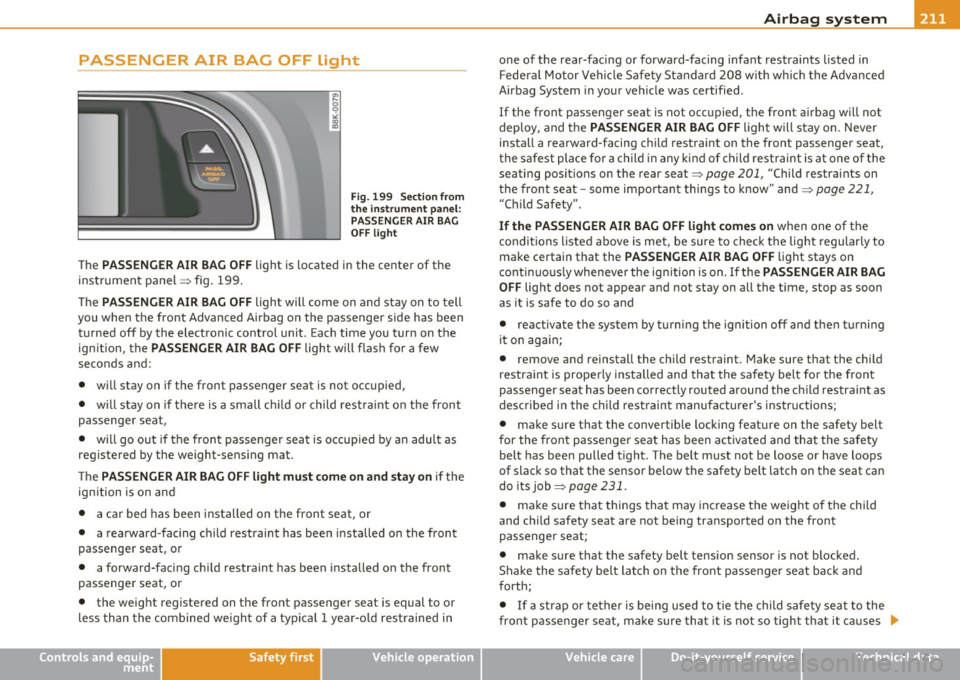
Fig. 199 Section from
the in strument pa nel:
PASSENGER AIR BAG
OFF light
T he PASSENGER AIR BAG OFF light is located in the center of the
ins trume nt panel ~ fig. 199 .
Th e
PASSENGER AIR BAG OFF ligh t will come on and stay on to tell
you when the front Advanced Airbag on the passenger side has been
t ur ne d off by the ele ct ronic control unit. Each t ime you t urn on t he
ign ition, the
PASSENGER AIR BAG OFF light will flash fo r a few
se conds a nd:
• will stay on if t he front passenger seat is not occupied,
• will stay on if th ere is a small c hild or child re strain t on the front
passenger seat,
• will go ou t if th e fron t passe nger sea t is o ccup ied by an adul t as
registe red by t he weight-sens ing mat.
Th e
PASSENGER AIR BAG OFF light must come on and stay on if the
ign ition is on and
• a car bed has been insta lled on t he front seat, o r
• a rearward-facing c hild rest raint has been installed on the front
passenger seat, or
• a forward-faci ng chi ld restraint has bee n in stalled on the front
passenge rseat,or
• the weight reg istered on the front passenger seat is equal to or
less th an the co m bined we ig ht of a ty pical 1 year-o ld re strained in
Controls and equip
ment Safety first
Vehicle operation
one of the rear-facing or forward- facing infa nt restraints listed in
F ede ral Mo tor Ve hicl e Sa fe ty S tan dard 20 8 wit h w hich th e Adv anced
Airbag System in your vehicle was certified .
If the front passenger seat is not occ upied, the front a irbag w ill not
dep loy, and the
PASSENGER AIR BAG OFF l igh t will s tay o n. N ever
install a rearward -facing chi ld restraint on the front passenge r seat,
t he s afest pla ce f or a ch ild in any kind o f ch ild re st ra int is at one of the
seating positions on t he rear seat~
page 201, "Child restra ints on
t he fr ont sea t- som e impo rtant t hings to know" and ~
page 2 21,
"Ch ild Safety" .
If the PASSENGER AIR BAG OFF light comes on when one of t he
co ndi tion s list ed above is m et, be sur e to che ck the light re gu la rly to
ma ke certain that the
PASSENGER AIR BAG OFF lig ht stays on
con tinu ously wheneve r the ignition is o n.
If the PASSENGER AIR BAG
OFF
lig ht does not appear and not stay on all the t ime, stop as soon
as it is safe to do so and
• reactivate the system by turni ng the ignition off and then t urning
it on agai n;
• remove and reinstall the ch ild restraint. Make sure that the ch ild
restra in t is prope rly installed and tha t the sa fety belt fo r the fron t
passenger seat has bee n correctly routed around the c hild restra int as
desc rib ed in the c hild restraint manufacturer's i nstr uctions;
• make s ure that the convertib le loc kin g feature o n the safety belt
for the front passenge r seat has been a ct ivated and t hat t he safety
belt has bee n pulled t ight. The be lt must not be loose or have loops
of slac k so that the senso r be low t he safety belt latch on the seat ca n
do its job~
page 23 1.
• make s ure tha t thi ngs tha t may inc rease the wei ght o f th e chi ld
and c hild safety seat are not bei ng transported on the front
passenge r seat;
• make s ure that the safety belt tension sensor is not blocked.
S hake the sa fety belt la tch on the front passen ger seat back an d
fort h;
• If a strap or teth er i s be ing used to tie the chi ld sa fe ty se at to the
front passe nger seat, make sure that it is not so tight that it causes .,
Vehicle care Do-it-yourself service Technical data
Page 214 of 364
-Airbag
system
----
--=----------------
the weight-sensing mat to measure more weight tha n is actua lly on
t he seat.
If the PASSENGER AIR BAG OFF light still does not come on and
does not stay on cont inuous ly (when the ignition is switched on),
• t ake the child res tra int off the fr ont p assenger seat an d ins ta ll it
properly at one of t he rear seat positions. Have the a irbag system
ins pec ted by your a uth ori zed Audi de aler immedi ately.
• move the child to a rea r seat position and ma ke s ure that the child
is p roperly res trained in a c hild rest rain t th at i s appr opriate fo r its
size and age .
T he
PASSENGER AIR BAG OFF light shou ld NOT come on when the
ignition is on a nd an adult is sitt ing in a proper sea ting pos ition on the
front passenger seat. If the
PASSENGER AIR BAG OFF light comes on
and s tays on o r flashes fo r abo ut 5 seconds while d riving, under these
circumstances, make sure that:
• t he adul t on the front passenger se at is pro perly seate d on the
center of the seat cushi on with his or her back up against the backrest
an d t he bac krest is not reclined => page 178, "P roper occ upan t
seating posit ions",
• t he adult is not tak ing weig ht o ff t he sea t by holding on to th e
passenge r assist handle above the front passe nger door or
supporti ng thei r weight on the armrest,
• the safety belt is be ing properly wor n and that there is not a lot of
s la ck in th e s afe ty be lt webb ing,
• accessory seat cove rs or cushions o r othe r th ings that may ca use
an in corre ct re ading o r impre ss io n on th e weigh t-sensin g m at un der
the upholstery of the seat have been removed from the front
p as senge r se at,
• a sa fety be lt extender has not been left in th e safety belt latch for
th e fr ont pas senger se at.
In addit io n to t he
PASSENGER AIR BAG OFF light in t he center of the
instrument pane l, the message
PASSENGER AIR BAG OFF o r
PASSENGER AIR BAG ON w ill briefly appea r in th e inst rument cluster display
. This is to inform the dr ive r of the current front passenger
a irb ag s tat us.•
Important safety instructions on
monitoring the Advanced Airbag System
& WARNING
An airbag system that is not functioning properly cannot provide
supplemental protection in a frontal crash.
• If the airbag indicator light comes on, it means that there may
be something wrong with the Advanced Airbag System.
It is
possible that the airbag will inflate when it is not supposed to, or
will not inflate when it should.
• Have the airbag system inspected immediately by your autho
r ized Audi dealer.
& WARNING
If the front airbag inflate s, a child without a child restraint, in a
rearward-facing child safety seat or in a forward-facing child
restraint that has not been properly installed will be seriously
injured and can be killed.
• Even though your vehicle is equipped with an Advanced Airbag
System, make certain that all children, especially 12 years and
younger, always r ide on the back seat properly restrained for their
age and size.
• Always install forward or rear-facing child safety seats on the
rear seat -even with an Advanced Airbag System.
• If you must install a rearward-facing child safety seat on the
front passenger seat because of exceptional circumstances and
the PASSENGER AIR BAG OFF light does not appear and stay on, immediately install the rear-facing child safety seat in a rear
~
Page 215 of 364
Airbag system Ill
----------------=--=---
& WARNING (co ntinued )
seating position and have the airbag system inspected by your
authorized Audi dealer.
• A tight tether o r other strap on a rearward -facing child
restraint attached to the front pa ssenger seat can put too much
pressure on the weight -sensing mat in the seat and register more
weight than i s actually on the seat . The heavier weight regi stered
can make the system work as though an adult were on the seat
and deploy the Advan ced Airbag when it mu st be suppre ssed
causing serious or even fatal injury to the child .
• If , in exceptional circumstanc es, you must install a forward
facing child restraint on the front passenger seat, always move
the seat into its rearmost po sition in the seat' s fore and aft adjust
ment range, as far away from the airbag as possible . The backrest
must be adjusted to an upright position. Make sure that the PASSENGER AIR BAG OFF light comes on and stays on all the time
whenever the ignition is switched on.
& WARNING
• If the PASSENGER AIR BAG OFF light doe s not go out when an
adult is sitting on the front passenger seat after taking the steps
described above, make sure the adult is properly seated and
restrained at one of the rear seating positions.
• Have the airbag system inspected by your authorized Audi
dealer before transporting anyone on the front passenger seat .
[ i ] Tips
If the we ight-sens ing mat in the front passenger seat detects an
em pty seat, the front airbag on the passenge r side will be t urne d off,
and PASSENGER AIR BAG OFF will stay on.•
Controls and equip ment Safety first Vehicle operation
Repair, care and disposal of the airbags
Parts of the airbag system a
re insta lled at many different places on
your Audi. I nstall ing, remov ing, serv icing o r rep airi ng a pa rt in an
area of the vehicle ca n damage a part of a n airbag system and prevent
t ha t sys tem from working prope rly in a coll is io n.
Th ere are some importa nt things you have to know to ma ke sure t hat
the effectiveness of the system will not be impai red and that
dis ca rded compo nents do not cause injury or po llute t he e nvir on
ment .
& WARNING
Improper care , serv icing and repair procedures can increase the
risk of personal injury and death by preventing an airbag from
deploying when needed or deploying an airbag unexpectedly:
• Never cover, obstruct, or change the steering wheel horn pad or
airbag cover or the instrument panel or modify them in any way .
• Never attach any objects such as cupholders or telephone
mountings to the surfaces covering the airbag units .
• For cleaning the horn pad or instrument panel, use only a soft ,
dry cloth or one moistened with plain water . Solvent s or cleaners
could damage the airbag cover or change the stiffness or strength
of the material so that the airbag cannot deploy and protect prop
erly.
• Never repair, adjust, or change any part s of the airbag system .
• All work on the steering wheel, instrument panel , front seats
or electrical sy stem (including the installation of audio equip
ment, cellular telephones and CB radios, etc. ) must be performed
by a qualified technician who has the training and special equip ment necessary .
• For any work on the airbag system, we strongly recommend
that you see your authorized Audi dealer or qualified workshop.
• Never modify the front bumper or parts of the vehicle body . ..,_
Vehicle care Do-it-yourself service Technical data
Page 223 of 364
Child Safety -
-------------------"'---.,,.
Child Safety
Important things to know
Introduction
The rear seat is generally the safest place in a collision.
The physical pr in ci ples o f wha t happens w hen yo ur vehicl e is in a crash
app ly a lso to children=>
page 191, "What happens to occupants not
wearing safety be lts?". But unlik e adu lts and teenagers, the ir
muscles and bones are not fully developed. In many respects c hildren
are at greate r risk of ser io us injury in cras hes than adults .
Because children 's bodies a re not f ully deve loped, they require
restraint systems especially designed fo r their size, weight, and body
st ruct ure. Many cou ntries and all states of t he Unite d States and
prov inces of Canada have laws req uiring the use of approved ch ild
restrain t sys tems for infan ts an d sm all ch ild ren .
I n a fronta l crash at a speed of 20 -35 mph (30-56 km/h) the forces
act ing o n a 13- pound (6 kg) infant w ill be more than 20 times the
we ight of the ch ild . This means the we ight of the child wo uld
suddenly be more than 260 po unds (120 kg). Unde r these conditions,
only a n app ropr iat e child restra int proper ly used can red uce the risk
o f serious injury. Child restrai nts must be used properly to be e ffec
t ive. Used i mpro perly, t hey can increase the risk of serio us injury in an
acc ident.
C onsult the ch ild safety seat manufacturer's instr uctions in order to
be sure the seat is r ight for you r child's size=>
page 224, "Important
safety instructions fo r using child safety seats". P lease be s ure to
read and heed a ll of the important informa tion and WAR NINGS
about chi ld safety, Advanced Airbags, an d the installation of child
restra in ts in this chapte r.
There is a lot you need to know about the Advanced Airbags in your
vehicle and how t hey wo rk when inf ants and childre n in child
restra ints are on the front passenger seat. Beca use of t he large
Controls and equip
ment Safety first Vehicle operation
amou
nt of importa nt info rmation, we cannot repeat i t all he re. We
urge you to read the detailed information in th is owne r's man ua l
abou t airbags and t he Advanced A irbag Syste m in your vehicle and the
very important information abo ut transporting c hildren on the front
p assenger se at. P lea se be sure to heed the WARNIN GS - they a re
extremely important for your safety and the safety of your passe n
gers, especially infan ts and small ch il dre n.
& WARNING
• Accid ent statisti cs have shown that children are generally safer
in the rear seat area than in the front seating position. Always
re strain any child age 12 and under in the rear.
• All vehicle occupants and especially children must be
restrained properly when ever riding in a vehicle. An unre strained
or improperly restrained child could be injured by striking the
interior or by being ejected from the vehicle during a sudden
maneuver or impact. An unrestrained or improperly rest rained
child is also at greater risk of injury or death through contact with
an inflat ing airbag .
• A suitable child restraint properly installed and used at one of
the rear seating posi tions provides the highest degree of protec
tion for infants and small children in most accident situations.
& WARNING
Children on the front seat of any car even with Advanced Airbags
can be seriously injured or even killed when an airbag inflates. A
c hild in a rearward -facing child safety seat ins talled on the front
passenger seat will be seriously injured and can be killed if the
front airbag inflate s.
• The inflating airbag will hit the child safety seat or infant
c arrier with great force and will sma sh the child safety seat and
child aga inst the backrest, or door. •
Vehicle care Do-it-yourself service Technical data
Page 224 of 364
____ C_h _i_ld _ S_a _f ...;.e ....:t "- y ________________________________________ _
& WARNING (conti nued)
• Alway s in stall rearwa rd-facing child safety seats on the rear
seat.
• If you must install a rearward facing child safety seat on the
front passenger seat in exceptional circumstance s and the
PASSENGER AIR BAG OFF light does not come on and stay on ,
immed iately install the rearward-facing child safety seat in a rear
seating position and have the airbag system inspected immedi
ately by your authorized Audi dealer .
& WARNING
If, in exceptional circumstances, you must install a forward-facing
child res traint on the front pas senger's seat:
• Always make sure the forward-facing seat has been designed
and certified by it s manufacturer for use on a front seat with a
passenger front and side airbag.
• Always follow the manufacturer 's instruction s provided with
the child safety seat or carrier.
• Always move the passenger seat into it s rearmost position in
the seat 's fore and aft adjustment range, as far away from the
airbag as possible before installing the child restraint. The back rest must be adjusted to an upright position.
• Always make sure that the PASSENGER AIR BAG OFF light
comes on and stays on all the time whenever the ignition is
switched on .•
Advanced front airbag system and children
Your vehicle is equi pped wi th a fron t "Advanced Airbag System" in
compliance with United States Federal Motor Vehicle Safety Standard
( F MVSS) 2 08 as appli ca ble at t he time your ve hicle was manufa c
tured. The Advanced A
irbag system in yo ur vehicle has been certif ied to
mee t the "low -r is k" requiremen ts fo r 3-and 6-ye ar old ch ildre n on
t he passenger side and small adults on the dr iver side . The low risk
dep loyment criteria are inten ded to reduce the risk of injury through
interaction with the a irbag t hat can occur, for example, by being too
close to the stee ring wheel an d instr ument panel when the airbag
inflates. In addi tion, the system has been certified to comp ly with t he
"suppression" requirements of the Safety Standa rd, to t urn off the
fron t air bag for infan ts up to 1 2 months who a re res train ed on the
front passenger seat in child restrai nts that are listed in the Stan
d ar d.
Even thoug h your vehicle is equipped with an Advanced Airbag
system , a ll ch ildren, especially those 12 years and yo unger, should
always r ide in t he back seat p roperly restrained for t heir ag e and si ze .
Th e ai rbag on the passenge r si de makes the front seat a potentia lly
dange rous p lace for a child to r ide. Th e front seat is not th e safest
place fo r a child in a forward-facing c hild safety seat. It can be a very
d an ge rous p lace for a n infan t or a large r chil d i n a rea rwa rd-facing
seat. •
Advanced Airbags and the weight-sensing
mat in the front seat
Th e Advanced A irbag System i n your ve hicle de tects t he p resence o f
an infa nt o r ch ild in a child rest rai nt on the fro nt passenger sea t using
the we ight-sens ing mat in the seat cushion and the senso r be low the
saf ety belt la tch o n th e front passenge r seat tha t measur es t he
tension on the safety belt.
Th e weigh t-sens ing ma t me asures tot al we ight of the child and the
child safety seat and a child blanket on the fro nt passe nger seat . The
we ight on the fro nt passenger se at is re lated to t he design of the
child res traint and i ts "footpri nt", the size and shape of t he bottom
of the ch ild restraint as it sits o n the seat . The weight of a child
restrain t an d its "foo tpr int" vary for differe nt k inds of child res tra ints .,_
Page 225 of 364
__________________________________________ ___:C~ h~il ~d ~ S~a ~f ~e ~t ¥_Y __ _
and for the different models of the same kind of child restraint
offered by child restraint manufacturers.
The weight ranges for the individual types, makes and models of ch ild
restraints that the NHTSA has specified in the Safety Standard
together with the weight ranges of typical infants and typical 1 year
old child have been stored in the control unit of the Advanced Airbag
System. When a child restraint is being used on the front passenger
seat with a typical 1 year-old chi ld, the Advanced Airbag System
compares the weight meas ured by the weight sensing mat with the
information stored in the electronic control unit .
The electronic contro l unit a lso registers the tension on the front
passenger safety belt. The tension on the safety belt for the front
passenger seat will be different for an adult who is properly using the
safety belt as compared to the tension on the belt when it is used to
attach a child restraint to the seat . The sensor below the latch for the
safety belt for the front seat passenger measures the tension on the
belt. The input from this sensor is then used with the weight to
"decide", whether there is a child restraint with a typical 1 year-old
child on the front passenger seat and whether or not the airbag must
be turned off .•
Child restraints and Advanced Airbags
Regardless of the child restraint that you use, ma ke sure that it has
been certified to meet United States Federal Motor Vehicle Safety
Standards and has been ce rtified by its manufacturer for use with an
airbag . Always be sure that the child restraint is properly installed at
one of the rear seating positions. If in exceptional circumstances you
must use it on the front passenger seat, carefully read all of the infor
mation on ch ild safety and Advanced Airbags and heed all of the
app licab le WARNINGS. Make certain that the child restra int is
correctly recognized by the weight-sensing mat inside the front
passenger seat, that the front passenger airbag is turned off and that
the airbag status is always correctly signaled by the
PASSENGER AIR
BAG OFF
light.
Controls and equip ment Safety first Vehicle operation
Many types and models of child restra
ints have been available over
t he years, new models are introduced reg ularly incorpo rating new
and improved designs and older models are taken out of product ion.
Chi ld restraints are not standardized. Child restraints of the same
type typ ically have d ifferent weights and sizes and differe nt 'foot
prints,' the size and shape of the bottom of the child restraint that
sits on the seat, when they are installed on a vehicle seat . These
differences make it virtually impossib le to certify compliance with
t he requirements for advanced airbags with each and every chil d
restra int that has ever been sold in the past or will be sold over the
course of the useful life of your vehicle.
For this reason, the United States Nationa l Highway Traffic Safety
Administration has published a list of specific type, makes and
mode ls of child restra ints that must be used to cert ify compliance of
the Advanced Airbag System in yo ur vehicle with the suppression
requirements of Federal Motor Veh icle Safety Standard 208. These
child restraints are:
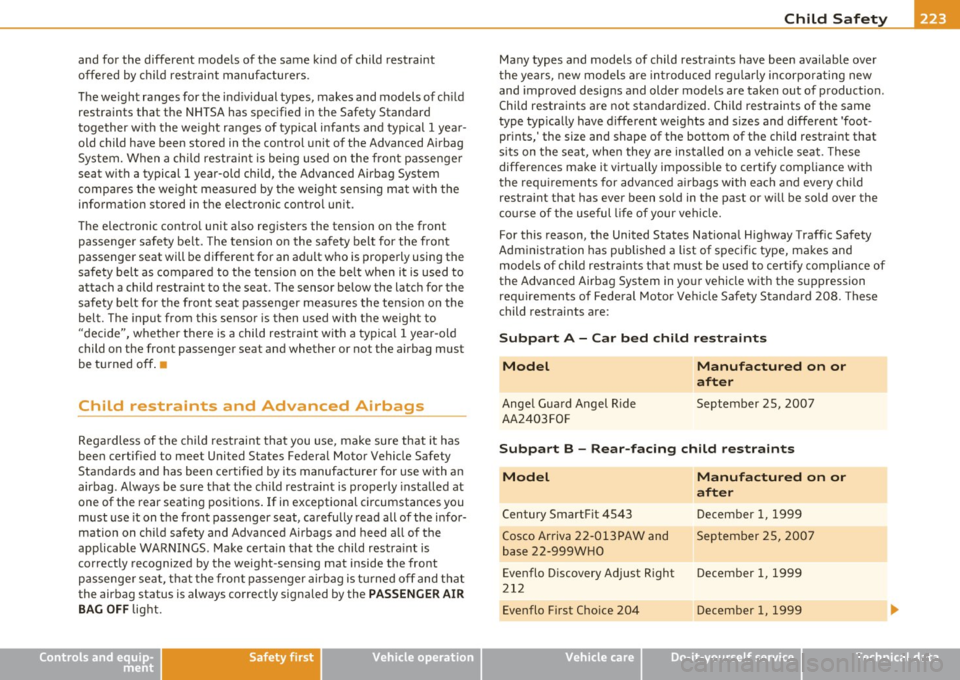
Subpart A - Car bed child restraints
Model
Angel Gua rd Angel Ride
AA2403 FOF
Manufactured on or
after
September 25, 2007
Subpart B -Rear-facing child restraints
Model
Century SmartF it 4543
Cosco Ar riva 22-013PAW and
base 22-999 WHO
Evenflo D iscovery Ad just Right
21 2
Evenflo First Cho ice 204
Manufactured on or
after
December 1, 1999
September 25, 20 07
December 1, 1999
December 1, 1999
Vehicle care Do-it-yourself service Technical data
Page 227 of 364
_____________________________________________ C_h _i_ld _ S_ a_ f_ e_ t_. y'--- __
- If a stra p or tet her is be ing us ed to tie t he chil d safety seat
to t he fro nt passenger seat, make sure that it is no t so
tight that i t causes the weight-sens ing ma t to measure
more weight t han is act ually on the seat.
Alw ays reme mbe r: Even though yo ur vehicle is equip ped with an
Adva nced Airbag system, all ch ild ren, especially those 12 years a nd
younger, should a lways ride in the bac k seat proper ly rest ra ined for
their age and size .
& WARNING
Not using a child safety seat, us ing the wrong child safety seat or
improperly in stalling a child re straint in crea se s the ri sk of serious
personal injury and death .
• All vehicle oc cupants and e specially children mu st always be
restrained properly whenever riding in a vehicle.
- An unrestrained or improperly restrained child can be injured or killed by being thrown against the inside of the
vehicle or by being ejected from it during a sudden maneuver
or impact .
- An unre strained or improperly restrained child is at much
greater risk of injury or death by being struck by an inflating
airbag .
• Commercially a vailable child safety seats are requi red to
c omply with U .S. Federal Motor Vehicle Safety Standard (FMVSS )
213 (in Canada CMVSS 213 ).
- When buying a child restraint, select one that fits your child
and the vehicle.
- Only u se child restraint sy stem s that fully contact the flat
portion of the seat cushion . The child rest raint must not tip or
lean to either side . Audi does not recommend using child
s a fety seats that rest on legs or tube-like frames. They do not
provide adequate contact with the seat .
Controls and equip ment Safety first Vehicle operation
& WARNING
(co ntinued )
-Always heed all legal requirements pe rtaining to the in stal
lation and use of child safety seat s and carefully follow the
inst ructions provided by the manufacturer of the seat you are
using.
• Never allow child ren under 57 inches (1.5 meters ) to wear a
normal safety belt . They must always be restrained by a prop er
child restraint system . Otherwise , they could sustain injuries to
the abdomen and neck areas during sudden braking maneuvers or accidents.
• Never let more than one child occupy a child safety seat.
• Never let babies or olde r children ride in a vehicle while sitting
on the lap of another passenger.
-Holding a child in your arms is never a sub stitute for a child
restraint system .
- The stronge st p ers on could not hold the child with the force s
that e xist in an accident . The child will strike the interio r of the
v ehicle and can also be struck by the pa ssenger.
- The child and the passenger can also injure each other in an
accident.
• Never install rear-facing child safety seats or infant carriers on
the front pas senger seat. A child will be seriously injured and can
be killed when the passenger airbag inflates - e ven with an
Advanced Airbag Sy stem .
• The inflating airbag will hit the child safety seat or infant
c arrier with great force and will sma sh the child safety seat and
child aga inst the bac krest, center arm rest, door o r roof.
• Always in stall rear -facing child safety seats or infant carriers
on the rear seat .
• Forward-facing child safety seats installed on th e front
passenger 's seat can interfere w ith the airbag when it inflates and
c ause seriou s injury to the child . Always install forward-facing
c hild safet y seats on the rear seat . .,
Vehicle care Do-it-yourself service Technical data
Page 229 of 364
Child safety seats
Infant seats
Babies an d infan ts up t o a bout one y ear old a nd 2 0 lbs . or
9 kg need speci al rearward -facing child res tra int s tha t
s upport th e back, nec k and head in a crash.
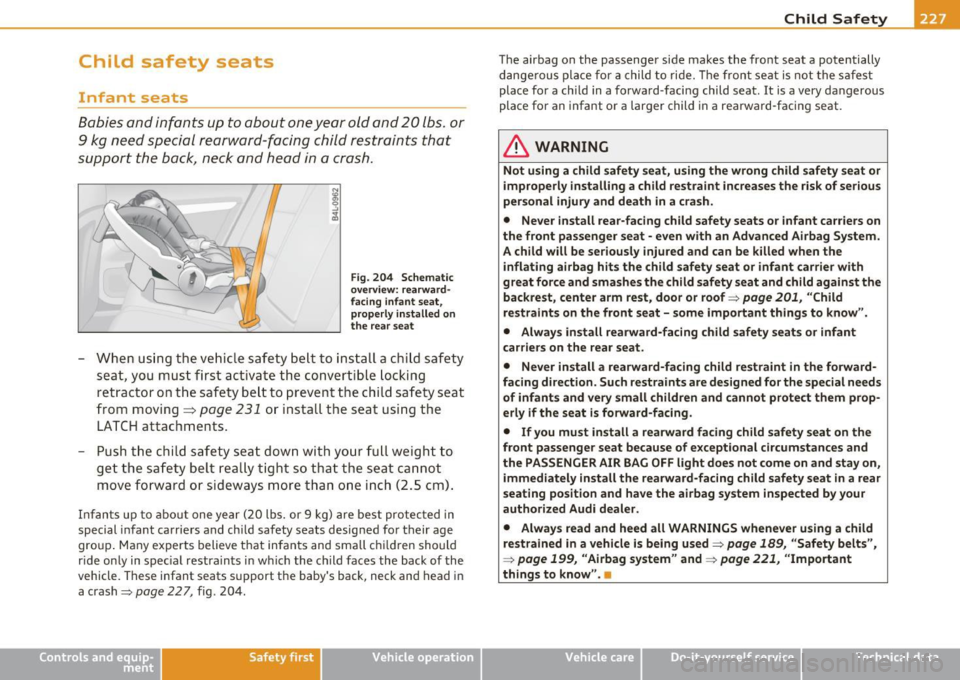
F ig. 204 Schem atic
overview : re arwa rd
facing infa nt seat,
properly install ed on
the rea r seat
- Whe n u sin g the veh icle sa fety bel t to insta ll a child s afety
s e at, you mu st first acti vate the converti ble lo cking
ret ractor on th e saf ety belt to preven t th e chi ld safet y seat
fro m moving==>
page 231 or install t he seat usi ng t he
LATCH attachments .
- Pus h the child sa fety s eat d own with y our fu ll weight to
g et t he sa fety be lt really tig ht so t hat th e sea t c an not
mov e fo rwar d or sid eways mor e t han one in ch ( 2.5 cm) .
Infa nts up t o ab out one yea r (2 0 lb s. or 9 kg) are best protec ted in
special infant carr iers a nd ch ild safety seats desig ned fo r th eir age
g roup. Many e xperts believe t hat infa nts and sm all c hildr en sho uld
r ide on ly in spec ia l re stra in ts i n w hic h the child faces th e back of the
v ehicle . T hese i nfant seats support t he baby's back, neck and head in
a crash=>
page 227 , fig . 204 .
Safety first Vehicle OP-eration
Child Safety
The airbag on the passenger side makes the fro nt seat a potentially
d ange rous place for a child to rid e. Th e front seat is not the safest
place for a ch ild in a forwa rd-faci ng child seat . It is a very da ngerous
place for an infant o r a larger child in a rearward-fac ing seat .
& WARNING
Not using a child safety seat, u sing the wrong child safety seat or
improperly installing a child restraint increases the risk of serious
personal injury and death in a cra sh .
• Never install rear-facing child safety seats or infant carriers on
the front passenger seat -even with an Advanced Airbag Sy stem.
A child will be seriously injured and can be killed when the
inflating airbag hits the child safety seat or infant carrier with
great force and smashes the child safety seat and child against the
backrest, center arm rest, door or roof=>
page 201, "Child
restraints on the front seat -some important things to know ".
• Always install rearward-facing child safety seats or infant
carriers on the rear seat.
• Never install a rearward -facing child restraint in the forward ·
facing direction . Such restraints are designed for the special needs
of infants and very small children and cannot protect them prop·
erly if the seat is forward-facing.
• If you must install a rearward facing child safety seat on the
front passenger seat because of exceptional circumstances and
the PASSENGER AIR BAG
OFF light does not come on and stay on,
immediately install the rearward-facing child safety seat in a rear
seating position and have the airbag system inspected by your
authorized Audi dealer .
• Always read and heed all WARNINGS whenever using a child
restrained in a vehicle is being used=>
page 189, "Safety belts ",
=> page 199 , "Airbag system" and => page 221 , "Important
things to know". •
Vehicle care Do-it-yourselt service iTechnical data
Page 230 of 364
___ C_h _i_ld _ S_ a_ f_ e_ t_,, y'-----------------------------------------------
Convertible
child safety seats
Properly used convertible child safety seats can help
protect toddlers and children over age one who weigh between 20 and 40 lbs. (9 and 18 kg) in a crash.
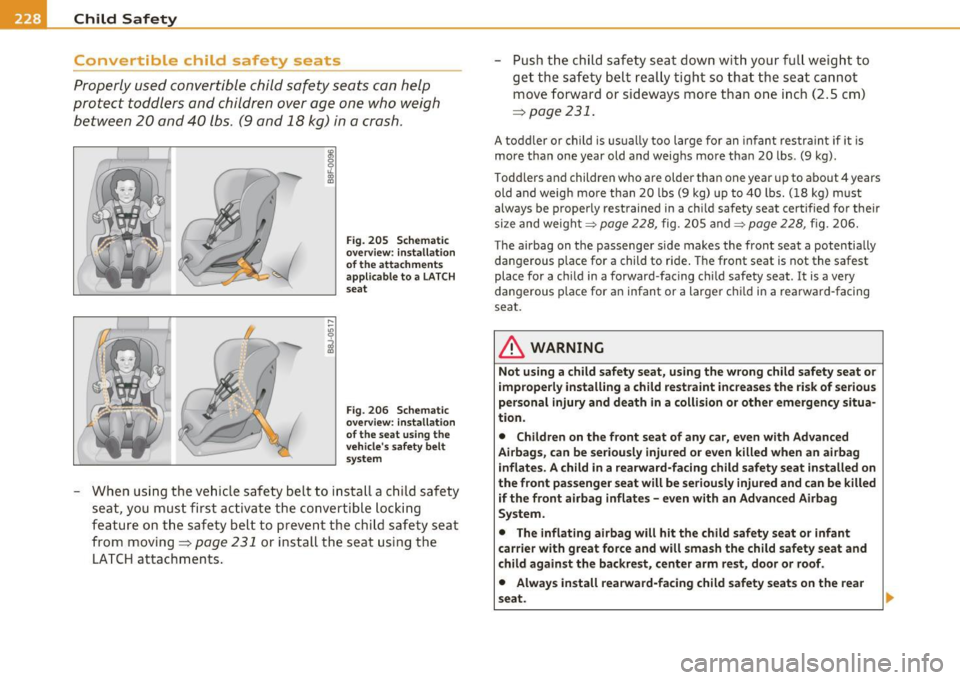
Fig. 205 Schematic
overview : installation
of the attachments
applicable to a LATCH
seat
Fig. 206 Schematic
overview: installation
of the seat using the
vehicle's safety belt
system
- When using the vehicle safety belt to install a child safety
seat, you must first activate the convertible locking
feature on the safety belt to prevent the child safety seat
from moving=>
page 231 or install the seat using the
LATCH attachments. -
Push the child safety seat down with your full weight to
get the safety belt really tight so that the seat cannot
move forward or sideways more than one inch (2.5 cm)
=>
page 231.
A toddler or child is usually too large for an infant restraint if it is
more than one year old and weighs more than 20 lbs . (9 kg) .
Toddlers and children who are older than one year up to about 4 years
old and weigh more than 20 lbs (9 kg) up to 40 lbs. (18 kg) must
always be properly restrained in a child safety seat certified for their
size and weight=>
page 228, fig. 205 and=> page 228, fig. 206.
The airbag on the passenger side makes the front seat a potentially dangerous place for a child to ride. The front seat is not the safest
place for a child in a forward -facing child safety seat . It is a very
dangerous place for an infant or a larger child in a rearward-facing
seat.
& WARNING
Not using a child safety seat, using the wrong child safety seat or
improperly installing a child restraint increases the risk of serious
personal injury and death in a collision or other emergency situa
tion.
• Children on the front seat of any car, even with Advanced
Airbags, can be seriously injured or even killed when an airbag
inflates. A child in a rearward-facing child safety seat installed on
the front passenger seat will be seriously injured and can be killed
if the front airbag inflates -even with an Advanced Airbag
System.
• The inflating airbag will hit the child safety seat or infant
carrier with great force and will smash the child safety seat and
child against the backrest, center arm rest, door or roof.
• Always install rearward-facing child safety seats on the rear
~~-~