warning AUDI A5 CABRIOLET 2011 Owners Manual
[x] Cancel search | Manufacturer: AUDI, Model Year: 2011, Model line: A5 CABRIOLET, Model: AUDI A5 CABRIOLET 2011Pages: 364, PDF Size: 86.48 MB
Page 285 of 364

_____________________________________________ C_h_ e_ c_k _in --= g=--- a_n_ d_ f_ i_ll _i_n __.g=-- -•
Changing the engine oil
The engine oil and oil filter must be changed according to the mileage
(kilometers) and time intervals specified in your vehicle's Warranty
&
Maintenance booklet. Do not exceed these intervals -harmful
deposits from old engine oil can reduce engine performance and can
lead to expensive engine repairs.
Changing the oil at the recommended intervals is so very important
because the lubricating properties of oil decrease gradually during
normal vehicle use. If you are not sure when you have your oil
changed, ask your authorized Audi Service Advisor .
Under some circumstances the engine oil should even be changed
more frequently. Change oil more often if you drive mostly short
distances, operate the vehicle in dusty areas or mostly under stop
and-go traffic conditions, or when you use your vehicle where temper
atures stay below freezing point for long periods.
Detergent additives in the oil will make fresh oil look dark after the
engine has been running for a short time. This is normal and is not a
reason to change the oil more often than recommended.
Damage or malfunctions due to lack of maintenance
It is essential that you change your oil at the recommended intervals
using only engine oil that complies with Audi oil standard
VW
502 00 . Your Limited New Vehicle Warranty does not cover
damage or malfunctions due to failure to follow recommended main
tenance and use requirements as set forth in the Audi Owner's
Manual and Warranty
& Maintenance booklet. Your dealer will have
to deny warranty coverage unless you present to the dealer proof in
the form of Service or Repair Orders that all scheduled maintenance
was performed in a timely manner. •
Safety first
Engine oil consumption
The engine in your vehicle depends on an adequate
amount of oil to lubricate and cool all of its moving parts.
In order to provide effective lubrication and cooling of internal
engine components, all internal combustion engines consume a
certain amount of oil. Oil consumption varies from engine to engine
and may change significantly over the life of the engine. Typically,
engines with a specified break-in period (see~
page 250) consume
more oil during the break-in period than they consume after oil
consumption has stabilized.
Under normal conditions, the rate of oil consumption depends on the
quality and viscosity of the oil, the RPM (revolutions per minute) at
which the engine is operated, the ambient temperature and road
conditions. Further factors are the amount of oil dilution from water
condensation or fuel residue and the oxidation level of the oil. As any
engine is subject to wear as mileage builds up, the oil consumption
may increase over time until replacement of worn components may
become necessary.
With all these variables coming into play, no standard rate of oil
consumption can be established or specified. There is no alternative
to regular and frequent checking of the oil level, see
Note.
If the yellow engine oil level warning symbol in the instrument
cluster _ lights up, you should check the oil level as soon as possible
~ page 284. Top off the oil at your earliest convenience~ page 284.
& WARNING
Before you check anything in the engine compartment, always
read and heed all WARNINGS~
& in "Working in the engine
compartment" on page
280.
Vehicle care Technical data
Page 286 of 364

•--=C:.:.h.:.. e=. c=.:..:: k .:.:in ..:. g ~ a::..:..: n~d .:...:.. f:....:il ..:.li :.:.n.;.: g~ ------------------------------------------
0 Note
Driv ing with an insufficient o il level is likely to cause severe damage
to the engine .
[ i J Tips
• The oil pressure wa rning display 9:!::r. is not an ind icator of the oil
level. Do not rely on it. Instead, check the oil level
in your engine at
r egula r inte rvals , prefe rably ea ch time you refuel , and always
before going on a long trip.
• If you have the impression your engine consumes excessive
amounts of o il, we recommend th at yo u consult an autho riz ed Aud i
dealer to have the cause of your concern properly diagnosed . Keep in
m ind that the accurate measu rement of oil consumption re quires
great care and may take some t ime. An authorized Audi dealer has
instructions about how to meas ure oil consumption accu rately .•
Checking the engine oil level
Fig. 2 21 MMI D isplay :
Oil le vel ind icat or
Read oil level
-Park your vehicle on a level sur face.
- S hut the engine off when it is warm. -
Switc h only th e ignition back on .
- Wa it appro ximately two minutes.
- Select: Function button
[CAR ]> Oil level.
- Check the oi l level in the display=> fig. 2 2 1. Add e ngi ne oil
if t he ba r of the oil level ind icator is near "min"
=>
page 284 .
The oil leve l needs to be c hec ked at regular intervals. The bes t times
to do this are whe neve r you refuel and p rior to long tr ips.
Depending on the way the vehicle is driven and the operating condi
ti ons, oi l cons ump tion can be u p to 1/2 q uart per 600 m iles (0.5 l iter
per 1,000 km). Consumpt ion may be higher with in the first 3,000
m iles (5,0 00 km).
[ i J Tips
T he oil leve l ind icator in the MM I Display is only an informa tion
display . If the oil level is too low, a minim um oil warning appea rs in
the inst rument cl uster . Add oil=>
page 284 . If th e hood has been
opened, the current oil level is shown in the instrument cluster the
ne xt time the ignition is switched on. •
Adding engine oil ce:i,-:
Fig. 222 Engine
com partment : Oil fill er
c a p l oca tion ...
Page 287 of 364

___________________________________________ C_ h_e _c _k_ i_n ~g_ a_n_ d_ f_ i_ll _i_n _g __ _
Before you check anything in the engine compartment,
always read and heed all WARNINGS=> & in "Working in
the engine compartment" on
page 280.
- Unscrew the cap~ to the engine oi l filling hole
=> page 284, fig. 222.
- Carefully top off with the appropriate oil in 0 .5 liter doses.
- Screw the cap back on the filling hole and close the engine
hood.
- Check the oil level again after two minutes=>
page 284.
- Top off the oil again, if necessary.
& WARNING
• While topping off, the oil must not come in contact with hot
engine parts· fire hazard!
• The oil filler cap must be properly secured to prevent oil from
being sprayed on the hot engine and exhaust system when the
engine is running · fire hazard!
• If your skin has come in contact with the engine oil, you must
subsequently cleanse it thoroughly.
0 Note
• Check the oil leve l using the radio or the M MI*. If the message
Please reduce oil level appears, contact your authorized Audi dealer
or other qualified workshop to have excess oil extracted if necessary .
• Audi does not recommend the use of oil additives. They may
damage the engine and adversely affect your New Vehicle
Warranty.
Safety first
<£' For the sake of the environment
• Under no circumstances can the oil come in contact with the
sewage network or the soil.
• Observe and follow legal regulat ions when d ispos ing of empty oil
containers. •
Changing the engine oil
We recommend that have your oil changed by an autho
rized Audi dealer or a qualified service station.
Before you check anything in the engine compartment, always read
and heed all WARNINGS=>
& in "Working in the engine compart
ment" on
page 280 .
The eng ine oil must be changed accord ing to the intervals specified in
your Warranty
& Maintenance book let. This is very important because
the lubricating properties of oil diminish gradually dur ing normal
vehicle use.
Under some circumstances the engine oil sho uld be changed more
frequently. Change oil more ofte n if you drive mostly short distances,
operate the vehicle in dusty areas or under predominant ly stop-and
go traffic conditions, or have your ve hicle where temperatures rema in
below freezing for extended periods.
Detergent additives in the oil will make fresh oil look dark after the
engine has been running for a short time . This is normal and is not a
reason to change the oil mo re often than recommended .
Because of the problem of proper disposal, along with the specia l
too ls and necessary expertise required, we strongly recommend that
you have your oil changed by an authorized
Audi dealer or a qualified
service station.
If you choose to change your oil yourself, please note the following
important information: .,_
Vehicle care Technical data
Page 288 of 364

___ C_ h_ e_c _k _i _ n _g ~ a_n _d_ f_il _l_in _ g _________________________________________ _
in. WARNING
To reduce the risk of personal injury if you must change the engin e
oil in your vehicle your self:
• Wear eye protection.
• To reduce the ri sk of burns from hot engine oil, let the engine
cool down to the touch.
• When removing the oil drain plug w ith your finger s, stay as far
away as possible. Always keep you r forearm parallel to the ground
to help prevent hot oil from runn ing down your arm .
• Drain the oil into a containe r designed for this purpo se, one
large enough to hold at lea st the total amount of oil in your
engine.
• Engine oil is poisonous . Keep it well out of the reach of chil
dren.
• Continuous contact w ith used eng ine oil is harmful to your
skin. Always protect your skin by washing oil off thoroughly with
soap and water.
0 Note
N ever m ix o il add itives w it h your eng ine oi l. These additives can
damage your engine and adverse ly affect your Audi Limited New
Vehicle Warranty .
ffi For the sake of the environment
• Before chang ing yo ur o il, firs t ma ke s ure you know w here yo u can
proper ly dispose of the used oi l.
• Always dispose of used eng ine o il properly . D o not dump it on
garden soi l, wooded areas, into open streams or down sewage drains.
• Recycle used engine o il by taking it to a used eng ine oil collection
facility in your area, or contact a serv ice stat io n. •
Engine cooling system
Coolant
The engine coo lant performs two functions: i t keeps the
en gine fro m overhe ating and i t protects the engine fr om
fre ezing in th e winter .
The cooling system is sea led and genera lly requ ires little attention .
Th e cool ing sy stem h as been filled at the f actory wit h a permanent
coo lant which does not need to be changed . T he coolant cons ists of a
mixt ure of water an d the manufacturer's glycol -basedcoolant ad di
tive Gl2++ antifreeze w ith anticorros ion addit ives (50% for USA
mode ls; 60% for Canadian models). This mixture both ass ures the
necessary frost protect ion and p rotects meta l components in th e
eng ine's cooling system from co rrosion an d scaling. It also raises the
boiling point of the cool ant.
Do not red uce the concentration of the coolant in the summer by
add ing p la in water. The proportion of coolant additive must be at
least 50 % but not more than 60 %
to maintai n antifreeze protection
and coo ling efficiency. If the coolant frost pro tect io n i s too low, t he
coo lant co uld free ze and damage t he veh icle heating an d eng ine
coo ling system.
For yea r- round drivi ng , antifree ze is added at t he factory for tempe r
atures dow n to:
• - 31°F(- 35°C)USA
• -40°F ( -40°C) Canada .
You can mi x the Gl2+ + coo lant additive wit h other additives (G12 + or
Gl2) . Always check with you r autho rized Aud i dea ler .
in. WARNING
Before you check anything in the engine compartment , always
read and heed all WARNINGS =>
& in "Working in the engine
compartment " on
page 280.
Page 289 of 364

___________________________________________ C_ h _ e_c _k _ i_n -=g .._ a_n _ d_ f_i _ll _i _ n -=g '--- ........ 11'1
0 Note
• Before winter sets in, have the coolant checked to see if the
coolant additive in your vehicle is sufficient to meet the climate
conditions. This is especially important if you live in a region where
the winter is extremely cold. If necessary, increase the proportion of
coo lant additive to 60% .
• When adding coolant additive to your cooling system, remember:
-We recommend using only coolant additive G12++ (check the
label) for your vehicle. This coolant additive is available at autho
r iz ed Audi dealers. Other types of antifreeze can s ignificantly
reduce corrosion protection. The resulting corrosion can cause a
loss of coolant and serious engine damage.
• Do not add any type of radiator leak sealant to your vehicle 's
eng ine coolant. Adding radiator repair fluid may adversely affect the
function and performance of your cooling system and could result in
damage not covered by your New Vehicle Limited Warranty. •
Checking the engine coolant level
The engine coolant level can be checked with a quick
glance.
Fig. 223 Engine
compartment: Coolant
expansion tank
Vehicle OP-eration
Before you check anything in the engine compartment,
always read and heed all WARNINGS=:> & in "Working in
the engine compartment" on
page 280.
-Turn off the ignition.
- Let the engine cool down .
- Place a thick rag over the coolant expansion tank
=:> fi.9. 223 and carefully twist the cap counter -clockwise
=> & .
- Read the engine coolant level in the open coolant expan
sion tank=:> fig. 223. With a cold engine, the coolant level
should be between the "min" and "max" markings. When
the engine is warm, the level may be slightly above the
"max" marking.
The location of the coo lant expansion tank can be seen in the engine
compartment illustration =>
page 281.
To obtain an accurate reading, the engine must be sw itched off.
The expansion tank in your vehicle is equipped with an electric coolant level sensor.
When the coolant level is too low, the warn ing light in the Auto-Check
System =>
page 31 will blink until you add coolant and the level has
been restored to normal. Even though there is an electric coolant
level sensor, we st ill recommend you check the coolant leve l from
t ime to time .
Coolant loss
Coolant loss may indicate a leak in the cooling system . In the event of
coolant loss , the cooling system should be inspected immediately by
your authorized Aud i dealer . It is not enough merely to add coolant .
In a
sealed system, losses can occur only if the boiling point of the
coo lant is exceeded as a result of overheating . .,
Vehicle care Do-it-yourselt service iTechnical data
Page 290 of 364

___ C_ h_ e_c _k _i _ n _g ~ a_n _d_ f_il _l_in _ g _________________________________________ _
in. WARNING
The cooling system is under pressure and can get very hot. Reduce
the ri sk of scalding from hot coolant by following the se steps .
• Tu rn off the engine and allow it to cool down .
• Protect your face, hands and arms from e scaping fluid and
steam by covering the cap with a large , thick rag.
• Turn the cap slowly and very c arefully in a counter-clockwise
direction while applying light , downward pressure on the top of
the cap.
• To avoid being burned, do not spill antifreeze or coolant on the
exhaust system or hot engine parts. Under certain conditions, the
ethylene glycol in engine coolant can catch fire.
0 Note
Do not add any type of radiator leak sealant to yo ur vehicle 's engine
coo lant. Adding radiator repair fluid may adverse ly affect the func
tion and performance of your cooling system and could result in
damage no t c ove red by y our New Vehi cle Limited Warr anty. •
Adding coolant
Be very careful when adding engine coolant.
Before you check anyt hing in th e eng ine compartment ,
always read and heed all WARNINGS=> & in "Wor king i n
t h e e ngine compa rtment" on page
280.
-Tur n off the e ng ine.
- Let t he engi ne co ol d ow n.
- Place a t hick rag over the coolant expans ion tank
=> page 2 87, fig . 223 a nd carefully turn the ca p cou nte r
clo ckwise
=> & .
- Add coo lant .
- Tw ist t he cap o n agai n
tightly.
Replacement eng ine coolant must conform to exact specificat ions
~ page 28 6, "Coolant" . Even in an emergency, if coolant a dditive
Gl2 ++, Gl2+ or Gl2 is not available, do not use a d ifferent add it ive.
Use plain water instead until you can get the correct additive a nd can
restore the co rrect ra tio. This s hould be done as soon as possib le.
If you have lost a considerable amount of coolant, then you shou ld
add co ld a ntifree ze and cold wa ter only when t he e ngine is cold.
Always use
new engine coo lant when refilling .
Do not fill coolant above the "M AX" mark. Excess coo lant wi ll be
for ced out through t he p ress ure relief va lve in t he cap w hen the
eng ine becomes hot .
& WARNING
• The cooling system is under pressure and can get very hot.
Reduce the risk of scalding from hot coolant by following these
steps.
-Turn off the engine and allow it to cool down.
- Protect your face , hands and arms from escaping fluid and
s team by covering the cap with a large, thi ck rag.
- Turn the cap slowly and very carefully
in a counter-clockwise
direction while applying light , downward pre ssure on the top
of the cap.
- To avoid being burned, do not spill ant ifreeze or coolant on
the exhaust system or hot engine parts. Under certain condi
tions, the ethylene glycol in engine coolant can catch fire .
• Antifreeze is poisonous. Always store antifreeze
in its original
container and well out of the reach of children .
• If you drain the coolant , it mu st be caught and safely stored in
a proper container clearly marked "poison ".
~
Page 291 of 364

___________________________________________ C_;_ h _.:. e_c _k _ i_n -=g ~ a_n _ d_ f_i _ll _i _ n -=g '--.......J-
0 Note
• Coolan t poll utes the environment and co uld cause an engine fire.
Excess coolant w ill be forced out throug h the pressure relief valve in
t he cap w hen the eng ine becomes ho t.
• If, i n an emer gency, only water can be adde d, the correct ratio
between wate r an d an tifree ze=>
page 28 6 must be restored as soon
as possib le.
<£> For the sake of the environment
Dra ined coolant should not be reused. A lways dispose of used coolant
w hile observ ing a ll enviro nmental regula tions. •
Radiator fan
The r adia tor fan switc hes on au tomatic ally by its elf .
Th e radiator fan is dr iven by the e ngine vi a the V-bel t. Th e v iscous
clutch regu lates the speed of the fan accord ing to the temperature of
th e co olan t.
An auxiliary e lectr ic rad iator fan* sw itches on a nd off depend ing o n
coo la nt temperat ure and other vehicle ope rating conditions .
After you sw itch t he engi ne off, the a uxiliary f an can con tinue r unning
for up to 10 minutes -even w ith the ignition off . It can even switch on
a g ain lat er by itse lf=> &, if
• the temperature of the e ngine coola nt rises due to the heat build
up from the eng ine in the engi ne compa rtment, o r
• the engine compartment heats up because the vehicle is parked in
intense s unlight .
& WARNING
• To reduce the risk of personal injury never touch the radiator
fan.
Vehicle OP-eration
& WARNING (continued )
• The auxiliary ele ctric fan is temperature controlled and can
switch on suddenly even when the engine is not running.
• The auxiliary radiator fan switches on automatically when the
engine coolant reaches a certain temperature and will continue to
run until the coolant temperature drops. •
Brake fluid
Checking brake fluid level
The brake flu id level ca n be chec ked wit h a quick gl an ce.
Fig . 224 Engi ne
c ompartm ent : Brake
fluid re se rvoir
B efo re you check anyth ing i n the e ngine compartment ,
always read and heed all WARNINGS~ & in " Workin g in
t h e e ng in e co mpartme nt" on
p age 280.
- Rea d the b rak e fl uid le ve l f ro m t he brak e fluid re serv oir
~ f ig. 224. The br ak e fl uid le vel mus t be be tw ee n the
" M IN " an d "MAX " m ar kin gs.
Th e br ake fl uid re se rvoir is loca ted at th e rear pa rt iti on of the engine
compartment on the left side=>
page 281. .,_
Vehicle care Do-it-yourselt service iTechnical data
Page 292 of 364
___ C_ h_ e_c _k _i _ n _g ~ a_n _d_ f_il _l_in _ g _________________________________________ _
The fluid level may drop slightly after some time d ue to the auto
m atic adjus tment o f th e b rake pads. This is no t ca use for alarm.
If the brake flu id level falls considerably below the "MIN" mark, the
brake warning/indicator light ( U.S. models:
BRAKE , Canadian mode ls:
ID ) will come on=> page 17 and=> page 30. Do not contin ue to
operate the vehicle. The complete brake system should be thoro ughly
c he cked by an au thor ized Aud i deale r or q ualified works hop and t he
cause corrected. If the brake fluid level is too low, the brake
w ar ning/ind ic a tor ligh t will illum ina te. Con ta ct a n au thori ze d Audi
dealer
immediately .
rn Tips
The brake fluid reservoir is located underneath t he cover. •
Changing brake fluid
Have the brake fluid cha nged b y an experienced tech ni
c ia n.
Brake fluid absorbs mo isture from the a ir . If the water content in the
bra ke fl uid i s too hig h, cor ros io n in th e bra ke system may res ult afte r
a period of time. The boiling po int of the brake fluid will also decrease
cons iderab ly and decrease brak ing perfo rmance .
Th erefo re, th e brake fl uid must be changed
every two years . Always
use new bra ke fluid w hich conforms to Federal Motor Vehicle Stan
dard "F MVSS 1 16 DO T 4".
The brake flu id reservoir can be diffic ult to reac h, therefore, we
recommend that you have the bra ke fluid c hanged by your author ized
Audi dealer . Your dealer has the correct tools, the right brake flu id
and the know -how to do t his for you .
LJ}. WARNING
• Brake fluid is poisonou s. It mu st be stored only in the closed
original containe r out of the reach of children!
& WARNING (co ntinued )
• Brake failure can result from old or inappropriate brake fluid.
Observe these precaution s:
- Use only brake fluid that meets SAE specification
J 1703 and
conforms to Federal Motor Vehicle Standard 116 . Always check
with your authorized Audi dealer to make sure you are using
the correct brake fluid. The correct type of brake fluid is also indicated on the brake fluid reservo ir.
- The brake flu id must be new . Heavy use of the brakes can
cause a vapor lock if the brake fluid is left in the system too
long. This can seriously affect the efficiency of the brakes as
well as your safety. This could result in an accident.
0 Note
Bra ke fluid will damage the paint of your veh icle.
For the sake of the environment
Because of the prob lem of proper disposal of brake fl uid as well as
t he s pecial tool s required a nd the nece ssary ex pert ise, we recom
mend that you have t he brake f lu id changed by your authorized Audi
de aler. •
Battery
General information
Under normal operat ing con dit ions, the battery in your Aud i does not
need any main tenance . Wit h high outs ide temperatures o r long daily
dr ives we recommend that yo u have the electrolyte level checked by
an a uth orized Audi dealer o r q ua lified wor kshop. The electro lyte lev el
should also be checked each time the battery is charged=> page 293 . .,_
Page 293 of 364

___________________________________________ C_ h_e _c _k_ i_n ~g_ a_n_ d_ f_ i_ll _i_n _g __ _
Have the battery checked when you take your vehicle in for service .
You are well advised to replace a battery that is older than 5 years.
With certain types of a irbag deployment, the battery is disconnected
from the vehicle electrica l system for safety reasons~
& in "Repair,
care and disposal of the airbags" on
page 213.
Disconnecting the battery terminals
Some vehicle funct ions (power window regulators, for example) are
lost if the battery terminals are disconnected. These functions have
to be relearned after the battery termina ls are connected aga in . To
prevent this, the battery should only be disconnected from the
vehicle electr ica l system when absolute ly necessary for repairs.
Vehicles not driven for long periods
If you do not drive your veh icle over a period of several days or weeks,
electrical components are gradually cut back or switched off. This
reduces energy consumption and maintains starting capability ove r a
longer period
~ page 247.
Take into consideration that when you unlock your vehicle, some
convenience functions, such as the master key remote function or
powe r seat adjustment, may not be available. The convenience func
tions will be available again when you turn on the ignition and start
the engine.
Winter operation
During the winter months, battery capacity tends to decrease as
temperatures drop. This is because more power is also consumed
while starting, and the headlights, rear window defogger, etc., are
used more often .
Avoid unnecessary power consumption, particu larly in city traffic or
when travel ing only short distances. Let your authorized Audi dealer
check the capacity of the vehicle battery before winter sets in
~ page 293. A well charged battery will not only p revent start ing
problems when the weather is cold, but will also last longer.
Safety first
(I] Tips
If your vehicle is left standing for several weeks at extremely low
temperatures, the vehicle battery shou ld be removed and stored
where it will not freeze. This will prevent it from being damaged and
having to be replaced. •
Working on the battery
Be especially careful when working on or near the
battery.
The battery is located in the luggage compartment under the
floor. Before you check anything in the lu~gage compart
ment,
read and heed all WARNINGS =:,& .
Always heed the safety warnings, when working on the vehicle
battery or the vehicle electrical system to prevent injury .
The following WARNINGS are very important when
working on the battery:
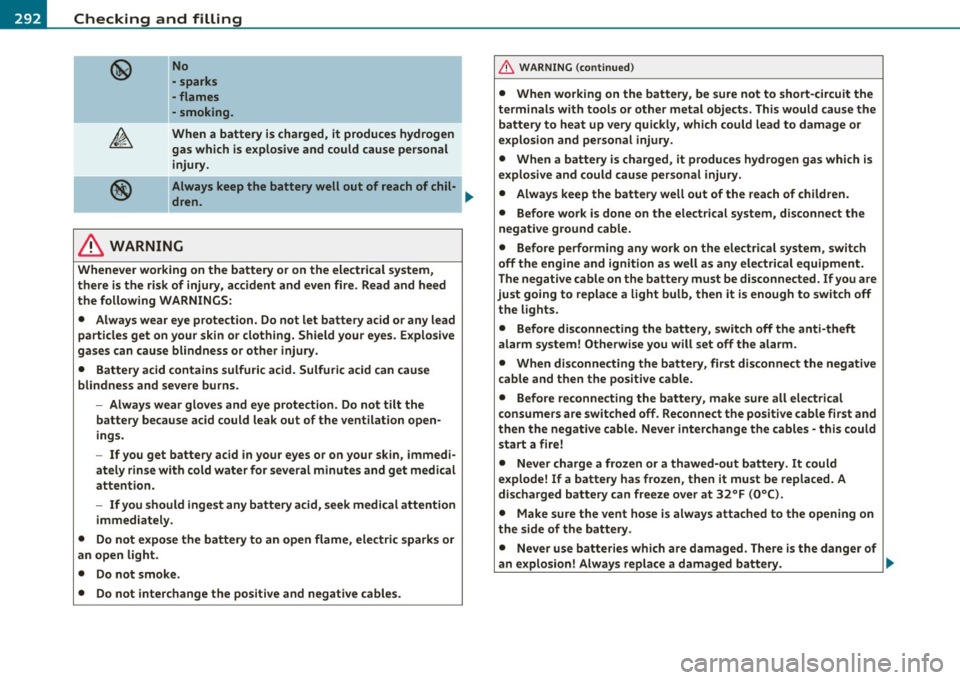
Always heed the following WARNING SYMBOLS and safety pre
cautions when working on the battery.
Always wear eye protection.
Battery acid contains sulfuric acid. Always wear
gloves and eye protection. .,_
Vehicle care Technical data
Page 294 of 364
lfflJL_JC~h~e~c~k~i~n~g~a~n~d:!._!f~il~l:!!in~g L_ ________________________________________ _
No
• sparks
- flames
- smoking .
When a battery is charged, it produces hydrogen
gas which is explosive and could cause personal injury .
Always keep the battery well out of reach of chil- _,.
dren .
& WARNING
Whenever working on the battery or on the electrical system,
there is the risk of injury, accident and even fire. Read and heed
the following WARNINGS:
• Always wear eye protection. Do not let battery acid or any l~ad
particles get on your skin or clothing. Shield your eyes . Explosive
gases can cause blindness or other injury.
• Battery acid contains sulfuric acid. Sulfuric acid can cause
blindness and severe burns.
-Always wear gloves and eye protection. Do not tilt the
battery because acid could leak out of the ventilation open
ings.
- If you get battery acid in your eyes or on your skin, immedi·
ately rinse with cold water for several minutes and get medical
attention.
- If you should ingest any battery acid, seek medical attention
immediately.
• Do not expose the battery to an open flame, electric sparks or
an open light. • Do not smoke.
• Do not interchange the positive and negative cables.
& WARNING (co ntinued )
• When working on the battery , be sure not to short-circuit the
terminals with tools or other metal objects. This would cause the battery to heat up very quickly, which could lead to damage or
explosion and personal injury.
• When a battery is charged , it produces hydrogen gas which is
explosive and could cause personal injury.
• Always keep the battery well out of the reach of children.
• Before work is done on the electrical system, disconnect the
negative ground cable.
• Before performing any work on the electrical system, switch
off the engine and ignition as well as any electrical equipment.
The negative cable on the battery must be disconnected. If you are
just going to replace a light bulb, then it is enough to switch off
the lights.
• Before disconnecting the battery, switch off the anti-theft
alarm system! Otherwise you will set
off the alarm.
• When disconnecting the battery, first disconnect the negative
cable and then the positive cable.
• Before reconnecting the battery, make sure all electrical
consumers are switched off. Reconnect the positive cable first and
then the negative cable. Never interchange the cables· this could start a fire!
• Never charge a frozen or a thawed-out battery. It could
explode! If a battery has frozen , then it must be replaced. A
discharged battery can freeze over at 32°F (0°C).
• Make sure the vent hose is always attached to the opening on
the side of the battery .
• Never use batteries which are damaged . There is the danger of
an explosion! Always replace a damaged battery. _,.