change time AUDI A5 CABRIOLET 2011 Owner's Manual
[x] Cancel search | Manufacturer: AUDI, Model Year: 2011, Model line: A5 CABRIOLET, Model: AUDI A5 CABRIOLET 2011Pages: 364, PDF Size: 86.48 MB
Page 292 of 364
___ C_ h_ e_c _k _i _ n _g ~ a_n _d_ f_il _l_in _ g _________________________________________ _
The fluid level may drop slightly after some time d ue to the auto
m atic adjus tment o f th e b rake pads. This is no t ca use for alarm.
If the brake flu id level falls considerably below the "MIN" mark, the
brake warning/indicator light ( U.S. models:
BRAKE , Canadian mode ls:
ID ) will come on=> page 17 and=> page 30. Do not contin ue to
operate the vehicle. The complete brake system should be thoro ughly
c he cked by an au thor ized Aud i deale r or q ualified works hop and t he
cause corrected. If the brake fluid level is too low, the brake
w ar ning/ind ic a tor ligh t will illum ina te. Con ta ct a n au thori ze d Audi
dealer
immediately .
rn Tips
The brake fluid reservoir is located underneath t he cover. •
Changing brake fluid
Have the brake fluid cha nged b y an experienced tech ni
c ia n.
Brake fluid absorbs mo isture from the a ir . If the water content in the
bra ke fl uid i s too hig h, cor ros io n in th e bra ke system may res ult afte r
a period of time. The boiling po int of the brake fluid will also decrease
cons iderab ly and decrease brak ing perfo rmance .
Th erefo re, th e brake fl uid must be changed
every two years . Always
use new bra ke fluid w hich conforms to Federal Motor Vehicle Stan
dard "F MVSS 1 16 DO T 4".
The brake flu id reservoir can be diffic ult to reac h, therefore, we
recommend that you have the bra ke fluid c hanged by your author ized
Audi dealer . Your dealer has the correct tools, the right brake flu id
and the know -how to do t his for you .
LJ}. WARNING
• Brake fluid is poisonou s. It mu st be stored only in the closed
original containe r out of the reach of children!
& WARNING (co ntinued )
• Brake failure can result from old or inappropriate brake fluid.
Observe these precaution s:
- Use only brake fluid that meets SAE specification
J 1703 and
conforms to Federal Motor Vehicle Standard 116 . Always check
with your authorized Audi dealer to make sure you are using
the correct brake fluid. The correct type of brake fluid is also indicated on the brake fluid reservo ir.
- The brake flu id must be new . Heavy use of the brakes can
cause a vapor lock if the brake fluid is left in the system too
long. This can seriously affect the efficiency of the brakes as
well as your safety. This could result in an accident.
0 Note
Bra ke fluid will damage the paint of your veh icle.
For the sake of the environment
Because of the prob lem of proper disposal of brake fl uid as well as
t he s pecial tool s required a nd the nece ssary ex pert ise, we recom
mend that you have t he brake f lu id changed by your authorized Audi
de aler. •
Battery
General information
Under normal operat ing con dit ions, the battery in your Aud i does not
need any main tenance . Wit h high outs ide temperatures o r long daily
dr ives we recommend that yo u have the electrolyte level checked by
an a uth orized Audi dealer o r q ua lified wor kshop. The electro lyte lev el
should also be checked each time the battery is charged=> page 293 . .,_
Page 300 of 364
-~_T_ ir_e_ s_ a_ n_ d_ w_ h_e_ e_ ls _______________________________________________ _
Groove
means the space between two adjacent tread ribs.
Load rating (code)
means the maximum load that a tire is rated to carry for a given infla
tion pressure. You may not find this information on all tires because
it is not required by law.
Maximum load rating
means the load rating fo r a tir e at the maximum permissible inflation
pressure for that tire.
Maximum loaded vehicle weight
means the sum of:
(a) Curb weight
(b) Accessory weight
(c) Vehicle capacity weight, and
(d) Production options weight
Maximum (permissible) inflation pressure
means the maximum cold inflation pressure to which a tire may be
inflated. Also called "maximum inflation pressure."
Normal occupant weight
means 150 lbs. (68 kilograms) times the number of occupants seated
in the vehicle up to the total seating capacity of your vehicle.
Occupant distribution
means distr ibution of occupants in a vehicle .
Outer diameter
means the overall diameter of an inflated new tire.
Overall width
means the linear distance between the exteriors of the sidewalls of
an inflated tire, including elevations due to labeling, decorations, or
protective bands or ribs.
Ply
means a layer of rubber -coated paralle l cords.
Production options weight
means the combined weight of those installed regular production
options weigh ing over 5 lbs. (2.3 kg) in excess of those standard
items which they replace, not previously considered in curb weight or
accessory weight, including heavy duty brakes, ride levelers, heavy
duty battery, and specia l trim .
Radial ply tire
means a pneumatic tire in which the ply cords that extend to the
beads are laid at substantially 90 degrees to the centerline of the
tread .
Recommended inflation pressure
see=> page 297, "Cold tire inflation pressure".
Reinforced tire
means a tire design to operate at higher loads and at higher inflation
pressures than the corresponding standard tire. Reinforced t ires may
be identified as "XL ", "x l", "EXTRA LOAD", or "RF" on the sidewall.
Rim
means a metal support for a tire or a tire and tube assembly upon
wh ich the tire beads are seated .
Rim diameter
means nominal diameter of the bead seat . If you change your wheel
size, you w ill have to purchase new tires to match the new rim diam
eter .
Rim size designation
means rim diameter and width.
Rim width
means nominal distance between rim flanges.
Page 303 of 364
__________________________________________________ T_i_ r _e _s_ a_ n_ d_ w_ h_e_ e _ l_s __ _
If you wish to improve comfort when operating the vehicle at
normal load (up to 3 o ccupant s), you can adjust tire pres sures to
those specified for normal vehicle load . Before operating the
vehicle at maximum lo ad, you must increase the tire p res sures to
those specified for maximum vehicle load=>& .
Bear in mind that the tire press ure monitor ing system* can only
mon itor the t ire pressu re s you h ave sto red . T he sys tem does no t
recogn ize the load cond it ion of your vehicle.
Th e effectiveness of the ti re pressure monitoring system* wi ll be
impa ired if you store normal load pressu res but then operate the
vehicle at its maxim um loa d=> & . See the
illustration=> fig. 227 for the location of the label on driver's
side B- pillar (colo r of the act ual la bel and ex act l ocation on the
vehicle will vary slig htly).
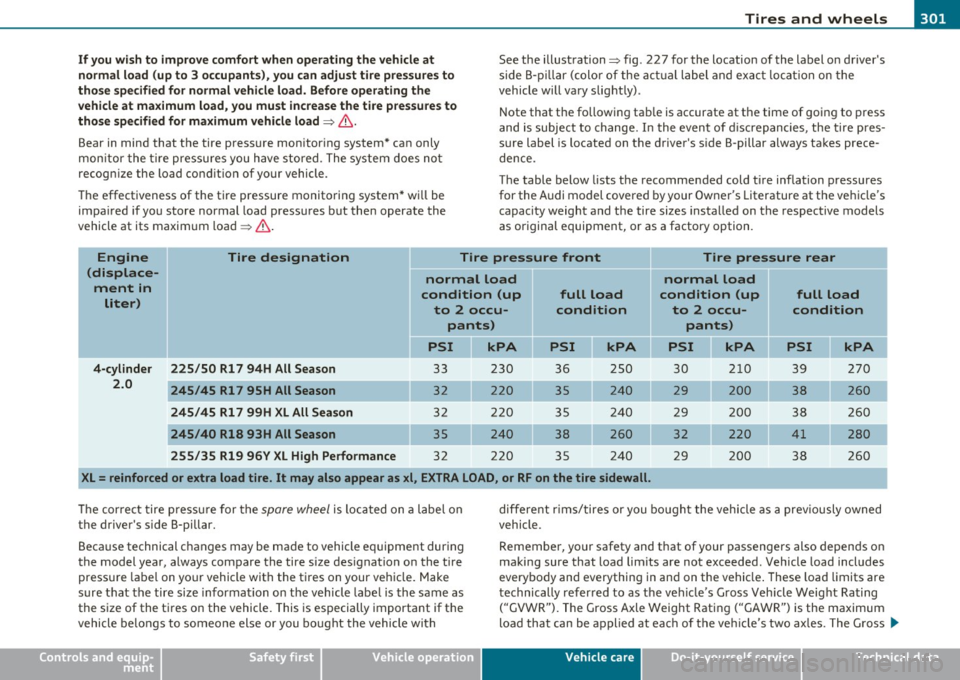
N ote that the fo llow ing tab le is accurate at the time of going to press
and is subjec t to change. I n the even t of discrepancies , the tire pres
sure label is located on the driver 's side B-pillar always takes prece
dence .
T he table below lists the recommended cold t ire inflation pressures
for the Audi model covered by your Owne r's Literature at t he ve hicle's
capac ity weight and the tire sizes insta lled on the respective models
as original equipment, or as a factory option .
Engine Tire designation Tire pressure front Tire pressure rear
(displace- normal load normal load
ment in
liter) condition (up
full load condition (up
full load
to 2 occu- condition to 2 occu- condition pants) pants)
kPA PSI PSI kPA PSI kPA
4-cylinder 225/50 Rl 7 94H All Season
33 230
36 250
30 2
10 39 270
2.0 245/45
Rl 7 95H All Season 32 220 35 240
29 200 38 260
245/45
Rl 7 99H XL All Season 32 22 0 35 240 2 9 200 3 8 260
245 /40 R18 93H All Sea son 35 240 38 260 32 220 41 280
255/35 R19 96V
XL High Performance 32 220 35 240
29 200 38 260
XL= reinforced or extra load tire . It may also appear as xl , EXTRA LOAD, or RF on the tire sidewall .
The correct tire p ress ure for t he spare wheel is loca ted on a labe l o n
the driver 's s ide B-pillar.
Beca use technical c hanges may be made to vehicle equipment dur ing
the model year, always compare the tire size des ignation on the t ire
pressu re labe l on yo ur vehicle with the t ires on your vehicle. Make
sure that the tire size informat ion on t he v ehicle labe l is the same as
the size of the t ires o n the vehicle. This is especially important if the
vehicle belo ngs to so meone else or you bo ug ht the vehicle with
Safety first
differe nt r im s/ tires or you bo ugh t the vehicle as a prev iously owned
vehicle.
Remember, yo ur safety and t hat of your passengers also depends o n
making sure that load limits are not exceeded. Vehicle load includes
everybody and everything in an d on the vehi cle. These load limits are
t e chnically refer red to as the veh icle's G ross Veh icle Weig ht Rating
("GVW R"). The Gross Axle Weight Rati ng ("GAWR") is the maximum
load tha t can be applied at ea ch of the ve hicle's two ax les . T he G ross ..
Vehicle care Technical data
Page 363 of 364
It has always been Aud i's poli cy to continuously improve i ts p roducts.
Audi, therefore, reserves the right to make changes in design and
specifica tions, and to make addi tions or improvemen ts in it s p rod
ucts, without incurr ing a ny obligation to i nstall them on prod ucts
prev io usly man ufa ct ur ed.
T ext, ill ustrat ions and specifications in th is manua l are based on the
most up-to-date informat ion avai lab le at the time of pr int ing .
All r igh ts rese rved. M ay not be reproduced or tra ns lated in who le or
in part without the written consent of AUDI AG. Specifications are
s ub ject to ch ange wi thout notice. "Au
di", "qu attro" and the four rings emb lem are reg is tered trade
marks of AUDI AG. "AS Cabriolet" is trademark of AUDI AG.
Editorial deadline: 04/08/2010
<£> For the sake of the environment
Printed on environmen tally friend ly pape r (b leac hed witho ut chlo
r ine, recyclable) .
Printed in Germany
© 2010 A UDI AG