coolant reservoir AUDI A5 CABRIOLET 2011 Owners Manual
[x] Cancel search | Manufacturer: AUDI, Model Year: 2011, Model line: A5 CABRIOLET, Model: AUDI A5 CABRIOLET 2011Pages: 364, PDF Size: 86.48 MB
Page 282 of 364
-Checking and filling
-------=------=---------------------------------------------------
Closing the engine hood
-Pull the hood down until the pressure from the struts is
reduced.
- Let the hood
drop down and latch in place . Do not try to
push it shut;
it may fail to engage=> &.
& WARNING
A hood that is not completely latched could fly up and block your
view while driving.
• When you close the engine hood, check it to make sure the
safety catch has properly engaged. The hood should be flush with
the surrounding vehicle body parts.
• If you notice while driving that the hood is not secured prop
erly, stop at once and close it. •
Working in the engine compartment
Be especially careful whenever you work in the engine
compartment.
Whenever you must perform any work in the engine compartment,
for example checking and filling different fluids, there is a risk of
injury, burns and accidents. To prevent personal injury always
observe the following WARNINGS. The engine compartment of any
vehicle is a hazardous area
=> & .
& WARNING
To help avoid injury, before you check anything under the hood :
• Turn off the engine.
• Remove the ignition key.
• Apply the parking brake.
& WARNING (continued)
• Move selector lever of automatic transmission to "P" (Park).
• Always let the engine cool down. Hot components will burn
skin on contact.
• To reduce the risk of being burned, never open the hood if you
see or hear steam or coolant escaping from the engine compart
ment. Wait until no steam or coolant can be seen or heard before
carefully opening the hood.
• Keep children away from the engine compartment.
• Never spill fluids on hot engine components. They can cause a
fire.
• Never touch the radiator fan. The auxiliary electric fan is
temperature controlled and can switch on suddenly.
• Never open the coolant reservoir cap when the engine is still
warm. The coolant system is pressurized and hot coolant could
spray out.
• Protect your face, hands and arm from steam or hot engine
coolant by placing a thick rag over the cap when you open the
coolant reservoir.
• If work on the fuel system or the electrical system is necessary:
-Always disconnect the battery.
- Never smoke or work near heaters or open flames. Fluids in
the engine compartment could start a fire.
- Keep an approved fire extinguisher immediately available.
• To avoid electrical shock and personal injury while the engine is
running or being started, never touch: -Ignition cables
- Other components of the high voltage electronic ignition system.
• If you must perform a check or repair with the engine running: -First, fully apply the parking brake, move selector lever of
automatic transmission to "P" (Park). ..,
Page 283 of 364
_____________________________________________ C_h _ e_ c_ k_in --= g'-- a_n _d_ f_i _ll _i_n -=g ::;__ ____.1111
& WARNING (co ntinued )
-Alway s use extreme caution to prevent clothing , jewelry , or
long hair from getting caught in the radiator fan, V-belts or
other moving parts, or from contacting hot parts. Tie back hair
before start ing , and do not wear clothing that will hang or
d roop into the engine.
• Minimize expo sure to emis sion and chemical hazards~& .
& WARNING
California Proposition 65 Warning:
• Engine exhaust, some of it s constituents, and certain vehicle
components contain or emit chemicals known to the State of Cali
fornia to cause can cer and birth defects and reproductive harm . In
addition, certain fluids contained in vehicles and ce rtain products
of component wear contain or emit chemicals known to the State
of California to cause cancer and birth defects or othe r reproduc
tive harm.
• Battery posts, terminals and related accessories contain lead
and lead compounds, chemicals known to the State of California
to cause cancer and reproductive harms . Wash hands after
handling.
0 Note
When adding fluids , a lways make sure that they are poured into the
proper co nta iner o r filler opening, otherwise serio us damage to
vehicle systems will occur.
<£> For the sake of the environment
To detect leaks in time, inspect the vehicle floor pan from underneath
reg ula rly . If yo u see spot s from o il or o ther vehicle fluid s, have your
vehicle inspected by an authorized Aud i dea ler. •
Vehicle OP-eration
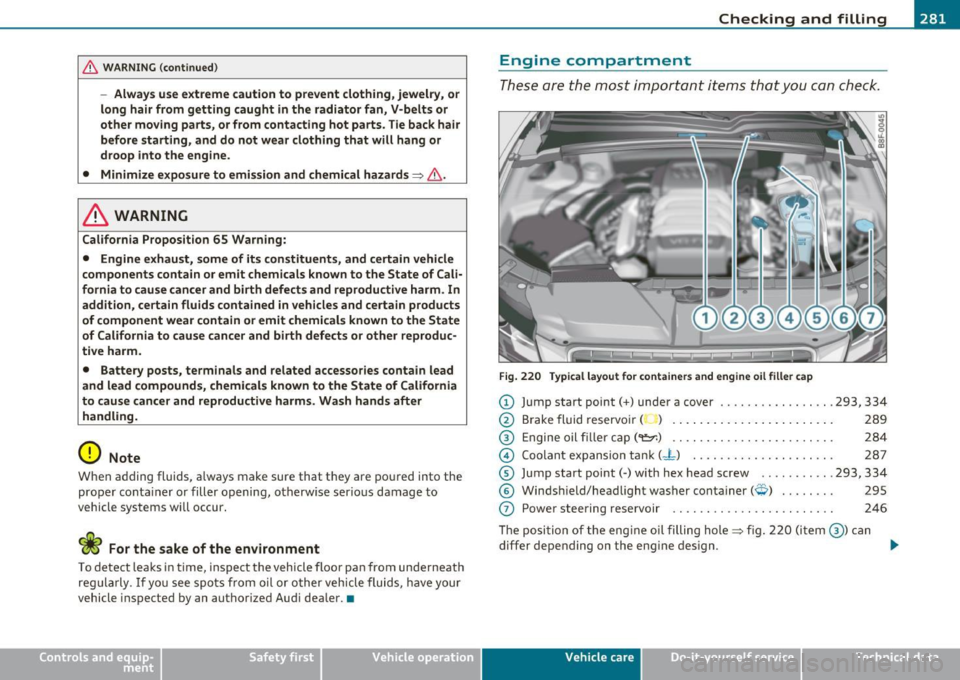
Engine compartment
These are the most i mportan t it ems that you can check.
Fig . 220 Typ ical layout for c ontainer s and engine oil filler cap
(D Jump start point( +) under a cover ........ .. .. .. .. . 293, 334
@ Brake fluid reservo ir ( ) . . . . . . . . . . . . . . . . . . . . . . . . 289
@ Engine oil f iller c ap
('1::r. ) . . . . . . . . . . . . . . . . . . . . . . . . 28 4
© Coolant ex pansion ta nk (-L ) . . . . . . . . . . . . . . . . . . . . . 28 7
© Jump start point( -) w ith he x head screw ..... ... .. . 293 , 33 4
© Winds hield/head light washer container (0 ) . . . . . . . . 295
(j) Power steering reservoir . . . . . . . . . . . . . . . . . . . . . . . . 246
Th e posi tion of the eng ine o il filling hole ~ fig. 220 (i tem @) can
differ depending on the eng ine des ign . ..,.
Vehicle care Do-it-yourselt service iTechnical data
Page 297 of 364
Checking and filling IJl!II
--------------------------------------------=------- =------
<£> For the sake of the environment
Because of the problem of proper disposal of a battery, we recom
mend your authorized Audi dealer change the battery for you.
Batte ries contain sulfuric acid and lead and must always be disposed
of properly in compliance with all environmental regulations.
Disposing of vehicle batter ies improperly is very dangerous to the
environment. •
Windshield/headlight washer
container
Fig. 226 Engine
co mp artmen t: Wind
sh ield and headlight*
washer fluid container
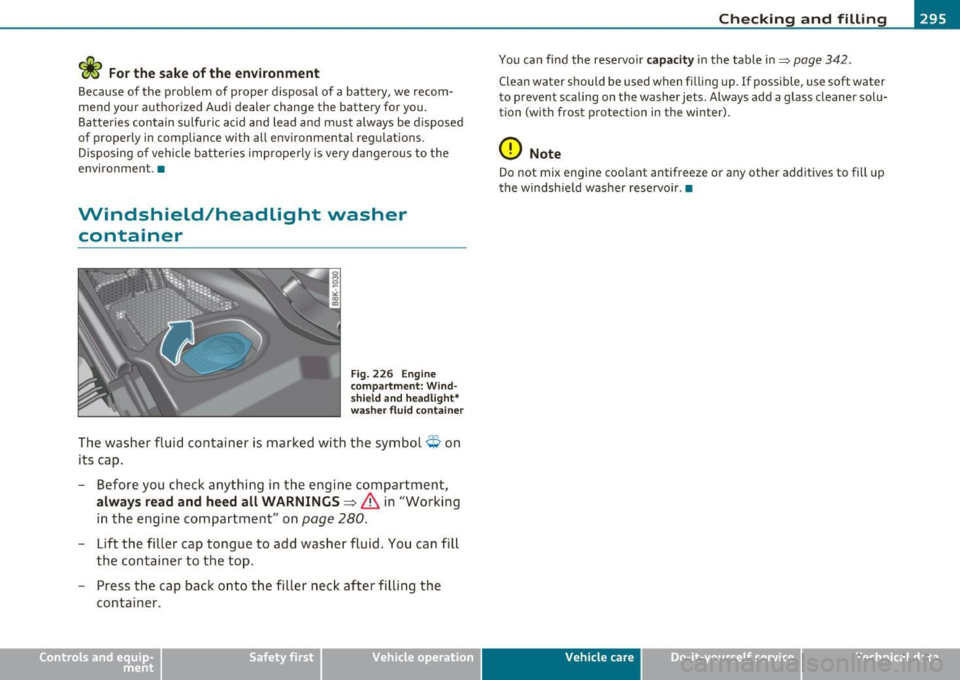
The washer fluid container is marked with the symbol Q on
its cap.
- Before you check anything in the engine compartment,
always read and heed all WARNINGS => & in "Working
in the engine compartme nt" on
page 280 .
-Lift the filler cap tongue to add washer fluid. You can fill
the container to the top.
- Press the cap back onto the filler neck after filling the
container.
Vehicle OP-eration
You can find the reservoir capacity in the table in::::, page 342.
Clean water should be used when filling up. If possible, use soft water
to prevent scaling on the washer jets. Always add a glass cleaner solu
tion (with frost protection in the winter).
0 Note
Do not mix engine coolant antifreeze or any other additives to fill up
the windshie ld washer reservoir .•
Vehicle care Do-it-yourselt service iTechnical data
Page 355 of 364
Alphabetical index -________________ fWI
For the sake of the environment
Gasol ine fumes and the env ironment 276
Refueling ..... .. .. .. ............ 276
Saving fuel by early upshifting ..... .. . 9
F ront ai rbags
Description ....... ... . .. .. .. ..... 203
How they work ................ .. . 208
Front armrest Adjusting ........................ 83
Storage compartment ............ .. 83
Front ashtray . .. .. .. ...... ....... ... . 85
Front seats .. .. .. .. ............. .... 77
Adjus ting . .. ... .... ... .. .. ..... . 179
Child restraints in the front seat .... 201
Conven ience side view . .. ...... ..... 82
Symmetrical seat posit ions .......... 82
Upper cabin heati ng ........... .. . 104
Frontal collisions and the laws of physics 190
Fuel Add itives ....................... 274
Blended gasoline ................ . 274
Consumpt ion ....... ...... .. .. .. .. 21
Filler neck ..... .. .. .... .......... 275
Fuel gauge ......... ...... .. .... .. 10
Gasoline .................... .... 274
Gasoline additives .. .... ... ... ... . 275
Octane rating ............... .. .. . 274
Recommendation ... .... .... .. .. . 274
Refuell ing ... ... . ...... ......... . 276
Reserve ...... ...... .. .. .. .. .... .. 10
Tank capacity ............. .. .... . 342
Unlocking the fuel filler flap by hand . 278
Controls and equip
ment Safety first
Fuel economy messages (efficiency
program)
25
Fuel filler flap Unlocking the fuel filler flap by hand . 278
Fuel supply too low ..... .. .. .. .. ...... 36
Fuse arrangement ........... ...... .. 328
Fuses Assignment ............ 329,330,331
Replacing . ... .. .... .. .. .. .. .. .. . 328
G
Garage door opener (Homelink ®) .. .. .. 171
Gas d ischarge lamps ...... ........... 332
Gauges Engine coolant tern perature .......... 8
Fuel gauge .. ..... .. .............. 10
Ta chometer ............. .. .. .. .... 9
General illustration
Instruments and controls ........ .. .. 7
Glossary of tire and loading terminology 297
Glove compartment ............... ... 87
Gross Vehicle Weight Rating (GVWR) ... 341
H
Head restraints .................. ... 180
Adjusting .. .. ... ... .. ... ...... .. 180
Front seats . .. .. .................. 82
Headlight washer reservoir ..... .. .. .. 295
Headlights Adaptive light ........... .. ....... 66
Fog lights . ... ................ .... 64 Headlight range control defective
.. .. 37
Rear fog lights .............. .. ... . 64
Washer system ................... 69
Heated Front seats ............... ...... . 103
Rear seats .. .. .. .. ............. . 103
Rear window . . . . . . . . . . . . . . . . 92, 100
Washer fluid nozzles ...... ... . ... .. 69
Heated outside mirrors ............... 73
Heating . . . . . . . . . . . . . . . . . . . . . . . . 88 , 95
Heavy clothing and safety belts ....... . 192
High beam ............ ...... .... .. .. 67
Warning/indicator lights ....... .. .. 15
High voltage warning label .... ..... .. 340
Homelink ® universal remote control ... 171
Hood Opening ........... .. .. .. .. .. .. . 279
Release lever ............. .... .. . 279
Horn ........ ........ .. . ... ... .. ... .. 7
How are child restraint system anchors related to child safety .. .. .... .......... 234
How many airbags does my vehicle have? ...
206
How often should I check my tire pressures? 303
How safety belt pretensioners work .... 197
Hydroplaning . ..................... 307
I
Ignition key ........... ...... .... ... 106
Emergency unlocking ............ .. 40
Vehicle operation Vehicle care Do-it-yourself service Technical data
Page 361 of 364
___________________________________________ A_ l::.. p _h _a_ b_ e_t _ic _a_ l_ in_ d _ e_x __ _
u
Undercoating ............... .... ... . 267
Unfastening safety be lts ......... .... 196
Unidirectional tires ....... .. .. .... .. . 296
Uniform tire quality grading .. .. .. ... .. 311
Unlocking Power locking switch ............... 46
Rear lid/trunk lid ...... ... ..... .... 47
Remote control key .. ...... .. .... .. 43
Using the mechanical key . .. .... .. .. 45
Upper cabin heating .... .. .. .. .. .... . 104
Use of jumper cables . .. ... ... .. ..... 334
V
Vanity mirror ................... .... . 69
Vehicle Identification Number (VIN) ... . 340
Vehicle jack .................... ... . 323
Vehicle literature ... ............. .. ... 4
Vehicle tool kit ....... ... .. .. .. ..... 318
Vehicle -care products .... ......... .. . 260
Ventilation . . . . . . . . . . . . . . . . . . . . . 91, 98
Warning/indicator lights .... ...... .. .. 12
adaptive cruise control ... .. ... . .. . 123
Airbag system ............ .... .. .. 14
Anti-lock brake system (ABS) ........ 15 Brake system ...... ... ... ... .. .. .. 17
Cruise control ............. ... ... .. 15
Electromechanical parking brake ... .. 16
Controls and equip
ment Safety first
Electronic power control
.. ...... ... . 13
Electronic stabilization program (ESP) . 14
H igh beam ................... .... 15
Malfunction Ind icator Lamp (MIL) ... . 15
Safety belt . .. .. ................. . 15
T ire pressure monitoring system ..... 14
T urn signals ................... ... 15
Warranty coverages .... .. .. .. .. .. .. . 343
Washer reservoir .................... 295
Wash ing . .... .. ........... ...... .. 260
Automatic car was h .... .. ......... 261
by hand .. .. .. ................. .. 261
General information .............. 260
Power top cleaning .......... ... .. 263
with a power washer .............. 262
Waxing .. .. .. .. .. .... .. ... ...... .. 263
Wear indicator .. ... ................ 306
Weatherstr ips ............. ......... 266
Weights ....... .... ... ............. 341
What happens if you wear your safety be lt too
loose? ... .. .. ... ..... ..... .. .. 1 95
What happens to unbelted occupants? .. 191
What impairs driving safety? ........ .. 177
What should I do after changing a wheel? . .
303
What should I do after replacing wheels? .. .
303
Wheel bolts Torque .... ................... .. 313
Wheels .. .. .. .. ... ................ 296
Cast alloy ....................... 266
Checking tire pressure .. .. .... .... . 302
Cold tire inflation pressure ......... 300 General notes
........ ... ... .. .. . 296
Glossary of tire and loading terminology. 297
New tires and wheels ........... .. 307
Tires and vehicle load limits ........ 304
When must a safety belt be replaced? .. 192
When must the airbag system be inspected?
210
When should I adjust the tire pressures? 303
When should I check the tire pressures? . 303
Where are lower anchorages located? .. . 236
Where can I find the tire pressures for my car? 302
Why safety belts? . . . . . . . . . . . . . . 189, 190
Wind deflector ..... .. ............... 55
Cleaning ............ .... ..... ... 263
Window regulators
Malfunctions ............ ...... ... 50
Powe r locks ....... ............... 49
Windows Cleaning ........... .. ... ... .. .. . 265
Windshield defogging/defrosting . . 92, 100
Windshield washer fluid
Low level ........................ 35
Windshield wipers .. .. .. .. .......... . 69
Faulty .................. ... .. ... . 37
Folding up .. .. .. .. .... ... ........ 71
Serv ice position .. .. .... ........... 70
Washer reservoir ... .............. 295
Winter operation Battery ......... ... .. .. ... ... ... 290
Coolant system ..... ..... ... . ... . 286
Defrosting windows . . . . . . . . . . . 92, 99
Vehicle operation Vehicle care Do-it-yourself service Technical data