tire pressure AUDI A5 CABRIOLET 2013 Owner's Manual
[x] Cancel search | Manufacturer: AUDI, Model Year: 2013, Model line: A5 CABRIOLET, Model: AUDI A5 CABRIOLET 2013Pages: 290, PDF Size: 72.35 MB
Page 242 of 290

24 0 T ire s and wheel s
H up to 130 mph (210 km/h)
V up to 149 mph (240 km/h)l)
Z over 149 mph (240 km/h)ll
W up to 168 mph (270 km/h)
1l
Y up to 186 mph (298 km/h)ll
Your vehicle is norma lly factory equipped with
tires, which possess excellent driving charac
teristics and give your Audi opt imum driving
comfort. An electronic speed limiter
c::> page 29 w ill normally prevent your vehicle
from go ing faste r than the tire speed rating
¢ & .
U.S . DOT Tire Identification Number (TIN)
and tire manufacture date
This is the t ire's "serial number". It beg ins
with the lette rs "DO T" and indicates that the
tire meets all federal standards. The next two
numbers or letters indica te the p lant where it
was manufactured, and the last four numbers
represent the week and year of manufacture .
F or examp le, the numbers 2212 mean that
the tire was produced in the 22nd week of
2012 . The other numbers are marketing co
des that may or may not be used by the tire
manufacturer . This information is used to con
tact consumers if a tire defect requires a re
call.
Audi Original tire
Tires with the ident ificat ion "AO" or "RO" have
been spec ially matched with your Aud i. We
recommend using only these tires because
they meet the highest standards regard ing
safety and d riving character istics when used
correctly. Yo ur au tho riz ed Audi dealer will
g lad ly provide you with more information.
Tire ply composition and materials used
The number of pl ies ind icates the numbe r of
l ayers of rubber-coated fabric in the t ire. In
general, the g rea ter the numbe r of p lies, the
mo re weig ht a t ire can support. Tire man ufac
turers a lso must indicate the materials in the
ll For tir es w it h a m ax im um spee d ca pabil ity ove r
1 4 9 mp h (2 40 k m/h) , t ire ma nufact urers somet imes
u se the lette rs "ZR. "
tir e, which include stee l, nylon, po lyester, and
others .
Maximum Load Rating
This number ind icates the maximum load in
k ilog rams and po unds t hat can be ca rr ied by
the tire .
Tire quality grading for treadwear ,
traction, and temperature resistance
T read wear, tra ct ion and tempera ture grades
c::>page 241 .
Maximum Permissible Inflation Pressure
This number is the greatest amount of a ir
pressure that should ever be put in the t ire
u nder norma l dr iv ing cond itions .
_& WARNING
- Using incorrect o r unm atc hed tires and/
or wheels or improper tire and wheel
combinat ions can lead to loss of control
'
collis ion and serio us personal i nju ry .
- A lways use t ires, rims and whee l bolts
that meet the specifications of origina l
factory- insta lled tires or other combina
tions that have been specifically ap proved by the vehicle manufacturer.
- Tires age even if they are not being used
and can fai l sudden ly, especially at hig h
speeds. Tires that are more than 6 yea rs
old can only be used in an emergency
and then w it h specia l care and at lower
speeds.
- Never mo unt used tires on your veh icle if
you are not sure of the ir "previo us histo
ry." O ld used tires may have been dam
a ged even thoug h the damage cannot be
seen that can lead to sud den tire fa ilure
and loss of vehicle control.
- All fo ur whee ls must be fitted with r adial
tires of the same type, size (rolling cir
cumference) an d the same tread pattern .
Driving with different tires reduces ..,_
Page 243 of 290
vehicle handling and can lead to a loss of control.
- If the spare tire is not the same as the
tires that are mounted on the vehicle -
for example with winter tires -only use
the spare tire for a short period of time and drive with extra care . Refit the nor
mal road wheel as soon as safely possi
ble .
- Never drive faster than the maximum speed for which the tires on your vehicle are rated because tires that are driven
faster than their rated speed can fail
suddenly.
- Overloading tires cause heat build-up,
sudden tire failure, including a blowout
and sudden deflation and loss of control.
- Temperature grades apply to tires that
are properly inflated and not over or un
derinflated.
- For technical reasons it is not always
possible to use wheels from other
vehicles -in some cases not even wheels
from the same vehicle model.
- If you install wheel trim discs on the ve
hicle wheels, make sure that the air flow
to the brakes is not blocked. Reduced air
flow to the brakes can them to overheat, increasing stopping distances and caus
ing a collision .
- Run flat tires may only be used on
vehicles that were equipped with them
at the factory. The vehicle must have a
chassis designed for run flat tires and a
factory-installed tire pressure monitor
ing system* that indicates a loss of tire
pressure. Incorrect use of run flat tires
can lead to vehicle damage or accidents.
Check with an authorized Audi dealer or
tire specialist to see if your vehicle can be
equipped with run flat tires . If run flat
tires are used, they must be installed on
all four wheels. Mixing tire types is not
permitted .
0 Note
-For technical reasons, it is not generally
possible to use the wheel rims from oth-
Tires and wheels 241
er vehicles. This can hold true for wheels
of the same vehicle type.
- If the spare tire is different from the
tires that you have mounted on your ve
hicle (for example winter tires or wide
profile tires), then use the spare tire for a
short period of time only and drive with
extra care. Replace the flat tire with the
tire matching the others on your vehicle as soon as possible .
- Never drive without the valve stem cap .
The valves could get damaged .
(® For the sake of the environment
Dispose of old tires in accordance with the
local requirements.
Uniform tire quality grading
-Tread wear
- Traction AA A B C
- Temperature AB C
Quality grades can be found where applicable
on the tire side wall between tread shoulder
and maximum section width 9 fig. 186.
For example: Tread wear 200, Traction AA,
Temperature A.
All passenger car tires must conform to Feder
al Safety Requirements in addition to these
grades.
Tread wear
The tread wear grade is a comparative rating
based on the wear rate of the tire when tested
under controlled conditions on a specified
government test course.
For example, a tire graded ISO would wear
one and one half (11/2) times as well on the government course as a tire graded 100.
The relative performance of tires depends upon the actual conditions of their use, how
ever, and may depart significantly from the norm due to variations in driving habits, serv
ice practices and differences in road character-
istics and climate.
1J1>
•
•
Page 246 of 290
24 4 T ire s and wheel s
Wheel bolts
Wheel bolts must always be tightened to the
correct torque .
The design of wheel bolts is matched to the
factory installed rims. If differen t rims are fit
ted, the correct wheel bolts with the r ight
length and correctly shaped bolt heads must
be used. This ensures that wheels are fitted
secure ly and that the brake system funct ions
correctly .
In ce rtain circumstances, you may not use
wheel bolts from a different vehicle -even if it
i s the same model~
page 2 71.
_& WARNING
Improperly tig htened o r maintained whee l
bolts can become loose ca using loss of
contro l, a co llision and serious persona l in
jury.
- Always keep the wheel bolts and the
threads in the wheel hubs clean so the
wheel bolts can turn easily and be prop
erly t ightened.
- Never grease or oil the wheel bo lts and
the threads in the wheel hubs. They can
become loose while driving if greased or
oiled, even if tightened to the specif ied
torque .
- Only use wheel bolts that belong to the
rim being installed .
- Never use different wheels bolts on your
vehicle .
-Always maintain the correct tighten ing
torque for the wheel bo lts to reduce the
risk of a wheel loss. If the tightening tor
que of the wheel bolts is too low, they
can loosen and com e out when the veh i
cl e is moving. If the tightening torque is
too high, the whee l bolts and threads
can be damaged and the wheel can be
come loose.
@ Note
The spec ified torq ue fo r the wheel bo lts is
90 ft lbs. (120 Nm) wi th a toler ance of
± 7,4 ft lbs. (± 10 Nm). Torque wheel bo lts diagonally. After changing a wheel, the
torque m
ust be checked as soon as possi
ble with a torque wrench -preferably by an
a uthori zed Audi dea ler or q ua lified work
shop .
Low aspect ratio tires
Your Audi is factory -equ ipped w ith low aspect
ratio tires . T hese tires have been thoroughly
tested and been se lected specifically fo r your
model for their superb perfo rmance, road fee l
and hand ling under a variety o f driv ing condi
t ions . As k your authorized A udi dealer for
more details .
T he low aspect ratio of these tires is ind icated
by a numera l of
55 or l ess in the tire's s ize
designation. The numeral represents the ratio
of the tire's sidewa ll height in relation to its
tread width exp ressed in percentage . Conven
tiona l tires have a he ight/w idth ratio of 60 or
more .
The performance of low-a spect-r atio tire s is
pa rt icul arly s ens itive to imp ro per i nfl ation
pressure. It is therefore import ant that low
aspect ratio tires are inflated to the specified pre ssure and that the inflation pressure is
r e gularly checked and maintained . Tire pres
sur es should be checked at l east once a
month and always before a long trip
~ page 233, Checking tire pressure.
What you can do to avoid tire and rim
damage
Low aspect ratio tires can be damaged mo re
easily by impact w it h potholes, c urbs, g ull ies
o r ridges on the road, pa rticul arly if the tire is
u nderinfla ted .
In orde r to minimize the occurrence of impact
damage to t he tires of your vehi cle, we recom
mend tha t you observe the following preca u
tions:
- Always ma inta in recommended inflation
pressu res. Check your tire pressure eve ry
2 ,000 miles (3,000 km) and add air if neces -
sary. ..,.
Page 247 of 290
-Drive carefully on roads with potholes, deep
gullies or ridges. The impact from driving
thro ugh or over such obstacles can damage
your tires. Impact with a curb may also cause damage to your tires.
- After any impact, immediately inspect your
tires or have them inspected by the nearest
authorized Aud i dealer. Replace a damaged
t ire as soon as possible .
- Inspect your t ires every 2,000 miles (3,000
km) for damage and wear . Damage is not al
ways easy to see . Damage can lead to loss of
air and underinflation, wh ich could eventu
ally cause ti re fail ure. If you be lieve that a
t ire may have been damaged , replace the
t ir e as soon as possible.
- These tires may wea r more q uick ly than oth
ers.
- Please also remember that, wh ile these t ires
deliver respons ive handling, they may ride
less comfortably and make mo re noise than
othe r choices .
Reduced performance in winter /cold
season condit ions
All t ires are des igned for certa in pu rposes.
The low aspect ratio, ultra high pe rformance
tires originally installed o n your vehicle are in
tended for max imum dry and wet road per
formance and handling . They are not suitable
for cold, snowy or icy weather condit ions. If
you dr ive under those circumstances, you
should equip your veh icle with all-season or
winter t ires, which offer better traction under
those cond itions . We suggest you use the re c
ommended snow or all-season tires specified
for your ve hicl e, or their equ ivalent .
Refer to~
page 242 for more deta iled info r
mat ion regarding win ter t ires.
Tire pressure
monitoring system
U) General notes
Ap plies to vehicles: with tire pressure monitoring system
Each t ire , includ ing the spare (if provided),
should be che cked mo nth ly when cold and in-
Tire s an d wheel s 245
flated to the inflation pressure recommended
by the vehicle man ufact urer on the vehicle
placard or tire inflat ion pressure labe l. (If your
vehicle has tires of a different size than the
s ize indicated o n the vehicle placard or tire in
flat ion pressure labe l, you shou ld determine
the proper t ire inflation pressu re for those
tires) .
As an added safety feature, your veh icle has
been equipped with a tire pressure monitoring
system ( TPMS) that illum inates a low tire
pr essure te lltale when one o r more of you r
tir es is s ignificant ly unde r-inflated. Acco rding
ly, when the low tire pressure tell tale illumi
nates, you shou ld stop and check you r tires as
soon as possib le, and inflate them to the
proper pressure . Driving on a significant ly un
der- inflated t ire causes the tire to overheat
and can lead to tire fa ilure. Under-inflation al
so reduces fuel effic iency and tire tread life,
and may affect the vehicle's hand ling and
stopp ing abil ity .
Please note that the TPMS is not a substit ute
for proper tire ma intenance, and it is the driv
er 's respons ibility to maintain correct tire
pressure, even if under-inflation has not
reached the level to tr igger illuminat ion of the
T PMS low ti re p ressu re tellta le.
Your vehicle has also been equipped with a
T PMS ma lfunction ind icator to ind icate when
the system is not operating p rope rly . T he
T PMS ma lfun ction indicator is comb ined w ith
the low tire pressure te lltale . Whe n the sys
tem detects a malfunc tion, the telltale will
flash for approximate ly one mi nute and then
remain continuously i lluminated. T his se
quence will continue upon subsequent vehicle
start-ups as long as the malfunct ion exists .
When the malfunction indicato r is illum inat
ed, the system may not be ab le to detect or
s ignal low tire pressure as intended. TPMS
malfu nctions may occur for a var iety of rea
sons, including the installation of replace
ment or a lternate tires or wheels on the vehi
cle that p revent the TPMS from functioning
properly. Always check the TPMS malfunction
t e llt ale after rep laci ng one or more tires o r ..,.
•
•
Page 248 of 290
246 Tires and wheels
wheels on your vehicle to ensure that the re
p lacement or a lternate tires and wheels allow
the TPMS to continue to function properly.
Tire pressure indicator appears
Applies to vehicles: with tire pressure monitoring system
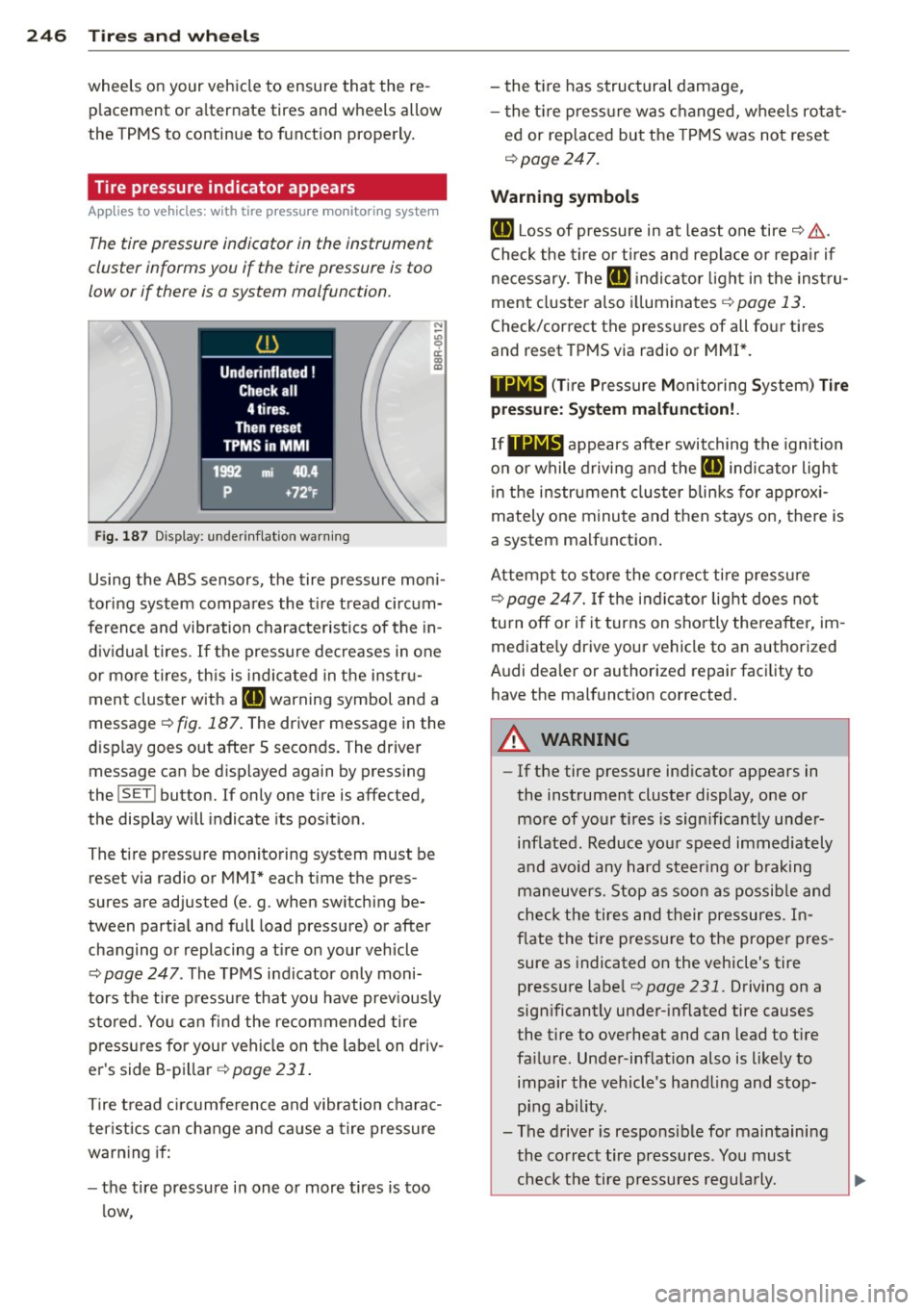
The tire pressure indicator in the instrument
cluster informs you if the tire pressure is too
low or if there is a system malfunction.
Fig. 187 Display: underinflation warning
N :;:; 9 a:
l:l
Using the ABS sensors, the tire pressure moni
tor ing system compares the tire tread circum
ference and vibration characteristics of the in
dividual tires.
If the pressure decreases in one
or mo re tires, this is indicated in the instru
ment cluster with a
[I] warning symbol and a
message
r:!> fig. 187 . The driver message in the
display goes out after S seconds. The driver
message can be displayed again by pressing
the
! SET ! button. If only one tire is affected,
the display will indicate its position.
The tire press ure monitoring system must be
reset via radio or MMI* each time the pres
sures are adjusted (e. g . when switching be
tween partial and full load pressure) or after
changing or replacing a tire on your veh icle
r:!> page 247 . The TPMS indicator only moni
tors the tire pressure that you have prev iously
stored . You can find the recommended tire
pressures for your vehicle on the label on driv
er's side 8-pillar
¢page 231.
Tire tread circumference and vibration charac
ter istics can change and cause a tire pressure
warning if:
- the tire pressure in one or more tires is too
low, - the
tire has structural damage,
- the tire pressure was changed, wheels rotat-
ed or replaced but the TPMS was not reset
c;, page 247.
Warning symbols
[I] Loss of pressure in at least one tire c;, .&,..
Check the tire or tires and replace or repa ir if
necessary. The
[I] indicator light in the instru
ment cluster also illuminates
¢page 13.
Check/correct the pressures of all four tires
and reset TPMS via radio or MMI*.
11Nl~1 (Tir e Pressure Mon itor ing System) Tire
pressure: System malfunction!.
IfllilB appears after switching the ignition
on or while driving and the
[I] indicator light
in the instrument cluster blinks for approx i
mately one minute and then stays on, there is
a system malfunction .
Attempt to store the correct tire pressu re
c;, page 247. If the indicator light does not
turn off or if it turns on shortly thereafter, im
mediate ly driv e your vehicle to an author ized
Audi dealer or authorized repair facility to
have the malfunct ion corrected.
A WARNING
-
- If the tire pressure ind icator appears in
the instrument cluster display, one or
more of your t ires is sign ificantly under
inflated . Reduce yo ur speed immediately
and avoid any hard steering or braking
maneuvers. Stop as soon as possible and
check the tires and their pressures. In
f la te the tire pressure to the prope r pres
sure as indicated on the vehicle's tire
pressure label
r:!> page 231. Driving on a
significantly under-inflated tire causes
the t ire to overheat and can lead to tire
fa ilure . Under -inflation also is likely to
impair the vehicle's handling and stop ping ability.
- The driver is responsible for maintaining
the co rrect tire pressures. You must
check the tire pressures regularly.
Page 249 of 290
-Under certain conditions (such as a spor
ty driving style, winter conditions or un
paved roads), the pressure monitor indi
cator may be delayed.
- Ask your authorized Audi dealer if run
flat tires may be used on your vehicle.
Your vehicle registration becomes invalid
if you use these tires when not permit
ted. Damage to your vehicle or accidents could also result.
(D Tips
- The tire pressure monitoring system
stops working when there is an ESC/ABS
malfunction.
- Using snow chains may result in a system
malfunction .
- The tire pressure monitoring system on
your Audi was developed using tires with the "AO" or "RO" identification on the
tire sidewall ~
page 238. We recom
mend using these tires.
Reset tire pressure monitoring system
Applies to vehicles: with tire pressure monito ring system
If the tire pressure is adjusted, wheels are ro
tated or changed, the
TPMS must be reset via
radio or
MMI*.
~ Before resetting the TPMS, the current pres
sures of all four tires must correspond to
the specified values. Adjust the tire pressure and reset the pressure in the tire pressure
monitoring system according to the load
you are carrying
~ page 231.
~ Turn on the ignition.
~ Select: the ICARI function button> Tire
pressure monitoring
> Store now . Or
~ Select: the ICARI function button > Car sys
tems*
control button > Servicing & checks >
Tire pressure monitoring > Store tire pres
sures.
(D Tips
Do not store the ti re pressure if there a re
snow chains on the tire.
Tires and wheels 24 7
•
•
Page 251 of 290
There are some restrictions on the use of the
compact spare tire. The compact spare tire
has been des igned specifically for your type of
ve hicle.
It must not be swapped with a com
pact spare t ire from another type of veh icle.
Snow cha in s
For technica l reasons, the use of snow chains
on the compact spare tire is
not permitted .
If you do have to dr ive with snow chains and a
front tire fails, mou nt the spare whee l w ith
tire instead o f a rea r ti re . Install the snow
chains on the rear tire and use it to replace
the defective front tire.
A WARNING
- Never use the spare tire if it is damaged
o r if it is worn down to the tread wear in
dicators.
- If the spare tire is more than 6 years o ld,
use it only in an emergency and w ith ex
t reme caution and careful driving .
- The spare tire is intended only for tem
porary and short-term use. It should be
replaced as soon as possib le w ith the
normal wheel and t ire.
- After mounting the compact spare tire, the tire pressure must be checked as soo n as poss ible. The tire pressure of the
c ompac t sp are tire must be 4.2 bar; o th
erwise, yo u risk hav ing an accident.
- Do not drive faster than 50 mph (80 km/
h). You risk having an a ccident.
- Avoid fu ll-throttle acce le rat ion, heavy
braking, and fast corner ing. Yo u risk h av
ing an acc iden t.
- Never drive us ing more t han one spa re
whee l and tire. You risk having an acci
dent.
- No rma l su mmer or wi nte r tires m ust not
be mounted on the comp act spare whee l
rim.
- F or technical reasons, t he use of ti re
chains on the spare tire is not permitted .
If it is necessary to drive with tire chains,
the spare whee l must be mounted on the
front axle in the event of a flat in a rear
What do I do now? 249
tire. The newly available front whee l
m ust then be insta lled in place of the
rear whee l w ith the flat tire. Installing
the t ire cha in before mounting the whee l
and tire is recommended .
- Loose items in the passenger compart
ment can cause serious personal injury
during hard bra king or in a n accide nt.
Never store the spa re tire or jack and
too ls in t he passenger compa rtment.
Changing a wheel
Before changing a wheel
Observe the following precautions for your
own and your passenger's safety when chang
ing a wheel .
"' After you experience a t ire failure, p ull the
car we ll away from moving traffic and try to
reach
le vel ground before you stop¢ A.
"' All passengers should lea ve the car and
move to a safe location (for instance, behind
the guardrail) ¢ &, .
"' Engage the
park ing brak e to prevent your
veh icle from rolling unintentionally¢&, .
"' Move the
se lec tor lever to th e P position .
"' If you are towing a t ra iler : unhit ch the trail
er from you r vehicle.
"' Take the
jack ¢ page 248 and the spare tire
c::> page 248 out of the luggage compart
ment .
A WARNING
You or your passengers could be injured
while changing a wheel if you do not fo l-
l ow these safety precaut ions :
- If you have a flat tire, move a safe d is
tance off the road. Turn off the engine,
turn the emergency flashers on and use other warning devices to a le rt other mo
torists.
- Ma ke sure that passenge rs wait in a safe
place away from the vehicle and well
away from the road and traffic.
- To help prevent the vehicle from moving
-
suddenly and possib ly slipping off the ..,. •
•
Page 252 of 290
250 What do I do n ow ?
jack, always fully set the parking brake
and block the wheel diagonally opposite the wheel being changed with the fold
ing chocks or other objects . When one
front wheel is lifted off the ground, plac
ing the Automatic Transmiss ion in "P"
(Park) will
not prevent the vehicle from
moving.
- Before yo u change a wheel, be su re the
ground is leve l and firm. If necessa ry,
use a st urdy board under the jack.
- Always store the vehicle tool kit, the
jack * and the replaced ti re in the l uggage
compartment
r=>page 12 7.
(D Note
If you are chang ing the wheel on a steep
incline, use a rock or s imilar object to
bloc k the opposite wheel to prevent the
veh icle from mov ing.
@ Tips
Obey a ll laws.
Changing a wheel
When you change a wheel, follow these
quence described below step-by-step and in
exactly tha t order .
1. Remove the decorativ e wheel c over* or
the
wheel bol t cap s* . Fo r more details see
a lso
r=> page 250, Decorative wheel cov
ers
or ¢ page 251, Wheels with wheel
bolt caps.
2 . Loosen the wheel bo lts r=> page 251.
3 . Locate the proper mount ing point for the
jack and align the jack below that point
r=> page 252.
4 . Lift the car with the jack r=> page 252.
5. Remove the wheel with th e flat tire and
then i nstall the
spar e tire r=> page 253 .
6. Tighten all wheel bo lts light ly .
7 .
Low er the ve hicle w it h the jack.
8 . Use the wheel bolt wrench an d
firmly
tighte n all whee l bolts in a crisscross pa t
tern
r=> page 251.
9. Replace the decorative wheel c over* or
the
wheel bolt cap s*.
A WARNING
A lways read and follow all WARNINGS and
i nformation
r=> .& in Raising the vehicle on
page 252
and r=> page 254.
After changing a wheel
A wheel change is not complete without the
doing the following.
.. Always store the vehicle tool kit, the jack*,
and the replaced tire in the luggage com
partment
r=> page 127.
.,. Check the tire pressure of the spare tire as
soon as possible .
"' As soon as poss ible, have the
tighteni ng
torqu es
on all wheel bolts checked w ith a
t orque wrenc h. The correct tig hte ning tor
que is
90 ft lbs. (120 Nm).
.,. Have the flat tire
repl aced as soon as possi
b le.
(D Tips
- If
you not ice that the wheel bo lts ar e
corroded and difficult to turn while
changing a tire, they shou ld be rep laced
before you check the tightening torque.
- Dr ive at reduced speed until you have the
tightening torques checked .
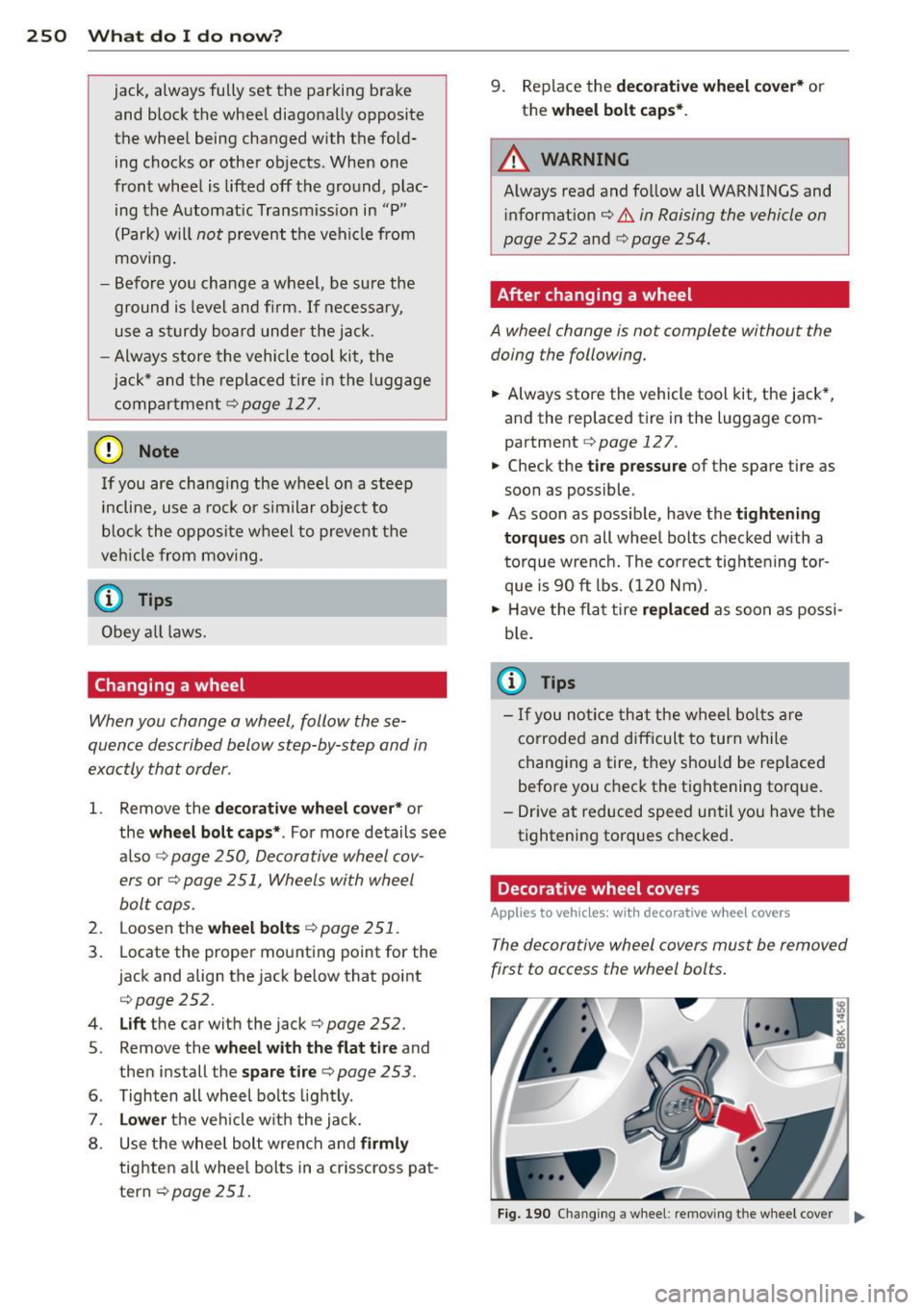
Decorative wheel covers
Applies to vehicles: w ith decorative w hee l covers
The decorative wheel covers must be removed
first to access the wheel bolts .
Fig. 19 0 Cha nging a whee l: removing t he w heel cove r Ill>
Page 256 of 290

254 What do I do now? Tires with unidirectional tread design
Tires with unidirectional tread design must be
mounted with their tread pattern pointed in the right direction .
Using a spare tire w ith a tread pattern
intended for use in a specific direction
When using a spa re tire w ith a t read patte rn
i n tended fo r use in a specific direction, please
n ote t he followi ng:
- The direction of rotation is marked by a n
ar
row on the side of the tire .
-If the spare t ire has to be installed in the in
correct direction, use the spare tire only
tempora rily si nce the t ire will not be able to
achi eve its optimum perfo rma nce cha racter
i st ics w ith reg ard t o aquaplani ng, noise and
we ar.
- W e reco mmend t hat you pay pa rticular at
ten tion t o this fact during wet we ather and
t h at you a dju st you r spee d to m atc h ro ad
con ditions.
- R epl ace the fla t tire w ith a n ew one an d
have it ins talled o n your ve hicle as soon as
p oss ible to restore the handlin g ad vantages
of a uni direct io na l tire .
Notes on wheel changing
Please rea d the information c> page 238 , New
t ires and replacing tires and wheels
if you are
go ing t o use a spare tire which is d ifferent
from the tires on your ve hicle.
Afte r you chan ge a t ire :
-Check the tire pressure on the spare imme
diately after installation.
- Have the wheel bolt tightening torque
checked with a torque wrench as soon as possible by your authorized Audi dealer or
a qualified workshop .
- With steel and alloy wheel rims , the wheel
bolts are correctly tightened at a torque of
90 ft lbs . (120 Nm) .
- If you notice that the wheel bolts are cor
roded and difficult to turn while changing
a tire, they should be replaced before you
check the tightening torque . -
Replace the flat tire with a new one and
have it installed on your vehicle as soon as
possible. Remount the wheel cover .
Until then , drive with extra care and at re
duced speeds.
_& WARNING
-
- If yo u are going to e quip your ve hicl e
with tires o r rims which differ from those
which were facto ry installed, then be
sure to read the informati on
¢ page 238,
New tir es and replacing tires and
w he els .
- Always ma ke sure the damaged wheel o r
even a flat tire a nd the jack a nd tool kit
a re pro pe rly s ecu red in the luggage co m
p artm ent and are not lo ose in the pas
s en ger c ompa rtm en t.
- I n an acci dent or sudde n man euve r they
co uld fly forwa rd, inju ring anyone in the
ve hicl e.
- Always s to re damaged wh ee l, j ack and
t oo ls se cur ely in the l uggage co mpa rt
ment. Otherwise, in an accident or su d
de n maneuve r they co uld fly forwa rd,
causing inj ury to passe ngers in the ve hi
cle.
(D Note
Do not use comm erc ia lly availabl e tire
sea lants. O therwise, t he e lectr ical co mpo
n ents of t he ti re pressu re mo nitoring sys
tem * w ill no longe r work proper ly an d the
sensor fo r the tire pressure mo nitor ing
system* will have t o be replaced by a
q ualified wor ks ho p.
Page 274 of 290
272 Consumer Information
Technical Modifications
Our guidelines must be complied with when technical modifications are made .
Always consult an authorized Audi dealer be
fore starting work on any modifications.
This will help ensure that vehicle function,
performance and safety are not impaired
¢ &. .
Attempting to work on electronic components
and the software used with them can cause
malfunctions. Because of the way electronic
components are interconnected with each
other, such malfunctions can also have an ad
verse affect on other systems that are not di
rectly involved. This means that you risk both
a substantial reduction in the operational
safety of your vehicle and an increased wear of
ve hicle parts ¢
A:,..
Author ized Audi dealers will perform th is
wo rk in a professiona l and competent manner
or, in special cases, refer you to a professional
company that specializes in such modifica
tions .
A WARNING
-
Improper repairs and modifications can
change the way vehicle systems work and
cause serious personal injury.
(D Note
If emergency repairs must be performed
elsewhere, have the vehicle examined by
an authorized A udi dealer as soon as possi
ble.
Declaration of
Compliance, Telecom
munications and
Electronic Systems
Radio Frequency Devices and Radiocommuni
cation Equipment User Manual Notice.
The manufacturer is not responsib le for any
radio or TV interference caused by unauthor
ized modifications to this equipment.
Devices
T he following devices each comply with FCC
Part 15.19, FCC Part 15.21 and RSS-Gen Iss ue
1:
- Adapt ive cru ise control*
- Conven ience key*
- Side assist*
- Cell phone package*
- Electron ic immobilizer
- Homelink ® universal remote control*
- Remote control key
- Tire pressure monitoring system*
FCC Part 15.19
This device complies with part 15 of the FCC
Rules . Operation is subject to the follow ing
two conditions:
(1) This device may not cause harmful inter
ference, and
(2) this device must accept any interference
received, including interference that may
cause undesired operation.
FCC Part 15.21
CAU TION:
Changes or mod ifications not expressly ap
proved by the party responsible for compli
ance could void the user 's authority to operate
the equipment .
RSS-Gen Issue 1
Operation is subject to the following two con
ditions: