seats AUDI A5 CABRIOLET 2013 Service Manual
[x] Cancel search | Manufacturer: AUDI, Model Year: 2013, Model line: A5 CABRIOLET, Model: AUDI A5 CABRIOLET 2013Pages: 290, PDF Size: 72.35 MB
Page 177 of 290
LATCH Lower
anchorages and tether
for children
Child Restraint System anchors and how
are they related to child safety
To provide a s impler and more pract icable way
to attach the chi ld restraint on the vehicle
seat, Federa l reg ulations require specia l lower
anchorages in vehicles and dev ices on new
chi ld restraints to attach to the vehicle ancho
rages .
The combination of the tether anchorages and
the lower anchorages is now generally called
the
LATCH system for " Lower Anchorages and
T ethers for Children ."
F orward-facing child rest raints manufactured
after September 1, 1999, are required by U.S.
federal regulations to comply wit h new c hild
head movement performance requirements .
These new performance requirements make a tether necessary on most new chi ld seats.
I nstal ling a chi ld restraint that requi res a top
tether witho ut one can serio usly impair the
performance of the chi ld restraint and its ab il
ity to protect the c hild in a co llision . Installing
a child restraint that requires a top tether
without the top tether may be a v io lation of
state law.
Ch ild restra int manufacturers offer LATCH
lower anchorages on the ir ch ild seats with
hook -on or push-on connecto rs attached to
adjustable straps .
In addition to the LATCH lower anchorages,
these child restraint systems usually require
the use of tether straps to help keep the child restra int firmly in place .
Tether anchorage s
Your Audi Cabriolet is not equipped with a
LATCH system. It is not equ ipped with top
tether anchorages. It is equipped with lower
anchorages only.
Your Cabriolet is equipped with the Active Rollover Protection System, w hich is integrat-
Child Sa fet y 175
ed into the back rest of the rear seat . The Ac
tive Ro llover P rotection System dep loys up
wards to he lp prov ide addit ional protection in
certain co llisions and crash s ituations. For this
reason, your vehicle is
not equipped with top
tether anchorages for use with forward -facing
c hi ld restra ints.
In Canada , provinc ial law requ ires that for
ward-fac ing ch ild restraints use both top teth
er anchorages and lower anchorages; the re
fore, it is
not pos sib le to install a forward-fac
ing child restra int in this vehicle.
In the United States , child restraint installa
tion must conform w ith the child restraint
manufacture r's instructions. Check the in
structions that come w ith the c hild restra int
o r contact the ma nufactu rer to determine if
the ch ild res traint may be ins ta lled fac ing fo r
ward without sec uring the top te ther strap .
A WARNING ,..__
Improper installation of child restraints
will increase the risk of injury and death in
a crash.
- Always follow the instr uctions provided
by the manufacture r of the child re
straint yo u intend to install in your vehi
cle.
- Improper use of child restraint LATCH
lower anchorage points can lead to injury
in a collision. The LATC H lower anchorage
points are designed to wi thstand on ly
those loads i mposed by co rrectly fitted
child r est raints.
- Never mount two ch ild restra int systems
on one LATC H lower anchorage point.
- Never secure or attach any luggage or other item to the LATCH lower anchorag
es.
@ Tips
In other countries, the term "ISOFIX" is
used to describe the lower anchorages .
•
•
Page 178 of 290
1 76 Child Safety
location
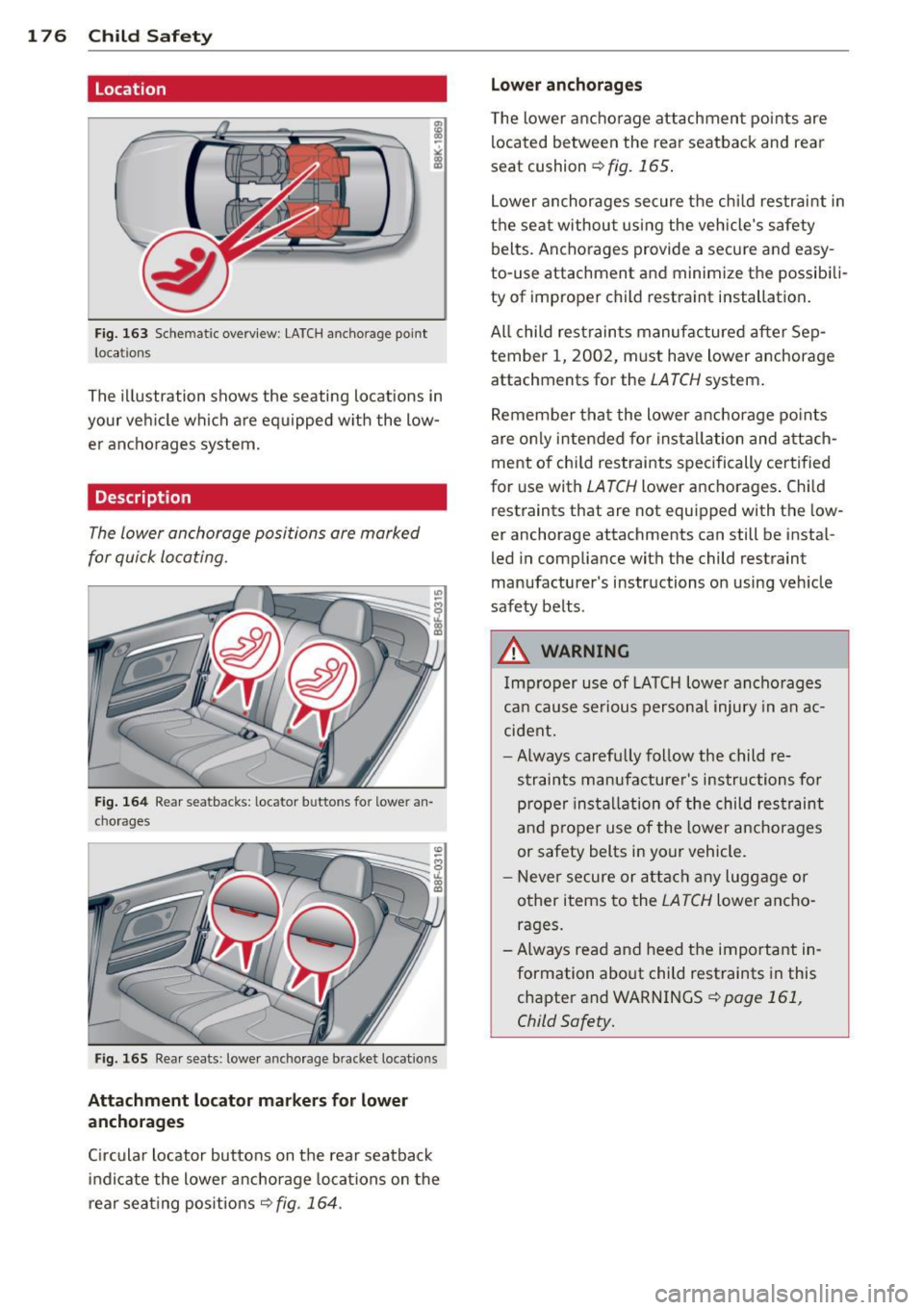
Fig. 163 Schematic overview: LATCH anchorage point
locations
The illustration shows the seating locations in
your vehicle which are equipp ed with the low
er anchorages system.
Description
The lower anchorage positions are marked
for quick locating.
Fig. 164 Rear seatbacks: locator buttons for lower an
chorages
Fig. 165 Rear seats: lower anchorage bracket locations
Attachment locator markers for lower
anchorages
Circular locator buttons on the rear seatback
indicat e the lower anchorage locations on the
rear seating positions
¢ fig . 164.
lower anchorages
Th e lower anchorage attachment points are
located between the rear seatback and rear
seat cushion
¢fig. 165.
Lower anchorages secure the child restraint in
the seat without using the vehicle's safety belts. Anchorages provide a secure and easy
to-use attachment and minimize the possibili
ty of improper child restraint installation .
All child restraints manufactured after Sep
tember 1, 2002, must have lower anchorage
attachments for the
LATCH system.
Remember that the lower anchorage points
are only intended for installation and attach
ment of child restraints specifically certified
for use with
LATCH lower anchorages. Child
restraints that are not equipped with the low
er anchorage attachments can still be instal
led in compliance with the child restraint
manufacturer's instructions on using vehicle
safety belts .
.&_ WARNING
-Improper use of LATCH lower anchorages
can cause serious personal injury in an ac
cident.
-Always carefully follow the child re
straints manufacturer's instructions for proper installation of the child restraint
and proper use of the lower anchorages
or safety belts in your vehicle.
- Never secure or attach any luggage or
other items to the
LATCH lower ancho
rages.
- Always read and heed the important in
formation about child restraints in this
chapter and WARNINGS
¢page 161,
Child Safety.
Page 179 of 290
Installing a child restraint with LATCH
lower anchorages
Whenever you install a child restraint always
follow the child restraint manufacturer's in
structions.
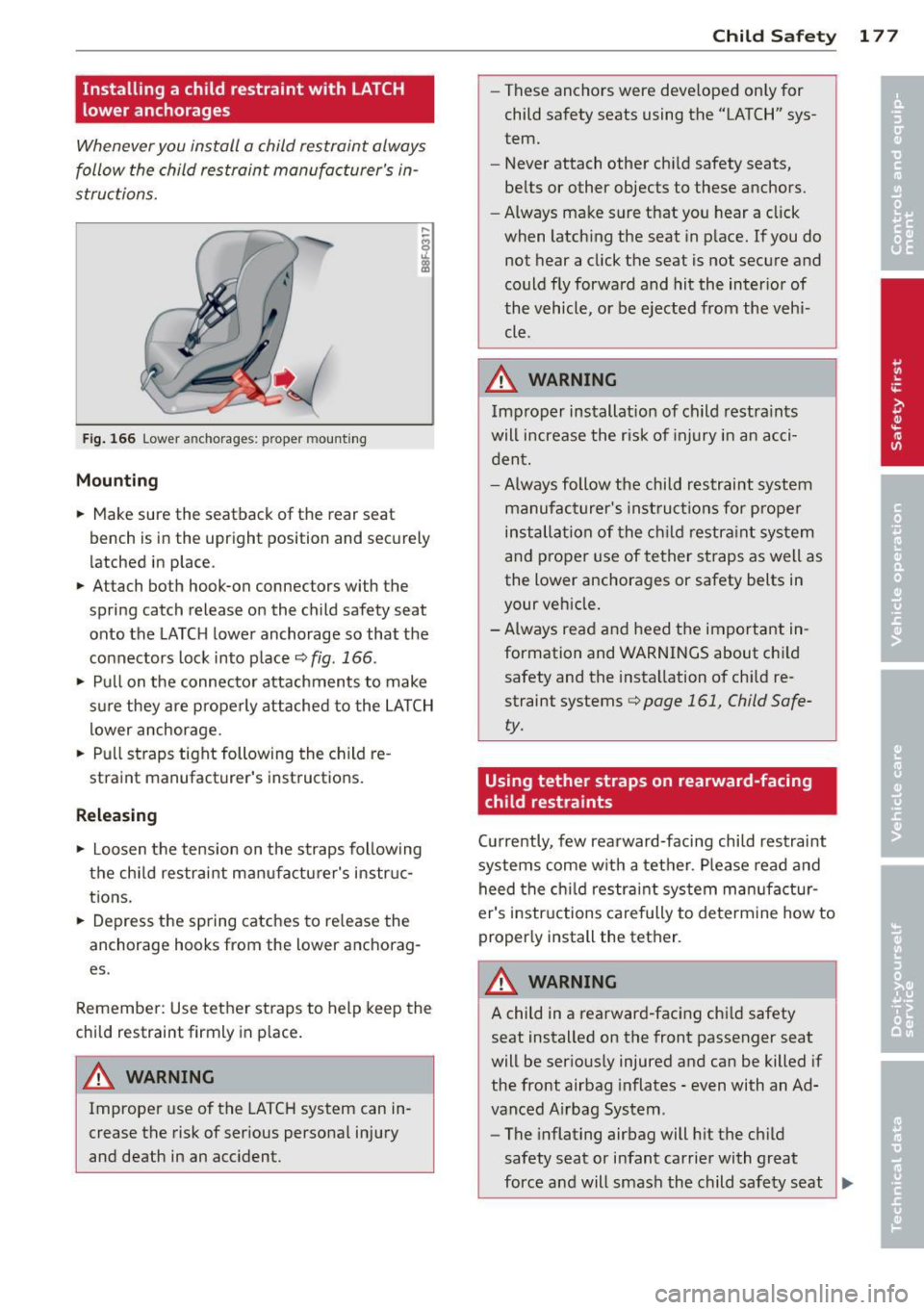
F ig . 166 Lower anchorages: proper mounting
Mou nting
~ Make sure the seatback of the rear seat
bench is in the upright position and securely
latched in place.
~ Attach both hook-on connectors with the
spring catch release on the child safety seat
onto the LATC H lower anchorage so that the
connectors lock into p lace
c::> fig. 166 .
~ Pull on the connector attachments to make
s u re they are properly attached to the LATCH
lower anchorage.
~ Pull st raps tight following the child re
straint manufacturer's instructions.
Re leasing
~ Loosen the tension on the straps follow ing
the chi ld restraint manufacturer's instr uc
tions.
~ Depress the spring catches to re lease the
anchorage hooks from the lower anchorag
es.
Remember: Use tether straps to help keep the
child restraint firmly in p lace.
A WARNING
Improper use of the LATCH system can in
crease the risk of ser ious personal injury
and death in an acc ident.
Child S afety 177
- These anchors were deve loped only for
child safety seats using the "LATCH" sys
tem.
- Never attach other chi ld safety seats,
belts or other objects to these anchors.
- Always make sure that you hear a click
when latch ing the seat in p lace. If you do
not hear a click the seat is not secure and
could fly forward and hit the interior of
the vehicle, or be ejected from the veh i
cle .
A WARNING
Improper installat ion of ch ild rest ra ints
will increase the risk of injury in an acci
dent.
- Always follow the child restraint system
manufacturer's inst ruct ions for prope r
installation of the ch ild restra int system
and proper use of tether s traps as well as
the lower anchorages or safety belts in
your vehicle.
- Always read and heed the important in
formation and WARNINGS about chi ld
safety and the insta llation of chi ld re
straint systems
c::> page 161, Child Safe
ty.
Using tether straps on rearward-facing
child restraints
-
Currently, few rearward-facing chi ld restraint
systems come w ith a tether . Please read and
heed the ch ild restraint system manufactur
er's instructions carefully to determine how to
properly install the tether.
A WARNING
-
A child in a rearward-fac ing chi ld safety
seat installed on the front passenger seat
will be ser iously injured and can be killed if
the front airbag inflates - even with an Ad
vanced Airbag System .
- The inflating airbag will h it the ch ild
safety seat or i nfant carrier with great
force and will smash the child safety seat
11>-
Page 188 of 290
186 Intelligent technology
Plea se start the engine soon or the system
will be tu rned off.
The warning ind icates that the system will be
turned off automa tic ally after 3 m inu tes. If
you wish to cont inue using the functions , you
have to start the engine .
With the engine running
Although ele ct ric al e nergy is generated when
the vehicle i s be ing driven , the battery can be
come d ischarged. This happens most ly w hen
little energy is being generated and a great
deal consumed and the battery 's state of
charge is not optima l.
To br ing the energy balance back into equili
brium, cons umers which require especia lly
l arge amounts of energy are temporarily c ut
back or switched off. Heating systems in par·
ticular requ ire a great deal of energy. If you
notice, for example, that the heated seats* or
the heated rear window are not heating, they have been temporar ily cut back o r switched
off. These systems will be ava ilable again as
soon as the ene rgy ba lance h as been restored.
You will a lso notice that engine idle speed has
been inc reased slightly . This is norma l and not
a cause fo r conce rn . By increas ing engine idle
speed the add itiona l ene rgy required is gener
ated and the ba tte ry is charged.
Page 204 of 290
202 Cleaning and protection
Aluminum trim
Use only neutral-pH products to remove spots
and depos its from alum inum s urfaces.
Chrome care products and alkaline cleaners
will attack aluminum surfaces and can dam
age them over time.
A WARNING
Always read and heed all WARNINGS and other information
9 page 194.
Fabrics and fabric coverings
Fabrics and fabric coverings (e.g. seats, door
trim panels, etc .) should be cleaned at regular
intervals with a vacuum cleaner . This removes
surface dirt particles which could become em
bedded in the fabric through use. Steam
cleane rs shou ld not be used, because the
steam tends to push the dirt deeper into the
fabric and lock it there.
Normal cleaning
Generally, we recommend using a soft sponge
or a l int-free m icrofiber cloth to the clean fab
ric. Brushes should only be used for carpets
and floor mats, since other fabric surfaces
could be harmed by brushes.
Normal surface sta ins can be cleaned using a
commercially available foam cleaner. Spread
the foam on the surface of the fabric with a
soft sponge and work it in gently. Do not satu
rate the fabric . Then pat the foam dry using
absorbent, dry cloths (e.g . microfiber cloth)
and vacuum it after it has dried completely.
Cleaning stains
Stains caused by beverages (e.g. coffee, fruit
juice, etc .) can be treated with a mild deter
gent solut ion . App ly the detergent so lution
with a sponge. In the case of stubborn stains,
a detergent paste can be applied directly to
the stain and worked into the fabric. After
wards, use copious amounts of clean water to remove the remaining detergent . Apply the
water with a damp cloth or sponge and pat
the fabric dry with an absorbent, dry cloth. Stains
from choco late or makeup should have
detergent paste rubbed into them. After
wards, remove the soap with water (damp
sponge).
Alcohol can be used to treat stains from
grease, oil, lipstick or a ballpoint pen. Melted
grease or dye must be patted off using ab
sorbent material. It may be necessary to re
treat the areas with detergent paste and wa
ter .
In the case of general soiling of the uphols
tery and cover material, we recommend hir ing
a specialist that has the equipment to clean
the seat covers and other fabric surfaces by
shampooing a nd spray extraction.
A WARNING ,..__
Always read and heed all WARNINGS and
the information
9page 194.
(j) Tips
Open Velcro fasteners on your clothing can
damage the seat cover. Please make sure
that Velcro fasteners are closed .
Plastic parts and instrument panel
Always use a clean cloth moistened in clear
water to clean these areas. For persistent dirt
use an Audi approved
solvent-free plastic
clea ner/protectant.
A WARNING
-Solvents can change the properties of
some p lastics and make it harder for the
a ir bag to deploy.
-
-Never clean the instrument panel or the
surface of airbag modules w ith cleaning
products that conta in solvents.
- Products containing solvents will make the surface of this part porous.
- Serious injuries can resu lt if plastic parts
come loose when the airbag is deployed.
- Always read and heed all WARNINGS and
other information
9 page 194.
Page 205 of 290
CD Note
Cleaning agents containing solvents will
attack the material and can change the
way it behaves.
Natural leather
App lies to vehicles: with natura l leather
Audi makes great efforts to maintain the
properties, natural look and feel of interior
leather.
G ene ra l
We offer many different types of leather on
our veh icles. Most are different types of nappa
leather, which has a smooth surface and
comes in various co lors.
The intensity of the color determines the visu
al characteristics and appearance . If the sur
face of the leather has a typical natural look,
then the leather is a nappa leather that has
been left in a relatively natural condition. This
leather offers particularly good comfort and
breathes well. F ine veins, closed grains, insect
b ites, skin folds, and subtle variations in co lor
remain visible. These cha racte ristics demon
strate that the mater ia l is na tural.
Natural nappa leather is not covered by a col
or finish.
It is therefore more sensitive to so il
ing and wear, wh ich is something you need to
consider if ch ild ren, an imals o r othe r factors
m ight prove to be particularly hard on the
l eather .
By contrast, leather types that are cove red by
a co lored finish laye r are more durable. This
h as a posit ive effect on the leather's resist
ance to wear and soiling in daily use . On the
other hand, the typical characteristics of natu
ra l leather are bare ly or not apparent. Howev
er, this does not mean that the leather itself
is of infer ior quality.
Ca re and handling
Because of the exclusive nat ure of the types of
l eather that Audi uses and their unique prop
erties (such as sensitivity to oils, grease, soi l
ing, etc.), you will need to be somewhat care-
Cleaning and protec tion 203
ful with these leathers, and a ce rtain type of
care is required. For example, dark clothing
mater ia ls can disco lor leather seats (especia l
l y if such clothing is damp and was not dyed
correctly). Dust and dirt particles in pores,
folds, and seams can have an abrasive effect
and can damage the leather surface as well as
weaken seams .
The leather should be cleaned regularly as needed . After having been used for a relat ively
long time, your leather seats will acqu ire a
rich aged fin ish. This is a character istic of nat
ural leathe r and a s ign of true quality.
In order to maintain the value of this natural
product over the life of your ve hicle, you
shou ld follow the recommendat ions below:
CD Note
- To keep your leather from b leac hing out,
do not allow it to be exposed to bright
sunlight for long periods of time. If you
have to leave the veh icle parked outside
for long per iods, cover the leather to
protect it from direct exposure to s un
light.
- Sharp objects on clothing, such as zip
pers, rivets or sharp pieces on belts can
leave permanent sc ratches or scrape
marks on the surface of the leather .
{i) Tips
-After each time you clean the leather and
at regular intervals, use a leather preser
vative cream that contains UV-b lockers
and that works into the leather. Th is
cream will nour is h and mo isturize the
leather, helping it to breathe and stay
supple. It also helps to build up a protec
tive coating on the surface .
- Clean the leather every 2 - 3 months,
and clean any areas that get soiled.
- Remove fresh marks made by ballpo int
pens, ink, lipstick, shoe polish, etc. as
soon as poss ible.
- Preserve the color of the leather as need
ed by us ing a special colored leather care
cream to touch up areas of uneven color. •
•
Page 230 of 290
228 Tire s and wheel s
-Never mount used tires on yo ur vehicle if
you are not sure of their "previous histo
ry." Old used tires may have been dam
aged even though the damage cannot be
seen that can lead to sudden t ire failure
and loss of vehicle control.
- If you notice unusual vibration or if the
vehicle pulls to one side when driving, al
ways stop as soon as it is safe to do so
and check the wheels and tires for dam
age.
(D Note
Please note that summer and winter tires
are designed for the cond itions that are
Glossary of tire and loading terminology
Accessory weight
means t he comb ined we ight (in excess of
those sta ndard items which may be rep laced)
of au toma tic tra nsmission, power steer ing,
power brakes, power windows, power seats,
radio, and heater, to the extent that th ese
items are availab le as factory -installed equip
ment (whether installed or not) .
Aspect ratio
means t he ratio of the he ight to the w idth of
the tire in percent . Numbers of 55 or lower in
dicate a low sidewall for improved steering re
sponse and better overall handling on dry pavement .
Bead
means the part of the ti re that is made of
steel wires, wrapped or reinforced by ply cords
and that is shaped to fit the rim.
Bead separation
means a b reakdown of the bond between
components in the bead.
Cord
means the strands forming the plies in the
tire . typ
ica l in those seasons . Audi recommends
using winter tires during the winter
months . Low temperatures signif icant ly
decrease the e lasticity of summer tires,
which affects tract ion and brak ing ability.
If summer tires are used in very co ld tem
peratures, cracks ca n form on the tread
bars, res ulting in permanent tire damage
that can cause loud driving no ise and un
balan ced t ires. Audi is not responsible for
th is type of damage .
Cold tire inflation pressure
means the tire p ressu re recommended by t he
vehicle manufacturer fo r a tire of a des igna ted
s iz e that has not bee n driven for more than a
coup le of miles (k ilometers) at low speeds in
t h e three hour period before the tire pressure
is measured or adjusted.
Curb weight
mea ns the we ight of a motor ve hicl e w ith
standard equipment including the max imum
capacity of fuel, oil, and coolant, air condi
tioning and additional weight of optiona l
equipment.
Extra load tire
me ans a t ire design to operate at higher loads
and at h igher inflation pressures than the cor
responding standard tire . Extra load tires may
be identified as "XL", "x l" , "EXTRA LOAD", or
"RF" on the sidewall.
Gross A xle Weight Rating ("GAWR ")
means the lo ad -c a rry ing c apac ity of a s ingle
axle system , measured a t the tire-ground in
terfaces.
Gross Vehicle Weight Rating ("GVWR ")
mea ns the maximum total loaded we ight of
t h e ve hicl e. .,.
Page 277 of 290
Automatic climate control Air vents ... .... .. .... ... .. .. .. .... 72
Operation . ..... ...... ... .. .. .. .. .. 71
Setup ... .. ................. .. .... 73
Automatic power top . . . . . . . . . . . . . . . . . 42
Automatic S hift Lock (ASL) ...... ... ... 87
Automatic transmission . . . . . . . . . . . . . . . 86
Automatic Shift Lock (ASL) . . . . . . . . . . . 87
Driving ... . ............. .... .. .. .. 88
Emergency mode . . . . . . . . . . . . . . . . . . . 92
Emergency release ........... .... ... 92
Kick-down . . . . . . . . . . . . . . . . . . . . . . . . . 9 1
M anual sh ift program ..... .. .. .. .. .. 90
multitronic . . . . . . . . . . . . . . . . . . . . . . . . 86
Remov al lock ( ignition key) . .. .. .. .. .. 75
Selecto r lever . . . . . . . . . . . . . . . . . . . . . . 86
S tron ic .. .. ... .. ..... ... .. .. .. .... 86
tiptronic . . . . . . . . . . . . . . . . . . . . . . . . . . 86
Automatic wipe rs .......... .. .. .. .. .. 57
Auto Safety Hotline ........ .. .. .. .. . 129
Average speed . . . . . . . . . . . . . . . . . . . . . . . 25
Avoid damaging the vehicle ...... . ... . 187
B
Battery . . . . . . . . . . . . . . . . . . . . . . . 17,222
Battery locat ion inside the luggage com-
pa rtment .. ................ ... ... 223
C harging . .. ............. .... .. .. . 225
I mpor tan t warn ings when work ing o n
the bat tery .... .. ..... ... .. .. .. ... 223
Ju mp starting ... ...... ... .. .. .. ... 259
L ow ..... .. ... .. .. ..... ... .. .. ... 185
Replacing the battery ..... .. .. .. .. . 226
State of charge ........... .... .. .. . 185
W inter operation ......... .. .. .. .. . 222
Working on the battery ........ ... .. 223
Before driving . .. .. ..... ... .. .. .. ... 121
B elt positioner ............ .... .. ... 135
Bio-ethanol (Fue l) .......... .. .. .. .. . 208
Blended gasoline .. ..... ... .. .. .. .. . 20 7
B lower (automatic climate cont rol) . . . . . . 72
Body cav ity sealing ......... .. .. .. .. . 201
B ooste r seats .. ........... .. .. .. ... 169
Brake flu id
Changing the brake flu id .... ... . ... . 222
Checking the brake fluid level ... .. .. . 22 1
Inde x 275
Rese rvoir ... .... ... .. .. ..... ... .. 221
What is the correct brake fluid level? .. 221
What shou ld I do if the brake fluid wa rn -
ing light comes on? ................ 221
B ra ke system .. .. .. ................. 221
Anti -lock braking system ..... ... .. .. . 19
B rake assist system . . . . . . . . . . . . . . . . 179
Brake fluid . ... .. .. .. .. ...... ... .. 221
Brake fluid specifications for refill and re-
placeme nt .. .. .. ................. 222
Brake light defective ................ 21
Bra ke powe r ass ist unit . .... ... ... .. 181
B ra kes ....... ... .. ............... 181
Ce ram ic bra kes . .. ................. 181
El ectromech ani ca l par king br ake . .. .. . 80
Warning/ind icator lights ..... ... .. .. . 15
Worn b rake pads symbo l ..... ... .. .. . 20
B rak ing
E mergency bra king f unct io n ..... .. .. . 82
braking guard . .. .. .. ............... . 94
Messages . .. .. .. .... ... .... .... .. 101
Settings ........ .. ..... .......... 101
Break-in per iod . ..... . .. .. ..... ... .. 187
Tires ....... .. .. .. . .............. 187
Bul bs ...... .. .. .. .. .. ........... .. 258
C
Califor nia Proposition 65 Warn ing ... .. 213
B attery spe cific .. ............. .... 224
Capacities .. .... .. ................. 267
Car care . ... .. .... .. . .. .. ..... ... .. 194
Interior ... .. .... .. . .. .. ..... ... .. 201
Plastic and vinyl ...... ............. 199
Care of ex terior .. .. .. ............... 19 4
Cargo a rea
refer to L uggage compa rtmen t. . . 68, 127
Catalytic converter ... . ... .... ... .. .. 188
Center armres t . . . . . . . . . . . . . . . . . . . . . . 64
Central lock ing .. .. ................. . 31
Central lock ing switch . .. ...... .... .. 3S
Convenience key .. .. .. .. ...... .... .. 35
Remote cont ro l key . . . . . . . . . . . . . . . . . 34
Ceram ic brake rotors
New brake pads .. .. ........... .... 181
Certif ication . ..... ... .. .. ..... ... .. 272
Chang ing a flat t ire ... . .. .. .. ... ... .. 249
•
•
Page 278 of 290

276 Index
Changing a wheel
Changing engine oil
Chassis 249
218
Undercoating .............. .. .... . 201
Checking Eng ine coolant leve l ...... ... .. .... . 219
Checking tire pressure ....... ..... .. . 233
Child restraints Danger of using child restraints in the
front seat . . . . . . . . . . . . . . . . . . . . . . . . 141
Where can I get add itional information
about child restraints and their use? . . 178
Child restraint system anchors ... .. .. . 175
Ch ild safety .. ............. .. .. .. .. . 161
Convertible locking retractor . ..... ... 17 1
Important safety instructions for using
child safety seats ................. . 164
Important things to know when driving
with children .............. .. .... . 161
Installing a child restraint using the
L ATCH system ......... .... ... .. .. . 177
Lower anchorages ............ .. ... 176
Mounting and releasing the anchorage
hook .. .... ... .......... .. .. .. .. . 177
Ch ild safety seats . ..... .... .. .. .... . 167
Booster seats ............. ... .. ... 169
Convertible ch ild seats . . . . . . . . . . . . . 168
Conve rtible locking retractor .. .. .. .. . 171
Danger of using child restra ints in the
front seat .... ............. ...... . 141
How do I properly install a child safety
seat in my vehicle? ................. 164
Infant seats .............. ... .. .. . 167
Installing . . . . . . . . . . . . . . . . . . . . . . . . 171
LATCH system ............ .. .. .. .. . 177
Safety instructions .. ...... .. .. .. .. . 164
Unused safety belts on the rear seat .. 166
Cigarette lighter . . . . . . . . . . . . . . . . . . . . . 66
C leaning
A lcantara® (synthe tic suede) .. .. .. .. . 204
E ngine compartment ............ .. . 205
Exhaust tail pipes ........... .. .... . 201
Fabrics and fabric coverings . ..... .. . 202
Instrument panel ........... .. .... . 202
Interior .. ............... .. .. .... . 201
Leather .... .......... ...... ... .. . 204
Matte finish pa int ......... ... .. ... 197
MMI disp lay/controls .. .... .. .. .. .. . 201 Plastic
and vinyl . . . . . . . . . . . . . . . . . . . 199
Plastic parts ..... ................ . 202
Safety be lts ... .. ................ . 205
Trim strips .... .. ............. .... 199
Cleaning and protection .......... .... 194
Climate controls ... ..... ........... .. 70
Climate control system Automatic recircu lation ......... .... . 73
Supplementary heater ........ .. .. .. . 73
synchroni zing . . . . . . . . . . . . . . . . . . . . . . 73
Clock ..... ..... .. .. .............. .. 12
Closing Power windows .. ............. .. .. . 39
Closing/opening at the lock cylinder ................ .. 36
by remote control . . . . . . . . . . . . . . . . . . 34
with the centra l locking switch ........ 35
with the conven ience key ........ .... . 35
Cold tire inflation pressure ........ .... 231
Coming home . . . . . . . . . . . . . . . . . . . . . . . 53
Compact spare tire . ................ . 248
also refer to Spare tire . ...... ... .. .. 248
Compass in the mirror ........... .... . 59
Compliance ... .. .. .. .............. . 272
Consumer Information . . . . . . . . . . 129, 269
Contacting NHTSA ................. . 129
Convenience key
Indicator lights .. ... .......... .. .. . 79
Starting engine (S TART ENGINE STOP
button) ....... .. .. .............. .. 78
Stopping the engine (START ENGINE
STOP button) . . . . . . . . . . . . . . . . . . . . . . 79
Switching on ignition ........... .... . 78
unlocking/locking ... ... .... ... .. .. . 35
Convenience opening/closing ....... .. . 40
Convertib le child safety seats ......... 168
Convertible locking retractor Activating ..... .. ............. .... 173
Deactivating . .. .. ..... ........... . 173
Using to secure a child safety seat 1.71, 173
Coolant system . ... ................ . 219
Cooling mode (automat ic climate control) 71
Cooling System Expansion tank . .. ................ . 219
Cornering light . . . . . . . . . . . . . . . . . . . . . . 52
Page 280 of 290
278 Index
Hood ....... .. .. ..... ... .. .. .... . 212
Starting . . . . . . . . . . . . . . . . . . . . . . 75, 78
Starting with jumper cab les .. .. .. .. . 259
Stopping . . . . . . . . . . . . . . . . . . . . . . 77, 79
E ng ine compar tmen t
Safety instructions . . . . . . . . . . . . . . . . . 212
Working the engi ne compa rtment 212
E ng ine coolant
I ndicator light . . . . . . . . . . . . . . . . . . . . . 18
Eng ine coolant system ...... .. .. .. .. . 219
Adding coolant .. .......... ... .. .. . 220
Check ing coolant leve l ...... ... .. .. . 219
C hec king the eng ine coolant leve l . . . . . 21 9
R ad ia to r fan .. . ........ .. .. .. .. .. . 22 1
Eng ine coolant temperature
Temperature gauge ........... .. .... 10
Engine data . .... . ...... ... .. .. .... . 267
E ng ine hood
C losing .... ............. .. .. .. .. . 212
H ow to release the hood ... .. .. .... . 2 12
E ng ine oi l ... .. ........ .... ... .. .. . 214
Adding .. .. ................ ... ... 217
Addit ives . ... ............ .. .. .. .. . 217
C hanging .. ... .......... .. .. .. .. . 218
Che ck oil leve l ........... .... .... . 217
Consumpt io n . ... ..... ... .. .. .... . 217
Indicator light . .. ..... ... .. .. .. 1 7,21
O il consumption .......... .... .... . 216
O il grades ... ............ .. .. .. .. . 214
O il level symbol ............ .. .... .. 21
Pressure malfunction ....... ..... .. .. 17
Sensor defective . . . . . . . . . . . . . . . . . . . . 21
Specif ication and viscos ity . . . . . . . . . . . 214
Eng ine speed limitat ion ..... .. .. .... .. 21
E nv iro nment
Break -in period . .. ..... ... .. .. .... . 18 7
Cata lytic converter ..... ... .. .. .... . 188
Disposing of yo ur vehicle battery .. .. . 226
Driving at high speeds . . . . . . . . . . . . . . 189
Driving to m inim ize pollution and no ise 189
Fue l . . . . . . . . . . . . . . . . . . . . . . . . . . . . . 210
F uel economy ............. ... .. ... 189
Le aks under your veh icle . ........ .. . 212
L ett ing t he ve hicl e s tand and wa rm up . 189
P roper disposal of dra ined br ake flu id . 22 2 Proper disposal of d
rained eng ine cool -
ant . ... .. .... .. .. ... ..... ... .. .. 220
Proper d isposal of d rained eng ine
o il ... .... .... .. ............ 217,218
Recycling used engine oil ........ .... 217
U nleaded fuel .. .. ................ . 207
What s hou ld I do w ith an old battery? . 226
EPC
refer to Electronic power control . . . . . . 20
E SC (Electron ic Sta biliz atio n Con trol )
Warning/ind icator lights ..... ... .. .. . 19
E thy l alcohol (Fuel) . ................ . 208
Event Data Recorder (EDR) . . . . . . . . . . . . 179
E xhaus t tai l pipes
C leaning . ..... .. .. ... ..... ... .. .. 2 01
E xpansion tank . ... ... .. .. ... ..... .. 219
Exterior lighting . . . . . . . . . . . . . . . . . . . . . 52
E xte rior m irrors
Adjus ting . . . . . . . . . . . . . . . . . . . . . . . . . 55
D imming . ..... .. .. ... ..... ... .. .. . 56
Heating ... .... .. .. ... ..... ... .. .. . 55
F
Fan
R adiator
Fastening 2
21
Boos ter seats .... ............. .... 169
C o nvertib le child sa fe ty seats .. ...... 168
Infan t se ats
Flat tire 16
7
Chang ing ... .. .. ... .. .. ... ..... .. 2 49
flexib le fue l ... .. .. ............. .. .. 208
Floor ma ts .. .. .. .. ............. .. .. 126
Fog lights/rea r fog lig ht(s) .. .. .. .. .. .. . 52
Fol ding the rear seats ..... .... ... .. .. . 68
Foot peda ls . .. .. .. ............. .. .. 1 26
For the sake of the environment Gasoli ne fumes and the e nvironme nt .. 210
Letting the engine warm up . . . . . . 75, 78
Ref ueling ... .. .. ... .. .. ... ..... .. 210
Sav ing f uel by early ups hifting . .. .. .. . 11
Front a irbags
Description .... .. ................. 144
How they work . . . . . . . . . . . . . . . . . . . . 149
Frontal coll is ions and the laws of phys ics 133
F ront passenger's door emergency lo cking 36