warning light AUDI A5 CABRIOLET 2013 Repair Manual
[x] Cancel search | Manufacturer: AUDI, Model Year: 2013, Model line: A5 CABRIOLET, Model: AUDI A5 CABRIOLET 2013Pages: 290, PDF Size: 72.35 MB
Page 168 of 290
166 Child Safet y
range, and as far away from the airbag
as possible before installing the child
restra int.
- Always make sure that nothing pre
vents the front passenger's seat from be ing moved to the rearmost position
in its fore and aft adjustment range.
- Always make sure that the backrest is
in the upright position .
- Always buck le the child safety seat firmly
in place even if a child is not s itting in it.
A loose ch ild safety seat can fly around
dur ing a sudden stop or in a coll is ion.
- Always read and heed all WARNINGS
whenever using a child restrained in ave
hicle is being used
c::> page 132, Safety
belts,
c::> page 140, Airbag system and
c::> page 161, Child Safety.
.,&. WARNING
To reduce the risk of serious injury, make
sure that the
PAS SENGER AIR B AG OFF
light comes on and stays on whenever a
child restraint is installed on the front pas
senger seat and the ignition is switched
on.
- Take the child rest raint off the front pas
senger seat and install it proper ly at one
of the rear seat positions if the
PASSEN
GER AIR BAG OFF
light does not stay on.
- Have the airbag system inspected by
your authorized Audi dealer immediate
ly.
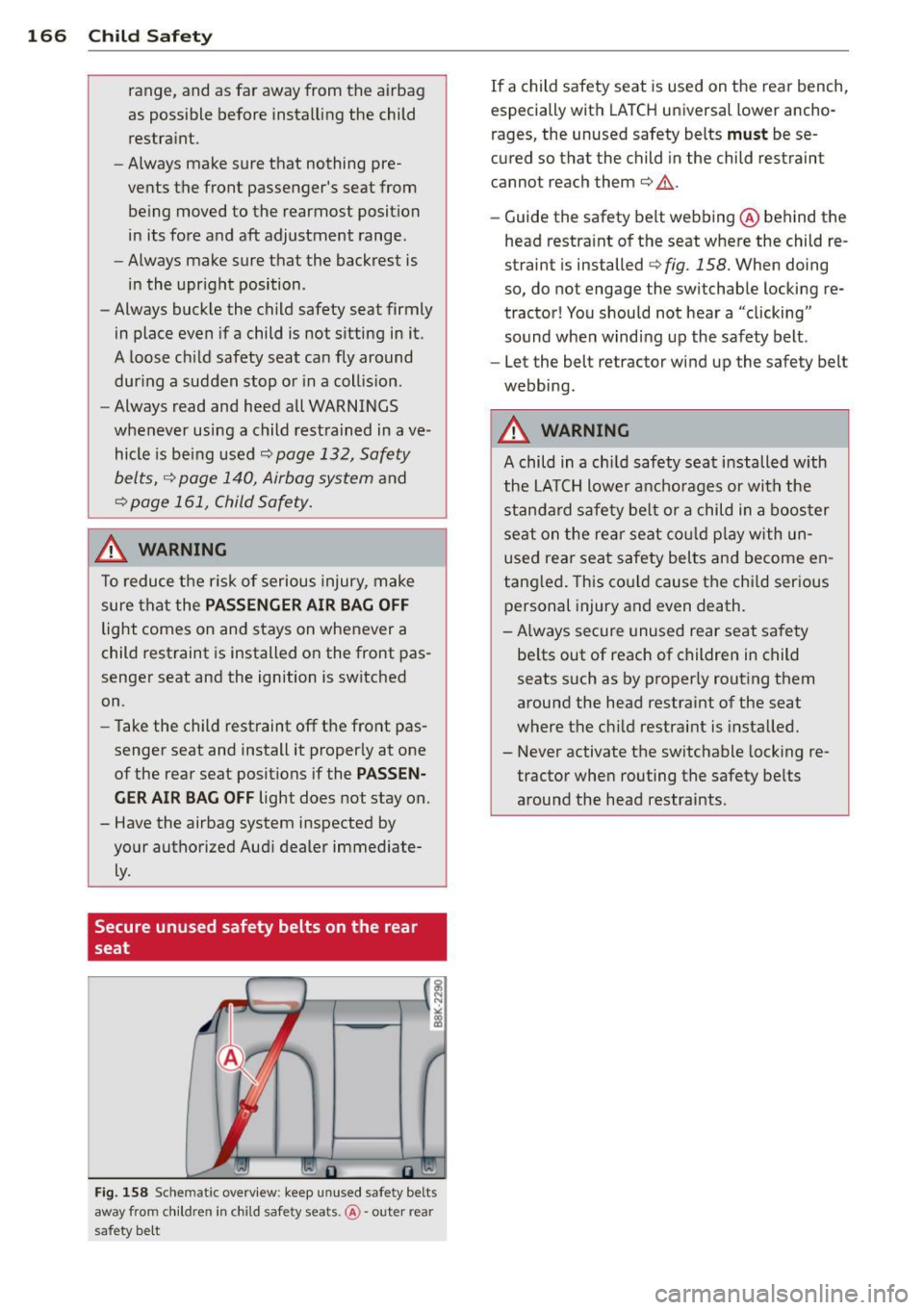
Secure unused safety belts on the rear
seat
Fig. 158 Schematic overview: keep unused safety belts
away from chil dren in child safety seats. @· outer rear
sa fety be lt
.
If a child safety seat is used on the rear bench,
especially with LATCH universal lower ancho
rages, the unused safety belts
must be se
cured so that the child in the child restraint
cannot reach them
c::> &.
-Guide the safety belt webbing @ behind the
head restra int of the seat where the child re
straint is installed
c::> fig . 158. When doing
so, do not engage the switchable locking re
tractor! You should not hear a "clicking"
sound when winding up the safety belt.
- Let the belt retractor wind up the safety belt
webbing.
.,&. WARNING
-A child in a chi ld safety seat installed with
the LA TCH lower a nchorages or with the
standard safety be lt or a child in a boos ter
seat on the rear seat co uld p lay with un
used rear seat safety belts and become en
tang led . This co uld cause the chi ld ser ious
personal injury and even death.
-Always secure unused rear seat sa fety
be lts out of reach of children in child
seats such as by proper ly routing them
around the head restraint of the seat
where the ch ild restraint is installed.
- Never activate the switchable locking re
tractor when routing the safety belts
around the head restraints.
Page 169 of 290
Child safety seats
Infant seats
Babies and infants up to about one year old
and 20 lbs. or 9 kg need special rearward -fac
ing child restraints that support the back,
neck and head in a crash.
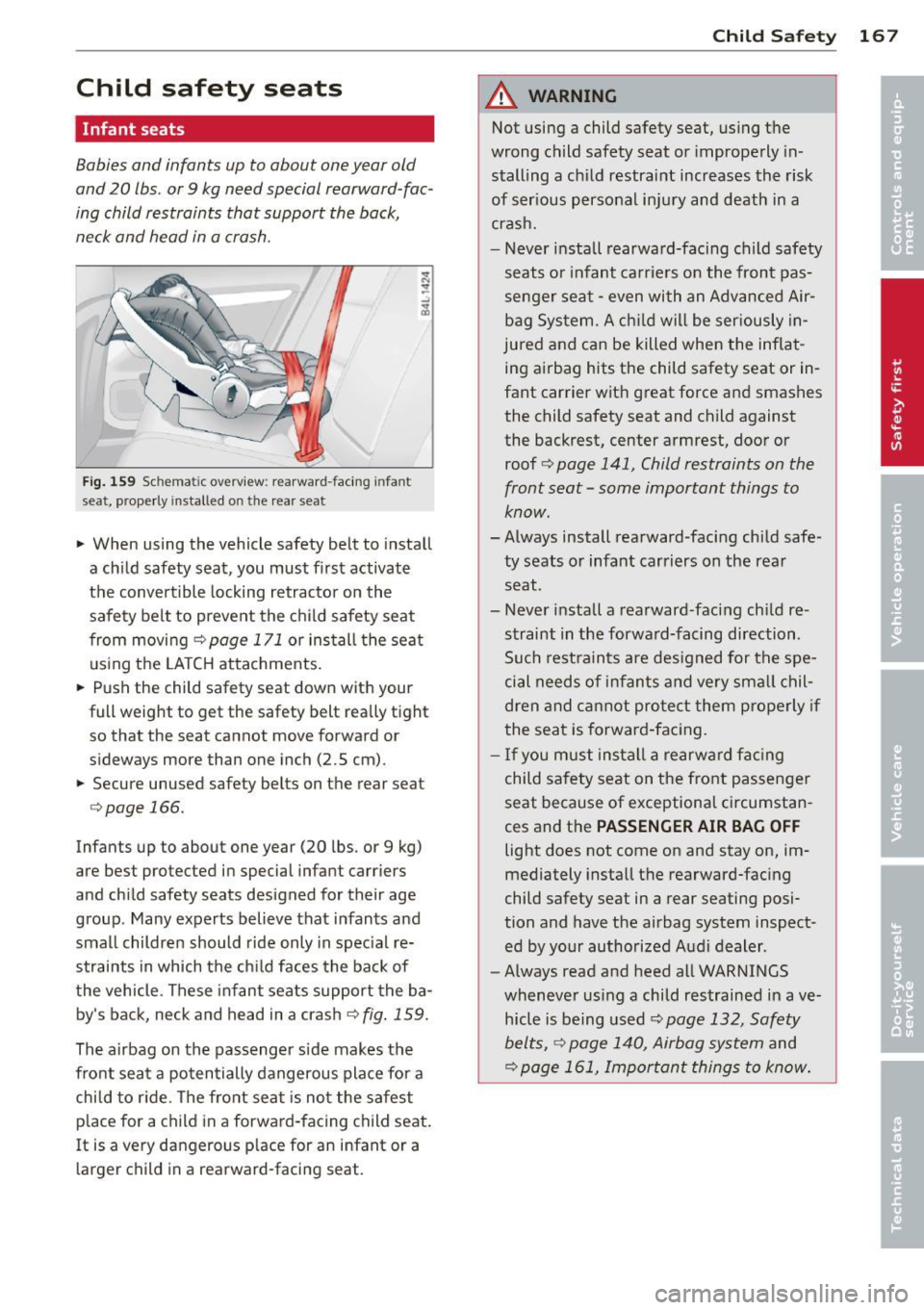
Fig . 159 Sche matic overv iew: rearward-fac ing infant
seat, properly installed o n the rear seat
~ When using the vehicle safety belt to install
a ch ild safety seat, you must first activate
the convertible locking retracto r on the
safety be lt to prevent the child safety seat
from moving
¢ page 171 or install the seat
using the LA T CH attachments.
~ Push the child safety seat down with your
full weight to get the safety belt rea lly tight
so that the seat cannot move forward or
sideways more than one inch (2.5 cm).
~ Secure unused safety belts on the rear seat
¢page 166.
Infants up to about one year (20 lbs . or 9 kg)
are best protected in special infan t carriers
and child safety seats designed for their age
group . Many experts believe that infants and
small children should ride only in spec ial re
straints in which the ch ild faces the back of
the vehicle. These infant seats support the ba
by's back, neck and head in a crash
¢fig . 159.
The airbag on the passenger side makes the
front seat a po tentially dangerous place for a
child to r ide . The front seat is not the safest
p lace for a child in a forward -facing child seat.
It is a very dangerous p lace for an infant or a
l arger ch ild in a rearward-facing seat.
Child Safety 16 7
A WARNING
Not using a child safety seat, using t he
wrong child safety seat or improperly in
stall ing a ch ild restraint increases the risk
of ser ious personal injury and death in a
crash.
- Never install rearwa rd-facing child safety
seats or infant ca rr ie rs on the front pas
senger seat -even with an Advanced Air
bag Sys tem. A ch ild will be ser iously in
jured and ca n be killed when the inflat
ing airbag hits the child safety seat or in
fant carrier with great force and smashes the child safety seat and child against
the backrest, center armrest, door or
roof ¢
page 141, Child restraints on the
front seat- some important things to
know .
-Always install rea rward -facing chi ld safe
ty seats or infant carriers on the rea r
seat .
- Never install a rea rward -facing ch ild re
straint in the forward-facing direction .
Such rest ra in ts are designed for the spe
cial needs of infants a nd ve ry sma ll chil
d ren and cannot pro te ct them p roperly if
the seat is forward -facing.
- If you must insta ll a rearwa rd fac ing
child safety seat on the front passenger
seat because of exceptiona l circumstan
ces and the
PASSENGER AIR BAG OFF
light does not come on and stay on, im
mediately insta ll t he rearward-facing
child safety seat in a rear seating posi
tion and have the airbag system inspect ed by your autho riz ed Audi dealer .
- Always read and heed all WARNINGS
wheneve r us ing a child restrained in ave
h icle is being used ¢
page 132, Safety
belts,
Q page 140, Airbag system and
¢ page 161, Impor tan t thi ngs to know .
Page 170 of 290
168 Child Safet y
Convertible child safety seats
Properly used convertible child safety seats
can help protect toddlers and children over
age one who weigh between
20 and 40 lbs. (9
and 18 kg) in a crash.
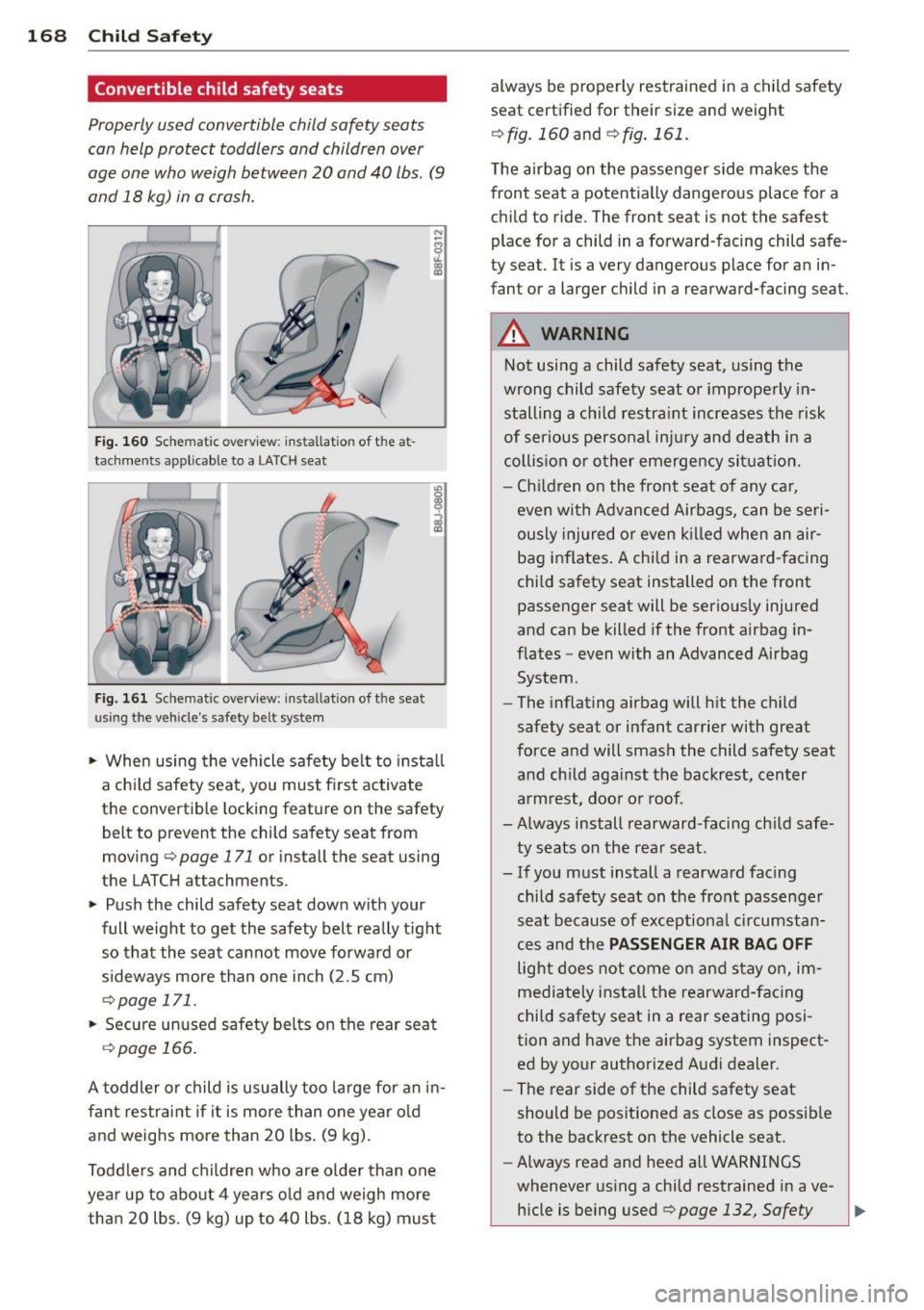
Fig . 160 Sche matic overv iew : ins tallat ion of t he at
t a chments appl icable to a LATCH seat
Fig. 161 Sche matic overview: in sta llat ion of t he sea t
us ing t he veh icle's safety be lt system
.. When using the vehicle safety be lt to install
a chi ld safety seat, you must f irst activate
the convertible locking feature on the safety
belt to prevent the child safety seat from
moving
c::> page 171 or insta ll the seat using
the LATCH attachments .
.. Push the child safety seat down with your
full weight to get the safety belt really t ight
so that the seat cannot move forward or s ideways more than one inch (2.5 cm)
c::> page 171.
.. Secure unused safety bel ts on the rear sea t
~page 166.
A toddler or child is usually too large for an in
fant restraint if i t is more than one year old
and weighs more than 20 lbs . (9 kg).
Toddle rs and ch ildren who are o lder than one
yea r up to about 4 years o ld and weigh more
than 20 lbs. (9 kg) up to 40 lbs. (18 kg) must always be proper
ly restrained in a child safety
seat certified for the ir size and weight
~ fig. 160 and r:!) fig . 161 .
The airbag on the passenger side makes the
front seat a potentia lly dangerous place for a
c h ild to ride. The front seat is not the safest
place for a child in a forward-facing child safe
ty seat. It is a very dangerous place for an in
fant or a larger ch ild in a rearward-facing seat.
A WARNING c=
Not using a child safety seat, us ing the
wrong child safety seat or imprope rly in
stalling a ch ild restra int increases the risk
of ser ious personal in jury and death in a
collis ion or o ther emerge ncy sit uat ion.
- Ch ild ren on the front seat of any ca r,
even with Advan ced Airbags, can be seri
ously injured or even k illed when an air
bag inflates. A chi ld in a rearwa rd -facing
child safety seat installed on the front passenger seat will be serio usly injured
and can be killed if the front airbag in
flates -even with an Advanced Airbag
System .
-
-The inflating airbag will h it the ch ild
safety seat or infant carrier with great
force and will smash the child safety seat
and child aga inst the back rest, center
armrest, doo r or roof .
-Always install rearward-facing ch ild safe
ty seats on the rea r seat .
- If you must install a rearward fac ing
child safety seat on the front passenger
seat because of exceptiona l circumstan
ces and the
PA SSENGER AIR BAG OFF
light does not come o n and stay on, im
mediately insta ll the rearward-facing
child safety seat in a rear seating posi
tion and have the airbag system inspect
ed by your authorized A udi dealer.
- The rear side of the child safety seat
should be pos itioned as close as possib le
to the backrest on the vehicle seat.
- Always read and heed all WARNINGS
whenever using a child restrained in ave-
h icle is being used
c::> page 132, Safety ll>-
Page 171 of 290
belts,<:!) page 140, Airbag system and
i=> page 161, Important things to know.
A WARNING
If exceptional circumstances require the
use of a forward-facing child restraint on
the front passenger's seat, the child's safe
ty and well-being require that the follow ing special precautions be taken:
- Make sure the forward-facing seat has
been designed and certified by its manu
facturer for use on a front seat with a
passenger front and side airbag.
-Always follow the manufacturer's in
structions provided with the child safety
seat or infant carrier.
- Always move the front passenger seat in
to the rearmost position of the passen
ger seat's fore and aft adjustment range,
and as far away from the airbag as possi
ble before installing the child restraint.
- Always make sure that nothing prevents
the front passenger's seat from being
moved to the rearmost position in its
fore and aft adjustment range.
- Always make sure the backrest is in an
upright position.
- Make sure that the
PASSENGER AIR BAG
OFF
light comes on and stays on all the
time whenever the ignition is switched
on.
- If the light does not stay on, perform the
checks
q page 151, Monitoring the Ad
vanced Airbag System.
- Take the child restraint off the front pas
senger seat and install it properly at one
of the rear seat positions if the
PASSEN
GER AIR BAG OFF
light does not stay on
whenever the ignition is switched on.
-
Child Safety 169
Booster seats and safety belts
Properly used booster seats can help protect
children weighing between about 40 lbs . and
80 lbs . (18 kg and 36 kg) who are less than 4
ft. 9 in. (57 inches/1.45 meters) tall.
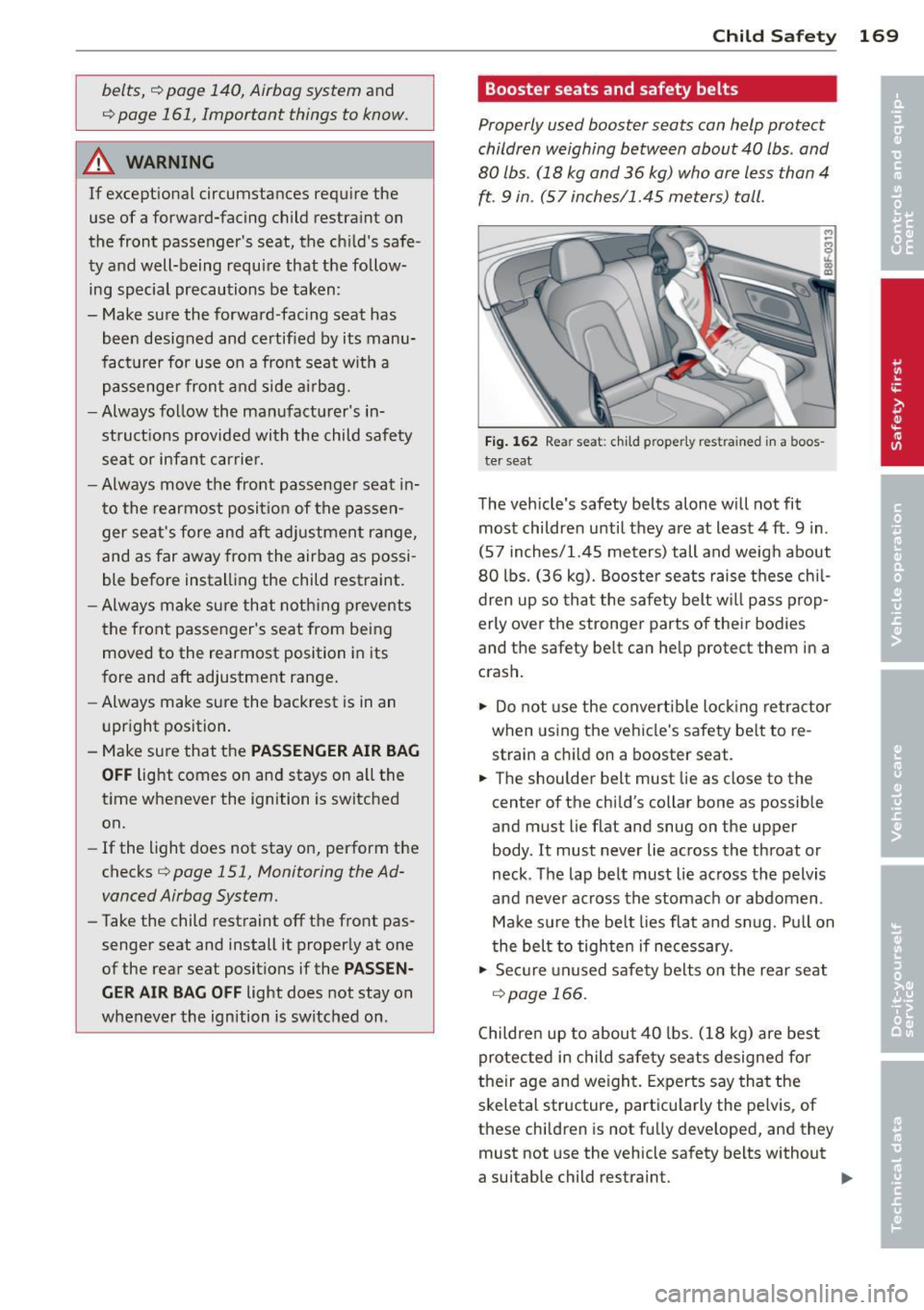
Fig. 162 Rear seat: c hild p roperly restrained in a boos
ter seat
The vehicle's safety belts alone will not fit
most children until they are at least 4 ft. 9 in .
(57 inches/1.45 meters) tall and weigh about
80 lbs.
(36 kg). Booster seats raise these chil
dren up so that the safety belt will pass prop
erly over the stronger parts of their bodies and the safety belt can help protect them in a
crash.
.,. Do not use the convertible locking retractor
when using the vehicle's safety belt to re
strain a child on a booster seat.
.. The shoulder belt must lie as close to the
center of the child's collar bone as possible
and must lie flat and snug on the upper
body .
It must never lie across the throat or
neck . The lap belt must lie across the pelvis
and never across the stomach or abdomen .
Make sure the belt lies flat and snug. Pull on
the belt to tighten if necessary .
.,. Secure unused safety belts on the rear seat
r:1;>page 166 .
Children up to about 40 lbs. (18 kg) are best
protected in child safety seats designed for
their age and weight. Experts say that the
skeletal structure, particularly the pelvis, of
these children is not fully developed, and they
must not use the vehicle safety belts without
a suitable child restraint.
Page 172 of 290
1 70 Child Safety
It is usually best to put these children in ap
propriate booster seats. Be sure the booster
seat meets all applicable safety standards.
Booster seats raise the seating position of the
child and reposition both the lap and shoulder
parts of the safety belt so that they pass
across the child's body in the right places. The
routing of the belt over the child's body is very
important for the child's protection, whether
or not a booster seat is used . Children age 12
and under must always ride in the rear seat.
Children who are at least 4
ft. 9 in. (57 in
ches/1.45 meters) tall can generally use the
vehicle 's three point lap and shoulder belts .
Never use the lap belt portion of the vehicle's
safety belt alone to restrain any child, regard
less of how big the child is. Always remember
that children do not have the pronounced pel
vic structure required for the proper function
of lap belt portion of the vehicle's three point lap and shoulder belts. The child 's safety ab
solutely requires that a lap belt portion of the
safety belt be fastened snugly and as low as
possible around the pelvis. Never let the lap
belt portion of the safety belt pass over the
child's stomach or abdomen.
In a crash, airbags must inflate within a blink
of an eye and with considerable force. In order
to do its job, the airbag needs room to inflate
so that it will be there to protect the occupant
as the occupant moves forward into the air bag.
A vehicle occupant who is out of position and
too close to the airbag gets in the way of an
inflating airbag. When an occupant is too
close, he or she will be struck violently and
will receive serious or possibly even fatal in
jury.
In order for the airbag to offer protection, it is
important that all vehicle occupants, especial
ly any children, who must be in the front seat
because of exceptional circumstances, be
properly restrained and as far away from the
airbag as possible. By keeping room between
the child's body and the front of the passen
ger compartment, the airbag can inflate com- pletely and provide supplemental protection
in certain frontal collisions.
A WARNING
--
Not using a booster seat, using the boos
ter seat improperly, incorrectly installing a booster seat or using the vehicle safety
belt improperly increases the risk of seri
ous personal injury and death in a collision
or other emergency situation. To help re
duce the risk of serious personal injury
and/or death:
- The shoulder belt must lie as close to the
center of the child's collar bone as possi
ble and must lie flat and snug on the up
per body.
It must never lie across the
throat or neck. The lap belt must lie
across the pelvis and never across the
stomach or abdomen. Make sure the belt
lies flat and snug. Pull on the belt to
tighten if necessary .
- Failure to properly route safety belts
over a child's body will cause severe inju ries in an accident or other emergency
situation
~ page 132 .
-The rear side of the child safety seat
should be positioned as close as possible
to the backrest on the vehicle seat .
- Children on the front seat of any car, even with Advanced Airbags, can be seri
ously injured or even killed when an airbag inflates .
- Never let a child stand or kneel on any
seat .
- Never let a child ride in the cargo area of
your vehicle.
-Always remember that a child leaning
forward, sitting sideways or out of posi tion in any way during an accident can be
struck by a deploying airbag. This will re
sult in serious personal injury or death.
- If you must install a booster seat on the
front passenger seat because of excep
tional circumstances the
PASSENGER
AIR BAG OFF
light must come on and
stay on, whenever the ignition is switch
ed on .
Page 173 of 290
-If the PA SS ENGER AIR BAG O FF light
does not come o n an d stay on, perform
the checks described
c:> page 151, Moni
toring the Advanced Airbag System .
-Take the child restraint off the front pas
senger seat and install it properly at one
of the rear seat positions if the
PAS SEN
GER AIR BAG OFF
light does not stay on
whenever the ignition is switched on.
- Always read and heed all WARNINGS
whenever using a child rest rained in ave
hicle is being used
c:> page 132, Safety
belts,
c:> page 140, Airbag system and
c:> page 161, Important things to know.
Installing a child safety
seat
Securing a child safety seat using a
safety belt
Safety belts for the rear seats and the front
pas senger's seat can be locked with the con
vertible locking retractor to properly secure
child saf ety seat s.
The safety belts eme rgency lock ing re tracto rs
for the re ar seats safety belts and for the
front passenger 's seat sa fety belt have a con
ve rtible locking retractor for child restraints.
The safety belt must be locked so that belt
webbing cannot unreel. The retractor can be
activated to lock the safety belt and prevent
t he safety belt webbing from loosening up
during normal driving . A child safety seat can
only be properly installed when the safety belt
i s locked so tha t the child and ch ild safety
seat will stay in place.
Always remember: Even though your veh icle is
equ ipped w it h an Advanced A irbag system, all
chi ld ren , espec ia lly those 12 yea rs and yo ung
e r, should always ride in the back seat proper
l y rest rained for thei r age and weig ht.
~ WARNING
Improperly insta lled child sa fety seats in
crease the risk of ser ious personal inju ry
and death in a collision.
Child Sa fet y 1 71
-Always ma ke sure that the safety be lt re
tractor is locked when insta lling a child
safety seat. An unlocked safety belt re
tracto r cannot hold the child safety seat
in place dur ing no rma l dr iving o r in a
crash .
- Always buckle the child safety seat firmly
in place even if a ch ild is not sitt ing in it .
A loose child safety seat can fly around
du ring a s udden stop or in a collision.
- If t he backrest is not securely latched,
the child and the child res traint will be
thrown fo rward togethe r with the bac k
rest and wi ll stri ke par ts of the ve hicle
interior. The child can be seriously i n
jured or killed .
- Never install rearwa rd -fac in g ch ild safety
seats or infant ca rrie rs on the front pas
senger seat . A child will be serio usly in
jured and can be killed when the passen
ger airbag inflates .
- The inflating airbag will h it the ch ild
safety seat or infant carrier with great
force and will smas h the child safety seat
and child against the backrest, center
armrest, doo r or roof .
- Always install rearward-facing chi ld safe
ty seats or infant carriers on the rea r
seat.
- Forward-facing child safety seats or in
fant carriers installed on the front pas
senger's seat may interfer e with the de
ployment of t he a irbag and cause serious
in jur y to the child.
- I t is safer to install a forwa rd-facing
child safety seat on t he rear seat.
- Always read a nd heed a ll WAR NIN GS
wheneve r us ing a chi ld restrained in ave
hicle is being used
c:> p age 161. Special
prec autions apply when instal ling a child
safety seat on the fron t passenger seat
c:> page 141, Child restraints on the front
seat -some important things to know.
A WARNING
A lways take specia l precautions if you
must install a forward or rearward-facing •
•
Page 174 of 290
172 Child Safety
child restraint on the front passenger's
seat in exceptional situations:
- Whenever a forward or rearward-facing
child restraint is installed on the front
passenger seat, the
PASSENGER AIR
BAG OFF
light must come on and stay on
whenever the ignition is switched on .
- If the
PASSENGER AIR BAG OFF light
does not come on and stay on, perform
the checks described
<::) page 151, Moni
toring the Advanced Airbag System .
- Take the child restraint off the front pas
senger seat and install it properly at one
of the rear seat positions if the
PASS EN·
GER AIR BAG OFF
light does not stay on
whenever the ignition is switched on.
- Improper installation of child restraints
can reduce their effectiveness or even
prevent them from providing any protec
tion.
- An improperly installed child restraint
can interfere with the airbag as it de
ploys and seriously injure or even kill the
child.
- Always carefully follow the manufactur
er's instructions provided with the child
safety seat or carrier.
- Never place additional items on the seat
that can increase the total weight regis
tered by the weight-sensing mat and can
cause injury in a crash .
.&_ WARNING
Forward-facing child restraints:
- Always make sure the forward-facing
seat has been designed and certified by
its manufacturer for use on a front seat
with a passenger front and side airbag.
- Never put the forward-facing child re
straint up, against or very near the in
strument panel.
- Always move the passenger seat into its
rearmost position in the seat's fore and
aft adjustment range, as far away from
the airbag as possible before installing
the forward-facing child restraint. The backrest must be adjusted to an upright
position.
- Make sure that the
PASSENGER AIR BAG
OFF
light comes on and stays on all the
time whenever the ignition is switched
on.
.&_ WARNING ~
Rearward-facing child restraints:
- A child in a rearward-facing child safety
seat installed on the front passenger
seat will be seriously injured and can be killed if the front airbag inflates - even
with an Advanced Airbag System .
- The inflating airbag will hit the child
safety seat or infant carrier with great
force and will smash the child safety seat
and child against the backrest, center
armrest, door or roof.
-Always be especially careful if you must
install a rearward facing child safety seat
on the front passenger seat in exception
al circumstances.
-A tight tether strap on a rearward-facing
child restraint attached to the front pas
senger seat can put too much pressure
on the weight-mat in the seat and regis
ter a heavier weight in the Advanced Air bag System. The heavier weight regis
tered can make the system work as
though an adult were on the seat and de
ploy the Advanced Airbag when it must
be suppressed causing serious or even
fatal injury to the child.
- Make sure that the
PASSENGER AIR BAG
OFF
light comes on and stays on all the
time whenever the ignition is switched
on.
- If the PASSENGER AIR BAG OFF light
does not come on and stay on, immedi
ately install the rearward-facing child
safety seat in a rear seating position and
have the airbag system inspected by your
authorized Audi dealer.
Page 183 of 290
always help to reduce the risk of loss of
vehicle control.
(D T ips
- ABS and ASR on ly work correctly when
a ll four wheels are eq uipped with identi
ca l tires . Different tire s izes can lead to a
reduction in eng ine power.
- You may hear noises when the systems
described are working.
- If the indicator light
DJ or r.1:1::1 (U SA
models) ;tiJ (Canada mode ls) appears,
there may be a malfunction
c:> page 19,
c:> page 19.
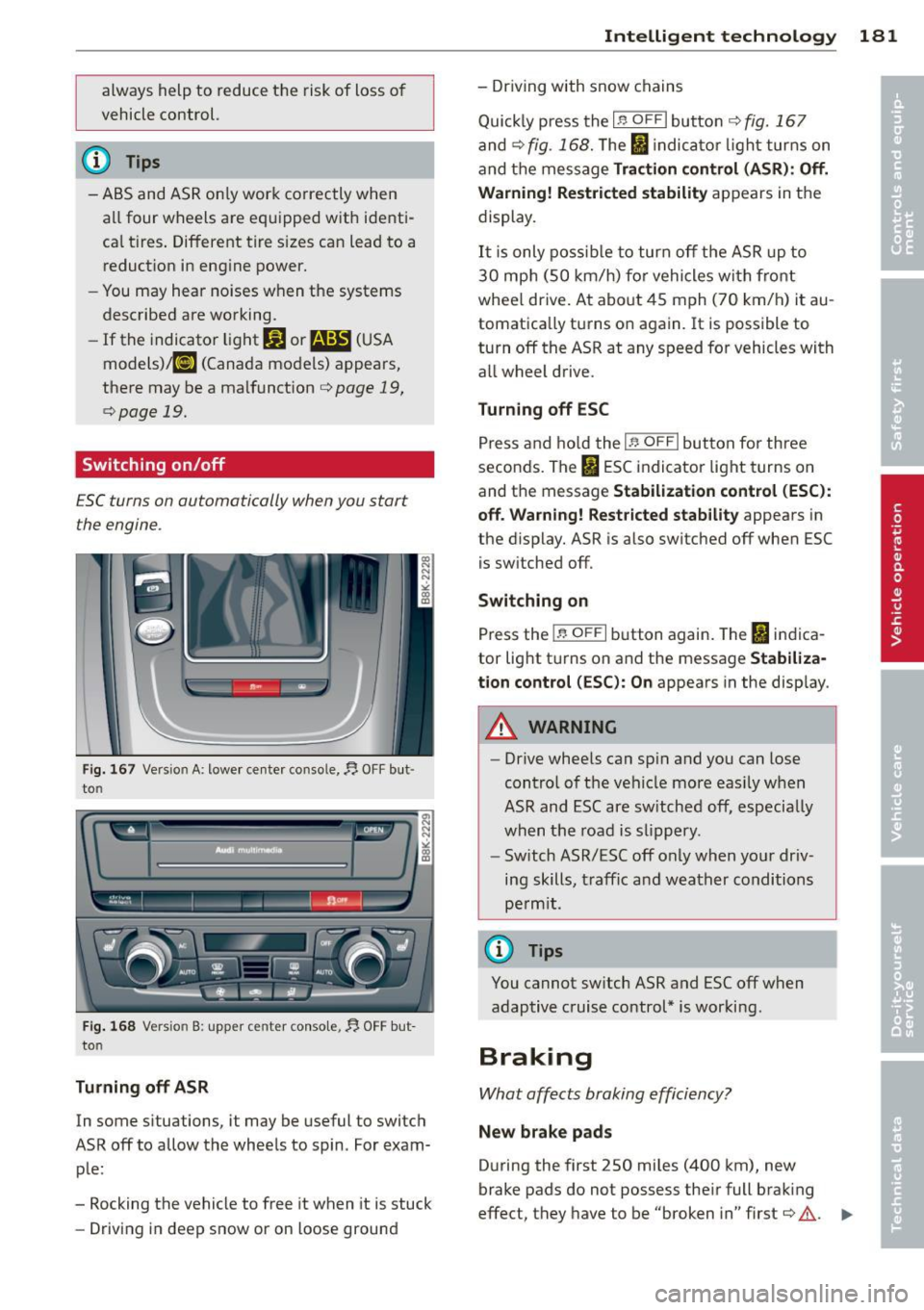
Switching on/off
ESC turns on automaticolly when you start
the engine.
Fi g. 16 7 Version A: lowe r ce nter console,~ OFF but
to n
:.!;::.:-, I I ---- 1- n~I -
l.
~
- o~ -· \)1) 1./ .., l~c~~ ·-WJO -J •-MJTO -~, -
-----....... -... ~ ~ -~
Fi g. 16 8 Versio n 8: upper ce nter conso le,~ OFF but
to n
Tu rning off ASR
In some situations, it may be useful to switch
ASR off to allow the wheels to spin. For exam ple:
- Rocking the vehicle to free it when it is stuck
- Driving in deep snow or on loose ground
Intelligen t technolog y 181
- Driving with snow chains
Quick ly press the
lf3 O FF ! button c:> fig. 167
and c:> fig. 168. The I indica to r li ght turns on
and the message
Trac tion control (ASR ): Off.
Warning! Restri cted stabilit y
appears in the
display.
It i s only poss ib le to turn off the ASR up to
30 mp h (SO km/h) fo r vehicles with front
whee l drive. At about 45 mph (70 km/h) it au
tomatica lly turns on again. It is possible to
turn off the ASR at any speed for vehicles with
all wheel drive.
Turning off ESC
Press and hold the It, O FF I button fo r th ree
seconds. The
fl ESC indicator light t urns on
and the message
Stabil ization cont rol (ES C):
off. Wa rnin g! Restricte d stability
appears in
the d isplay. A5R is also switched off when ESC
is sw itched off.
Switching on
Press the I~ OF FI button again. The fl indica
tor lig ht t urns on and the message
Stabiliza
tion cont rol (ES C): O n
appears in the disp lay.
_.& WARNING
- Drive whee ls can sp in and you can lose
contro l of t he vehicle more eas ily w hen
ASR and ESC are sw itched off, especially
when the road is slipp ery .
- Sw itch A5R/ESC off only when your driv
ing skills, t raffic and weather conditions
pe rm it .
(D Tips
You cannot sw itch ASR and ESC off when
adaptive cruise control* is worki ng.
Braking
What affects braking efficiency?
Ne w brake p ads
During the first 250 miles (400 km), new
-
brake pads do not possess the ir full brak ing
effect, they have to be "broken in" first
c:> .&.. .,.
Page 184 of 290
182 Intelligent technology
You can compensate for this slightly reduced
braking power by pushing harder on the brake
pedal. Avoid heavy braking loads d uring the
break-in per iod.
Operating condition s and d riv ing hab it s
The brakes on today 's automob iles are st ill
subject to wear, depending largely on operat
ing conditions and driving habits¢.&. . On
vehicles that are either driven mostly in stop
and-go city traffic or are driven hard, the brake pads should be checked by your author
ized Audi dealer more often than specified in
the
Warra nty & Maint enance booklet . Failure
to have your brake pads inspected can result in red uced b rake pe rformance.
On steep slopes, you should use the brak ing
effect of the engine . Th is way, you prevent un
necessa ry wear on the brake system. If you
must use yo ur brakes, do not hold the brakes
down continuously . P u mp the brakes at inter
va ls.
Operating noise
Noises may occur when braking depending on
the speed, braking fo rce and outside condi
tions s uch as temperature and humidity .
Effect of w ater and ro ad s alt
In certain situat ions, for example after driving
through water, in heavy ra in, after overn ight
condensat ion or after washing your car, the
b rak ing effect can be reduced by moistu re or
ice on the bra ke roto rs and b rake pads . The
b rakes must be dried fi rst with a few caref ul
b rake app lications .
At higher speeds and with the w indshield w ip
e rs turned on, the brake pads press agains t
the brake rotors for a short amount of time.
This occurs at regular intervals without the
driver noticing and provides for better brake response time under wet condit ions.
The effectiveness of the brakes can be reduced
when the vehicle is driven on a salt-covered road and the brakes are not used. Likewise,
you clean
off accumulated sa lt coating from brake d
iscs and pads with a few cautio us ap
plications of the brake
Q ,&. .
Corrosion
The re may be a tendency for dirt to bu ild up
o n the brake pads and corros io n to fo rm on
the d iscs if the car is not driven regu la rly or
only for short trips with litt le use of the
brakes.
If the brakes a re not used frequently, o r if cor
rosion has formed on the discs, it is advisable
to clean
off the pads and discs by braking
firmly a few times from a moderately high
speed
c> &. .
Faults in the brak e syst em
If you shou ld no tice a sudden increase in
brake pedal trave l, then one of the two brake
ci rcuits may have fai led
c> &. .
Lo w brake fluid lev el
Malfunctions can occu r in the bra ke system if
the b rake fluid level is too low. The brake f lu id
level is monitored electronically.
Brake booster
The brake booster increases the pressure that
yo u generate with the brake peda l. It works
o n ly when the engine is running .¢
&
Brake lining we ar status
Brake lining wear may be checked by visual in
spect ion of the condition of the brake pads
through the open ings in the wheel. If neces
sary, the wheel may be removed for th is i n
spect io n ¢
page 249, Changing a wheel.
_&. WARNING
- New brake pads don't have the bes t stop
p ing power and m ust be "bro ken-in" dur
ing the initial 100 to 150 miles (150 to
200 kilometers) of normal city driving.
You can compensate for this by pressing
the brake pedal more firmly. Th is also
applies later when new pads are instal led.
Page 186 of 290
184 Intelligent technology
_& WARNING
Have the dynamic steering* system mal
function repaired as soon as possible by an
authorized Audi dealer or any qualified
workshop -risk of accident!
(D Tips
- If the . or
'-r,ij indicator light only stays
on for a short time, you may continue
driving.
- The dynamic steering* stability systems
are not available in the event of a system
malfunction.
- For additional information on dynamic
steering*, refer to¢
page 107.
Driving with your
quattro®
App lies to vehicles: with all-wheel dr ive
-
With all-wheel drive, all four wheels are driv
en.
General information
With all-wheel drive, power is distributed to
all four wheels. This happens automatically
depending on your driving style and the road
conditions at the time . See also
¢ page 179.
A center differential distributes the driving
power variably to the front and rear axle . It
works together with selective wheel torque control, which activates when driving through
curves
c> page 180. With the sport differen
tial*, power distribution to the rear wheels is
variable and can be adjusted with drive select
c:>page 107.
The all-wheel drive concept is designed for
high engine power . Your vehicle is exception
ally powerful and has excellent driving charac
teristics both under normal driving conditions
and on snow and ice. Always read and follow
safety precautions ¢
&.
Winter tires
When driving in the winter , your vehicle with
all-wheel drive has an advantage, even with
regular tires. In winter road conditions it may be advisable to mount winter tires (or all-sea
son tires) for
improved driveability and brak
ing: these tires must be mounted on all four
wheels. See also ¢ page 242, Winter tires.
Tire chains
Where tire chains are mandatory on certain
roads, this normally also applies to vehicles
with all-wheel drive¢
page 243, Snow
chains .
Replacing wheels/tires
Vehicles with all-wheel drive must always
have tires of the same size. Also avoid tires
with different tread depths. For details see
page
c> page 238, New tires and replacing
tires and wheels.
Off·Road driving?
Your Audi does not have enough ground clear
ance to be used as an off-road vehicle.
It is
therefore best to avoid rough tracks and un
even terrain as much as possible. Also refer to
c:> page 187.
_& WARNING
-Always adjust your driving to road and traf-
fic conditions. Do not let the extra safety
afforded by all-wheel drive tempt you into
taking extra risks .
- Although the all-wheel drive is very ef
fective, always remember that braking
capacity is limited by tire traction. You
should therefore not drive at excessive
speeds on icy or slippery road surfaces.
- On wet road surfaces, be careful not to
drive too fast because the front wheels
could begin to slide on top of the water
(aquaplaning). If this should occur, you
will have no warning from a sudden in
crease in engine speed as with a front
wheel drive vehicle. Always drive at speeds which are suited to the road con
ditions - risk of crash .