warning AUDI A5 CABRIOLET 2014 Owners Manual
[x] Cancel search | Manufacturer: AUDI, Model Year: 2014, Model line: A5 CABRIOLET, Model: AUDI A5 CABRIOLET 2014Pages: 286, PDF Size: 70.4 MB
Page 172 of 286
1 70 Child Safety
It is usually best to put these children in ap
propriate booster seats. Be sure the booster
seat meets all applicable safety standards.
Booster seats raise the seating position of the
child and reposition both the lap and shoulder
parts of the safety belt so that they pass
across the child's body in the right places. The
routing of the belt over the child's body is very
important for the child's protection, whether
or not a booster seat is used . Children age 12
and under must always ride in the rear seat.
Children who are at least 4
ft. 9 in. (57 in
ches/1.45 meters) tall can generally use the
vehicle 's three point lap and shoulder belts .
Never use the lap belt portion of the vehicle's
safety belt alone to restrain any child, regard
less of how big the child is. Always remember
that children do not have the pronounced pel
vic structure required for the proper function
of lap belt portion of the vehicle's three point lap and shoulder belts. The child 's safety ab
solutely requires that a lap belt portion of the
safety belt be fastened snugly and as low as
possible around the pelvis. Never let the lap
belt portion of the safety belt pass over the
child's stomach or abdomen.
In a crash, airbags must inflate within a blink
of an eye and with considerable force. In order
to do its job, the airbag needs room to inflate
so that it will be there to protect the occupant
as the occupant moves forward into the air bag.
A vehicle occupant who is out of position and
too close to the airbag gets in the way of an
inflating airbag. When an occupant is too
close, he or she will be struck violently and
will receive serious or possibly even fatal in
jury.
In order for the airbag to offer protection, it is
important that all vehicle occupants, especial
ly any children, who must be in the front seat
because of exceptional circumstances, be
properly restrained and as far away from the
airbag as possible. By keeping room between
the child's body and the front of the passen
ger compartment, the airbag can inflate com- pletely and provide supplemental protection
in certain frontal collisions.
A WARNING
--
Not using a booster seat, using the boos
ter seat improperly, incorrectly installing a booster seat or using the vehicle safety
belt improperly increases the risk of seri
ous personal injury and death in a collision
or other emergency situation. To help re
duce the risk of serious personal injury
and/or death:
- The shoulder belt must lie as close to the
center of the child's collar bone as possi
ble and must lie flat and snug on the up
per body.
It must never lie across the
throat or neck. The lap belt must lie
across the pelvis and never across the
stomach or abdomen. Make sure the belt
lies flat and snug. Pull on the belt to
tighten if necessary .
- Failure to properly route safety belts
over a child's body will cause severe inju ries in an accident or other emergency
situation
~ page 132 .
-The rear side of the child safety seat
should be positioned as close as possible
to the backrest on the vehicle seat .
- Children on the front seat of any car, even with Advanced Airbags, can be seri
ously injured or even killed when an airbag inflates .
- Never let a child stand or kneel on any
seat .
- Never let a child ride in the cargo area of
your vehicle.
-Always remember that a child leaning
forward, sitting sideways or out of posi tion in any way during an accident can be
struck by a deploying airbag. This will re
sult in serious personal injury or death.
- If you must install a booster seat on the
front passenger seat because of excep
tional circumstances the
PASSENGER
AIR BAG OFF
light must come on and
stay on, whenever the ignition is switch
ed on .
Page 173 of 286
-If the PA SS ENGER AIR BAG O FF light
does not come o n an d stay on, perform
the checks described
c:> page 150, Moni
toring the Advanced Airbag System .
-Take the child restraint off the front pas
senger seat and install it properly at one
of the rear seat positions if the
PAS SEN
GER AIR BAG OFF
light does not stay on
whenever the ignition is switched on.
- Always read and heed all WARNINGS
whenever using a child rest rained in ave
hicle is being used
c:> page 132, Safety
belts,
c:> page 140, Airbag system and
c:> page 161, Important things to know.
Installing a child safety
seat
Securing a child safety seat using a
safety belt
Safety belts for the rear seats and the front
pas senger's seat can be locked with the con
vertible locking retractor to properly secure
child saf ety seat s.
The safety belts eme rgency lock ing re tracto rs
for the re ar seats safety belts and for the
front passenger 's seat sa fety belt have a con
ve rtible locking retractor for child restraints.
The safety belt must be locked so that belt
webbing cannot unreel. The retractor can be
activated to lock the safety belt and prevent
t he safety belt webbing from loosening up
during normal driving . A child safety seat can
only be properly installed when the safety belt
i s locked so tha t the child and ch ild safety
seat will stay in place.
Always remember: Even though your veh icle is
equ ipped w it h an Advanced A irbag system, all
chi ld ren , espec ia lly those 12 yea rs and yo ung
e r, should always ride in the back seat proper
l y rest rained for thei r age and weig ht.
~ WARNING
Improperly insta lled child sa fety seats in
crease the risk of ser ious personal inju ry
and death in a collision.
Child Sa fet y 1 71
-Always ma ke sure that the safety be lt re
tractor is locked when insta lling a child
safety seat. An unlocked safety belt re
tracto r cannot hold the child safety seat
in place dur ing no rma l dr iving o r in a
crash .
- Always buckle the child safety seat firmly
in place even if a ch ild is not sitt ing in it .
A loose child safety seat can fly around
du ring a s udden stop or in a collision.
- If t he backrest is not securely latched,
the child and the child res traint will be
thrown fo rward togethe r with the bac k
rest and wi ll stri ke par ts of the ve hicle
interior. The child can be seriously i n
jured or killed .
- Never install rearwa rd -fac in g ch ild safety
seats or infant ca rrie rs on the front pas
senger seat . A child will be serio usly in
jured and can be killed when the passen
ger airbag inflates .
- The inflating airbag will h it the ch ild
safety seat or infant carrier with great
force and will smas h the child safety seat
and child against the backrest, center
armrest, doo r or roof .
- Always install rearward-facing chi ld safe
ty seats or infant carriers on the rea r
seat.
- Forward-facing child safety seats or in
fant carriers installed on the front pas
senger's seat may interfer e with the de
ployment of t he a irbag and cause serious
in jur y to the child.
- I t is safer to install a forwa rd-facing
child safety seat on t he rear seat.
- Always read a nd heed a ll WAR NIN GS
wheneve r us ing a chi ld restrained in ave
hicle is being used
c:> p age 161. Special
prec autions apply when instal ling a child
safety seat on the fron t passenger seat
c:> page 141, Child restraints on the front
seat -some important things to know.
A WARNING
A lways take specia l precautions if you
must install a forward or rearward-facing •
•
Page 174 of 286
172 Child Safety
child restraint on the front passenger's
seat in exceptional situations:
- Whenever a forward or rearward-facing
child restraint is installed on the front
passenger seat, the
PASSENGER AIR
BAG OFF
light must come on and stay on
whenever the ignition is switched on .
- If the
PASSENGER AIR BAG OFF light
does not come on and stay on, perform
the checks described<::)
page 150, Moni
toring the Advanced Airbag System .
- Take the child restraint off the front pas
senger seat and install it properly at one
of the rear seat positions if the
PASS EN·
GER AIR BAG OFF
light does not stay on
whenever the ignition is switched on.
- Improper installation of child restraints
can reduce their effectiveness or even
prevent them from providing any protec
tion.
- An improperly installed child restraint
can interfere with the airbag as it de
ploys and seriously injure or even kill the
child.
- Always carefully follow the manufactur
er's instructions provided with the child
safety seat or carrier.
- Never place additional items on the seat
that can increase the total weight regis
tered by the weight-sensing mat and can
cause injury in a crash .
.&_ WARNING
Forward-facing child restraints:
- Always make sure the forward-facing
seat has been designed and certified by
its manufacturer for use on a front seat
with a passenger front and side airbag.
- Never put the forward-facing child re
straint up, against or very near the in
strument panel.
- Always move the passenger seat into its
rearmost position in the seat's fore and
aft adjustment range, as far away from
the airbag as possible before installing
the forward-facing child restraint. The backrest must be adjusted to an upright
position.
- Make sure that the
PASSENGER AIR BAG
OFF
light comes on and stays on all the
time whenever the ignition is switched
on.
.&_ WARNING
-Rearward-facing child restraints:
- A child in a rearward-facing child safety
seat installed on the front passenger
seat will be seriously injured and can be killed if the front airbag inflates - even
with an Advanced Airbag System .
- The inflating airbag will hit the child
safety seat or infant carrier with great
force and will smash the child safety seat
and child against the backrest, center
armrest, door or roof.
-Always be especially careful if you must
install a rearward facing child safety seat
on the front passenger seat in exception
al circumstances.
-A tight tether strap on a rearward-facing
child restraint attached to the front pas
senger seat can put too much pressure
on the weight-mat in the seat and regis
ter a heavier weight in the Advanced Air bag System. The heavier weight regis
tered can make the system work as
though an adult were on the seat and de
ploy the Advanced Airbag when it must
be suppressed causing serious or even
fatal injury to the child.
- Make sure that the
PASSENGER AIR BAG
OFF
light comes on and stays on all the
time whenever the ignition is switched
on.
- If the PASSENGER AIR BAG OFF light
does not come on and stay on, immedi
ately install the rearward-facing child
safety seat in a rear seating position and
have the airbag system inspected by your
authorized Audi dealer.
Page 175 of 286
Activating the convertible locking retractor
Use the convertible locking retractor to se
cure a child restraint .
Always heed the child safety seat manufactur
er's instructions when installing a child re
straint in your vehicle. To activate the conver
tible locking retractor :
"" Place the child restraint on a seat, prefera
bly on the rear seat.
.. Slowly pull the belt
all the way out.
.. Route it around or through the child re
straint belt path¢.&_ .
.. Push the child safety seat down with your
full weight to get the safety belt really tight.
.. Insert the belt tongue into the buckle for
that seating position .
.. Guide the sa fety belt back into the retractor
until the belt lies flat and snug on the child
safety seat .
.. You should hear a "clicking " noise as the
belt winds back into the inertia reel. Test the
convertible locking retractor by pulling on
the belt. You should no longer be able to
pull the belt out of the retractor. The con
v ertible locking retractor is now activated.
.. Make sure that the red release button is fac
ing away from the child restraint so that it
can be unbuckled quickly .
""Pull on the belt to make sure the safety belt
is properly tight and fastened so that the
seat cannot move forward or sideways more
than one inch (2.5 cm).
A WARNING
Using the wrong child restraint or an im
properly installed child restraint can cause
serious personal injury or death in a crash.
- Always make sure that the safety belt re-
tractor is locked when installing a child safety seat. An unlocked safety belt re
tractor cannot hold the child safety seat in place during normal driving or in a
crash .
- Always buckle the child safety seat firmly
in place even if a child is not sitting in it.
-
Child Safety 173
A loose child safety seat can fly around
during a sudden stop or in a crash.
- Always make sure the seat backrest to
which the child restraint is installed is in
an upright position and securely latched
into place and cannot fold forward . Oth
erwise, the seatback with the child safety
seat attached to it could fly forward in
the event of an accident or other emer
gency situation.
- Always read and heed all WARNINGS
whenever using a child restrained in ave
hicle is being used¢
page 161. Special
precautions apply when installing a child
safety seat on the front passenger seat
¢ page 141, Child restraints on the front
seat -some important things to know .
Deactivating the convertible locking
retractor
T he convertible locking retractor for child re
straints will be deactivated automatically
when the bel t is wound oil the way bock in to
the retractor .
.. Press the red button on the safety belt buck
le . The belt tongue will pop out of the buck
le.
.,. Guide the safety belt all the way back into
its stowed position .
Always let the sa fety belt retract completely
into its stowed position . The safety belt can
now be used as an ordinary safety belt with
out the convertible locking retractor for child
restraints.
If the convertible locking retractor should be
activated inadvertently, the safety belt must be unfastened and guided completely back in
to its stowed position to deactivate this fea
ture. If the convertible locking retractor is not
deactivated , the safety belt will gradually be-
come tighter and uncomfortable to wear.
11>
•
•
Page 176 of 286
174 Child Saf ety
A WARNING
Improperly installed child safety seats in
crease the risk of ser ious personal injury
and death in a collision .
- Never unfasten the safety belt to deacti
vate the convert ible lock ing retractor for
child rest raints while the veh icle is mov
ing. You would not be rest rained and
c ou ld be ser iously injured in an ac cident.
- Always read and heed all WARNI NGS
whenever using a child rest rained in ave
hicle is being use d
¢page 161. Spe cial
precautions apply when installing a ch ild
sa fety seat on the front passenger seat
¢ page 141, Child restraints on the front
seat -some important things to know.
Page 177 of 286
LATCH Lower
anchorages and tether
for children
Child Restraint System anchors and how
are they related to child safety
To provide a s impler and more pract icable way
to attach the chi ld restraint on the vehicle
seat, Federa l reg ulations require specia l lower
anchorages in vehicles and dev ices on new
chi ld restraints to attach to the vehicle ancho
rages .
The combination of the tether anchorages and
the lower anchorages is now generally called
the
LATCH system for " Lower Anchorages and
T ethers for Children ."
F orward-facing child rest raints manufactured
after September 1, 1999, are required by U.S.
federal regulations to comply wit h new c hild
head movement performance requirements .
These new performance requirements make a tether necessary on most new chi ld seats.
I nstal ling a chi ld restraint that requi res a top
tether witho ut one can serio usly impair the
performance of the chi ld restraint and its ab il
ity to protect the c hild in a co llision . Installing
a child restraint that requires a top tether
without the top tether may be a v io lation of
state law.
Ch ild restra int manufacturers offer LATCH
lower anchorages on the ir ch ild seats with
hook -on or push-on connecto rs attached to
adjustable straps .
In addition to the LATCH lower anchorages,
these child restraint systems usually require
the use of tether straps to help keep the child restra int firmly in place .
Tether anchorage s
Your Audi Cabriolet is not equipped with a
LATCH system. It is not equ ipped with top
tether anchorages. It is equipped with lower
anchorages only.
Your Cabriolet is equipped with the Active Rollover Protection System, w hich is integrat-
Child Sa fet y 175
ed into the back rest of the rear seat . The Ac
tive Ro llover P rotection System dep loys up
wards to he lp prov ide addit ional protection in
certain co llisions and crash s ituations. For this
reason, your vehicle is
not equipped with top
tether anchorages for use with forward -facing
c hi ld restra ints.
In Canada , provinc ial law requ ires that for
ward-fac ing ch ild restraints use both top teth
er anchorages and lower anchorages; the re
fore, it is
not pos sib le to install a forward-fac
ing child restra int in this vehicle.
In the United States , child restraint installa
tion must conform w ith the child restraint
manufacture r's instructions. Check the in
structions that come w ith the c hild restra int
o r contact the ma nufactu rer to determine if
the ch ild res traint may be ins ta lled fac ing fo r
ward without sec uring the top te ther strap .
A WARNING ,..__
Improper installation of child restraints
will increase the risk of injury and death in
a crash.
- Always follow the instr uctions provided
by the manufacture r of the child re
straint yo u intend to install in your vehi
cle.
- Improper use of child restraint LATCH
lower anchorage points can lead to injury
in a collision. The LATC H lower anchorage
points are designed to wi thstand on ly
those loads i mposed by co rrectly fitted
child r est raints.
- Never mount two ch ild restra int systems
on one LATC H lower anchorage point.
- Never secure or attach any luggage or other item to the LATCH lower anchorag
es.
@ Tips
In other countries, the term "ISOFIX" is
used to describe the lower anchorages .
•
•
Page 178 of 286
1 76 Child Safety
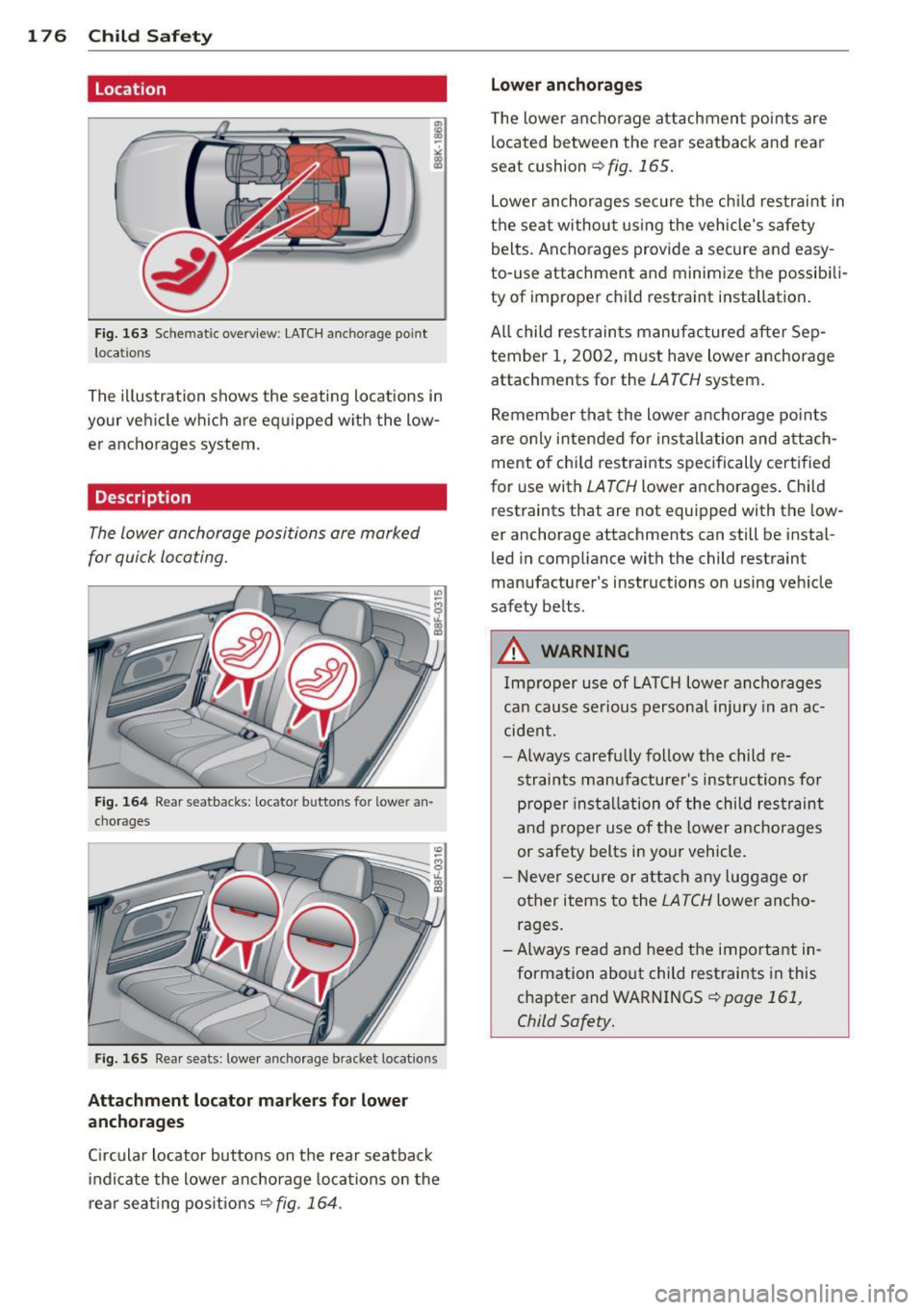
location
Fig. 163 Schematic overview: LATCH anchorage point
locations
The illustration shows the seating locations in
your vehicle which are equipp ed with the low
er anchorages system.
Description
The lower anchorage positions are marked
for quick locating.
Fig. 164 Rear seatbacks: locator buttons for lower an
chorages
Fig. 165 Rear seats: lower anchorage bracket locations
Attachment locator markers for lower
anchorages
Circular locator buttons on the rear seatback
indicat e the lower anchorage locations on the
rear seating positions
¢ fig . 164.
lower anchorages
Th e lower anchorage attachment points are
located between the rear seatback and rear
seat cushion
¢fig. 165.
Lower anchorages secure the child restraint in
the seat without using the vehicle's safety belts. Anchorages provide a secure and easy
to-use attachment and minimize the possibili
ty of improper child restraint installation .
All child restraints manufactured after Sep
tember 1, 2002, must have lower anchorage
attachments for the
LATCH system.
Remember that the lower anchorage points
are only intended for installation and attach
ment of child restraints specifically certified
for use with
LATCH lower anchorages. Child
restraints that are not equipped with the low
er anchorage attachments can still be instal
led in compliance with the child restraint
manufacturer's instructions on using vehicle
safety belts .
.&_ WARNING
-Improper use of LATCH lower anchorages
can cause serious personal injury in an ac
cident.
-Always carefully follow the child re
straints manufacturer's instructions for proper installation of the child restraint
and proper use of the lower anchorages
or safety belts in your vehicle.
- Never secure or attach any luggage or
other items to the
LATCH lower ancho
rages.
- Always read and heed the important in
formation about child restraints in this
chapter and WARNINGS
¢page 161,
Child Safety.
Page 179 of 286
Installing a child restraint with LATCH
lower anchorages
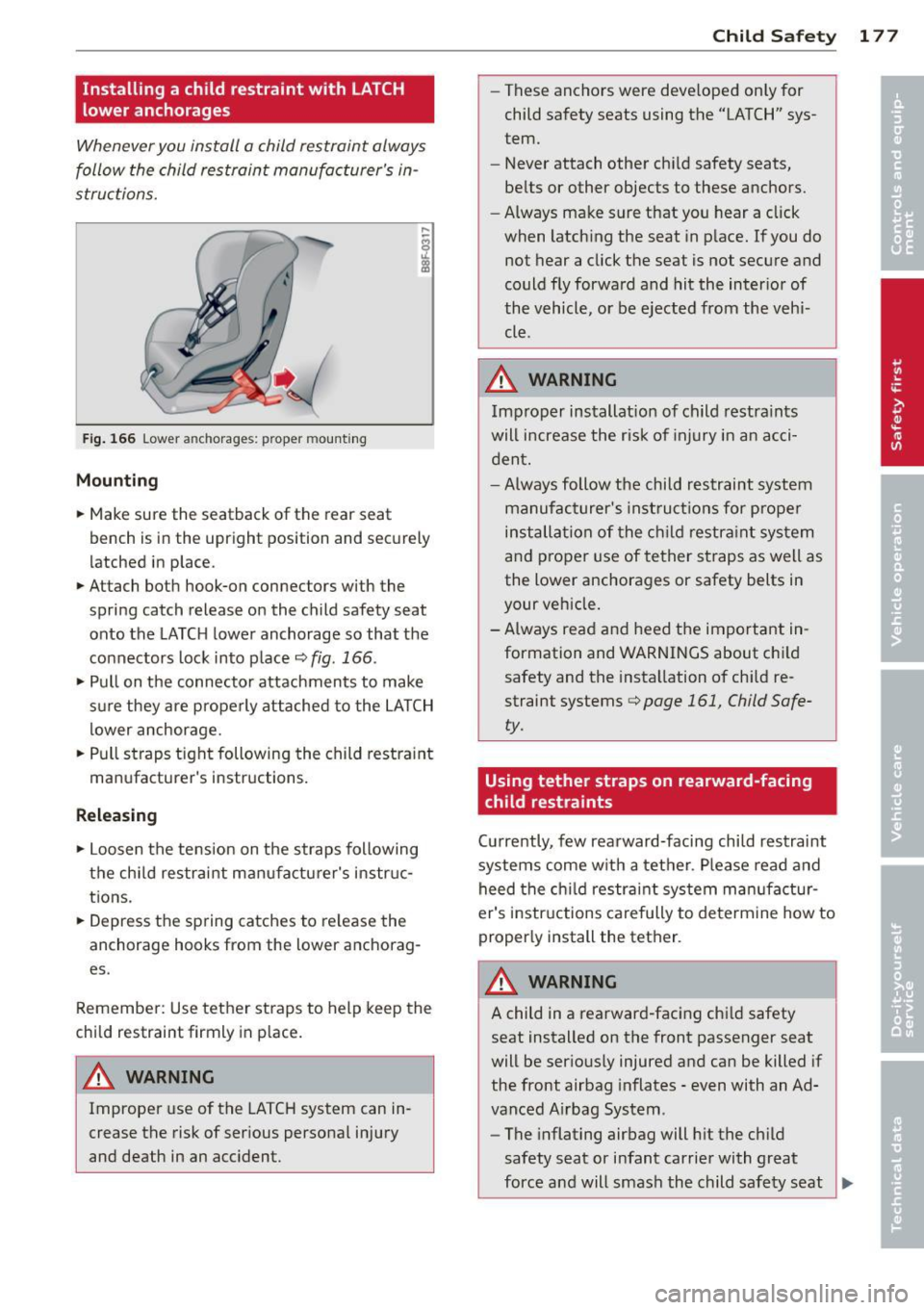
Whenever you install a child restraint always
follow the child restraint manufacturer's in
structions.
F ig . 166 Lower anchorages: proper mounting
Mou nting
~ Make sure the seatback of the rear seat
bench is in the upright position and securely
latched in place.
~ Attach both hook-on connectors with the
spring catch release on the child safety seat
onto the LATC H lower anchorage so that the
connectors lock into p lace
c::> fig. 166 .
~Pullon the connector attachments to make
s u re they are properly attached to the LATCH
lower anchorage.
~ Pull straps tight following the child restraint
manufacturer's instructions.
Releasing
~ Loosen the te nsion on the straps following
the chi ld restraint manufacturer's instr uc
tions.
~ Depress the spring catches to re lease the
anchorage hooks from the lower anchorag
es.
Remember: Use tether straps to help keep the
child restraint firmly in p lace.
A WARNING
Improper use of the LATCH system can in
crease the risk of ser ious personal injury
and death in an acc ident.
Child S afety 177
- These anchors were deve loped only for
child safety seats using the "LATCH" sys
tem.
- Never attach other chi ld safety seats,
belts or other objects to these anchors.
- Always make sure that you hear a click
when latch ing the seat in p lace. If you do
not hear a click the seat is not secure and
could fly forward and hit the interior of
the vehicle, or be ejected from the veh i
cle .
A WARNING
Improper installat ion of ch ild rest ra ints
will increase the risk of injury in an acci
dent.
- Always follow the child restraint system
manufacturer's inst ruct io ns for prope r
installation of the ch ild restra int system
and proper use of te ther s traps as well as
the lower anchorages or safety belts in
your vehicle.
- Always read and heed the im portant in
formation and WARNINGS about chi ld
safety and the insta llation of chi ld re
straint systems
c::> page 161, Child Safe
ty.
Using tether straps on rearward-facing
child restraints
-
Currently, few rearward-facing chi ld res traint
systems come w ith a tether . Please read and
heed the ch ild restraint system ma nufactur
er's instr uctions carefully to dete rmine how to
proper ly install the tether.
A WARNING
-
A child in a rearward-fac ing chi ld safety
seat installed on the front passenger seat
will be ser iously injured and can be killed if
the front airbag inflates - even with an Ad
vanced Airbag System .
- The inflating airbag will h it the ch ild
safety seat or i nfant carrier with great
force and will smash the child safety seat
11>-
Page 182 of 286

180 Intelligent technology
ESC includes and/or works together with the
anti-lock brake system (ABS), brake assist sys
tem, anti-slip regulation (ASR) , e lectronic dif
ferential lock (EDL), dynamic steering" and
e lectronic interaxle differentia l lock* /selective
wheel torque control* . ESC is switched on all
the t ime. I n certa in s ituations whe n you need
l ess t raction, you can switch
off ASR by p ress
i ng the bu tto n
[ru ¢ page 181, fig. 167 or
¢page 181, fig. 168. Be sure to sw itch ASR
on aga in when yo u no longer need less t rac
tion .
Anti -lock braking system (ABS)
ABS prevents the wheels from locking up
when braki ng. The veh icle can still be steered
even d uring h ard br aking. Apply ste ady p res
sure to the brake pedal. Do no t pump the ped
a l. A pulsing in the brake peda l indicates t hat
the system is he lping yo u to b rake the vehicle .
Brake assist system
The brake assis t system can decrease b ra ki ng
d ista nce. It incre ases braking power w hen the
d river p resses the brake pedal q uic kl y in eme r
gency situations . You must p ress and hold the
b rake peda l until the situation is over. In
vehicles w ith adapt ive cru ise contro l", the
brake assist system is more sensit ive if the
d ista nce detected to t he vehicle a head is too
small.
Anti-slip regulation (ASR)
ASR reduces engine power when the drive
wheels begin to spin and adapts the fo rce to
the road condit ions. This makes it eas ier to
start , accelerate and drive up hills.
Electronic differenti al lock (EDL )
The ED L brakes wheels that are spinn ing and
transfers the drive power to the other drive
wheel or whee ls if t he vehicle is equipped with
all-w heel drive*. This function is available up
to about 60 mph (100 km/h).
In extreme cases, EDL automat ica lly switches
off to help keep the bra ke on the braked whee l
from overheating. EDL wi ll switch on again au-tomat
ica lly when conditions have ret urned to
no rma l.
Dynamic steering*
On vehicles wi th dynam ic steering*, ESC he lps
st abi liz e the steer ing in cr itical situ ations.
Electronic interaxle differential lock* /
selective wheel torque control*
T he elec troni c int eraxle differentia l lock (front
whee l dr ive) o r th e se lec tive whee l torque
control (all-whee l dr ive) oper ates when dr iv
ing t hro ugh curves. The front wheel on the in
side of the c urve or both whee ls on the inside
of the c urve are b raked se lectively as needed.
This m inimizes sliding in the front wheels and
allows for more precise driving through
curves . The applicable system may not acti
vate when dr iving in wet o r snowy cond itions.
A WARNING
- ESC, ABS, ASR, EDL dynam ic steering*
a nd the ele ct roni c interaxle d ifferential
lo ck* /se lective whee l torque con trol *
cannot ove rcome the laws of physics .
This is especially important on sli ppery
or wet roads.
If the systems beg in acting
to stabilize your veh icle, yo u should im
mediately change your speed to match
the road and traffic conditions . Do not
let the increased safety prov ided by
these systems tempt you to take r isks.
Doing so will increase the risk of a loss of
veh icle cont ro l, col lision and ser ious pe r
sonal injur ies.
- Always ada pt your speed to road, traffi c
a nd wea ther conditions. The r isk of los-
ing con trol of the vehicle i ncreases when
d riving too fast, es pec ia lly through
curves and o n slippe ry or wet roads, an d
when dr iv ing too close to vehicles up
ahead. ESC, ABS, the brake ass ist sys
tem, ASR, EDL dynam ic steer ing* and the
e lectronic inte raxle differentia l lock*/se
lec tive whee l to rque control* cannot p re-
-
vent co llisi ons. ~
Page 184 of 286

182 Intelligent technology
Sport mode on ESC/ASR off Sport mode off or
ESC/ASR on
Behav ior
The ESC and ASR stabiliza- The stabilization function The full stabilization func-
tion functions are limited is not ava ilable
c> .&. . ESC tion of the ESC and ASR is
¢ _&.. and ASR are sw itched off. available again.
Operation Press the l.i; OFF ! button P ress and hold the 1.i; OFFI Press the l.i; OFF ! button
briefly. button
longer than 3 sec-
again.
onds.
Indicator II turns on. II and Ill turn on. II turns off or II and II
lights tur n off.
Driver mes- Stabilization control Stabilization control Stabilization control
sages (ESC): Sport. Warning! (ESC): off. Warning! Re- (ESC): On
Restricted stability stricted stability
It is only possible to turn off the ASR up to 30
mph (SO km/h) for vehicles with front wheel
drive . At about
45 mph (70 km/h) it automat i
cally turns on aga in . It is poss ible to turn off
the ASR at any speed for veh icles with all
wheel dr ive.
.&, WARNING
Yo u should only switch sport mode on or
switch ESC/ASR off if your driving abilities
and road conditions permit.
- The stabilization function is limited
when sport mode is switched on. The
driving whee ls cou ld spin and the vehicle
cou ld swerve, especially on slick or slip
pery road surfaces.
- There is no vehicle stabilization when
ESC/ASR are switched off.
(D Tips
ESC/ASR cannot be switched off or sport
mode cannot be switched on when adap
tive cruise control* is switched on.
Braking
What affects braking efficiency?
New brake pads
During the first 250 miles (400 km), new
brake pads do not possess their fu ll braking
effect, they have to be "broken in" first
c> .&. .
You can compensate for this slightly reduced
braking power by push ing harder on the brake pedal. Avoid heavy brak
ing loads dur ing the
break -in period.
Operating conditions and driving habits
The brakes on today's automobiles are still
subject to wear, depending largely on operat
ing condit ions and driving hab its
c> .&. . On
vehicles that are either driven mostly in stop and-go city traff ic or are dr iven hard, the
brake pads should be checked by your author
ized Audi dea ler more often than specified in
the
Warranty & Maintenance booklet. Failure
to have you r brake pads inspected can result
in reduced brake performance.
On steep slopes, you should use the braking
effect of the engine . This way, you prevent un
necessary wear on the brake system.
If you
must use your brakes, do not hold the brakes
down continuous ly . Pump the brakes at inter
vals.
Operating noise
Noises may occur when braking depending on
the speed, b rak ing force and outside cond i
t ions such as temperature and humidity .
Effect of water and road salt
In certain situations, for example after driv in g
t hr ough water, in heavy rain, after overnight
condensation or after washing you r car, the
braking effec t can be reduced by mois ture or
ice on the brake rotors and brake pads. The
brakes must be dried first with a few careful
brake applications .