towing AUDI A5 CABRIOLET 2014 User Guide
[x] Cancel search | Manufacturer: AUDI, Model Year: 2014, Model line: A5 CABRIOLET, Model: AUDI A5 CABRIOLET 2014Pages: 286, PDF Size: 70.4 MB
Page 196 of 286

194 Trailer towing
Trailer towing tips
Important to know
Your vehicle hand les different ly w hen tow ing
a tr ailer because of the addit ional weight and
different weight distribution . Safety, perform
ance and economy wi ll greatly depend on how
carefully you load your trailer and operate
your rig.
Before you actually tow your trailer, practice
turning, stopp ing and backing up in an area
away from traffic. Keep practicing until you have become comp letely familiar with the way
your veh icle-trailer combination behaves and
responds.
Backing up is difficult and requires practice.
Backing up with a trai ler genera lly requires
steering action opposite to that when backing
up your veh icle without a trailer.
Maintain a greater distance between your ve
hicle and the one in front of you . You will need
more room to stop. To compensate for the
trailer, you will need a larger than normal
turning radius .
When passing, remember that you cannot ac
celerate as fast as you normally would be
cause of the added load. Make sure you have
enough room to pass . After passing, allow
plenty of room for your tra iler before chang
in g lanes again.
Avoid jerky starts, sharp turns or rapid lane
changes.
{Dl Tips
- Do not tow a tra iler dur ing the break-in
period of your vehicle.
- If you tow a trailer, your A udi may re
quire more frequent maintenance due to
the extra load
q page 264.
Parking on a slope
Do not park on a slope with a trailer . If it can
not be avoided, do so only after doing the fol lowing :
When parking:
.. App ly the foot brake.
.. Have someone place chocks under both the
veh icle and the trailer wheels .
.,. With chocks in place, slowly release the
brakes until the wheel chocks absorb the
load.
.. Turn the whee ls towards the curb.
.. App ly the parking brake.
.. Move the selector lever to P.
When restarting after parking:
.. App ly the foot brake .
.. Start the engine.
.. Move the selector lever to D/S .
.. Release the parking brake and s lowly pull
out and away from the wheel chocks .
.. Stop and have someone retrieve the wheel
chocks .
(D Tips
If you move the selector lever of the auto
matic transmission to P before applying
the parking brake and before blocking the
whee ls, you may have to use more force
later to move the lever out of the P posi
tion.
Page 233 of 286
-Carrying more weight than your vehicle
was designed to carry will prevent the
vehicle from handling properly and in
crease the risk of the loss of vehicle con
trol.
- The brakes on a vehicle that has been
overloaded may not be able to stop the
vehicle within a safe distance.
- Tires on a vehicle that has been overload
ed can fail suddenly, including a blowout
and sudden deflation, causing loss of
control and a crash.
- Always make sure that the total load be
ing transported -including the weight of
a trailer hitch and the tongue weight of a
loaded trailer - does not make the vehi
cle heavier than the vehicle's Gross Vehi
cle Weight Rating.
Determining correct load limit
Use the example below to cal
culate the total weight of the
passengers and luggage or oth
er things that you plan to trans
port so that you can make sure
that your vehicle will not be
overloaded.
Steps for Determining Correct Load Limit
1. Locate the statement "THE
COMBINED WEIGHT OF OC
CUPANTS AND CARGO
SHOULD NEVER EXCEED XXX KG OR XXX LBS"on your vehi
cle's placard (tire inflation
pressure label)
c::> page 226,
fig. 182.
Tires and wheels 231
2. Determine the combined weight of the driver and passengers that will be riding in
your vehicle.
3. Subtract the combined weight of the driver and passengers from
"XXX" kilo
grams or
"XXX" pounds
shown on the sticker
c::>page 226, fig. 182.
4. The resulting figure equals the available amount of car
go and luggage load capaci
ty. For example, if the
"XXX"
amount equals 1400 lbs.
and there will be five 150
lbs. passengers in your vehi
cle, the amount of available
cargo and luggage load ca pacity is 650 lbs. (1400-7 50
(5
X 150) = 650 lbs.)
5. Determine the combined weight of luggage and cargo being loaded on the vehicle.
That weight may not safely
exceed the available cargo
and luggage load capacity
calculated in Step 4.
6. If your vehicle will be towing
a trailer, load from your trail
er will be transferred to your
vehicle. Consult this manual ..,.
•
•
'
Page 245 of 286
What do I do now?
Vehicle tool kit
The tools ore stored underneath the floor
panel in the luggage comportment.
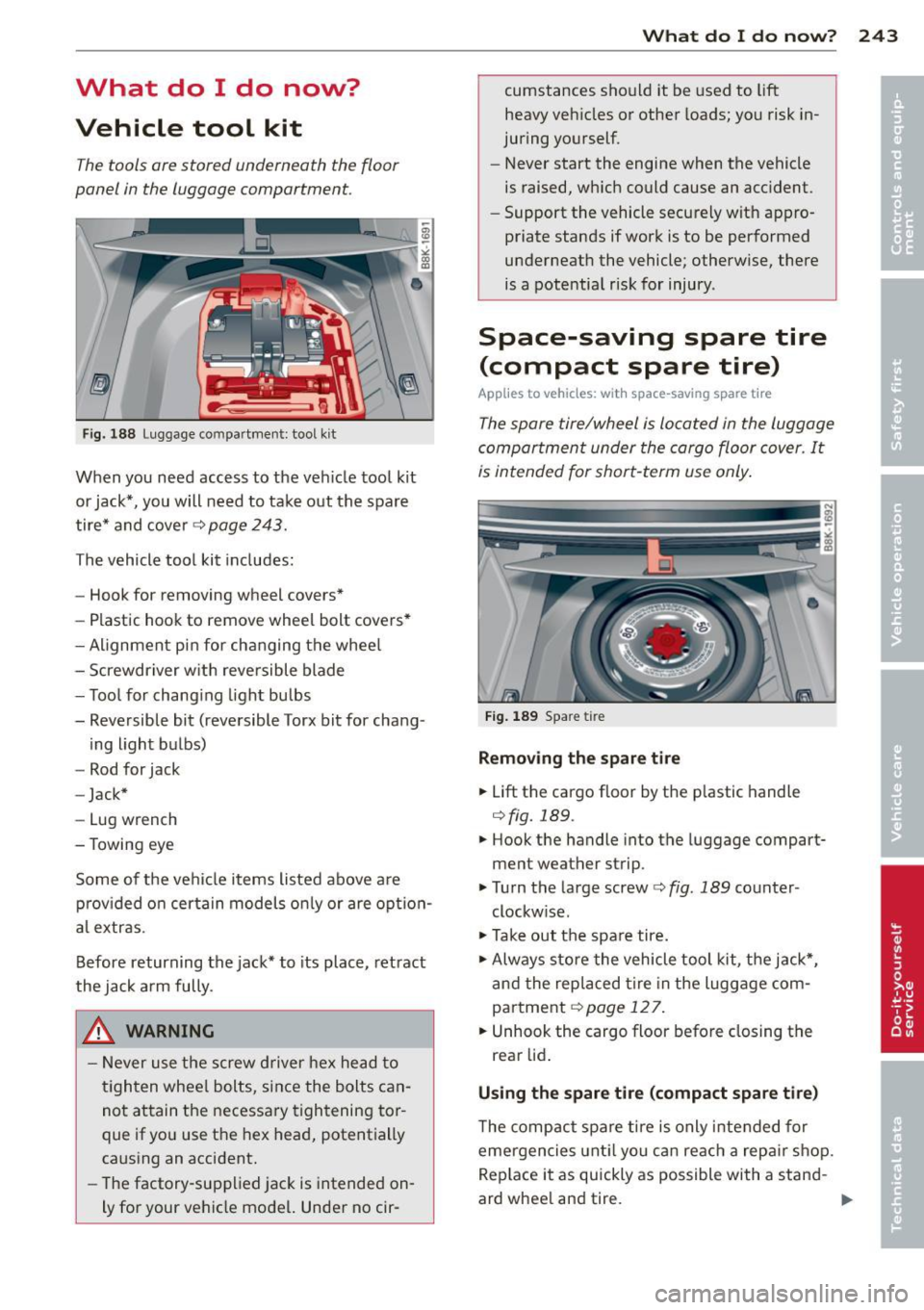
Fig. 188 Luggage compartment: tool kit
When you need access to the veh icle tool kit
or jack*, you will need to take o ut the spare
tire* and cover¢
page 243.
The vehicle tool kit includes:
- Hook for removing wheel covers*
- Plastic hook to remove wheel bolt covers*
- Alignmen t pin for ch anging the whee l
- Screwdriver w ith reversible blade
- Too l for chang ing light bulbs
- Reversible bit (reversible Torx bit for chang -
ing light bulbs)
- Rod for jack
- Jack*
- Lug wrench
- Towing eye
Some of the vehi cle items listed above are
p rov ided o n certain models o nly or are opt io n
al extras .
Before returning the jack* to its place, retract
the jack arm fully.
.&, WARNING
-
-Never use the screw d river hex head to
tighten whee l bolts, since the bolts can
not attain the necessary tightening tor
que if yo u use the hex head, potentially
caus ing an accident.
- The factory-supplied jac k is intended on
ly for your vehicle model. Unde r no cir-
What do I d o now ? 243
cumstances should it be used to lift
heavy veh icles or other loads; you risk in
juring yourself.
- Never start the engine when the vehicle
is raised, wh ich could cause an acc ident.
- Support the vehicle securely w it h appro
priate stands if work is to be performed
underneath the vehicle; otherwise , there
is a pote ntia l risk for injury .
Space-saving spare tire
(compact spare tire)
App lies to vehicles: wit h space -saving spare t ire
The spore tire/wheel is located in the luggage
comportment under the cargo floor cover. It
is intended for short-term use only .
Fig. 189 Spa re tir e
Remo ving th e spare tire
.. Lift the cargo floor by the p lastic handle
¢ fig. 189 .
.. Hook the handle into the luggage compart
ment wea ther strip .
.. Turn the large screw <=>
fig. 189 counter
clockw ise.
.. Take out the spa re tire .
.. Always s tore the vehicle tool kit, the jack*,
and the rep laced tire in the luggage com
partment
¢ page 127 .
.. Unhook the cargo floor before closing the
rear lid .
Using th e spare tire (compact spar e tire )
The compact spare t ire is only intended fo r
eme rgencies unt il you can reach a repa ir sh op.
Rep lace it as qu ickly as possible with a stand -
ard whee l and tire. ..,..
Page 246 of 286

24 4 What do I do no w?
There are some restrictions on the use of the
compact spare tire. The compact spare tire
has been des igned specifically for your type of
vehicle.
It must not be swapped with a com
pact spare tire from another type of vehicle.
Sno w cha in s
For technical reasons, the use of snow chains
on the compact spare tire is
n ot permitted .
If you do have to dr ive with snow cha ins and a
front tire fails, mount the spare wheel w ith
tire instead of a rear tire. Install the snow
chains on the rear tire and use it to rep lace
the defective front tire.
A WARNING
- Never use the spare tire if it is damaged
or if it is worn down to the tread wear in
dicators.
- If the spare tire is more than 6 years o ld,
use it only in an emergency and w ith ex
t reme caution and careful driving.
- The spare tire is intended only for tem
porary and short-term use. It should be
replaced as soon as possib le w ith the
normal wheel and t ire.
- After mounting the compact spare tire, the tire pressu re must be checked as
soon as poss ible. The tire pressure of the
c ompac t spare tire must be 4.2 bar; oth
erwise, you risk hav ing an accident.
- Do not drive faster than 50 mph (80 km/
h). You risk having an acc ident.
- Avoid full-throttle acce le rat ion, heavy
braking, and fast corner ing . Yo u risk hav
ing an acc iden t.
- Never drive us ing more than one spare
wheel and tire. You risk having an acci
dent.
- No rma l summer or winte r tires m ust not
be mounted on the compact spare whee l
rim.
- F or te chni cal reasons, the use of ti re
chains on the spare tire is not permitte d.
If it is necessary to drive with tire chains,
the spare whee l must be mounted on the
front axle in the event o f a f lat in a rear tire. The new
ly available front wheel
must then be installed in place of the
rear whee l with the flat tire. Installing
the t ire cha in before mounting the whee l
and tire is recommended .
- Loose items in the passenger compart
ment can cause serious personal injury
during hard brak ing or in an accident.
Never store the spa re tire or jack and
too ls in the passenger compa rtment.
Changing a wheel
Before changing a wheel
Observe the following precautions for your
own and your passenger's safety when chang
ing a wheel .
"'After you expe rience a tire failure, pull the
car we ll away from moving traffic and try to
reach
le vel ground before you stop ¢ ,&.
"'All passengers should leave the car and
move to a safe location (for instance, behind
the guardrail)¢ &,.
"' Engage the
parking brake to p revent your
veh icle from rolling unintentionally¢&, .
"' Move the
selec tor lever to the P positi on.
"'I f you are towing a t railer : unhitch t he trai l
er from you r vehicle.
"' Take the
jack ¢ page 243 and the spare tire
¢ page 243 out of the luggage compart
ment .
A WARNING
=
You or your passengers could be injured
while changing a wheel if you do not fo l
l ow these safety precaut ions :
- If you have a flat tire, move a safe dis
tance off the road . Turn off the engine ,
turn the eme rgency flashers on and use
other warning devices to a le rt other mo
torists.
- Make sure that passengers wait in a safe
place away from th e vehicle and well
away from the road and traffi c.
- To help prevent the vehicle from moving
-
suddenly a nd possib ly slipping off the ..,_
Page 257 of 286

Emergency situations
General
This chapter is intended for trained emer
gency crews and working personnel who have the necessary tools and equipment to
perform these operations.
Starting by pushing or
towing
(D Note
Vehicles with an automatic transmission
cannot be started by pushing or towing.
Starting with jumper
cables
If necessary, the engine can be started by
connecting it to the battery of another vehi
cle.
If the engine should fail to start because of a
discharged or weak battery, the battery can be
connected to the battery of
another vehicle,
using a
pair of jumper cables to start the en
gine.
Jumper cables
Use only jumper cables of sufficiently
largecross section to carry the starter current
safely. Refer to the manufacturer's specifica
tions.
Use only jumper cables with
insulated termi
nal clamps which are distinctly marked:
plus(+) cable in most cases colored red
minus(-) cable
in most cases colored black .
A WARNING
Batteries contain electricity, acid, and gas.
Any of these can cause very serious or fatal
injury. Follow the instructions below for
safe handling of your vehicle's battery.
- Always shield your eyes and avoid lean
ing over the battery whenever possible.
Emergency situations 255
-A discharged battery can freeze at tem
peratures just below 32 °F (0 °C). Before
connecting a jumper cable, you must
thaw the frozen battery completely, oth
erwise it could explode.
- Do not allow battery acid to contact eyes
or skin . Flush any contacted area with
water immediately .
- Improper use of a booster battery to
start a vehicle may cause an explosion.
- Vehicle batteries generate explosive gas
es. Keep sparks, flame and lighted ciga
rettes away from batteries.
- Do not try to jump start any vehicle with
a low acid level in the battery.
- The voltage of the booster battery must
also have a 12-Volt rating. The capacity
(Ah) of the booster battery should not be
lower than that of the discharged bat
tery. Use of batteries of different voltage
or substantially different "Ah" rating
may cause an explosion and personal in
jury.
- Never charge a frozen battery. Gas trap
ped in the ice may cause an explosion.
- Never charge or use a battery that has
been frozen. The battery case may have
be weakened.
- Use of batteries of different voltage or
substantially different capacity (Ah) rat
ing may cause an explosion and injury.
The ca pa city (Ah) of the booster battery
should not be lower than that of the dis
charged battery.
- Before you check anything in the engine
compartment, always read and heed all
WARNINGS¢
page 206.
(D Note
- Applying a higher voltage booster bat
tery will cause expensive damage to sen
sitive electronic components, such as
control units, relays, radio, etc.
- There must be no electrical contact be tween the vehicles as otherwise current
could already start to flow as soon as the
positive(+) terminals are connected. ..,. •
•
Page 259 of 286
-Jumper cables must be long enough so
that the vehicles do not t ouch.
- W hen connecting jumper ca bles, make
sure that they cannot get caught in any
moving parts in the eng ine compart
ment.
- Do not bend over the batteries - danger
of chemical burns!
- The battery ce ll locking screws must be
t ightened securely .
- Before you check anything in the engine
compartment, always read and heed all
WARNINGS ¢
page 206.
Improper hook-up of jumper cables can ru
in the generator.
- Always connect POSITIVE( +) to POSI
TIVE(+), and NEGATIVE( -) to NEGATIVE
( - ) ground post of the battery manager
control unit.
- Check that all screw plugs on the battery
ce lls are screwed in firmly . If not, tighten
plugs p rior to connecting clamp on nega
tive battery terminal.
- Please note that the procedure for con
necting a jumper cable as described
above applies spec ifically to the case of
your vehicle be ing jump started. When
you are givi ng a jump start to another ve
hicle, do
not connect the negat ive( -) ca
ble to the negat ive( -) term inal on the
discharged battery @¢
fig. 20 2. In
stead, securely connect the negative(- )
cable to e ither a solid metal component
that is firmly bolted to the engine block
or to the engine block itse lf. If the bat
tery that is being charged does not vent
to the outside, escaping battery gas
could ignite and explode!
Em erg en cy si tuation s 257
Emergency towing
with commercial tow
truck
General hints
Your Audi requires special handling for tow
ing.
T he following information is to be used by
commercial tow t ruck operators who know
how to operate their equipment safely.
- Never tow your Audi , towing will cause
damage to the engine a nd transmi ssion.
- Never wrap th e safet y chain s or winch c a
ble s around th e brak e lin es.
- To prevent unne ce ss ary dam age, your Aud i
mu st be t ransp orted with a flat bed truck .
- To load th e vehi cle on to the fl at bed , use
the t owing loop found in the vehicle t ool s
and atta ch to the front or rear anch o rage
r=:> page 258 and ¢page 258 .
A WARNING
A vehicle being towed is not safe for pas
sengers. Never allow anyone to ride in a
vehicle be ing towed, for any reason.
-
•
•
Page 260 of 286
258 Emergency situations
Front towing loop
Do not install the front towing loop until it is
needed.
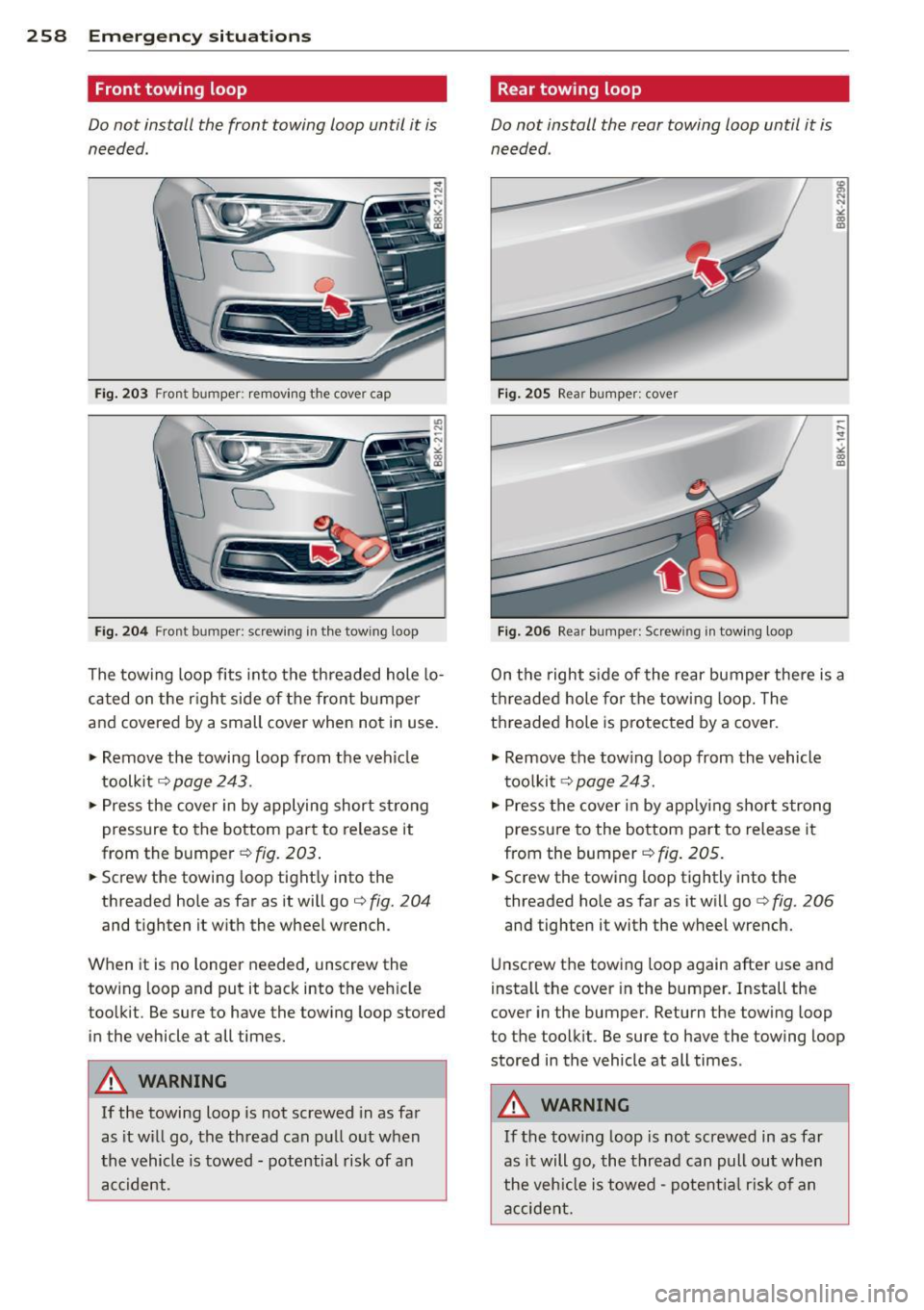
Fig. 203 Front bumper: removing th e cove r cap
Fig. 204 Fron t bumper: screw ing in t he tow ing loop
The towing loop fits into the threaded hole lo
cated on the right side of the front bumper
and covered by a small cover when not in use.
... Remove the towing loop from the vehicle
toolkit
c::> page 243 .
... Press the cover in by applying short strong
pressure to the bottom part to release it
from the bumper
c::> fig . 203.
... Screw the towing loop tightly into the
threaded hole as far as it will go
c::> fig. 204
and tighten it with the wheel wrench .
When it is no longer needed, unscrew the
towing loop and put it back into the veh icle
too lkit . Be sure to have the towing loop stored
in the vehicle at all times.
A WARNING
If the towing loop is not screwed in as far
as it will go, the thread can pull out when
the vehicle is towed -potential risk of an
accident .
-
Rear towing loop
Do not install the rear towing loop until it is
needed .
Fig. 205 Rea r bumper: cove r
Fig . 206 Rea r bumper: Screw ing in tow ing loop
On the right side of the rear bumper there is a
threaded hole for the towing loop. The
threaded hole is protected by a cover.
... Remove the tow ing loop from the vehicle
toolkit
c::> page 243.
... Press the cover in by applying short strong
pressure to the bottom part to release it
from the bumper
c::> fig. 205.
... Screw the towing loop tightly into the
threaded hole as far as it will go
c::> fig. 206
and tighten it with the wheel wrench.
Unscrew the towing loop again after use and
install the cover in the bumper. Install the
cover in the bumper. Return the towing loop
to the toolkit . Be su re to have the towing loop
stored in the vehicle at all times .
A WARNING
-
If the towing loop is not screwed in as far
as it will go, the thread can pull out when
the vehicle is towed -potential r isk of an
accident.
Page 266 of 286

264 Consumer Information
Consumer Information
Warranty coverages
You r Audi i s covered by the following war
ranties:
- New Vehicle Limited Warranty
- Limited Warranty Against Corrosion Perfo-
ration
- Emissions Control System Warranty
- Emissions Performance Warranty
- California Emissions Control Warranty (USA
vehicles only)
- California Emissions Performance Warranty
(USA vehicles only)
Detailed information regarding your warran
ties can be found in your
Warranty & Mainte
nance booklet .
Operating your vehicle
outside the U.S.A. or
Canada
Government regu lations in the United States
and Canada require that automobiles meet
specific emission regulations and safety
standards. Therefore, veh icles built for the
U.S.A . and Canada differ from vehicles sold in
other countries .
If you p lan to take your vehicle outside the
continental limits of the United States or Can
ada, there is the possibility that:
- unleaded fuels for vehicles with cata lytic
converter may not be available;
- fuel may have a considerably lowe r octane
rating. Improper fuel may cause engine
damage ;
- service may be inadequate due to lack of
proper service facilities, tools or testing
equipment ;
- replacement pa rts may not be readily availa
ble.
- Navigation systems for vehicles built for the
U.S.A. and Canada will not necessar ily work
in Europe, and may not work in other coun
tries outside of North America.
(D Note
Audi cannot be responsible for mechanical
damage that could result from inadequate
fuel, service or parts availability.
Audi Service Repair Manuals and Literature
Audi Official Factory Service Manuals and Lit
erature are published as soon as possible after
model introduction. Service manuals and lit
erature are available to order from the Audi
T echnical Literature Ordering Center at:
www.audi.techliterature.com
Maintenance
General
Your vehicle has been designed to help keep
maintenance requirements to a minimum.
However, a certain amount of regular mainte
nance is still necessary to assure your vehicle's
s afety, economy and rel iability. For detailed
vehicle maintenance consult your Warranty &
Maintenance booklet.
Under difficult operating conditions, for ex
ample at extremely low outside temperatures,
i n very dusty regions , when towing a trailer
very frequently, etc., some service work
should be performed between the intervals
specified. This applies particularly to:
- oil changes, and
- cleaning or replacing the air filter .
(® For the sake of the environment
By regularly maintaining your vehicle, you
help make sure that emission standards
are maintained, thus minimizing adverse
effects on the environment.
Important considerations for you and
your vehicle
The increasing use of electronics, sophisticat
ed fuel injection and emission contro l sys-
tems, and the genera lly increasing technical
liJJ,
Page 274 of 286

272 Index
Homelink universal remote contro l 267
Remote control key ...... ... .. .... . 267
Decorative parts/trim
C leaning . .. ............. .. .. .. .. . 197
Defective light bulb warning . . . . . . . . . . . 21
Defrosting (windows) ........ ... .... .. 71
Determining correct load limit ..... .. . 231
Digita l clock .............. .. .. ...... 12
Digital compass ............. .. .... .. 58
Dimensions .. .. .. ...... .... ... .. .. . 262
Dimming the rearview mirror . ..... .. .. 55
Displays Cleaning . ... ............ .. .. .. .. . 197
Doors emergency lock ing .. ...... .. .. .. .. .. 36
Driver information system Open door or front lid warning . . . . . . . . 24
Outside temperature display .. .. .. .... 24
Sound system display . . . . . . . . . . . . . . . 24
Driver seat
refer to Seating position ............ 122
Driving safely ........... .. .. .. .. .. . 121
Driving through water ...... .. .. .... . 187
Driving time . . . . . . . . . . . . . . . . . . . . . . . . 25
Dust filter
refer to Pollutant filter (automatic AC
system) ................. .... ...... 69
Dynamic steering . . . . . . . . . . . . . . 106, 184
E
E85 (Fuel) . ................. .. .. .. . 202
Easy entry function ......... .... .... .. 62
Efficiency program ........... .. .. ... . 27
Fuel economy messages . ........ .. .. 27
Memory levels . . . . . . . . . . . . . . . . . . . . . 25
Other equipment ........... .. .. .. .. 27
Electro-mechanical power assist .. .. .. . 184
Electromechanical parking brake
Emergency braking ........ ... .... . . 81
Indicator light . . . . . . . . . . . . . . . . . . . . . 79
Parking ...... ........... .. .. .... .. 80
Releasing and closing ......... .. .... 79
Starting ass ist .. .. .... ... .. .. .. .. .. 80
Starting from rest ........ .. .. .. .. .. 80
Starting off with a tra ile r ... .. .. .. .. . . 81
War ning/ indicator l ights ... .... .... .. 16 Electronic
differential lock
Warning/indicator lights ............. 18
El ectronic differential lock (ED L) ... .... 179
Warning/indicator lights .......... .. . 19
Electronic immob ilizer . . . . . . . . . . . . 12, 37
E lectronic power control
(EPC) warning/indicator light . . . . . . . . . 20
Electronic speed limiter .............. . 29
Electronic stabilization control Sport mode ..... ... ....... ... .. .. 181
E lectronic Stabilization Contro l (ESC) ... 179
Warning/indicator lights ............. 18
Emergency actuation
Doors .... .. .. . .............. .... . 36
Ignition key ..... ................ .. 34
Emergency braking . ... .. ..... ... .. .. . 81
Emergency flasher . . . . . . . . . . . . . . . . . . . 53 Warning/indicator lights ............ . 23
Emergency key . . . . . . . . . . . . . . . . . . . . . . 32
Starting engine . . . . . . . . . . . . . . . . . . . . 76
Emergency operation
Emergency braking funct ion (pa rking
brake) .. .. .. .. .. ................. . 81
Luggage compartment lid . . . . . . . . . . . . 38
Power top . . . . . . . . . . . . . . . . . . . . . . . . . 46
Emergency starting ... ....... ... .. .. 255
Emergency towing .................. 257
Energy management . . . . . . . . . . . . . . . . 185
Battery power . . . . . . . . . . . . . . . . . . . . . 17
Driver notification . . . . . . . . . . . . . . . . . . 17
Engine Compartment ................... .. 208
Coolant ..... .. .. .. ........... .... 213
Data ......... .. .. ............ ... 263
Hood ............................ 206
Starting . . . . . . . . . . . . . . . . . . . . . . 7 4, 77
Starting with jumper cables ......... 255
Stopping . . . . . . . . . . . . . . . . . . . . . . 76, 78
Engine compartment
Safety instructions ................. 206
Working the engine compartment 206
Engine coolant
Indicator light . .. ............... ... 17
Engine coolant system ..... ...... .... 213
Adding coolant . .. ... .. ..... ... .. .. 214
Checking coolant level . ...... ... .. .. 213
Page 281 of 286

------------------------------~I~ n~ d~ e~x~ 279
START ENGINE STOP button (Convenience
key) ...... .. .. ................ ..... 77
Starting from rest . . . . . . . . . . . . . . . . . . . . 80
Starting off with a trailer .... .. .. .. .. .. 81
Starting the engine . . . . . . . . . . . . . . 74, 77
Steer ing
Lacking the steer ing . . . . . . . . . . . . . . . . 7 4
also refer to Electro-mechanical power
assist . .. .. .... ............. .. .. . 184
Steering wheel Adjust ing steering column . .. .. .. .. .. 74
Indicator light . . . . . . . . . . . . . . . . 18, 184
Steps for determining correct load limit . 231
Stopping the engine . . . . . . . . . . . . . . 76, 78
Storage . .. ... ...... ............. ... 65
S tronic ..... .. ................ ..... 85
Selector lever . . . . . . . . . . . . . . . . . . . . . . 85
S tronic transmission
Emergency release .................. 91
L aunch Contro l Program ............. 90
Sun visors . . . . . . . . . . . . . . . . . . . . . . . . . . 56
Symbols
refer to Warning/indicator lights .. .. .. 13
T
Tachometer . . . . . . . . . . . . . . . . . . . . . . . . . 11
Ta il lights
C leaning ... .... ........... .. .. .. .
Technical mod ifications
Textiles 196
267
C leaning ... .. ............. .. .. ... 198
The first 1,000 miles (1,500 km) and after-
wards ..... .. .. ................ .... 187
Tie-downs . . . . . . . . . . . . . . . . . . . . . 67, 128
tiptronic . . . . . . . . . . . . . . . . . . . . . . . . . . . 85
Automatic Shift Lock (ASL) . . . . . . . . . . . 86
Driving ... . .... ............. .. .. .. 87
Emergency mode ... ...... .. .. .. .. .. 91
Manual shift program . . . . . . . . . . . . . . . 89
Selector lever . . . . . . . . . . . . . . . . . . . . . . 85
Tire pressure .............. .... .. ... 228
T ire pressure monitoring system
L oss of air pressu re ................ 241
Malfunction ................ ... ... 241
Resetting tire pressures ....... ... .. . 242 T
ires .............................. 222
Low aspect ratio tires .............. . 239
Serv ice life . ... .. .. ............... 232
Speed rating letter code ............ 234
Tire manufacturing date ............ 234
Tire pressure monitoring system ..... 240
Tire specifications .. . .... .. .... .... 234
Tread depth ...... ...... .......... 232
Uniform tire quality grading ..... .. .. 236
Winter tires . .. .. .... ........... .. 237
Tires and vehicle load limits ........... 230
Tires and wheels Checking tire pressure ............. .
Cold tire inflation pressure ...... .. . .
Dimensions
. . .. .. .................
General notes .. .. .. ... ....... .... .
Glossary of tire and loading terminolo-
gy .......... ... .. .............. .
New tires and wheels ........... .. . .
Replacing ..... ...... ............ .
Snow cha ins . .. .. .. . ............. .
Tires and vehicle load limits ........ .
Wheel bolts
Winter tires
T ire service life
Tool kit
..... .. ...............
Torn or frayed safety belts
Towing 228
226
233
222
223
233
234
238
230
239
237
232
243
135
Front eyelet ... .. .... ............. 258
Rear eyelet .. .. .. ................. 258
Tow truck procedures .............. . 257
TPMS Tire pressure monitoring system ..... 241
Trailer towing ... .. ................. 192
Operating instructions .......... .... 192
Technical requirements . . . . . . . . 192, 193
Tips ......... ... .. ..... .......... 194
Transmission . ... .. .. ................ 85
Transmission malfunction (in dicato r light) 91
Transport Canada .. ................. 129
Travel mode . . . . . . . . . . . . . . . . . . . . . . . . 53
Tread Wear Indicator (TWI) ........... 232
Trip computer Fuel consumption . . . . . . . . . . . . . . . . . . 25
Mileage ... .. .. .. .. . .. .... ........ . 25
Single-trip memory ................. 25
Total-trip memory ..... ....... .... .. 25
•
•