door lock AUDI A5 CABRIOLET 2014 Owner's Manual
[x] Cancel search | Manufacturer: AUDI, Model Year: 2014, Model line: A5 CABRIOLET, Model: AUDI A5 CABRIOLET 2014Pages: 286, PDF Size: 70.4 MB
Page 89 of 286

The Automatic Shift Lock only functions when
the vehicle is statio nary or at speeds below
1 mph (2 km/h).
At speeds above about 1 mph (2 km/h) the
Automatic Shift Lock is automatically deacti
vated in the
N position.
A time de lay element prevents the se lector
l ever from locking when it is moved thro ugh
the N position (going from R to D/S). The lock
ing e lement will lock the selector lever if the
l ever is left in N (Neutral) for more than ap
prox imately 2 seconds, w ithout the brake ped
al being pressed.
R elease button
The release bu tton on the selec tor lever pre
vents the leve r from being accidenta lly shifted
into certain positions. Depend ing on the direc
tion of the shift, the se lector lever locks at d if
ferent positions. The positions are h ighlighted
i n the illustration ¢
fig. 97 .
Ignition key s afety interl ock
The key cannot be removed from the ignition un less the se lector lever is in the P park posi
tion . When the ign ition key is removed, the
selector lever will be locked in the P pos ition.
Driving the automatic transmission
App lies to vehicles: with mu ltitron ic/S tronic/t iptronic
F ig. 98 Shi ft gat e on th e center co nso le: se lec tor lever
wit h release b utto n
Starting the engine
"' The selector lever must be in P o r
N.
Starting off
"' Press and ho ld the brake pedal. Tran
sm iss ion 87
"' Press and hold the re lease button in these
lector lever hand le, select the desired selec
to r lever posit ion such as D/S and re lease
the button.
"' Wait briefly unt il the transmission has shift
ed (you w ill fee l a slight movement) .
"' Remove your foot from the brake pedal and
accelerate .
Stopping temporarily "' Keep the veh icle stationary using the brak
ing pedal, for example at traffic lig hts.
"' Do not press the accelerator peda l when do
ing this .
"' To prevent the vehicle from ro lling when you
s tart dr iv ing, set the parki ng b ra ke when
s topping on steep in clines ~,&. .
"' The parking brake will release a utomat ica lly
and the vehicle will start moving once you
press the acce lerator pedal.
Stopping/parking
I f the se lector lever is not in the P position
when you open the d river 's door, the ve hicle
could roll . The message Transmission : Car
may roll! Shift to park! appears.
"' Press and hold the bra ke peda l un til the ve -
hicle has come to a complete stop.
"' App ly the parking brake ~
page 80, Parking.
"'Select the P selector lever position ¢ ,&..
Stopping on an incline
"'Always press the brake pedal to ho ld the ve
hicle in pla ce and p revent it from " ro lli ng
b ack" ~,&. . Do not try to p reven t the veh i
cle from "rolling back" when a gear is en
gaged by increasing the engine speed
~ 0.
Starting on an incline
"' Ac tiva te the pa rk ing brake.
"' With the d riv in g gear sele cted, p ress the ac
celerator peda l carefully . The parking bra ke
w ill release automa tically if your seat be lt is
fastened .
U nder cert ain circ umstan ces, su ch as driving
in the mou nta ins, it may be usef ul to sw itch
temporarily to the man ual shift program in .,..
Page 130 of 286
128 Driving Safely
area because the rear lid cannot be fully
closed.
- If you absolutely must drive with the rear
lid open, observe the following notes to
reduce the risk of poisoning:
- Close all windows,
- Close the power top,
- Open all air outlets in the instrument
panel,
- Switch off the air recirculation,
- Set the fresh air fan to the highest
speed.
A WARNING
Always make sure that the doors, all win
dows, the power top and the rear lid are
securely closed and locked to reduce the
risk of injury when the vehicle is not being
used .
-After closing the rear lid, always make
sure that it is properly closed and locked .
- Never leave your vehicle unattended es
pecially with the rear lid left open. A
child could crawl into the vehicle through
the luggage compartment and close the
rear lid becoming trapped and unable to
get out. Being trapped in a vehicle can
lead to serious personal injury.
- Never let children play in or around the
vehicle.
- Never let passengers ride in the luggage
compartment. Vehicle occupants must
always be properly restrained in one of
the vehicle's seating positions.
(D Tips
- Air circulation helps to reduce window
fogging. Stale air escapes to the outside
through vents in the trim panel. Be sure
to keep these slots free and open.
- The tire pressure must correspond to the
load. The tire pressure is shown on the
tire pressure label. The tire pressure la
bel is located on the driver's side B-pillar.
The tire pressure label lists the recom
mended cold tire inflation pressures for
the vehicle at its maximum capacity
-
'
weight and the tires that were on your
vehicle at the time it was manufactured.
For recommended tire pressures for nor
mal load conditions, please see chapter
¢page 226.
Tie-downs
Applies to vehicles: with tie-downs
The luggage compartment is equipped with
four tie-downs to secure luggage and o ther
items.
Use the tie-downs to secure your cargo prop
erly
¢ page 12 7, Loading the luggage com
par tmen t.
In a collision, the laws of physics mean that
even smaller items that are loose in the vehi
cle will become heavy missiles that can cause
serious injury. Items in the vehicle possess en
ergy which vary with vehicle speed and the
weight of the item . Vehicle speed is the most
significant factor.
For example, in a frontal collision at a speed
of 30 mph (48 km/h), the forces acting on a 10-lb (4 .S kg) object are about 20 times the
normal weight of the item . This means that
the weight of the item would suddenly be about 200 lbs. (90 kg). You can imagine the
injuries that a 200 lbs. (90 kg) item flying
freely through the passenger compartment could cause in a collision like this.
A WARNING
Weak, damaged or improper straps used
to secure items to tie-downs can fail dur ing hard braking or in a collision and cause
serious personal injury.
- Always use suitable mounting straps and
properly secure items to the tie-downs in
the luggage compartment to help pre
vent items from shifting or flying for
ward as dangerous missiles.
- When the rear seat backrest is folded
down, always use suitable mounting
straps and properly secure items to the
tie-downs in the luggage compartment
to help prevent items from flying
Page 138 of 286
136 Safet y belt s
The front seats are equipped with belt posi
tioners so it is easier to fasten the safety
be lts . T he belt positioners automatically ex
tend when the door closes and the ignition
switches on
¢ fig . 145.
The belt positioner returns to its starting posi
tion again when
- the tongue in the belt latch engages or the
belt was not fastened within 60 seconds .
- yo u sw itch the igni tion off .
- you open the doo r.
&_ WARNING
- Only yo ur autho rized Aud i dea le r shou ld
wor k on the sys tem or remove and insta l
ling system com ponents when per form
ing other work .
- T he be lt positione rs could cause injury or
damage if they p inch peop le or objects
when extending or retracting .
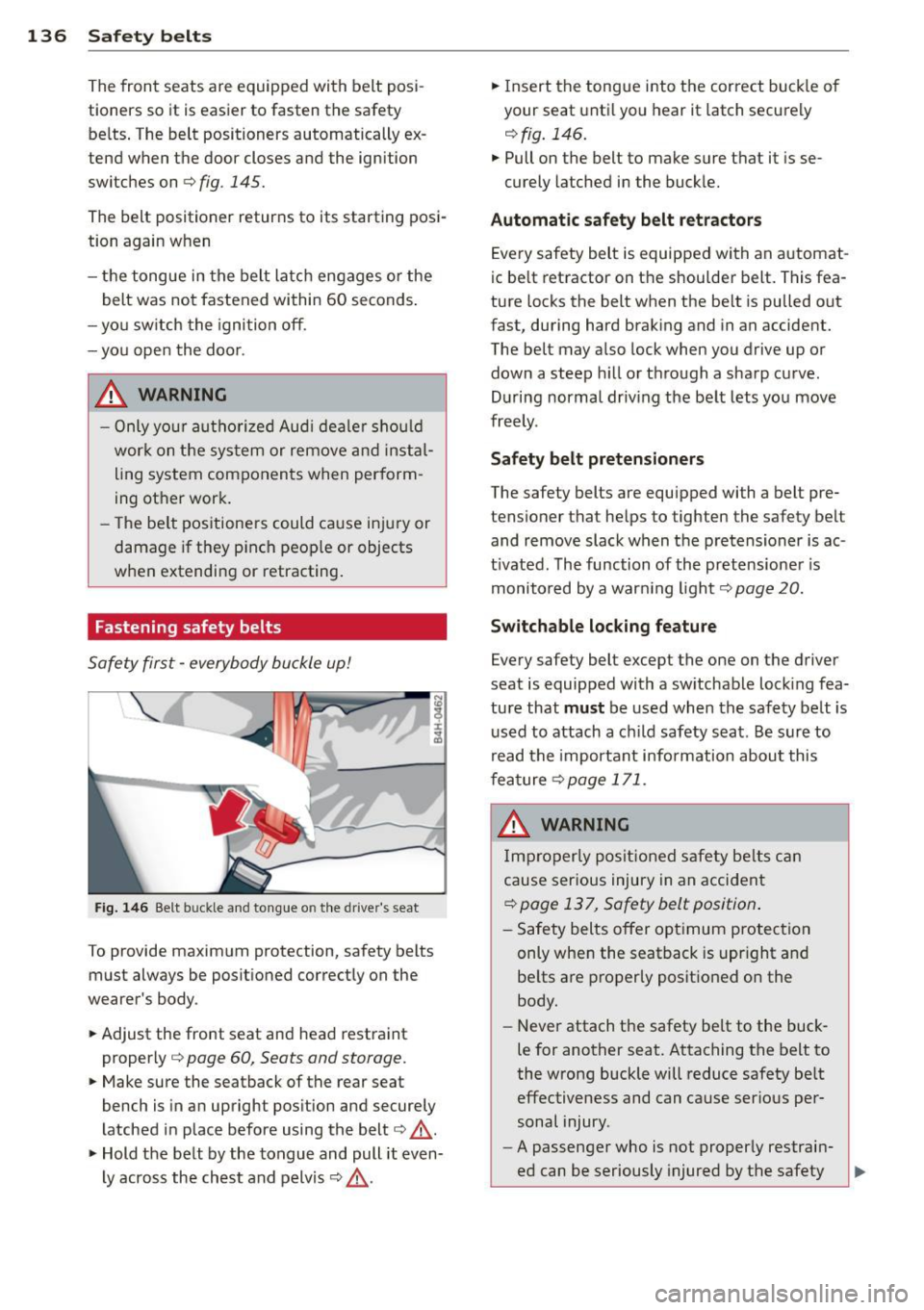
Fastening safety belts
Safety first -everybody buckle up!
Fig. 146 Belt buckle a nd tong ue o n th e dr iver's seat
To prov ide maximum protection, sa fety belts
must always be posit ioned correctly on the
wearer's body .
.. Adjust the front seat and head restra int
properly ¢
page 60, Seats and storage .
.. Make sure the seatback of the rear seat
bench is in an upright pos ition and securely
latched in place before using the belt¢,& .
.. Hold the belt by the tongue and pull it even-
ly across the chest and pelvis
c:::> &, .
.. Insert the tongue into the correct buck le of
your seat unti l you hear it latch securely
c:::> fig . 146.
.. Pull on the belt to make sure that it is se-
curely latched in the buckle.
Automatic safety belt r etractors
Every safety belt is equipped with an a utomat
ic be lt retractor on t he shou lder belt. This fea
ture locks the belt when the be lt is pulled out
fast, during hard braking and in an accide nt.
The belt may a lso lock when you drive up or
down a steep h ill or through a sha rp curve.
D uring normal driv ing the be lt lets you move
freely .
Safety belt pretensioners
The safety belts are equipped with a belt pre
tensioner that he lps to tighten the safety belt
and remove slack when t he pretensioner is ac
t ivated . T he function of the pretensione r is
monitored by a war ning light
c:::> page 20.
Switchable locking feature
Every safety belt except the one on the driver
seat is equipped with a sw itchable lock ing fea
ture that
must be used when the safety be lt is
u sed to attach a c hild safety s eat. Be sure to
read the important information abou t this
feature
c:::> page 171.
&_ WARNING
I mp roperly posit ioned s afety be lts c an
cause ser ious injury in an accident
c:::> page 137, Safety belt position .
-Safety belts offer opt imum protection
only when the seat back is u pright and
be lts are proper ly posit ioned o n the
body.
-
- Never attach t he safety belt to the buck
le for another seat. Attaching the belt to
the wrong buckle will reduce safety be lt
effectiveness and can cause serious per
sonal injury .
- A passenger who is not proper ly restrain-
ed can be seriously injured by the safety ..,.
Page 154 of 286

152 Airbag sys te m
make certain that the PA SSENGER AIR BAG
OFF
light stays on continuous ly whenever the
ignit ion is on. If the
PASS ENGER AIR BAG
OFF
light does not appear and not stay on all
the time, stop as soon as it is safe to do so
and
- react ivate the system by turning the ignition
off and then turning it on again;
- remove and reinstall the child restraint.
Make sure that the child restraint is properly
installed and that the safety belt for the
front passenger seat has been correctly
routed around the child restraint as descr i
bed in the child restraint manufacturer's in
structions;
- make sure that the convertible locking fea
ture on the safety belt for the front passen
ger seat has been activated and that t he
safety belt has been pulled tight. The belt
must not be loose or have loops of slack so
that the sensor below the safety be lt latch
on the seat can do its job ¢
page 171.
-make su re that th ings that may increase the
weight of the chi ld and child safety seat are
not being transported on the front passen
ger seat;
- make sure that the safety belt tension sen
sor is not b locked. Shake the safety belt
latch on the front passenger seat back and
forth;
- If a strap or tether is being used to tie the child safety seat to the front passenger
seat, make sure that it is not so tight that it
causes the we ight-sensing mat to measure
more we ight than is actua lly on the seat.
If the PASSEN GER AIR BAG OFF light st ill
doe s not come o n
and does not stay on con
tinuously (when the ignition is switched on),
- take the chi ld restraint off the front passen -
ger seat and install it properly at one of the
rear seat pos itions . Have the a irbag system
inspected by your authorized Audi dealer
immediately .
- move the ch ild to a rear seat pos it io n and
make sure that the child is properly restrain
ed in a child restraint that is appropriate for
i ts size and age. The
PA
SSENGER AIR BAG OFF light sho uld
NOT come on when the ignition is on and an
adult is s itting in a proper seating position on
the front passenger seat. If the
PAS SENGER
AIR BAG OFF
light comes on and stays on or
flashes for about 5 seconds wh ile driving, un
der these c ircumstances, make sure that:
- the adult on the front passenger seat is properly seated on the center of the seat
cushion with his or her back up aga inst the
backrest and the backrest is not recl ined
¢ page 122, Proper occupant seating posi
tions,
- the adult is not tak ing weight off the seat by
holding on to the passenger assist handle
above the fron t passenger door or support
ing thei r weight on the armrest,
- t he safety belt is being properly wo rn and
t hat there is not a lot of s lack in the safety
be lt webb ing,
- accesso ry seat covers or cushions o r othe r
t hings tha t may cause an incorrect reading
or impression on the weight-sensing mat
under the upho lstery of the seat have been
removed from the front passenger seat,
- a safety belt extender has not been left in the safety belt latch for the front passenger
seat.
In add ition to the
PASSENGER AIR BAG OFF
li ght in the center o f the instrument panel,
t h e message
PASSENGER AIR BAG OFF or
PAS SEN GER AIR BAG ON wi ll briefly appear
in the instrument cluster disp lay. This is to in
form the dr iver of the current front passenger
airbag status.
Important safety instructions on
monitoring the Advanced Airbag System
A WARNING
An a irbag system that is not functioning
properly cannot provide supplemental pro
tection in a frontal c rash.
- If the airbag ind icator light
¢ page 20
comes when the veh icle is being used,
have the system inspected immediately
by your authorized Audi dealer .
It is
-
Page 169 of 286
Child safety seats
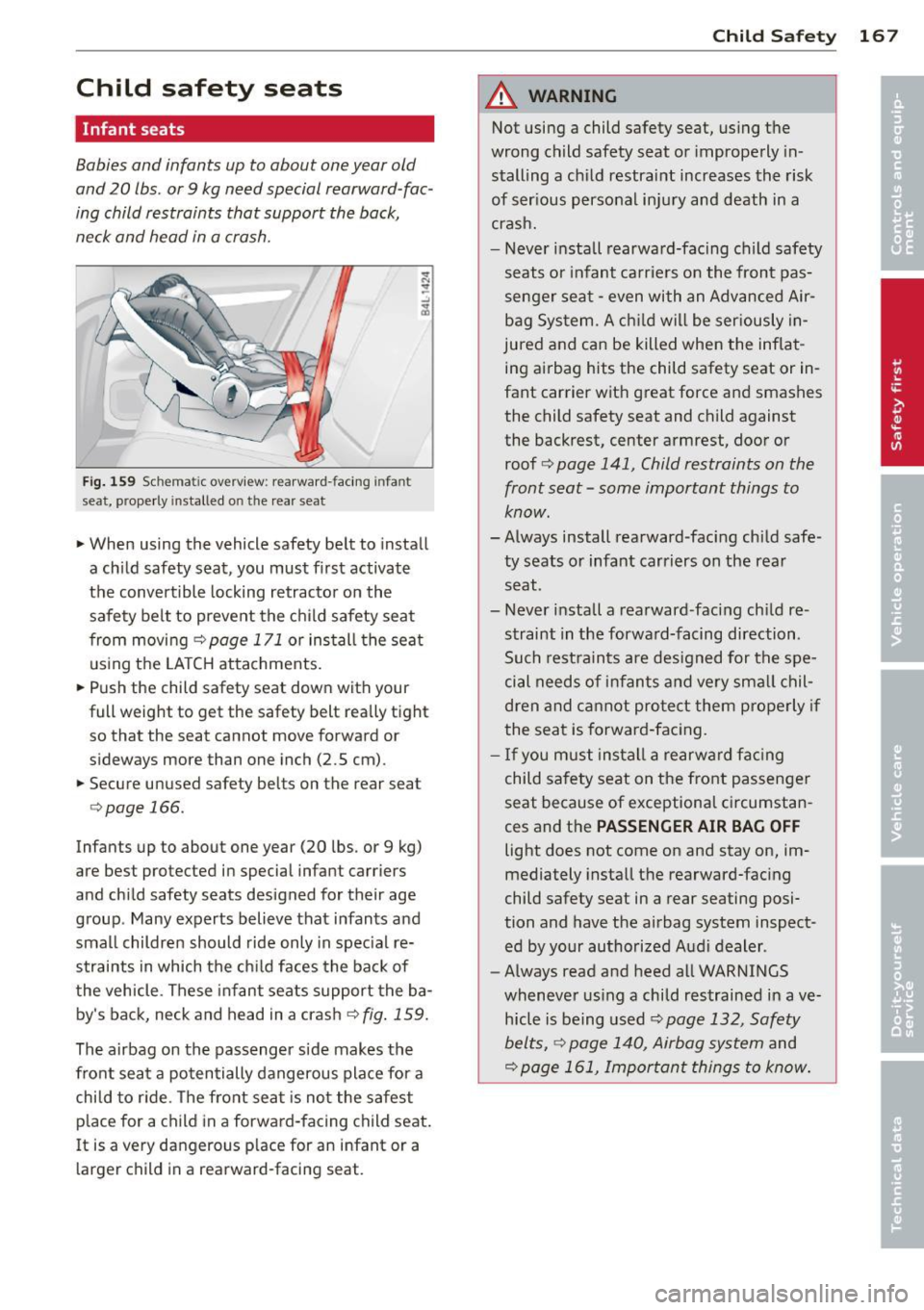
Infant seats
Babies and infants up to about one year old
and 20 lbs. or 9 kg need special rearward -fac
ing child restraints that support the back,
neck and head in a crash.
Fig . 159 Sche matic overv iew: rearward-fac ing infant
seat, properly installed o n the rear seat
~ When using the vehicle safety belt to install
a child safety seat, you must first activate
the convertible locking retracto r on the
safety be lt to prevent the child safety seat
from moving
¢ page 171 or install the seat
using the LA T CH attachments.
~ Push the child safety seat down with your
full weight to get the safety belt rea lly tight
so that the seat cannot move forward or
sideways more than one inch (2.5 cm).
~ Secure unused safety belts on the rear seat
¢page 166.
Infants up to about one year (20 lbs . or 9 kg)
are best protected in special infan t carriers
and child safety seats designed for their age
group . Many experts believe that infants and
small children should ride only in spec ial re
straints in which the ch ild faces the back of
the vehicle. These infant seats support the ba
by's back, neck and head in a crash
¢fig . 159.
The airbag on the passenger side makes the
front seat a po tentially dangerous place for a
child to r ide . The front seat is not the safest
p lace for a child in a forward -facing child seat.
It is a very dangerous p lace for an infant or a
l arger ch ild in a rearward-facing seat.
Child Safety 16 7
A WARNING
Not using a child safety seat, using t he
wrong child safety seat or improperly in
stall ing a ch ild restraint increases the risk
of ser ious personal injury and death in a
crash.
- Never install rearwa rd-facing child safety
seats or infant ca rr ie rs on the front pas
senger seat -even with an Advanced Air
bag Sys tem. A ch ild will be ser iously in
jured and ca n be killed when the inflat
ing airbag hits the child safety seat or in
fant carrier with great force and smashes the child safety seat and child against
the backrest, center armrest, door or
roof ¢
page 141, Child restraints on the
front seat- some important things to
know .
-Always install rearward -facing chi ld safe
ty seats or infant carriers on the rea r
seat .
- Never install a rea rward -facing ch ild re
straint in the forward-facing direction .
Such rest ra in ts are designed for the spe
cial needs of infants a nd ve ry sma ll chil
d ren and cannot pro te ct them p roperly if
the seat is forward -facing.
- If you must insta ll a rearwa rd fac ing
child safety seat on the front passenger
seat because of exceptiona l circumstan
ces and the
PASSENGER AIR BAG OFF
light does not come on and stay on, im
mediately install t he rearward-facing
child safety seat in a rear seating posi
tion and have the airbag system inspect ed by your autho riz ed Audi dealer .
- Always read and heed all WARNINGS
wheneve r us ing a child restrained in ave
h icle is being used ¢
page 132, Safety
belts,
Q page 140, Airbag system and
¢ page 161, Impor tan t thi ngs to know .
Page 206 of 286
204 Fuel suppl y and filli ng your fu el t ank
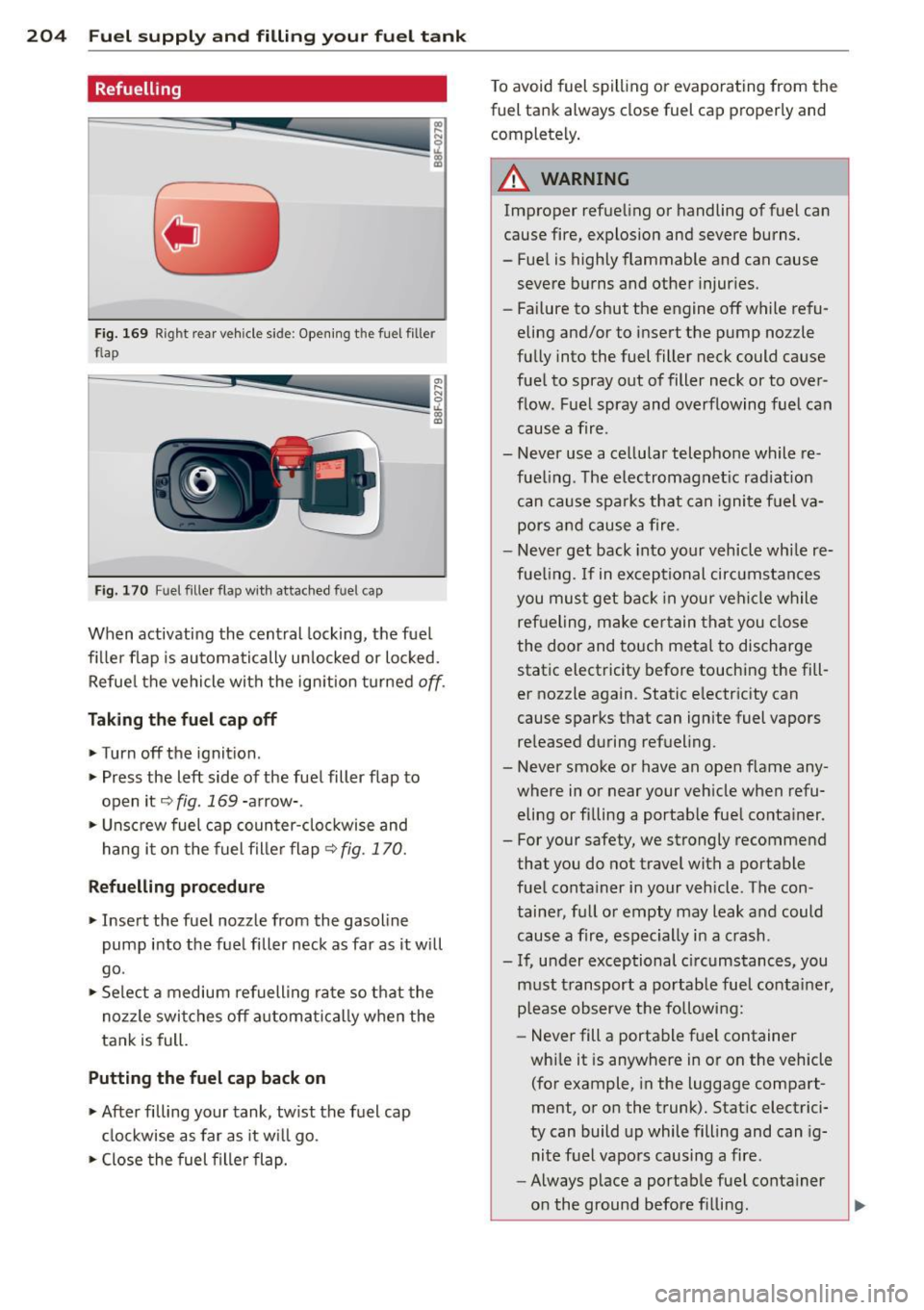
Refuelling
Fig. 169 Rig ht rear veh icle s ide: Open ing t he fuel fille r
fl ap
Fig. 170 Fu el fi ller fla p w ith attached fuel c ap
When activating the central lock ing, the fuel
fi ller flap is automatically un locked or loc ked.
Refue l the vehicle with the ig nition turned
off .
Tak ing th e fuel cap off
~ Turnoff the ignition .
~ Press the left side of the fuel filler flap to
open it
c::> fig. 169 -arrow- .
~ Unscrew fuel cap counter-clockwise and
hang it on the fuel filler flap
~ fig . 170.
Refu elling proc edure
~ Insert the fuel no zzle from the gasoline
pump into the fuel filler nec k as far as it will
go .
~ Select a medium refuelling ra te so that the
nozzle swi tches off a utomatica lly when the
tank is full.
Putting the fuel cap back on
~ After filling your tank , tw ist the fuel cap
clockwise as far as it w ill go .
~ Close the fuel fil le r flap. T
o avoid fuel spill ing or evaporating from the
fuel tank always close fuel cap properly and
completely .
A WARNING
-Im proper refueling or handling of fuel can
cause fire, explosion and severe burns.
- Fue l is highly flammable and can cause
severe burns and other injur ies.
- Failure to shut the engine off while refu
eling and/or to insert the pump noz zle
fully into the fuel filler neck could cause fuel to spray out of filler neck or to over
f low . Fuel spray and overflowing fuel can
cause a fire .
- Never use a cellular telephone while re
fueling . The electromagnet ic rad iat io n
can cause sparks that can ignite fuel va
pors a nd cause a fire .
- Never get back into your vehicle wh ile re
fue ling.
If in exceptional circumstances
you mus t get back in your vehi cle while
ref ueling, make ce rtain that you close
the door and touch meta l to discharge
static electricity before touching the fill
er nozzle again . Static e lectr icity can
cause sparks that can ignite fuel vapors re leased during refueling .
- Never smoke or have an open flame any
where in or near your veh icle when refu
eling or filling a portable fue l conta iner .
- For your safety, we strongly recommend
that you do not travel with a portable
fue l conta iner in your vehicle . The con
tainer, fu ll o r empty may leak and could
cause a fire, especially in a crash .
- If, u nder exceptional c ircumstances, you
must transport a portable fuel conta iner,
p lease observe t he follow ing:
- Never fill a portable f uel container
whi le it is anywhere in or on the vehicle
(for example, in the luggage compart
ment, or on the trunk). Static electrici
ty can build up while filling and can ig
ni te f uel vapors causing a fire .
- Always place a portab le fue l conta iner
on the ground before fi lling.
Page 207 of 286

-Always keep the f iller nozzle complete
ly inside the portable conta iner before
and during filling.
- If filling a portable container made of
metal, the filler nozz le must always be
in contact with the container. Th is w ill
he lp prevent static electricity from dis
charging and cause a fire .
- Never spi ll fuel inside the vehicle or
luggage compartment. Fuel vapors are
h ighly f lammable .
- Always observe local and state/provin cial laws regarding the use, storage
and tra nsporta tion of fuel containers.
- Make certa in the fuel container meets
industry standards (ANSI
I ASTM
F852-86).
(D Note
If any fuel has spilled onto the car, it
should be removed immediate ly to prevent
damage to the paint.
@ For the sake of the environment
As soon as the correctly operated nozzle
sw itches off automatically for the fi rs t
time, the tank is full. Do not try to add
more fue l because fuel may spill out. In
add it ion, the expans io n space in the fuel
t ank will be fi lled -ca using the fue l to
overflow when it becomes warm and pol
lute the env ironment.
@ Tips
- Runn ing yo ur engine while re fuelling
may cause vapors to escape or even
cause fue l to spill out of the tank . This
would then shut off the fuel nozzle be
fo re the tank is fu ll.
- Do not refuel your vehicle w ith the igni
tion t urned on. The fuel gauge may oth
erwise not ind icate the correct fue l level
after refuelling.
- The fuel filler flap of your vehicle is not locked when you lock the vehicle from
the i nside.
Fu el suppl y and filli ng your fuel t ank 205
Unlocking the fuel filler flap by hand
You can open the fuel filler flap by hand if the
power locking system should fail .
Fig . 1 71 Lu ggage co mpartme nt: ope ning the side trim
Fi g. 172 Lu ggage co mpa rtme nt: Eme rgency ope ning
of fue l fil ler flap
The emergency opening mechanism is located
behind the right side trim panel in the lug
gage compartment .
Opening the side trim
... Insert a tool such as a screwdriver
~ page 243 or the emergency key into the
r ight side of the upper gap
c::> fig. 171 .
... Pry upward to release the trim.
Fuel filler door emergency release
... Loosen the st rap from its bracket a nd p ull
on it
c::> fig . 172. Yo u can now open the fuel
filler flap as usual~
page 204.
Page 253 of 286

Fuses and bulb s 251
No. Con sumer Amps No. Consumer Amps
•
A/C system pressure sensor, Two-door models: rear left
• electromechanical parking window regulator; Four-
brake, Homelink, automatic 11 door models:
rear left door
30
3 dimming interior rear view
5 (window regulator, central
m irror, air quality/outside locking, switch, lighting)
air sensor, Electronic Stab ili-
12 Rain and light sensor
5
zation Control (button)
5 Sound
actuator
5
Fuse panel© (r e d )
6 Headlight
range cont rol/
5/7,5
head light (cornering light)
No. Consumer Amps
3 Lumbar support 10
7 Headlight (corner
ing light) 7,5
4 Dynamic steering 35
Contro l modu les (e lectro-
s Inter ior lighting (Cabriolet)
5
8 mechanical parking brake,
5
shock absorber, quattro
sport), DCDC converter
9 Adaptive cru ise contro l 5 6
W
indshield washer system,
35
h eadlight washe r system
7 Vehicle electrical
system
20
control module 1
10 Shift gate/clutch
sensor
5
1 1 Side ass ist 5
8
Vehicle electr ica l system
30
control module 1
1 2 Headlight range
control,
5
park ing system 9 Left rear window regulator
7,5/20
motor (Cabriolet)/sunroof
13 Airbag 5
14 Rear wiper (allroad) 15 10 Vehicle e
lectrical system
30
control module 1
1 5 Auxi
liary fuse (instrument
10
pane l) 11 R
ight rea r window regulato r
7,5/20
(Cabriolet)/sun shade motor
16 Aux
iliary fuse terminal 15
40
(engine area) 12 Anti-theft
alarm warning
5
system
Fuse p anel @ (brown )
No. Con sumer Amps
2 Brake light sensor 5
3 Fuel
pump
25
4 Clutc h sensor 5
5 Left
seat heating with/w ith-
15/30
out seat vent ilation
6 Electronic Stab
il iz at ion Con-
5
tro l (e lectric)
7 Horn 15
Front left door (window reg-
8 ulator, centra
l locking, mir-
30
ror, switch, lighting)
9 Winds hield wipe r motor 30
1 0 Electronic
Stabilizat ion Con-
25
trol (valves)
Page 255 of 286
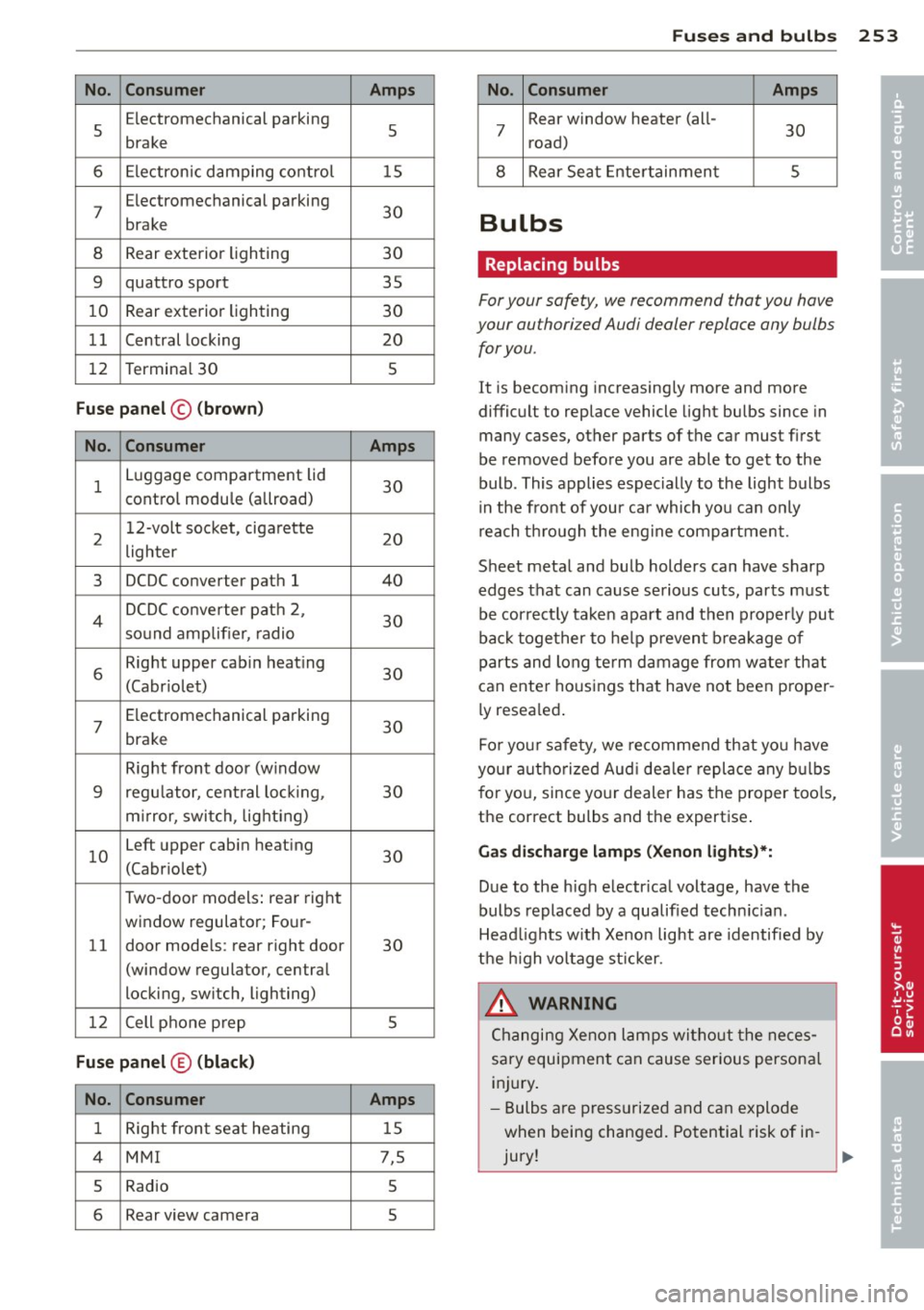
No. Consumer
5 Electromechanical
parking
brake
6 Electronic damping control
7
Electromechanical parking
brake
8 Rear exterior lighting
9 quattro sport
10 Rear
exterior lighting
1 1 Central locking
12 Termina
l 30
Fu se pa nel © (brown )
No. Con sumer
1 Luggage compartment lid
control module (allroad)
2 1
2-volt socket, cigarette
lighter
3 DCDC
converter path 1
4 DCDC converter path 2,
so und amplifier, radio
6
Right upper cabin heat ing
(Cabr iolet)
7
Electromechanical parking
brake
Right front door (w indow
9 regu lator, central lock ing,
m irror, swit ch, lig hting)
10 Left upper
cabin heating
(Cabriolet)
Two -door models: rear right
window regulator; Four-
11 door mode
ls: rear right door
(window regulator, central
locking, sw itch, lighting)
12 Cell phone prep
Fu se panel © (black )
No. Consumer
1 Right front seat heating
4
MMI
5 Radio
6 Rear view camera
Amp s
5
15
30
30
35
30
20 5
Amp s
30
20
40
30
30
30
30
30
30
5
Amps
15
7,5
5
5
Fu ses and bulb s 253
No. Consumer Amps
7
Rear window heater (all-
30
road)
8 Rear Seat Entertainment 5
Bulbs
Replacing bulbs
For your safety, we recommend that you hove
your authorized Audi dealer replace any bulbs
for you .
It is becoming increasingly more and more
difficult to replace vehicle light bulbs since in
many cases, other parts of the car must first
be removed before you are able to get to the
bulb. This applies especially to the light bulbs
in the front of your car which you can only
reach through the engine compartment.
Sheet metal and bulb holders can have sharp
edges that can cause serious cuts, parts must
be correct ly take n apa rt and then p roperly put
bac k together to he lp p revent breakage of
parts and long te rm damage from water that
can enter housings that have not been p roper
ly re sea led .
Fo r you r safety, we re commend that you have
your autho rized Audi de aler replace any b ulbs
f or you, since your dealer has the proper too ls,
the correct bulbs and the expertise.
Gas disc har ge la mp s (Xenon l ig hts)*:
Due to the high electr ical voltage, have the
bulbs replaced by a qualified techn ic ian .
Head lights w ith Xenon light are identified by
the h igh vol tage sticker.
_&. WARNING
Changing Xenon lamps without the neces
sary equipment can cause serious persona l
injury .
- Bulbs are pressurized and can explode
when being changed. Potential risk of in
jury!
-
•
•
Page 274 of 286

272 Index
Homelink universal remote contro l 267
Remote control key ...... ... .. .... . 267
Decorative parts/trim
C leaning . .. ............. .. .. .. .. . 197
Defective light bulb warning . . . . . . . . . . . 21
Defrosting (windows) ........ ... .... .. 71
Determining correct load limit ..... .. . 231
Digita l clock .............. .. .. ...... 12
Digital compass ............. .. .... .. 58
Dimensions .. .. .. ...... .... ... .. .. . 262
Dimming the rearview mirror . ..... .. .. 55
Displays Cleaning . ... ............ .. .. .. .. . 197
Doors emergency lock ing .. ...... .. .. .. .. .. 36
Driver information system Open door or front lid warning . . . . . . . . 24
Outside temperature display .. .. .. .... 24
Sound system display . . . . . . . . . . . . . . . 24
Driver seat
refer to Seating position ............ 122
Driving safely ........... .. .. .. .. .. . 121
Driving through water ...... .. .. .... . 187
Driving time . . . . . . . . . . . . . . . . . . . . . . . . 25
Dust filter
refer to Pollutant filter (automatic AC
system) ................. .... ...... 69
Dynamic steering . . . . . . . . . . . . . . 106, 184
E
E85 (Fuel) . ................. .. .. .. . 202
Easy entry function ......... .... .... .. 62
Efficiency program ........... .. .. ... . 27
Fuel economy messages . ........ .. .. 27
Memory levels . . . . . . . . . . . . . . . . . . . . . 25
Other equipment ........... .. .. .. .. 27
Electro-mechanical power assist .. .. .. . 184
Electromechanical parking brake
Emergency braking ........ ... .... . . 81
Indicator light . . . . . . . . . . . . . . . . . . . . . 79
Parking ...... ........... .. .. .... .. 80
Releasing and closing ......... .. .... 79
Starting ass ist .. .. .... ... .. .. .. .. .. 80
Starting from rest ........ .. .. .. .. .. 80
Starting off with a tra ile r ... .. .. .. .. . . 81
War ning/ indicator l ights ... .... .... .. 16 Electronic
differential lock
Warning/indicator lights ............. 18
El ectronic differential lock (ED L) ... .... 179
Warning/indicator lights .......... .. . 19
Electronic immob ilizer . . . . . . . . . . . . 12, 37
E lectronic power control
(EPC) warning/indicator light . . . . . . . . . 20
Electronic speed limiter .............. . 29
Electronic stabilization control Sport mode ..... ... ....... ... .. .. 181
E lectronic Stabilization Contro l (ESC) ... 179
Warning/indicator lights ............. 18
Emergency actuation
Doors .... .. .. . .............. .... . 36
Ignition key ..... ................ .. 34
Emergency braking . ... .. ..... ... .. .. . 81
Emergency flasher . . . . . . . . . . . . . . . . . . . 53 Warning/indicator lights ............ . 23
Emergency key . . . . . . . . . . . . . . . . . . . . . . 32
Starting engine . . . . . . . . . . . . . . . . . . . . 76
Emergency operation
Emergency braking funct ion (pa rking
brake) .. .. .. .. .. ................. . 81
Luggage compartment lid . . . . . . . . . . . . 38
Power top . . . . . . . . . . . . . . . . . . . . . . . . . 46
Emergency starting ... ....... ... .. .. 255
Emergency towing .................. 257
Energy management . . . . . . . . . . . . . . . . 185
Battery power . . . . . . . . . . . . . . . . . . . . . 17
Driver notification . . . . . . . . . . . . . . . . . . 17
Engine Compartment ................... .. 208
Coolant ..... .. .. .. ........... .... 213
Data ......... .. .. ............ ... 263
Hood ............................ 206
Starting . . . . . . . . . . . . . . . . . . . . . . 7 4, 77
Starting with jumper cables ......... 255
Stopping . . . . . . . . . . . . . . . . . . . . . . 76, 78
Engine compartment
Safety instructions ................. 206
Working the engine compartment 206
Engine coolant
Indicator light . .. ............... ... 17
Engine coolant system ..... ...... .... 213
Adding coolant . .. ... .. ..... ... .. .. 214
Checking coolant level . ...... ... .. .. 213