steering AUDI A5 CABRIOLET 2014 Owner's Guide
[x] Cancel search | Manufacturer: AUDI, Model Year: 2014, Model line: A5 CABRIOLET, Model: AUDI A5 CABRIOLET 2014Pages: 286, PDF Size: 70.4 MB
Page 195 of 286

Tire pressure
When towing a trailer, inflate the tires of your
vehicle to the cold tire pressure listed under
"Full load" on the label located on the driver's
side B-pillar (visible when the door is open).
Inflate trailer tires to trailer and tire manufac
turers' specifications.
Lights
The headlight settings should be checked with
the trailer attached before driving off. Check
to make sure both vehicle and trailer lights
are working properly.
Safety chains
Be sure trailer safety chains are properly con
nected from the trailer to the hitch on the ve
hicle. Leave enough slack in the chains to per
mit turning corners . When you install safety
chains, make sure they will not drag on the road when you are driving.
The chains should cross under the trailer
tongue to prevent it from dropping in case of
separation from the hitch .
Driving instructions
Driving with a trailer always requires extra
core and consideration.
To obtain the best possible handling of vehicle
and trailer, please note the following:
.,. Do not tow a loaded trailer when your car it
self is not loaded.
.,. Be especially careful when passing other
vehicles.
.,. Observe speed limits .
.,. Do not drive at the maximum permissible
speed .
.,. Always apply brakes early.
.,. Monitor the temperature gauge.
Weight distribution
Towing a loaded trailer with an empty car re
sults in a highly unstable distribution of
weight . If this cannot be avoided, drive at very
low speeds only to avoid the risk of losing
steering control.
Trailer towing 193
A "balanced" rig is easier to operate and con
trol. This means that the tow vehicle should be loaded to the extent possible and permissi
ble, while keeping the trailer as light as possi
ble under the circumstances. Whenever possi
ble, transfer some cargo to the luggage com
partment of the tow vehicle while observing
tongue load requirements and vehicle loading
considerations.
Speed
The higher the speed, the more difficult it be
comes for the driver to control the rig . Do not
drive at the maximum permissible speed . Re
duce your speed even more if load, weather or
wind conditions are unfavorable -particularly
when going downhill.
Reduce vehicle speed
immediately if the trail
er shows the slightest sign of swaying .
Do not
try to stop the swaying by accelerating.
Observe speed limits. In some areas, speeds
for vehicles towing trailers are lower than for
regular vehicles .
Always apply brakes early. When driving downhill, shift into a lower gear to use the en
gine braking effect to slow the vehicle . Use of
the brakes alone can cause them to overheat
and fail.
Coolant temperature
The coolant temperature gauge<=> page 10
must be observed carefully . If the need le
moves close to the upper end of the scale, re
duce speed immediately and/or turn off the
air conditioner.
If the coolant temperature warning light •
in the instrument cluster starts flashing, pull
off the road, stop and let the engine
idle for
about two minutes to prevent heat build-up .
A WARNING
Anyone not properly restrained in a mov
ing vehicle is at a much greater risk in an
accident. Never let anyone ride in your car
who is not properly wearing the restraints
provided by Audi.
-
•
•
Page 196 of 286

194 Trailer towing
Trailer towing tips
Important to know
Your vehicle hand les different ly w hen tow ing
a tr ailer because of the addit ional weight and
different weight distribution . Safety, perform
ance and economy wi ll greatly depend on how
carefully you load your trailer and operate
your rig.
Before you actually tow your trailer, practice
turning, stopp ing and backing up in an area
away from traffic. Keep practicing until you have become comp letely familiar with the way
your veh icle-trailer combination behaves and
responds.
Backing up is difficult and requires practice.
Backing up with a trai ler genera lly requires
steering action opposite to that when backing
up your veh icle without a trailer.
Maintain a greater distance between your ve
hicle and the one in front of you . You will need
more room to stop. To compensate for the
trailer, you will need a larger than normal
turning radius .
When passing, remember that you cannot ac
celerate as fast as you normally would be
cause of the added load. Make sure you have
enough room to pass . After passing, allow
plenty of room for your tra iler before chang
in g lanes again.
Avoid jerky starts, sharp turns or rapid lane
changes.
{Dl Tips
- Do not tow a tra iler dur ing the break-in
period of your vehicle.
- If you tow a trailer, your A udi may re
quire more frequent maintenance due to
the extra load
q page 264.
Parking on a slope
Do not park on a slope with a trailer . If it can
not be avoided, do so only after doing the fol lowing :
When parking:
.. App ly the foot brake.
.. Have someone place chocks under both the
veh icle and the trailer wheels .
.,. With chocks in place, slowly release the
brakes until the wheel chocks absorb the
load.
.. Turn the whee ls towards the curb.
.. App ly the parking brake.
.. Move the selector lever to P.
When restarting after parking:
.. App ly the foot brake .
.. Start the engine.
.. Move the selector lever to D/S .
.. Release the parking brake and s lowly pull
out and away from the wheel chocks .
.. Stop and have someone retrieve the wheel
chocks .
(D Tips
If you move the selector lever of the auto
matic transmission to P before applying
the parking brake and before blocking the
whee ls, you may have to use more force
later to move the lever out of the P posi
tion.
Page 225 of 286

-Never mount used tires on yo ur vehicle if
yo u are not sure of their "previous histo
ry." Old used tires may have been dam
aged even though the damage cannot be
seen that can lead to sudden tire failure
and loss of vehicle control.
- If you notice unusual vibration or if the
vehicle pulls to one side when d riving, al
ways stop as soon as it is safe to do so
and check the wheels and tires for dam
age .
(D Note
-Please note that summer and winter
tires are designed for the cond itions that
are typ ic al in those seasons. Aud i recom
mends using w inter t ires du ring the win-
Glossary of tire and loading terminology
Accessory weight
means the comb ined weight (in excess of
those standard items which may be replaced)
of automatic tra nsmission, power steering,
power brakes, power windows, power seats,
radio, and heater, to the extent that these
items are availab le as factory-installed equip
ment (whether installed or not) .
Aspect ratio
means the ratio of the height to the width of
the tire in percent . Numbers of 55 or lower in
d icate a low sidewall for improved steering re
sponse and better overall handling on dry
pavement .
Bead
means the pa rt of the ti re that is made of
steel wires, wrapped or reinforced by ply cords
and that is shaped to fit the rim.
Bead s eparation
means a b reakdown of the bond between
components in the bead.
Cord
means the strands forming the plies in the
tire.
Tire s an d wheel s 223
ter months . Low temperatu res signifi
cantly decrease the elastic ity of summer
t ires, which affects traction and braking
ability. If summer tires are used in very
co ld temperatures, cracks can form on
the tread bars, res ulting in permanent
ti re damage that can cause loud drivi ng
noise and unbalanced tires. Aud i is not
responsib le for this type of damage.
- Burn ished, polished or chromed rims
must not be used in winter weather. Th e
surfa ce of the rims does not have suffi
c ien t cor rosion pro te cti on for this and
c o ul d be pe rmanen tly damaged by road
salt or similar substances. This damage
is not covered by warranty.
Cold tir e inflation pressure
me ans the t ire press ure re commended by the
vehicle manufacturer fo r a tire o f a des igna ted
size that has not bee n driven for more than a
couple of miles (k ilomete rs) at low speeds in
the three hour pe riod before the tire p ress ure
is measured or adjusted.
Curb weight
means the weight o f a motor vehicle with
standard equipment including the maximum
capacity of fuel, o il, and coolant, air cond i
tion ing and additional weight of optiona l
equipment.
E xtra load tire
means a tire design to operate at higher loads
and at higher inflation pressures than the cor
responding standard tire. Extra load tires may
be identified as "XL", "xl", "EXTRA LOAD", or
"RF" on the sidewall.
Gross Axle Weight Rating ("GAWR")
means the load-carrying capacity of a single
axle system, measured at the tire-ground in-
ter~ces .
~
•
•
Page 234 of 286

232 Tires and wheels
to determine how this reduces the available cargo
and luggage load capacity of
your vehicle.
.,.Check the tire sidewall
(¢ page 233, fig. 186) to de
termine the designated load rating for a specific tire.
Tire service life
The service life of tires depends on a lot of
different things including proper installation
and balancing, correct tire pressure and driv·
ing style.
Fig. 184 Tire tread: tread wear indicators (TWI)
_____ ___,.J)
Fig. 185 Rotating tires for more even wear
Tread Wear Indicator (TWI)
The original tires on your vehicle have
1/16 inch (1.6 mm) high "wear indicators"
c:> fig. 184 running across the tread. Depend·
ing on the make , there will be six to eight of
them evenly placed around the tire. M ar ks on
the tire sidewall (for example "TWI" or other
symbols) indicate the positions of the tread
wear indicators. Worn tires must be replaced. Different
figures may apply in other countries
c:>& .
Tire pressure
Incorrect tire pressure causes premature wear
and can cause sudden tire blow-out. For this
reason, tire pressure must be checked at least
once a month
c:> page 228.
Driving style
Driving fast around curves, heavy acceleration
and hard braking increase tire wear .
Rotating tires for more even wear
For all four tires on your vehicle to have the
same service life, we recommend that the
front and rear tires are rotated according to
the tire manufacturer's suggested tire rota
tion intervals. Please remember the follow
ing :
- Tire rotation intervals may differ from the
vehicle service intervals outlined in your
Maintenance and Warranty Booklet .
- The longer one tire is used in one location
on the vehicle, the more it wears at certain
points; therefore, we recommend that you
follow the tire manufacturer's suggested
tire rotation intervals.
- Vehicles with front-wheel drive experience
more tread wear on the front wheels com
pa red to all wheel drive (quattro).
- Please rotate tires as shown
c:>fig. 185.
- Extra care must be taken when rotating di-
rection-specific tires
c:> page 249 .
Wheel balancing
The wheels on new vehicles are balanced .
However, various situations during everyday
driving can cause them to become unbal
anced, resulting in vibrations you can usually
feel through the steering wheel.
Unbalanced wheels must be rebalanced to
avoid excessive wear on steering, suspension
and tires. A wheel must also be rebalanced
when a new tire is installed. .,.
Page 252 of 286
250 Fuses and bulbs
Fuses and bulbs
Fuses
Replacing a fuse
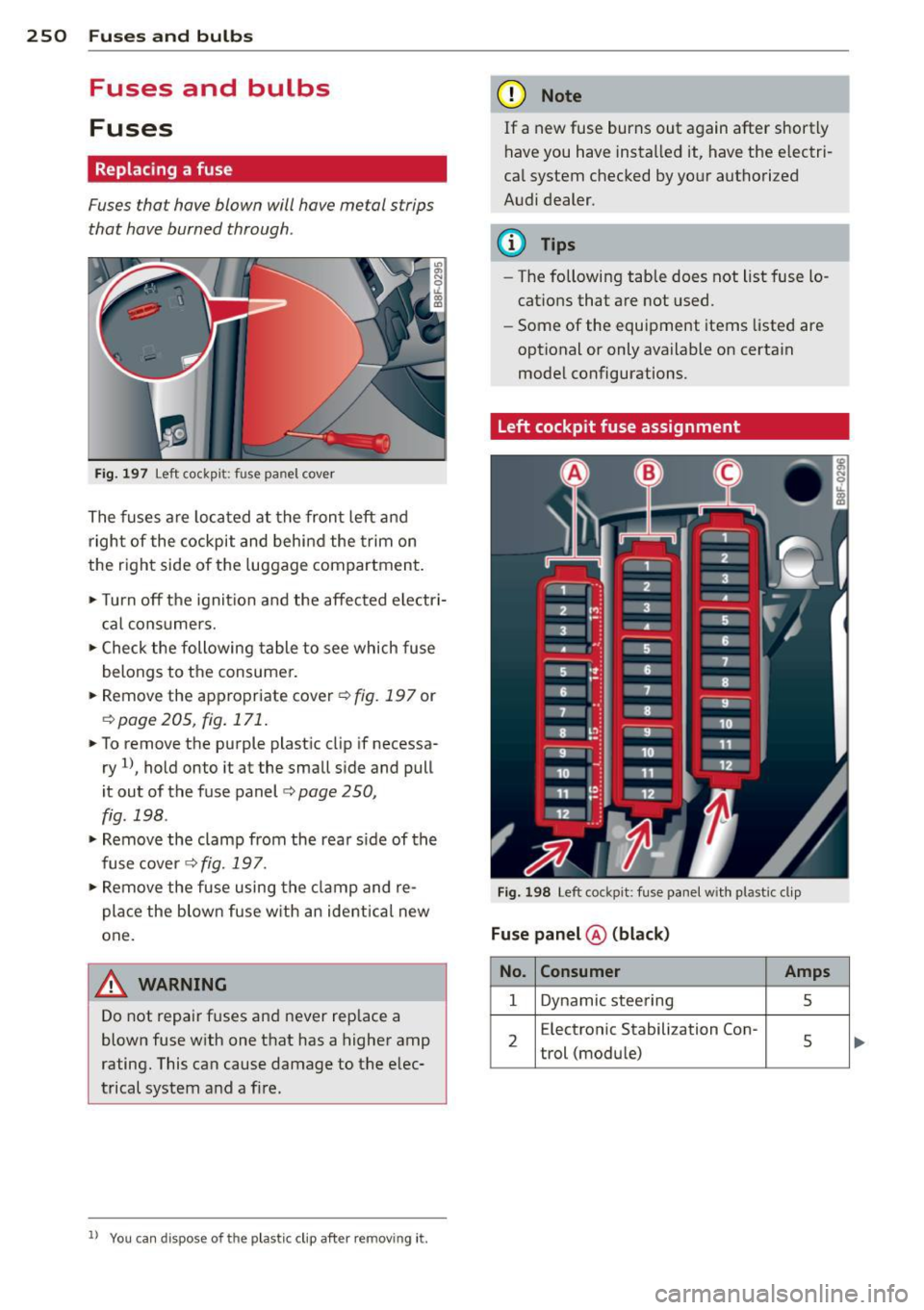
Fuses that have blown will have metal strips
that have burned through.
Fig. 197 Left cockpit: fuse panel cover
The fuses are located at the front left and
right of the cockpit and behind the trim on
the right side of the luggage compartment.
•Turnoff the ignit ion and the affected electri-
cal consumers.
• Check the following table to see which fuse
belongs to the consumer.
• Remov e the appropriate cover ¢
fig. 197 or
¢ page 205, fig. 171.
• To remove the purple plastic clip if necessa
ry
1l, hold onto it at the small side and pull
it out of the fuse panel
c:> page 250,
fig . 198 .
• Remove the clamp from the rear side of the
fuse cover <>
fig. 197 .
• Remove the fuse using the clamp and re
place the blown fuse w ith an ident ical new
one.
A WARNING
Do not repair fuses and never replace a
blown fuse with one that has a higher amp
rating. This can cause damage to the elec
trical system and a fire.
ll You can dis pose of the p last ic clip afte r re moving it.
(D Note
If a new fuse burns out again after shortly
have you have installed it, have the electri
cal system checked by your authorized
Audi dealer .
(D Tips
-The following table does not list fuse lo
cations that are not used.
- Some of the equipment items listed are
optional or only available on certain
model configurations.
Left cockpit fuse assignment
Fig. 198 Left cockpi t: fu se pane l with plastic clip
Fuse panel ® (black)
No. Consumer Amps
1 Dynamic steering s
2
E lectronic Stabilization Con-
s tr ol (module)
Page 253 of 286

Fuses and bulb s 251
No. Con sumer Amps No. Consumer Amps
•
A/C system pressure sensor, Two-door models: rear left
• electromechanical parking window regulator; Four-
brake, Homelink, automatic 11 door models:
rear left door
30
3 dimming interior rear view
5 (window regulator, central
m irror, air quality/outside locking, switch, lighting)
air sensor, Electronic Stab ili-
12 Rain and light sensor
5
zation Control (button)
5 Sound
actuator
5
Fuse panel© (r e d )
6 Headlight
range cont rol/
5/7,5
head light (cornering light)
No. Consumer Amps
3 Lumbar support 10
7 Headlight (corner
ing light) 7,5
4 Dynamic steering 35
Contro l modu les (e lectro-
s Inter ior lighting (Cabriolet)
5
8 mechanical parking brake,
5
shock absorber, quattro
sport), DCDC converter
9 Adaptive cru ise contro l 5 6
W
indshield washer system,
35
h eadlight washe r system
7 Vehicle electrical
system
20
control module 1
10 Shift gate/clutch
sensor
5
1 1 Side ass ist 5
8
Vehicle electr ica l system
30
control module 1
1 2 Headlight range
control,
5
park ing system 9 Left rear window regulator
7,5/20
motor (Cabriolet)/sunroof
13 Airbag 5
14 Rear wiper (allroad) 15 10 Vehicle e
lectrical system
30
control module 1
1 5 Auxi
liary fuse (instrument
10
pane l) 11 R
ight rea r window regulato r
7,5/20
(Cabriolet)/sun shade motor
16 Aux
iliary fuse terminal 15
40
(engine area) 12 Anti-theft
alarm warning
5
system
Fuse p anel @ (brown )
No. Con sumer Amps
2 Brake light sensor 5
3 Fuel
pump
25
4 Clutc h sensor 5
5 Left
seat heating with/w ith-
15/30
out seat vent ilation
6 Electronic Stab
il iz at ion Con-
5
tro l (e lectric)
7 Horn 15
Front left door (window reg-
8 ulator, centra
l locking, mir-
30
ror, switch, lighting)
9 Winds hield wipe r motor 30
1 0 Electronic
Stabilizat ion Con-
25
trol (valves)
Page 254 of 286

252 Fuses and bulbs
Right cockpit fuse assignment
Fi g. 199 Right cockpit: f use pane l w it h plastic clip
Fuse panel @ (black )
No. Consumer Amps
5 Steering col
umn switch
5
modu le
7
Terminal 15 d iagnostic con-
nec tor 5
8
Gateway (Databus d
iagnos -
5
tic interface)
9 S u pplemen tary heate r 5
Fuse panel @ (brown )
No. Consumer
Amps
1 CD/DVD p laye r 5
2 Wi·Fi 5
3
M MI/Radio 5/20
4 Instrume nt cluster
5
5
Gateway (ins trumen t cluster
5 contro l modu le)
6 Igni tion lock
5
7 Light switch
5
8
Climate contro l system 40
blowe r
9 Steering column lock 5
No . Consumer
10 C
limate control system
11 T
erm inal 30 diagnosti c con-
n ectar
12 Steer
ing column switch
module
Right luggage compartment fuse
assignment Amps
10
10
5
F ig . 2 00 Right lu ggage compartment: fu se pane l w it h
plast ic clip
Fuse panel @ (black)
No . Consumer Amps
2 Rear window heater (Ca b
rio-
30
let)
3 Power
top latch (Cabriolet)
30
4 Power top hyd ra ulics ( Cab-
so rio let)
Fuse panel @ (black)
No. Consumer Amps
Luggage compartmen t lid
1 control mod
ule (a llroad)/
30/10
Power top contro l modu le
(Cabriolet)
2 Re
tra ctable rear spoiler
10
( R S 5 Coupe)
Page 274 of 286

272 Index
Homelink universal remote contro l 267
Remote control key ...... ... .. .... . 267
Decorative parts/trim
C leaning . .. ............. .. .. .. .. . 197
Defective light bulb warning . . . . . . . . . . . 21
Defrosting (windows) ........ ... .... .. 71
Determining correct load limit ..... .. . 231
Digita l clock .............. .. .. ...... 12
Digital compass ............. .. .... .. 58
Dimensions .. .. .. ...... .... ... .. .. . 262
Dimming the rearview mirror . ..... .. .. 55
Displays Cleaning . ... ............ .. .. .. .. . 197
Doors emergency lock ing .. ...... .. .. .. .. .. 36
Driver information system Open door or front lid warning . . . . . . . . 24
Outside temperature display .. .. .. .... 24
Sound system display . . . . . . . . . . . . . . . 24
Driver seat
refer to Seating position ............ 122
Driving safely ........... .. .. .. .. .. . 121
Driving through water ...... .. .. .... . 187
Driving time . . . . . . . . . . . . . . . . . . . . . . . . 25
Dust filter
refer to Pollutant filter (automatic AC
system) ................. .... ...... 69
Dynamic steering . . . . . . . . . . . . . . 106, 184
E
E85 (Fuel) . ................. .. .. .. . 202
Easy entry function ......... .... .... .. 62
Efficiency program ........... .. .. ... . 27
Fuel economy messages . ........ .. .. 27
Memory levels . . . . . . . . . . . . . . . . . . . . . 25
Other equipment ........... .. .. .. .. 27
Electro-mechanical power assist .. .. .. . 184
Electromechanical parking brake
Emergency braking ........ ... .... . . 81
Indicator light . . . . . . . . . . . . . . . . . . . . . 79
Parking ...... ........... .. .. .... .. 80
Releasing and closing ......... .. .... 79
Starting ass ist .. .. .... ... .. .. .. .. .. 80
Starting from rest ........ .. .. .. .. .. 80
Starting off with a tra ile r ... .. .. .. .. . . 81
War ning/ indicator l ights ... .... .... .. 16 Electronic
differential lock
Warning/indicator lights ............. 18
El ectronic differential lock (ED L) ... .... 179
Warning/indicator lights .......... .. . 19
Electronic immob ilizer . . . . . . . . . . . . 12, 37
E lectronic power control
(EPC) warning/indicator light . . . . . . . . . 20
Electronic speed limiter .............. . 29
Electronic stabilization control Sport mode ..... ... ....... ... .. .. 181
E lectronic Stabilization Contro l (ESC) ... 179
Warning/indicator lights ............. 18
Emergency actuation
Doors .... .. .. . .............. .... . 36
Ignition key ..... ................ .. 34
Emergency braking . ... .. ..... ... .. .. . 81
Emergency flasher . . . . . . . . . . . . . . . . . . . 53 Warning/indicator lights ............ . 23
Emergency key . . . . . . . . . . . . . . . . . . . . . . 32
Starting engine . . . . . . . . . . . . . . . . . . . . 76
Emergency operation
Emergency braking funct ion (pa rking
brake) .. .. .. .. .. ................. . 81
Luggage compartment lid . . . . . . . . . . . . 38
Power top . . . . . . . . . . . . . . . . . . . . . . . . . 46
Emergency starting ... ....... ... .. .. 255
Emergency towing .................. 257
Energy management . . . . . . . . . . . . . . . . 185
Battery power . . . . . . . . . . . . . . . . . . . . . 17
Driver notification . . . . . . . . . . . . . . . . . . 17
Engine Compartment ................... .. 208
Coolant ..... .. .. .. ........... .... 213
Data ......... .. .. ............ ... 263
Hood ............................ 206
Starting . . . . . . . . . . . . . . . . . . . . . . 7 4, 77
Starting with jumper cables ......... 255
Stopping . . . . . . . . . . . . . . . . . . . . . . 76, 78
Engine compartment
Safety instructions ................. 206
Working the engine compartment 206
Engine coolant
Indicator light . .. ............... ... 17
Engine coolant system ..... ...... .... 213
Adding coolant . .. ... .. ..... ... .. .. 214
Checking coolant level . ...... ... .. .. 213
Page 276 of 286
274 Index
Tank system .......... ... .. .. .... .. 21
Unlocking the fue l filler flap by hand .. 205
Fu el economy messages (eff iciency pro-
g ram) . .. .. .. ............. .. .. .. .. .. 27
Fuel filler flap Unlock ing the fuel filler flap by hand . . 205
Fuses Assignment . . . . . . . . . . . . . . . . . 250, 252
Replacing .. ............. .. .. .. ... 250
G
Garage door opener (Homelink)
117
Gas discharge lamps ........ .. .. .... . 253
Gauges Eng ine coolant temperature .. .. .. .... 10
Fuel gauge .... .. .. ...... .. .. .. .. .. 12
Tachometer . . . . . . . . . . . . . . . . . . . . . . . 11
General illustration
Instruments and controls . . . . . . . . . . . . . 8
Generator Warning/ indicato r lights ... .. .... .. . . 17
Glossary of tire and loading terminology 223
Glove compar tment . . . . . . . . . . . . . . . . . . 66
Valet park ing ... .... ..... .. .. .. .. .. 40
GPS controlled clock .......... .. .... . . 12
Gross Vehicle Weight Rating (GVWR) ... 261
H
Headlights
Clea ning ... ... .. .. ...... .. .. .. .. . 196
C leaning system ... ..... .. .. .. .. ... . 56
D efe ctiv e . . . . . . . . . . . . . . . . . . . . . . . . . 21
H ead light range con tro l . . . . . . . . . . . . . 22
L eft hand drive, righ t hand drive ... .. . . 53
Travel mode . . . . . . . . . . . . . . . . . . . . . . . 53
Hea dlight washer reservoir .. .. .. .. ... 220
Head restraints .............. .. .... . 124
Adjusting . . . . . . . . . . . . . . . . . . . . 63, 124
Heated exterior m irrors . . . . . . . . . . . . . . . . . . . . 54
rear window ............. .. .. .... .. 71
seats .. .. .. ..................... .. 71
windshie ld washer spray noz zles . . . . . . 56
Heating ..... ... .......... .. .. .... .. 69
He avy clothing and safety belts ... .. .. . 135
High beam ................ .. .. .... .. 52 High voltage warning label
......... .. 261
Hill descent control . . . . . . . . . . . . . . . . . . 89
Homelink (remote control)
Hood 117
Opening .. .... .. .. ........... .. .. 206
Release lever .... ... .......... .. .. 206
Horn .. ..... ... .. .. ... ....... ... .. .. 8
How are child restraint system anchors re-
lated to child safety ............. .... 175
How many airbags does my vehicle have? 147
How often should I check my tire pres-
su res? . .. .. .. .. .. .. ............. .. 229
How safety belt pretens ioners work .. .. 138
Hydroplaning ..... ... .......... .. .. 232
I
Ignition
switching on/off .... ........... .. .. . 74
Ign it ion key
Eme rgency unlock ing ... .. ... ..... .. . 34
lg n it ion lock . . . . . . . . . . . . . . . . . . . . . . . . 7 4
Indicator lig ht ... ... .......... .. .. . 18
Malfunction . . . . . . . . . . . . . . . . . . . . . . . 22
Immobilizer . . . . . . . . . . . . . . . . . . . . . . . . 12
Important thin gs to do before driving .. 121
Improperly worn safety belts ........ .. 138
Indicator lights .. .. ... .......... .... . 13
Airbag system . . . . . . . . . . . . . . . 150, 151
Dynamic steering .... .......... .. .. 184
PASSENGER AIR BAG OFF ........... 151
also refer to Warning/indicator lights .. 13
Infant seats ...... ............. .... 167
Installing child safety seats Safety belts . . . . . . . . . . . . . . . . . . . . . . 171
Instruments Adjusting the lighting .......... ..... 54
Instruments and controls .......... .. . 10
General illustration . . . . . . . . . . . . . . . . . . 8
Interior lights
Front ..... .. .. .. ............... ... 54
Rear ......... ................... . 54
Intermittent (windshield wipers) .... .. . 56
J
Jump-starting . .. .. ............. .. .. 255
Page 278 of 286

276 Index .:..:..:..::....::..
...:..._ ___________________________ _
Monitoring the Advanced Airbag System 150
multitronic . . . . . . . . . . . . . . . . . . . . . . . . . 85
Automatic Shift Lock (ASL) . . . . . . . . . . . 86
Driving .... ............. .. .. .. .. .. 87
Emergency mode ......... .. .. .... .. 91
Manual shift program ............... 89
Selector lever . . . . . . . . . . . . . . . . . . . . . . 85
N
Natural leather
C leaning ... ................ ..... . 198
New tires and wheels ........... .. ... 233
NHTSA Contacting . ............. .. .. .. ... 129
Number of seats ............ ... .... . 132
0
Occupant seating positions .. .. .. .... . 122
Octane rating .. ........... ........ . 201
Odometer ... ................ ..... .. 12
OFF (automatic climate contro l) . . . . . . . . 70
Oil
refer to Engine oil . . . . . . . . . . . . 208, 211
Oi l consumption ............ ... .... . 211
On-Board Diagnostic System (OBD) Data Link Connector (DLC) .. .. .. .. .. . . 29
E lectronic speed limiter . . . . . . . . . . . . . . 29
Malfunction Indicator Lamp (MIL) . . . . . 29
Open door or front lid warning . . . . . . . . . 24
Opening Power windows .......... .. .. .... .. 39
Opening/clos ing
at the lock cylinder ......... ... .... .. 36
by remote contro l . . . . . . . . . . . . . . . . . . 34
with the central locking switch . ... .. .. 35
with the convenience key ... .. .. .... .. 35
Operate your vehicle econom ically and
minim ize po llution ......... .. .. .. .. . 189
Optional equipment Marked with an asterisk .... .. .. .. .. .. . 6
Other equipment (efficiency program) 27
Outside mirrors
refer to Exterior mir rors . . . . . . . . . . . . . 54
Outside temperature display ..... .. ....
24
Owner's manual
How the Owner 's Manual is organized ... 6
p
Paint damage ..... ................ . 197
Pa int No ... ... .. .. .. ...... ..... .. .. 261
Park assist . ..... .. ............. .... 109
Cleaning sensors/camera lenses .. .. .. 196
Parking .... .... .. ............. .... . 80
Automatic transmission ............. 87
Valet parking .... ................ .. 40
Parking brake . .. .. .. .. ...... ... .. .. . 79
also refer to Electromechanical parking
brake ... .. .. .. .. .. ........... .. .. . 79
Parking system .. .. ................ . 109
Rear .... ... .. .. .. ...... ....... .. 109
Rear , with rear view camera .. .... .. .. 111
Parking system (rear) . ........... .. .. 109
Adjusting the warning tones ....... .. 110
Parking system (rear , with rear view cam-
era) Parking mode 1 .. ............. .... 113
Parking mode 2 .. ... .......... .. .. 114
Safety precautions ............. .... 111
Switching on/off . ................ . 112
Switching rear view camera on/off .. .. 115
Parts replacement ................. . 266
PASSENGER AIR BAG OFF light .... .... 151
Passive safety system . ... ..... ... .. .. 121
Pedals ............................ 126
Physical principles of a frontal co llision 133
Plastic parts Cleaning .. .. .. .. ............. .. .. 197
Polishing ... .... .. ................ . 197
Pollutant filter (automat ic AC system) .. . 69
Power seat adjustment .. ... .......... .. .. . 61
Power locking system ................ . 31
Emergency locking ................ .. 36
Power windows . ................. .. 40
Rear lid ... .... .. ............. .... . 37
Selective unlock feature . . . . . . . . . . . . . 36
Settings .. .... .. ............. .... . 36
Power steering
refer to Electro-mechanical power as-
sist 184