brake pads AUDI A5 CABRIOLET 2014 Owners Manual
[x] Cancel search | Manufacturer: AUDI, Model Year: 2014, Model line: A5 CABRIOLET, Model: AUDI A5 CABRIOLET 2014Pages: 286, PDF Size: 70.4 MB
Page 16 of 286
14 Instruments and warning/indicator lights
Ignit ion loc k
¢ page 18
USA models:
Speed warning sys tem
¢ page 81
Canada models:
Speed warning system
¢ page 81
Adaptive cruise contro l./
¢ page 95
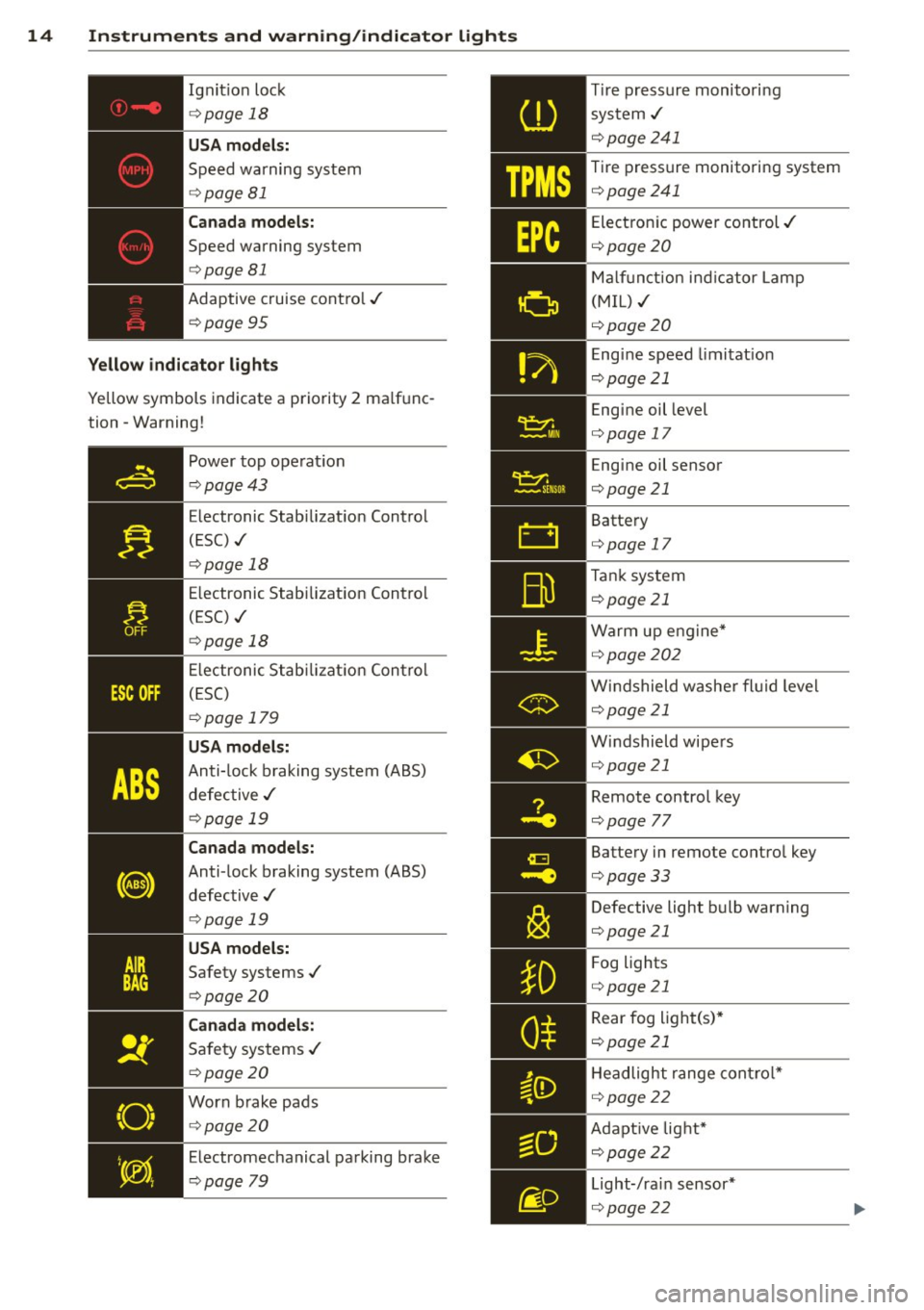
Yellow indicator lights
Yellow symbols indicate a priority 2 ma lf u nc
tion -Warning!
Power top ope rat ion
¢ page43
E lectronic Stab ilizat io n Cont rol
( E SC) ./
¢ page 18
E lectronic Stab ilizat ion Contro l
(ESC) ./
¢ page 18
E lectronic S tabiliz atio n Con trol
( E SC)
¢ page 179
USA models:
Anti-lock b raking system (A BS)
d efec tive ./
¢page 19
Canada models:
Anti-lock b raking system (ABS)
d efective ./
¢ page 19
USA models:
Safety systems ./
¢ page20
Canada models:
Safe ty sys tems ./
¢ page20
Worn brake pads
¢ page 20
E lectromechanical parking brake
¢ page
79
TPMS
Tir e pressur e monitori ng
sys tem ./
¢ page241
T ire pressure monitori ng system
¢ page 241
Ele ct ron ic powe r co ntrol ./
¢page20
Ma lf u n ct ion i nd ica tor Lam p
(M IL) ./
¢ page2 0
E ng ine speed limi tat ion
¢ page2 1
Eng ine oil level
¢page 17
E ng ine oil sensor
¢page21
Batte ry
¢ page 17
Tan k system
¢ page 21
Warm u p en gin e*
~ pa ge 202
Win dshield washe r flui d leve l
¢page 21
Win dshield wipe rs
¢ page 21
Remot e control key
¢ page
77
Batte ry in remote contro l key
¢page33
Defective light b ulb warn ing
¢page21
F og lig hts
¢ page 21
R ear fog ligh t(s) *
¢ page21
H ead ligh t range con trol *
¢ page22
A da ptive lig ht*
¢ page22
L ight-/ra in sensor*
¢ page 22
Page 17 of 286
Instruments and warning/indicator lights 15
Adaptive dampers*
¢page 22
Sport d ifferential*
¢ page 22
Ignit ion lock
¢ page 22
Steering co lumn lock
¢page 18
Electromechanical steering,
dynamic steering*./¢
page 184
Transmission
- mu ltitronic, tiptronic
¢ page 91
-S tronic ¢ page 91
Transmission
- S tronic
¢p age 91
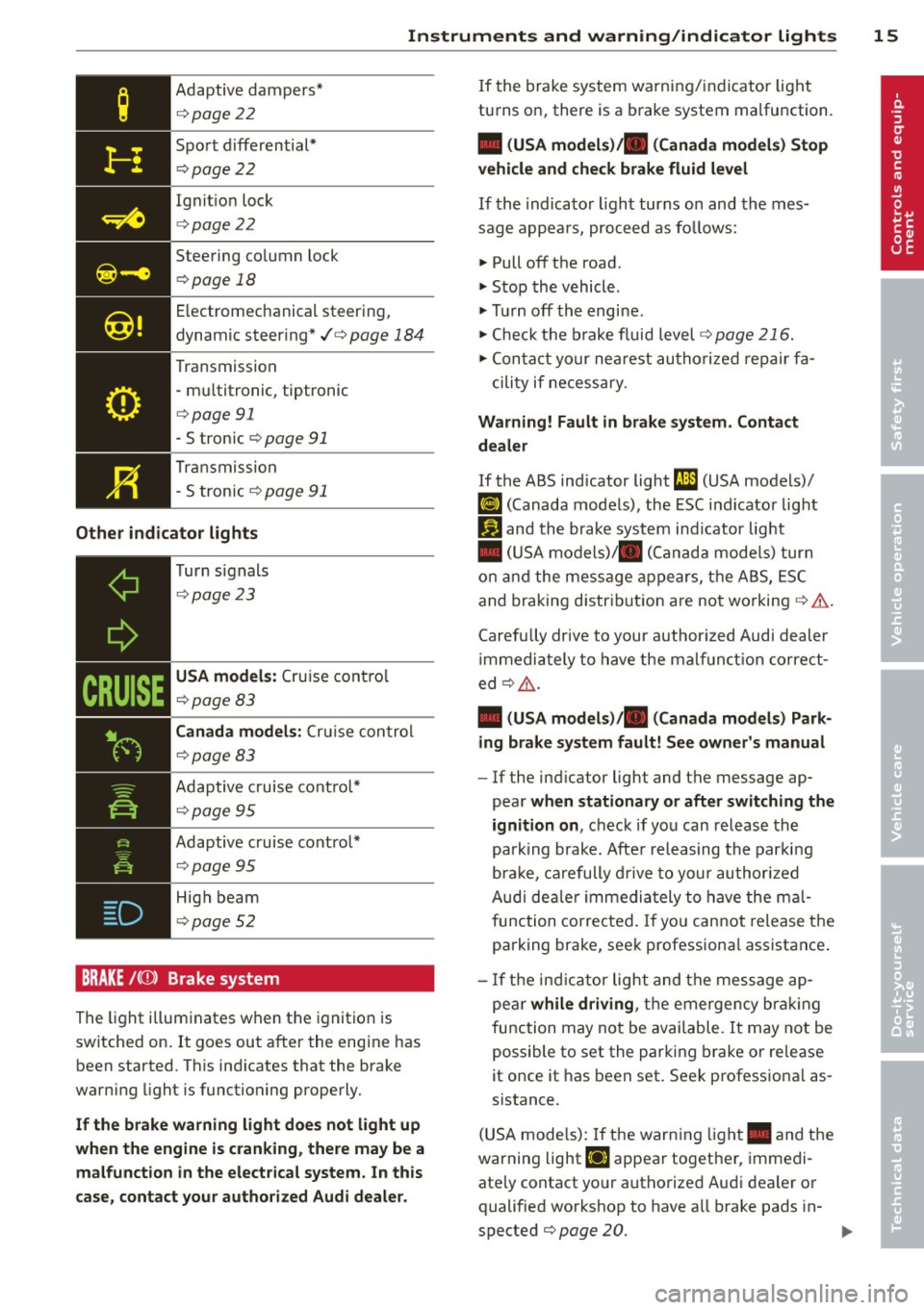
Other indicator lights
Turn signals
¢page 23
USA models: Cruise control
¢page 83
Canada models: Cruise control
¢page 83
Adaptive cruise control*
¢page 95
Adaptive cruise control*
¢pag e 95
High beam
¢page 52
BRAKE /((J)) Brake system
The light illuminates when the ignition is
switched on.
It goes out after the engine has
been started. Th is ind icates that the brake
warn ing light is functioning properly.
If the brake warning light does not light up
when the engine is cranking, there may be a
malfunction in the electrical system. In this
case, contact your authorized Audi dealer.
If the brake system warning/indicator light
turns on, there is a brake system malfunction.
• (USA models)/ . (Canada models) Stop
vehicle and check brake fluid level
If the indicator light turns on and the mes
sage appea rs, proceed as fo llows:
"' Pull off the road.
"' Stop the vehicle.
"' Turn off the engine .
"' Check the brake fluid level
¢page 216.
"' Contact your nearest authorized repair fa-
cility if necessary.
Warning! Fault in brake system. Contact
dealer
If the ABS indicator light m) (USA models)/
IIJ (Canada models), the ESC indicator light
GJ and the brake system ind icator light
• (USA models)/ . (Canada models) turn
on and the message appears, the ABS, ESC
and braking distribution are not working ¢& .
Carefu lly drive to your author ized Audi dealer
immediately to have the malfunction correct
ed
¢ ,6 .
• (USA models)/ . (Canada models) Park
ing brake system fault! See owner's manual
-If the ind icator light and the message ap-
pear
when stationary or after switching the
ignition on ,
check if you can release the
park ing brake . After releasing the parking
bra ke, carefully drive to your authorized
Audi dealer immediately to have the mal
function corrected. If yo u cannot release the
parking brake, seek professiona l assistance .
- If the indicator light and the message ap
pea r
while driving , the emergency brak ing
function may not be available. It may not be
possible to set the parking brake or release
it once it has been set. Seek professiona l as
sistance.
(USA mode ls) : If the warning light. and the
warning light
Ei] appear together, immedi
ate ly contact your authorized Audi dea ler or
qualified workshop to have a ll brake pads in-
spected
¢ page 20. .,.
Page 22 of 286

20 Instrum ent s a nd w arn in g/i ndic ato r light s
Contact your authorized Audi dealer as
soon as possible.
- USA models: If the . warning light and
the
rJl1 warning light come on together,
the rear wheels could lock up first under
hard braking. Rear wheel lock-up can
cause loss of vehicle control and an acci
dent . Have your vehicle repaired immed i
ately by your authorized Audi dealer or
qualified workshop. Dr ive slowly and
avo id sudden, hard brake applicat ions.
- Canada models: If the brake warn ing
light . and the ABS warning light
[IJ
come on together, the rear wheels could
lock up first under hard braking. Rear
wheel lock-up can cause loss of vehicle
control and an acc ident. Have your vehi
cle repaired immediately by your author
ized Audi dealer or qualified workshop.
Drive slowly and avoid sudden, hard
brake applicat ions.
~ /!J.' Safety systems
The fl (USA models)/ E,I (Canada models) in
d icator light monitors the safety systems (e .g.
a ir bags, pretensioners) and ill uminates for a
few seconds each time you switch the ignition
on.
I f the
fl (USA mode ls)/ E,I (Canada models)
i ndi cato r light does not go out, or if it illumi
nates wh ile you are driv ing, or if it sta rts to
blink, then there is a ma lfunction somewhere
in the system.
If the light does not illuminate
when you switch the ignition on, this also means there is a malfunction.
A WARNING
If you have a malfunction in the safety sys
tems, contact your author ized Audi dealer
immediately. Otherw ise the safety sys
tems may not work properly in an acci
dent.
l) .: USA mode ls on ly
(0) Worn brake pads
llJ Br ake pad s!
If the warning light illuminates, immed iately
contact your authorized Audi dealer or quali
fied workshop to have all brake pads inspect ed . On USA models the warn ing light
llJ
comes on together with the warning light •.
Both sets of brake pads on an axle must al
ways be replaced at the same time.
A WARNING
Driving with bad brakes can cause a colli
sion and serious personal injury.
- If the warning light
llJ and the warning
light
. 1) with the message Brake pads!
comes on in the instrument cluster dis
play, immediately contact your author
ized Audi dealer or qualified workshop to
have all brake pads checked or replaced if
necessary.
EPC Electronic power control
This warning/indicator light monitors the
electronic power control.
The l3i warn ing/ indicator light (Electron ic
Power Control) illuminates when you sw itch
the ignit ion on as a function check.
(D Tips
If this warning/ indicator light illum inates
while you are driving, then there is a mal
funct ion in the engine electronics. Have
the malfunct ion corrected as soon as pos
s ible by your authorized Audi dealer or a
qualified repa ir facility.
Ci Malfunction Indicator Lamp (MIL)
T he Ma lfun ction Indicator Lamp (MIL) is par t
of the On-Board Diagnostic (OBD II) system.
-
The symbo l ('4 lights up when the ignition is
switched on and will turn off after the engine
has started and has settled at a constant idle
IJ>,
Page 184 of 286

182 Intelligent technology
Sport mode on ESC/ASR off Sport mode off or
ESC/ASR on
Behav ior
The ESC and ASR stabiliza- The stabilization function The full stabilization func-
tion functions are limited is not ava ilable
c> .&. . ESC tion of the ESC and ASR is
¢ _&.. and ASR are sw itched off. available again.
Operation Press the l.i; OFF ! button P ress and hold the 1.i; OFFI Press the l.i; OFF ! button
briefly. button
longer than 3 sec-
again.
onds.
Indicator II turns on. II and Ill turn on. II turns off or II and II
lights tur n off.
Driver mes- Stabilization control Stabilization control Stabilization control
sages (ESC): Sport. Warning! (ESC): off. Warning! Re- (ESC): On
Restricted stability stricted stability
It is only possible to turn off the ASR up to 30
mph (SO km/h) for vehicles with front wheel
drive . At about
45 mph (70 km/h) it automat i
cally turns on aga in . It is poss ible to turn off
the ASR at any speed for veh icles with all
wheel dr ive.
.&, WARNING
Yo u should only switch sport mode on or
switch ESC/ASR off if your driving abilities
and road conditions permit.
- The stabilization function is limited
when sport mode is switched on. The
driving whee ls cou ld spin and the vehicle
cou ld swerve, especially on slick or slip
pery road surfaces.
- There is no vehicle stabilization when
ESC/ASR are switched off.
(D Tips
ESC/ASR cannot be switched off or sport
mode cannot be switched on when adap
tive cruise control* is switched on.
Braking
What affects braking efficiency?
New brake pads
During the first 250 miles (400 km), new
brake pads do not possess their fu ll braking
effect, they have to be "broken in" first
c> .&. .
You can compensate for this slightly reduced
braking power by push ing harder on the brake pedal. Avoid heavy brak
ing loads dur ing the
break -in period.
Operating conditions and driving habits
The brakes on today's automobiles are still
subject to wear, depending largely on operat
ing condit ions and driving hab its
c> .&. . On
vehicles that are either driven mostly in stop and-go city traff ic or are dr iven hard, the
brake pads should be checked by your author
ized Audi dea ler more often than specified in
the
Warranty & Maintenance booklet. Failure
to have you r brake pads inspected can result
in reduced brake performance.
On steep slopes, you should use the braking
effect of the engine . This way, you prevent un
necessary wear on the brake system.
If you
must use your brakes, do not hold the brakes
down continuous ly . Pump the brakes at inter
vals.
Operating noise
Noises may occur when braking depending on
the speed, b rak ing force and outside cond i
t ions such as temperature and humidity .
Effect of water and road salt
In certain situations, for example after driv in g
t hr ough water, in heavy rain, after overnight
condensation or after washing you r car, the
braking effec t can be reduced by mois ture or
ice on the brake rotors and brake pads. The
brakes must be dried first with a few careful
brake applications .
Page 185 of 286
At higher speeds and with the windshield wip
ers turned on, the brake pads press against
the brake rotors for a short amount of time.
This occurs at regular intervals without the
driver noticing and provides for better brake
response time under wet conditions.
The effectiveness of the brakes can be reduced
when the vehicle is dr iven on a salt-covered
road and the brakes are not used . Likewise,
you clean
off accumulated sa lt coating from
brake discs and pads with a few cautious ap
plications of the brake~&. .
Cor ro sion
There may be a tendency for dirt to build up
on the brake pads and corrosion to form on
the discs if the car is not dr iven regularly or
only for short trips with little use of the
brakes .
If the brakes are not used frequently, or if cor
rosion has formed on the discs, it is advisable
to clean
off the pads and discs by brak ing
firm ly a few times from a moderately h igh
speed
¢ .Li). .
Fa ults in the brake system
If you should notice a sudden increase in
brake pedal travel, then one of the two brake
circu its may have failed~&,. .
Low brake flu id le vel
Malfunct ions can occur in the brake system if
the brake fluid level is too low . T he brake fluid
level is monitored electronically .
Brake boo ste r
The brake booster increases the pressure th at
you generate w ith the bra ke pedal. It works
only when the engine is running
. ¢ &.
Brake lining w ear statu s
Brake lining wea r may be c hecked by vis ual in
spection of the condition of the brake pads
through the openings in the whee l. If neces
sary, the whee l may be removed for this in
spection
¢ page 244, Changing a wheel.
Int ellig ent technolog y 183
A WARNING
-New brake pads don't have the best stop
ping power and must be "b roken-in" dur
ing the initial 100 to 150 miles (150 to
200 kilometers) of normal c ity dr iving .
You can compensate for this by pressing the brake pedal more firmly. This also
applies la ter when new pads are instal
led.
- You should perform braking m aneuvers
for the purpose of cleaning the brake
system only if road conditions permit .
Other road users must not be put at risk -
you may ca use an accident!
- Before descend ing a steep grade, reduce
speed and sh ift transmission into a lower
gea r or lower dr iving range. Do not ride
the brakes or hold the pedal down too
long or too often . Th is could cause the
brakes to get hot and diminish braking
efficiency.
- Do not "ride the brakes" by rest ing your
foot on the pedal when you do not intend
to b rake. This may cause the brakes to
overheat, p remature wear and increased
s topping distance.
- Unde r ce rtain cl imatic and ope rat ing
conditions such as passing thro ugh wa
ter, dr iv ing in heavy rain o r after washing
the vehicle, the effectiveness of the
brakes can be reduced. In winter, ice can
accumu late on the brake pads, linings,
discs and drums. Carefully app ly brakes
for a test. Brakes w ill dry and ice coat
ings w ill be cleaned
off after a few care
fu l brake applicat ions .
- Driving for an extended period of time o n
salt-cove red roads without using your
brakes can a lso affect braking efficiency.
C lean
off accum ulated salt coa ting from
bra ke disc s and pad s wi th a few ca reful
bra ke applica tions.
- If you damage the front spoiler, or if you
install a diffe rent spoiler, be sure the air
f low to the front brakes is not obstruct
ed . Otherw ise the bra ke system could
•
•
Page 190 of 286

188 Driving and en vironm ent
8_ WARNING
After driving through water, mud, slush,
etc ., the brakes may be slow to take effect
because of wet brake rotors and pads . Dry
the brakes first by braking carefully to re
store the full braking effect.
(D Note
Vehicle components such as the engine,
transmiss ion, suspension or electrical sys
tem can be severely damaged by driving
through wate r.
@ Tips
- Check the depth of the water before dr iv
i ng through it .
- Do not stop the veh icle, dr ive in reverse
or switc h the engine off when driving
t hr ough water .
- Keep in mind that oncoming vehicles
may c reate waves that raise the water
l evel and make it too deep fo r you r vehi
cle to dr ive through safely.
-
- Avoid dr iving thro ugh salt water because
i t can ca use corrosion.
Catalytic converter
It is very important that your emission con
trol system (catalytic conv ert er) is function
ing properly to ensure that your vehicle is run
ning in on env ironm entally sound manner.
,,. Always use lead-free gaso line Q page 201,
Fuel supply .
,,. Never run the tank down a ll th e way to emp
ty.
,,. Never put too much moto r oil in your engine
Q page 211 , ~ Adding engine oil .
,,. Never try to push -or tow -start your ve hicle .
T he cata lytic converter is an eff ic ient "clean
up" device built in to the exhaust system of
the vehicle . The catalytic converter burns
many of the polluta nts in the exhaust gas be
fore they are released into the atmosphe re . The exclus
ive use of unleaded f uel is critica lly
important for the life of the catalytic conv ert
er and p roper funct ion ing of the eng ine .
A WARNING
=
-The temperature of the exhaust system
is high, both when driving and after stop
p ing the eng ine .
- Never touch the exhaust tail pipes once
they have become hot. This could result
in burns.
- Do not park or operate the vehicle i n
areas where the hot exhaust system may
come in co ntact with dry grass, brush,
fue l spill or other material wh ich can
cause a fire .
- Do not app ly additional undercoating or
r u stp roofing on or nea r the exhaust
manifold, exhaust pipes, cataly tic con
ver ter or he at s hields. Dur ing driv ing, the
substance used fo r undercoating could
overheat and cause a fire.
CI) Note
- Be aware tha t just o ne tank filling with
leaded fu el w ill alre ady ser io usly de
grade the performance of the cata lytic
converter .
- Do not exceed the cor rect engine oil level
Q poge 211.
-Do not drive until the fuel t ank becomes
comple tely empty . The engine cou ld mis
fire . Unburned fuel could also get into
the exhaust system and th is co uld cause
the catalytic converter to overheat.
- Do not turn off the ignition while the ve
hicle is mov ing.
- Do not contin ue to ope rate your veh icle
under these conditions, as otherwise fuel
can reach the catalyt ic converter. Th is
co uld result in overheating of the con
verter, requir ing its replacement.
- To assure efficient operation of the Emis -
sion Control System: .,..
Page 218 of 286
216 Checking and filling
Brake fluid
Checking brake fluid level
The brake fluid level can be checked with a
quick glance .
N N ~ N
" (X) (0
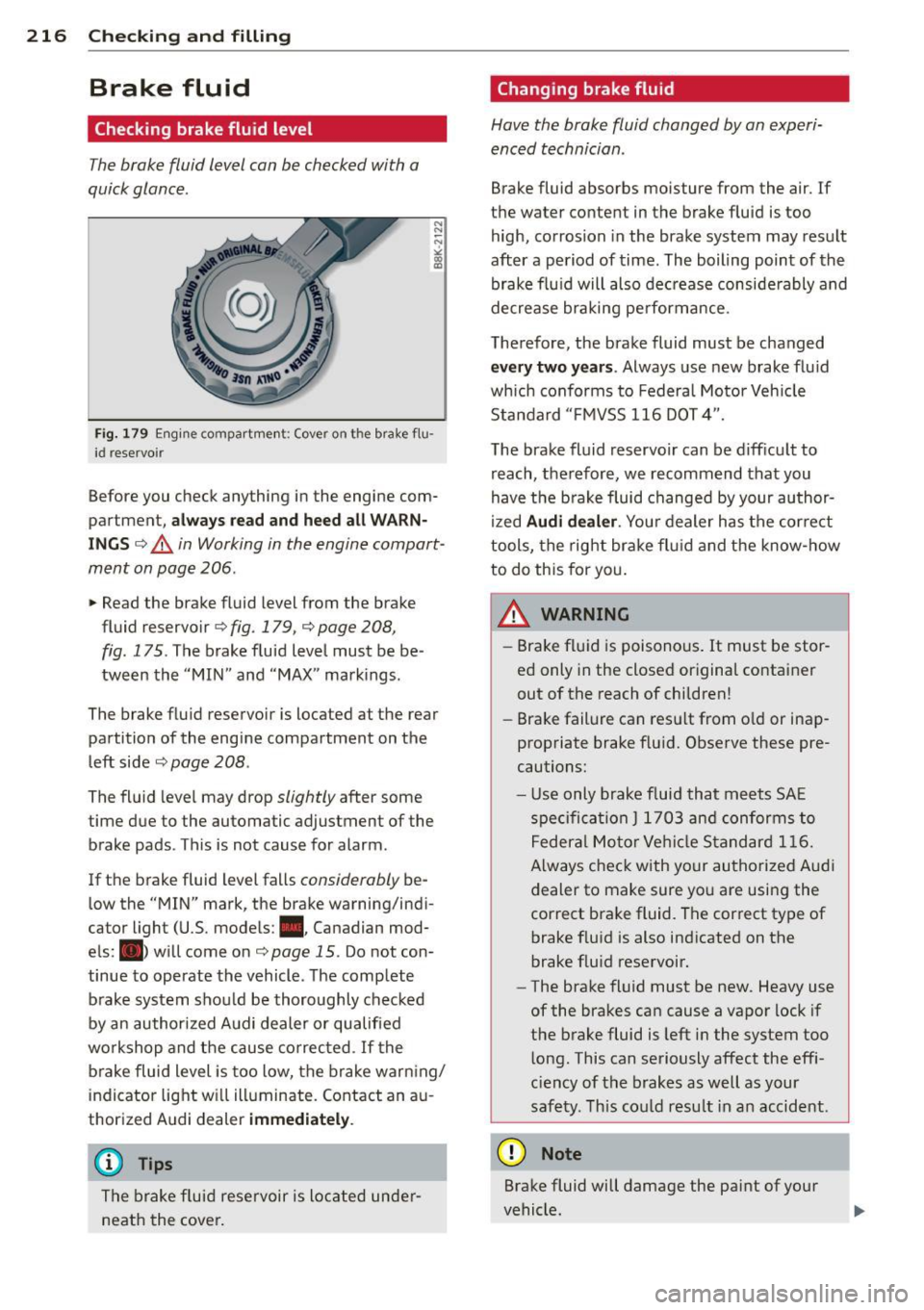
Fig. 179 Engine compartme nt: Cover on the brake flu ·
id reservo ir
Before you check anything in the engine com
partment,
always read and heed all WARN·
INGS ¢ .&._ in Working in the engine compart
ment on page 206 .
.. Read the brake fluid level from the brake
fluid reservoir ¢
fig. 179 , ¢ page 208,
fig. 175.
The brake fluid level must be be ·
tween the "MIN" and
"MAX" markings.
The brake fluid reservoir is located at the rear
partition of the engine compartment on the
left side ¢
page 208 .
The fluid level may drop slightly after some
time due to the automatic adjustment of the
brake pads . This is not cause for alarm.
If the brake fluid level falls
considerably be
low the "MIN" mark, the brake warning/indi
cator light (U.S. models: ., Canadian mod
els: .) will come on¢
page 15. Do not con
tinue to operate the vehicle . The complete
brake system should be thoroughly checked
by an authorized Audi dealer or qualified
workshop and the cause corrected.
If the
brake fluid level is too low, the brake warning/
indicator light will illuminate. Contact an au
thorized Audi dealer
immediately .
@ Tips
The brake fluid reservoir is located under
neath the cover.
Changing brake fluid
Have the brake fluid changed by an experi
enced technician .
Brake fluid absorbs moisture from the air. If
t he water content in the brake fluid is too
high, corrosion in the brake system may result
after a period of time . The boiling point of the
brake fluid will also decrease considerably and
decrease braking performance.
Therefore, the brake fluid must be changed
every two years . Always use new brake fluid
which conforms to Federal Motor Vehicle
Standard "FMVSS 116 DOT 4".
The brake fluid reservoir can be difficult to reach, therefore, we recommend that you
have the brake fluid changed by your author
ized
Audi dealer. Your dealer has the correct
tools, the right brake fluid and the know-how
to do this for you .
A WARNING
- Brake fluid is poisonous. It must be stor
ed only in the closed original container
out of the reach of children!
- Brake failure can result from old or inap
propriate brake fluid. Observe these pre
cautions:
- Use only brake fluid that meets SAE
specification
J 1703 and conforms to
Federal Motor Vehicle Standard 116.
Always check with your authorized Audi
dealer to make sure you are using the
correct brake fluid. The correct type of
brake fluid is also indicated on the
brake fluid reservoir.
- The brake fluid must be new. Heavy use
of the brakes can cause a vapor lock if
the brake fluid is left in the system too
long . This can seriously affect the effi
ciency of the brakes as well as your
safety. This could result in an accident.
(D Note
Brake fluid will damage the paint of your
vehicle.
Page 272 of 286
270 Index
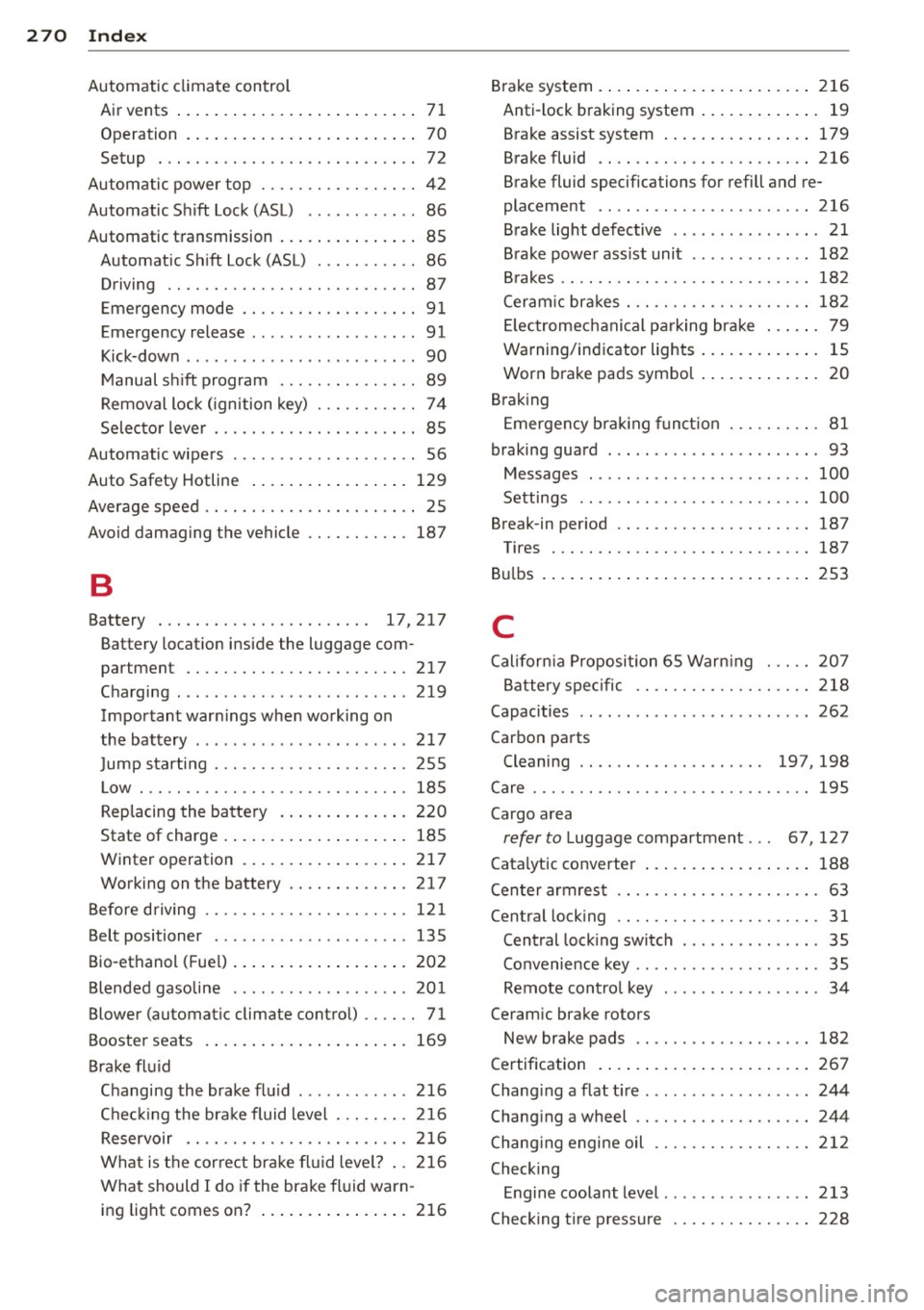
Automatic climate control Air vents ... ............... .. .... ..
71
Operation . . . . . . . . . . . . . . . . . . . . . . . . . 70
Setup . .. ............... .. .. .... .. 72
Automatic power top ................. 42
Automatic Shift Lock (ASL) . . . . . . . . . . . .
86
Automatic transm ission . . . . . . . . . . . . . . . 85
Automatic Shift Lock (ASL) . . . . . . . . . . . 86
Driving .. .. ............. .. .. .. ... . 87
Emergency mode . . . . . . . . . . . . . . . . . . . 91
Emergency release . . . . . . . . . . . . . . . . . . 91
Kick-down . . . . . . . . . . . . . . . . . . . . . . . . . 90
Manual shift program ..... .. .. .. .. . . 89
Removal lock (ignition key) ... .. .. .. . . 74
Selector lever . . . . . . . . . . . . . . . . . . . . . .
85
Automatic wipers . . . . . . . . . . . . . . . . . . . . 56
Auto Safety Hotline ............ .... . 129
Average speed . . . . . . . . . . . . . . . . . . . . . . . 25
Avoid damaging the vehicle . . . . . . . . . . . 187
B
Battery . . . . . . . . . . . . . . . . . . . . . . . 17,217
Battery locat ion inside the luggage com-
partment ................. .. .... .
217
Charging ... .................. ... . 219
Important warn ings when working on
the battery . . . . . . . . . . . . . . . . . . . . . . .
217
Jump starting .............. .. .. .. . 255
Low . .. .. .. ... .......... .. .. .. .. . 185
Replacing the battery ........... .. . 220
State of charge ............ ... .... .
185
Winter operation .......... ... .... . 217
Working on the battery ............. 217
Before driving ............. .. .. .. .. . 121
Belt positioner .. .. ..... ..... .. .. .. . 135
Bio-ethanol (Fue l) ............ .. .... . 202
Blended gasoline .......... .. .. .. .. . 201
Blower (automatic climate control) . . . . . . 71
Booster seats .............. ... .... . 169
Brake fluid
Changing the brake fluid ........ ....
216
Check ing the brake fluid level . .. ..... 216
Reservoir .... ........... .. .. .. .. . 216
What is the correct brake fluid leve l? .. 216
What should I do if the brake fluid warn-
ing light comes on? ........ ..... .. .
216
Brake system .... .. ............. .... 216
Anti- lock braking system ............. 19
Brake assist system ................ 179
Brake fluid .... .. ............. .... 216
Brake fluid specifications for refill and re-
placement ...... ................ .
216
Brake light defective . . . . . . . . . . . . . . . . 21
Brake power assist unit ............. 182
Brakes .. .. .. .. . .............. .. .. 182
Ceramic brakes . .. ... .......... .. .. 182
Electromechanical parking brake ...... 79
Warning/indicator lights .......... .. . 15
Worn brake pads symbol . . . . . . . . . . . . . 20
Braking
Emerg ency braking funct ion ... .. .. .. .
81
braking guard . . . . . . . . . . . . . . . . . . . . . . . 93
Messages ........ ............... . 100
Settings ........ .. .............. . 100
Break-in period . . . . . . . . . . . . . . . . . . . . . 187
Tires . .. .. .. .. .. ............. .. .. 187
Bu lbs ..... ..... .. ............. .... 253
C
Californ ia Proposition 65 Warn ing . .... 207
Batte ry specific .. ... .......... .. .. 218
Capac1t1es ........ .. .............. . 262
Carbon parts
Cleaning . . . . . . . . . . . . . . . . . . . .
197,198
Care ... .. .. .. .. .. ............. .. .. 195
Cargo area
refer to Luggage compartment. .. 67, 127
Catalytic converter ................. . 188
Center armrest . . . . . . . . . . . . . . . . . . . . . . 63
Central locking ...................... 31
Central locking switch ............... 35
Convenience key .. .. ..... ........ .. . 35
Remote control key . . . . . . . . . . . . . . . . . 34
Ceramic brake rotors New brake pads .. ............. ....
182
Certification . ..... ................. 267
Changi ng a flat tire ................. . 244
Changing a wheel .. ............. .... 244
Changi ng engine oil ............. ....
212
Checking
Engine coolant level ................
213
Checking tire pressure ........... .... 228