fold seats AUDI A5 CABRIOLET 2014 Owners Manual
[x] Cancel search | Manufacturer: AUDI, Model Year: 2014, Model line: A5 CABRIOLET, Model: AUDI A5 CABRIOLET 2014Pages: 286, PDF Size: 70.4 MB
Page 64 of 286
62 Seats and storage
Power easy entry function
Applies to vehicles: with power adjustable seats
The easy entry function makes it easier for
the rear passengers to enter and leave the ve
hicle.
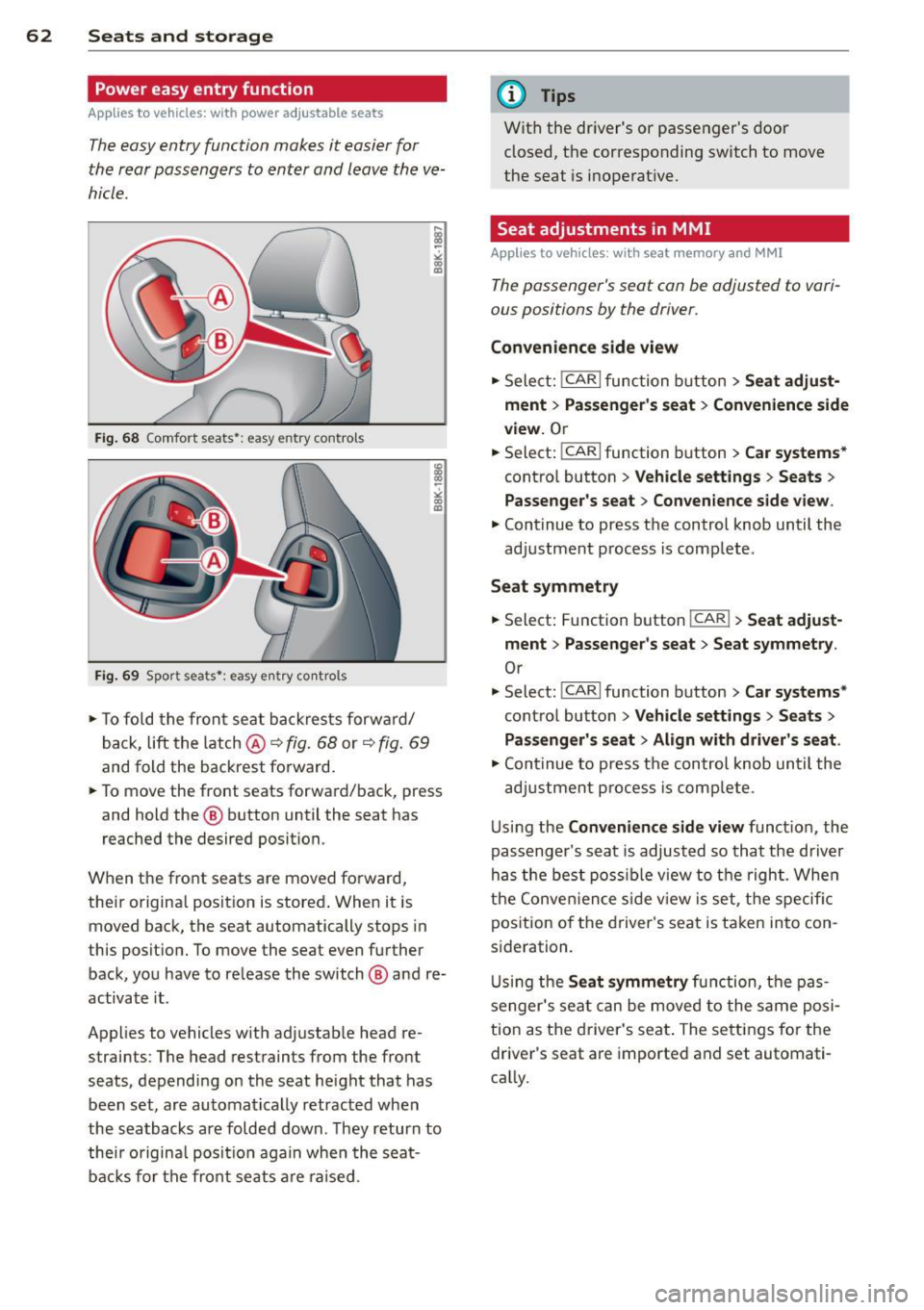
Fig. 68 Comfort seat s•: easy entry contro ls
Fi g. 69 Spor t sea ts•: easy e ntry co ntrols
• To fold the front seat backrests forward/
back,
lift the latch @¢ fig. 68 or¢ fig. 69
and fold the backrest forward.
• To move the front seats forward/back, press
and hold the @ button until the seat has
reached the desired position.
When the front seats are moved forward,
their origina l position is stored . When it is
moved back, the seat automatically stops in
this position. To move the seat even further
back, you have to release the switch @ and re
activate it .
Applies to vehicles w ith adjustab le head re
straints : The head restraints from the front
seats, depending on the seat height that has
been set, are automat ically retracted when
the seatbacks are folded down . They return to
the ir original position again when the seat
backs for the front seats are raised .
(D Tips
With the driver's or passenger's door
closed, the corresponding switch to move
the seat is inoperat ive.
Seat adjustments in MMI
Appl ies to vehicles: with seat memory and MMI
The passenger 's seat can be adjusted to vari
ous positions by the driver.
Convenience side view
• Select: !CAR I function button > Seat adjust
ment > Passenger's seat > Convenience side
view.
O r
- -• Select: I CAR I function button > Car systems*
control button > Vehicle settings > Seats >
Passenger's seat > Convenience side view.
• Continue to press the control knob until the
adjustment process is complete.
Seat symmetry
• Select: Function button !CAR !> Seat adjust
ment > Passenger's seat > Seat symmetry.
Or
• Select: !CARI function button> Car systems*
control button > Vehicle settings > Seats >
Passenger's seat> Align with driver's seat.
• Continue to press the control knob until the
adjustment process is comp lete.
U sing the
Convenience side view function, the
passenger's seat is adjusted so that the driver
has the best possible view to the right. Whe n
the Convenience side view is set, the specific
position of the driver's seat is taken into con
sideration .
Using the
Seat symmetry function, the pas
senger's seat can be moved to the same posi
tion as the driver's seat. The settings for the
driver's seat are imported and set automati
ca lly.
Page 65 of 286
Center armrest
The center armrest can be adjusted to several
levels .
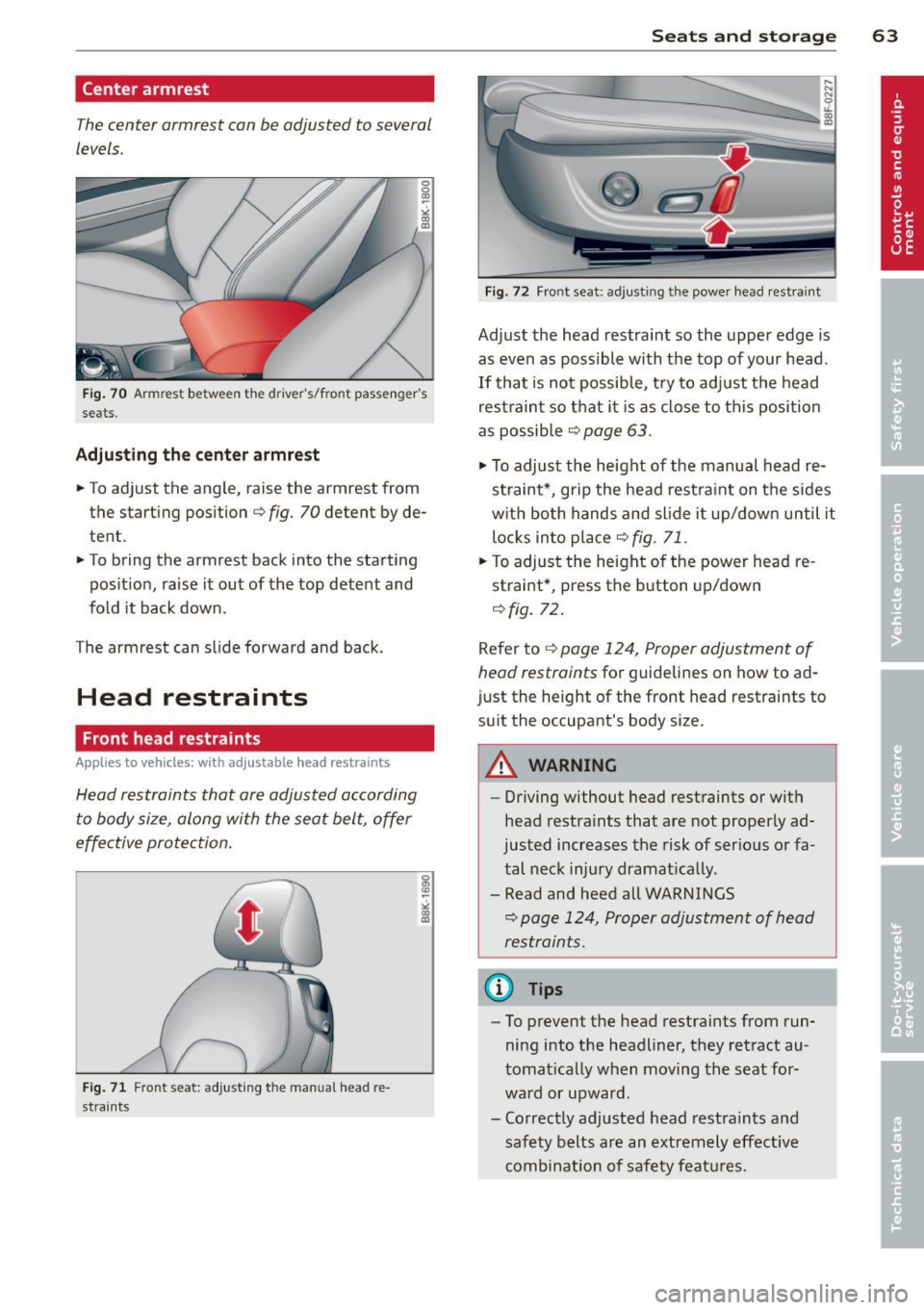
Fig. 70 Arm rest between t he driver 's/front passenger's
seats .
Adjusting the center armrest
.. To adjust the angle, raise the armrest from
the starting position
r=:> fig. 70 detent by de
tent .
.. To bring the armrest back into the starting
pos ition, raise it out of the top detent and
fold it back down .
The armrest can slide forward and back .
Head restraints
Front head restraints
Applies to vehicles: with ad justable head restraints
Head restraints that are adjusted according
to body size, along with the seat belt, offer
effective protection.
F ig . 71 Fro nt seat: adjusting the man ual head re
st raint s
Seats and storage 63
Fig. 72 Front seat: adjusting the power head restraint
Adjust the head restraint so the upper edge is
as even as possible with the top of your head .
If that is not possib le, t ry to adjust the head
restraint so that it is as close to this position
as possible
r=:> page 63 .
.,. To adjust the height of the manual head re
straint*, grip the head restraint on the sides
with both hands and slide it up/down until it
locks into pla cer=:>
fig. 71 .
.. To adjust the height of the power head re
straint *, press the button up/down
<=:> fig. 72.
Refer tor=:> page 124, Proper adjustment of
head restraints
for guidelines on how to ad
j ust the height of the front head restraints to
suit the occupant 's body size.
A WARNING
-Driving without head restraints or with
head restraints that are not properly ad
justed increases the risk of serious or fa
tal neck injury dramatica lly.
- Read and heed all WARNINGS
<=:> page 124, Proper adjustment of head
restraints .
@ Tips
-To prevent the head restraints from run
ning into the headliner, they retract au
tomatically when moving the seat for
ward or upward .
- Correctly adjusted head restraints and
safety belts are an extremely effective
combination of safety featu res.
Page 69 of 286
Luggage compartment
General information
A WARNING
Read and follow the important safety pre
cautions on
<=> page 12 7, Stowing lug
gage.
Enlarging the luggage compartment
The backrests can be folded forward either
separately or together .
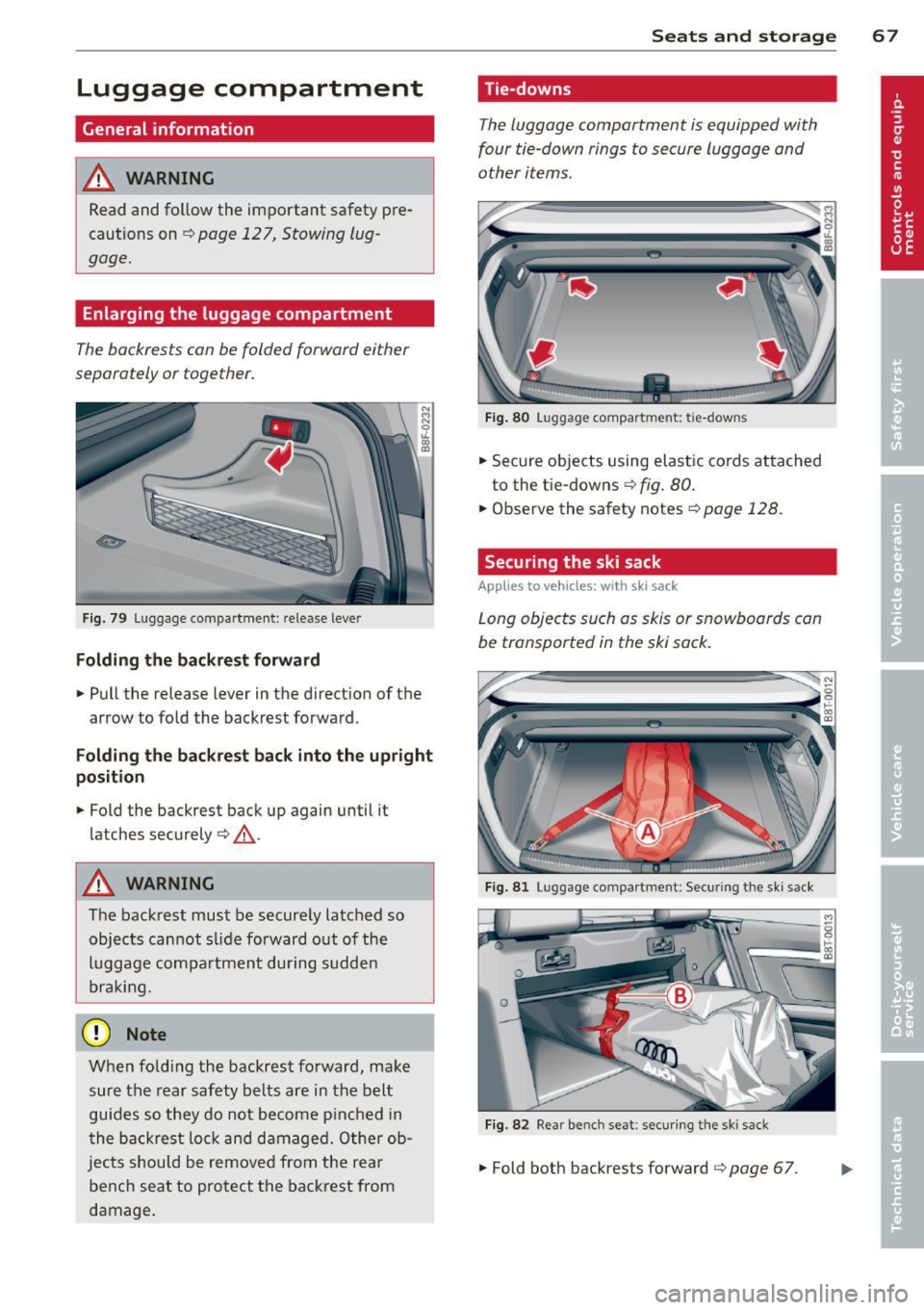
Fig. 79 Luggage compartment: release lever
Folding the backrest forward
• Pull the release lever in the direction of the
arrow to fold the backrest forward.
Folding the backrest back into the upright
position
• Fold the backrest back up again until it
latches securely <=>&_ .
A WARNING
The backrest must be securely latched so
objects cannot slide forward out of the
luggage compartment du ring sudden
braking.
(D Note
When folding the backrest forward, make
sure the rear safety belts are in the belt
guides so they do not become p inched in
the backrest lock and damaged. Other ob
jects should be removed from the rear bench seat to protect the backrest from
damage.
Seats and storage 67
Tie-downs
The luggage compartment is equipped with
four tie-down rings to secure luggage and
other items.
Fig. 80 Luggage compartment : tie-down s
• Secure objects using elast ic cords attached
to the t ie-downs
<=> fig. 80.
• Observe the safety notes <=> page 128.
Securing the ski sack
App lies to vehicles: wi th ski sack
Long objects such as skis or snowboards can
be transported in the ski sock.
Fig. 81 Luggage compartment: Secur ing the ski sack
Fig. 82 Rea r bench seat: securing the sk i sack
• Fold both backrests forward q page 67 .
Page 70 of 286
68 Seats and storage
• Slide the ski sack from the luggage com
partment through the opening¢
A with
the zipper at the rear.
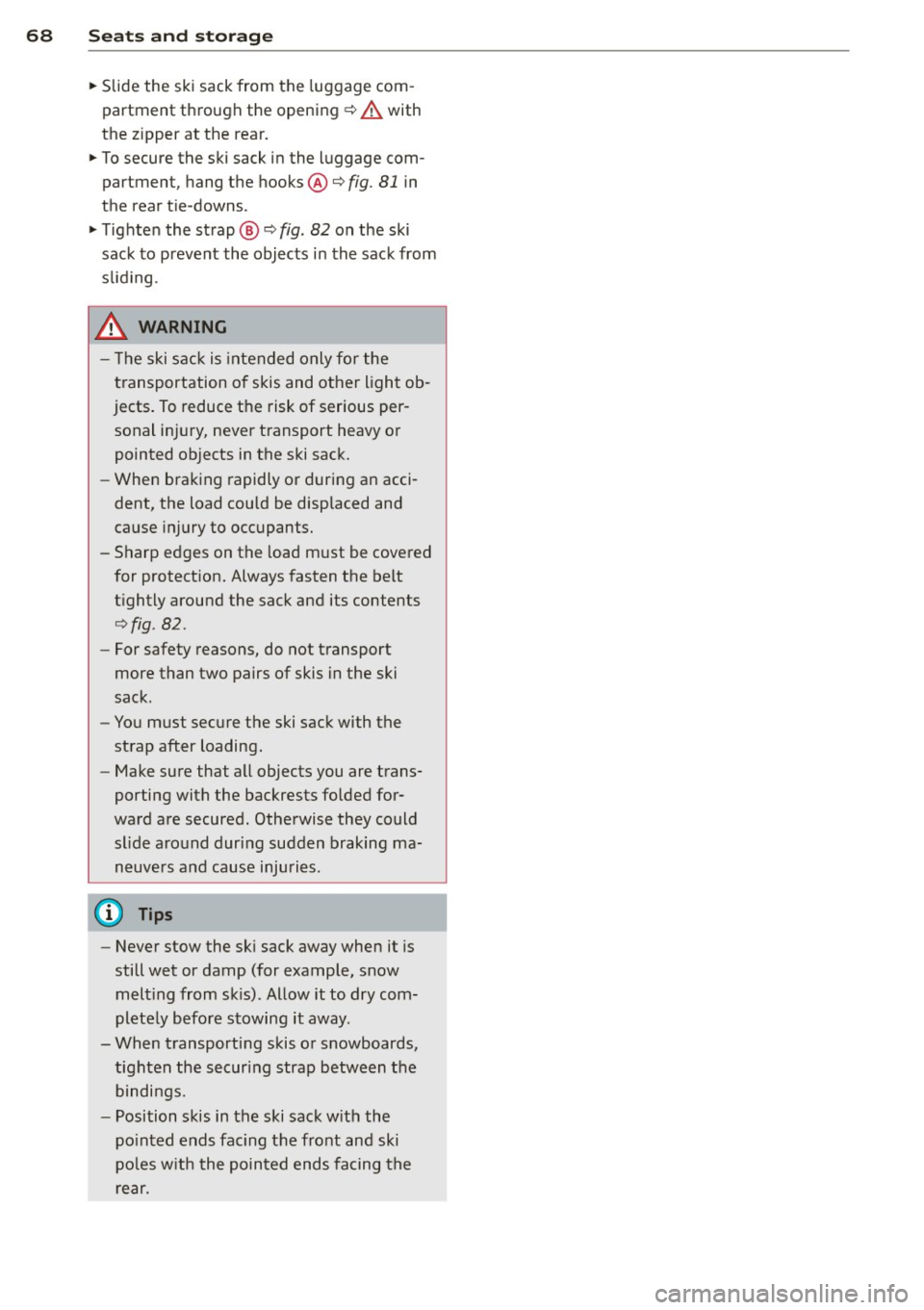
• To secu re the ski sack in the luggage com
partment, hang the hooks@¢
fig. 81 in
the rear tie -downs .
• Tighten the strap®¢
fig. 82 on the ski
sack to prevent the objects in the sack from
sliding .
& WARNING
-
- The ski sack is intended only for the
transportation of skis and other light ob
jects. To reduce the risk of serious per
sonal injury, never transport heavy or
pointed objects in the ski sack.
- When braking rapidly or during an acci
dent, the load could be displaced and
cause injury to occupants.
- Sharp edges on the load must be covered
for protection. Always fasten the belt
tightly around the sack and its contents
¢ fig . 82 .
-For safety reasons, do not transport
more than two pairs of skis in the ski
sack .
- You must secure the ski sack with the
strap after loading.
- Make sure that all objects you are trans
porting with the backrests folded for
ward are secured. Otherwise they could slide around during sudden braking ma
neuvers and cause injuries.
(i) Tips
- Never stow the ski sack away when it is
still wet or damp (for example, snow melting from skis) . Allow it to dry com
pletely before stowing it away .
- When transporting skis or snowboards, tighten the securing strap between the
bindings.
- Position skis in the ski sack with the
pointed ends facing the front and ski
poles with the pointed ends facing the
rear.
Page 125 of 286
~ Always keep both feet in the footwell so
that you are in control of the vehicle at all
times .
F or detai led information on how to adjust the
driver's seat, see
c:;, page 61.
A WARNING
Drivers who are unbelted, out of position
or too close to the airbag can be ser iously
injured by an airbag as it unfolds. To help
reduce the risk of serious personal injury :
- Always adjust the dr iver's seat and the
steering wheel so that there are at least
10 inches (25 cm) between your breast
bone and the steering wheel.
- Always hold the steering wheel o n the
outside of the steering wheel rim with
your hands at the 9 o'clock and 3 o'clock posit ions to he lp red uce the risk of pe r
sonal in jury if the drive r's airbag inflates.
- Never hold the steer ing whee l at the
1 2 o'clock posit ion or w it h your hands at
other pos it ions inside the steering wheel
rim or on the stee ring wheel h ub. Hold
ing the steering wheel the wrong way
can cause serious injuries to the hands,
arms and head i f the driver 's airbag de
ploys.
- Pointing the steering whee l toward your
face decreases the ab ility o f the supp le
menta l dr iver's airbag to protect you in a
co llision.
- Always s it in an upright position and nev
er lean against or place any part of your
body too close to the a rea where the air
bags are located.
- Before driv ing, a lways ad just the front
seats and head restra ints prope rly and
make s ure that all passengers are prop
er ly restrained.
- Never adjust the seats while the vehicle
is moving . Your seat may move unexpect
edly and you could lose control of the ve
hicle.
- Never drive with the backrest recl ined o r
t il ted far ba ck! T he farther the ba ck rests
are t ilted back, the greate r the ris k of in-
Dr iving S afel y 123
jury due to incorrect pos itioning of the
safety belt and improper seating posi
tion.
- Ch ildren must a lways ride in ch ild safety
seats
c:;, page 161. Special precaut ions
apply when installing a child safety seat
on the front passenger seat
c:;, page 140.
Proper seating position for the front
passenger
The proper front passenger seating position
is important for safe, relaxed driving.
For your own safety and to reduce the risk of
injury in the event of an accident, we recom
mend that you adjust the seat for the front
passenger to the following position:
~ Move the front passenger seat back as far as
possible . There must be a m inimum of
1 0 i nches (25 cm) between the breastbone
and the ins trument panel
c:;, &, .
~ Adjust t he a ngle of the seatbac k so that it is
in an upr igh t position and yo ur ba ck comes
in full contact wit h it whenever the vehicle is
moving.
~ Applies to vehicles with adjustab le head re
straints: Adjust the head restraint so the up
per edge is as even as possible wit h the top
of your head. If that is not possib le, try to
adjust the head restraint so that it is as
close to this pos it ion as poss ible.
~ Keep both feet flat on the floor in front of
t he fron t passenger seat .
~ Fasten and we ar safe ty be lts cor re ctly
c:;, page 135.
For detailed information on how to adj ust the
fron t passenger's seat, see
c:;, page 60.
A WARNING
-
Front seat passengers w ho are un belted,
out of posi tion or too close to the airbag
can be ser iously injured or killed by the air
bag as it unfolds. To help reduce the risk of
serious personal injury:
•
•
Page 126 of 286
124 Driving Safely
-Passengers must always sit in an upright
position and never lean against or place
any part of their body too close to the
area where the airbags are located.
- Passengers who are unbelted, out of po
sition or too close to the airbag can be
seriously injured by an airbag as it un
folds with great force in the blink of an
eye.
- Always make sure that there are at least
10 inches (25 cm) between the front
passenger's breastbone and the instru
ment panel.
- Each passenger must always sit on a seat
of their own and properly fasten and
wear the safety belt belonging to that
seat.
- Before driving, always adjust the front
passenger seat and head restraint prop
erly.
- Always keep your feet on the floor in
front of the seat. Never rest them on the
seat, instrument panel, out of the win
dow, etc. The airbag system and safety
belt will not be able to protect you prop
erly and can even increase the risk of in
jury in a crash.
- Never drive with the backrest reclined or
tilted far back! The farther the backrests
are tilted back, the greater the risk of in
jury due to incorrect positioning of the
safety belt and improper seating posi
tion.
- Children must always ride in child safety
seats
c::> page 161 . Special precautions
apply when installing a child safety seat
on the front passenger seat<=:>
page 140.
Proper seating positions for passengers
in rear seats
Rear seat passengers must sit upright with
both feet on the floor consistent with their
physical size and be properly restrained
whenever the vehicle is in use.
To reduce the risk of injury caused by an incor
rect seating position in the event of a sudden
braking maneuver or an accident, your pas -sengers on the
rear bench seat must always
observe the following:
" Make sure that the seatback is securely
latched in the upright position <=:>
page 67.
"Keep both feet flat in the footwell in front of
the rear seat.
" Fasten and wear safety belts properly
<=:>
page 135 .
"Make sure that children are always properly
restrained in a child restraint that is appro
priate for their size and age ¢
page 161.
,&. WARNING
Passengers who are improperly seated on
the rear seat can be seriously injured in a
crash.
- Each passenger must always sit on a seat
of their own and properly fasten and
wear the safety belt belonging to that
seat .
- Safety belts only offer maximum protec
tion when the seatback is securely latch
ed in the upright position and the safety
belts are properly positioned on the body. By not sitting upright, a rear seat
passenger increases the risk of personal
injury from improperly positioned safety
belts!
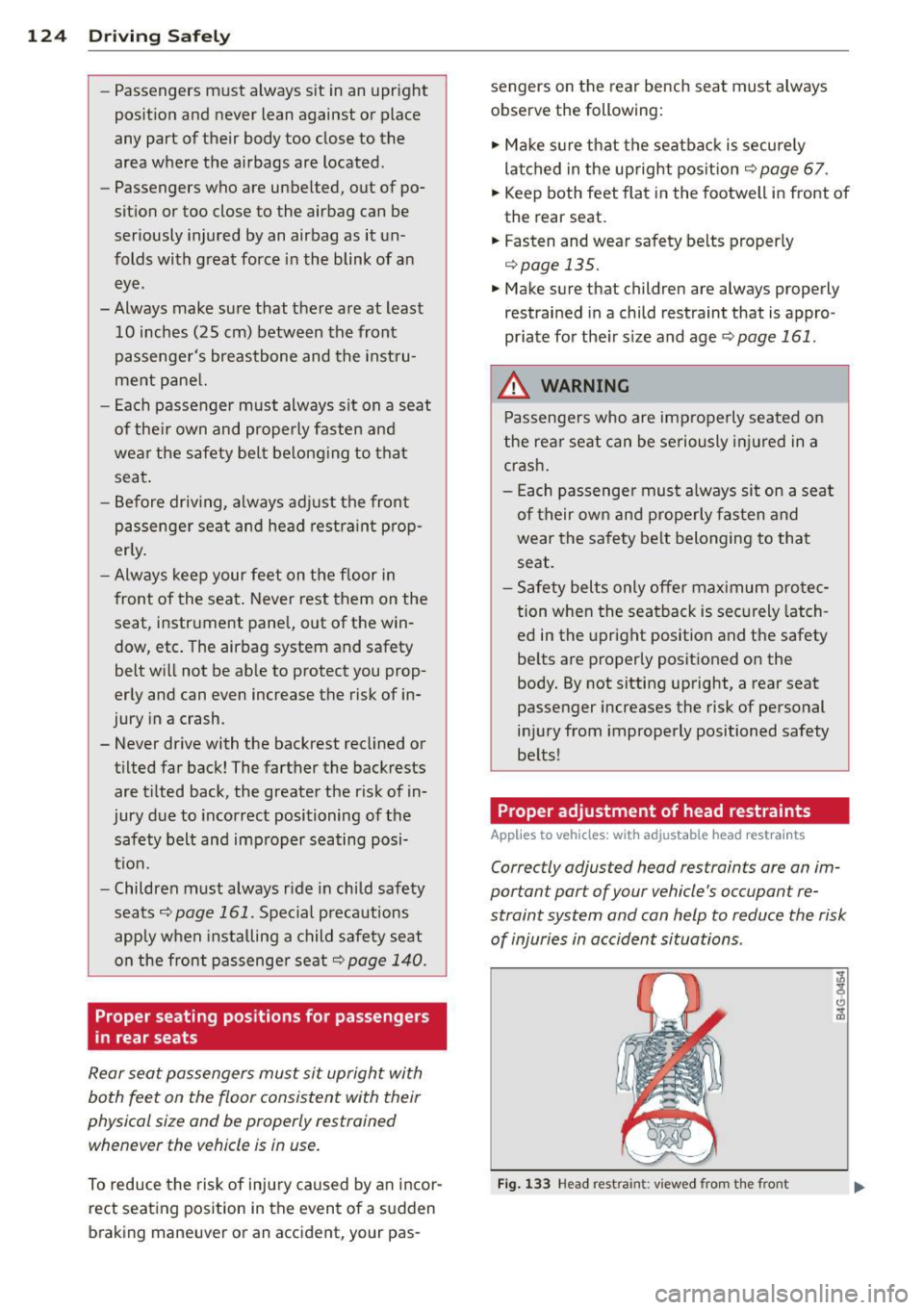
Proper adjustment of head restraints
-
App lies to vehicles: with adjustable head restraints
Correctly adjusted head restrain ts are an im
portant part of your vehicle 's occupant re
straint system and can help to reduce the risk
of injuries in accident situations .
Fig. 133 Head restra int: v iewed from the front
Page 152 of 286

150 Airbag sys te m
- Occupants who are unbelte d, ou t of p osi
t ion or too close to the air bag can be
seriously injured by an airbag as it un
folds wi th grea t force i n the blink of an
ey e
~pag e 141 .
A WARNING
-
A child in a rearward -faci ng child safety
s e at insta lled on the front passenger seat
w ill be seriously injured and can be k illed if
the front a irbag inflates -even with an Ad
vanced Airbag System.
- T he inflating a irbag will hit the child
safety seat or infant carrier with g reat
force and wi ll smash the chi ld safety seat
and child against the backrest , center
armrest, door or roof .
- Always install rear -facing child safety
seats on the rear seat.
- If you must install a rearward facing
child safety seat on the front passenger
seat because of exceptional circ umstan
ces and the
PAS SENG ER AIR BAG OFF
light does not come on and stay on, im ·
med iately install the rear-facing child
safety seat in a rear seating position and
have the a irbag system inspected by you r
authori zed Audi dealer .
A WARNING
Objects between you and the a irbag will
increase the risk of inj ury in a crash by in
terfering wi th the way the airbag unfolds
or by being pushed into yo u as the a irbag
inflates.
- Never hold th ings in your hands or on
yo ur lap when the vehicle is in use.
- Never transport items on or in the area
of the front passenge r seat . Objects
cou ld move into the area of the front air
bags during braking or other s udden ma
neuver and become dangerous projec
t iles that can cause serious personal in
jury if the airbags inflate .
- Never place or attach accessories or oth
er objects (such as cupholders, te le
phone brackets, la rge, heavy or b ulky ob -
-
jects) on the doors, over or near the area
marked "AIRBAG" on the steer ing whee l,
instr ument panel, seat backrests or be
tween those areas and yourself . These
objects could cause in jury in a crash, es
pecia lly when the airbags inflate .
- Never recline the front passenger 's seat
to transport objects . Items can a lso
move into the area of the s ide airbag or
the front a irbag du ring bra kin g or in a
sudden maneuver. Objects nea r the air
bags can become projec tiles and cause
inj ury, partic ularly when the seat is re
clined .
A WARNING ~
The fine dust created when airbags deploy
can cause breathing prob lems for people
with a history of asthma or other breath i ng cond itions .
- To reduce the risk of breath ing problems,
those with asthma or other respiratory conditions shou ld get fresh air right
away by getting o ut of the veh icle or
open ing windows or doors .
- If you are in a collision in which airbags
deploy, wash your hands and face with
mild soap and wate r before eating.
- Be ca reful not to get the dust into your
eyes, o r into any c uts or sc ratches .
- If the res id ue should get into your eyes ,
f lush them w ith wate r.
Monitoring the
Advanced Airbag
System
Airbag monitoring indicator light
T wo separate indicators monitor the function
of the Advanced Airbag System: the airbag
monitoring indicator light and the
PASSEN·
GER AIR BAG OFF
light.
T he Advanced A irbag System (including the
electron ic cont ro l unit , sensor circu its and sys
tem wiring) is mon ito red continuously to
make su re that it is funct io ni ng properly
Page 275 of 286

Checking the engine coolant leve l .. ... 213
Radiator fan ................. .. ... 215
Engin e coolant temperature
Temperature gauge ................. 10
Eng ine hood
Closing .. ..... ........... ...... .. 206
How to release the hood ............ 206
Eng ine oil . .. ............. .... .. ... 208
Adding ... . ............. .... .. .. . 211
Additives . .. ............. .... .. ... 211
Changing ...................... .. 212
Check oil level .................. .. 211
Consumption ............ .... .. ... 211
I ndicator light ................. 17,21
Oil consumption .......... .... .. ... 210
Oil grades .. ................. .. ... 208
Pressure malfunction ........... ..... 17
Sensor defective . . . . . . . . . . . . . . . . . . . . 21
Specification and viscosity .. .. .. .. .. . 208
Engine speed limitation ............... 21
Env ironment
Break- in period ... .. ... ... .. .. .. .. . 187
Catalytic converter . .......... ... .. . 188
Disposing of your vehicle battery .. .. . 220
Driving at high speeds .............. 189
Driving to minimize pollution and noise 189
Fuel . .... .. .. ................ .... 204
Fu el economy ................ .. ... 189
Leaks under your vehicle ... .. .. .. .. . 206
Letting the vehicle stand and warm up. 190
Proper disposal of drained brake fluid . 216
Proper disposal of drained engine cool -
ant . .. .. .. .. .... ........ .... ... . 214
Proper disposal of drained engine
oil ...... .. ................. 211,212
Recycling used engine oil ... .. .. .. .. . 211
Unleaded fuel ..................... 201
What should I do with an old battery? . 220
EPC
refer to Electronic power control . . . . . . 20
Ethyl alcohol (Fuel) .................. 202
Ev ent Data Recorder (EDR) . . . . . . . . . . . . 179
Exhaust tail pipes
C leaning . .. ............. .... .. ... 197
Expansion tank ............ .... .. ... 213
Exterior lighting . . . . . . . . . . . . . . . . . . . . . 51
Index 273
Exterior mirrors
Adjusting . . . . . . . . . . . . . . . . . . . . . . . . . 54
Dimming ... ... .. .. ................ 55
Heating ... .. .. .. ................. . 54
F
Fan
Radiator 215
Fastening Booster seats .. .. .. .............. . 169
Convertible child safety seats ....... . 168
Infant seats ..... ................. 167
Flat tire Changing ... .. ...... ............. 244
flexible fuel ........................ 202
Floor mats ... ..... .. ............... 126
Fog lights/rear fog lig ht(s) . . . . . . . . . . . . . 51
Folding the rear seats ............ .. .. . 67
Foot pedals . .. .. .. .. . .............. 126
For the sake of the environment Gasoline fumes and the environment .. 204
Letting the engine warm up . . . . . . 74, 77
Refueling . .. .. .. .. .. ........... .. 204
Saving fuel by early upsh ifting ..... .. . 11
Front airbags Description . . . . . . . . . . . . . . . . . . . . . . . 144
How they work . . . . . . . . . . . . . . . . . . . . 149
Frontal collisions and the laws of physics 133
Front passenger's door emergency locking 36
Front seats Adjusting ....... .. ............... 123
Child restraints in the front seat ...... 141
Upper cabin heating ............ .. .. . 72
Fuel Additives ............... .......... 201
Blended gasoline .................. 201
Consumption .. .. .... ......... .. .. . 25
Filler neck . .. .. .. .. ............... 203
Fuel gauge . . . . . . . . . . . . . . . . . . . . . . . . 12
Gasoline ... ... .... ............... 201
Gasoline additives . ............... . 203
Low fue l level symbol . . . . . . . . . . . . . . . 21
Octane rating .. .. ................. 201
Recommendation . .. ........... .... 201
Refuelling ... .. .. .. . .. ... .... ..... 204
Reserve ................ ........... 12
Tank capac ity .. .. .. .............. . 262
•
•
Page 280 of 286

278 Index
Fastening . ...... ......... ... .... . 136
Improperly worn . . . . . . . . . . . . . . . . . . 138
Not worn . ................. ..... . 133
Safety belt position ....... .. .. .... . 137
Safety instructions .......... .. .... . 135
Securing child safety seats ..... .. ... 171
Special cons iderations for pregnant
women .. .. ................ ... .. .
137
Unfasten ing ........... .. .... .. .. . 138
Warn ing/ indicator l ight .... .. .. .. .. . 132
Warning light ...................... 16
Why YOU MUST wear them ......... . 132
Worn properly ............ ... .... . 134
Safety belt warn ing light .... .. .. .... . 132
Safety compliance sticker ... .. .. .... . 261
Safety equipment ................... 121
Safety features for occupant restraint and
protection . .. ... . ...... ... .. .. .. .. .
121
Safety guidelines
Seats .. .. .... ........... ........ ..
60
Safety instructions
Engine compartment ....... ... .... .
206
for using child safety seats . .. .. .. .. . 164
for using safety belts ...... .. .. .. .. . 135
Monitoring the Advanced Airbag Sys-
tem ..... .. ................ ... .. .
152
Seat adjustment
Head restraints .......... .. .. .... .
124
Seat belts
refer to Safety belts ....... .. .. .... . 132
Seat covers
Cleaning . .. .. ........ ...... ... .. .
198
Seat heating . . . . . . . . . . . . . . . . . . . . . . . . 71
Upper cabin heating . . . . . . . . . . . . . . . . . 72
Seating capacity ............ ... .... . 132
Seating position
Driver ... .. ................ ... ...
122
Front passenger .......... .. .. .. .. . 123
How to adjust the front seats . .. .. .. . 123
Incorrect seat position ........... .. . 125
Occupants .. ................ ..... . 122
Rear passengers . . . . . . . . . . . . . . . . . . . 124
Seat memory . . . . . . . . . . . . . . . . . . . . . . . 64
Seats
Adjusting .. ... .... ...... .. .. .. .. ..
61
Adjusting in the MMI .......... .. .... 62
Convenience side view . . . . . . . . . . . . . . . 62
Drive r's seat . . . . . . . . . . . . . . . . . . . . . . . 60
Folding ........................... 67
Front passenger's seat ............... 61
Head restraints ............... ..... 63
Number of seats . ............. .... 132
Power easy entry function ............ 62
Safety gu idelines ........ ...... .. .. . 60
Seat symmetry . .. .......... ...... .. 62
Seat ventilation . . . . . . . . . . . . . . . . . . . . . 71
Seat (upper cabin heating) ........ .. .. . 72
Selective unlock feature . . . . . . . . . . . . . . . 36
Se lector lever . . . . . . . . . . . . . . . . . . . . . . . 85
Emergency re lease ............... .. . 91
Selector lever emergency release .. .. .. . 91
Service and disposal
Safety belt pretensioner ..... ... .. ..
139
Service interval display . . . . . . . . . . . . . . . . 28
Serv ice position
refer to Replacing w iper blades .. .... . 57
SET button . . . . . . . . . . . . . . . . . . . . . . . . . 11
Shutting down vehicle ............ ... 189
S ide a irbags
Description .. .. .. ............. .. ..
158
How they work ... ................ . 159
side assist
Adjusting the brightness ............
104
Sensor range .. .. ... .......... .. .. 103
Side assist
Activating and deactivating ...... ....
104
Cleaning the sensors ........ .... ... 196
Description .. .. .. .......... ...... . 102
Side marker lights . . . . . . . . . . . . . . . . . . . 51
Ski sack ...... .. .. .. ... ........ .... . 67
Snow chains .. .. .. .......... ...... . 238
Sound system display . . . . . . . . . . . . . . . . . 24
Sources of information about child re-
stra ints and their use ............ .. ..
178
Spare tire ... .. ... . .. .... .... ... .. .. 243
Speedometer . . . . . . . . . . . . . . . . . . . . . . . 12
Speed rating letter code ............. . 234
Speed warning system ........... .. .. . 81
Sport d ifferential .. ............. .... 106
Indicator lamp ... ................ .. 22
START ENGINE STOP button (conven ience
key) ....... .... .. ............. .... .
78