open hood AUDI A5 CABRIOLET 2014 Owners Manual
[x] Cancel search | Manufacturer: AUDI, Model Year: 2014, Model line: A5 CABRIOLET, Model: AUDI A5 CABRIOLET 2014Pages: 286, PDF Size: 70.4 MB
Page 13 of 286
Instrument s and warning /indicator lights 11
A WARNING
- Always observe the warning in
c::> page 206 , before opening the hood
and checking the engine coolant level.
- Never open the engine hood if you see or
hear steam, or if you see engine coolant
dripping from the engine compartment.
You could burn yourself. Let the engine
cool off first so that you cannot hear or
see any steam or engine coolant .
(D Note
-Mounting additional lights or accessories
in front of the air inlets reduces the cool
ing effect of the rad iator. At high outside
temperatures or high eng ine load , the
engine could overheat.
- The front spoiler has been designed to
properly distribute the cooling air when
the veh icle is moving .
If the spoiler is
damaged , this cou ld reduce the cooling
effect and the engine co uld then over
heat. Ask your authorized Aud i dealer for
assistance.
Tachometer (engine rev counter)
The tachometer indicates the engine RPM
(revolutions per minutes).
If engine RPM drops below 1,500, you should
downshift to the next lower gear . T he red area
at the end of the scale indicates maximum
perm issible engine RPM after the break-in pe
riod. Before reaching this area, move these
lector lever to position 0/5 or ease your foot
off the accelerator pedal.
@) Note
The tachometer needle@c::> page 10,
fig . 3 shou ld only briefly be in the red
zone: you could damage your engine! The
beg inning of the red zone varies depend-
ing on the engine .
@) For the sake of the environment
Upshifting early saves fuel and reduces en
gine noise.
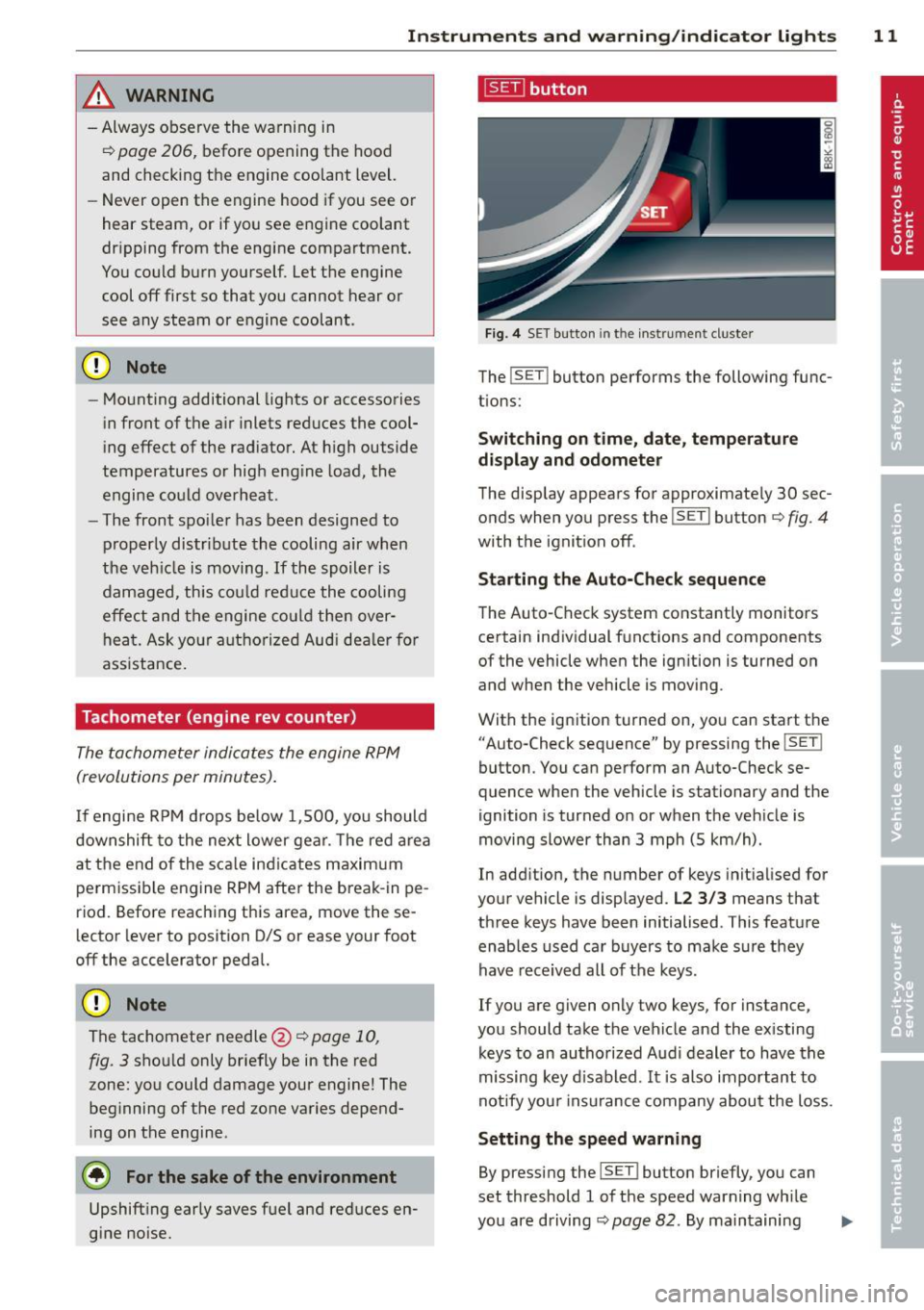
~ button
Fig. 4 SET button in th e ins trume nt cluster
The !SET ! button performs the following func
tions:
Switching on time, date, temperature
display and odometer
The display appears for approximate ly 30 sec
onds when you press the
I S ET ! button c::> fig . 4
with the ignit ion off .
Starting the Auto-Check sequence
The Auto-Check system constantly monitors
certa in individual functions and components
of the vehicle when the ignition is turned on
and when the vehicle is moving .
With the ignition turned on, you can start the "Auto-Check sequence" by pressing the
! SE T!
button . You can perform an Auto-Check se
quence when the vehicle is stationary and the
ignition is turned on or when the vehicle is
moving slower than 3 mph (5 km/h).
In addition, the number of keys initialised for
your vehicle is displayed.
L2 3 /3 means that
three keys have been initialised . This feature
enables used car buyers to make sure they
have received all of the keys.
If you are given only two keys, for ins tance ,
you should take the vehicle and the ex isting
keys to an authorized Audi dealer to have the
missing key d isabled .
It is also important to
notify your insurance company about the loss.
Setting the speed warning
By pressing the !SET ! button briefly, you can
set threshold 1 of the speed warning wh ile
you are driving
c::> page 82 . By maintaining II>
Page 18 of 286
16 Instrum ent s and w arn ing /indic ato r light s
When the light comes on, an audib le warning
signal is also given .
A WARNING
-Always observe the warnings in
9 page 206, before opening the hood
and checking the brake fluid.
- Driving with low brake fluid is a safety
hazard. Stop the car and get professional
assista nee.
- If the. (USA models)/ . (Canada
models) brake system indicator light
turns on together with the ABS and ESC indicator lights, the ABS/ESC regulating
function may have failed. F unctions that
stabilize the vehicle are no longer availa
ble. Th is could cause the vehicle to
swerve and increase the risk of sliding .
Drive carefu lly to the nearest a uthorized
Audi dealer or other qualified workshop and have the malfunction corrected.
- If the brake warning/indicator light does
not go o ut afte r a few seconds and the
park ing brake is released, or lights up
wh ile you are driving, the fluid level in
the brake fluid reservoir is too low. If you believe that it is safe to do so, proceed
immediately at low speed to th e nearest
authorized Aud i dealer o r qualified wo rk
shop and have the bra ke system inspect
ed.
- Always keep in m ind that afte r several
brake applicat ions, yo u w ill need g reater
pressure on the brake peda l to s top your
vehicle. Do not re ly on strained brakes to
respond with maxim um stopp ing power
in critical situations. You must a llow for
increased brak ing distances. The extra
distance used up by fad ing brakes could
lead to an acc ident .
1:11.I(®) Electromechanical parking brake
The warning/indicator light monitors the
electromechanical parking brake.
If the indicator light. (USA models)/ .
(Canada models) turns on, the park ing brake
was set . If the parking brake is set when the ignition
is off, the indicator light turns off a f
ter abo ut 20 seconds .
T he wa rn in g/i ndic ator light wi ll go ou t when
the parking bra ke is re leased.
• (USA models ) /. (Canada mod els) Cau
tion: Vehi cle parked too ste ep
If the indicator light b links and the message
appears, there is not enough braking power to
k eep the vehicle from roll ing . Th e b rakes have
overheated. The veh icle cou ld roll away eve n
o n a sm all incline .
Pre ss brake pedal to release parking brake
To re lease the park ing brake, press the brake
pedal and press the button(®) or start driving
with starting assist at the same time 9 page 80.
Please release park ing brake
T o re lease the park ing brake manually , p ress
the brake peda l and press the button<®> at
the same time. The pa rking brake o nly re leas
es automatically if the driver's safety be lt is
fastened.
Ill Pa rking brake!
If the Ill ind ic a tor light tu rns on a nd this
message appears, the re is a par king b rake
malfu nction . D rive to your au thorized A udi
dealer or qualified workshop immediately to
have the malfunct ion corrected .
~ Safety belts
This warning/indicator light reminds you to
put on your safety belt.
T he . war ning/ indica to r li gh t illum inates
when the ignition is switched on to remind
t h e driver and (on USA models on ly) any front
passenger to put on the safety be lt . Addit ion
ally, an acoustic warning (gong) will also
sound.
Fo r more I nformat ion ¢ page 132 , Safety
belt warning light .
Page 20 of 286
18 Instrum ent s and w arn ing /indic ato r light s
• Contact your authorized Audi dea ler fo r as-
sistance if necessary.
I f the engine coolant level is co rrect, then the
radiator fan may be the cause of the malfunc
tion .
• Coo lant temper ature! L et engine run
with vehicl e sta tionary
If the indicator light turns on and the mes
sage appears, let the engine run at idle fo r a
few minutes to cool down.
A WARNING
- If your veh icle should break down for
mechanical or other reasons, park at a
safe distance from moving traffic, turn
off the engine and turn on the hazard
warning lights¢
page 53, Emergency
flashers.
-
- Never open the hood if you see or hear
steam or coolant escaping from the en
gine compartment -you risk being scald
ed . Wait until you can no longer see or
hear steam or coolant escaping.
- The engine compartment of any veh icle
is a dangerous area. Before you perform
any work in the engine compartment,
tu rn of the eng ine and allow it to cool.
Follow the wa rning sticke rs¢
page 206.
([) Note
Do not continue driving if the. symbol
illuminates . There is a malfunct ion in the
eng ine cooling system -you could damage
your eng ine .
@ -Steering column lock
• Stee ring defecti ve! Do not dri ve vehicle!
If the indicator light turns on and t he mes
sage appears, the re is an elect ronic steer ing
col umn lock ma lfunction. You cannot switch
the ignition on.
Do
not tow your vehicle because it ca nnot be
steered. Seek professional assistance.
Ill S tee ring lock: Contact de aler!
If the indicator light turns on and the mes
sage appears, there is an e lectronic steering
co lumn lock malfunct ion .
Drive to your authorized A udi dealer immedi
ate ly to have the ma lfunction corrected.
A WARNING
-
Your veh icle must not be towed in the
event of a malfunction in the electronic
steering co lumn lock because it cannot be
steered due to the locked steering. If it is
towed with the steering locked, there is
the r isk of an accident.
© -Ignition lock
• Ignition lock d efe ctive . Contact deal er!
If the indicator light turns on and the mes
sage appears, do
not switch the ign it ion off
because you may not be able to sw itch it on
again .
Drive to your authorized Audi dealer immedi
ately to have the malfunction corrected .
On vehicles with convenience key*, the engine
should not be switched off using the
I START ENGINE STOPI button because the en
gine cannot be started again after the ignition
has been switched off .
(D Tips
The symbol's appearance might be differ
ent in some models.
$=J I[}. Electronic Stabilization Control
( ESC)
If the JjJ ind icator light blinks while driv ing,
the ES C or ASR (Anti-Slip Reg ulation) is active
ly reg ulating .
If the
GJ ind icator light tu rns o n, the system
has switched the ESC off. In this case, yo u can
swi tch the ign ition off and then on to switch
the ESC on again. The indicator light turns off
when the system is functioning fu lly. ..,..
Page 33 of 286

Opening and closing
Power locking system
General description
The power locking system locks or unlocks all
doors and the rear lid simultaneously.
You can lock and unlock the vehicle centrally.
You have the following choices:
- Remote master key~
page 34,
-Door handles with convenience key*
O? page 35 ,
-Lock cylinder at the dr iver's door
r=> page 36 , or
- Power loc king switc h inside
<:!> page 35.
Automatic locking
The automat ic locking feature locks all the ve
hi cle doors and the rear lid when you drive
faster than 9 mph (15 km/h).
The car is unlocked again once the ignition key
is removed . In addition, the vehicle can be un
locked if the opening fu nction in the power
locking system sw itch or at one of the door
l eve rs is actuated. The Au to Lo ck function can
be turned o n and off in the rad io or
MMI*
r=> page 36 .
Additionally, in the event of a c rash with air
bag deployment the doors are automatically
u nl ocked to a llow access to the veh icle.
Selective unlocking
When you lock the vehicle, the power locking
system w ill lock the doors and the rear lid.
W hen unlocking, you ca n set in the rad io or
M MI* whethe r
only the dr iver's door or the
enti re ve hicle should be unlocked
r=> page 3 6.
Anti -theft alarm warning system
If the a nti-theft alarm warning system de
tects a brea k-in into t he vehicle, acoust ic and
visua l wa rning sig na ls are triggered .
The an ti- theft warn ing system is act ivated au
tomatically when you lock the vehicle .
It is de
activated when u nlocking using the remote
Opening and clo sin g 31
key, w ith the mechan ica l key, and when you
switch on the ignition.
T he al arm a lso t urns off w hen t he a la rm cy cl e
has expired.
Turn signals
When you u nlock the ve hicle, the turn signals
flash twice, when yo u lock it once . If they do
not flash, one of the doo rs, the luggage com
partment lid or the hood is not lo cked or the
ignition is s till sw itched on.
Unint entionally locking yourself out
In the follow ing cases there safeg uards to
prevent you lock ing you r remote master key in
t h e ve hicl e:
- The vehicle does not loc k w ith the power
lock ing switc h
r=> page 35 if the drive r's
door is open .
- On veh icles with convenience key*, if the
most recently used master key is in the lug
gage compartment, the rear lid is a utomat i
cally u nlocked again after it is closed.
Do not lock your veh icle w ith the remote mas
te r key o r convenience key* unt il all doors a nd
the rear lid a re closed . In this way you avoid
l ocking yo urse lf o ut accidentally .
_&. WARNING
-
-When you leave the veh icle, alw ays re
move the ignition key an d take it with
you. This wi ll prevent passengers (chil
dren, for example) from acc identally be
ing locked in the vehicle should they acci
dentally press the power locking switch in the front doors .
- Do not leave ch ildren inside the vehicle
unsuperv ised. In an emergency it would
be imposs ible to open the doors from
the o utside w itho ut the key .
(D Tips
- In the event of a crash with airbag de
ployment all locked doors will be auto
matically unlocked to give access to the
v ehicle occupants from the outside.
Page 36 of 286

34 Openin g and clo sing
@ For the sake of the environment
Dispose of dead batteries proper ly so as
not to pollute the environment.
@ Tips
The replacement battery must be the
same specification as the original.
Emergency unlocking of the ignition key
In the event of malfunctions in the electrical
system, it may happen that you cannot re move the ignition key .
,. Remove the mechanical key r::¢> page 33.
,. Lock the veh icle using the mechanica l key
r::¢> page 3 6.
,. Have the electrical system inspected by an
authorized Audi dealership.
Locking and unlocking the vehicle with
the remote control
Fig . 20 Remote master key: funct ion buttons
,. Press button 0 to unlock the veh icle
r::¢> fig. 20.
,. Press button fij to lock the vehicle¢ .&. in
General description on page 31.
,. Press button C::5 briefly to unlock the rear
lid.
,. Press the bu tton
e::5 for a t least o ne second
to open t he rear lid.
,. Push the red
IPANICI button to activate the
panic function . The horn sounds and the
tu rn s ignals flash . Push the red
I PANIC I but
ton again to deactivate the panic function.
If the vehicle is unlocked and no door, the rear
lid or the hood is opened within 60 seconds, the vehicle locks itself again automatica
lly.
T his feature prevents the vehicle from being
accidentally left unlocked over a long period
of time.
It depends on t he settings in the radio or
MMI * whether the entire vehicle is unlocked
or on ly certain doors¢
page 36.
On vehicles wi th a utomatic transm ission, the
selector lever must be in the P position, other
wise the vehicle cannot be locked.
.&_ WARNING
--
Read and follow all WARNINGS i::> & in
General description on page 31.
(D Tips
- In order to make sure the locking f unc
tion is work ing, you should a lways keep
your eye on the vehicle to make s ure it is
properly locked .
- Do not use the remote cont rol if yo u are
inside the car, otherw ise you may unin
tentionally lock the vehicle, and then you
would set off the anti-theft alarm whe n
you try to sta rt the engine or open a
door. In case this happens anyhow, push
the unlock button@.
- Use the pa nic function o nly if you a re in
an eme rgency s ituation.
-Add itiona l remote co ntrol key functions
¢page 40.
Page 90 of 286

88 Transmission
order to adjust the gears to the driving condi
tions by hand
¢page 89.
On slopes, activate the parking brake first and
then move the selector lever to the P position.
This prevents too much stress from being placed on the locking mechanism.
Vehicles with multitronic transmission : Your
vehicle is equipped with
hill hold assist allow
ing you to start while on an incline. The sys
tem is activated when the brake pedal is pressed down and held
for a few seconds. The
br ake pre ssure will hold for
a moment after
the brake pedal loosens to preven t the vehicle
from rolling backwards while starting up.
A WARNING
- The vehicle can also roll when the engine
is stopped .
- Unintended vehicle movement can cause serious injury .
- Never leave your vehicle with the engine
running while in gear . If you must leave
your vehicle when the engine is running,
activate the parking brake and move the
selector lever to P.
- Power is still transmitted to the wheels
when the engine is running at idle. To
prevent the vehicle from "creeping", you
must keep your foot on the brake when
the engine is running and the selector
lever is in D/S or R or "tiptronic" mode is
selected.
- Do not press the accelerator pedal when
changing the selector lever position
while the vehicle is stationary and the
engine is running.
- Never shift into R or P while driving.
- Before driving down a steep slope, re-
duce your speed and shift into a lower
gear with "tiptronic".
- Do not ride the brakes or press the brake
pedal too often or too long when driving
down a hill . Constant braking causes the
brakes to overheat and substantially re
duces braking performance, increases
braking distance or causes complete fail
ure of the brake system. -
To prevent the vehicle from rolling back
when stopping on inclines, always hold it
in place with the brake pedal or parking
brake .
- Never hold the vehicle on an incline with
a slipping clutch. The clutch opens auto
matically when it becomes too hot from
the overload . An indicator lamp
mJ illu
minates and a driver message appears
¢ page 91 when the clutch is overload
ed.
- If the engine must remain running, never
have any driving position engaged when
checking under the hood. Make sure the
selector lever has securely engaged and
is locked in P with the parking brake set
¢ page 206. Otherwise, any increase in
engine speed may set the vehicle in mo
tion, even with the parking brake ap
plied .
(D Note
-S tronic- and tiptronic transmission :
When stopping on an incline, do not try
to hold the vehicle in place by pressing the accelerator pedal while a driving gear
is selected . This can cause the transmis
sion to overheat and can damage it. Acti
vate the parking brake or press the brake pedal to prevent the vehicle from rolling .
- S tronic- and tiptronic transmission : Al
lowing the vehicle to roll when the en
gine is stopped and the selector lever is
in N will damage the transmission be
cause it is not lubricated under those cir
cumstances.
(D Tips
For safety reasons, the parking brake is re
leased automatically only when the driv
er's safety belt is engaged in the buckle.
Page 208 of 286

206 Checking and filling
Checking and filling
Engine hood
Releasing and opening the engine hood
The engine hood is released from inside the
vehicle .
Fig . 173 D river' s side footwe ll: e ngin e hood re lease
lever
F ig. 1 74 Re lease lever u nde r the eng ine hood
Before openin g the engine hood, ma ke s ure
that the windshie ld w ipers are flat against the
windshield. Otherwise, they co uld damage the
pa int on the hood .
... Pull the release lever on the left unde r the
inst rument panel in the direction of the ar
row
c;, fig . 173.
... Raise the hood slightly r::;, .&,
... Press the rocke r swi tch u nder the hood up
ward
c;, fig . 174 . Th is re leases the catch .
... Ope n t he hood.
A WARNING
Hot engi ne co olan t ca n bur n you.
- T o redu ce the r is k o f being burned, never
op en t he ho od if yo u see or hea r steam
or cool an t esc aping from the engine
c ompartment. Wait unti l no steam or co
olant can be seen or heard before care
fu lly opening the hood.
Closing the engine hood
... Pull the hood down until the pressure from
the struts is reduced .
... Le t the hood
drop down and latch in p lace.
Do not try to push it shut; it may fail to en
gage
r::;, .&, .
A WARNING
-
A ho od th at is not co mpletely latched
could fly u p an d block your view while driv
in g.
- Wh en you close the engi ne ho od, ch ec k it
t o make sure the sa fe ty ca tch has pro pe r
ly engaged . The hood s hould be flush
wit h the surroun ding vehicle body pa rts .
-If you notice while driv in g that t he hood
is not secured prope rly, sto p at once and
close it.
Working in the engine compartment
Be especially ca reful whenever you work in
the engine compartment.
Whenever you must perform any work in the
engine compartment, for example checking
and filling different fluid s, there is a ri sk of
injury , burns and accidents . To prevent per
sonal injury always observe the following
WARNINGS. The engine compartment of any
vehicle is a hazardous area
r::;, ,&. .
A WARNING
-To help avo id injury, before yo u check any-
thing unde r the hoo d:
- Turn off the eng ine.
- Remove the ignition key.
- Ap ply the park ing brake .
- Move selector leve r of automatic t rans -
miss io n to "P" (Par k).
- Alway s le t the eng ine cool d own. Ho t
components w ill bur n skin on contact .
Page 209 of 286

-To reduce the r isk of being burned, never
open the hood if you see or hear steam
or coolant escaping from the engine
compartment . Wait until no steam or
coolant can be seen or heard before ca re
fully opening the hood .
- Keep children away from the engine com
partment.
- Never spill flu ids on hot engine compo
nents. They can cause a fire .
- Never touch the radiator fan. The aux ili
ary e lectr ic fan is temperature controlled
and can switch on suddenly .
- Never open the coolant reservoir cap
when the eng ine is still warm . The cool
ant system is pressur ized and hot coo l
ant could spray out.
- Protect your face, hands and arm from
steam or hot eng ine coolant by placing a
thic k rag over the cap when you open the
coolant reservoir.
- Do not remove the engine cover under
any c ircumstances. Th is increases the
risk of bu rns.
- If wo rk on the fuel system or the electri
cal sys tem is ne cessary:
- Always disconnect the battery.
- Never smoke or work near heaters or
open flames . Fluids in the engine com
partment co uld start a fire.
- Keep an approved fire extinguisher im
mediately ava ilable.
- To avoid electrical s hock and persona l in
jury while the engine is running or being
started, never touch:
- Ignition cables
- Other components of the high voltage
electronic ignition system.
- If you must perform a check or repa ir
with the engine running:
- Fir st, fully apply the parking brake,
move se lector lever of a utomatic trans
mission to "P" (Park).
Checkin g and fillin g 207
-Always use extreme caut ion to prevent
clothing, jewelry, or long hair from get
ting caught in the radiator fan, V-be lts
or other moving parts, or from contact
i ng hot parts . Tie back hair before
starting, and do not wear clothing that
will hang o r droop into the engine.
- Minimize exposure to em ission and
chemical hazards
9 .&, .
&_ WARNING
Califo rnia Proposition 65 Wa rni ng:
- Engi ne exhaust, some of its const ituents,
and certa in vehicle components contain
or emit chemi cals known to the State of
California to cause cancer and birth de
fects and reproduc tive harm. In addition,
certain fl uids con tained in vehicles and
certain products of component wear con
tain or emit chemica ls known to the
State of California to cause cancer and
birth defects or other reproductive harm.
- Battery posts, terminals and related ac
cessories conta in lead and lead com
pounds, c hemicals known to the State of
California to cause cancer and reproduc
tive harms. Wash hands afte r handling .
(D Note
When adding flu ids, always make sure that
they are poured into the proper conta iner
or f iller opening, otherwise serious dam
age to vehicle systems w ill occur .
@ For the sake of the environment
To detect leaks in time, inspect the vehicle
floor pan from underneath regularly . If
you see spots from oil or other veh icle flu
i ds, have you r vehicle inspected by an au
thori zed Audi dealer. •
•
Page 213 of 286

Checking the engine oil level
Fig . 176 MMI Disp lay: Oil l eve l ind icator
Re ad oil le vel
.,. Park your vehicle so that it is horizonta lly
level.
.,. Shut the engine off when it is at operating
temperature .
.,. Switch only the ignition back on .
.,. Wait approx . two minutes .
.,. Select: Function button
ICARI > Oil l evel. Or
.,. Se lect: Funct ion button
ICARI > C ar sys-
tem s*
cont rol button > S ervicing & ch e ck s >
Oil level.
.,. Read the oil leve l in the MMI* Display
c::> fig . 176 . Add engine oi l if the bar o f the
oi l level ind icator is near "min"
c::> page 211
Depending on the way the veh icle is driven
and the operating conditions, oil consumption
can be up to a 1/2 quart per 600 miles (0 .5
li
ter per 1,000 km) . Consumption may be high
er within the first 3,000 m iles (S,000 km).
@ Tips
The oil level indicator in the MMI* Disp lay
is only an information display.
If the oi l
level is too low, a min imum oil warning ap
pears in the instrument cluster. Add oil
c::> page 211 . If the hood has been opened,
the current oil level is shown in the instru
ment cluster the next time the ign ition is
sw itched on.
Checkin g and fillin g 211
~ Adding engine oil
Fig. 177 Eng in e compart men t: Cove r on the oil filler
n eck
.,. Before yo u check anything in the engine
compa rtment,
alwa ys rea d and h eed all
WARNING S c::> .&. in Working in the engine
compartment on page 206 .
.,. Shut the engine off.
.,. Unscrew the cap~ to the engine oi l filling
hole
c::> fig. 177, c::> page 208, fig. 175 .
.,. Carefully top off with 0.5 quarts (0.5 liters)
of the appropriate oil
c::> page 208.
"' Check the oil level again after two minutes
c::> page 211, Checking the engine oil level .
"'Top off the o il aga in, if necessary .
"' Screw the cap back on the filling hole .
_&. WARNING
- While topping off, the oil must not come
in contact with hot e ngine parts -fir e
hazard!
- The oil filler cap must be properly se
cured to prevent oil from being sprayed
on the hot engine and exhaust system
when the engine is runn ing -fire hazard!
- If your skin has come in contact with the
engine o il, you must subsequently
cleanse it thoroughly.
(D Note
- Check the oil level using the radio or
M MI*. If the message
Plea se redu ce oil
le vel
appears, contact yo ur authorized
Audi dealer or qua lified workshop to
have excess oil extracted if necessary .
-Audi does not recommend the u se of o il
additiv es. They m ay damage the engine .,.
Page 221 of 286
(D Note
-Do not disconnect the ve hicle battery
when the ignition is sw itched on or when
the engine is running, otherwise, yo u will
damage e lectronic components in the
electrica l system .
- If your vehicle is going to stand for a
l ong period of time without being driven,
protect the battery from "freezing", oth
erwise it w ill be damaged and w ill then
have to be replaced .
Battery charging
Starting the engine requires a well charged
batt ery.
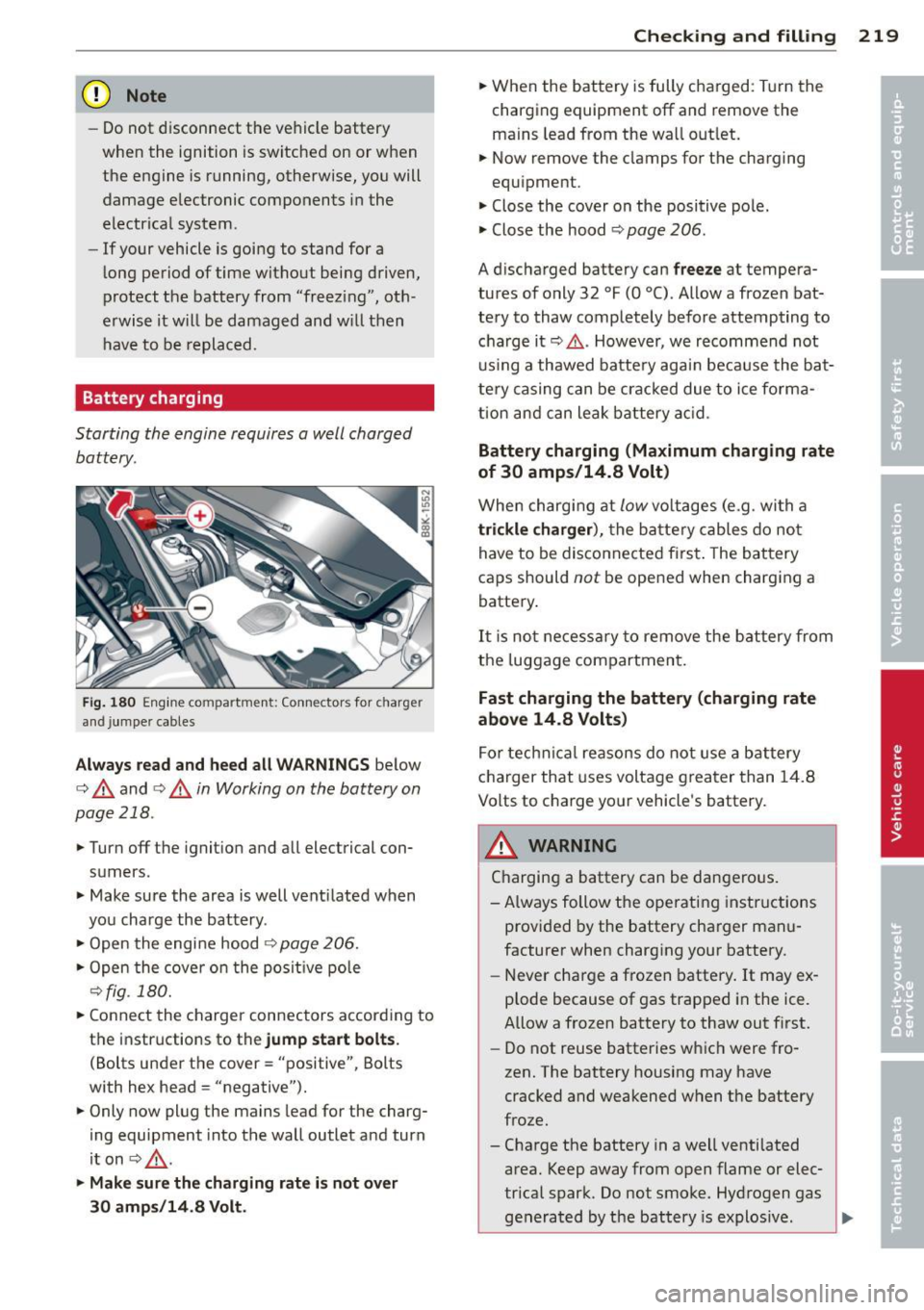
F ig. 180 Engin e comp artm ent: Conn ecto rs for char ger
an d jumper cables
Always read and heed all WARNINGS below
c::, &. and c::, &. in Working on the battery on
page
218 .
.,. Turn off t he ignit io n and all electrical con
s umer s .
.,. Make sure the area is well vent ilated when
you charge the bat tery .
.,. Open the engi ne hood
c::, page 2 06.
.,. Open the cove r on the pos it ive pole
¢ fig . 180 .
.,. Co nnect the charger connectors according to
the instructions to the
jump start bolts.
(Bolts under t he cover= "positive", Bolts
with hex head = "negative").
.,. Only now plug the mains lead for the charg
i ng equipment into the wall outlet a nd turn
i t on
c::, &_ .
.,. Make sure the charging rate i s not over
30 amp s/14 .8 Volt .
Checkin g and fillin g 219
.,. When the bat tery is fully cha rged : Tu rn the
charging equ ipment off and
remove the
mains lead from the wa ll out let .
.,. Now remove the clamps for the charging
equ ipment.
.,. Close the cover on the positive pole .
.,. Close the hood
c::, pag e 206 .
A discha rged bat tery can freeze at tempera
tures of only 32 °F (0 °C) . Allow a frozen bat
tery to thaw comp letely before attempting to
cha rge it
c::, .&. . However, we r ecommend not
u sing a thawed batte ry aga in beca use the b at
te ry casing can be cr acked due to i ce fo rma
tion an d ca n leak b attery a cid.
Battery charging (Maximum charging rate
of 30 amps/14.8 Volt )
When charging at low vo ltages (e.g. wi th a
trickle charger) , the ba tte ry cables do no t
have to be disco nne cte d fir st. T he bat tery
caps should
not be opened when charg ing a
batte ry .
It is no t necessa ry to remove the b attery from
the luggage compartmen t.
Fast charging the battery (charging rate
above 14 .8 Volts)
Fo r tec hni cal re asons do not use a bat tery
c h arger th at uses voltage g reater than
1 4 .8
Volts to c harge yo ur veh icle's battery.
A WARNING
C harging a battery can be dangero us.
-A lways follow t he operati ng instr uctions
provided by the battery charger manu
facturer when charging your battery .
- Never cha rge a fro zen battery. It may ex
p lode because of gas trapped in the ice .
A llow a frozen battery to thaw out f irst.
- Do not reuse batteries wh ic h were fro
zen. The battery housing may have
cracked and weakened w hen the battery
froze.
- Charge the battery in a well venti lated
area . Keep away from open flame or elec
trical spark. Do not smoke . Hydrogen gas
generated by t he battery is explos ive . ..,